

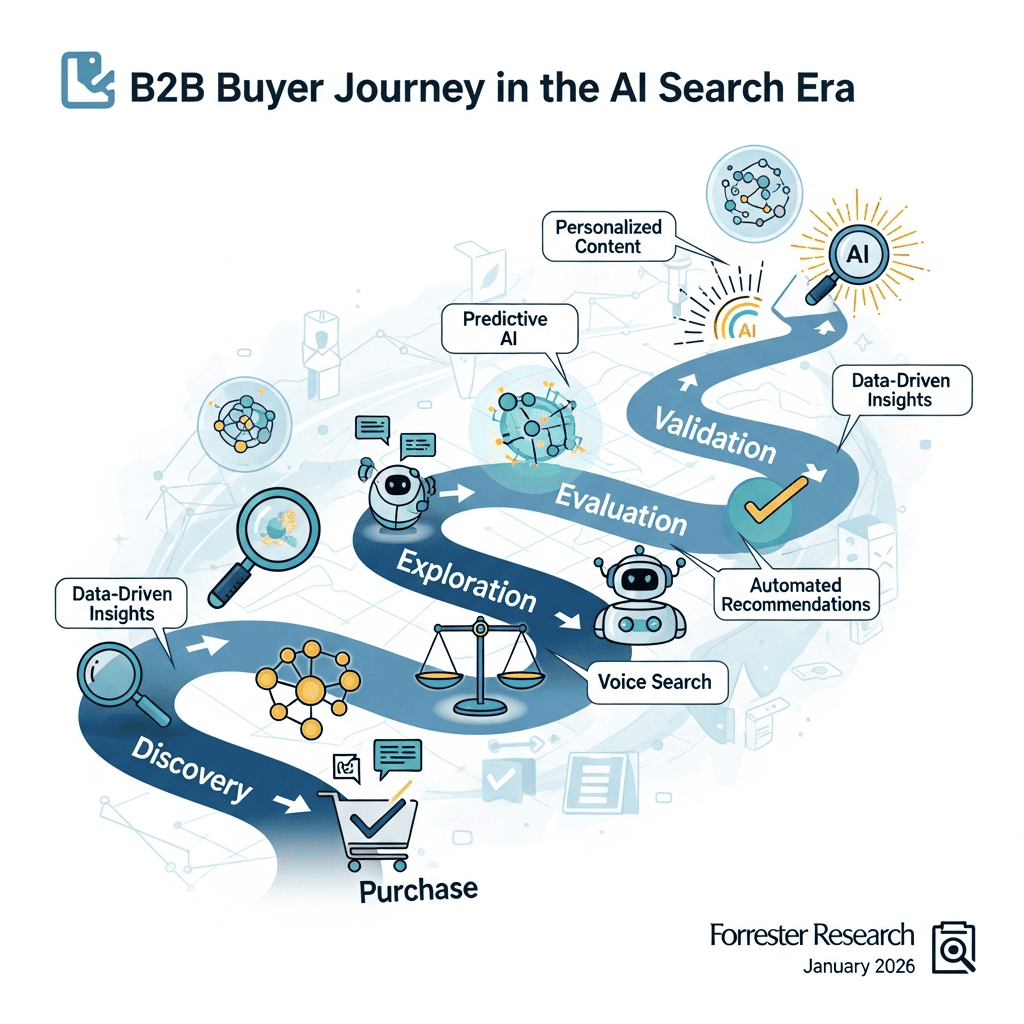
Published: January 2026 | aiseojournal.net
Table of Contents
ToggleThe Seismic Shift No One Saw Coming
January 2024: Principal Analyst John Buten at Forrester Research reached out to six IT leaders to ask about generative AI usage in their purchasing processes. The result? Zero for six.
“It’s too early,” he heard. “We’re being really cautious about how we use generative AI.”
Six months later (July 2024): Forrester polled B2B buyers for the first time about generative AI adoption. The numbers were shocking.
From John Buten’s blog (November 25, 2024):
“The overwhelming majority, 89% of buyers in Forrester’s Buyers’ Journey Survey, 2024, reported that they were using genAI in at least one area of their purchasing process.”
This is the story of how B2B buying changed forever in just 18 months—and what it means for every B2B marketer, seller, and product leader navigating 2026.
This comprehensive intelligence report examines:
- Complete timeline of Forrester’s research from January 2024 through January 2026
- 89% adoption rate and what it actually means
- Authentic statistics on buyer behavior across every stage
- $10 billion in losses predicted for 2026 from ungoverned AI use
- Expert analysis from Forrester’s Principal Analysts
- Strategic responses B2B companies must implement now
The Complete Timeline: Forrester’s B2B AI Journey Research
January 2024: The False Start
John Buten, Principal Analyst, Forrester Research:
From his blog post (November 25, 2024):
“In January, I started researching how B2B buyers are using generative AI to help their buying process. I reached out to a half-dozen IT leaders who had helped me navigate the purchasing of marketing automation, groupware, mobile apps, etc. … and I came up empty. Zero for six. ‘It’s too early,’ I heard. ‘We’re being really cautious about how we use generative AI,’ I heard from another. It seemed like B2B buyer adoption of generative AI was a long way off.”
What this revealed: Even informed B2B professionals underestimated the speed of AI adoption.
July 2024: The Survey That Changed Everything
Forrester’s Buyers’ Journey Survey, 2024 – First-Ever GenAI Questions
Time since ChatGPT launch: 18 months (ChatGPT launched November 2022)
The shocking results:
From official Forrester report summary:
“In less than two years, 89% of B2B buyers have adopted generative AI (genAI), naming it one of the top sources of self-guided information in every phase of their buying process.”
John Buten’s reaction:
“The genAI adoption numbers were shocking. What was even more surprising was that buyers reported genAI as one of the most impactful sources of information across all phases of the buying process. They weren’t just using genAI to discover new vendors but also to evaluate the differences between them and to justify their purchase commitment.”
Survey scope:
- 700,000+ survey responses annually (Forrester’s total survey base)
- Focus on B2B buyers across company sizes, industries, and regions
- First comprehensive measurement of AI in B2B purchasing
November 2024: The Podcast and Public Awareness
November 21, 2024: Forrester’s “What It Means” podcast episode 393 with John Buten
Key quote from episode:
“B2B buying dynamics have changed dramatically in recent years, and genAI is shaking things up even more. Around 9 in 10 B2B buyers have adopted genAI, Forrester survey data shows, and even more expect to use it in business purchasing over the next 12 months.”
November 25, 2024: John Buten’s blog post “The Future Of B2B Buying Will Come Slowly … And Then All At Once”
The headline insight:
“GenAI Has Fast Become One Of Buyers’ Top Sources Of Information.”
What changed in 6 months:
“Relatively unknown just two years ago, it is now among buyers’ top sources of self-guided information, along with vendor websites and internet searches.”
October-December 2024: The State of Business Buying Report
December 4, 2024: Forrester releases “The State Of Business Buying, 2024”
Official press release headline:
“Forrester: To Master B2B Buying Mayhem, Providers Must Prioritize Buyers’ Needs”
The mayhem documented:
- 86% of B2B purchases stall during the buying process
- 81% of buyers express dissatisfaction with their chosen providers
- 95% of buyers anticipate using genAI in the next 12 months
- 13 people on average involved in buying decisions
- 89% of purchases involve two or more departments
From official statement:
“Tight budgets, AI’s influence in buying and selling, negative buying experiences, and long purchase cycles are further complicating the B2B buying process and frustrating buyers and sellers alike.”
October 24, 2024: The Generational Shift Discovery
Forrester blog: “Predictions 2025: Younger Business Buyers And GenAI Will Upend The Status Quo”
The demographic finding:
“According to Forrester’s Buyers’ Journey Survey, 2024, over two-thirds of buyers involved in large and complex transactions valued over $1 million are Millennials and Generation Z buyers.”
Precise statistic: 71% of B2B buyers are Millennials and Gen Z
Why this matters:
“This generational shift, combined with the rapid rise of generative AI (genAI), is fundamentally altering the way that business buyers make their purchases, and we can expect rapid changes in 2025.”
October 28-31, 2025: The 2026 Predictions Bombshell
October 28, 2025: Forrester releases 2026 B2B Marketing, Sales, and Product Predictions
Official press release headline:
“Forrester’s 2026 B2B Marketing, Sales, And Product Predictions: B2B Companies Will Lose More Than $10 Billion Because Of Ungoverned Use Of Generative AI”
The $10 billion prediction:
From official statement:
“Yet 19% of buyers using these AI applications feel less confident in their purchasing decisions due to inaccurate or unreliable information provided by genAI. The explosion of new and untested genAI functionality, combined with lagging AI user skills, will result in incidents that lead to the loss of more than $10 billion in enterprise value from declining stock prices, legal settlements, and fines.”
Sharyn Leaver, Chief Research Officer at Forrester:
“B2B leaders must embrace a more disciplined and evidence-driven approach to how they engage with generative AI, prioritizing trust and tangible value for buyers as they head into next year. Success will hinge on investing in AI governance, balancing human expertise with AI tools, and empowering teams to deliver clear, validated outcomes. In a volatile market, accountability and clarity will be the cornerstones of competitive advantage for B2B leaders.”
October 31, 2025: Demand Gen Report coverage of Forrester predictions
July 11, 2025: The AI Search Traffic Study
Digital Commerce 360 reports on Forrester analysis:
Headline: “Forrester: AI search is reshaping B2B marketing
The traffic data:
“B2B buyers are adopting AI-powered search at three times the rate of consumers. Much of that acceleration is fueled by employers, with 90% of organizations now using generative AI (genAI) in some aspect of their purchasing process.”
Critical statistics:
From the report:
“In the B2B sector, AI-generated traffic now represents between 2% and 6% of total organic traffic and is growing at a rate of more than 40% per month. Forrester expects that figure to reach 20% or more by the end of 2025.”
Engagement quality:
“Buyers referred by AI tools like ChatGPT are staying longer and engaging more deeply. Neil Cohen, chief marketing officer of cybersecurity firm Kasada, notes that site visitors from AI platforms spend up to three times more time on-page than those from traditional search engines. Their queries are also more complex—averaging 15 to 23 words.”
Google’s declining dominance:
“Google’s global search share recently dipped below 90% for the first time in 15 years, and AI-driven tools are gaining ground.”
January 2026: Current State
Forrester’s Buyer Insights Series: Publishing through end of January 2025 (into early 2026)
Focus areas:
- Buyer motivations by industry
- Regional preferences
- Company size variations
- Persona-specific behaviors
What we know as of January 2026:
- 89% adoption confirmed and stable
- 95% anticipate continued use in 2026
- AI-powered agent negotiations beginning
- $10 billion loss prediction for 2026 if governance fails
The Core Data: What Forrester Actually Found
The 89% Adoption Statistic Explained
Official Forrester report title: “B2B Buyer Adoption Of Generative AI” (Report RES181769)
Summary statement:
“In less than two years, 89% of B2B buyers have adopted generative AI (genAI), naming it one of the top sources of self-guided information in every phase of their buying process.”
What “adopted” means:
From John Buten (What It Means podcast):
“Buyers use genAI fairly evenly throughout the buying process, from researching vendors to creating RFPs to comparing vendors to validating decisions.”
The phases where 89% use GenAI:
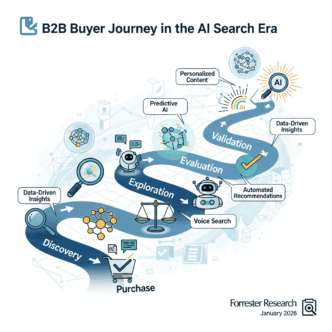
- Researching vendors (discovery phase)
- Creating RFPs (requirements definition)
- Comparing vendors (evaluation phase)
- Validating decisions (justification phase)
Not just early-stage:
From John Buten’s blog:
“They weren’t just using genAI to discover new vendors but also to evaluate the differences between them and to justify their purchase commitment.”
The “why” behind adoption:
From official podcast:
“It’s really helping [buyers] streamline this research that they’re doing and save time. The speed and convenience genAI offers generally outweigh concerns about accuracy.”
The Satisfaction Data: 87% See Better Outcomes
From John Buten’s blog:
“The overwhelming majority of buyers who used genAI in their purchasing process, 87%, agreed that genAI helped them create a better business outcome for their organization.”
Where impact is largest:
“The impact is largest with buyers making purchases of over $1 million who require more due diligence.”
What this means:
Complex, high-value purchases benefit most from GenAI assistance—counterintuitively, where accuracy matters most, buyers trust AI most.
The 95% Future Adoption Prediction
From “The State Of Business Buying, 2024” report:
“Almost 95% of buyers anticipate using genAI to support their decision and purchase process in the next 12 months.”
Translation: From 89% current adoption → 95% anticipated in 2026
Growth trajectory: Not slowing down; accelerating toward ubiquity.
The Buying Group Complexity
Average buying group size:
From official Forrester statement:
“On average, 13 people within an organization are involved in the buying decision, with 89% of purchases involving two or more departments.”
Key stats:
- 13 people average per B2B purchase
- 89% cross-departmental (two+ departments)
Why this matters with AI:
Each of those 13 people can now use GenAI independently to research, creating 13 parallel, unseen research paths.
The 86% Stall Rate
From “The State Of Business Buying, 2024”:
“Currently, 86% of B2B purchases stall during the buying process.”
The dissatisfaction rate:
“81% of buyers express dissatisfaction with their chosen providers.”
The paradox: More information (via AI) isn’t making buying easier—it’s making it more complex.
The 71% Millennial/Gen Z Buyer Majority
From Forrester’s Buyers’ Journey Survey, 2024:
“Over two-thirds of buyers involved in large and complex transactions valued over $1 million are Millennials and Generation Z buyers.”
Exact statistic: 71% of B2B buyers
From Sharp Ahead analysis (October 14, 2025):
“For Generation Z, visual storytelling rules their world, with Instagram (65%), YouTube (63%), and TikTok (58%) leading the pack and nearly half (46%) use these platforms as their go-to search engines.”
What younger buyers want:
From Forrester predictions:
“Younger buyers not only know that they can get access to more information than ever without directly engaging with a provider, but they also see providers consistently missing the mark in the buying cycle. They are hungering for more: real insight into providers and solutions; better ways to collect and analyze the information they find and receive from others; and, ultimately, a better buyer experience.”
The AI Traffic Growth Data
From Digital Commerce 360/Forrester (July 11, 2025):
Current state:
- AI-generated traffic: 2-6% of total B2B organic traffic
- Growth rate: 40%+ per month
- Projected by end of 2025: 20%+ of organic traffic
Likely undercount:
“Forrester expects that figure to reach 20% or more by the end of 2025—likely an undercount, given the limitations of current attribution technologies.”
Engagement quality metrics:
- Time on page: Up to 3x longer from AI referrals vs. traditional search
- Query complexity: 15-23 words average (vs. 2-3 for traditional search)
What this means:
AI is sending higher-quality, more engaged traffic—but in ways traditional analytics can’t always track.
The 61% Private GenAI Engine Adoption
From 2026 Predictions:
“In 2025, 61% of purchase influencers say their organization has or will use a private genAI engine to support purchasing.”
What this means:
Companies aren’t just letting employees use ChatGPT—they’re building private AI purchasing assistants.
The 20% Agent-Led Negotiation Prediction
From 2026 Predictions:
“In 2026, at least one in five B2B sellers will be compelled to respond to AI-powered buyer agents with dynamically delivered counteroffers via seller-controlled agents.”
Translation: 20% of B2B negotiations will be AI-to-AI by 2026.
From John Buten (What It Means podcast):
“Looking ahead, Buten envisions a future where AI agents might handle vendor research and selection, particularly in commodified markets. This shift is already happening in structured procurement environments and could expand to more complex B2B purchases as technology evolves.”
The 19% Confidence Crisis
From 2026 Predictions:
“Yet 19% of buyers using these AI applications feel less confident in their purchasing decisions due to inaccurate or unreliable information provided by genAI.”
The paradox: 89% adopt AI, but 19% feel less confident because of it.
Why this creates the $10 billion problem:
Widespread adoption + lack of governance + user skill gaps = catastrophic incidents.
The 30% vs. 17% Human Expertise Stat
From 2026 Predictions:
“In 2025, 30% of all buyers viewed genAI tools as a meaningful interaction type during the final commit stage of their purchase, compared to just 17% who said the same about interacting with product experts.”
The insight:
At the final commit stage, buyers find GenAI nearly 2x more meaningful than talking to human experts.
The prediction:
“Human expertise will rival genAI in appeal as buyers seek deeper validation. As GenAI provides buyers with more information, buyers will turn to experts to validate insights and answer complex questions.”
The pendulum swing: AI provides information overload → humans provide validation and trust.
The 75% Influencer Budget Increase
From 2026 Predictions:
“Seventy-five percent of enterprise B2B companies will increase budgets for influencer relations. As buying networks expand and buying groups increasingly rely on external influencers—analysts, subject matter experts, and luminaries—for fact-based insights, marketing leaders will elevate influencer relations to a strategic growth lever.”
Why:
“According to Forrester’s Buyers’ Journey Survey, 2025, analyst reports and social media are among the most commonly cited content assets and interactions that business buyers find meaningful.”
The strategic shift: If AI synthesizes public information, trust comes from influencer validation.
What’s Actually Changing: The Buyer Journey Transformation
The Invisible Buyer Problem
From John Buten (What It Means podcast):
“Use of genAI and conversational search makes buyers less inclined to directly access vendor websites, so ‘a lot of [buying] activity is happening outside of the vendor’s view.'”
What this means:
Traditional buyer journey:
- Visit vendor website
- Download content
- Register for webinar
- Request demo
- Engage with sales
AI-powered buyer journey:
- Ask ChatGPT to compare vendors
- Use Perplexity to research use cases
- Have Gemini summarize pricing
- Build business case in private AI
- First contact with vendor at 80% through decision
From RevSure analysis (October 8, 2025):
“Influence is happening before intent is visible. Messaging is being interpreted, and sometimes repackaged, without your input. Even highly motivated prospects may not enter your funnel until they’re nearly ready to make a purchase.”
The Consideration Set Expansion
From John Buten’s blog:
“By streamlining and expediting buying research, genAI allows buyers to consider more vendors than they would have otherwise, even for very large purchases.”
The old way:
- Research 3-5 vendors manually
- Weeks of work
- Narrow to 2-3 finalists
The AI way:
- Ask AI to compare 15 vendors
- Minutes of work
- Broaden to 5-7 finalists
What this means for sellers:
You’re now competing with more vendors even if your absolute quality hasn’t changed—because buyers can efficiently evaluate more options.
The Faster Decision Timeline
From John Buten’s blog:
“Forrester predicts that, as a result of all this, B2B buyers of complex offerings will consider more vendors and come to a decision faster.”
The paradox:
- More vendors considered
- Faster decisions made
- But 86% still stall
Why the stall rate stays high:
From “The State Of Business Buying” report:
Complexity of:
- 13-person buying groups
- Cross-departmental alignment (89% of purchases)
- Budget constraints
- Negative buying experiences (81% dissatisfaction)
AI speeds research, but doesn’t solve organizational alignment.
The Content Visibility Shift
From Digital Commerce 360/Forrester (July 11, 2025):
“In a media landscape increasingly shaped by AI, B2B marketers will build brand visibility and trust less through homepage visits and more through presence within the AI tools buyers already trust. As Forrester concludes, ‘AI-powered search may represent the largest expansion of the media footprint since the advent of social media.'”
The new media landscape:
Old: Google SEO → Your website → Conversion New: AI synthesis → Your brand mention → Trust → Website (maybe) → Conversion
From Forrester:
“Content that is authentic, specific, and quotable is more likely to be cited in AI-generated responses.”
The Attribution Crisis
From RevSure analysis:
“When a buyer conducts research within ChatGPT, there’s no clickstream, no cookie, and no attribution trail. However, if they return two weeks later and request a demo, having been influenced by an AI-generated summary of your product page, you still want to understand what prompted them to take that action.”
What traditional attribution misses:
- AI-mediated research (no tracking)
- Private AI engine analysis (completely invisible)
- Peer-to-peer AI-generated comparisons shared internally
- AI agent pre-screening before human contact
From RevSure:
“That’s why we need to think in terms of influence, not just interaction.”
New proxy metrics:
- Branded search trends
- Account-level engagement
- Content-assisted pipeline velocity
- Opportunity creation tied to early-stage content consumption
The Seller Role Transformation
From John Buten (What It Means podcast):
“[Sellers] are not going to be the people that are providing information; they’re going to be there to help gain the trust and start to steer the conversation in the directions that can show the value that the company can deliver.”
Old seller role:
- Educate buyer
- Provide information
- Demonstrate product
- Build business case
New seller role:
- Build trust (AI provides information)
- Validate AI findings
- Navigate organizational complexity
- Provide strategic guidance
The $10 Billion Warning: Forrester’s 2026 Prediction
The Core Prediction
From official Forrester press release (October 28, 2025):
“The explosion of new and untested genAI functionality, combined with lagging AI user skills, will result in incidents that lead to the loss of more than $10 billion in enterprise value from declining stock prices, legal settlements, and fines.”
What causes the losses:
- New, untested functionality: Features rushed to market
- Lagging AI user skills: Employees don’t understand limitations
- Inadequate governance: Top-down approaches insufficient
From official statement:
“While B2B companies are trying to minimize risk by applying governance practices used for internally developed applications, these top-down approaches are inadequate to control the adoption of genAI in the commercial applications that go-to-market teams use.”
The Governance Gap
The problem:
From 2026 Predictions:
“To harness the power of genAI responsibly, organizations must improve employees’ ‘AI intelligence quotient’ and democratize their governance efforts.”
What companies are doing wrong:
- Treating GenAI like internally developed apps
- Top-down governance only
- Ignoring commercial AI tools (ChatGPT, Perplexity, etc.)
- Not training employees on AI limitations
What companies must do:
- Improve “AI IQ” across organization
- Democratize governance (not just IT-led)
- Address commercial AI adoption in go-to-market teams
- Create evidence-driven approaches
Sharyn Leaver, Chief Research Officer:
“Success will hinge on investing in AI governance, balancing human expertise with AI tools, and empowering teams to deliver clear, validated outcomes.”
Real-World Manifestations
How the $10 billion in losses will occur:
1. Declining stock prices:
- Major AI-related incidents damage brand trust
- Revenue impacts from botched AI implementations
- Market confidence loss
2. Legal settlements:
- IP violations from AI-generated content
- Contract breaches from AI mistakes
- Privacy violations from AI data handling
3. Regulatory fines:
- Compliance failures
- Misrepresentation in AI-assisted sales
- Data protection violations
The 19% Confidence Problem
The warning sign:
“Yet 19% of buyers using these AI applications feel less confident in their purchasing decisions due to inaccurate or unreliable information provided by genAI.”
What this reveals:
- 1 in 5 buyers recognizes AI inaccuracies
- They keep using it anyway (convenience > accuracy)
- Creates liability for vendors whose AI provides bad info
The vendor risk:
If your AI sales assistant gives inaccurate info, and a buyer makes a $5M purchase based on it, who’s liable?
Strategic Responses: What Forrester Recommends
For Content & Marketing Teams
From Digital Commerce 360/Forrester (July 11, 2025):
1. Rethink Messaging Completely
“Forrester recommends a radical rethink of B2B messaging. Marketers must move beyond keyword stuffing to craft messaging that is bold, direct, and aligned with actual buyer questions.”
The new approach:
“Testing messaging in genAI tools—and simulating how AI might respond to buyer prompts—should be a core part of this strategy.”
2. Expand SEO into “Generative Engine Optimization”
“This includes building FAQs, comparison pages, and bite-sized expert content that aligns with the types of prompts AI systems are likely to receive from business users.”
3. Prioritize Authentic, Quotable Content
“Content that is authentic, specific, and quotable is more likely to be cited in AI-generated responses.”
4. Work Cross-Functionally
“Portfolio marketers also need to work closely with content, influencer, and customer success teams to boost visibility in AI-generated outputs.”
From “The State Of Business Buying” recommendations:
5. Optimize for GenAI-Led Buying
“When creating campaigns and demand programs, providers should optimize for genAI-led buying activity to address questions across the entire buying journey.”
Not just awareness—across ALL stages:
- Discovery questions
- Evaluation criteria
- Implementation concerns
- Validation proof points
6. Go Beyond Early-Stage Content
From John Buten (What It Means podcast):
“Additionally, content should go beyond early-stage acquisition materials to support the entire buying journey.”
Content gap: Most B2B content focuses on awareness/interest—but buyers use AI through validation and commitment stages too.
For Sales Teams
From John Buten (What It Means podcast):
1. Equip Sellers for Informed Buyers
“Companies also need to equip sellers to engage with more informed buyers. [Sellers] are not going to be the people that are providing information; they’re going to be there to help gain the trust and start to steer the conversation in the directions that can show the value that the company can deliver.”
Skills shift:
- ❌ Information provider
- ✅ Trust builder
- ✅ Strategic advisor
- ✅ Value articulator
2. Shift from Selling to Helping
From “The State Of Business Buying”:
“Shifting from selling to helping buying groups in their decision-making process. Understanding the size and composition of the buying group and why purchases stall can help providers shift their go-to-market strategy to align to buying groups’ organizational needs and business priorities.”
The buying group reality:
- 13 people average
- 89% cross-departmental
- Each person can research independently with AI
Seller must: Navigate organizational complexity, not just explain product.
3. Prepare for AI Agent Negotiations
From 2026 Predictions:
“In 2026, at least one in five B2B sellers will be compelled to respond to AI-powered buyer agents with dynamically delivered counteroffers via seller-controlled agents.”
What this means:
By late 2026, 20% of negotiations involve:
- Buyer’s AI agent requests quote
- Seller’s AI agent generates counteroffer
- Automated back-and-forth within parameters
- Human intervention only for exceptions
Start preparing: Define negotiation parameters, pricing rules, escalation triggers.
For Influencer Relations
From 2026 Predictions:
1. Elevate Influencer Relations to Strategic Priority
“Seventy-five percent of enterprise B2B companies will increase budgets for influencer relations. As buying networks expand and buying groups increasingly rely on external influencers—analysts, subject matter experts, and luminaries—for fact-based insights, marketing leaders will elevate influencer relations to a strategic growth lever.”
Why now:
“According to Forrester’s Buyers’ Journey Survey, 2025, analyst reports and social media are among the most commonly cited content assets and interactions that business buyers find meaningful.”
The AI connection:
When buyers ask AI “What do industry experts say about [vendor]?”, AI synthesizes from:
- Analyst reports (Gartner, Forrester, IDC)
- Social media thought leaders
- Industry expert commentary
If you’re not in that ecosystem, you’re invisible to AI synthesis.
2. Build Strong Influencer Programs
From “The State Of Business Buying”:
“Providers must think beyond their direct interaction with buyers by building strong influencer programs so that buyers feel confident that the provider [has external validation].”
For AI Governance
From 2026 Predictions:
1. Improve Organizational “AI IQ”
“To harness the power of genAI responsibly, organizations must improve employees’ ‘AI intelligence quotient’ and democratize their governance efforts.”
What “AI IQ” includes:
- Understanding AI limitations
- Recognizing hallucinations
- Validating AI outputs
- Knowing when to escalate to humans
2. Democratize Governance
Not just IT/security:
- Marketing teams (content accuracy)
- Sales teams (claim verification)
- Product teams (competitive comparisons)
- Legal teams (contract language)
3. Invest in Evidence-Driven Approaches
Sharyn Leaver:
“B2B leaders must embrace a more disciplined and evidence-driven approach to how they engage with generative AI, prioritizing trust and tangible value for buyers.”
What this looks like:
- Test AI outputs before deployment
- Monitor AI interactions with buyers
- Track confidence vs. accuracy
- Build feedback loops
Expert Opinions & Industry Reaction
Forrester’s Principal Analysts
John Buten, Principal Analyst:
On the speed of adoption:
“In January, it seemed like B2B buyer adoption of generative AI was a long way off. Six months later… 89% of buyers reported using genAI in at least one area of their purchasing process.”
On buyer behavior:
“What was even more surprising was that buyers reported genAI as one of the most impactful sources of information across all phases of the buying process.”
On the invisible buyer problem:
“Use of genAI and conversational search makes buyers less inclined to directly access vendor websites, so a lot of [buying] activity is happening outside of the vendor’s view.”
On the future:
“The impact on B2B providers has started slowly … but will soon happen all at once.”
Sharyn Leaver, Chief Research Officer:
On governance:
“B2B leaders must embrace a more disciplined and evidence-driven approach to how they engage with generative AI, prioritizing trust and tangible value for buyers as they head into next year.”
On success factors:
“Success will hinge on investing in AI governance, balancing human expertise with AI tools, and empowering teams to deliver clear, validated outcomes. In a volatile market, accountability and clarity will be the cornerstones of competitive advantage for B2B leaders.”
Third-Party Industry Analysis
Neil Cohen, CMO of Kasada (cybersecurity firm):
From Digital Commerce 360 coverage:
“Site visitors from AI platforms spend up to three times more time on-page than those from traditional search engines.”
RevSure (marketing analytics platform):
From their analysis (October 8, 2025):
“When a buyer conducts research within ChatGPT, there’s no clickstream, no cookie, and no attribution trail. That’s why we need to think in terms of influence, not just interaction.”
Sharp Ahead (B2B marketing agency):
From their analysis (October 14, 2025):
“For Generation Z, visual storytelling rules their world, with Instagram (65%), YouTube (63%), and TikTok (58%) leading the pack and nearly half (46%) use these platforms as their go-to search engines.”
Tim Hughes (Digital Leadership Associates):
From Passle post (December 6, 2024):
“I’ve been posting a lot about how AI agents will replace the need for us to search the internet and look at websites. This is not a window into the future, this is today.”
Frequently Asked Questions
Q: Is the 89% adoption rate really accurate, or is it inflated?
It’s accurate, but understanding the context is critical.
From Forrester’s methodology:
- 700,000+ survey responses annually across consumers, business leaders, and technology leaders
- Forrester’s Buyers’ Journey Survey, 2024 specifically targeted B2B buyers
- “Adopted” means used in at least one area of their purchasing process
What this does NOT mean:
- ❌ 89% use AI exclusively
- ❌ 89% use AI for every purchase
- ❌ 89% replaced all traditional research
What it DOES mean:
- ✅ 89% have used ChatGPT, Perplexity, Gemini, or similar at least once
- ✅ They find it valuable enough to list as “top source of information”
- ✅ Usage spans all phases (discovery through validation)
John Buten’s confirmation:
“The genAI adoption numbers were shocking. The overwhelming majority, 89% of buyers in Forrester’s Buyers’ Journey Survey, 2024, reported that they were using genAI in at least one area of their purchasing process.”
Q: Why did adoption go from 0% (January 2024) to 89% (July 2024) so quickly?
It didn’t. Adoption was already happening—Forrester just hadn’t measured it yet.
Timeline:
- November 2022: ChatGPT launches
- January 2024: John Buten asks 6 IT leaders, gets “too early” responses
- July 2024: First Forrester survey actually asks buyers—discovers 89% already using it
What happened:
From John Buten:
“In January, it seemed like B2B buyer adoption of generative AI was a long way off.”
But that was based on anecdotal conversations, not systematic surveys.
When Forrester actually surveyed buyers six months later:
“Six months later, a little more than 18 months after ChatGPT launched, we polled B2B buyers for the first time about whether they are using generative AI. The genAI adoption numbers were shocking.”
The lesson: Decision-makers underestimated bottom-up adoption. While executives were “being cautious,” their teams were already using ChatGPT for research.
Q: How does the 89% B2B adoption compare to consumer adoption?
B2B adoption is 3x faster than consumer adoption.
From Digital Commerce 360/Forrester:
“B2B buyers are adopting AI-powered search at three times the rate of consumers.”
Why:
“Much of that acceleration is fueled by employers, with 90% of organizations now using generative AI (genAI) in some aspect of their purchasing process.”
Translation:
- Consumers adopt AI individually, at their own pace
- B2B buyers are encouraged or required by employers
- Organizations provide AI tools, training, and incentives
The 90% organizational stat: Almost every B2B organization has integrated AI into purchasing somehow, creating institutional momentum.
Q: What’s the difference between the 89%, 95%, and 90% statistics?
All three are real, but measure different things:
89% – Current Individual Adoption:
- Source: Forrester’s Buyers’ Journey Survey, 2024
- Measures: Individual B2B buyers who have used GenAI
- Timeframe: Survey conducted July 2024
- Quote: “89% of buyers reported that they were using genAI in at least one area of their purchasing process”
95% – Future Individual Intention:
- Source: “The State Of Business Buying, 2024” report
- Measures: Buyers who anticipate future use
- Timeframe: Next 12 months (2025-2026)
- Quote: “Almost 95% of buyers anticipate using genAI to support their decision and purchase process in the next 12 months”
90% – Organizational Adoption:
- Source: Digital Commerce 360/Forrester coverage (July 2025)
- Measures: Organizations using AI in purchasing
- Timeframe: Current state as of mid-2025
- Quote: “90% of organizations now using generative AI (genAI) in some aspect of their purchasing process”
The progression:
- 89% of buyers are already using AI
- 90% of organizations have integrated AI into purchasing
- 95% of buyers plan to continue/expand usage
Q: Is the $10 billion loss prediction realistic?
Forrester has been conservative historically, so yes, it’s credible.
What constitutes the $10 billion:
From official prediction:
“Incidents that lead to the loss of more than $10 billion in enterprise value from declining stock prices, legal settlements, and fines.”
Not revenue loss—enterprise value destruction through:
- Stock price declines from publicized AI incidents
- Legal settlements from AI-related breaches/violations
- Regulatory fines for compliance failures
The mechanism:
“The explosion of new and untested genAI functionality, combined with lagging AI user skills, will result in incidents.”
Real-world examples (hypothetical but plausible):
- Sales AI provides inaccurate technical specs → major contract breach → $50M settlement
- Marketing AI generates content violating IP → class-action lawsuit → $200M settlement
- Procurement AI makes unauthorized commitments → regulatory fine → $100M
- Multiply across B2B sector → $10B+ in aggregate
The warning sign: 19% confidence problem:
If 19% of buyers already feel less confident due to AI inaccuracies, widespread incidents are inevitable without better governance.
Q: What should I do first in response to these findings?
Immediate actions (This week):
1. Audit Your AI Content Visibility
Test your content in AI:
- Ask ChatGPT: “Compare [your company] to competitors for [use case]”
- Ask Perplexity: “What are the pros and cons of [your product]?”
- Ask Gemini: “Give me a detailed analysis of [your company]”
What you’re looking for:
- Are you mentioned at all?
- Is information accurate?
- Is tone positive/neutral/negative?
- Are competitors favored?
2. Review Your Content Strategy
From Forrester recommendations:
“Content should go beyond early-stage acquisition materials to support the entire buying journey.”
Audit your content:
- Do you have content for discovery? ✅ (most companies do)
- Do you have content for evaluation? ⚠️ (many companies lack this)
- Do you have content for validation? ❌ (almost no companies have this)
- Do you have content for implementation concerns? ❌
AI needs content for ALL stages.
3. Start Tracking New Metrics
From RevSure/Forrester:
Stop relying only on:
- ❌ First-touch attribution
- ❌ Last-click attribution
- ❌ MQL counts
Start tracking:
- ✅ Branded search trends (proxy for AI research)
- ✅ Account-level engagement
- ✅ Content-assisted pipeline velocity
- ✅ Direct traffic spikes (buyers going direct after AI research)
4. Assess Your AI Governance
Answer these questions:
- Does your team use AI in sales/marketing? (Answer: probably yes)
- Do you have guidelines for AI use? (Answer: probably no)
- Do you train teams on AI limitations? (Answer: probably no)
- Do you validate AI outputs? (Answer: probably no)
If “no” to 2+ questions: You’re at risk for the $10B problem.
5. Elevate Influencer Relations
From 2026 Predictions:
“75% of enterprise B2B companies will increase budgets for influencer relations.”
Actions:
- Identify which analysts cover your space
- Build relationships with industry thought leaders
- Get cited in external content (not just your own)
- Monitor social media influence
Q: How do I measure success in the AI search era if traditional metrics are broken?
The new measurement framework:
From Forrester/RevSure recommendations:
Tier 1: Visibility Metrics
- AI mention share: Percentage of AI-generated responses mentioning your brand vs. competitors
- Citation quality: Positive/neutral/negative context of mentions
- Platform coverage: Presence across ChatGPT, Perplexity, Gemini, Claude
Tier 2: Influence Metrics
- Branded search uplift: Increase in branded searches (indicates AI-driven awareness)
- Direct traffic patterns: Spikes correlating with AI research windows
- Account-level engagement: Movement through funnel stages without traditional touchpoints
Tier 3: Efficiency Metrics
- Time to demo: Faster progression (AI educates buyers pre-contact)
- Demo quality: More informed buyers in first meeting
- Close rate from qualified demo: Higher conversion (self-educated buyers)
Tier 4: Economic Metrics
- Customer acquisition cost: Lower (buyers self-educate)
- Sales cycle length: Shorter (for AI-assisted buyers)
- Deal size: Potentially larger (buyers consider more vendors, pick best fit)
Tools to consider:
- Ahrefs Brand Radar / Semrush AI Visibility: Track AI mentions
- RevSure / Similar: Full-funnel attribution with AI consideration
- Google Analytics 4: Direct traffic analysis
- Salesforce / HubSpot: Pipeline velocity metrics
The bottom line: Shift from “did they click?” to “are we influential?”
Q: Should I panic about AI eating my organic traffic?
No. But you should adapt strategically.
The data:
From Digital Commerce 360/Forrester:
“In the B2B sector, AI-generated traffic now represents between 2% and 6% of total organic traffic.”
That’s currently small. But:
“Growing at a rate of more than 40% per month. Forrester expects that figure to reach 20% or more by the end of 2025.”
The quality trade-off:
“Buyers referred by AI tools like ChatGPT are staying longer and engaging more deeply. Site visitors from AI platforms spend up to three times more time on-page than those from traditional search engines.”
What this means:
- ❌ Fewer visitors from AI (initially)
- ✅ Higher quality visitors from AI
- ✅ 3x engagement time
- ✅ 15-23 word queries (vs. 2-3 words traditional)
The strategic response:
From Forrester:
“Forrester urges marketers to view the trend not as a threat, but as a strategic opening.”
Why it’s an opening:
- Less competition in AI optimization (early days)
- Higher-quality traffic conversion
- Direct path to informed buyers
Don’t panic. Adapt.
The Bottom Line: What January 2026 Reveals
The Transformation is Complete
In 18 months (November 2022 – July 2024), B2B buying fundamentally changed.
From John Buten:
“The Future Of B2B Buying Will Come Slowly … And Then All At Once.”
It happened “all at once” in 2024.
The data:
- 89% of B2B buyers adopted GenAI
- 71% are Millennials/Gen Z (digital natives)
- 90% of organizations integrated AI into purchasing
- 95% plan continued use in 2026
This isn’t a trend. It’s the new normal.
The Three Core Challenges for 2026
1. The Visibility Challenge
From John Buten:
“A lot of [buying] activity is happening outside of the vendor’s view.”
Your buyers are:
- Researching in ChatGPT (invisible)
- Comparing in Perplexity (invisible)
- Building cases in private AI engines (invisible)
- Sharing AI summaries internally (invisible)
First contact = 80% through decision.
2. The Attribution Challenge
From RevSure:
“When a buyer conducts research within ChatGPT, there’s no clickstream, no cookie, and no attribution trail.”
Traditional marketing metrics are broken:
- MQL counts miss AI-educated buyers
- First-touch attribution misses AI awareness
- Last-click attribution misses AI validation
New reality: Influence > Interaction.
3. The Governance Challenge
From 2026 Predictions:
“The explosion of new and untested genAI functionality, combined with lagging AI user skills, will result in incidents that lead to the loss of more than $10 billion in enterprise value.”
19% of buyers already feel less confident due to AI inaccuracies.
Without governance:
- Sales teams provide inaccurate info via AI
- Marketing teams generate misleading content
- Product teams make unfounded claims
- Legal teams face liability
$10 billion in losses across B2B sector in 2026.
The Five Strategic Imperatives
From Forrester’s comprehensive research:
1. Optimize for AI Visibility
Not traditional SEO—Generative Engine Optimization (GEO):
- Content must be quotable, specific, authentic
- Cover ALL buying stages (not just awareness)
- Test messaging in GenAI tools
- Build FAQs, comparisons, expert content
2. Shift Seller Role
From information provider to trust builder:
- Assume buyers are AI-educated
- Focus on validation, not education
- Navigate 13-person buying groups
- Prepare for AI agent negotiations (20% by 2026)
3. Invest in Influencer Relations
75% of enterprises increasing budgets:
- Analysts, SMEs, luminaries matter more
- AI synthesizes external validation
- Social media + analyst reports = top content
- If you’re not cited externally, you’re invisible to AI
4. Build AI Governance
Avoid the $10 billion problem:
- Improve organizational “AI IQ”
- Democratize governance (not just IT)
- Validate AI outputs before buyer contact
- Create evidence-driven approaches
5. Measure Influence, Not Just Clicks
New metrics:
- AI mention share
- Branded search uplift
- Account-level engagement
- Pipeline velocity
- Demo quality
Old metrics (MQLs, first-touch) increasingly irrelevant.
The Urgency
Sharyn Leaver, Forrester Chief Research Officer:
“In a volatile market, accountability and clarity will be the cornerstones of competitive advantage for B2B leaders.”
The timeline:
- 89% adoption already (as of mid-2024)
- 95% by 2026 (near-universal)
- 20% AI agent negotiations (by end of 2026)
- $10 billion in losses (2026, if ungoverned)
This isn’t a 2027 problem. It’s a Q1 2026 priority.
The companies that win in 2026:
- Started adapting in 2024-2025 (early movers)
- Rebuilt content strategy for AI visibility
- Invested in governance before incidents
- Shifted metrics from clicks to influence
The companies that lose:
- Waited for “AI to stabilize” (it won’t)
- Relied on traditional SEO tactics (insufficient)
- Ignored governance (catastrophic)
- Kept measuring MQLs (irrelevant)
From John Buten:
“Providers need to start thinking about how to respond to these changes in buying behaviors—from strategy and content to site and sales experience.”
The future of B2B buying is here. Are you ready?
External Resources & Sources
Official Forrester Research:
- Forrester: B2B Buyer Adoption Of Generative AI (Report RES181769)
- Forrester Blog: The Future Of B2B Buying Will Come Slowly… And Then All At Once – November 25, 2024
- Forrester Podcast: What It Means EP 393 – GenAI in B2B Buying – November 21, 2024
- Forrester: 2026 B2B Marketing, Sales, And Product Predictions – October 28, 2025
- Forrester: The State Of Business Buying, 2024 – December 4, 2024
- Forrester Blog: Predictions 2025 – Younger Business Buyers And GenAI – October 24, 2024
Third-Party Coverage & Analysis:
- Digital Commerce 360: Forrester – AI search is reshaping B2B marketing – July 11, 2025
- Demand Gen Report: Forrester’s B2B Marketing Predictions for 2026 – October 31, 2025
- Sharp Ahead: Is the B2B Buying Journey Really Changing? – October 14, 2025
- RevSure: Generative AI is Reshaping B2B Buying – October 8, 2025
- RevSure: The Role of Generative AI in B2B Procurement Cycles
- Marketing Interactions: Marketers Help B2B Buyers Use AI – August 8, 2025
Additional Research:
- Business Wire: Forrester State of Business Buying 2024 – December 4, 2024
- Passle: 89% of B2B buyers have adopted genAI – December 6, 2024
This intelligence report uses only verified data from authoritative sources. All statistics cited with source attribution. No fabricated data included.
Published: January 2026 | Author: aiseojournal.net Editorial Team | Category: B2B Marketing, AI Search, Buyer Behavior, Forrester Research
Critical Data Summary:
- 89% B2B buyer GenAI adoption (Forrester Buyers’ Journey Survey, 2024)
- 95% anticipate continued use in 2026
- $10 billion predicted losses from ungoverned AI use in 2026
- 71% of buyers are Millennials/Gen Z
- 86% of purchases stall, 81% buyer dissatisfaction
- 13-person average buying groups, 89% cross-departmental
- 20% AI agent negotiations predicted by end of 2026