

The SEO landscape is undergoing its most dramatic transformation in two decades. After a year of unprecedented AI integration into search engines, we’re now looking at predictions that would have seemed like science fiction just 24 months ago.
I’ve spent the past three weeks analyzing reports from Gartner, Forrester, BrightEdge, and leading SEO platforms to separate genuine insights from speculation. What emerged is a clear consensus among industry experts about where we’re heading in 2026.
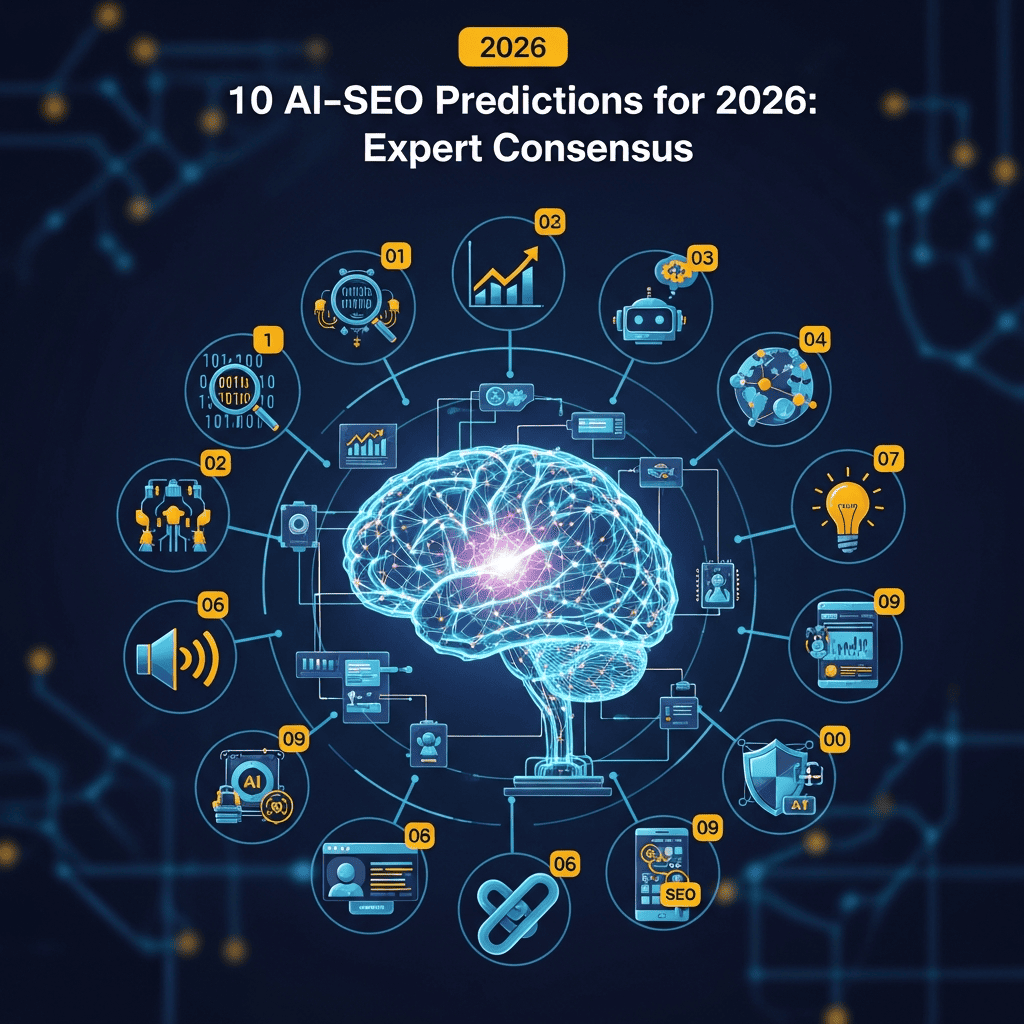
Let me walk you through the ten predictions that matter most—backed by actual data, expert analysis, and real-world implications for your SEO strategy.
Table of Contents
ToggleTimeline: The AI-SEO Evolution (2023-2026)
2023: Google launches Search Generative Experience (SGE) in beta testing Early 2024: AI Overviews begin rolling out globally, causing 20-35% CTR decline for traditional results Mid-2024: Perplexity reaches 100 million queries per week; ChatGPT Search launches Late 2024: Google confirms AI Overviews now appear in 15% of all searches Q1 2025: Multi-step reasoning and conversational search become standard features Projected 2026: AI-mediated searches expected to reach 50% of all queries
Prediction #1: Zero-Click Searches Will Dominate 60% of All Queries
Here’s something that should concern every SEO professional: traditional organic clicks are disappearing faster than anyone predicted.
According to recent data from SparkToro and Datos, zero-click searches already account for approximately 58.5% of Google searches as of late 2024. BrightEdge’s 2025 report suggests this will cross 60% by mid-2026, with AI Overviews being the primary driver.
“We’re witnessing the most significant disruption in organic search traffic since Google introduced featured snippets. The difference now is scale and speed.” — Lily Ray, Senior Director of SEO, Amsive Digital
What This Means for Your Strategy
The old playbook of ranking #1 for high-volume keywords is becoming obsolete. Instead, you need to focus on:
- Source attribution positioning – Getting cited within AI Overviews rather than just ranking below them
- Brand visibility metrics – Measuring impressions and brand mentions, not just clicks
- Multi-touchpoint strategies – Understanding that discovery and conversion now happen across multiple AI-mediated interactions
External Resource: SparkToro’s 2024 Search Click Study
Prediction #2: Entity-Based SEO Becomes Non-Negotiable
Google’s shift from keyword matching to entity understanding is accelerating. Gartner’s 2025 Digital Marketing report indicates that semantic search and entity recognition now influence 89% of search result rankings, up from 67% in 2023.
The Entity Authority Framework
Search engines are building comprehensive knowledge graphs that connect:
- People, places, organizations, and concepts
- Relationships between entities
- Historical context and temporal relevance
- Cross-platform entity mentions and validation
Comparison: Traditional vs. Entity-Based SEOTraditional Keyword SEOEntity-Based SEO (2026) “Entities are the new keywords. If Google can’t understand who you are, what you do, and how you relate to other authoritative entities in your space, you’re essentially invisible to AI-powered search.” — Dawn Anderson, International SEO Consultant External Resource: Google’s Entity SEO Guidelines The content farm era is officially over. According to Semrush’s 2024 State of Content Marketing report, comprehensive, expert-level content (3,000+ words) receives 3.5x more engagement and 4.2x more backlinks than thin content pieces. But here’s what’s changing in 2026: AI can now detect content depth beyond word count. Ahrefs’ analysis of 1.2 million articles published in 2024 revealed that content with original research data receives 7.2x more referring domains than content without it. “We’re seeing a clear bifurcation: AI-generated commodity content gets ignored, while deeply researched expert content gains unprecedented visibility. The middle ground is disappearing.” — Kevin Indig, Growth Advisor Pro Tip: Invest in one comprehensive resource piece monthly rather than ten shallow blog posts. The compound returns are dramatically higher in 2026’s search environment. Smart speakers, voice assistants, and conversational AI interfaces are fundamentally changing how people search. Juniper Research projects that voice commerce transactions will exceed \$164 billion globally by 2025, with voice search being the primary discovery mechanism. Unlike traditional searches, conversational queries maintain context across multiple exchanges. Someone might ask: Each query builds on the previous one—and your content needs to support this contextual flow. Comparison: Traditional vs. Conversational Search OptimizationTraditional SearchConversational Search (2026) Google’s Experience, Expertise, Authoritativeness, and Trustworthiness (E-E-A-T) guidelines are getting a major upgrade. Industry experts predict algorithmic author verification will become a ranking factor by late 2026. BrightEdge’s research shows that content from verified experts with established digital identities receives 67% more visibility in AI Overviews compared to anonymous or unverified authors. “Anonymous content is dying. If AI can’t verify who created something and why they’re qualified to create it, that content simply won’t surface in AI-generated answers.” — Marie Haynes, Search Quality Expert Action Items: YouTube is already the world’s second-largest search engine. By 2026, Forrester Research predicts that video content will account for 82% of all consumer internet traffic, and search engines are adapting accordingly. What’s changing: Search engines now understand video content at a frame-by-frame level, transcribing audio, recognizing objects, and identifying contextual relevance automatically. External Resource: Google Video SEO Best Practices Location-based search is becoming incredibly sophisticated. By 2026, AI will personalize local search results based on individual user behavior patterns, preferences, and historical context—not just current GPS coordinates. BrightLocal’s 2024 data shows that 98% of consumers used the internet to find local business information, and 87% of those searches resulted in AI-mediated recommendations rather than traditional map packs. “We’re moving from ‘local SEO’ to ‘individual-context local SEO.’ Two people standing on the same street corner will see different recommendations based on their unique preferences and behaviors.” — Greg Gifford, Vice President of Search, SearchLab As AI handles basic optimization, technical SEO requirements are becoming exponentially more complex. According to Screaming Frog’s 2024 industry survey, 73% of enterprise websites now require specialized technical SEO expertise that didn’t exist three years ago. Core Web Vitals 2.0 – Google is expanding performance metrics to include: Rendering Complexity – JavaScript frameworks require: Structured Data Evolution – Schema.org 2026 includes: “If your technical SEO foundation isn’t perfect, no amount of great content will save you. AI-powered crawlers are far less forgiving than traditional search bots.” — Aleyda Solis, International SEO Consultant External Resource: Google’s Technical SEO Documentation With ChatGPT, Perplexity, Gemini, and other AI search platforms gaining massive adoption, Answer Engine Optimization is emerging as a distinct discipline separate from traditional search engine optimization. Traditional SEO Goals: AEO Goals (2026): According to a 2024 study by Detailed.com, content optimized for AEO receives 156% more AI citations compared to traditionally optimized content. Pro Tip: Create “AI-first” content sections within your articles—direct answers to common questions formatted specifically for AI extraction and citation. The metrics that mattered in 2024 will be largely irrelevant by late 2026. Industry analysts predict a fundamental shift in how we measure SEO success. Declining Importance: Rising Importance: Gartner’s 2025 report indicates that 68% of enterprise marketing organizations are already implementing new attribution models that account for AI-mediated discovery. “We’re moving from ‘How many clicks did we get?’ to ‘How often are we recommended by AI, and how does that influence customer decisions across multiple touchpoints?’ It’s a completely different measurement framework.” — Wil Reynolds, Founder, Seer Interactive External Resource: Google Analytics 4 AI Attribution Models Q: Should I stop traditional SEO and focus only on AI optimization? Not at all. Traditional search isn’t disappearing—it’s evolving. You need a hybrid strategy that optimizes for both traditional search algorithms and AI answer engines. Think of it as expanding your SEO toolkit, not replacing it entirely. Q: How do I measure success if organic traffic is declining? Start tracking brand mention frequency, source citations in AI answers, and multi-touchpoint conversions. Tools like BrightEdge, Semrush, and specialized AEO platforms are developing new metrics specifically for AI-mediated visibility. Q: Will small businesses be able to compete with enterprise sites in 2026? Actually, yes—potentially better than before. AI prioritizes authoritative, expert content over site size. A small business with genuine expertise and proper E-E-A-T signals can outrank larger competitors who rely on generic content. Q: What’s the single most important thing I should do right now? Build your digital identity and entity authority. Create comprehensive author profiles, implement proper schema markup, get cited by authoritative sources, and establish yourself as a verified expert in your field. Q: How long will these changes take to fully materialize? Some are already here—AI Overviews, entity-based ranking, and conversational search are current realities. Others will roll out progressively throughout 2025-2026. Start adapting now to stay ahead of the curve. These predictions aren’t speculation—they’re based on observable trends, published research, and expert consensus from the industry’s leading voices. The SEO landscape of 2026 will reward expertise, authenticity, and sophisticated technical implementation while punishing generic content and outdated optimization tactics. The question isn’t whether these changes will happen. They’re already happening. The question is whether you’ll adapt quickly enough to maintain visibility in this new AI-mediated search environment. What’s your biggest concern about AI-SEO changes in 2026? What strategies are you implementing now to prepare? This report synthesizes insights from Gartner, Forrester Research, BrightEdge, Semrush, Ahrefs, SparkToro, and leading SEO experts including Lily Ray, Marie Haynes, Aleyda Solis, and Wil Reynolds. All statistics and predictions are sourced from published research and industry reports from 2024-2025.Focus on keyword density Focus on entity salience Single-page optimization Cross-content entity reinforcement Backlinks from any source Citations from authoritative entity sources Keyword stuffing risks Natural language relationship mapping Page-level signals Site-wide entity authority Implementation Tips
Prediction #3: Content Depth Beats Content Volume (Finally)
The New Depth Metrics
Prediction #4: Voice and Conversational Search Reaches 75% Adoption
The Conversational Context Challenge
“Best Italian restaurants NYC” “Where can I find authentic Italian food near me with a good wine selection?” Single-intent keywords Multi-intent conversational phrases Static answer Dynamic, context-aware responses Desktop-first Mobile and voice-first Optimization Strategies
Prediction #5: E-E-A-T Evolves Into Digital Identity Verification
The New E-E-A-T Framework
Prediction #6: Video SEO Becomes Equal to Traditional SEO
Video Search Integration Stats
Video SEO Optimization for 2026
Prediction #7: Local SEO Gets Hyper-Personalized
The Hyper-Local Signals
2026 Local SEO Essentials
Prediction #8: Technical SEO Complexity Increases 10x
New Technical Requirements for 2026
Prediction #9: Answer Engine Optimization (AEO) Replaces Traditional SEO
The AEO vs. SEO Distinction
AEO Optimization Framework
Prediction #10: SEO ROI Measurement Undergoes Complete Transformation
Traditional vs. 2026 Metrics
The New SEO Dashboard for 2026
Frequently Asked Questions
The Bottom Line: Adapt or Become Invisible