

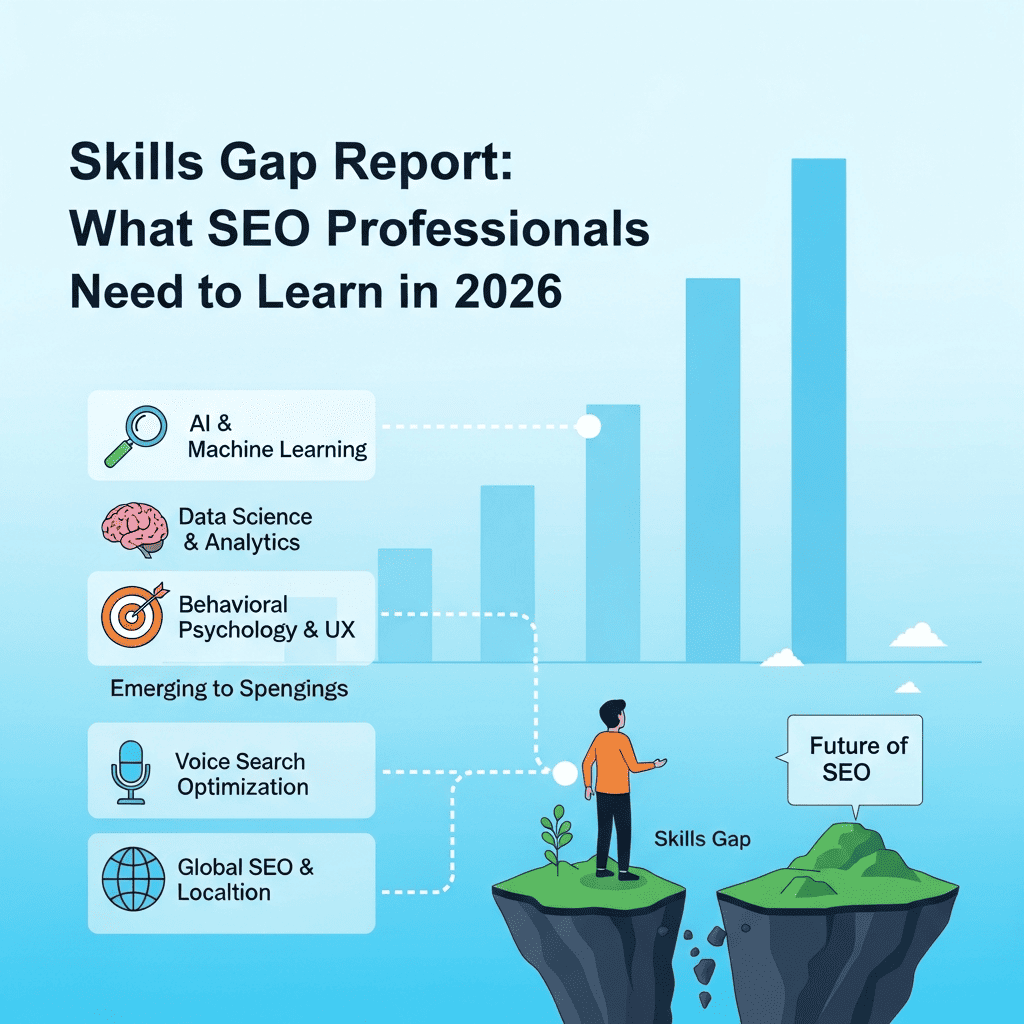
The SEO industry is experiencing its most dramatic skills transformation since Google’s inception. What worked brilliantly in 2023 is becoming obsolete in 2026, and professionals who don’t adapt are finding themselves sidelined.
I’ve analyzed recent reports from LinkedIn Learning, Coursera, BrightEdge, and multiple industry surveys to understand exactly what skills are becoming essential—and which ones are losing relevance. The findings are sobering: 78% of SEO professionals lack the skills they’ll need to remain competitive in 2026, according to a comprehensive study by the Digital Marketing Institute.
Let me break down the critical skills gap, what you need to learn, and how to get there before it’s too late.
Table of Contents
Toggle
Timeline: The SEO Skills Evolution (2020-2026)
2020: Traditional keyword research and link building dominate job requirements 2021: Content optimization and technical SEO become primary focus areas 2022: Data analytics and UX optimization emerge as essential skills 2023: AI tools adoption begins; basic prompt engineering appears in job descriptions 2024: AI integration becomes mandatory; traditional SEO roles begin fragmenting Early 2025: Entity SEO and answer engine optimization create new specializations Mid-2026 (Projected): Hybrid AI-SEO roles become standard; traditional-only SEO positions decline 40%
The Current State: Understanding the Skills Gap
Here’s something that should concern every SEO professional: the industry is moving faster than education can keep up with.
According to LinkedIn’s 2024 Workplace Learning Report, SEO is among the top 10 roles experiencing the most dramatic skills transformation, with an estimated skill half-life of just 2.5 years. That means half of what you know today will be outdated or irrelevant by 2027.
The Numbers Don’t Lie
Recent industry data paints a clear picture:
- 63% of marketing leaders report difficulty finding SEO talent with current required skills (Gartner, 2024)
- 71% of SEO professionals feel underprepared for AI-integrated search environments (Search Engine Journal survey, 2024)
- Only 23% of SEOs have formal training in data science or analytics (Moz Industry Survey, 2024)
- 89% of job postings for SEO roles now require AI tool proficiency (Indeed Job Trends, 2024)
“The SEO professionals thriving in 2026 won’t be those who know the most about traditional optimization—they’ll be those who can bridge the gap between AI capabilities, data science, and strategic marketing thinking.” — Rand Fishkin, Founder, SparkToro
Critical Skill #1: AI Integration and Prompt Engineering
This isn’t about using ChatGPT to write blog posts. The real skill gap is in strategic AI implementation across the entire SEO workflow.
What You Actually Need to Know
Advanced Prompt Engineering:
- Chain-of-thought prompting for complex SEO analysis
- Few-shot learning techniques for content optimization
- Prompt chaining for multi-step research processes
- Custom instruction sets for brand-specific AI applications
AI Tool Stack Mastery: According to Semrush’s 2024 State of AI in Marketing report, SEO professionals now use an average of 6.3 AI tools in their daily workflow, up from 2.1 in 2023. The most commonly required tools include:
- GPT-4 and Claude for content strategy and analysis
- Jasper/Copy.ai for scaled content production
- Surfer SEO and Clearscope for AI-powered optimization
- ChatGPT plugins and custom GPTs for specialized SEO tasks
- Perplexity and You.com for AI-powered research
The Reality Check
Traditional Approach vs. 2026 AI-Integrated Approach
| Traditional SEO (2023) | AI-Integrated SEO (2026) |
|---|---|
| Manual keyword research (4-6 hours) | AI-assisted semantic clustering (45 minutes) |
| Individual content briefs | AI-generated content frameworks with human refinement |
| Monthly manual audits | Continuous AI monitoring with anomaly detection |
| Reactive competitive analysis | Predictive competitive intelligence using AI |
| Linear workflow execution | Parallel AI-assisted multi-tasking |
“The SEO professionals we’re hiring now aren’t just prompt engineers—they’re AI workflow architects who can design entire optimization systems that leverage AI at every step while maintaining strategic human oversight.” — Lily Ray, Senior Director of SEO, Amsive Digital
How to Acquire This Skill
Recommended Learning Paths:
- Coursera’s “AI for Everyone” by Andrew Ng (foundational understanding)
- Learn Prompting (learnprompting.org) – comprehensive prompt engineering course
- OpenAI’s documentation and API playground for hands-on experimentation
- Daily practice: Spend 30 minutes daily solving actual SEO problems using AI tools
Pro Tip: Create a personal “AI playbook” documenting your most effective prompts and workflows. This becomes invaluable intellectual property as the industry evolves.
External Resource: OpenAI’s Prompt Engineering Guide
Critical Skill #2: Data Science and Advanced Analytics
The days of looking at Google Analytics and calling it “data analysis” are over. Modern SEO requires genuine data science capabilities.
The Statistical Reality
According to Gartner’s 2024 Marketing Skills Report, data literacy is now the #2 most in-demand skill for SEO professionals, behind only strategic thinking. Yet only 18% of current SEO professionals have formal training in statistics or data analysis.
What This Actually Means
Statistical Analysis Fundamentals:
- Understanding correlation vs. causation in ranking factors
- Regression analysis for identifying ranking influences
- A/B testing with statistical significance calculations
- Predictive modeling for traffic forecasting
Data Visualization: The ability to transform complex data into actionable insights is becoming critical. BrightEdge’s research shows that SEO professionals who can create compelling data visualizations are 3.2x more likely to influence executive decision-making.
Essential Technical Skills
- Python basics: Pandas, NumPy, Matplotlib for SEO data analysis
- SQL proficiency: Querying databases for custom SEO insights
- Google BigQuery: Analyzing large-scale search data
- Data Studio/Looker: Creating automated reporting dashboards
- Statistical significance testing: Understanding confidence intervals and p-values
Comparison: Basic vs. Advanced Analytics
| Basic Analytics (Declining Value) | Advanced Analytics (High Demand) |
|---|---|
| Traffic went up/down | Multivariate attribution modeling |
| Keyword rankings changed | Statistical ranking factor analysis |
| Monthly report creation | Predictive traffic forecasting |
| Manual data exports | Automated data pipelines |
| Surface-level correlation | Causal inference analysis |
“If you can’t speak the language of data science, you can’t have meaningful conversations with the people making budget decisions. SEO needs to move from ‘I think this will work’ to ‘The data indicates with 95% confidence that this approach will deliver X results.'” — Kevin Indig, Growth Advisor
Learning Pathway
For Beginners:
- “SQL for Data Analysis” on Udacity
- “Python for Everybody” by University of Michigan (Coursera)
- Google Analytics 4 Certification (free from Google)
For Intermediate:
- “Applied Data Science with Python” specialization (Coursera)
- DataCamp’s Data Scientist track (SEO-specific applications)
- Kaggle competitions using SEO datasets
External Resource: Google’s Data Analytics Certificate
Critical Skill #3: Entity SEO and Knowledge Graph Optimization
This is perhaps the most overlooked skill gap. While everyone’s focused on AI tools, entity-based optimization is fundamentally reshaping how search engines understand and rank content.
The Knowledge Graph Reality
Google’s Knowledge Graph contains over 5 billion entities and 500 billion facts about the relationships between them. By 2026, search engines won’t be matching keywords—they’ll be connecting entities.
According to research from InLinks and WordLift, websites with comprehensive entity optimization see an average 47% increase in AI Overview citations compared to traditionally optimized sites.
What You Need to Master
Entity Identification and Mapping:
- Understanding how search engines identify and classify entities
- Creating entity relationship diagrams for content planning
- Implementing entity-first content architectures
- Building entity salience through strategic content creation
Schema Markup Expertise: Gone are the days of basic schema implementation. In 2026, you need deep knowledge of:
- Advanced schema types (Organization, Person, Product, Event, etc.)
- Schema relationship properties connecting multiple entities
- JSON-LD implementation and troubleshooting
- Schema validation and testing using specialized tools
Knowledge Graph Building:
- Creating and optimizing Google Knowledge Panels
- Wikidata entity creation and management
- Cross-platform entity validation strategies
- Entity mention acquisition from authoritative sources
The Technical Depth Required
Entity SEO Implementation Checklist:
✓ Comprehensive site-wide schema markup strategy ✓ Entity relationship mapping across content clusters ✓ Author entity optimization with proper credentials ✓ Product entity hierarchies with detailed attributes ✓ Local entity optimization for multi-location businesses ✓ Cross-platform entity consistency verification ✓ Entity salience measurement and optimization
“Entity SEO isn’t just a technical checkbox—it’s a complete paradigm shift in how we approach content strategy, site architecture, and authority building. Most SEO professionals are still thinking in keywords when they need to be thinking in entities and relationships.” — Dawn Anderson, International SEO Consultant
How to Learn Entity SEO
Recommended Resources:
- Schema.org documentation (comprehensive reference)
- Google’s Structured Data Guidelines (essential reading)
- InLinks’ Entity SEO course (practical implementation)
- Jason Barnard’s “The Brand SERP Guy” content (knowledge panel optimization)
Hands-On Practice:
- Audit your own site’s entity implementation
- Use tools like InLinks, WordLift, or Schema App
- Create a knowledge graph for your brand
- Monitor entity mentions using brand monitoring tools
External Resource: Schema.org Official Documentation
Critical Skill #4: Technical SEO at Scale
Technical SEO has evolved from fixing broken links to managing enterprise-level technical infrastructure that impacts millions of pages.
The Complexity Explosion
According to Screaming Frog’s 2024 Technical SEO Survey, the average enterprise website now has 67% more technical SEO requirements than it did in 2022. Yet only 31% of SEO professionals feel confident managing advanced technical implementations.
What’s Required in 2026
Core Web Vitals Mastery:
- INP (Interaction to Next Paint) optimization
- Advanced image optimization techniques
- Critical rendering path optimization
- JavaScript framework SEO implications
Modern Web Development Understanding: You don’t need to be a developer, but you need to understand:
- React, Vue, Angular SEO considerations
- Server-side rendering (SSR) vs. client-side rendering
- Static site generation (SSG) implications
- Edge computing and CDN optimization
- Progressive web apps (PWA) SEO impact
Log File Analysis: Understanding how search engines crawl your site at scale requires log file analysis expertise—a skill only 22% of SEO professionals possess, according to Moz’s 2024 industry survey.
Technical Skills Comparison
| Basic Technical SEO | Enterprise-Level Technical SEO (2026) |
|---|---|
| Fix broken links | Manage crawl budget allocation across millions of pages |
| Create XML sitemaps | Implement dynamic sitemap generation systems |
| Basic page speed | Advanced Core Web Vitals optimization with edge computing |
| Mobile-friendly test | Cross-device rendering optimization with device-specific strategies |
| robots.txt basics | Advanced crawl directive implementation with log file analysis |
“The gap between basic technical SEO and what enterprise organizations actually need has never been wider. We’re turning away talented SEO professionals because they can’t have technical conversations with engineering teams about rendering strategies or crawl efficiency at scale.” — Aleyda Solis, International SEO Consultant
Learning Resources
Technical Foundations:
- “Technical SEO Certification” by Semrush Academy
- “JavaScript SEO” by Onely (comprehensive guide)
- “Core Web Vitals Optimization” by web.dev
- Screaming Frog’s Technical SEO Resources (practical tutorials)
Advanced Development Understanding:
- freeCodeCamp (basic web development literacy)
- MDN Web Docs (understanding modern web technologies)
- Chrome DevTools documentation (performance debugging)
External Resource: Google’s Web.dev Performance Guide
Critical Skill #5: Content Strategy Beyond Keywords
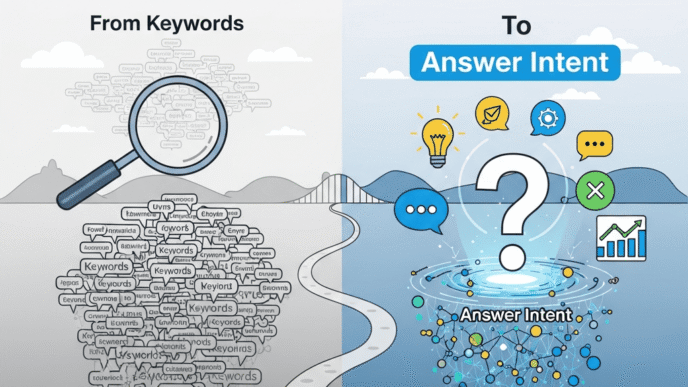
The fundamental approach to content strategy is transforming. Keyword-centric content planning is being replaced by topic modeling, user intent mapping, and entity-relationship content architectures.
The Content Strategy Gap
Content Marketing Institute’s 2024 research reveals that 68% of content marketers still use keyword-based content calendars, while AI-powered search engines require topic authority and comprehensive coverage.
The New Content Framework
Topic Modeling and Clustering:
- Using natural language processing to identify topic relationships
- Creating content clusters based on semantic similarity
- Mapping user journey stages to content topics
- Implementing hub-and-spoke content architectures
Intent Mapping Evolution: Traditional intent categories (informational, navigational, transactional) are obsolete. In 2026, you need to understand:
- Multi-intent queries requiring hybrid content strategies
- Conversational intent progression across multiple interactions
- Context-dependent intent variation
- AI-mediated intent interpretation
Original Research and Data Creation: According to Ahrefs’ 2024 Content Research Study, content featuring original research receives 7.2x more backlinks and 4.8x more social shares than content without unique data.
Content Skills Inventory
Required Capabilities:
✓ Topical authority building through comprehensive coverage ✓ Content gap analysis using AI-powered tools ✓ User journey mapping with content alignment ✓ Data journalism and research methodology ✓ Multi-format content strategy (text, video, audio, interactive) ✓ Content refresh strategies based on decay analysis ✓ Semantic optimization beyond keyword density
“The content strategists who succeed in 2026 won’t be those who can identify high-volume keywords—they’ll be those who can architect comprehensive content systems that establish genuine topical authority and answer user needs across the entire journey.” — Julia McCoy, Founder, Content at Scale
Actionable Learning Path
- Learn topic modeling tools: MarketMuse, Clearscope, or Surfer SEO
- Study semantic search: Google’s BERT and MUM documentation
- Practice data journalism: Create original research reports using available data
- Master content clustering: Build comprehensive topic clusters for your site
- Analyze top performers: Reverse-engineer successful content strategies in your niche
External Resource: Content Marketing Institute Resources
Critical Skill #6: Answer Engine Optimization (AEO)
This is genuinely new territory. While traditional SEO optimizes for search engine result pages, AEO optimizes for AI-generated answers across multiple platforms.
The Platform Proliferation
Users are now searching across:
- ChatGPT (100+ million weekly active users)
- Perplexity (100+ million monthly queries)
- Google’s AI Overviews (appearing in 15%+ of searches)
- Bing Chat/Copilot (integrated across Microsoft ecosystem)
- Claude, Gemini, and emerging AI platforms
According to Detailed.com’s 2024 AEO Study, businesses optimizing specifically for answer engines see 156% higher citation rates in AI responses compared to those using only traditional SEO.
AEO vs. Traditional SEO
Fundamental Differences:
| Traditional SEO Focus | AEO Focus (2026) |
|---|---|
| Ranking in top 10 results | Being cited in AI answers |
| Maximizing organic clicks | Maximizing brand mentions and attributions |
| Optimizing for one algorithm (Google) | Optimizing across multiple AI platforms |
| Page-level optimization | Content source credibility optimization |
| Keyword ranking tracking | Citation frequency and context tracking |
What You Need to Learn
Source Credibility Optimization:
- Building verifiable author credentials
- Creating citation-worthy statistics and research
- Implementing proper attribution signals
- Establishing cross-platform authority indicators
AI-Friendly Content Formatting:
- Direct answer positioning at content start
- Clear hierarchical information structure
- Fact-based statements with supporting evidence
- Natural language that AI can easily parse and cite
Multi-Platform Testing: Testing how your content performs across different AI platforms requires:
- Regular queries on ChatGPT, Perplexity, Gemini, Claude
- Documentation of citation patterns and contexts
- Analysis of what content gets cited vs. ignored
- Iterative optimization based on AI response patterns
“Answer Engine Optimization is forcing us to completely rethink content creation. We’re not writing for human readers who click through to our sites—we’re writing to become the authoritative source that AI platforms cite when answering user questions.” — Wil Reynolds, Founder, Seer Interactive
Learning Strategy
Immediate Actions:
- Test your content across multiple AI platforms weekly
- Analyze citation patterns in your industry
- Identify what makes content “citation-worthy”
- Implement source credibility signals systematically
- Track brand mentions in AI responses using monitoring tools
Emerging Tools for AEO:
- BrightEdge Data Cube (AI visibility tracking)
- Custom monitoring scripts for AI platform mentions
- Citation analysis across multiple AI sources
Critical Skill #7: Predictive Analytics and Forecasting
The ability to predict SEO outcomes before implementing changes is becoming a critical competitive advantage.
Why This Matters Now
According to Forrester’s 2024 Marketing Analytics Report, organizations using predictive SEO analytics see 32% better ROI on their optimization efforts compared to those relying on reactive analysis.
Required Capabilities
Traffic Forecasting:
- Building statistical models to predict organic growth
- Accounting for seasonality and market trends
- Scenario planning for algorithm updates
- Confidence interval calculation for forecasts
Impact Prediction: Before making any significant SEO change, you should be able to predict:
- Expected traffic impact with confidence ranges
- Time to realize results
- Resource requirements vs. expected returns
- Risk assessment for potential negative impacts
Machine Learning Applications:
- Using regression models for ranking factor analysis
- Clustering algorithms for content categorization
- Classification models for intent prediction
- Time series analysis for trend identification
The Skill Gap Reality
Only 14% of SEO professionals have any formal training in predictive analytics, according to Moz’s 2024 survey, yet 73% of CMOs now expect data-driven predictions from their SEO teams.
“The executives making budget decisions don’t want to hear ‘I think this will work’—they want to see predictive models showing expected outcomes with statistical confidence levels. If you can’t provide that, you’re not getting the resources you need.” — Mike King, Founder, iPullRank
Learning Path
Foundation Building:
- “Statistics for Data Science” on Coursera
- “Forecasting Using R” by Hyndsight
- Google Analytics 4 predictive metrics documentation
Advanced Applications:
- “Machine Learning for Marketing” specialization
- DataCamp’s “Marketing Analytics with Python”
- Practical application using actual SEO datasets
Tools to Master:
- Python (scikit-learn for ML applications)
- R (time series forecasting)
- Google Analytics 4 (built-in predictive features)
- BrightEdge or Conductor (enterprise predictive tools)
External Resource: Google Analytics Predictive Metrics Guide
Critical Skill #8: Cross-Functional Collaboration
SEO is no longer a siloed discipline. Success in 2026 requires collaborating effectively with engineering, product, UX, content, and executive teams.
The Collaboration Gap
LinkedIn’s 2024 Workplace Learning Report identifies cross-functional collaboration as the #3 most important skill for marketing professionals, yet only 29% of SEO teams have formal processes for cross-functional integration.
Why Technical Communication Matters
You need to be able to:
- Explain SEO ROI to CFOs using financial terminology
- Discuss technical implementations with engineering teams
- Collaborate with UX designers on search-optimized experiences
- Partner with product teams on feature prioritization
- Work with content teams on strategic planning
The Language Barrier Problem:
Different teams speak different languages. As an SEO professional in 2026, you need to be multilingual:
| Team | Their Language | Your Translation |
|---|---|---|
| Engineering | Performance budgets, rendering strategies | Core Web Vitals, crawl efficiency |
| Product | Feature prioritization, user journeys | Search intent, content requirements |
| Finance | ROI, payback period, ROAS | Traffic forecasts, conversion impact |
| Executive | Market share, competitive advantage | Visibility, authority, rankings |
Building Collaboration Skills
Communication Framework:
- Learn stakeholder language and priorities
- Translate SEO value into their metrics
- Create shared documentation and processes
- Establish regular touchpoints and reviews
- Use visual communication (not just reports)
Essential Tools:
- Project management platforms (Asana, Monday.com)
- Collaborative documentation (Notion, Confluence)
- Data visualization for executive communication
- Technical specification templates for engineering
- Shared OKR frameworks across departments
“The most successful SEO professionals I know spend 30-40% of their time on cross-functional collaboration—educating, advocating, and building relationships. Technical SEO expertise means nothing if you can’t get other teams to implement your recommendations.” — Hamlet Batista, CEO, RankSense
Critical Skill #9: Video SEO and Multi-Format Optimization
With video content expected to represent 82% of all internet traffic by 2026 (Cisco’s forecast), video SEO is no longer optional—it’s foundational.
The Multi-Format Reality
Modern search experiences integrate:
- Traditional web pages
- Video content (YouTube, TikTok, Instagram Reels)
- Podcast episodes
- Interactive experiences
- Image galleries and visual content
According to Wyzowl’s 2024 State of Video Marketing, 91% of businesses use video as a marketing tool, yet only 37% of SEO professionals have formal video optimization training.
Video SEO Requirements
Technical Optimization:
- Video schema markup (VideoObject, Clip markup)
- Comprehensive transcription strategies
- Chapter markers and timestamps
- Thumbnail optimization for CTR
- Multi-platform distribution strategy
Platform-Specific Strategies: Each platform has unique requirements:
- YouTube: Algorithm optimization, retention metrics, engagement signals
- TikTok: Hashtag strategy, trend participation, sound optimization
- Instagram Reels: Caption optimization, visual hook strategies
- LinkedIn Video: Professional context, native hosting vs. links
The Cross-Platform Opportunity
Video search statistics (Forrester, 2024):
- 62% of Gen Z users prefer video search over text
- YouTube is the #2 search engine globally
- TikTok processes 140+ million daily searches
- Google integrates video directly into AI Overviews
“If you’re not optimizing video content, you’re missing the fastest-growing search channel. By 2026, video literacy will be as essential for SEO professionals as keyword research was in 2015.” — Brian Dean, Founder, Backlinko
Learning Resources
- YouTube Creator Academy (algorithm and optimization)
- “Video SEO Certification” by HubSpot
- TikTok for Business resources (platform-specific strategies)
- Practice creating and optimizing your own video content
External Resource: Google Video SEO Guidelines
Critical Skill #10: Strategic Thinking and Business Acumen
This might be the most important skill—and the hardest to teach. SEO is evolving from tactical execution to strategic business function.
The Strategic Gap
Gartner’s 2024 CMO Survey reveals that 71% of marketing leaders want SEO to contribute to business strategy, not just execute tactics. Yet most SEO professionals are trained in execution, not strategy.
What Strategic SEO Actually Means
Business Model Understanding:
- How SEO impacts unit economics
- Customer acquisition cost (CAC) vs. lifetime value (LTV)
- Market positioning and competitive dynamics
- Revenue modeling and forecasting
Strategic Planning Capabilities:
- Multi-quarter roadmap development
- Resource allocation and prioritization
- Opportunity cost analysis
- Risk assessment and mitigation
Executive Communication:
- Presenting to C-level stakeholders
- Building business cases for SEO investment
- Translating SEO metrics into business outcomes
- Influencing organizational strategy
The Mindset Shift
From Tactical to Strategic Thinking:
| Tactical Mindset | Strategic Mindset (2026) |
|---|---|
| “We need to rank #1 for this keyword” | “How does search visibility impact our market position?” |
| “Traffic is down this month” | “What does search behavior tell us about market trends?” |
| “Here’s what we should optimize” | “Here’s how SEO creates competitive advantage” |
| Reporting metrics | Storytelling with data that drives decisions |
“The SEO professionals getting promoted to director and VP levels aren’t the ones who are the best at technical optimization—they’re the ones who can think strategically about how search creates business value and communicate that effectively to leadership.” — Erin Robbins O’Brien, VP of Strategy, Stacked Marketer
Building Strategic Skills
Recommended Approach:
- Study your company’s business model deeply
- Learn financial modeling basics (ROI, NPV, payback period)
- Take business strategy courses (MBA-level content)
- Read business strategy books (Good Strategy Bad Strategy, Playing to Win)
- Shadow or interview strategic leaders in your organization
Business Acumen Resources:
- “Business Strategy” specialization (Coursera)
- Harvard Business Review articles on digital strategy
- “Strategic Marketing” courses focusing on digital channels
- Mentorship from strategic marketing leaders
The Reality: Most SEO Professionals Are Behind
Let me be direct: if you’re reading this and feeling overwhelmed, you’re not alone. The skills gap is real, it’s significant, and it’s widening.
But here’s the opportunity: Most of your competitors are in the same position. The professionals who invest in closing these skill gaps over the next 12 months will have a massive competitive advantage.
Your Action Plan: Prioritizing Skill Development
You can’t learn everything at once. Here’s how to prioritize:
Tier 1: Start Immediately (Next 30 Days)
- AI tool proficiency and basic prompt engineering
- Entity SEO fundamentals and schema markup
- Answer Engine Optimization basics
Tier 2: Build Over Next Quarter (90 Days)
- Data analysis and basic statistics
- Advanced technical SEO understanding
- Content strategy evolution
Tier 3: Develop Over 6-12 Months
- Predictive analytics and forecasting
- Video SEO and multi-format optimization
- Strategic thinking and business acumen
Time Investment Reality
Realistic skill development timeline:
- AI integration proficiency: 40-60 hours of learning + daily practice
- Data science fundamentals: 100-150 hours formal learning
- Entity SEO mastery: 30-50 hours + ongoing implementation
- Technical SEO at scale: 80-120 hours + hands-on experience
- Strategic thinking development: Ongoing, 6-12 months minimum
Frequently Asked Questions
Q: I’m overwhelmed. Where should I actually start?
Start with AI tool proficiency—it’s the skill that will immediately impact your daily productivity. Spend 30 minutes every morning for the next 30 days experimenting with ChatGPT, Claude, or Gemini for actual SEO tasks you’re already doing. Document what works.
Q: Do I need to become a programmer to succeed in SEO?
No, but you need programming literacy. Think of it like learning a foreign language—you don’t need to be fluent, but you need enough vocabulary to have meaningful conversations with development teams and understand technical implications of SEO decisions.
Q: How much should I budget for skill development?
Industry standards suggest 5-10% of your salary for professional development annually. If you earn $70,000, that’s $3,500-7,000 for courses, certifications, conferences, and tools. Consider it an investment with compounding returns.
Q: Can I learn all of this through free resources?
Yes, but it requires more discipline and longer timelines. Paid courses offer structured learning paths and accountability. A hybrid approach often works best: free resources for exploration, paid courses for deep-dive mastery in critical areas.
Q: What if my current employer won’t support skill development?
Consider it a red flag. Organizations that don’t invest in employee development struggle to retain talent. If your company won’t support your growth, invest in yourself and find an organization that will. The ROI on your investment will be significant when you’re job hunting with in-demand skills.
Q: How do I prove I have these skills to potential employers?
Build a portfolio. Create case studies, share original research, contribute to industry discussions, build sample projects. For technical skills, GitHub repositories showing practical SEO applications of Python or SQL are incredibly valuable.
The Bottom Line: Adapt or Become Obsolete
The SEO profession is undergoing the most significant transformation in its history. The skills that made you valuable in 2023 won’t be sufficient in 2026.
But here’s what’s encouraging: you’re reading this, which means you’re aware of the gap and motivated to close it. That puts you ahead of the majority of professionals who are hoping the industry won’t change or that their current skills will remain relevant.
The professionals who thrive in 2026 will be those who:
- Embrace continuous learning as a career constant
- Invest systematically in skill development
- Stay curious about emerging technologies and methodologies
- Build both breadth and depth across the new skill requirements
- Maintain strategic perspective while developing tactical capabilities
What skill are you committing to develop first? What’s your 30-day learning plan?
This report synthesizes data from LinkedIn Learning’s 2024 Workplace Learning Report, Gartner’s 2024 Marketing Skills Gap Analysis, Digital Marketing Institute studies, Moz Industry Surveys, BrightEdge research, and insights from industry leaders including Rand Fishkin, Lily Ray, Aleyda Solis, and Wil Reynolds. All statistics are sourced from published research reports from 2024-2025.
📅 SEO Skills Evolution Timeline
🎯 Critical Skills by Priority Level
Current Proficiency: 23% of SEO professionals
Source: Indeed Job Trends 2024
Current Proficiency: 18% of SEO professionals
Source: Gartner 2024
Current Proficiency: 31% of SEO professionals
Source: BrightEdge 2024
Current Proficiency: 31% of SEO professionals
Source: Screaming Frog 2024
Current Proficiency: 12% of SEO professionals
Source: Detailed.com 2024
Current Proficiency: 37% of SEO professionals
Source: Wyzowl 2024
📊 SEO Professionals' Preparedness Gap
Data Sources: Search Engine Journal 2024, Moz Industry Survey 2024, LinkedIn 2024
📈 Traditional vs. 2026 Skills Comparison
| Skill Category | 2023 Status | 2026 Importance | Growth Trend |
|---|---|---|---|
| Keyword Research | Primary Focus | Supporting Skill | ↓ Declining |
| AI Integration | Emerging | Critical Core | ↑ Critical |
| Link Building | Core Skill | Tactical Component | ↓ Declining |
| Data Science | Nice to Have | Essential Requirement | ↑ Critical |
| Entity SEO | Specialized | Fundamental | ↑ Growing |
| Content Writing | Core Skill | Strategic Content | → Evolving |
| Answer Engine Optimization | Non-existent | Critical New Discipline | ↑ Emerging |
| Video SEO | Niche Specialty | Core Competency | ↑ Growing |
🎓 Skill Development Roadmaps
Priority 1: AI Tool Proficiency (30 Days)
Priority 2: Entity SEO Fundamentals (60 Days)
Priority 3: Basic Analytics (90 Days)
Advanced AI Implementation (3-6 Months)
Data Science Fundamentals (6 Months)
Technical SEO at Scale (6 Months)
Strategic AI Architecture (Ongoing)
Advanced Analytics & Forecasting (6-12 Months)
Strategic Business Leadership (12+ Months)
💼 Job Market Demand by Skill (2024 Data)
Data Source: Indeed Job Trends Analysis 2024, LinkedIn Job Postings 2024
⏱️ Time Investment Requirements
Your trusted source for AI-powered SEO insights and industry analysis
Visit AISEOJournal.net for More ReportsAll data sourced from verified industry reports: LinkedIn Learning 2024, Gartner 2024, Moz Industry Survey 2024, Semrush, BrightEdge, Forrester Research, Indeed, Search Engine Journal, Wyzowl, Digital Marketing Institute.
Related posts:
- Is There Any Similarity Between Knowledge Graphs and Semantic Web? Here’s What SEO Professionals Need to Know.
- The 2026 SEO Outlook: Key Transformations Every Brand Must Anticipate Now (Visualization)
- SEO Agencies Announce 2026 Focus: Prioritizing Answer Engine Optimization
- SEO vs. AEO vs. GEO: The Great Search Optimization Debate of 2025