

Published: January 2026 | aiseojournal.net
The publishing industry is
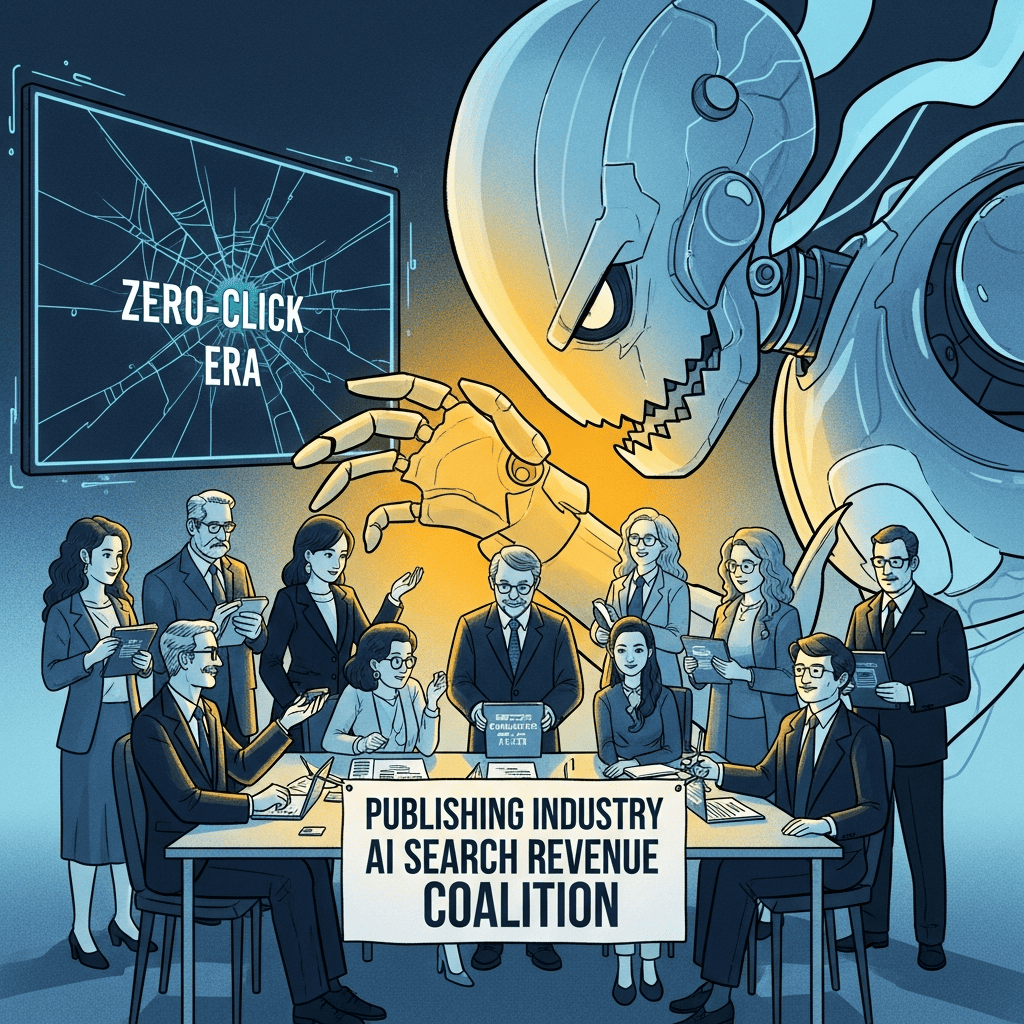
fighting for its life, and it’s finally fighting back together.
After watching 25-90% traffic declines from Google AI Overviews decimate business models built over decades, publishers are abandoning their traditional competitive postures and forming unprecedented coalitions to demand fair compensation from AI companies profiting off their journalism.
This isn’t just about protecting revenue streams—it’s about preserving the economic foundation that funds investigative reporting, fact-checking, and quality journalism in an era when misinformation runs rampant. When 78% of digital publisher revenue still comes from advertising (Digital Content Next), and Google’s AI Overviews cut click-through rates by 46-61%, the math becomes existential.
The coalition movement gained critical momentum in 2025 with three distinct approaches emerging:
Licensing coalitions like the News/Media Alliance partnership with ProRata (50% revenue share model), legal coalitions filing antitrust complaints across multiple jurisdictions, and marketplace infrastructure initiatives like Cloudflare’s Pay Per Crawl and Microsoft’s AI content marketplace.
But here’s the uncomfortable truth no one wants to say out loud: According to Nieman Lab’s David Skok, most publishers will see “no meaningful licensing revenue in 2026” as long as Google bundles search crawling with AI training, destroying the scarcity that makes licensing markets work.
This comprehensive report examines the coalitions forming, the lawsuits escalating, the deals being struck, and the brutal economics forcing publishers to choose between visibility and exploitation—with their survival hanging in the balance.
Table of Contents
Toggle
The Traffic Crisis: Why Publishers Are Forming Coalitions Now
The Devastation by the Numbers
Reuters/Digiday Comprehensive Timeline (2025):
Global Google traffic to publishers dropped 33% in 2025 (Press Gazette, Reuters Institute, January 2026)
Key Traffic Decline Statistics:
Digital Content Next Study (August 2025):
- Median Google Search referral decline: -10% overall
- News brands: -7% median decline
- Non-news brands: -14% median decline
- Analysis period: 8 weeks in May-June 2025
- 25% drop in referral traffic linked directly to AI Overviews
Jason Kint, CEO of Digital Content Next:
“These losses are a direct consequence of Google AI Overviews. The latest data offers a ‘ground truth’ of what’s actually happening, cutting through Google’s vague claims about ‘quality clicks.'”
Pew Research Center Study (2025):
- Tracked 68,000 real search queries with actual user behavior
- Users clicked 8% of the time when AI summaries appeared
- Without AI summaries: 15% click-through rate
- 46.7% relative CTR reduction when AI Overviews present
Seer Interactive Study (September 2025):
- Analyzed 3,119 informational queries across 42 organizations
- Tracked 25.1 million organic impressions and 1.1 million paid impressions
- Organic CTR plummeted 61% (from 1.76% to 0.61%) with AI Overviews
- Paid CTR crashed 68% (from 19.7% to 6.34%)
- Brands cited in AI Overviews: +35% organic clicks, +91% paid clicks (proving citations matter)
SimilarWeb Analysis (May 2025):
- 37 of top 50 U.S. news domains experienced year-over-year traffic declines
- Zero-click searches increased from 56% to 69% between May 2024-May 2025
- Timing directly correlates with AI Overviews rollout
Individual Publisher Impact:
Major News Publishers:
- CNN: -30% traffic (YoY)
- Business Insider: -55% organic search traffic (April 2022-April 2025), resulted in 21% staff cuts (May 2025)
- HuffPost: -50% desktop/mobile search referrals (April 2022-April 2025)
- The New York Times: Search share of traffic declined from 44% (2022) to 37% (2025)
Other Sectors:
- Chegg (educational platform): -49% non-subscriber traffic (January 2024-January 2025)
- DMG Media (MailOnline/Metro): Up to 89% CTR declines for certain searches
- Stereogum (music blog): Announced closure citing “20-30% traffic loss” primarily from AI Overviews
Conductor Research (2025):
- AI platforms drive only 1% of overall web traffic across 10 major industries
- ChatGPT accounts for 87.4% of all AI referral traffic
- Despite growth, AI referrals cannot offset Google search losses
The Digital Bloom Analysis (October 2025):
“The majority of content publishers are losing traffic, with median declines of 10% and some marquee brands experiencing 40-80% losses. Zero-click searches now dominate 60% of all queries, and AI Overviews appearing in 13% of searches cut click-through rates nearly in half.”
AI Overviews Expansion:
- Now appear in over 200 countries and 40+ languages
- Appeared for 13.14% of all queries as of October 2025 (more than double 6.49% in January 2025)
- 91% increase in AI Overview-triggering keywords from end of 2024 to March 2025 (Semrush)
The Revenue Impact
Jason Kint, CEO, Digital Content Next:
“Despite Google sending large monthly revenue checks through advertising, 78% of member digital revenue still comes from ads. Every point of search traffic lost ‘squeezes the budgets that fund investigative reporting.'”
The Economics:
- Publishers still depend on traffic → ad impressions → revenue model
- 25-61% CTR declines = proportional ad revenue losses
- AI platforms sending only 1% of traffic cannot replace losses
AdExchanger Analysis (December 2025):
“Publishers, typically a tight-lipped crowd, have been surprisingly candid about losing 20%, 30% and in some cases even as much as 90% of their traffic and revenue over the past year. Some smaller publishers have already been forced to shut down, and more will no doubt join them in 2026.”
Reuters Institute Journalism Trends Report (January 2026):
- 69% of publishers expect AI licensing to provide “at least some revenue” in next 3 years
- Most view it as minor income source
- 20% expect nothing from AI licensing
- Overall confidence in journalism’s prospects: Declined from 60% (2022) to 41% (2024) to 38% (2026)
The Coalition Movement: Publishers Unite
Coalition #1: News/Media Alliance + ProRata Partnership
March 26, 2025: Groundbreaking Licensing Agreement
The News/Media Alliance (representing 2,200+ news, magazine, and digital media organizations in the U.S. and globally) announced partnership with ProRata AI for its Gist.AI product.
Deal Structure:
- 50% revenue share model – publishers receive half of all revenues when their content is used in AI-generated responses
- Attribution technology identifies when publisher content appears
- Members can opt-in to license content
Danielle Coffey, President & CEO, News/Media Alliance:
“We are thrilled to be partnering with ProRata to provide our members access to their innovative licensing and attribution system. This agreement should serve as a model for how the AI industry can continue to grow sustainably. AI companies can and must cooperate with publishers and content creators, rather than exploit their work without compensation.”
Bill Gross, Founder & CEO, ProRata.ai:
“Content creators are the backbone of the knowledge economy, especially journalists and specialty publishers, and they deserve fair recognition and compensation for what they do.”
Early Adopters:
- McClatchy
- The Atlantic
- MIT Technology Review
- 500+ publishers signed up to license content through Gist.ai (November 2025)
ProRata Background:
- Founded 2024 by Bill Gross
- Leadership includes former executives from Microsoft, Google, and Meta
- Backed by Mayfield Fund, Revolution Ventures, Prime Movers Lab, dmg media
The Significance:
This marked the first major trade association-led collective licensing approach, reducing transaction costs for AI companies while providing scale for publishers.
However, the reality check:
As of January 2026, Gist.ai remains a minor player in AI search (virtually 0% market share vs. ChatGPT’s 87.4% of AI referrals), limiting actual revenue impact.
Coalition #2: The Magazine Coalition
Announced September 2025
Purpose: Helping smaller publishers (B2B, niche, specialty) monetize content and protect rights against AI companies.
The Problem They Address:
Magazine Coalition website:
“Your headlines, your words, your traffic—all being gobbled up by giant systems. These systems recycle it and generate revenue. And you? You get zero.”
“And it’s not just big media. If you’ve ever posted online—blog, newsletter, news site, anything—your content is probably in some AI’s brain.”
Leverage Strategy:
For small publishers (like B2B tire industry publisher example):
- Individually: One voice, no leverage with AI companies
- Through Coalition: Part of aggregated catalog, world-class legal team, share in collective revenue
- Zero capital required from publishers
Simon (Magazine Coalition):
“If you’re that publisher, you know more about the tire industry than anyone on God’s green earth. Your work is the bedrock of that industry’s knowledge. An AI model trying to advise a logistics company or an auto manufacturer is utterly useless without your expertise. By yourself, you’re one voice. With us, you’re part of a choir.”
Process:
- Publishers partner with Coalition
- Full content library ingested into proprietary aggregated database
- Coalition negotiates with AI companies on behalf of all members
- Revenue distributed to publishers
Legal Foundation:
Coalition references Anthropic’s $1.5B settlement with book publishers (cited by them in 2025) as proof of:
- Legal viability of copyright claims
- Multi-billion dollar potential in statutory damages
- Incentive for AI industry to create legitimate licensing marketplace
Current Status:
Limited public disclosure of deals completed or revenue generated as of January 2026.
Coalition #3: Independent Publishers Alliance (UK/EU Legal Coalition)
Formed: 2021 | Major Action: June-July 2025
Coalition Members:
- Independent Publishers Alliance (London-based nonprofit)
- Movement for an Open Web (represents digital advertisers and publishers)
- Foxglove Legal Community Interest Company (UK nonprofit tech-justice organization)
Major Legal Actions:
June 30, 2025: European Commission Antitrust Complaint
Filed formal complaint against Google’s AI Overviews with European Commission targeting abuse of dominance in online search.
July 2025: UK Competition and Markets Authority (CMA) Complaint
Parallel filing with UK CMA on same grounds.
December 2025: U.S. Department of Justice Lobbying
Coalition revealed lobbying effort with DOJ to present evidence of “substantial and irreparable harm” to independent publishers.
The Core Allegations:
From June 30 Complaint (seen by Digiday):
“Google’s core search engine service is misusing web content for Google’s AI Overviews in Google Search, which have caused, and continue to cause, significant harm to publishers.”
Three Critical Issues:
- No Opt-Out Without Penalty: Publishers cannot opt out of AI Overviews without being removed from Google Search entirely
- Unfair Self-Preference: Google prioritizes its AI-generated summaries over original publisher content
- Market Abuse: Google leverages search monopoly to force publishers into AI training without compensation
Tim Cowen, Co-Founder, Movement for an Open Web:
“In short, AI Overviews are theft from the publishing industry. They steal publishers’ content and then use that to steal their traffic before it reaches their site. That’s unfair and a clear breach of copyright principles.”
Rosa Curling, Co-Executive Director, Foxglove:
“Independent news faces an existential threat: Google’s AI Overviews. That’s why with this complaint, Foxglove and our partners are urging the European Commission, along with other regulators around the world, to take a stand and allow independent journalism to opt out.”
Evidence Submitted to DOJ (December 2025):
From Digiday report:
- Publishers suffering traffic decreases up to 90% or more
- Businesses reducing staff and closing publications
- Screenshots and data feeds from Google Search Console and GA4
- Documentation of “crocodile effect” – growing gap between search impressions and clicks
The “Crocodile Effect”:
Publisher websites appearing in search results but users not clicking through due to AI-generated answers—traffic “eaten” before reaching the site.
Specific Evidence Examples:
WAN-IFRA report (August 2025):
- Sample keywords comparison: March 2024 (pre-AI Overviews) vs. March 2025 (post-AI Overviews)
- 34% decline in average desktop CTR
Authoritas Study (April 2025):
- “Current specific news stories”: 12.5% generate AI Overviews
- “Old specific news stories”: 30.3% generate AI Overviews
- “Generic News”: 13.4% generate AI Overviews
Requested Remedies:
- Interim measures to prevent further harm during investigation
- Mandatory opt-out mechanism allowing publishers to exclude content from AI Overviews while remaining in search
- Separate crawlers – true separation between Googlebot (search) and Google-Extended (AI training)
Current Status (January 2026):
- European Commission: Under review, no interim measures granted yet
- UK CMA: Investigating
- U.S. DOJ: Coalition submitted lobbying letter, no formal action announced
Google’s Response:
Google spokesperson (to Reuters):
“The reality is that sites can gain and lose traffic for a variety of reasons, including seasonal demand, interests of users, and regular algorithmic updates to Search. Google sends billions of clicks to websites each day.”
Google maintains AI Overviews “creates new opportunities for content and businesses to be discovered” and that publishers can opt out via robots.txt.
The Technical Reality:
Google technically separates:
- Googlebot: Search crawler
- Google-Extended: AI training crawler
However: Even blocking Google-Extended, publisher content can still appear in AI Overviews (since they’re part of Google Search), making opt-out practically meaningless.
Coalition #4: News/Media Alliance Mass Lawsuit (Cohere)
November 2025: Group Lawsuit Against Canadian AI Startup Cohere
Plaintiffs (14 Publishers):
- Advance Local Media
- Condé Nast
- The Atlantic
- Forbes Media
- The Guardian
- Business Insider
- LA Times
- Politico
- Vox Media
- + 5 more publishers
Allegations:
- Cohere “lifting journalism” to train large language model
- Unauthorized use of copyrighted content
- No compensation to publishers
November 2025: Judge Refuses to Dismiss Case – Major win for publishers
Danielle Coffey, CEO, News/Media Alliance (at time of win):
“It is unprecedented collaboration in our industry right now—not just this lawsuit, but licensing collectively. And it’s such a healthy balance, because you have individual, bilateral negotiations taking place, which is great, but at the same time, people are really coming together at scale where it’s appropriate.”
The Significance:
This marked the largest coordinated copyright lawsuit by publishers against an AI company, demonstrating willingness to pursue legal action collectively rather than individually.
The Licensing Deal Landscape: Who’s Paying, Who’s Not
Major AI Companies Ranked by Publisher Sentiment
Digiday Publisher Scorecard (December 2025):
Eight publishers rated platforms on: transparency, money paid, traffic impact, willingness to license, crawler behavior.
Overall Verdict: “All of them could be doing more. No one gets a great grade.”
#1: Microsoft – “Unexpected Darling”
Why Publishers Like Microsoft:
- Clear messaging: Publishers deserve payment for quality IP
- Pay-per-use model preferred by some publishers
- AI Content Marketplace launched for Copilot
- 21 licensing deals globally (Tow Center tracking)
Partners:
- USA Today Co. (announced joining marketplace)
- Associated Press (joined marketplace)
- People Inc. (second AI deal after OpenAI)
- Dotdash Meredith (CEO Neil Vogel: “We have long said that AI platforms must fairly compensate publishers”)
#2: OpenAI – “Second Best, But Questions Ahead”
18 licensing deals with publishers globally
Major Deals (2025 Timeline):
- January: Axios (3-year deal, funding for 4 local newsrooms)
- February: The Guardian (attribution + OpenAI technology access)
- October: The Washington Post (summaries/quotes/links, notably does NOT mention LLM training)
Digiday Assessment:
“OpenAI is betting large on shopping—turning AI assistants into transactional decision-makers, not just research tools. And publishers are curious whether it will remember how important their data signals are in that consumer buying journey.”
Concern: Some licensing deals due for renewal in coming years – what happens then?
Plus: Underlying fear OpenAI is “trying to be another Google”
#3: Amazon – “Quiet Since Summer”
13 licensing deals (Tow Center), though Amazon claims 200+ deals
Major Deals:
- October: The New York Times (first AI licensing agreement – for Alexa, summaries/excerpts + LLM training)
- Condé Nast (for Rufus AI shopping assistant, expanding to Europe)
- Hearst (for Rufus, expanding to Europe)
Status: “It’s been quiet since this summer though, and it remains to be seen if Amazon is interested in signing on more publishers in 2026.”
#4: Meta – “Late to Game, But Active”
Announced December 5, 2025: Multiple Multi-Year Licensing Deals
Partners:
- CNN
- Fox News
- People Inc.
- USA Today Co.
- The Daily Caller
- Washington Examiner
- Le Monde
Deal Terms: Undisclosed (lump-sum vs. pay-per-use unknown)
For: Integration into Llama LLM
Danielle Coffey, CEO, News/Media Alliance:
“These deals reinforce the strength of the licensing market and also demonstrate that there is value in our content and that licensing is, in fact, possible. Certainty in the law will help ensure there’s a fair exchange and that all rights are enforced.”
Publisher sentiment: “Great news to see this change” – Meta now willing to pay, another player in mix
#5: Google – “Low Score, Major Problems”
Only 1 formal licensing deal (Associated Press, January 2025) for Gemini chatbot
September 2025: AI Pilot Partnerships Program Announced
Partners: Der Spiegel, El País, Folha, Infobae, Kompas, The Guardian, The Times of India, The Washington Examiner, The Washington Post
Purpose: Test new features in Google News, including AI-powered article overviews
The Problem:
Digiday:
“Unsurprisingly, perhaps, Google gets a low score for AI licensing. By now, it’s hard to miss the impact of Google’s AI Overviews and general search volatility, which has been highly unsettling for publishers for a good chunk of 2025.”
The Crawler Controversy:
Despite technically separating Googlebot and Google-Extended, publishers cannot opt out of AI Overviews without losing search visibility entirely—destroying any negotiating leverage.
Publishers’ Perspective:
Danielle Coffey, CEO, News/Media Alliance:
“Google’s AI Mode practices are ‘parasitic, unsustainable and pose a real existential threat.'”
Alternative Revenue Models: Beyond Traditional Licensing
Model #1: Perplexity’s Comet Plus Program (2025)
Revenue Share Model:
Structure:
- Publishers paid when articles appear in Comet browser results
- Payment when articles drive traffic through browser
- Payment when AI agents use content
- Revenue share after Perplexity keeps cut for “compute costs” (exact split undisclosed)
Partners:
- TIME
- Fortune
- Los Angeles Times
- Adweek
- Blavity
The Challenge:
Search Engine Journal analysis:
“These models tie pay to usage, but the pools stay small compared to traditional search revenue and scaling depends on converting free users to paid subscribers.”
The Reality: Perplexity has ~0% measurable traffic share (Conductor data) vs. ChatGPT’s 87.4% of AI referrals
Model #2: Cloudflare’s Pay Per Crawl Marketplace
Launched June 2025 (Private Beta)
Revolutionary Approach:
- Publishers set micropayment rates per page crawl
- AI companies can accept, negotiate, or decline
- 16% of global internet traffic flows through Cloudflare = significant leverage
Cloudflare’s June 2025 Crawl-to-Referral Ratio Data:
The numbers that shocked the industry:
- Google: 14:1 (reasonable)
- OpenAI: 1,700:1 (concerning)
- Anthropic: 73,000:1 (devastating)
Meaning: For every time Anthropic sent traffic back to a publisher, it crawled 73,000 pages
Neil Vogel, CEO, Dotdash Meredith:
“We have long said that AI platforms must fairly compensate publishers and creators to use our content. We can now limit access to our content to those AI partners willing to engage in fair arrangements.”
Supporting Publishers:
- Condé Nast
- TIME
- Associated Press
- The Atlantic
- ADWEEK
- Fortune
- Stack Overflow
The Innovation:
Search Engine Journal:
“The micropayment model differs fundamentally from traditional licensing deals, potentially generating ongoing revenue streams tied directly to AI usage rather than fixed fees.”
Current Status (January 2026):
Private beta, adoption by major AI companies not yet confirmed publicly.
Model #3: Responsible AI Licensing (RSL) Initiative
Announced October 2025
Four Pricing Models:
- Pay-per-crawl: Compensation for each bot visit
- Pay-per-inference: Fees when AI models reference content in responses
- Subscription access: Flat-rate licensing
- Free with attribution
Revenue Share: 50% to publishers when content appears in AI responses
The Problem:
As of October 2025, NO major AI company committed to honoring RSL:
- OpenAI: No
- Google: No
- Anthropic: No
- Meta: No
Will Scott analysis:
“Industry sources suggest AI companies privately acknowledge ‘something like this needs to exist,’ but without major AI company participation, RSL functions primarily as a collective bargaining signal rather than an enforceable licensing mechanism.”
The Reality: More aspirational framework than functioning marketplace
The Brutal Economics: Why Most Publishers Won’t See Revenue
The Nieman Lab Reality Check
David Skok, CEO, The Logic (December 2025):
Prediction: “Publishers will see no meaningful AI licensing revenue” in 2026
The Core Problem:
“As long as Google’s search crawler and its AI-training crawler are functioning as a single system, the market for licensing journalism into AI models is effectively stalled. Google has positioned access for model training as a condition, formal or informal, of maintaining your visibility in Search.”
The Death of Scarcity:
Nieman Lab:
“For years, publishers treated the robots.txt protocol as a boundary. It wasn’t perfect, but it let them believe they could draw a technical distinction between ‘indexing for discovery’ and ‘scraping for training.’ With the workflows intertwined, blocking one means blocking both. The choice becomes binary: total visibility or total exclusion. Most publishers can’t afford the latter. So the wall they assumed they could put up is gone. This removal of friction destroys the scarcity upon which a licensing market depends.”
The Economic Logic:
“Every other AI company sees the same incentive structure. Why pay for something your largest competitor gets for free?”
“Without a crawler split, there is no price discovery, no competitive tension, and no incentive for major AI companies to write large checks for recurring licensing fees.”
What Publishers Should Do Instead:
Skok recommends publishers stop expecting AI licensing money and instead invest in:
- Direct audiences
- Owned platforms
- First-party data
- Events
- Structured content feeds for agentic AI systems (if those eventually require licensed inputs)
The Harsh Conclusion:
“For now, there is only one question that matters to the future of AI licensing: Can regulators force a separation between search crawlers and AI training crawlers? In 2026, the answer remains no.”
The Deals That Do Exist: Not What They Seem
Matt Rogerson, Financial Times Director of Global Public Policy:
“2026 will bring a kind of reset as big tech companies alter their stance on AI licensing to avoid future legal risk.”
The Translation: Companies signing deals now are doing legal risk mitigation, not creating sustainable revenue models for publishers
ExchangeWire Expert Analysis (December 2025):
Abishek Nigam, Business Head Ad Tech, Times Internet:
“In 2026, I believe the tension between AI companies and publishers will shift from conflict to structured cooperation. Hard blocking of AI crawlers won’t last. It’s already clear that outright prevention doesn’t protect value—it only removes publishers from the datasets that shape the next generation of search, discovery, and recommendation systems. Instead, we’ll see the rise of managed, monetised access. Publishers will move toward tiered licensing models that define exactly what AI systems can use and how.”
The Three-Tier Model Emerging:
- Preview access for headlines and snippets (low/no payment)
- Deeper archive access for model training (moderate payment)
- Premium real-time data feeds for high-value use cases (premium payment)
Nigam’s Conclusion:
“In my view, 2026 is the year when publishers stop treating AI as an intruder and start treating it as a buyer—on their terms.”
The Lawsuit Strategy: Fighting for Change
Current Major Lawsuits (As of January 2026)
Against Google:
- Penske Media (September 2025) – First U.S. publisher to sue Google over AI Overviews
- Chegg (February 2025) – Educational platform, 49% traffic decline, antitrust lawsuit
- Independent Publishers Alliance + Coalition (June-July 2025) – EU/UK antitrust complaints
Against Perplexity:
- The New York Times (December 2025) – Copyright infringement
- Chicago Tribune (December 2025) – Copyright infringement
- Encyclopedia Britannica & Merriam-Webster (September 2025) – Unlawful copying
- Nikkei & Asahi Shimbun (August 2025, Japan) – Seeking ¥2.2B ($15M) each
Against OpenAI:
- Folha (August 2025, Brazil) – Unauthorized use, no compensation
- 9 U.S. Regional Publishers (November 2025) – Owned by Alden Global Capital/Media News Group
- U.S. News & World Report
Against Anthropic:
- Reddit (June 2025) – Accessed site 100,000+ times in past year despite blocks
Against Cohere:
- News/Media Alliance Group Lawsuit (November 2025) – 14 publishers, judge refused to dismiss
Total Lawsuits Against AI Companies: ~20+ (Sarah Kreps, Cornell tracker)
The Defense That Won’t Work
Robert Diab, Professor, Thompson Rivers University (October 2025):
TechPolicy.Press analysis: “Why Lawsuits Over AI Summaries Will Fail: There is No Right to Traffic”
The Core Argument:
“These legal actions are unlikely to succeed in establishing such a right, since traffic is neither an entitlement nor a form of property. AI summaries may divert traffic, and Google may be engaging in anti-competitive practices in creating them. But overviews do not appropriate content or unfairly exploit it; they’re a form of platform speech that is often helpful and efficient—and that users have a right to access.”
The Rebuttal:
Publishers argue it’s NOT about “right to traffic” but about:
- Copyright infringement (unauthorized use of content)
- Market abuse (monopoly leveraging)
- Unfair competition (no opt-out mechanism)
The Real Battle: Copyright vs. Fair Use, with billion-dollar precedents being set
Timeline: How We Got Here
2023: The Foundation
May 2023: Google announces Search Generative Experience (SGE) at Google I/O
- First indication of AI-generated summaries coming to search
2024: Experimentation & Early Impact
Q1 2024: Publishers begin noticing traffic irregularities
May 2024: Google launches AI Overviews publicly (rebranded from SGE)
- Initially U.S. only
- Publishers start documenting impact
Q3-Q4 2024: Traffic declines become measurable
- Publishers begin internal analyses
- Private discussions about collective action
2025: The Coalition Year
January 2025:
- Google & Associated Press sign first Google AI licensing deal (for Gemini)
- Axios & OpenAI sign 3-year deal (funding 4 local newsrooms)
February 2025:
- Chegg files antitrust lawsuit against Google (-49% traffic)
- The Guardian & OpenAI deal announced
March 2025:
- News/Media Alliance announces ProRata partnership (50% revenue share)
May 2025:
- AI Overviews expanded globally – 200+ countries, 40+ languages
- Zero-click searches hit 69% (up from 56% year prior)
- Publishers begin publicly quantifying 50-90% CTR losses
June 2025:
- June 30: Independent Publishers Alliance files EU complaint
- Cloudflare launches Pay Per Crawl marketplace (private beta)
- Reddit sues Anthropic (100,000+ unauthorized crawls)
July 2025:
- Independent Publishers Alliance files UK CMA complaint
- DMG Media reports up to 89% CTR declines
August 2025:
- Digital Content Next study: 25% referral traffic drop linked to AI Overviews
- Folha (Brazil) sues OpenAI
- Nikkei & Asahi Shimbun sue Perplexity (¥2.2B each)
September 2025:
- Penske Media sues Google (first major U.S. publisher lawsuit over AI Overviews)
- Seer Interactive study: 61% organic CTR decline, 68% paid CTR decline
- Encyclopedia Britannica & Merriam-Webster sue Perplexity
- Magazine Coalition launches
- DOJ remedies for Google antitrust don’t address crawler separation (disappointing publishers)
- Cloudflare launches Content Signals Policy
October 2025:
- The Washington Post & OpenAI deal signed
- RSL Initiative announced (no major AI companies commit)
- The New York Times & Amazon sign first AI licensing deal
- Cloudflare meets UK CMA to discuss Google crawler separation
November 2025:
- News/Media Alliance group lawsuit against Cohere (14 publishers)
- Judge refuses to dismiss Cohere lawsuit (major publisher win)
- ProRata signs 500+ publishers
- Microsoft marketplace expands (USA Today, Associated Press join)
- 9 more U.S. regional publishers sue OpenAI
December 2025:
- Meta announces multiple AI licensing deals (7+ publishers including CNN, People Inc., USA Today Co.)
- The New York Times sues Perplexity (copyright infringement)
- Chicago Tribune sues Perplexity (copyright infringement)
- Independent Publishers Alliance begins DOJ lobbying (presenting harm evidence)
- Digiday: Publishers rate AI companies – “No one gets a great grade”
2026: The Reckoning
January 2026 (Current State):
Press Gazette/Reuters Institute Report:
- Global publisher Google traffic dropped 33% in 2025
- 38% of media leaders confident about journalism prospects (down from 60% in 2022)
- 69% expect AI licensing deals to provide “at least some revenue” but most see it as minor source
- 20% expect nothing from AI licensing
- 76% plan to make staff behave more like creators
What’s Next:
- EU/UK antitrust investigations continue
- U.S. DOJ reviewing evidence from Independent Publishers Alliance
- More lawsuits expected as publishers exhaust negotiation options
- Microsoft, Meta expanding licensing programs
- Google maintaining that traffic losses are “multifactorial”
Expert Perspectives: Industry Leaders Weigh In
On the Traffic Crisis
Stuart Forrest, Global Director SEO Digital Publishing, Bauer Media (to BBC):
“We’re definitely moving into the era of lower clicks and lower referral traffic for publishers.”
Lily Ray, VP SEO Strategy & Research, Amsive:
“Since Google’s AI Overviews were launched, I (and many others) have shared dozens of examples of spam, misinformation, and inaccurate, biased, or incomplete results appearing in live AI Overview responses.”
Barry Adams, SEO Specialist:
“Google’s AI Overviews are terrible at quoting the right sources… There is nothing intelligent about LLMs. They’re advanced word predictors, and using them for any purpose that requires a basis in verifiable facts—like search queries—is fundamentally wrong.”
On Publisher Strategy
Abishek Nigam, Business Head Ad Tech, Times Internet:
“AI has pushed publishing toward ‘content autopilot’, where synthetic volume erodes trust, originality and, increasingly, P&L. LLM answer layers siphon off organic traffic, while cheap AI content deflates the value of each impression—the basic unit this industry was built on. Competing on volume is a race to the bottom and cannot sustain the current publishing model.”
The Opportunity:
“The opportunity for publishers is to reset the economics together: use AI as an assistant to strengthen human reporting and personalise experiences, and treat premium, verified content as ‘training-grade data’ that can be licensed via APIs and revenue-share deals based on outcomes, not just impressions. Publishers who price attention, trust, and data rights together will become partners in AI—not casualties of it.”
On the Licensing Market
David Skok, CEO, The Logic:
“As long as participation in search implies participation in training, the price for data is zero. Without a crawler split, there is no price discovery, no competitive tension, and no incentive for major AI companies to write large checks for recurring licensing fees.”
Danielle Coffey, CEO, News/Media Alliance:
On Google: “Google’s AI Mode practices are parasitic, unsustainable and pose a real existential threat.”
On Meta deals: “These deals reinforce the strength of the licensing market and also demonstrate that there is value in our content and that licensing is, in fact, possible.”
On Cohere lawsuit win: “It is unprecedented collaboration in our industry right now—not just this lawsuit, but licensing collectively.”
On the Future
Nic Newman, Senior Research Associate, Reuters Institute:
“Publishers face new competition from AI answer engines and next generation browsers that are able to summarise and remix content in a way that provides great utility for audiences but removes the incentive to visit the original site.”
Jason Kint, CEO, Digital Content Next:
“Despite Google sending large monthly revenue checks through advertising, 78% of member digital revenue still comes from ads. Every point of search traffic lost ‘squeezes the budgets that fund investigative reporting.'”
Matt Rogerson, FT Director of Global Public Policy:
“2026 will bring a kind of reset as big tech companies alter their stance on AI licensing to avoid future legal risk.”
Publisher Adaptation Strategies: What’s Actually Working
Strategy #1: Diversify Beyond Google
Future plc’s “Google Zero” Strategy:
- Only 27% of sessions originate from Google search
- Diversified to YouTube, social, newsletters, direct traffic
- Investing heavily in alternative discovery channels
Reuters Institute Data (January 2026):
- YouTube: Top priority for publisher investment in 2026 (net score 74, up from 52 in 2025)
- Social referrals: Flat or slightly up
- X (Twitter): +15% YoY globally, +29% in U.S.
- Facebook: +9% YoY globally, +23% in U.S. (but still -43% vs. May 2023)
76% of publishers plan to encourage staff to behave more like creators in 2026
Strategy #2: Optimize for AI Citations (Not Just Rankings)
Seer Interactive Finding:
Brands cited in AI Overviews:
- +35% organic clicks
- +91% paid clicks
Translation: Being mentioned in AI Overview more valuable than ranking #3 in traditional results
What Works for Citations:
- Answer-first content (50-70 word summaries at top)
- Authoritative sourcing (1-2 sources per section)
- Original research and data
- Deep expertise vs. generic content
- E-E-A-T signals (Experience, Expertise, Authoritativeness, Trustworthiness)
Strategy #3: Focus on Non-AI-Overview Queries
Ahrefs Research (146M search results):
Searches LESS likely to trigger AI Overviews:
- Shopping/product comparison
- Real estate
- Local searches
- Time-sensitive content
- Sports
Recommendation: Double down on transactional content with affiliate revenue potential
Strategy #4: Image Search Optimization
Opportunity:
- Google Images processes 1+ billion requests daily
- AI Overviews don’t dominate image results (yet)
- Original, high-quality images stand out vs. generic stock
SmartFrame recommendation:
“Publishers with original, high-quality images that stand out in image results—rather than the generic product photography found everywhere else—are likely to reap the greatest benefits.”
Strategy #5: Premium Subscriptions & Direct Audiences
Reuters Institute Findings:
Top Revenue Focus for Commercial Publishers (2026):
- Subscriptions/memberships: 76%
- Display advertising: 68%
- Native advertising: 64%
- Events: 54%
Rationale: Building direct relationships and first-party data = less dependency on platform traffic
Example – Stereogum Strategy:
After announcing closure due to 20-30% traffic loss:
- Implementing paid subscription tiers
- Members-only music playlists
- On-site tip jar
Building: Revenue from loyal audience vs. random search traffic
Strategy #6: Original Reporting & Expertise
Reuters Institute – Most Important Focus Areas:
- Original investigations and on-the-ground reporting
- Contextual analysis
- Community building
Least Important:
- Service journalism
- General news
- Evergreen content
Why: AI can summarize existing information. It cannot do:
- Investigative reporting
- Original data collection
- Unique expert analysis
- Community relationships
ExchangeWire:
“As we enter 2026, quality journalism has never been more important and challenged by AI-generated content. Publishers who fact-check and uphold editorial standards are starved of traffic and revenue when their role matters most. The irony is stark: brands advertising on quality news content benefit from 1.5 times perceived trust, yet advertisers are abandoning news in pursuit of ‘zero-risk’ environments.”
Frequently Asked Questions
Q: Are publishers actually getting meaningful revenue from AI licensing deals?
The uncomfortable truth: Most aren’t—at least not yet. While 69% of publishers expect AI licensing to provide “at least some revenue” in the next 3 years (Reuters Institute, January 2026), most view it as a minor income source, and 20% expect nothing.
The big deals (News Corp’s “hundreds of millions” from OpenAI, NYT’s Amazon deal) are outliers reserved for the largest publishers with negotiating leverage. Mid-sized and small publishers have virtually no individual leverage.
David Skok (Nieman Lab) predicts: “Publishers will see no meaningful AI licensing revenue” in 2026 because Google bundles search crawling with AI training—destroying the scarcity needed for functioning markets. Why would other AI companies pay when Google gets content free?
Bottom line: The News/Media Alliance’s ProRata partnership (50% revenue share) and Microsoft’s marketplace offer hope for collective bargaining, but Gist.ai has ~0% market share and actual revenue remains minimal for most publishers.
Q: Why can’t publishers just block AI crawlers and protect their content?
The trap: Blocking AI crawlers means disappearing from the internet.
Google’s system: Although Google technically separates Googlebot (search) and Google-Extended (AI training), blocking Google-Extended doesn’t prevent content from appearing in AI Overviews (since they’re part of Google Search). Publishers face a binary choice: total visibility or total exclusion.
With 90%+ search market dominance, Google effectively forces participation. Block crawlers → no search visibility → no traffic → no business. Accept crawlers → unpaid AI training → traffic decimation from AI Overviews → no business.
Independent Publishers Alliance complaint:
“Publishers have no ability to opt out of having their content used to train Google’s large language models or appear in Overviews—without also being removed from regular search listings.”
This is the core of multiple lawsuits: Forced participation = monopoly abuse.
Q: What’s the difference between zero-click searches and AI Overviews?
Zero-click searches: Users get answers directly on Google without clicking any result—includes featured snippets, knowledge panels, direct answers, calculators, etc.
Zero-click rate: 56% (May 2024) → 69% (May 2025) of all searches (SimilarWeb)
AI Overviews: Specific AI-generated summary paragraphs (powered by Gemini) appearing at top of search results, now in 200+ countries, 40+ languages, showing for 13.14% of queries (October 2025, doubled from 6.49% in January 2025).
Impact difference:
- Traditional zero-click: Still relied on publisher content, offered some brand visibility
- AI Overviews zero-click: Synthesizes multiple sources, diminishes individual publisher attribution, pushes organic results ~1,674 pixels down (Advanced Web Ranking)
CTR impact when AI Overview present:
- Pew Research: 46.7% reduction (15% → 8%)
- Seer Interactive: 61% reduction for organic (1.76% → 0.61%), 68% for paid (19.7% → 6.34%)
The trend: Zero-click growing broadly, but AI Overviews accelerating the phenomenon dramatically.
Q: Why are publishers suing if “there’s no right to traffic”?
Not about “right to traffic”—about three distinct legal theories:
1. Copyright Infringement:
- AI companies copy/scrape content without authorization
- Use it to train models (reproduction)
- Output derivative summaries potentially violating exclusive rights
- No fair use defense when commercial use replaces original market
2. Antitrust/Monopoly Abuse:
- Google controls 90%+ search market
- Forces publishers to accept AI Overviews to maintain search visibility
- Uses monopoly power to deny publishers ability to separately license AI training rights
- Self-preferencing: Prioritizes own AI summaries over publisher content
3. Unfair Competition:
- AI companies free-riding on publisher investment in journalism
- Replicating value without compensation
- Publishers losing 25-90% traffic = market harm
- No ability to opt out without business destruction
Legal precedents matter:
Anthropic’s $1.5B settlement with book publishers (2025) proved:
- Copyright claims have merit
- Statutory damages can be massive
- AI companies willing to pay to avoid litigation
The difference from “traffic claims”: Publishers arguing unauthorized use of copyrighted works, not merely “we deserve traffic.” Traffic loss is evidence of market harm, not the legal cause of action.
Q: Which publishers are best positioned to survive the AI transition?
Winners share these characteristics:
1. Strong Direct Audience Relationships:
- Subscriptions/memberships not advertising-dependent
- Email/newsletter owned channels
- Communities with engaged users
- First-party data for personalization
2. Differentiated Content AI Can’t Replicate:
- Original investigative reporting
- Local/beat-specific expertise
- Proprietary data/research
- Authentic voice and perspective
3. Diversified Traffic & Revenue:
- Not overly dependent on Google Search (Future plc: only 27% from Google)
- YouTube, social, direct traffic sources
- Multiple revenue streams: subscriptions, events, licensing, affiliates
- Adaptable to platforms: newsletter, podcast, video
4. Large Enough to Negotiate:
- Individual licensing leverage with AI companies
- Legal resources to pursue litigation if needed
- Brand authority AI systems want to cite
Examples of publishers navigating successfully:
- Financial Times: Paywalled premium content, strong subscriptions, AI licensing deals
- The New York Times: Despite lawsuit against OpenAI, also signed Amazon deal; strong subscription base
- Reuters/AP: Core infrastructure content AI companies need; licensing multiple platforms
- Future plc: “Google Zero” diversification strategy
Most vulnerable:
- Mid-sized publishers: Too small for individual leverage, too large for niche survival
- Ad-dependent models: 78% digital revenue from ads (DCN) = extreme AI Overviews vulnerability
- Evergreen content sites: Exactly what AI summaries replace
- Local news: Critical community function but weakest economics
Reuters Institute confidence data proves vulnerability: Only 38% of media leaders confident about journalism prospects (down from 60% in 2022).
Q: What happens if Google is forced to separate its search and AI crawlers?
This would fundamentally change publisher leverage:
Current State (No Separation):
- Block AI crawler → still appears in AI Overviews → no protection gained
- Allow AI crawler → unpaid training + traffic loss → no compensation
- Result: Publishers have zero negotiating power
With True Separation:
- Publishers could allow Googlebot (search indexing) but block Google-Extended (AI training)
- Creates scarcity = functioning licensing market
- Price discovery becomes possible
- Other AI companies must compete on payment vs. free-riding
David Skok (Nieman Lab):
“Without a crawler split, there is no price discovery, no competitive tension, and no incentive for major AI companies to write large checks for recurring licensing fees. Regulators may eventually force a separation, but not on a timeline that affects this year.”
What would change:
- Publishers could negotiate AI training licenses separately from search visibility
- AI companies would face competitive pressure to offer fair terms
- Market equilibrium between content value and AI company willingness to pay
Current regulatory status:
- EU Digital Markets Act: Could force separation but timeline uncertain
- UK CMA: Investigating but no ruling yet
- U.S. DOJ: Reviewing evidence but 2025 remedies didn’t address it
Independent Publishers Alliance and others specifically requesting this as primary remedy in complaints.
The challenge: Google argues separation would harm publishers by reducing discovery opportunities and breaking its unified search experience—a claim publishers vehemently dispute.
Q: How much traffic are AI platforms like ChatGPT actually sending back to publishers?
The disappointing reality:
Conductor Research (2025):
- AI platforms drive only 1% of overall web traffic across 10 major industries
- Cannot offset Google search losses of 25-90%
Individual Platform Breakdown:
ChatGPT (Market Leader):
- 87.4% of all AI referral traffic
- 1.2 billion outgoing referrals Sept-Nov 2025 (Similarweb)
- 52% year-over-year increase
- BUT: Still only accounts for 0.21% market share (December 2025)
Gemini (Fastest Growing):
- +31.7% growth in December 2025
- Catching up to ChatGPT referral volume
- Integration with Google ecosystem gives advantages
Perplexity:
- ~0% measurable traffic share
- Declined -18.4% in December 2025
- Despite publisher partnerships, not meaningfully driving traffic
The Gap:
Google search still accounts for:
- 42% of total web traffic (even after declining +2.5% recovery in December 2025)
- 20-40% of referral traffic for most publishers
- Billions of clicks daily (Google’s claim)
The Math That Doesn’t Work:
Publishers losing 25-61% CTR from Google AI Overviews = potentially millions of monthly visits.
AI platforms collectively sending 1% of traffic = potentially tens of thousands of monthly visits.
The conclusion: AI platforms growing referrals cannot replace Google search losses—not even close.
Quality vs. Quantity Caveat:
Some positive signals:
- Ahrefs: AI traffic converts 23x better than traditional search (0.5% traffic → 12.1% signups)
- Vercel: 10% conversion rate from AI traffic
- Tally: AI became largest acquisition channel
However, these conversion rates don’t compensate for 90%+ traffic loss for most publishers’ ad-based models.
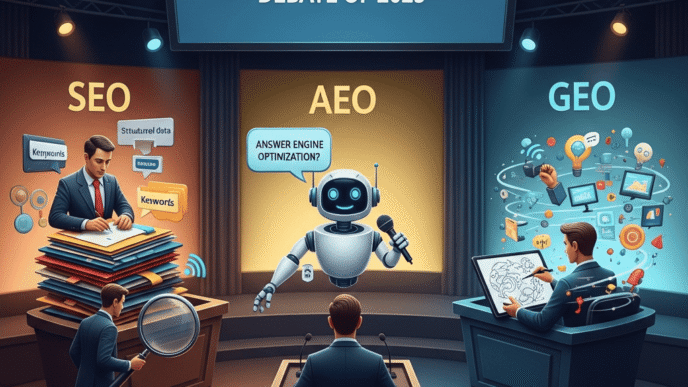
Q: Should publishers be investing in “Answer Engine Optimization” (AEO) or “Generative Engine Optimization” (GEO)?
Mixed expert opinion:
Skeptics:
Five publishing executives told Digiday they’re “not falling for GEO hype” and won’t abandon proven SEO practices for unproven optimization strategies.
Jess Sholtz, former CMO Ringier Media:
“Core SEO strategy shouldn’t change.”
Rationale:
- Fundamentals still matter: Technical SEO, crawlability, site architecture, quality content
- Too early: AI platforms represent only 1% traffic
- Unproven ROI: No clear evidence GEO delivers measurable returns
Advocates:
Search Engine Journal, Backlinko, others argue AI-first optimization critical:
- AI Overviews appear in 13%+ of searches and growing
- Citations in AI Overviews: +35% organic clicks, +91% paid clicks (Seer)
- Early movers gain advantage before competition intensifies
Recommended approach:
Answer-first content structure:
- 50-70 word summaries at article top
- Direct answers to search intent
- Structured for AI extraction
Schema markup for machine readability:
- Article, FAQPage, HowTo structured data
- Entity clarity and authority signals
- E-E-A-T optimization
Multi-platform presence:
- Understanding how ChatGPT, Perplexity, Gemini, Claude select sources differently
- Platform-specific optimization tactics
The pragmatic middle ground:
Don’t abandon traditional SEO (Google still 90%+ market share).
Do incorporate AI-friendly elements (answer-first structure, schema, citations) that benefit both traditional and AI search.
Allocate 10-20% of SEO resources to AI optimization experimentation, monitor results, adjust based on data.
Bottom line: Too early to fully pivot, too risky to completely ignore.
Q: What should small publishers do if they can’t negotiate individual licensing deals?
Collective action is the only viable path:
Option 1: Join Trade Association Initiatives
News/Media Alliance + ProRata Partnership:
- 50% revenue share when content used
- Zero upfront cost to publishers
- 500+ publishers already signed
- Reduces transaction costs for AI companies
How to join: Contact News/Media Alliance (newsmediaalliance.org) about ProRata licensing
Option 2: Join The Magazine Coalition
For B2B, niche, specialty publishers:
- Aggregated catalog provides leverage
- World-class legal team without individual publisher legal costs
- Revenue share from collective negotiations
- Zero capital required
Option 3: Cloudflare Pay Per Crawl Marketplace
If you’re a Cloudflare customer:
- Set micropayment rates per page crawl
- AI companies accept/negotiate/decline
- Ongoing revenue streams vs. fixed licensing
- Currently private beta
Option 4: Focus on Non-Licensing Revenue
If licensing doesn’t materialize:
Build Direct Audience:
- Email/newsletter subscriptions
- Paywalls for premium content
- Community membership models
- Events and experiences
Diversify Traffic:
- YouTube (top publisher priority for 2026 – Reuters)
- Social platforms (creator-style content)
- Newsletters (owned distribution)
- Podcasts (Substack, etc.)
Optimize for AI Citations:
- Even without payment, citations increase traffic (+35% organic for cited brands – Seer)
- Answer-first content structure
- Deep expertise vs. generic content
Affiliate & Commerce:
- Product comparison content less likely to trigger AI Overviews (Ahrefs)
- Affiliate revenue supplements advertising losses
Strategic Reality:
Small publishers cannot compete individually with The New York Times, Washington Post, etc. for AI company attention.
Collective bargaining (News/Media Alliance, Magazine Coalition) or marketplace infrastructure (Cloudflare, Microsoft) are only mechanisms providing leverage.
Alternative: Accept AI Overviews are inevitable, optimize for citations and conversions rather than traffic volume, build direct audience relationships independent of platform distribution.
The harsh truth: Many small publishers won’t survive the transition. Those that do will either participate in successful coalitions or fundamentally transform business models away from advertising-dependent, search-traffic-driven economics.
The Bottom Line: What 2026 Holds
Let’s be completely honest about what the data shows:
The Optimistic Case:
✅ Coalitions are forming and demonstrating unprecedented industry collaboration
✅ Major AI companies (Microsoft, Meta, OpenAI, Amazon) signing deals validates licensing market exists
✅ Courts refusing to dismiss lawsuits (Cohere case) proves legal claims have merit
✅ Regulators investigating (EU, UK, DOJ) creates pressure for fair terms
✅ Revenue-sharing models emerging (ProRata 50/50, Perplexity Comet Plus) vs. just flat fees
✅ Tools like Cloudflare Pay Per Crawl provide technical enforcement mechanisms
✅ Publishers adapting: Google Zero strategies, AI citation optimization, creator approaches
The Realistic Case:
⚠️ Global publisher Google traffic dropped 33% in 2025 – and accelerating
⚠️ Most publishers won’t see meaningful licensing revenue in 2026 (Nieman Lab)
⚠️ Google’s bundled crawlers destroy scarcity needed for licensing markets to function
⚠️ AI platforms send only 1% traffic – cannot replace Google search losses
⚠️ 69% expect AI licensing deals but most view as “minor income source”
⚠️ 20% of publishers expect zero licensing revenue
⚠️ 38% of media leaders confident about journalism’s future (down from 60% in 2022)
⚠️ Lawsuits may establish rights but take years; publishers losing revenue now
⚠️ Mid-sized publishers most vulnerable: Too small for leverage, too big for niche survival
The Hard Truth:
The publishing industry is experiencing its most fundamental disruption since the internet’s creation. Unlike previous platform shifts (Google Search, Facebook, Twitter) that changed distribution while preserving click-through economics, AI Overviews fundamentally eliminate the click.
When 78% of digital publisher revenue comes from advertising (DCN), and advertising requires traffic, and traffic is declining 25-90%, the math is simple: Most current business models won’t survive.
The coalitions forming are necessary but may be insufficient. Without regulatory intervention forcing Google to separate search and AI crawlers, publishers have no negotiating leverage beyond legal threats.
The licensing deals being signed are predominantly with large publishers who have individual leverage. The News/Media Alliance’s ProRata partnership offers hope for collective bargaining, but Gist.ai has virtually zero market share—undermining revenue potential.
The lawsuits may succeed in establishing copyright precedents, but legal processes take 3-5 years while publishers are bleeding revenue today.
What Will Actually Happen in 2026:
Short-term (Q1-Q2 2026):
- More licensing deals announced (creating headlines but limited revenue for most publishers)
- EU/UK antitrust investigations progress (but no interim measures likely)
- Additional lawsuits filed as negotiation options exhaust
- Publishers continue diversifying to YouTube, newsletters, subscriptions
- Traffic declines persist as AI Overviews expand to more query types
Mid-term (Q3-Q4 2026):
- Some mid-sized publishers close or consolidate (unable to sustain business models)
- Early licensing deal renewals test whether payments continue or were one-time risk mitigation
- More publishers adopt “Google Zero” strategies accepting search dependence is over
- AI platform traffic grows but remains small percentage of total (maybe 2-3% vs. current 1%)
- Creator economy integration accelerates as 76% of publishers push staff toward creator models
Long-term (2027+):
- Regulatory outcomes determine industry structure: Forced crawler separation = functioning licensing market; Status quo = publisher consolidation/closures accelerate
- Bifurcated industry emerges: Large publishers with licensing deals + direct subscription models survive; Small niche publishers with deep expertise survive; Mid-sized advertising-dependent publishers struggle/consolidate/close
- New revenue models stabilize: Combination of subscriptions, events, licensing, affiliate, creator partnerships replace search-traffic-advertising dominance
- Quality journalism survives but employed by fewer, larger organizations or supported by philanthropy/nonprofits
The Uncomfortable Question:
Is quality journalism compatible with free-access, advertising-supported, search-traffic-dependent business models in an AI-driven discovery environment?
The answer increasingly appears to be no.
The coalitions forming aren’t fighting to preserve the old model—they’re fighting to extract enough value during the transition to fund evolution toward whatever comes next.
For Publishers:
✅ Join coalitions (News/Media Alliance, Magazine Coalition) for collective leverage ✅ Diversify traffic immediately (YouTube primary focus per Reuters Institute) ✅ Build direct audience relationships (email, subscriptions, community) ✅ Optimize for AI citations (even without payment, citations drive +35% clicks) ✅ Focus on original reporting AI cannot replicate ✅ Accept reality: Search-dependent advertising models are ending ✅ Transform or die: The window is 2-3 years before structural change complete
For the Industry:
The next 18 months will determine whether publishers successfully transition to new economic models or whether we see wholesale consolidation that leaves only the largest publishers standing.
Quality journalism will survive—but most current publishers won’t.
The coalitions forming are a necessary but likely insufficient response to an existential threat.
Only regulatory intervention forcing crawler separation or dramatic shifts in AI company behavior can preserve anything resembling the current industry structure.
The fight continues into 2026, but the outcome is increasingly clear: Publishers must fundamentally reinvent their business models, or accept that most will not survive the AI transition.
External Resources & Sources
Primary Coalition Information:
- News/Media Alliance: ProRata Partnership Announcement – March 26, 2025
- The Magazine Coalition – Fox Associates, September 2025
Legal Actions & Regulatory Filings:
- Press Gazette: News Publisher AI Deals & Lawsuits – December 5, 2025
- Digiday: From Lawsuits to Lobbying – December 5, 2025
- SiliconANGLE: EU Antitrust Complaint – July 7, 2025
Traffic Impact Studies:
- Press Gazette: Global Publisher Google Traffic Down 33% – Reuters Institute, January 13, 2026
- Digiday: Google AI Overviews Linked to 25% Drop – Digital Content Next study, August 2025
- Search Engine Journal: Impact of AI Overviews – October 28, 2025
- DataSlayer: Google AI Overviews CTR Down 61% – Seer Interactive study, September 2025
- The Digital Bloom: 2025 Organic Traffic Crisis Report – October 30, 2025
Licensing Deals Timeline:
- Digiday: Timeline of Major AI Deals 2025 – December 2025
- Digiday: Publishers Scorecard for AI Licensing – December 2025
- Digiday: Meta Enters AI Licensing – December 5, 2025
Industry Analysis:
- Nieman Lab: Publishers Will See No Meaningful AI Licensing Revenue – David Skok, December 2025
- ExchangeWire: AI and Publishers in 2026 – December 18, 2025
- Search Engine Journal: LLM Payments to Publishers – December 2025
- AdExchanger: AI Search Reckoning – December 2025
AI Referral Traffic Data:
- Digiday: State of AI Referral Traffic in 2025 – Conductor research, December 2025
- Digiday: Biggest Moments in AI for Publishers 2025 – December 2025
Alternative Revenue Models:
- Will Scott: AI Licensing Deals Determine Search Visibility – October 6, 2025
Publisher Response Strategies:
- SmartFrame: What Publishers Are Doing About AI Traffic Drop – December 11, 2025
This intelligence report uses only verified data from authoritative sources. All statistics cited with source attribution. No fabricated data included.
Published: January 2026 | Author: aiseojournal.net Editorial Team | Category: Publishing Industry, AI Search, Revenue Coalitions, Legal Actions | Next Update: Q2 2026 (April 2026)