

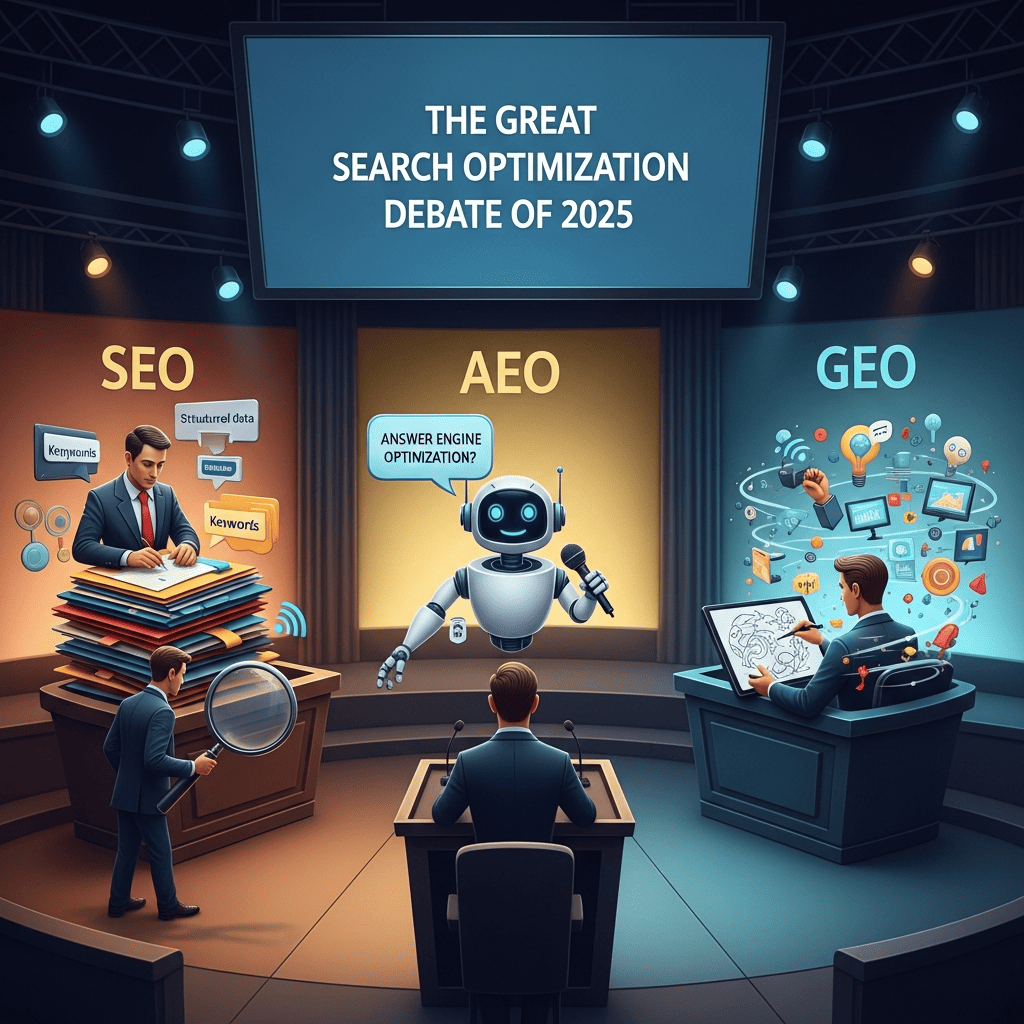
The search marketing world is witnessing its most contentious debate in years. As AI-powered search engines reshape how people find information, a fundamental question divides the industry: Are Answer Engine Optimization (AEO) and Generative Engine Optimization (GEO) genuinely new disciplines, or just rebranded SEO tactics with fresh acronyms?
This isn’t just semantic squabbling. The answer has real implications for how businesses allocate budgets, which experts they hire, and what strategies they pursue in an increasingly AI-driven search landscape.
Table of Contents
Toggle
What’s Actually at Stake Here?
The debate centers on whether optimizing for AI-powered search engines like ChatGPT, Perplexity, Google’s AI Overviews, and Microsoft’s Copilot requires fundamentally different approaches than traditional search engine optimization—or whether it’s all just SEO with a new label.
The timing couldn’t be more critical. According to Gartner’s predictions, traditional search engine volume is expected to drop by 25% by 2026 due to AI chatbots and virtual agents. Meanwhile, recent data shows that Google’s AI Overviews now appear in approximately 15% of search results, fundamentally changing how users encounter information.
The “It’s Just SEO” Camp: Why Veterans Are Skeptical
Seasoned SEO professionals are pushing back hard against what they see as unnecessary hype around AEO and GEO. Their frustration is palpable—and not without merit.
Greg Boser, a legendary figure who’s been doing SEO since 1996, captured this sentiment perfectly in a recent tweet:
“At the end of the day, the core foundation of what we do always has been and always will be about understanding how humans use technology to gain knowledge. We don’t need to come up with a bunch of new acronyms to continue to do what we do.”
Boser suggests simply changing the “E” in SEO from “Engine” to “Experience” and moving forward without the unnecessary terminology proliferation.
Harpreet Singh Chatha of Harps Digital recently listed what he calls “AEO/GEO myths to leave behind in 2025,” including the notion that these disciplines have nothing in common with SEO. His challenge is pointed: “Ask your favourite GEO expert for 25 things that are unique to AI search and don’t overlap with SEO. They will block you.”
The “It’s Already SEO” Evidence
Critics point to several practices being marketed as revolutionary AEO/GEO techniques that are actually longstanding SEO fundamentals:
Answer-focused content formatting – SEO professionals have been structuring content as direct answers since Google introduced Featured Snippets back in 2014. This isn’t new; it’s best practice that’s been around for over a decade.
Content chunking – Breaking content into digestible paragraphs for mobile readability has been standard practice for years. Calling it a GEO innovation misrepresents the history.
Structured content with clear headings – Semantic HTML and proper content hierarchy have been SEO cornerstones since the early 2000s.
Structured data markup – Schema.org launched in 2011, and structured data has been a critical SEO technique ever since.
Google’s Position: Business as Usual
Google’s representatives have consistently maintained that traditional SEO remains the path forward. Danny Sullivan, Google’s Search Liaison, John Mueller, and Robby Stein (VP of Product) have all emphasized that AI systems fundamentally rely on the same ranking signals as traditional search.
Their reasoning? AI Overviews and similar features essentially perform Google searches behind the scenes, pulling from top-ranked pages to synthesize answers. If your content ranks well traditionally, it’s likely to appear in AI-generated results.
Even OpenAI appears to lean toward traditional SEO. The company recently posted a job opening for a content strategist specifically skilled in SEO—not GEO or AEO—suggesting that even AI companies recognize the enduring value of conventional optimization.
The “It’s Fundamentally Different” Camp: Why Change May Be Real
Despite the skepticism, a growing number of practitioners argue that something genuinely different is happening—and dismissing it as “just SEO” misses critical shifts in how search actually works.
Manick Bhan, founder of Search Atlas, offers one of the most articulate defenses of treating GEO as distinct:
SEO has always meant ‘search engine optimization,‘ but in practice it has historically meant ‘Google optimization.’ Google defined the interface, the ranking paradigm, the incentives, and the entire mental model the industry used.
His key insight? While tactics may appear similar on the surface, the underlying mechanics of AI search engines are fundamentally different from traditional search.
The Technical Differences Are Real
Sub-document processing represents a genuine paradigm shift. As Jesse Dwyer from Perplexity AI recently explained, traditional search engines index whole pages, while AI-first search engines index “specific, granular snippets” at the sub-document level.
This means AI systems aren’t just ranking pages—they’re ranking individual pieces of information within those pages for potential inclusion in synthesized answers.
Microsoft’s recent blog post on optimizing for AI search emphasizes this distinction:
“In AI search, ranking still happens, but it’s less about ordering entire pages and more about which pieces of content earn a place in the final answer.”
Platform-Specific Optimization Matters
Bhan argues that there’s no single “GEO” because each AI platform operates differently:
- Different retrieval models – How they find and extract information varies significantly
- Varied citation patterns – What gets cited and how differs across platforms
- Unique trust signals – Each platform assigns authority differently
- Different recency handling – How current information is weighted varies
- Platform-specific query expansion – How they interpret and expand searches differs
Research from various sources confirms these differences. The same query on ChatGPT, Perplexity, Google AI Overviews, and Claude can produce dramatically different sources, citation patterns, and answer structures.
The Ecommerce Opportunity
One area of emerging consensus: ecommerce businesses stand to gain significantly from AI search optimization.
Microsoft’s recent guide on AEO and GEO notably focuses heavily on shopping applications, recognizing that product discovery through AI interfaces represents a genuine opportunity. When users ask AI assistants for product recommendations, being the featured option can drive substantial revenue.
However, the picture is bleaker for informational publishers. Industry analysis increasingly suggests that agentic AI may strip informational websites of branding and value-add, treating them merely as data sources rather than destinations. This poses an existential challenge for content-driven businesses.
Where Both Sides Actually Agree
Despite the heated rhetoric, several points of consensus are emerging:
The fundamentals still matter. Even GEO proponents acknowledge that traditional ranking signals—quality content, authoritative backlinks, technical excellence—remain crucial. AI systems don’t operate in a vacuum; they leverage existing web infrastructure.
Experimentation is essential. Given how rapidly AI search is evolving, nobody has all the answers. Both camps agree that testing and measurement matter more than dogma.
The industry is in transition. Whether you call it GEO, AEO, or evolved SEO, everyone acknowledges that search interfaces are changing and strategies must adapt.
Charlatans are a problem. Both sides express frustration with inexperienced “experts” making grand claims without evidence. The field needs more rigor, not more hype.
The Real Problem: Too Many Inexperienced Voices
Perhaps the most legitimate criticism of the AEO/GEO movement is that it’s attracted practitioners with minimal actual SEO experience who are rebranding basic techniques as revolutionary innovations.
When someone fresh out of college claims to be a “GEO expert” while recommending practices that have been SEO fundamentals for 15 years, it undermines legitimate discussion about what’s actually changing.
This creates a credibility problem that hurts everyone trying to navigate these transitions thoughtfully.
What Should Marketers Actually Do?
Given this contentious landscape, here’s practical guidance for making decisions:
Focus on Quality Over Terminology
Rather than getting caught up in whether you’re doing SEO, AEO, or GEO, focus on these principles that work across all platforms:
Create comprehensive, authoritative content – Whether it’s for Google, ChatGPT, or Perplexity, expertise and thoroughness matter.
Structure information clearly – Use headings, logical flow, and clear answers regardless of the platform.
Build genuine authority – Quality backlinks and citations remain valuable across all search modalities.
Implement structured data properly – Schema markup helps both traditional search engines and AI systems understand your content.
Test Across Platforms
Don’t assume what works on Google automatically works on AI search engines. Conduct your own testing:
- Search for your target queries on ChatGPT, Perplexity, Google AI Overviews, and Claude
- Analyze which sources appear and why
- Identify patterns in how content is cited and presented
- Adjust your strategy based on actual results, not theory
Stay Platform-Specific Where It Matters
For business-critical queries, optimize specifically for the platforms your audience actually uses. If your customers are asking ChatGPT for recommendations in your category, understand how ChatGPT selects and presents sources.
Maintain Healthy Skepticism
Be wary of anyone claiming to have all the answers about AI search optimization. The technology is evolving too rapidly for definitive playbooks. Instead, look for practitioners sharing actual test results and data rather than theoretical frameworks.
The Bottom Line
Is GEO/AEO genuinely different from SEO, or just rebranded tactics? The honest answer is: both perspectives have merit.
The skeptics are right that many so-called GEO innovations are simply good SEO practices that have existed for years. The fundamentals haven’t changed as much as some claim.
But the advocates are also right that AI search engines operate with genuinely different mechanics—sub-document indexing, platform-specific retrieval, varied citation logic—that sometimes require adapted approaches.
Perhaps the most productive path forward is recognizing that we’re witnessing an evolution rather than a revolution. Search optimization has always required understanding how the systems work and adapting accordingly. That core principle hasn’t changed, even if the systems themselves increasingly have.
The terminology debate matters less than the underlying reality: search is diversifying across multiple AI-powered interfaces, each with unique characteristics. Whether you call adapting to this “SEO,” “GEO,” “AEO,” or “search experience optimization” is far less important than actually understanding how these systems work and optimizing accordingly.
As Manick Bhan puts it: “In this landscape, humility and experimentation matter more than dogma.”
That might be the wisest take in this entire debate.
Frequently Asked Questions
Is traditional SEO dead?
No. Traditional SEO remains highly relevant because AI systems often pull from pages that rank well in conventional search. Google representatives have confirmed that AI Overviews use traditional ranking signals. However, SEO is evolving to accommodate new AI-powered interfaces.
Should I hire a GEO specialist or stick with traditional SEO?
Be cautious about specialists who only focus on GEO without strong traditional SEO fundamentals. The best practitioners understand both traditional optimization and AI-specific considerations. Ask for case studies and actual results rather than theoretical frameworks.
Do I need different content for AI search engines?
Not necessarily separate content, but you may need to structure existing content differently. Focus on clear, direct answers to specific questions, use structured data, and ensure information is easily extractable at the sub-document level.
Which AI search engines should I optimize for?
Focus on where your audience actually searches. Google AI Overviews reaches the largest audience currently, but ChatGPT, Perplexity, and others are growing rapidly. Monitor your referral traffic to see which platforms are sending visitors.
How can I tell if someone is a legitimate GEO/AEO expert versus just rebranding SEO?
Ask them to explain specific differences in how AI search engines retrieve and rank content compared to traditional search. Legitimate experts can articulate platform-specific mechanics and show testing results. Be skeptical of anyone claiming revolutionary techniques without evidence.
The search optimization landscape continues to evolve rapidly. What matters most is maintaining a learning mindset, testing rigorously, and focusing on creating genuinely valuable content regardless of which platform serves it to users.
Related posts:
- Semantic Search Optimization for Generative Engines: Beyond Keywords to Meaning
- Adobe Acquires Semrush for $1.9 Billion in Major SEO Industry Consolidation
- From Algorithms to AI Agents: The 2026 SEO Forecast Industry Leaders Are Preparing For
- SEO Agencies Announce 2026 Focus: Prioritizing Answer Engine Optimization