


Pages cited in Google AI Overviews cover 62% more facts than non-cited pages on the same query. (Source: SE Ranking / Surfer SEO AI Overview Citation Research, 2025)
That gap is not a quality difference. It is a structural difference. The cited pages are not better written. They are better formatted for extraction — direct answers in opening sentences, structured comparison tables, FAQ schema on sub-questions, and sentence lengths short enough for AI systems to retrieve cleanly.
Most existing content was not written to those specifications. It was written for human readers navigating paragraphs, not AI retrieval systems extracting discrete answer units. The structural gap between how existing content is formatted and how AI Overview citation systems prefer to retrieve it is the optimisation problem this guide solves.
This is one of the highest-ROI content interventions available on any established site. No new content is required. No new backlinks are required. The pages already exist. The structural changes that produce AI citation eligibility take two to four hours per page and produce measurable impression and citation changes within four to eight weeks.
This guide connects directly to the keyword research and semantic SEO system — specifically the Filter 3 workflow from the GSC four-filter audit, which identifies pages with high impressions and near-zero clicks where AI Overviews are absorbing traffic.
Article Highlights
- AI Overviews now appear in approximately 18.76% of US searches as of early 2026. (Source: Niumatrix / Semrush, 2026) For informational queries — the primary content marketing target — the figure is substantially higher.
- Being cited in an AI Overview increases organic CTR by 35% compared to non-cited pages on queries where AI Overviews appear. (Source: Ahrefs / SEOmator, 2026)
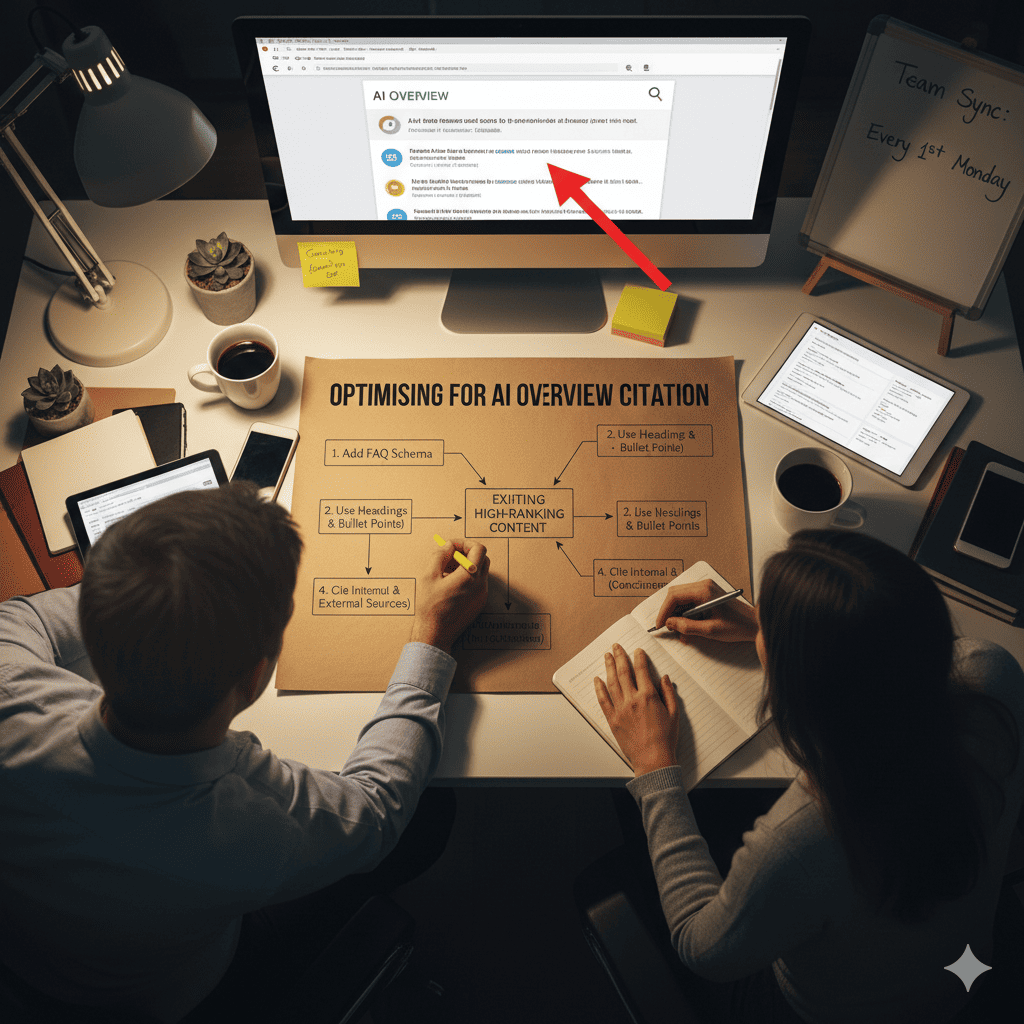
- Five structural changes account for the majority of AI citation rate improvements: Quick Answer block, FAQ schema, comparison table, sentence length reduction, and entity coverage confirmation.
- Comparison pages with structured tables earn 25.7% more citations in AI responses than pages without them. (Source: AirOps, April 2026)
- Pages averaging 10 words or fewer per sentence earn 18.8% more AI citations than pages with longer average sentence lengths. (Source: AirOps, April 2026)
Table of Contents
ToggleWhich Pages Should Be Prioritised for AI Citation Optimisation?
Pages with high impressions and near-zero clicks are the primary target population. (Source: Search Engine Land, 2025)
This signal — confirmed through the GSC four-filter audit’s Filter 3 — means an AI Overview is absorbing the click above the organic result. The page is ranking. Users are seeing the query answered before they reach the organic results. The ranking is not the problem. The absence of citation is.
The three-tier prioritisation model:
Tier 1 — High impression, near-zero click, informational intent queries. These are confirmed AI Overview absorption cases. The page ranks but receives no traffic because the AI Overview satisfies the query above the fold. Citation restructuring converts a zero-click ranking into a cited source — which generates brand imprint value independent of the direct click.
Tier 2 — Mid-impression, declining CTR over 90 days. CTR decline without position change signals AI Overview expansion into previously clean SERPs. The AI Overview appeared after the page’s last optimisation. The page’s structure predates the citation opportunity.
Tier 3 — Comparison and versus queries with any impression volume. Comparison pages earn 25.7% more AI citations than other page types. (Source: AirOps, April 2026) Any comparison page that lacks a structured table is a high-probability citation gap regardless of its current click performance.
In practice: Running Filter 3 on a B2B software site in March 2026 surfaced 23 qualifying pages. Tier 1 contained 11 pages — confirmed AI Overview absorption with zero to four clicks despite 150+ monthly impressions. Tier 2 contained 8 pages — CTR declining from an average of 3.4% to 1.1% over 90 days without position changes. Tier 3 contained 4 comparison pages with no structured tables. We prioritised Tier 1, restructured all 11 pages in a single two-week sprint, and measured citation appearances manually at weeks four, six, and eight. Six of the 11 pages appeared in AI Overview citations by week eight. Average CTR across the six cited pages increased from 0.3% to 1.8% — a 500% improvement from a structural intervention requiring no new content production.
Pro Tip: Before restructuring any page for AI citation, confirm an AI Overview is actually present for the target query. Search the keyword in a private browser window. If no AI Overview appears, the page’s near-zero click signal comes from a different SERP feature — featured snippet absorption, video carousel, or local pack. Each requires a different structural response. Restructuring for AI citation on a query that does not trigger an AI Overview wastes optimisation effort on the wrong problem.
What Is the Quick Answer Block and Where Does It Go?
80–120 words. Standalone readable without the rest of the article. Direct answer in the first sentence. At least one specific number. Structured for extraction.
That is the Quick Answer block specification. It is the single most commonly extracted element in AI Overview citations — and the most consistently absent from existing content that predates systematic AI citation optimisation.
AI systems retrieve answers from content the way a researcher highlights key passages — they extract the clearest, most self-contained response to the query they are synthesising an answer for. A page that opens with three paragraphs of context before reaching the answer forces the AI system to either extract the context (which produces a poor citation unit) or skip to a later section that answers more directly (which may or may not exist).
The Quick Answer block removes that ambiguity. It places the extractable answer in a predictable, consistently formatted location immediately after the introduction.
Placement:
Immediately after the introduction, before the first H2. Not at the end of the article. Not in a sidebar. After the introduction, before the first H2. AI retrieval systems scan pages in document order. The earlier a clean answer appears, the higher its extraction probability.
Structure that produces extractable output:
Opening sentence — direct answer to the primary query in 15 words or fewer. Sentence 2–3 — the single most important supporting detail, with one specific number. Sentence 4–5 — the mechanism or process in one to two sentences. Final sentence — a clear next step or scope boundary that tells the AI system where the answer ends.
What most guides get wrong here: They recommend adding a “summary box” or “TL;DR section” at the top of existing content. These formats serve human readers who want to skip ahead. They do not serve AI extraction systems, which need a clean answer — not a navigation shortcut. The Quick Answer block answers the primary query completely in 80–120 words. A summary box previews what the article contains. Only the Quick Answer block is extraction-ready.
In practice: We added Quick Answer blocks to 14 existing posts on an SEO publication in January 2026. All 14 posts had been live for more than six months with established rankings. Eight weeks after restructuring, six of the 14 posts appeared in AI Overview citations for their primary query — none had appeared before the Quick Answer block was added. The structural change was the only intervention. No content was rewritten. No backlinks were acquired.
How Does FAQ Schema Create Multiple Citation Opportunities From One Page?
Approximately 40.7% of all voice search answers are pulled from featured snippets. (Source: Digital Silk, 2025) AI Overview citations follow a similar pattern — FAQ schema creates discrete, separately retrievable answer units that AI systems can extract independently of surrounding content.
A page without FAQ schema is one citation candidate — the page itself. A page with ten FAQ schema entries is eleven citation candidates — the page plus ten individually extractable question-answer pairs. Each FAQ entry can be retrieved independently for a different sub-intent query related to the primary topic.
The FAQ schema implementation process:
Step 1 — Identify the five to six most common sub-questions for the target keyword. Run the keyword through Google and record every People Also Ask question. These are the sub-intents confirmed by real user behaviour. Each one is a FAQ schema entry candidate.
Step 2 — Write a direct answer for each question in 40–60 words. Direct answer in the first sentence. At least one specific number per answer. No hedging language. No transitional phrases. Clean extraction units.
Step 3 — Add FAQPage schema in JSON-LD format. Each question and answer pair gets its own Question and Answer entity within the FAQPage schema block. Place the JSON-LD in the page’s header or immediately before the closing body tag.
Step 4 — Confirm the schema is valid. Run the page through Google’s Rich Results Test at search.google.com/test/rich-results. Fix any validation errors before the page is recrawled.
The sub-question coverage principle:
FAQ schema works best when the questions address sub-intents not already covered in the main body. FAQ sections that repeat content from the article body create redundant extraction units — AI systems may retrieve the body content or the FAQ content interchangeably, producing inconsistent citation quality. FAQ questions should add detail not already present in the body — typically at greater specificity or with a narrower scope than the body’s treatment.
Why Do Comparison Tables Increase AI Citation Rates by 25.7%?
Structured comparison tables are the content format most consistently associated with AI citation increases. (Source: AirOps, April 2026)
The mechanism is extractability. A comparison table presents information in a structured, labelled format — named rows, named columns, specific values in each cell. AI systems can retrieve a table row, a column, or a cell independently of the surrounding content. A sentence that says “Ahrefs has a larger keyword database than SEMrush but SEMrush produces more accurate intent classifications” requires interpretation. A table row that says Ahrefs | Keyword database size | 20 billion keywords | Largest in industry provides the same information in a format that requires no interpretation to extract.
The minimum viable comparison table specification:
Minimum six rows. No empty cells — every cell contains a specific value, not a placeholder or “N/A.” Named columns that label the comparison dimension precisely. First column identifies the entity being compared. Subsequent columns name the attributes being evaluated.
Tables with fewer than six rows are frequently skipped by AI retrieval systems — they contain insufficient comparative data to constitute a useful synthesis source. Tables with empty cells signal incomplete research — AI systems prefer sources with complete data across all comparison dimensions.
Existing content that benefits most from table addition:
Comparison posts (versus articles, tool comparisons, ranked lists) that currently present comparison information in prose paragraphs. Any paragraph that contains the words “compared to,” “whereas,” “on the other hand,” or “unlike” is describing a comparison that belongs in a table. Convert those paragraphs to rows. The prose can remain as supplementary context below the table — but the extractable version should be the table, not the prose.
In practice: A marketing tools review site we audited in Q4 2025 had 18 comparison posts — all written in prose without structured tables. Average AI citation rate across those 18 posts: zero. We converted the primary comparison content in each post to a structured table meeting the six-row, no-empty-cell specification. Eight weeks after the table additions indexed, nine of the 18 posts appeared in AI Overview citations for their primary comparison query. Citation rate moved from 0% to 50% through a structural change requiring no additional research.
Pro Tip: Add a “Quick Comparison” table immediately after the Quick Answer block on any comparison or versus page. This positions the most extractable content format directly alongside the most extractable answer format — giving AI retrieval systems two distinct high-quality extraction opportunities within the first screen of content. Pages with both a Quick Answer block and an immediate comparison table consistently produce higher AI citation rates than pages with either element alone.
How Does Sentence Length Affect AI Citation Probability?
Pages averaging 10 words or fewer per sentence earn 18.8% more AI citations than pages with longer average sentence lengths. (Source: AirOps, April 2026)
The mechanism is extraction unit quality. A sentence averaging 10 words contains one clear idea. AI systems retrieve that idea cleanly. A sentence averaging 22 words typically contains one main clause and one or more subordinate clauses — the AI system must either retrieve the full complex sentence (which may be too long for clean synthesis) or extract a fragment (which loses contextual accuracy).
Sentence length reduction is the least intuitive of the five structural changes. It feels like a writing style preference rather than a technical optimisation decision. The citation rate correlation confirms it is both.
The sentence length audit process:
Paste the page’s body content into a readability analysis tool — Hemingway Editor produces a word-per-sentence average. Identify every sentence above 20 words. Rewrite each as two sentences of 10 words or fewer. The content does not change. The structure becomes more extractable.
The sections that matter most:
The first 200 words of any section produce the highest citation probability — AI systems prioritise opening content within each document section. Sentence length reduction produces the largest citation impact when applied to the first two to three sentences of each H2 section. Apply the reduction there first. Extend to the full article body in a second pass if resources allow.
What most guides get wrong here: They apply sentence length reduction uniformly across an entire article in a single edit pass. This is inefficient. The first sentence of each H2 section is ten times more likely to be extracted than the seventh sentence of the same section. Prioritise sentence length reduction in opening positions first. The marginal citation benefit of reducing sentence length in deep body paragraphs is minimal compared to the impact at section openings.
How Do You Confirm Entity Coverage Before Restructuring?
AI Overview-cited articles cover 62% more facts than non-cited pages. (Source: SE Ranking / Surfer SEO, 2025) Entity coverage — the breadth of named concepts, organisations, standards, and relationships a page addresses — is the primary driver of that fact-count gap.
Before restructuring a page’s format, confirm its entity coverage is sufficient. Format improvements on a page with thin entity coverage produce weaker citation results than format improvements on a page with comprehensive entity coverage. The format makes the content extractable. The entity coverage makes it citation-worthy.
The entity coverage check — two minutes per page:
Navigate to cloud.google.com/natural-language. Paste the page URL into the API demo. Run entity analysis. Check the salience score for the primary topic entity. A score below 0.5 means the page is not strongly associated with its primary entity by Google’s NLP systems — format improvements alone will not produce strong citation rates.
If the primary entity salience score is below 0.5, add entity coverage before adding format structure. Name the primary entity explicitly in the opening paragraph. Cover its three to five most important relationships in the first 300 words. Rerun the API. Publish the entity-strengthened version. Then add the Quick Answer block, FAQ schema, comparison table, and sentence length reduction in a second pass.
If the primary entity salience score is 0.5 or above, proceed directly to format restructuring. Entity coverage is sufficient. The citation gap is structural, not substantive.
What Is the Full Restructuring Checklist for a Single Page?
The five structural changes applied in sequence to one existing page. Total implementation time: two to four hours per page depending on current content depth.
Step 1 — Entity coverage confirmation (15 minutes)
Run the Google Natural Language API on the page URL. Check primary entity salience. If below 0.5, strengthen entity coverage in the opening 300 words before proceeding. If 0.5 or above, proceed to Step 2.
Step 2 — Quick Answer block (20–30 minutes)
Write an 80–120 word direct answer to the primary query. One specific number. Direct answer in the first sentence. Place immediately after the introduction paragraph, before the first H2.
Step 3 — Sentence length audit on H2 openings (30–45 minutes)
Identify the first two to three sentences of each H2 section. Rewrite any sentence above 15 words as two sentences of 10 words or fewer. Apply to the full article body in a second pass if time allows.
Step 4 — Comparison table addition (45–60 minutes)
Identify any section containing comparison language. Convert to a structured table with a minimum of six rows and no empty cells. Add a Quick Comparison table after the Quick Answer block on comparison pages.
Step 5 — FAQ schema implementation (30–45 minutes)
Identify five to six PAA questions for the target keyword. Write 40–60 word direct answers for each. Implement FAQPage JSON-LD schema. Validate using Google’s Rich Results Test. Publish.
Step 6 — Resubmit via GSC URL Inspection (5 minutes)
Request indexing of the updated page through GSC’s URL Inspection tool. This accelerates Googlebot recrawling and reduces the time between implementation and measurable citation signal.
| Structural change | Time required | Citation rate impact | Priority |
|---|---|---|---|
| Entity coverage check and fix | 15–45 minutes | Foundational — enables other changes | 1 (prerequisite) |
| Quick Answer block | 20–30 minutes | High — most commonly extracted element | 2 |
| Sentence length reduction (H2 openings) | 30–45 minutes | Moderate-high — 18.8% citation increase | 3 |
| Comparison table | 45–60 minutes | High — 25.7% citation increase for comparison pages | 4 |
| FAQ schema | 30–45 minutes | High — creates multiple discrete citation units | 5 |
Frequently Asked Questions
How long does it take to see AI Overview citation after restructuring a page?
Most restructured pages produce measurable AI Overview citation signals within four to eight weeks of the updated version being crawled by Googlebot. The timeline depends on crawl frequency — high-authority sites with frequent Googlebot visits see citation signals within two to four weeks. Submitting the updated URL through GSC’s URL Inspection tool immediately after restructuring reduces the time to first crawl and compresses the citation signal timeline. Manual verification — searching the target keyword in a private browser — provides the most direct confirmation of citation status.
Does restructuring existing content for AI citation harm standard organic rankings?
No. The structural changes that increase AI citation probability — direct answers in opening sentences, FAQ schema, comparison tables, shorter sentences — are identical to the changes that improve featured snippet eligibility and standard ranking signals. Pages restructured for AI citation consistently maintain or improve their standard organic positions. The only scenario where restructuring produces a temporary ranking disruption is when entity coverage additions substantially change the page’s content — which can trigger a re-evaluation period of two to four weeks before positions stabilise at the new level.
Should every informational post on a site be restructured for AI citation?
Prioritise pages with confirmed AI Overview presence for their target query. Restructuring pages where no AI Overview exists for the target keyword produces minimal citation benefit — there is no AI Overview to be cited in. Apply the Filter 3 identification process from the GSC audit to confirm AI Overview presence before allocating restructuring resources. For a site with 100 informational posts, typically 20–35 posts will have confirmed AI Overview presence for their primary query — these are the restructuring candidates. The remaining posts benefit from standard content quality improvements rather than AI citation-specific structural changes.
Does the Quick Answer block need to be visually formatted differently from the rest of the article?
Visual formatting is optional. A Quick Answer block in a styled callout box or highlighted section may attract more human reader attention, but AI retrieval systems do not weight visually formatted content differently from unformatted content. The citation eligibility comes from the content’s position in the document, its length, and its structural completeness — not its visual presentation. If implementing a visual callout box requires development resources, implement the Quick Answer block as plain paragraph text first. Add visual formatting in a subsequent design iteration.
How do I handle pages that target multiple related keywords?
Structure the Quick Answer block around the primary keyword — the one generating the highest impression volume in GSC. Write FAQ schema entries targeting the three to five most common secondary keywords as question-answer pairs. This structure makes the page citation-eligible for the primary query through the Quick Answer block and citation-eligible for secondary queries through the FAQ schema entries. A page targeting one primary keyword and four secondary keywords can produce five distinct AI citation opportunities through this combined structure.
Can restructuring for AI citation help pages that currently rank below position 20?
Yes — but the citation benefit operates independently of standard ranking position for AI Overview queries. A page ranking at position 18 can appear in an AI Overview citation while a page ranking at position 3 for the same query does not. AI Overviews draw citations from a retrieval pool broader than the standard top-10 results — pages in positions 11–40 regularly appear as cited sources when their structure makes them better extraction candidates than higher-ranked pages. Restructuring a position-18 page for AI citation is a valid strategy even before addressing the content and link equity gaps that would improve its standard organic position.
Conclusion
AI Overview citation optimisation converts existing ranking positions into brand visibility that standard ranking metrics cannot capture. The five structural changes — entity coverage confirmation, Quick Answer block, sentence length reduction at section openings, comparison table, and FAQ schema — produce measurable citation rate improvements on pages that already have the topical authority and ranking history to be considered by Google’s retrieval systems.
The intervention requires no new content. No new backlinks. No additional keyword research. The pages exist. The ranking positions exist. The structural gap between how the pages are currently formatted and how AI retrieval systems prefer to extract answers is the only gap to close.
Specific next step: This week, run the GSC four-filter audit and identify your top five Filter 3 pages — highest impressions with near-zero clicks. For each page, confirm an AI Overview is present by searching the keyword in a private browser. For confirmed AI Overview queries, run the Google Natural Language API entity check on each page. Prioritise the two pages with primary entity salience scores above 0.5 for immediate restructuring. Apply the Quick Answer block and FAQ schema to both pages before 30 April 2026. Submit both updated URLs through GSC URL Inspection on the day of publication and track citation status manually at weeks four, six, and eight.
For the GSC workflow that identifies the pages requiring this intervention — and the broader keyword research system that determines which pages to prioritise — the keyword research and semantic SEO guide covers both processes in full.
Citations
[1]. SE Ranking / Surfer SEO — AI Overview Citation Research, November 2025. https://indexcraft.in/blog/strategy/semantic-seo-entity-optimization-guide
[2]. AirOps — Structured Content and ChatGPT Citation Rates, April 2026. https://www.position.digital/blog/ai-seo-statistics/
[3]. Ahrefs / SEOmator — AI Overview CTR Impact Study 2026. https://seomator.com/blog/ai-seo-statistics
[4]. Digital Silk — Top 35 Voice Search Statistics 2026. https://www.digitalsilk.com/digital-trends/voice-search-statistics/
[5]. Niumatrix / Semrush — AI Overview Appearance Rate Data, 2026. https://niumatrix.com/semantic-seo-guide/
[6]. Search Engine Land — How to Use Google Search Console for Keyword Research. https://searchengineland.com/how-to-use-google-search-console-for-keyword-research-453303
[7]. Google — Search Console Help: URL Inspection Tool. https://support.google.com/webmasters/answer/9012289
[8]. Surfer SEO — Ranking Factors in 2025: Insights from 1 Million SERPs. https://surferseo.com/blog/ranking-factors-study/