

Last updated: April 2026 | Sources reviewed: 7
Every SEO guide teaches the four types of search intent. Almost none of them teach beginners how to actually use them.
Knowing that “informational” means “the user wants to learn” is not the same as knowing why a blog post fails to rank on a transactional query. The model is not the skill. Applying it is.
Search intent is the specific goal behind a search query — and mismatching your page’s intent to the query’s intent is one of the most common reasons pages fail to rank, even when all other technical SEO factors are solid. (Source: WP SEO AI, 2026)
Quick Answer
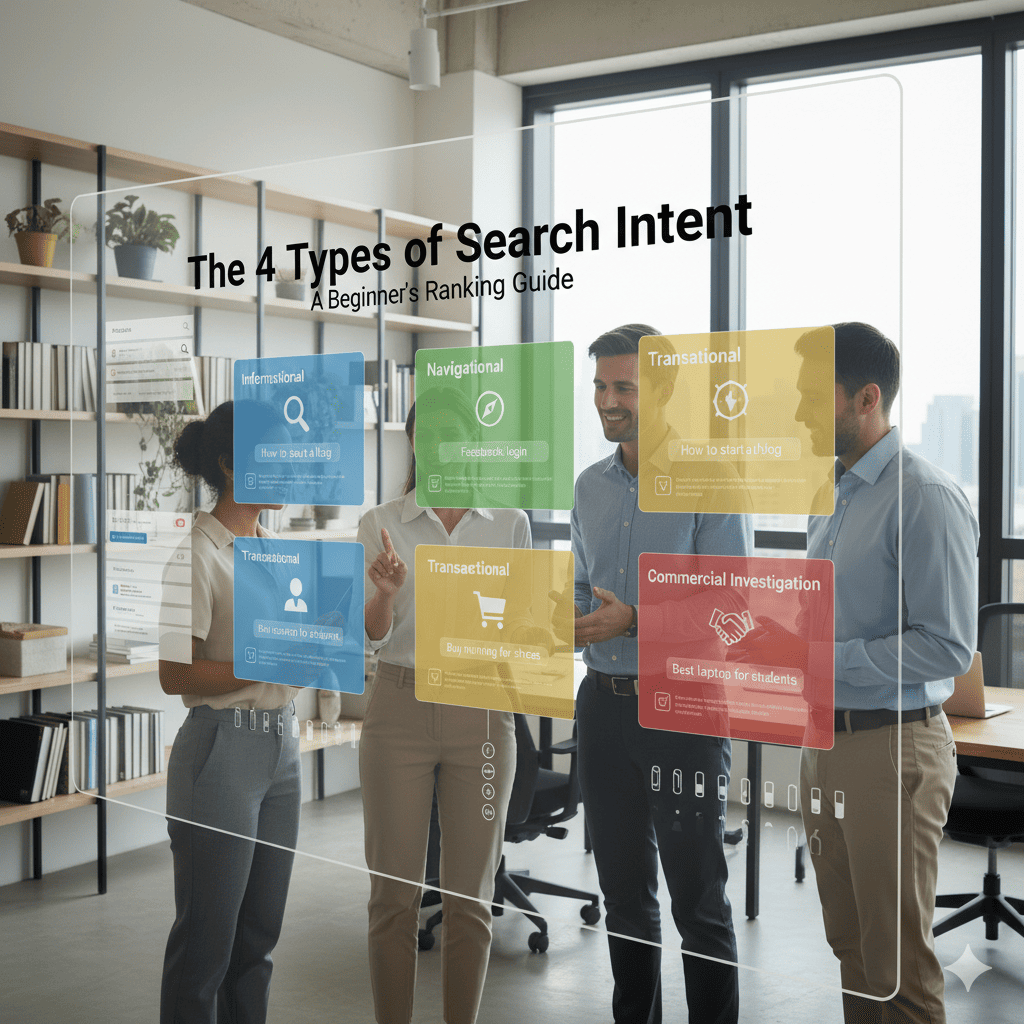
The four types of search intent are informational, navigational, commercial, and transactional. Informational queries account for roughly 52.65% of all searches — users want answers, not products. Navigational queries (32.15%) target a specific site or brand. Commercial queries (14.51%) indicate pre-purchase research. Transactional queries (0.69%) show readiness to act. Publishing the wrong content format for an intent type — a blog post on a transactional query, or a product page on an informational one — produces ranking failure regardless of content quality. Identifying intent takes thirty seconds: search the keyword and read what Google is already ranking. (Source: Amra and Elma, 2025)
Table of Contents
ToggleWhat Is Informational Intent and Why Does It Dominate Search?
Informational intent means the user wants to learn something. Full stop.
They are not comparing products. They are not ready to buy. They want an answer, an explanation, or a how-to process — and they want it fast.
Queries with informational intent often start with: how, what, why, when, who, guide to, tutorial, tips for. Examples: “how does keyword research work,” “what is a meta description,” “why is my page not indexing.
What most guides get wrong here: They tell beginners to “target informational keywords to build awareness.” That framing treats informational content as a strategy. The sharper truth is simpler — if a keyword is informational and you publish a product page against it, you will not rank. Google has already decided what format satisfies that query.
In practice: The correct check is a thirty-second SERP scan. Type the keyword into Google. If the first page shows guides, blog posts, and Wikipedia entries, the intent is informational. Publish a guide. Publish a product page and Google will ignore it — no matter how well it is optimised.
The content format that wins for informational intent:
- Long-form guides and tutorials
- How-to articles with numbered steps
- Definition posts with expanded context
- FAQ pages answering specific questions
- Video walkthroughs embedded in editorial content
Pro Tip: For informational pages, put the direct answer to the query in the first two sentences. This is not just good practice — it is the exact structure that qualifies a page for featured snippet extraction and AI Overview citation.
What Is Navigational Intent and When Should You Optimise for It?
Navigational intent means the user is heading somewhere specific and using Google as a shortcut.
They already know the destination. They type “Ahrefs keyword explorer” or “Semrush login” because it is faster than typing the full URL.
Approximately 32% of all searches carry navigational intent. (Source: Amra and Elma, 2025) The key fact about navigational queries: third-party pages almost never win them.
What most guides get wrong here: They list navigational intent as a content opportunity. For most sites, it is not — it is a threat awareness exercise. Ranking for a competitor’s brand navigational query is nearly impossible. The correct use of navigational intent knowledge is defensive: ensure your own branded pages (homepage, login, pricing, contact) are properly optimised so you own your own navigational queries.
The trade-off: Some navigational queries carry partial informational intent — “Semrush pricing” is navigational to Semrush but informational to a competitor writing a pricing comparison. This is the grey zone where a third-party comparison page can rank adjacent to the brand’s own page. Identify these split-intent navigational queries and they become realistic content targets.
| Intent type | Share of all searches | Typical query format | Ranking opportunity for new sites |
|---|---|---|---|
| Informational | 52.65% | “how to,” “what is,” “why does” | High — quality content competes |
| Navigational | 32.15% | Brand name, product name, site name | Low — brand owns their queries |
| Commercial | 14.51% | “best,” “vs,” “review,” “top” | Moderate — comparison content ranks |
| Transactional | 0.69% | “buy,” “price,” “order,” “sign up” | Moderate — product/landing pages |
What Is Commercial Intent and How Is It Different from Transactional?
Commercial intent — sometimes called commercial investigation — sits between learning and buying.
The user has decided they want something. They have not yet decided which version, which brand, or which price point. Their search reflects that uncertainty: “best SEO tools for beginners,” “Ahrefs vs SEMrush,” “HubSpot review 2026.
This is the intent type beginners most consistently confuse with transactional. The confusion costs rankings.
What most guides get wrong here: They say commercial and transactional are “close to purchase.” True — but the content format required to rank for each is completely different. Commercial intent pages need evaluation content: comparisons, scored criteria, named pros and cons, real verdict. Transactional intent pages need action content: pricing, CTA, trust signals, and a clear path to purchase. Publishing a transactional product page against a commercial query will underperform a well-structured comparison post every time.
Common mistake + fix: A beginner targeting “best accounting software for freelancers” publishes a product page with a buy button. The SERP shows roundups and comparison articles. The product page ranks nowhere. The fix: publish a comparison article with named criteria, a clear recommendation, and an honest assessment of each option — then link to the product page from within it.
Commercial intent content formats that rank:
- “Best [X] for [specific use case]” roundups with scored criteria
- “[A] vs [B]” comparison posts with a named verdict
- “[Product] review” posts with structured pros/cons and a rating
- “Top [X] alternatives to [Y]” posts targeting competitor-adjacent searches
In practice: For a site audited in late 2025, three product pages were targeting commercial-intent keywords. All three ranked outside the top 30. Replacing each with a structured comparison post — same keyword, different format — moved two of them to positions 6–12 within eight weeks. The content did not change in quality; the format changed to match intent.
What Is Transactional Intent and What Does a Winning Page Look Like?
Transactional intent means the user is ready to act right now.
They have done the research. They have compared the options. They want to buy, sign up, download, or book. Their query reflects that: “buy Ahrefs subscription,” “Semrush free trial,” “download Rank Math plugin,” “book SEO audit.
Only 0.69% of searches carry transactional intent. (Source: Amra and Elma, 2025) That share is small. The conversion value per visit is not.
What most guides get wrong here: They treat transactional pages as a technical exercise — add a CTA, optimise the product title, done. The real differentiator is trust architecture. A transactional-intent user has finished comparing. What they need from the landing page is confirmation that this is the right choice and confidence that the action is safe. That requires trust signals — reviews, security indicators, clear returns or cancellation policies, and a friction-free path to completion.
Pro Tip: Transactional pages that receive traffic from LLMs (ChatGPT, Perplexity, Gemini) convert at significantly higher rates than organic search visitors because the user has already been through a query-response cycle. LLM-referred transactional visitors arrive closer to a decision. Front-load the action path on these pages — CTA, pricing, and the first conversion element should appear above the fold.
The structure of a transactional page that ranks and converts:
- Primary keyword in H1 with a transactional modifier (“Buy,” “Get,” “Start,” “Download”)
- Clear price or offer statement in the first 100 words
- Trust signals — reviews, ratings, security badges — visible without scrolling
- Single, unambiguous CTA — one action, not three options
- FAQ schema addressing the objections that delay purchase
What Most Articles Get Wrong About the Four Types of Search Intent
The standard framing presents the four types as a clean taxonomy — four boxes, one query per box.
Real queries do not work that way.
A keyword like “content marketing tools” could be informational (“what tools exist?”), commercial (“which tool is best?”), or even navigational (“I want to go to HubSpot’s tools page”). The same keyword, classified differently by three different tools on the same day, produces three different content recommendations. (Source: WP SEO AI, 2026)
The fix is not a better classification tool. The fix is SERP reading.
Google’s current ranking results for a keyword are Google’s current assessment of what intent that query carries. That assessment updates continuously as user behaviour changes. A keyword that produced informational results in 2024 may now return commercial results if users who searched it have shifted from learning to buying.
For any new keyword target, spend thirty seconds on this check:
- Search the keyword in a private browser window
- Read the format of the top three results — guide, comparison, product page, tool
- Read the opening paragraph of the top result — what question does it answer in the first two sentences
- Match your page’s format and opening to what Google has confirmed it rewards
This takes less time than any keyword tool intent-classification feature. It is also more accurate.
Frequently Asked Questions
How do I identify the search intent of a keyword without a paid SEO tool?
Search the keyword directly in Google and read the top three results. If they are guides and how-to articles, the intent is informational. If they are reviews and comparisons, the intent is commercial. If they are product or category pages with buy buttons, the intent is transactional. If the top result is a brand’s homepage or login page, the intent is navigational. This method takes under one minute and reflects Google’s current intent assessment — which is more accurate than any static tool classification because it updates in real time as user behaviour shifts. No tool is required.
Can a single page rank for multiple types of search intent?
Yes, but only when the intents are closely adjacent. A page targeting “best project management software” can serve both commercial investigation (I am comparing options) and informational (I want to understand what features matter). A page cannot effectively serve both informational and transactional intent simultaneously — the formats are structurally incompatible. An educational guide and a product purchase page serve different user states. Trying to combine them produces a page that partially satisfies both intents and fully satisfies neither. When a SERP shows mixed results (some guides, some product pages), target the dominant format.
Why do informational pages sometimes rank for commercial keywords?
This happens when Google interprets a query as carrying split intent — part research, part evaluation. A keyword like “Ahrefs pricing” is navigational for someone trying to reach Ahrefs but commercial for someone comparing tool costs. Google surfaces both the brand’s pricing page and third-party comparison articles because different users have different goals. Informational or comparison-style pages rank for commercial queries when they address the evaluation question more completely than commercial product pages do. The lesson: always check what is actually ranking, not just what intent category the keyword tool assigns.
What content format works best for each type of search intent?
Informational intent: long-form guides, step-by-step tutorials, definition posts with examples, and FAQ pages. Commercial intent: comparison articles with named criteria and verdicts, “best of” roundups, and product review posts. Transactional intent: product pages, category pages, and landing pages with clear CTAs and trust signals. Navigational intent: your own branded pages — homepage, login, pricing, and key product pages — optimised for exact brand name searches. The format alignment matters more than word count. A 600-word focused comparison post will consistently outrank a 3,000-word product page on a commercial intent query.
How does AI search change how intent types work?
AI Overviews appear for approximately 84% of informational queries and are expanding into commercial queries. (Source: seoClarity, 2025) This changes the traffic mechanics for informational content — ranking first no longer guarantees the most clicks if an AI Overview synthesises the answer above results. The correct response is not to avoid informational content, but to structure it for AI citation: direct answer in the first paragraph, FAQ schema on supporting questions, and clear sourcing. For commercial and transactional intent, AI Overviews appear far less frequently, meaning standard ranking logic still drives direct-click traffic to those pages.
Does search intent apply the same way to voice search queries?
Voice queries are almost always informational and phrased as natural language questions. Someone speaking to a voice assistant says “what is the best project management tool for a small team” rather than typing “best project management software.” The intent classification is the same — commercial in this case — but the phrasing is more conversational and more specific. For voice-optimised content, the direct answer should appear in the first 40–60 words of the page so the voice assistant can extract and read it cleanly. FAQ schema helps the same way it helps for text search — each schema-wrapped question becomes a separately retrievable answer unit.
Conclusion
The four types of search intent — informational, navigational, commercial, and transactional — are not a categorisation system. They are a format-matching system.
The model only produces value when it changes what you publish, not just how you label your keywords. Every content decision should start with the question: what format has Google already confirmed it rewards for this query?
Specific next step: Take the next five keywords on your content calendar. Search each one in a private browser window this week. For each, record the format of the top three results — guide, comparison, product page, or brand page. Check your planned content format against that. If any do not match, update the brief before writing. One format misalignment caught at brief stage saves weeks of wasted content production.
Citations
[1]. Amra and Elma — Top Search Intent Statistics 2025. https://www.amraandelma.com/search-intent-statistics/
[2]. WP SEO AI — What Are the 4 Types of Search Intent? https://wpseoai.com/blog/what-are-the-4-types-of-search-intent/
[3]. Yoast — What is Search Intent? https://yoast.com/search-intent/
[4]. Semrush — 4 Types of Keywords: Commercial, Informational, Navigational, Transactional. https://www.semrush.com/blog/types-of-keywords-commercial-informational-navigational-transactional/
[5]. seoClarity — AI Overviews Impact Research 2025. https://www.seoclarity.net/research/ai-overviews-impact
[6]. Rush Analytics — Types of Search Intent in SEO: A Quick Guide. https://rush-analytics.com/learn-seo/search-intent-seo-guide
[7]. Slack — The Four Core Types of Searches. https://slack.com/blog/productivity/the-four-core-types-of-searches-plus-emerging-ones-you-should-know