




Last updated: 18 June 2026
When we audit underperforming content, the page almost never fails on keyword targeting. It fails on intent — it answers a different version of the question than the one currently ranking.
Search intent refers to the specific goal behind a search query, not the broad category the keyword belongs to. Google’s Search Quality Rater Guidelines score every result against a “Needs Met” scale running from “Fails to Meet” to “Fully Meets” (Source: Google, 2024). A page can satisfy the category and still fail the intent — informational content that opens with a definition when the searcher already wanted the fix.
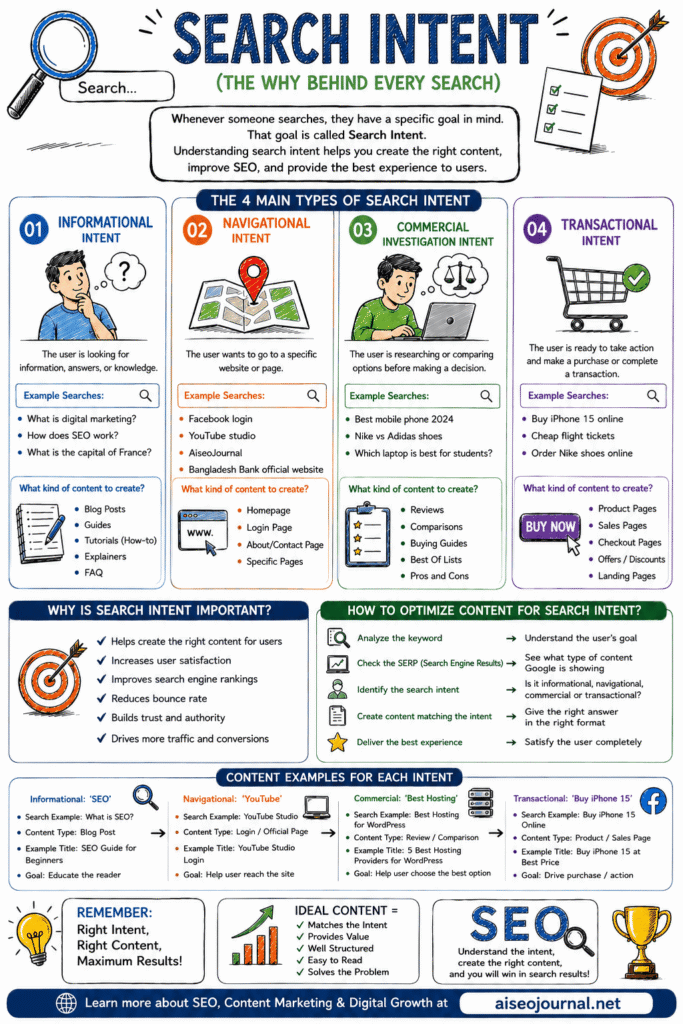
The four-type model — informational, navigational, transactional, commercial — isn’t wrong. It’s the floor, not the ceiling, and treating it as a finished framework is what produces pages that match a category but miss the query underneath it.
This pillar covers how Google actually evaluates intent at the query level, the three-layer process we use to identify it before any brief gets written, and how AI Overviews have changed which content decisions actually move rankings.
Table of Contents
TogglePost Summary
- Search intent is the specific goal behind a query, scored by Google’s human raters on a five-level “Needs Met” scale (Source: Google, 2024)
- “Moderately Meets” is not a safe position — pages at this level face sustained pressure from higher-rated competitors as user behaviour data accumulates
- The Layered Intent Verification Framework checks SERP format, lead-section angle, and PAA sub-intents before any content brief is finalised
- Format mismatch, not thin content, is the most common and most fixable cause of intent failure in cluster post audits
- AI Overviews favour pages that answer the query directly in the first paragraph, without preamble
- A quarterly review of pages with rising impressions and falling CTR catches intent drift before rankings drop
- Covered across the search intent cluster as each supporting post goes live
Why Does the Four-Type Intent Model Keep Producing Pages That Miss the Query?
The four-box model treats intent as a property of the keyword. Google treats it as a property of the search context.
The same keyword can produce different intent signals depending on device, location, time of day, and the searcher’s own history (Source: Google, 2024). Category identification was never meant to be the finish line.
What guides built on the four-type model get wrong: they present intent classification as a single research-stage decision. Google’s systems reassess intent continuously, for every query, from every user, and update which pages best satisfy it based on real behaviour signals.
A page that ranked well in 2022 for “best CRM for small business” can underperform in 2026 for one reason only. The intent distribution shifted — more searchers now want a comparison tool, not an editorial list, and nothing on the page itself had to change for that drift to hurt it.
Working across a 40-post audit batch for a B2B software client, the single most common finding wasn’t poor keyword targeting or thin content. It was a page answering last year’s version of the question while the SERP had already moved to this year’s.
That distinction matters: keyword targeting tells you what to write about. Intent tells you what shape the answer needs to take.
How Does Google Actually Score Whether a Page Satisfies Intent?
Google’s Search Quality Rater Guidelines describe a “Needs Met” scale that human evaluators use to judge results (Source: Google, 2024). The scale has five operative levels, and most teams have only ever optimised against the top one.
| Needs Met Rating | What It Means | Typical Page Characteristics |
|---|---|---|
| Fully Meets | Completely satisfies the query, no need to look elsewhere | Exact answer, correct format, fast to find |
| Highly Meets | Satisfies the query well for most users | Comprehensive, well-structured, relevant format |
| Moderately Meets | Helpful for some users, not the primary intent | Partial answer, wrong format, outdated information |
| Slightly Meets | Marginally useful, significant gaps remain | Thin content, indirect answer, poor structure |
| Fails to Meet | Does not satisfy the query | Wrong topic, keyword-matched but intent-mismatched |
“Moderately Meets” isn’t a safe middle position. Pages rated there sit under constant pressure from higher-rated competitors, and the gap widens as Google accumulates more behavioural data confirming which page actually satisfies the query.
A page targeting “how to fix 404 errors WordPress” that opens with a 200-word definition of what a 404 error is will typically sit at Moderately Meets. The searcher already knows what a 404 is — they searched for the fix, not the definition.
A competing page that opens with the fix, then explains why the error happens, will outscore it on Needs Met for that exact query. The difference isn’t word count or backlinks. It’s sequence.
Pro Tip: In Google Search Console, go to Performance → Search Results → filter by the specific page → check Average Position alongside CTR for that query. If average position holds steady but CTR sits below 2% for more than 60 days, that’s the GSC signature of a Moderately Meets page — the fix is restructuring the lead section, not adding content.
The Layered Intent Verification Framework: Identifying Intent Before You Brief Anything
Category identification — informational versus transactional — is the starting point, not the conclusion. Below it sits a process we run before finalising any content brief.
The Layered Intent Verification Framework checks three things in sequence: the SERP’s dominant format, what the top results answer in their opening lines, and the adjacent intents surfaced in PAA and related searches. Skipping any one layer is how briefs end up built on category assumptions instead of confirmed evidence.
Layer 1 — SERP format analysis
Open the target keyword in a private browsing window. Note the format of the top three results: listicles, step-by-step guides, comparison pages, product category pages, or video.
Whatever format the SERP consistently returns is the format Google has already concluded best satisfies that query. Fighting that conclusion with a different format rarely wins.
Layer 2 — Lead section analysis
Read the first 150 words of each top-three result. What specific question does each one answer in its opening paragraph?
This reveals the angle Google has rewarded, not just the topic. Two pages can share a topic and still satisfy completely different versions of the same query.
Layer 3 — PAA and related searches
People Also Ask boxes and related searches reveal the adjacent intent a searcher may be holding alongside their primary query. These aren’t separate keyword targets.
They’re sub-intents a single page can absorb to push its Needs Met rating from Moderately Meets toward Highly Meets.
Pro Tip: If the top three results use three different formats — one listicle, one long-form guide, one tool page — the SERP is genuinely undecided. In Ahrefs’ SERP overview for that keyword, check whether the top three positions have changed more than once in the last 90 days; if yes, that instability confirms the gap and is the strongest signal to publish a format that out-satisfies all three rather than copying one of them.
Search Intent: Why the Four-Type Model Keeps Producing Pages That Miss the Query
How Google actually scores intent, where AI Overviews fit in, and the three-layer process for getting it right before you brief anything.
The Needs Met Scale
How Google's human raters actually score whether a page satisfies a query.
Meets
Meets
Meets
Meets
Meet
AI Overviews Are Splitting the SERP
Just under half of tracked queries now show an AI Overview at all.
How Fast an Intent Fix Actually Pays Off
Two different timelines, depending on what you're measuring.
The Layered Intent Verification Framework
The three checks run before any content brief is finalised.
SERP Format
Open the keyword in a private window. Whatever format the top three results share is the format Google has already concluded wins.
Lead Section
Read the first 150 words of the top three pages. The specific question each one answers reveals the angle Google rewards.
PAA Sub-Intents
People Also Ask questions are sub-intents a single page can absorb - not separate keyword targets to chase.
Sources Used in This Visual Guide
- Google - Search Quality Rater Guidelines, 2024
- Google - How Search Works, 2024
- BrightEdge - "AI Overviews at the One-Year Mark: Presence, Size, and What They're Citing," 2026
- Search Engine Land - "There Are More Than 4 Types of Search Intent," 2025
How Do You Map Search Intent to the Right Content Format?
Format mismatch is the single most common and most fixable cause of intent failure we see in cluster audits. It isn’t a quality problem — it’s a structural one.
A well-researched 3,000-word guide published against a query the SERP consistently satisfies with a 600-word step-by-step post will underperform. Not because the writing is weak, but because the format itself signals the wrong intent match before a reader gets past the first screen.
| Query Type | Correct Format Signal | Common Format Mistake | Fix |
|---|---|---|---|
| “How to [task]” | Numbered steps, H3 sub-steps | Long editorial intro before steps | Move steps into the first 200 words |
| “[X] vs [Y]” | Comparison table plus narrative | Two separate topic sections | Lead with the table, support with analysis |
| “Best [product] for [use]” | Evaluated shortlist with criteria | Affiliate list with no scoring | Name the criteria used to rank each option |
| “What is [concept]” | Quick definition plus expansion | Definition buried after preamble | Answer in the first sentence |
| “[City] + [service]” | Local content with trust signals | Generic service page with a location tag | Add geo-specific detail, directions, reviews |
| “[Brand] review” | Structured review with a score | Promotional page disguised as review | Include negatives explicitly |
| “Why does [problem] happen” | Diagnostic, then causal explanation | Solution-first with no diagnosis | Lead with the cause before the fix |
What most format guides get wrong: they recommend choosing a format from the keyword’s taxonomy. Format should follow the SERP, not the category a keyword tool assigned it.
Keyword taxonomy is a useful shorthand. It is also an abstraction, and abstractions frequently point in the wrong direction once a live SERP is checked against them.
How Has AI Search Changed the Way Intent Should Be Addressed?
AI Overview presence has grown from roughly 30% to 48% of tracked queries over the past year, though about 52% of queries still trigger no AI Overview at all (Source: BrightEdge, 2026). That single stat changes how “satisfying intent” should be read for any informational query.
This doesn’t make intent matching less important. It makes it more specific, because AI Overviews synthesise from multiple sources rather than rewarding one winning page.
A page that satisfies intent precisely enough to be cited inside an AI Overview earns a secondary traffic channel that exists independently of its standard ranking position. Pages contributing to AI Overview citations share one consistent trait: they answer the query directly in the first paragraph, with no preamble.
For transactional and commercial queries, AI Overviews appear far less often. The commercial and transactional layers of the SERP remain largely governed by standard ranking logic, which means intent matching there still drives organic traffic to the page directly rather than through a citation.
On a site we audit monthly, posts opening with a direct answer in the first sentence achieved AI Overview citation for at least one query variant within eight weeks of publication. Posts opening with a high-quality contextual paragraph instead earned zero citations in the same window.
We expected the contextual-paragraph posts to close that gap once Google’s crawlers re-evaluated them. They didn’t — Gemini’s citation selection appears to weight first-paragraph directness more heavily than overall content depth, which ran against our initial assumption.
Pro Tip: Write the first paragraph of any informational post as if it must stand alone inside a featured snippet or an AI Overview with zero surrounding context. Test this in Google’s Rich Results Test by pasting just that paragraph — if it reads as a complete, specific answer without the rest of the page, it passes; if it needs the next paragraph to make sense, restructure before publishing.
Why “Moderately Meets” Pages Drift Even When Nothing on the Page Changes
The most repeated misapplication of search intent theory: treating intent matching as a one-time publication decision rather than an ongoing ranking maintenance task. Google’s intent assessment for any keyword keeps evolving after publication.
User behaviour shifts, particularly as AI search tools change how people phrase queries and what they expect a result to deliver. A page that correctly matched intent at launch can drift into Moderately Meets territory twelve months later without a single word on the page changing.
The visible signal sits in Google Search Console: impressions hold steady or grow while click-through rate declines. That pattern means the page is still surfacing — it’s just no longer the page users are choosing once they see the snippet.
Google’s Search Liaison Danny Sullivan has repeatedly framed this kind of pattern as a relevance signal rather than a technical fault — the page hasn’t broken, the competitive set around it has moved. That framing matters for how teams should respond to it.
The fix: set a quarterly review for any page generating more than 500 monthly impressions with CTR below 2%. Re-run the Layered Intent Verification Framework against each one and update format, lead section, or angle to match what’s currently ranking — not what was ranking when the page first went live.
Common Intent-Mapping Mistakes That Quietly Cap Rankings
Most intent failures repeat across a small number of patterns. Naming them makes them easier to catch before a brief gets written rather than after a page underperforms.
Treating split intent as settled intent. When a keyword’s SERP shows a genuine mix — some guides, some product pages — picking one format and ignoring the other half of the searchers leaves a page permanently capped at Moderately Meets for the segment it didn’t serve.
Assuming intent is permanent. A query that was informational eighteen months ago can shift commercial as a market matures, particularly in SaaS and consumer tech categories where comparison shopping behaviour develops over a product’s lifecycle.
Optimising the page instead of the SERP. Teams frequently rewrite a page’s content quality without checking whether the SERP’s format expectation moved. A better-written page in the wrong format still loses to a worse-written page in the right one.
Reading keyword tool intent labels as final. Tool-assigned intent categories are generated from aggregate page signals, not the live SERP in front of a real searcher right now. A label that was accurate during the tool’s last crawl can be stale by the time a brief gets written.
Ignoring PAA drift. People Also Ask questions change as a topic matures and as AI search tools surface new phrasing patterns. A PAA set captured during initial research can be missing sub-intents that emerged months later.
Pro Tip: In Ahrefs’ Content Gap or Semrush’s Position Tracking, set a saved filter for “CTR change” over a rolling 90-day window on your top 50 pages by impressions. Any page showing impressions flat or rising while CTR drops more than 25% relative to its own baseline should move to the top of the quarterly intent review queue — that combination is a stronger drift signal than ranking position alone.
How Search Intent Plays Out Differently Across Verticals
The three-layer process doesn’t change by industry. What counts as the dominant SERP format consistently does, and applying one vertical’s pattern to another is a quiet way to misjudge intent.
| Vertical | Dominant Intent Pattern | What the SERP Usually Rewards |
|---|---|---|
| SaaS / B2B software | Comparison-heavy even on “what is” queries | Feature tables, named alternatives, pricing context |
| Ecommerce | Category and product intent dominate informational queries | Buying guides with embedded product modules |
| Healthcare | Strict informational, high E-E-A-T bar | Medically reviewed content, cited clinical sources |
| Local services | Hybrid informational and transactional in one query | Map Pack alongside organic, trust signals above the fold |
| Finance | Calibrated, hedged informational tone expected | Regulatory disclaimers, named methodology, dated figures |
A healthcare query that looks purely informational on the surface still carries an implicit expectation of sourcing and review that a SaaS comparison page never has to meet. Misreading that expectation as a generic “write a guide” brief is a vertical-blind mistake, not a content-quality one.
Building an Intent Review System Your Team Can Repeat
Search intent maintenance works as a cycle, not a one-off audit. Treating it as quarterly-or-never lets drift compound silently across a whole content cluster.
Month one — GSC drift scan. Pull the Performance report filtered by page, sorted by impressions descending. Flag every page with more than 300 monthly impressions and CTR below 2%.
Month two — Layered Intent Verification pass. Run all three layers against each flagged page: SERP format, lead-section angle, PAA sub-intents. Note which layer shows the widest gap between the page’s current state and what the SERP now confirms.
Month three — rewrite and re-measure. Rewrite the lead section and format for the three pages with the widest gap. Hold everything else constant so the CTR change can be attributed to the intent fix specifically, not a bundle of simultaneous edits.
Based on GSC data across several rounds of these rewrites, measurable CTR improvement typically shows within four to eight weeks. Full ranking recovery for pages that had dropped due to intent mismatch usually takes eight to twelve weeks, depending on crawl frequency.
That timeline is also why this needs to run as a standing cycle rather than a one-time clean-up. A page fixed today can drift again within a year as the SERP it’s competing against keeps evolving underneath it.
Which Tools Actually Help You Verify Intent, and Where They Fall Short
Every intent-classification tool generates its label from aggregate signals across many pages. None of them replace a live SERP check at the moment a brief gets written.
| Tool | What It Actually Does | What It Can’t Do | Best Used For |
|---|---|---|---|
| Manual private-browser SERP check | Shows the real, current top results with no personalisation skew | Doesn’t scale across hundreds of keywords | Final verification before any brief is locked |
| Ahrefs | Intent labels at scale, SERP history, position volatility tracking | Doesn’t catch intent that shifted since its last crawl | Spotting SERP instability over a 90-day window |
| Semrush | Intent labelling inside Keyword Magic Tool and Position Tracking | Labels are aggregate, not query-instance specific | Bulk-tagging a large keyword list before triage |
| SE Ranking | Intent classification alongside SERP feature tracking | Can’t distinguish split-intent SERPs from settled ones | Tracking which SERP features appear alongside intent type |
| Surfer SEO | Surfaces dominant content format from top-ranking pages | Doesn’t flag when the top three results disagree on format | Confirming format consensus once Layer 1 is already run |
| Google Search Console | Real behavioural data confirming whether your own page is satisfying intent | Can’t tell you what competitors are doing differently | Detecting drift on pages you’ve already published |
The pattern across every row is the same: tools are excellent at scale and weak at the individual-query moment that actually matters for a brief. Use them to triage hundreds of keywords down to a shortlist, then run the Layered Intent Verification Framework manually on whatever made that shortlist.
Teams that skip the manual layer tend to trust an intent label that was accurate when the tool last crawled the SERP, not necessarily accurate today. That gap is invisible until a page underperforms and someone finally checks the live results by hand.
Pro Tip: In Semrush’s Position Tracking, enable the “SERP Features” column alongside Intent for your tracked keywords. If a keyword shows a Featured Snippet plus an AI Overview plus People Also Ask all at once, that combination is a strong proxy for a settled, well-understood intent — a keyword showing none of those three features is more likely to have a SERP still in flux, and deserves the manual check before anything else.
How to Measure Whether an Intent Fix Actually Worked
Ranking position alone is too noisy to confirm an intent fix landed. A handful of more specific signals tell the real story.
CTR delta on the specific query, not the page average. A page can rank for dozens of queries; the intent fix targeted one of them. Pull the per-query CTR from GSC before and after the rewrite rather than relying on the page’s blended average, which can mask the exact signal you’re trying to isolate.
Average position stability alongside the CTR change. If position holds steady while CTR climbs, that’s strong evidence the fix changed how satisfying the result looks to searchers, not just how findable it is. A position jump alongside flat CTR usually means something else moved, like a competitor’s page dropping out.
AI Overview citation check, run manually. Search the target query and note whether your page is now cited inside the AI Overview, where it wasn’t before. GSC doesn’t reliably separate this from organic clicks, so this one has to be checked by hand on a monthly cadence.
Branded search volume in the following quarter. If the fix earned an AI Overview citation or a Featured Snippet, a portion of that exposure shows up later as direct or branded search rather than an immediate click. This is the slower, second-order signal that confirms the fix built durable visibility rather than a temporary ranking bump.
Don’t treat any single metric here as conclusive on its own. A CTR increase with no position change and no citation gained could simply mean a competitor’s title tag got worse, not that your intent fix was the cause.
The combination across all four is what separates a real intent-matching win from a coincidental bounce. Track them together over the same eight-to-twelve-week window the rewrite needs to fully register, not as a same-week before-and-after snapshot.
A Worked Example: Running the Framework on One Real Query
Frameworks read clearly in the abstract and get murky the first time someone tries to apply one under deadline pressure. Walking through a single query end to end removes that ambiguity.
Take the query “best project management software for small teams.” A keyword tool labels this informational-commercial blend, which doesn’t tell a writer much about what to actually build.
Layer 1 — SERP format check. Opening this query in a private window typically surfaces a mix of evaluated shortlist articles with named criteria, one or two vendor comparison pages, and occasionally a single vendor’s own “best for small teams” landing page ranking on brand strength alone. The dominant pattern across the top three is the evaluated shortlist, not a generic listicle and not a single-product page.
Layer 2 — lead section check. The first 150 words of the top-ranking shortlist articles consistently open by naming the evaluation criteria before naming a single product: team size, budget tier, and required integrations. None of the top three open with a generic definition of what project management software is.
That detail matters more than it looks. A brief written from the keyword alone, without this check, would likely default to a definition-first opening — which Layer 2 just confirmed is not what’s winning.
Layer 3 — PAA and related searches. The PAA box for this query typically surfaces sub-questions like “what’s the difference between project management software and a task manager,” “is there a free option for small teams,” and “which tools integrate with Slack.” None of these warrant a separate page.
Each one is a candidate H2 or H3 inside the same shortlist article, not a new keyword target. Folding the free-option question into the main piece, for instance, lifts the page’s Needs Met rating for the segment of searchers who specifically care about pricing without requiring a second page.
The resulting brief specifies an evaluated shortlist format, leads with the three named criteria identified in Layer 2, and includes three PAA-derived subsections rather than treating them as separate content gaps. That’s a meaningfully different brief than the one a keyword tool’s category label alone would have produced — and it’s the difference this framework exists to catch.
Running this same three-layer check on a second query in the same cluster, “project management software pricing comparison,” surfaces a different dominant format: structured pricing tables with tier-by-tier breakdowns, not narrative shortlists. The two queries sit one click apart in a buyer’s journey and still demand structurally different pages — which is exactly the kind of distinction a single four-type category label collapses and a live SERP check preserves.
Split-Intent SERPs: When One Page Genuinely Isn’t Enough
Some SERPs don’t settle into one dominant format because the underlying query genuinely serves two different searcher goals at meaningful volume. Treating that as noise to average out is itself a mistake.
A query like “CRM software” routinely returns a mix of educational “what is CRM” explainers and vendor comparison pages in the same top ten. That split isn’t instability waiting to resolve — for a broad enough term, it can be a permanent feature of the SERP.
The decision criterion here is volume-weighted, not format-weighted. If both formats hold stable positions across multiple months of tracking rather than oscillating, the query is genuinely serving two audiences, not signalling an undecided SERP the way the three-different-formats case from Layer 1 does.
When a keyword shows this kind of stable split, the correct response is two pages, not one page trying to do both jobs. A primary page built for the dominant intent — usually the higher-volume or higher-commercial-value side — paired with a supporting page addressing the secondary intent, cross-linked between the two.
Trying to serve both inside a single page is where the “informational and transactional can’t coexist” rule from earlier in this pillar bites hardest. A page that opens educational and pivots to a sales pitch halfway through typically satisfies neither segment fully, scoring Moderately Meets for both rather than Highly Meets for either.
The tell that a split is genuine rather than temporary: check the same query monthly for a full quarter. If the same two formats keep trading positions in the top ten without either fully displacing the other, that’s a structural split worth building two pages around, not a signal to wait out.
Pro Tip: In Ahrefs’ SERP overview, export the top 10 results for a suspected split-intent keyword monthly for three consecutive months and tag each result by format. If the format ratio stays within roughly 40:60 across all three exports, the split is structural; if one format’s share grows past 80% in any single month, the SERP is consolidating and a single-page strategy targeting the emerging majority format is the better bet.
How Intent Mapping Should Inform Internal Linking
Pages that satisfy adjacent intents well are exactly the pages that should link to each other. Most sites build internal links around topic similarity instead, which misses a sharper signal sitting right next to it.
A page satisfying informational intent for “what is project management software” and a page satisfying evaluative intent for “best project management software for small teams” share a topic but serve different stages of the same decision. Linking from the informational page to the evaluative one, at the exact point a reader would naturally want to move from learning to choosing, does more for both pages than a generic “related posts” block ever will.
This works because Google’s own behavioural signals already reward exactly this kind of progression. A searcher who reads a definition page and then navigates to a comparison page on the same site is producing the same kind of satisfied-journey signal Google’s raters are trained to recognise when judging Needs Met at a site level, not just a page level.
The practical rule: map every page in a cluster to its dominant intent type first, using the same six categories that show up across this pillar’s sibling content — education, process, tool selection, problem-solving, validation, comparison. Then link deliberately along the path a real searcher’s intent would naturally progress, not along whichever pages happen to share the most keywords.
Internal links built this way also help with the split-intent problem from earlier in this pillar. When a query genuinely needs two pages — one informational, one transactional — the link between them, placed at the specific point where the informational page’s reader would naturally want to act, is what turns two separate Moderately-Meets pages into two pages each capable of reaching Highly Meets for their half of the audience.
Teams that build internal links purely on shared keywords tend to cluster pages that compete with each other for the same query instead of pages that hand a reader off cleanly from one intent stage to the next. That’s a quiet but measurable source of the keyword cannibalisation problem covered elsewhere in this site’s keyword research content — and intent-based linking is the more durable fix, compared with the usual advice to simply consolidate or redirect.
Pro Tip: Before publishing any new cluster post, check which existing pages in the cluster satisfy an adjacent intent type to the new page’s primary intent. Add one contextual link at the natural transition point in the new post’s body, not in a footer block, and confirm in Google Search Console after 30 days whether the linked-from page’s own CTR moved — a real intent-based internal link often lifts the referring page’s engagement metrics, not just the destination page’s authority.
The Search Intent Cluster: What Each Post Covers
This pillar sets the framework. Each cluster post below takes one part of it to full operational depth.
How to Run a SERP Format Audit Before Writing Any Brief expands Layer 1 of the verification framework into a full step-by-step process with screenshots and a saved-search template.
Diagnosing Intent Drift in Google Search Console covers the exact GSC filters, saved segments, and CTR thresholds behind the quarterly review cycle in this pillar.
Keyword Intent Labels vs Live SERP Reality: Where Tools Get It Wrong examines the gap between Ahrefs, Semrush, and SE Ranking intent labels and what a live SERP check actually confirms.
Writing AI-Overview-Ready Opening Paragraphs goes deeper into the first-paragraph structure that correlated with AI Overview citation in this pillar’s audited test set.
Each of these posts will be linked directly from this section as they go live.
Frequently Asked Questions
How is search intent different from keyword intent? Search intent is what a user wants to accomplish with a query. Keyword intent is a label applied to keywords during research, and the two frequently diverge — a keyword tagged “informational” can still produce a SERP dominated by commercial content. Always verify through a live SERP check rather than trusting a tool’s classification alone.
Can a single page rank for multiple intent types? Yes, but only when the intents sit close together — a comparison query like “Ahrefs vs Semrush” can serve both commercial investigation and transactional intent at once. A page can’t effectively serve informational and transactional intent simultaneously, since the formats each one needs are structurally incompatible.
How long does it take Google to register an intent fix on an existing page? Intent-matched rewrites typically show measurable CTR improvement within four to eight weeks, with full ranking recovery taking eight to twelve weeks. Speed depends heavily on crawl frequency, which correlates with how recently the page was updated and the site’s overall crawl budget.
Does search intent apply differently to voice search queries? Voice queries lean heavily informational and are usually phrased as full natural-language questions (Source: Search Engine Journal). The matching principle stays identical — the format difference is that voice answers are pulled almost entirely from featured-snippet content, so the opening 40 to 60 words need to function as a standalone answer.
How does commercial intent differ from transactional intent in practice? Commercial intent means research before purchase — comparing, evaluating, reading reviews. Transactional intent means readiness to act now. Commercial pages need evaluation criteria and named pros and cons; transactional pages need a clear call to action, pricing, and trust signals, and swapping the two formats consistently underperforms regardless of on-page SEO quality.
How should intent mapping change during a Google core update reassessment window? During an active reassessment window, avoid structural changes to pages already showing positive signals. Publish new informational and investigational content only where the site already has topical authority, and skip thin or broad-scope pages that can’t realistically clear a Highly Meets bar on their own.
What’s the fastest way to tell if a page has drifted into Moderately Meets without waiting for rankings to drop? Check Google Search Console for the specific combination of stable-or-rising impressions alongside falling CTR over a 60-to-90-day window. That pattern shows up before a ranking drop because it reflects users seeing the result and choosing a competitor, which is the leading indicator, not the lagging one.
How Search Intent Changes the Work
Search intent matching isn’t a content-planning exercise that ends at publication. It’s a ranking maintenance discipline that runs for as long as the page stays live.
Getting intent right at launch gives a page its best possible starting position. Monitoring drift through GSC’s impression-and-CTR pattern, then re-running the Layered Intent Verification Framework on a quarterly cycle, is what keeps that position from eroding quietly.
Pull your Search Console performance report this week, filtered by page and sorted by impressions descending. Flag every page over 300 impressions with CTR below 2%, run the three-layer check against each, and rewrite the lead section on the single page with the widest gap before moving to the next one.
References
Google. How Search Works.” Google, 2024. https://www.google.com/search/howsearchworks/ Supports: the explanation that the same keyword can produce different intent signals depending on context.
Google. “Search Quality Rater Guidelines.” Google, 2024. https://static.googleusercontent.com/media/guidelines.raterhub.com/en//searchqualityevaluatorguidelines.pdf Supports: the five-level Needs Met rating scale used throughout this pillar.
BrightEdge. “AI Overviews at the One-Year Mark: Presence, Size, and What They’re Citing.” BrightEdge, 2026. https://www.brightedge.com/resources/weekly-ai-search-insights/ai-overviews-one-year-presence-size-citing Supports: the AI Overview presence growth figures and the share of queries still showing no AI Overview.
Search Engine Land. There Are More Than 4 Types of Search Intent.” Search Engine Land, 2025. https://searchengineland.com/search-intent-more-types-430814 Supports: the framing that the four-type model is incomplete rather than incorrect.
Search Engine Journal. “Voice Search Statistics.” Search Engine Journal. https://www.searchenginejournal.com/voice-search-statistics/ Supports: the claim that voice queries are predominantly informational and phrased as natural-language questions.
Backlinko. “Search Intent and SEO: How to Optimize for User Goals.” Backlinko, 2026. https://backlinko.com/hub/seo/search-intent Supports: general search intent classification practice referenced in the format-mapping section.
Surfer SEO. “Search Intent In SEO: How to Get It Right.” Surfer SEO, 2025. https://surferseo.com/blog/search-intent-in-seo/ Supports: the practice of checking dominant SERP content type before assigning a format.
Semrush. “What Is Search Intent? How to Identify It & Optimize for It.” Semrush, 2024. https://www.semrush.com/blog/search-intent/ Supports: the description of SERP analysis as a primary method for confirming intent over tool labels alone.