

After 25 years of development, Tim Berners-Lee’s Semantic Web vision is finally becoming mainstream through knowledge graphs—and it’s reshaping how brands appear in AI search results.
For two decades, the Semantic Web remained a theoretical framework discussed primarily in academic circles. Today, with the explosive growth of AI-powered search engines like ChatGPT, Perplexity, and Google’s AI Overviews, this once-abstract concept has become critically important for SEO professionals. But here’s what most marketers don’t realize: knowledge graphs and the Semantic Web aren’t competing technologies—they’re intrinsically connected.
Table of Contents
Toggle
The Relationship Explained: Vision Meets Reality
The Semantic Web is the blueprint. Knowledge graphs are the buildings constructed from that blueprint.
When Tim Berners-Lee introduced the Semantic web concept in 2001, he envisioned transforming the internet from a collection of documents designed for human readers into a web of interconnected data that machines could understand, process, and reason about. The problem? Traditional web pages contain text that humans comprehend contextually, but machines can only process as strings of characters. They can’t distinguish between “Apple the company” and “apple the fruit” without additional structure.
Knowledge graphs solve this problem by implementing Semantic Web principles in practical, actionable ways. They organize information as entities (people, places, products, concepts) connected through defined relationships, creating a structured web of knowledge that AI systems can navigate and understand.
Five Core Technologies That Connect Them
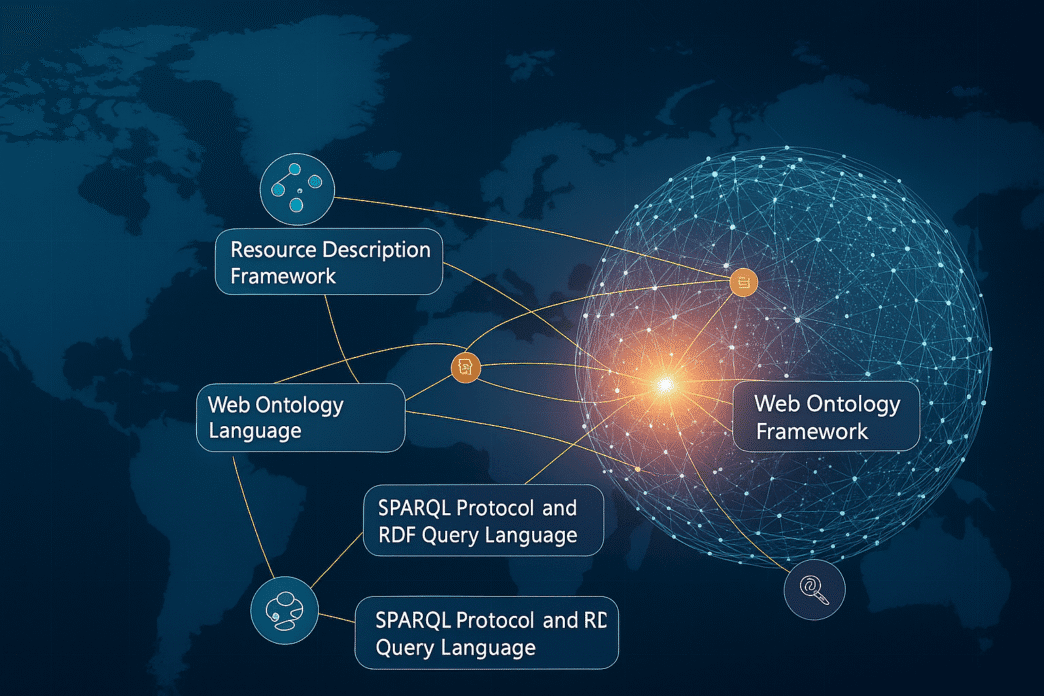
Both knowledge graphs and the Semantic Web rely on identical foundational technologies:
1. RDF (Resource Description Framework)
The universal language for expressing relationships in subject-predicate-object format (called triples). For example:
- Subject: “Tim Berners-Lee”
- Predicate: “invented”
- Object: “World Wide Web”
This simple structure allows machines to understand not just data points, but the relationships between them.
2. Ontologies (OWL – Web Ontology Language)
Define hierarchies, rules, and relationships about entities. An ontology might establish that “CEO” is a type of “Employee,” and “Employee” works for “Company”—therefore enabling machines to infer that a “CEO” works for a “Company” even when not explicitly stated.
3. Schema.org Markup
The practical implementation that SEO professionals use daily. When you add schema markup to your website, you’re applying Semantic Web standards to feed knowledge graphs with structured data about your brand, products, and content.
4. Linked Data Principles
Both connect information across different sources on the web, creating a unified knowledge network rather than isolated data silos.
5. Unique Identifiers (URIs/IRIs)
Every entity receives a unique identifier across the web, ensuring consistency when different systems reference the same concept.
Why This Matters Now: The AI Search Revolution
Andrea Volpini, Founder and CEO of WordLift, recently noted: “After 25 years, the Semantic Web has finally arrived. The idea that agents can reach a shared understanding by exchanging ontologies and even bootstrap new reasoning capabilities is no longer theoretical.”
The catalyst? Generative AI search engines that depend entirely on structured, semantic knowledge to generate answers.
Recent data reveals the urgency:
- 83% of consumers find AI-powered search more efficient than traditional search engines
- 91% of frequent AI users turn to large language models like ChatGPT for searches
- 60% of consumers click through after seeing AI-generated overviews in Google Search
- Forrester predicts AI-powered search will drive 20% of all organic traffic by end of 2025
When someone asks ChatGPT “What’s the best CRM for enterprise brands?”, the AI doesn’t search web pages—it queries its internal knowledge graph built from semantically structured data it has ingested from across the web.
If your content lacks semantic structure, AI systems can’t properly understand, categorize, or cite it.
From Theory to Practice: The Adobe-Semrush Deal Proves the Point
Adobe’s recent announcement to acquire Semrush for $1.9 billion (expected to close in H1 2026) demonstrates how seriously major tech companies take this semantic shift. Adobe isn’t buying Semrush primarily for traditional SEO tools—they’re investing in Generative Engine Optimization (GEO) capabilities that help brands structure their knowledge for AI discoverability.
Anil Chakravarthy, President of Adobe’s Digital Experience Business, explained: “Brand visibility is being reshaped by generative AI, and brands that don’t embrace this new opportunity risk losing relevance and revenue.
The acquisition specifically targets Semrush’s expertise in helping brands appear in AI-generated responses through proper semantic structuring—essentially, implementing Semantic Web principles to populate knowledge graphs.
Key Differences SEO Professionals Should Understand
While deeply connected, there are important distinctions:
| Semantic Web | Knowledge Graphs |
|---|---|
| Broader vision for entire web as connected data | Specific implementation as organized database of entities |
| Decentralized across the entire internet | Typically centralized within one system (Google’s, your company’s) |
| Protocol and standards (how to structure data) | Product or application (actual database to use) |
| Open W3C standards | Can be proprietary (Google’s is closed) |
| Historically theoretical/academic | Practical and commercial |
Think of it this way: Semantic Web gave us the grammar rules for machine-readable data. Knowledge graphs are the sentences we write using those rules.
The SEO Workflow Connection
When you implement schema markup on your website, you’re participating in both ecosystems simultaneously:
The chain of connection:
- Semantic Web = The foundational technology and standards
- Schema Markup = Your implementation of those standards
- Knowledge Graphs = Systems (Google’s, AI engines’) that consume your structured data
- AI Answers = The visible output users see in search results
Every piece of schema markup you add—whether Organization schema, Person schema, Article schema, or FAQ schema—helps AI systems build more accurate knowledge graphs about your brand.
Practical Implementation for SEO Success
To leverage this connection effectively, SEO professionals should focus on:
1. Build Entity-Based Content Architecture Stop thinking in keywords alone. Structure content around entities and their relationships. A software company shouldn’t just optimize for “best CRM integrations”—they should define their relationship to concepts like “CRM,” “workflow automation,” “customer data platforms,” and “sales enablement.
2. Implement Comprehensive Schema Markup
- Organization schema: Company identity, logo, social profiles
- Person schema: Author credentials, expertise areas
- Article schema: Publication metadata, author attribution
- Product schema: Specifications, pricing, reviews
- FAQ schema: Direct answers to common questions
- HowTo schema: Step-by-step process documentation
3. Create Verifiable Authority Signals AI models cross-validate multiple sources. Include clear citations, author credentials, and links to authoritative sources. The goal isn’t just to be searchable—it’s to be “knowable” as a trusted entity.
4. Build Internal Knowledge Graphs Map relationships between your content, products, team members, and topics. Use internal linking strategically to reinforce these connections. Create dedicated pages for core entities rather than mentioning them only in passing.
5. Monitor AI Representation Use tools like SE Ranking, Peec AI, Profound, or Conductor to track how AI systems represent your brand. Run regular queries in ChatGPT, Perplexity, and Google AI Overviews to audit your knowledge graph presence.
The New Success Metrics
Traditional SEO metrics remain important, but the knowledge graph era requires additional measurements:
- AI Citations: Frequency of content references in AI-generated responses
- Answer Visibility Share: Percentage of relevant queries where your content appears in AI answers
- Semantic Coverage: Breadth of related entities and subtopics your brand consistently appears for
- Entity Recognition: How accurately AI systems understand and describe your brand
Looking Forward: The Convergence Continues
The lines between Semantic Web and knowledge graphs will continue blurring as these technologies mature. What remains clear is that both are essential for modern SEO success.
As AI-powered search becomes dominant, brands face a fundamental choice: continue optimizing for traditional keyword-based search, or evolve toward semantic entity optimization that makes them genuinely “knowable” to AI systems.
The Semantic Web provided the vision and technical framework. Knowledge graphs made it practical and profitable. And now, AI search engines have made it absolutely necessary.
For SEO professionals, the question isn’t whether to adopt semantic strategies—it’s how quickly you can implement them before your competitors do.
Key Takeaways
✅ Knowledge graphs are the practical implementation of Semantic Web principles
✅ Both use identical technologies: RDF, ontologies, schema markup, and linked data
✅ AI search engines depend on semantic structure to generate accurate answers
✅ Schema markup is your bridge between Semantic Web standards and knowledge graph inclusion
✅ Success requires thinking in entities and relationships, not just keywords
✅ The $1.9B Adobe-Semrush deal proves enterprise investment in semantic capabilities
More Resources:
- How LLMs Interpret Content: How To Structure Information For AI Search
- Merging SEO And Content Using Your Knowledge Graph To AI-Proof Content
- Entity SEO: What It Is & How to Optimize for It