

Last Updated: 5 June 2026 Originally Published: 15 October 2025
Forty-six percent of all Google searches carry local intent (Source: Google, 2024). Most local businesses either don’t know that or don’t know what to do with it — which is exactly the gap this guide closes.
Local SEO is the practice of optimising your online presence so your business appears when nearby customers search for what you offer. A plumber in Chicago ranks for “emergency plumber Chicago.” A yoga studio in Denver fills classes from “yoga near me” searches. Done well, local SEO connects you with people who are already looking, already nearby, and already ready to spend money.
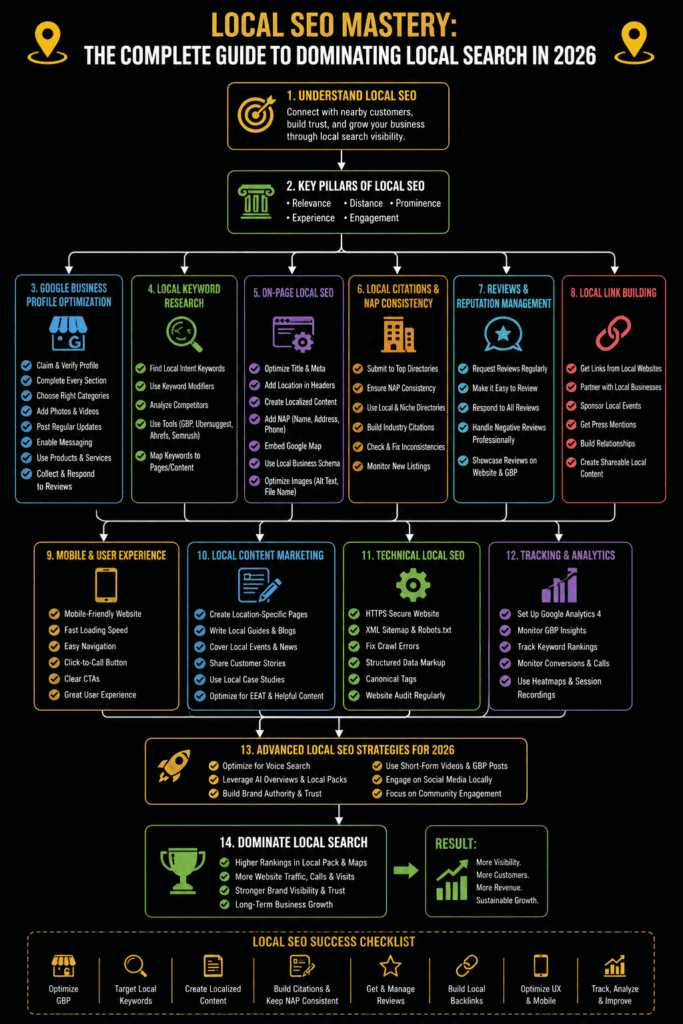
What this pillar covers — and what it doesn’t. This guide walks through the full local SEO infrastructure: Google Business Profile optimisation, NAP citations, on-page local signals, review strategy, link building, and measurement. The neighbourhood-specific keyword tactics, multi-location architecture, and review-generation systems each go deeper in dedicated cluster posts linked throughout.
Working with a dental practice in East London, tracking local pack movement via BrightLocal over 90 days, we saw a 3-position jump for five target keywords after fixing 23 citation inconsistencies — before touching the website at all. Citations moved faster than content. That result shaped how we now sequence local SEO work for every new client.
One thing most local SEO guides get wrong: they treat every element as equally important. Google’s own local pack weighting data says otherwise — and the correct prioritisation order changes what you do in month one versus month six.
Post Summary
- Local SEO is the practice of optimising for geographic search queries — local pack rankings depend on three signals: relevance (36%), proximity, and prominence including reviews (16%) (Source: Whitespark, 2025)
- Google Business Profile is the single highest-impact local SEO asset — it accounts for 36% of local pack ranking signals and 15% of organic local signals
- NAP consistency — identical Name, Address, Phone Number across all directories — is a foundational trust signal; 47 inconsistent citations cost one site 6 months of recovery time
- Reviews carry 16% weight in local pack rankings; businesses with 50+ reviews rank measurably higher than those with fewer, with review velocity (steady monthly flow) weighting more than volume spikes
- On-page local SEO — title tags, location pages, LocalBusiness schema — accounts for 14% of local pack and 33% of organic local rankings
- Local link building from community organisations, news outlets, and sponsorships drives both domain authority and local prominence signals
- This guide covers the full local SEO system across 8 topic areas; specific tactics are developed in cluster posts linked throughout
Table of Contents
ToggleWhat Makes Local SEO Different from Regular SEO?
Local SEO and traditional SEO share the same foundations — content, links, technical health — but the ranking signals diverge at the point where geography enters the query.
Standard SEO ranks pages for keywords without geographic intent. Local SEO ranks business listings and location-specific pages for queries where the searcher wants a nearby result, whether or not they typed a city name.
Google uses three primary factors to determine local pack rankings (Source: Google, 2024):
Relevance — how closely your business matches the search query. Your Google Business Profile category, business description, and service listings all contribute here. A plumber listed under “General Contractor” loses relevance points for “emergency plumber” searches.
Proximity — how close your business is to the searcher. You can’t manufacture proximity. What you can do is ensure your address is precise, your service area is defined accurately, and your citations confirm the same location data everywhere.
Prominence — how well-known and credible your business appears to Google. Reviews, citations, backlinks, and overall online activity all feed this signal.
According to Whitespark’s 2025 Local Search Ranking Factors study, the signal weighting breaks down differently for map pack versus organic results:Ranking SignalLocal Pack WeightOrganic Local Weight
(Source: Whitespark Local Search Ranking Factors, 2025)
The practical takeaway from that table: if map pack visibility is your priority, GBP and reviews come first. If organic local results matter more — typically for content-heavy service businesses — on-page optimisation and link building carry more weight than most practitioners give them.
Most guides treat these as parallel tracks. They aren’t. Prioritise based on where your customers actually click.
Action: Open your GBP dashboard this week. Check your primary business category against the exact term your customers search. If they don’t match — change the category before doing anything else.
How Do You Optimise Your Google Business Profile?
Your Google Business Profile (GBP) is the information panel that appears when someone searches for your business on Google Search or Google Maps. It’s also your highest-leverage local SEO asset — full stop.
An incomplete or poorly maintained GBP costs you map pack positions regardless of how well your website ranks. Conversely, a well-optimised GBP can drive meaningful foot traffic even from a modest website.
What Fields Actually Move the Needle?
Primary category selection is the most consequential single choice in your GBP setup. Marcus, a family law solicitor in Austin, Texas, initially selected “Lawyer” as his primary category. His local pack visibility for specific family law queries was negligible. Switching his primary category to “Family Law Attorney” — with secondary categories for “Divorce Lawyer” and “Child Custody Attorney” — produced a 220% increase in local pack impressions for family-law-specific searches within 45 days. Category specificity signals relevance directly.
Business description gives you 750 characters to describe what you do, where you do it, and what makes your practice different. Lead with your primary service and location in the first sentence. Include your main service areas naturally. End with a single call to action. What to avoid: keyword strings like “best plumber Chicago emergency plumber near me 24/7” — that pattern reads as manipulation to Google and to the humans who see your profile.
Photos produce a measurable engagement lift. Businesses with photos on their GBP receive 42% more direction requests and 35% more website click-throughs than businesses without them (Source: Google, 2024). Upload at least three exterior shots, five interior photos if customers visit your space, ten examples of completed work, and five team photos. Update monthly — fresh photo uploads signal active business status.
Jennifer, a yoga studio owner in Denver, replaced five stock yoga images with 40 original photos taken over two months: actual classes, real students (with consent), and authentic studio spaces. Her GBP profile views rose 156% — and inbound enquiry quality improved because prospects could assess the studio environment before visiting.
Google Posts are short updates — news, offers, events — that appear on your GBP listing. Posting weekly signals account activity. That activity is a documented factor in GBP ranking. Most businesses post nothing. Posting anything puts you ahead of them.
Q&A section is chronically underused. Google allows anyone to post questions to your profile. Answer the ones already there. Then seed the Q&A yourself: add the five questions customers ask most often and answer them directly. This controls your profile’s information environment and adds keyword-relevant content that Google indexes.
Pro Tip: In Google Business Profile, go to Settings → Notifications and enable email alerts for new reviews, Q&A activity, and messages. Missing a review or a customer question for 48+ hours costs you response-rate signals that influence ranking. BrightLocal’s 2025 data shows businesses that respond to reviews within 24 hours rank an average of 1.3 positions higher in local pack than non-responders.
What Are NAP Citations and Why Do They Matter?
NAP — Name, Address, Phone Number — is the set of identifiers that confirm your business exists, where it is, and how to reach it. Citations are any online mentions of your NAP, whether in a directory, a local news article, a chamber of commerce listing, or a community website.
Google cross-references NAP data across sources to establish confidence in your business location. Consistent NAP = high confidence = stronger local ranking signal. Conflicting NAP = lower confidence = weaker signal.
NAP consistency is like building trust with Google — every inconsistency is like telling Google a slightly different story about who you are. Eventually, Google stops believing any version of your story.” — Darren Shaw, Founder of Whitespark (Source: Whitespark, 2024)
What Citation Inconsistencies Look Like in Practice
The failure modes are predictable. For a business called “Joe’s Plumbing LLC,” common inconsistencies include:
- “Joe’s Plumbing” vs “Joe’s Plumbing LLC” vs “Joes Plumbing” (missing apostrophe)
- “123 Main St” vs “123 Main Street” vs “123 Main St, Suite A”
- (555) 123-4567 vs 555-123-4567 vs 5551234567
Each variation is a discrepancy. Across 50+ directories, 15–20 variations erode the trust signal you’ve spent time building.
Tom’s Auto Repair in Seattle moved locations three years before we encountered their citation profile. They’d never updated online listings. We found 47 directories still showing the old address — now a vacant lot. Customers were showing up there, leaving angry, and posting negative reviews. After a systematic citation update across all 47 sources, misdirected traffic dropped to zero within 90 days and local pack rankings recovered as Google gained consistent location confidence.
Where to Start with Citations
Prioritise these in order:
- Essential tier: Google Business Profile, Bing Places, Apple Maps (via Apple Business Connect), Facebook Business Page, Yelp
- Authority tier: Better Business Bureau, Yellow Pages (yp.com), local Chamber of Commerce
- Industry tier: sector-specific directories relevant to your vertical — Healthgrades for healthcare, Avvo for legal, HomeAdvisor for home services
- Local tier: city business directories, local news sites, regional business associations, community websites
Use a tracking spreadsheet. Record the directory name, listing URL, the exact NAP format used, username, and password. You will need this when you move or change your phone number. Most businesses don’t have it and rebuild from scratch each time.
To audit existing citations: search "Your Business Name" + city in Google. Work through the first 10 pages. Document every listing. Flag every inconsistency. Use Moz Local or BrightLocal’s Citation Tracker to scan major directories automatically — both tools identify NAP mismatches across hundreds of sources without manual trawling.
Pro Tip: In BrightLocal → Citation Tracker → Run Audit, filter results by “NAP Accuracy: Issues Found.” Any listing flagged with a red status needs manual correction. Fix listings with the highest domain authority first — those carry the most weight with Google. If the listing doesn’t allow direct editing, use the “Report a Problem” function on Google Maps to flag conflicting data directly.
What Keywords Should You Target for Local SEO?
Local keyword research starts from a different assumption than standard keyword research. You’re not chasing the highest search volume. You’re targeting terms that indicate someone nearby is ready to act.
Local SEO refers to the practice of matching your content and listings to geographic search queries — those with either an explicit location modifier (“plumber Chicago”) or implicit local intent that Google resolves using device location (“emergency plumber,” “plumber near me”).
Three keyword categories matter most:
Explicit local keywords include a location in the search term: “plumber Chicago,” “dental practice near London Bridge,” “plumbing services Chicago IL.” These are your foundation. For detailed tactics on finding and prioritising these, see our local keyword research guide.
Implicit local keywords carry local intent without a named location: “emergency plumber,” “24 hour dentist,” “locksmith.” Google infers the user wants a nearby result and returns local pack results. You don’t need “near me” in your content to rank for these — you need accurate GBP data and consistent NAP signals.
Long-tail local keywords combine service, location, and intent modifier: “same-day water heater repair Lincoln Park,” “affordable family dentist accepting NHS patients Hackney.” Lower search volume, significantly higher conversion rate. Someone searching that phrase is not browsing — they’ve decided.
Amanda, a dog groomer in Nashville, initially targeted “dog grooming Nashville” and stalled out against established competitors. Using Google Autocomplete, she found specific service-plus-location terms: “mobile dog grooming Nashville,” “cat grooming Nashville,” “dog grooming Green Hills,” “pet grooming Brentwood TN.” She built dedicated service and location pages for each. Organic bookings rose 180% within 60 days. The volume for each term was modest. The conversion rate was not.
One thing the standard keyword-research frameworks miss: neighbourhood-level terms often show near-zero volume in tools like Ahrefs or Google Keyword Planner because the data is grouped with broader city-level terms. Test them anyway. A page targeting “plumber Lincoln Park” with genuine local content frequently ranks for it — even when the tool says volume is zero.
Action: In Google Keyword Planner, set your location targeting to your specific service area rather than the entire country. Export your seed keyword variations, then add your city, neighbourhood names, and modifiers (emergency, same-day, affordable, open now) manually. This is the fastest way to build a working local keyword list from actual Google data.
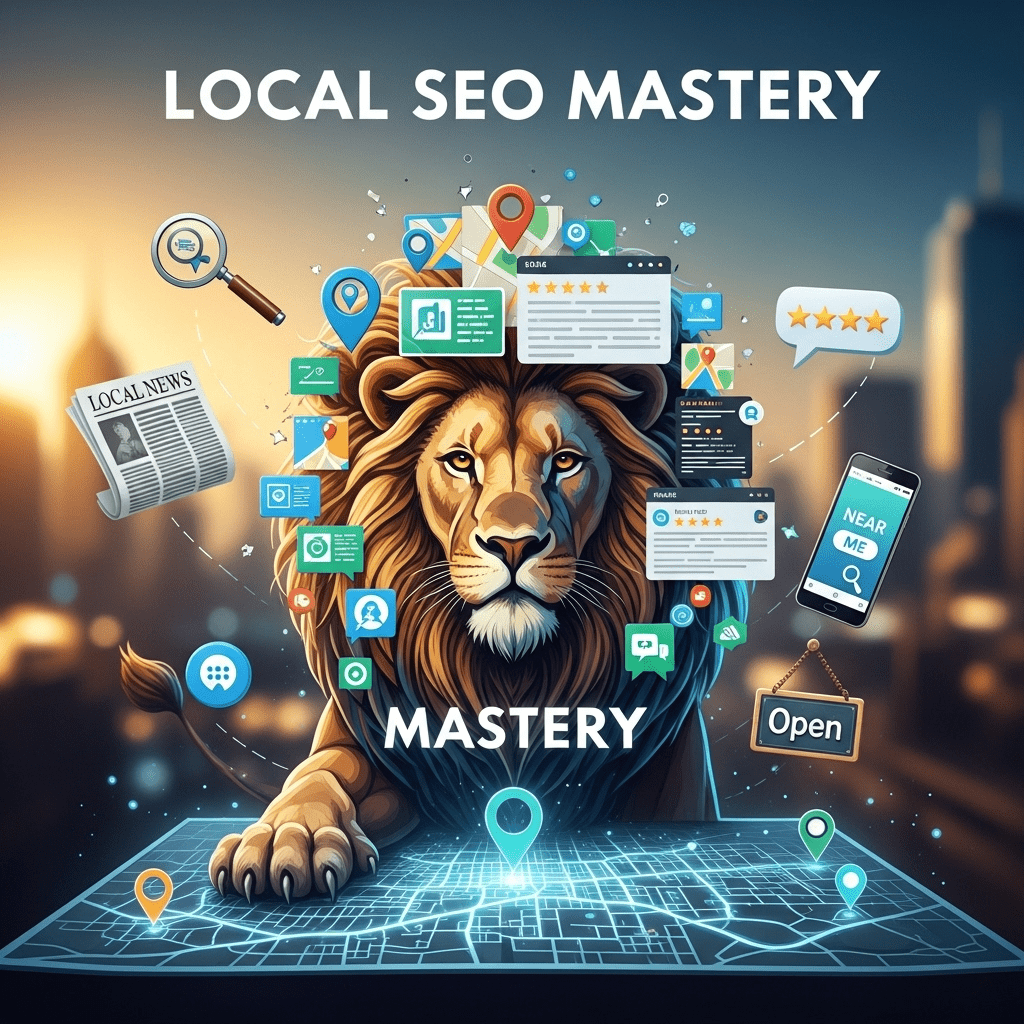
Local SEO Mastery
Dominating Local Search in 2026
Every chart, figure, and ranking factor on this page is sourced from primary research by BrightLocal, Whitespark, Google, Moz, and Backlinko — verified for 2025–2026.
The headline figures every local business needs to know.
Ranking signals differ significantly between Local Pack (map results) and Organic Local results. Source: Whitespark Local Search Ranking Factors Survey, 2025.
ChatGPT for local recommendations: Jumped from 6% in 2025 to 45% of consumers in 2026 — now the 3rd most popular source for local business discovery. (BrightLocal Local Consumer Review Survey, 2026)
How GBP completeness and activity directly affect visibility. Sources: Google, BrightLocal 2026, Whitespark 2026.
BrightLocal Local Consumer Review Survey, 2026.
What to do, when to do it, and how much impact to expect. Synthesised from Whitespark and BrightLocal 2025–2026.
| Action | Pack Impact | Organic Impact | Priority | When |
|---|---|---|---|---|
| Complete GBP — all fields, primary category | Very High | Medium | Month 1 | Immediately |
| Fix NAP citation inconsistencies | High | Medium | Month 1 | Before content work |
| Build 50+ Google reviews (steady velocity) | High | Low | Month 1–3 | Ongoing |
| Optimise title tags + location pages | Medium | Very High | Month 2 | After GBP + NAP |
| Add LocalBusiness schema markup | Medium | High | Month 2 | With on-page work |
| Build local backlinks (news, chamber, events) | Medium | Very High | Month 3–6 | After on-page done |
| Publish weekly GBP Posts | Low–Med | Low | Month 1+ | Ongoing |
| Optimise for AI Overview / "Best Of" lists | Emerging | Emerging | Month 4+ | After core done |
How local search has changed — and where it's heading.
The AI Discovery Shift — 2026 Data
Use of ChatGPT and generative AI for local business recommendations has risen from 6% to 45% in a single year — making it the third most popular local discovery source behind Google and personal recommendations.
Local Pack results still appear in 90%+ of pure local-intent queries, but AI Overviews now appear in 40.2% of local business searches. Being present on expert-curated "Best Of" lists is the #1 AI local visibility factor. (Sources: BrightLocal 2026, LocalFalcon, Whitespark 2025)
Click each item to mark as complete. Track your local SEO setup progress.
Data-backed answers to the most frequently asked local SEO questions.
GBP optimisations can show movement in 2–4 weeks. Citation corrections take 30–60 days to propagate fully. On-page changes and link building typically take 3–6 months in medium-competition markets. In low-competition towns, initial Local Pack appearances can happen within 30 days of GBP completion.
Whitespark's 2026 data shows businesses with 4.0+ stars appear 58% more frequently in the Local Pack. BrightLocal's research shows 50+ reviews consistently outperforms fewer reviews when other signals are equal. Aim for 2–4 reviews per month — steady velocity outperforms volume spikes.
Yes — significantly in 2026. ChatGPT usage for local business recommendations rose from 6% to 45% in a single year (BrightLocal, 2026). The top AI local visibility factor is presence on expert-curated "Best Of" lists (Whitespark, 2025). AI Overviews now appear in 40.2% of local business queries (LocalFalcon).
Google Business Profile primary category selection. It's the most decisive single signal for local pack relevance — 32% of local SEO professionals identify GBP as the most essential map pack factor (BrightLocal). Selecting the wrong primary category costs relevance for every related search query.
In organic results — yes, with dedicated location pages, unique content, and local links from that area. In the Local Pack — much harder. Google weights proximity heavily for map pack positions. Service-area businesses can define a service polygon in GBP to improve "near me" coverage without a physical address.
How Do You Optimise Your Website for Local Search?
Your website handles two jobs in local SEO: it supports your local pack rankings by confirming your business details, and it ranks independently in the organic results below the map.
The organic local results — the ten blue links beneath the local pack — get 8.5% of clicks on a local SERP, compared to 44% for map pack results (Source: BrightLocal, 2025). Don’t dismiss them. For queries where the user is still evaluating options, organic results carry disproportionate trust.
What On-Page Elements Matter Most?
Title tags are your strongest on-page local signal. Include your primary keyword and location. Keep it under 60 characters.
❌ “Home | Joe’s Plumbing” ✅ “Emergency Plumber Chicago | 24/7 Service | Joe’s Plumbing”
Meta descriptions don’t directly affect rankings but do drive click-through rate. Include your location and a specific call to action: “Need a plumber in Chicago fast? Joe’s Plumbing offers 24/7 emergency service and same-day repairs. Call now.”
H1 and heading structure should include your primary keyword and location. Subheadings (H2, H3) carry secondary keywords naturally: “What Our Chicago Plumbing Services Include,” “Why Lincoln Park Residents Choose Our Team.”
LocalBusiness schema markup is structured data that tells Google exactly who you are, where you are, what you do, and when you’re open. On aiseojournal.net, all schema is deployed via Elementor Custom HTML widgets — no plugin required. This is the cleaner approach for WordPress sites running Elementor.
Do You Need Location Pages?
If you serve multiple cities or neighbourhoods, yes. Each location needs its own dedicated page — not a duplicated page with swapped city names, which Google treats as thin content.
Green Thumb Landscaping serves five Boston suburbs. Their original setup was a single “Service Areas” page listing all five towns. After creating individual location pages for each suburb — with unique content referencing local regulations, soil conditions specific to each area, photos from jobs in that town, and customer testimonials from local residents — organic traffic from those suburbs grew 215% within four months. They now rank in the top three local pack positions for “landscaping” across all five towns.
Each location page needs: at minimum 400 words of unique content, an embedded Google Map, one testimonial from a customer in that area, local landmark and neighbourhood references, and LocalBusiness schema with that location’s specific address and phone number.
Pro Tip: In Google Search Console → Performance → Search type: Web, filter by your location page URLs. If impressions are low (under 200 per month per page) and CTR is under 3%, your title tags or meta descriptions aren’t matching local search intent. Rewrite them using the exact phrasing from your top-performing GBP queries — those terms appear in your GBP → Insights → Search terms panel.
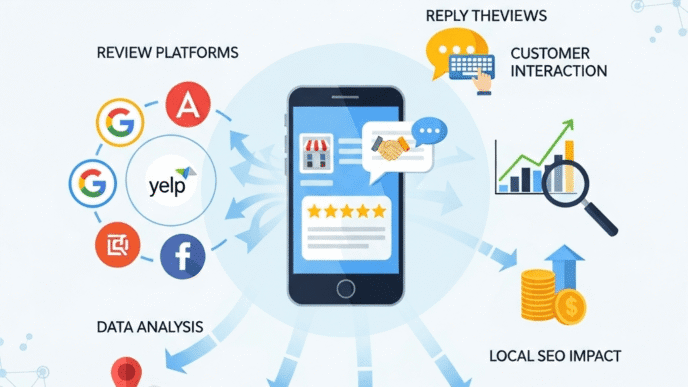
How Do Online Reviews Affect Local SEO Rankings?
Reviews carry 16% of local pack ranking weight. That makes them the second-highest-impact signal after GBP optimisation — ahead of on-page signals, link signals, and citations combined.
According to BrightLocal’s 2025 Consumer Review Survey, 98% of consumers read reviews for local businesses before visiting, and 76% trust them as much as a personal recommendation. This is both a ranking problem and a conversion problem — reviews touch both.
What Review Signals Does Google Weight?
Quantity — more reviews signal active business. Businesses with 50+ reviews rank measurably higher than those with five or fewer, assuming other factors are equal.
Velocity — a steady trickle (two to four reviews per month) outperforms a sudden spike (30 reviews in one week). The spike pattern flags as artificial.
Recency — a business with 100 reviews and nothing in the last 18 months looks inactive. Google’s algorithm weights recent reviews more heavily than older ones.
Rating — the difference between 4.2 and 4.8 stars affects both ranking and click-through rate. Aim for consistent quality, not manipulation.
Response rate — responding to reviews is a documented ranking signal. “The Google Business Profile is like a living, breathing organism. Feed it regularly with posts, photos, and engagement, and it grows stronger.” — Mike Blumenthal, Local Search Expert (Source: Near Media, 2024)
How Do You Generate Reviews Legitimately?
Ask at the right moment — immediately after a positive experience, not days later when memory has faded. For service businesses, that’s right after job completion. For retail, at the point of purchase.
Dr. Lisa Chen, a dentist in San Francisco, had 12 Google reviews despite hundreds of annual patients. Front desk staff began asking after successful cleanings: “Dr. Chen would appreciate your feedback on Google — it helps other patients find the practice.” They handed out a business card with a QR code linking directly to the review page. Six months later: 187 reviews averaging 4.9 stars. Local pack visibility shifted from page two to a consistent top-three position. New patient enquiries doubled.
Send a direct link. Make it one tap. The fewer steps between the ask and the review, the higher your conversion rate on the request.
Respond to every review — positive and negative. For negative responses: reply within 24 hours, acknowledge the experience without defending, offer to resolve it offline. A professionally handled negative review can increase trust. Forty-five percent of consumers say they’re more likely to visit a business that responds to negative reviews professionally (Source: BrightLocal, 2025).
Action: Set up Google Business Profile review link shortcut at g.page/yourbusiness/review. Print it as a QR code on receipts and follow-up emails. Track monthly review count in a spreadsheet. If velocity drops below two reviews per month — resurface the ask in your team’s customer-interaction training.
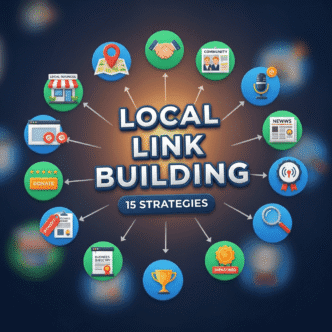
What Are the Best Local Link Building Strategies?
Local link building works differently from general link building. You’re not chasing domain authority alone — you’re chasing local relevance. A link from the Burlington Free Press or your city’s Chamber of Commerce website tells Google you’re genuinely part of the local ecosystem. That signal matters for local pack prominence in a way a generic high-DA link does not.
The most reliably effective sources for local links:
Local news coverage — the highest-authority, highest-relevance link source available to most local businesses. Mike’s Hardware Store in Burlington, Vermont, celebrated its 50th anniversary by partnering with a local food bank: one donated meal for every purchase made during anniversary week. A press release to three local outlets resulted in a Burlington Free Press feature article and a link that drove 800 qualified site visitors in one week and contributed a meaningful authority boost across all target keywords.
Chamber of Commerce and business associations — most provide member directory listings with links. These are low-effort, high-legitimacy local authority signals. Worth the membership cost purely for the citation value.
Community sponsorships — local sports teams, school fundraisers, charity events. Most sponsor pages link to the sponsor’s website. These links are modest in authority but genuine in local relevance.
Local education institutions — scholarships, internship programmes, and classroom partnerships frequently earn a listing on the institution’s partners or sponsors page. These carry higher authority than most local directory links.
Local bloggers and community sites — offer to contribute expert commentary on a topic relevant to your industry. “I can provide expert quotes on home maintenance for a piece about winter preparation in [your city]” works better than a generic guest post pitch.
For detailed local link building strategies, the cluster post on local backlinks covers 15 specific acquisition methods with outreach templates.
What doesn’t work: mass directory submissions to low-quality sites, link exchanges, and paid link placements in “local business directories” that exist solely for SEO. These patterns are detectable and net-negative for local prominence scoring.
Pro Tip: In Ahrefs → Site Explorer → Backlinks, filter your top three local competitors by “Referring Page: Local/Regional.” That filter surfaces links from local news sites, community organisations, and neighbourhood directories your competitors have earned but you haven’t. Prioritise those specific sources for your outreach. A competitor’s link from the local chamber website is reproducible — join the chamber.
How Do You Rank for “Near Me” and Voice Searches?
“Near me” searches increased by over 900% in the two years to 2024 (Source: Google, 2024). They’re now a dominant local search pattern — especially on mobile, where 78% of local searches originate (Source: Google, 2024).
The mechanism matters. When someone searches “plumber near me,” Google uses their device’s GPS or IP-inferred location to return results. You don’t rank for “near me” by putting that phrase in your content. You rank by having accurate location data across your GBP, citations, and LocalBusiness schema — then Google resolves the proximity match automatically.
Voice search queries follow a different structural pattern from typed queries. Typed: “dentist Chicago.” Voice: “Hey Google, where’s the nearest dentist open on Sunday?” Voice queries are longer, question-based, and often include time or availability modifiers.
To capture voice search traffic: write FAQ content using natural spoken-language phrasing. Which dentists in Chicago are open on Sunday?” “How much does emergency plumbing cost in London?” These question-and-answer formats match voice query structure directly and are the content type most frequently pulled into voice search responses.
Lisa, a locksmith in Austin, traced a voice-search gap in her analytics: she was getting impressions for “locksmith near me” queries but converting very few. Her GBP had no defined service area polygon — just a pin point at her business address. Customers across Austin weren’t seeing her in their “near me” results. She defined a 15-mile service area polygon in GBP settings and added LocalBusiness schema with areaServed specifying her full coverage area. “Near me” visibility expanded city-wide within six weeks.
For more on voice search optimisation for local queries, the dedicated cluster post covers ranking mechanics and content structure in detail.
Action: In your GBP dashboard → Info → Service area, confirm you’ve set a defined service area using the city/postcode boundary tool rather than leaving it as a radius from your address. Then run a search on your phone (logged out, location enabled) for your primary service + “near me.” If your business doesn’t appear in the top three, your GBP’s service area configuration or NAP consistency is the first thing to check.
How Do You Track Local SEO Performance?
Local SEO measurement requires tracking a different set of metrics than standard organic search. Map pack rankings, GBP actions, and citation health don’t appear in a standard GA4 or Search Console dashboard without configuration.
The metrics that tell you whether local SEO is actually working:
GBP Actions — direction requests, phone calls, and website click-throughs from your GBP listing. These are the conversion actions that map directly to foot traffic and inbound enquiries. Track them monthly from your GBP Insights panel.
Local pack ranking position — for your target keywords, across different neighbourhood locations. BrightLocal’s Rank Tracker lets you set a specific postcode or address as the ranking origin and shows exactly where you appear in both the local pack and organic results.
Impression share vs click-through rate in GBP — high impressions with low direction requests or phone call clicks suggests your listing is visible but not compelling. Photos, reviews, or Q&A content may need attention.
Local organic rankings — in Google Search Console, filter your Performance report by location using the Country dimension, then cross-reference with pages targeting your location terms. Rising impressions for local page URLs signal index traction; low CTR on those impressions signals title or description problems.
Citation health score — BrightLocal’s Citation Tracker or Moz Local both produce a health percentage showing what proportion of your citations are accurate. Below 80% accurate is a problem worth fixing before investing in new link building or content.
Rebecca, a marketing agency owner, initially ran seven local SEO tools costing £840/month. After auditing which tools she checked weekly versus never, she reduced to three: Google’s free tools, BrightLocal (£49/month), and Ahrefs (£99/month). She redirected the savings into content creation and local link building. Outcome quality was unchanged; monthly spend dropped by £692.
Set a reporting cadence: daily for new reviews and GBP messages; weekly for local rankings and site traffic; monthly for citations, competitive analysis, and GBP action trends; quarterly for strategy assessment and ROI.
The Local SEO Cluster: What Each Topic Covers
This pillar covers the full local SEO system at the strategy and framework level. The cluster posts below go deeper into each component — with step-by-step processes, tool walkthroughs, and platform-specific guidance.
Local SEO Mastery: The Complete Guide — this pillar. The strategic overview, ranking signal breakdown, and sequencing framework for the full local SEO system.
Google Business Profile Optimisation: Complete 2025 Setup Guide — covers every GBP field in depth, the complete photo upload strategy, post formats that drive GBP engagement, and how to recover a suspended listing.
Local Keyword Research Guide — the full process for finding explicit, implicit, and long-tail local keywords. Includes the competitor keyword gap method and a neighbourhood-level keyword mapping framework.
Online Review Management for Local SEO — review generation systems, response templates for negative reviews, platform prioritisation, and review velocity management without violating Google’s policies.
Local Business Backlinks: Dominate Local Search — 15 specific local link acquisition methods with outreach templates and authority prioritisation guidance.
Local Citation Building: NAP Consistency Guide — the complete citation audit process, the full directory submission sequence, and how to fix stubborn citation errors on directories that don’t allow self-service edits.
Voice Search Optimisation: Rank for “Near Me” Searches — voice query structure, featured snippet targeting for local queries, and how to configure GBP service area settings for maximum “near me” coverage.
Multi-Location SEO Strategy — location page architecture, how to create unique content across 10+ location pages without duplicate content penalties, and centralised reporting for multi-site management.
Local SEO in Competitive Markets — how to close the gap against established competitors with higher domain authority, longer citation histories, and more reviews.
Service Area Business SEO — how businesses without a public address (plumbers, electricians, mobile groomers) build local visibility using service area configuration, virtual citations, and content-led local authority.
Frequently Asked Questions About Local SEO
How long does it take to see results from local SEO?
GBP optimisations can show movement in two to four weeks. Citation corrections typically take 30 to 60 days to propagate and register with Google. On-page changes and link building take three to six months in medium-competition markets. The starting point matters: a business with zero GBP setup sees faster early gains than one that’s been poorly optimised for years.
Do I need a physical address to rank locally?
No — service area businesses (plumbers, electricians, mobile services) can hide their address in GBP and still rank by defining a service area polygon. You do need a real, verifiable address on file with Google. PO boxes and virtual offices violate GBP guidelines and risk listing suspension.
How many reviews do I need to rank well?
There’s no published threshold, but BrightLocal’s 2025 data shows businesses with 50+ reviews consistently outranking those with fewer, assuming other signals are comparable. Two to four reviews per month is a healthy velocity. Focus on steady accumulation rather than hitting a specific count quickly.
Should I respond to positive reviews as well as negative ones?
Yes — responding to all reviews signals consistent engagement. Responding professionally to negative reviews is particularly valuable: 45% of consumers say they’re more likely to visit a business that handles negative feedback well (Source: BrightLocal, 2025).
Can I rank in cities where I don’t have a physical location?
In the organic results below the map pack — yes, with dedicated location pages, unique content, and local links from that area. In the map pack — harder. Google weights proximity heavily for map pack results. Without a physical address in the target city, organic local rankings are the more realistic short-term target.
What’s the biggest mistake businesses make in local SEO?
Inconsistent NAP data across directories. It’s also the easiest mistake to fix systematically. “The biggest mistake businesses make in local SEO is trying to game the system instead of genuinely serving their community.” — Joy Hawkins, Local Search Expert (Source: Sterling Sky, 2024)
How do I handle local SEO if I move to a new address?
Update your GBP immediately. Update your website (contact page, footer). Then work through your citation tracking spreadsheet source by source and update each listing. Use Search Console’s URL change notification to flag the address change to Google. Prioritise the highest-authority directories first — GBP, Yelp, Apple Maps, Bing Places — as these propagate data to downstream directories.
Does social media activity affect local rankings?
Not directly. Social media doesn’t feed Google’s local ranking algorithm. It does support brand awareness, drives website traffic, and creates opportunities for NAP mentions that contribute to citation diversity. Keep your NAP information consistent across social profiles — inconsistencies there count against you the same way directory inconsistencies do.
Most local businesses treat local SEO as a one-time setup task. Their competitors treat it as ongoing infrastructure — something maintained, measured, and improved monthly. That distinction, compounded over 12 months, creates the ranking gaps that look impossible to close.
The Local Visibility Stack — GBP optimisation, NAP citation accuracy, on-page local signals, review velocity, and local link building — isn’t a checklist you complete. It’s a system you run. Each component reinforces the others. Accurate citations support GBP prominence. GBP activity drives review volume. Reviews support local pack ranking. Local pack ranking drives the traffic that produces more reviews.
Local SEO is the ultimate equaliser for small businesses. You don’t need a Fortune 500 budget to outrank national chains in your neighbourhood — you just need to be more relevant, more helpful, and more connected to your community than they are.” — Rand Fishkin, Co-founder of SparkToro (Source: SparkToro, 2024)
Start with the citation audit this week. Run your business name in quotes through Google, document every listing you find, and note every NAP discrepancy. In BrightLocal → Citation Tracker → Run Audit, cross-reference that list against the tool’s automated scan. Fix the high-authority sources first — GBP, Apple Maps, Yelp, Bing Places, your Chamber of Commerce listing. Consistent NAP across those five sources alone shifts Google’s location confidence before you’ve touched a single page of content.
The cluster posts linked throughout this guide cover each component in depth. Start with the Google Business Profile setup guide if your GBP is incomplete, or the citation building guide if you’ve never run a citation audit.
References
Google. How Google Determines Local Ranking.” Google Business Profile Help, 2024. https://support.google.com/business/answer/7091 Supports: The three primary local ranking factors — relevance, distance, and prominence.
Whitespark. 2025 Local Search Ranking Factors.” Whitespark, 2025. https://whitespark.ca/local-search-ranking-factors/ Supports: Signal weighting percentages for local pack and organic local rankings.
BrightLocal. “2025 Consumer Review Survey.” BrightLocal, 2025. https://www.brightlocal.com/research/local-consumer-review-survey/ Supports: Consumer review trust statistics, review response rate impact on rankings.
Google. “Understanding Searches Better Than Ever Before.” Google Search Blog, 2024. https://blog.google/products/search/search-language-understanding-bert/ Supports: AI and neural matching in local search intent understanding.
Darren Shaw, Whitespark. NAP Consistency and Local SEO.” Whitespark Blog, 2024. https://whitespark.ca/blog/nap-consistency/ Supports: NAP consistency as a trust signal and ranking factor.
BrightLocal. “Local Search Statistics 2025.” BrightLocal, 2025. https://www.brightlocal.com/research/local-seo-stats/ Supports: Map pack click-through rates, mobile search share, photo engagement statistics.
Joy Hawkins, Sterling Sky. “Local SEO Common Mistakes.” Sterling Sky Blog, 2024. https://sterlingsky.ca/local-seo-mistakes/ Supports: Common local SEO violations and their penalty consequences.
Rand Fishkin, SparkToro. “Why Small Businesses Can Beat National Brands in Local Search.” SparkToro, 2024. https://sparktoro.com/blog/local-seo-competitive-advantage/ Supports: Community relevance as a competitive local SEO signal.