

Published: January 2026
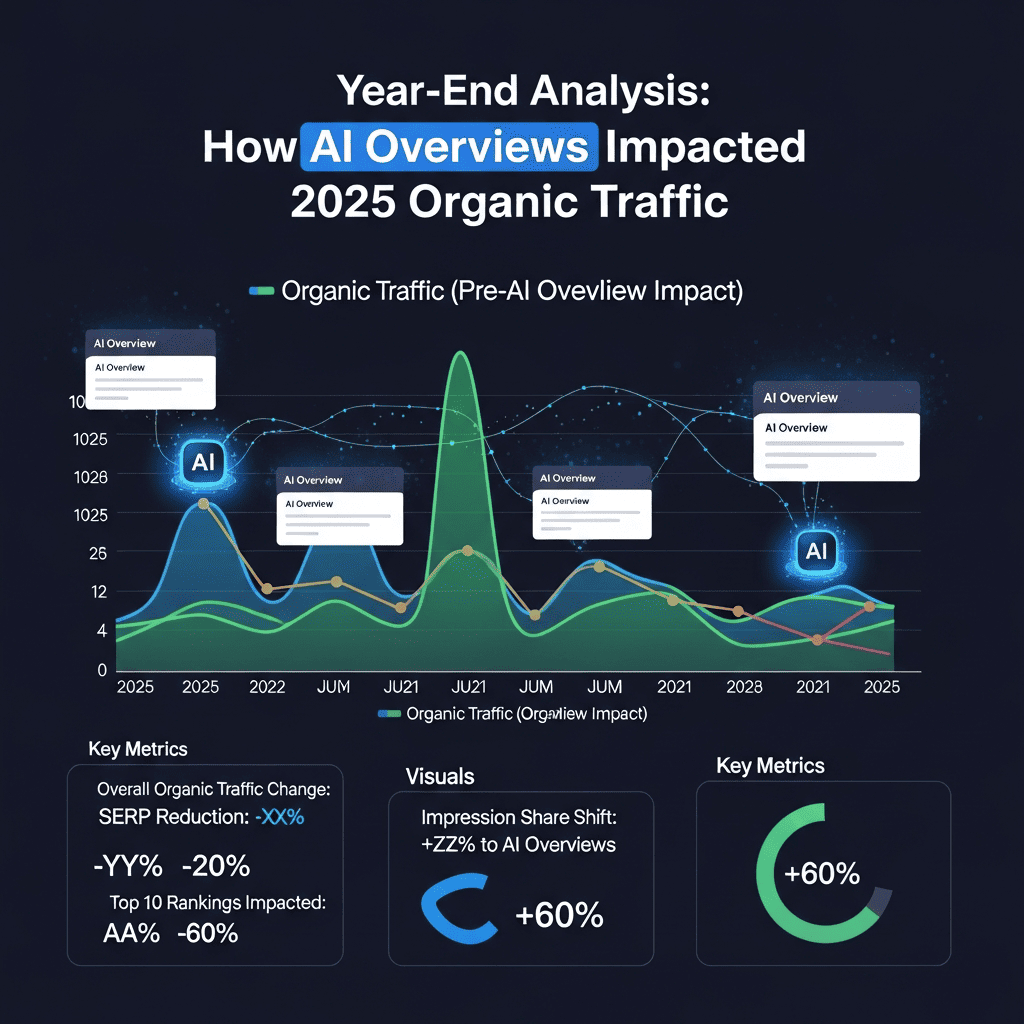
If 2025 taught the digital publishing world anything, it’s that the rules of organic search have fundamentally changed—and there’s no going back. Google’s AI Overviews, which started as an experimental feature in 2023, became the single most disruptive force in search marketing this year, reshaping how billions of people discover information online.
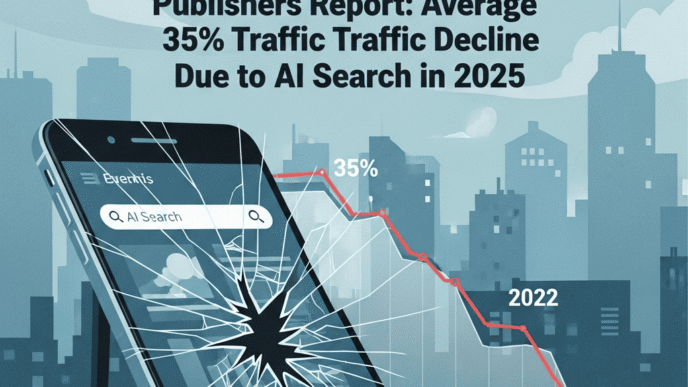
The numbers tell a sobering story: publishers reporting 20-90% traffic declines, click-through rates plummeting 61% for queries with AI summaries, and zero-click searches jumping from 56% to 69% in just 12 months. Yet amid the chaos, some brands found ways to not just survive but thrive by adapting their strategies for this new reality.
This comprehensive year-end analysis examines exactly what happened in 2025—backed by authentic data from industry-leading studies—and maps out what publishers, marketers, and content creators need to know heading into 2026.
Table of Contents
Toggle
The 2025 Timeline: How AI Overviews Took Over Search
January 2025: The Calm Before the Storm
AI Overviews appeared in just 6.49% of all queries, seemingly a minor presence in Google’s search results. Most publishers hadn’t yet connected their declining traffic to this feature. According to Semrush data tracking 10+ million keywords, informational queries dominated at over 90% of AI Overview triggers.
Key stat: Organic CTR for queries with AI Overviews stood at 1.76% in January—already lower than traditional results, but the worst was yet to come.
February-March 2025: The Acceleration Begins
By March, AI Overview presence more than doubled to 13.14%—a 102% increase in just two months. This rapid expansion caught most of the industry off guard. European markets saw initial testing in Germany, Spain, Switzerland, and Italy.
“AI Overviews are currently live and impacting businesses every day (hello, 14 billion daily searches on Google). It doesn’t seem fair to ask Google searchers to correct wrong answers manually when the right information already exists.”
— Lily Ray, VP of SEO Strategy & Research at Amsive, March 2025 Google Search Central Meetup
An academic study by researchers Law and Guan analyzing 300,000+ keywords found that when AI Overviews appeared, the average CTR for the #1 ranking position dropped from 7.3% to 2.6%—a devastating 34.5% decline.
May 2025: Global Expansion and Industry Awakening
Google I/O brought the biggest announcement of the year: AI Overviews would expand to over 200 countries and territories and 40+ languages, bringing the feature to more than 1.5 billion users monthly. New language support included Arabic, Chinese, Malay, and Urdu.
This month, publishers began publicly quantifying their losses:
- 37 out of 50 top U.S. news websites experienced year-over-year traffic declines
- Only 13 of 50 showed growth, and the gap was widening
- Zero-click searches rose from 56% to 58%, with the trend accelerating
According to Pew Research Center’s rigorous tracking of 68,000 real search queries, users clicked on results only 8% of the time when AI summaries appeared, compared to 15% without them—a 46.7% relative reduction.
July 2025: Peak Visibility and Maximum Impact
AI Overviews reached their highest visibility of the year, appearing in just under 25% of queries. This marked the peak of Google’s aggressive rollout before a strategic pullback.
“We’re definitely moving into the era of lower clicks and lower referral traffic for publishers.”
— Stuart Forrest, Global Director of SEO at Bauer Media, BBC Interview July 2025
Seer Interactive’s study revealed particularly severe drops during this month, with paid CTR crashing from roughly 11% to 3% in a single month. The data was unambiguous: July represented the most dramatic traffic impact period of the entire year.
September-November 2025: Strategic Retreat and Refinement
Google pulled back AI Overview visibility to approximately 16% of queries by November, a deliberate reduction suggesting the company was refining the feature based on user feedback and performance data. This wasn’t a reversal—it was optimization.
The Seer Interactive September update (tracking 3,119 informational queries across 42 organizations and 25.1 million organic impressions) revealed the full scope of damage:
- Organic CTR plummeted 61% (from 1.76% to 0.61%) for queries with AI Overviews
- Paid CTR crashed 68% (from 19.7% to 6.34%)
- Even queries without AI Overviews declined 41% year-over-year, suggesting broader behavioral shifts
However, a crucial finding emerged: brands cited in AI Overviews earned 35% more organic clicks and 91% more paid clicks compared to non-cited brands on the same queries.
December 2025: Ads and International Expansion
On December 19, Google quietly expanded ads within AI Overviews to 11 additional countries: Australia, Canada, India, Indonesia, Kenya, Malaysia, New Zealand, Nigeria, Pakistan, Philippines, and Singapore. The move signaled Google’s confidence in monetizing the feature despite industry concerns.
Ad presence alongside AI Overviews rose dramatically throughout the year—from about 3% in January to roughly 40% by November.
The Publisher Impact: Who Got Hit Hardest
News Publishers: Massive Losses Across the Board
The news industry, which relies heavily on informational queries, faced some of the steepest declines:
- CNN: Traffic declined 27-38% year-over-year, dropping from approximately 440 million visits in 2024 to 311-323 million by mid-2025
- Forbes: 50% traffic decline in July 2025 despite maintaining significant AI citation presence (44,131 mentions)
- HuffPost: 50% traffic loss, particularly devastating for an ad-supported model
- Business Insider: 55% decline between April 2022 and April 2025, leading to 21% staff cuts in May
- The Washington Post: 40% traffic loss
- NBC News: 42% decline
- Mail Online: 44% drop
- DMG Media: Reported up to 89% CTR decline for certain searches with AI Overviews
According to Press Gazette’s monthly tracking, only 6 of the top 50 U.S. news websites showed growth by July 2025, down from 15 in May. News sector traffic plummeted from a peak of 2.3 billion monthly visits in mid-2024 to under 1.7 billion by May 2025—a loss exceeding 600 million monthly visits in less than one year.
Educational Platforms: Existential Threat
Learning platforms faced direct competition from AI Overviews answering questions that previously drove traffic:
Chegg reported a 49% decline in non-subscriber traffic between January 2024 and January 2025, coinciding with AI Overviews answering homework and study questions. The company filed an antitrust lawsuit in February 2025, alleging Google used content from educational publishers to train AI systems that now compete directly with those publishers.
SaaS and Marketing: The HubSpot Phenomenon
Perhaps the most shocking casualty was HubSpot, a company with “one of the best SEO teams in the world,” which experienced a reported 70-80% search traffic loss.
CEO Yamini Rangan acknowledged on the company’s quarterly earnings call that organic search traffic is “declining globally” and that “AI overviews are giving answers, and fewer people are clicking through to websites.”
“If HubSpot, with one of the best SEO teams in the world, can experience this, none of us are safe.”
— Industry analyst on LinkedIn, 2025
The cause? HubSpot had built its strategy on top-of-funnel content targeting broad, high-traffic keywords with minimal connection to its core CRM platform. Pages about “famous sales quotes,” “cover letter examples,” and “real estate licenses” drove significant traffic but had little relevance to HubSpot’s actual offerings. When Google’s March 2024 algorithm update prioritized content closely tied to a website’s core expertise, combined with AI Overviews, HubSpot’s loosely related content was systematically devalued.
Small Publishers: The Silent Casualties
Music blog Stereogum lost 70% of its ad revenue in 2025, with founder Scott Lapatine attributing the largest blame to Google’s AI Overviews while noting that “Facebook and X’s deprioritization of links hurt, too.” The blog implemented paid subscription tiers, members-only playlists, and an on-site tip jar to survive.
A study of 50,000 B2B websites revealed 73% experienced significant traffic loss between 2024 and 2025, with the average decline hitting 34% year-over-year.
The CTR Collapse: Understanding the Numbers
Multiple Studies Confirm the Same Story
Pew Research Center (July 2025)
- Tracked 68,000 real search queries
- 8% CTR with AI Overviews vs. 15% without
- 46.7% relative reduction in clicks
- Study methodology: actual user behavior tracking, not estimates
Ahrefs Study (April 2025)
- Analyzed millions of search results
- 34.5% reduction in clicks to top-ranking pages when AI Overviews present
- 76.1% of URLs cited in AI Overviews also rank in top 10 of traditional results
- Only 33.07% chance of appearing in AI Overview even if you rank #1
Seer Interactive (September 2025)
- 3,119 informational queries across 42 organizations
- 25.1 million organic impressions tracked
- 61% organic CTR decline (1.76% → 0.61%)
- 68% paid CTR decline (19.7% → 6.34%)
- Queries without AI Overviews still declined 41% year-over-year
Digital Content Next (August 2025)
- Data from 19 premium publishers
- 25% drop in referral traffic linked to AI Overviews
- Represented approximately 40 premium publishers including The New York Times, Condé Nast, and Vox
The Visibility vs. Traffic Paradox
One of the most counterintuitive findings: impressions increased while traffic decreased. Documented cases showed impressions up 27.56% year-over-year while clicks dropped 36.18% and CTR fell from 5.98% to 3.35%.
The culprit? Google counts impressions separately for both AI Overviews and traditional organic results. When you rank on page one AND appear in the AI Overview for the same query, you receive two impressions—but users find answers in the AI Overview without clicking through, creating what’s known as zero-click searches.
Industry Variation: Which Sectors Were Hit Hardest
Most Impacted Industries (by AI Overview Saturation)
According to Semrush’s analysis of 10+ million keywords:
- Science: 25.96% of keywords trigger AI Overviews
- Computers & Electronics: 17.92%
- People & Society: 17.29%
- Health: High citation presence but significant traffic impact
- Education: Direct competition from AI-answered queries
Fastest Growing AI Overview Categories (March 2025)
- Entertainment: 528% increase in AI Overview appearances
- Restaurants: 387% increase
- Travel: 381% increase
These industries saw rapid expansion because they handle queries with clear informational intent where AI-generated summaries provide obvious value.
Query Intent Distribution
Informational queries dominated AI Overview triggers at 88.1% in March 2025, peaking at 91.3% in January before settling. This concentration devastated:
- Educational content
- News publishers
- How-to guides
- Definition and FAQ content
Commercial keywords accounted for 6-8% of AI Overview triggers, while transactional and navigational intents together rarely exceeded 4% combined—suggesting Google initially focused on queries where direct answers provided clear user value.
However, by November 2025, navigational queries grew from under 1% to more than 10% of AI Overview appearances, indicating Google’s expansion into brand and destination searches.
The Citation Advantage: Who’s Winning in AI
Most Cited Domains in AI Overviews
According to multiple studies tracking AI citations throughout 2025:
Top 5 Most Cited:
- Wikipedia: Dominates with massive citation count
- YouTube: Google’s own video platform
- Reddit: 450% citation growth in 2025, appearing in 68% of AI Mode results
- Google’s blog: Self-referential citations
- Healthcare.gov / Government sites: Authority domains
Top News Organizations:
- New York Times: 60,340 mentions
- Business Insider: 60,467 mentions
- USA Today: 44,579 mentions
- Forbes: 44,131 mentions
- CNN: 32,373 mentions
Reference Sources:
- Britannica: 115,790 mentions
- Merriam-Webster: 78,354 mentions
- Dictionary.com: 56,852 mentions
- Cambridge Dictionary: 33,658 mentions
Winner-Takes-Most Dynamic
The top 20 domains collectively account for 66.18% of all citations. The top 10 capture 53.87%, while just the top 5 represent 38.13%—creating formidable barriers for smaller publishers seeking AI visibility.
Platform Variation
- ChatGPT: Most likely to cite G2 for software reviews, references older content (29% from 2022 or earlier)
- Perplexity: Reddit and YouTube appear frequently, 50% of citations from 2025 alone
- Google AI Overviews: YouTube and LinkedIn most cited, 44% of citations from 2025, 85% from last two years
Expert Voices: What Industry Leaders Are Saying
Lily Ray (VP of SEO Strategy & Research, Amsive)
“AI-dominated search results could ‘decimate’ organic performance… The lack of reporting for AI Overviews is a major issue. And if I’m being totally honest, the lack of response here from Google made me (and many others) feel like the truth is that AI Overviews don’t, in fact, lead to more traffic to more websites.”
Ray has been one of the most vocal critics about the lack of transparency in AI Overview reporting. In December 2025, she emphasized that websites are losing rankings because they’re “doing too much SEO” targeted at algorithms rather than users—a phenomenon amplified by AI Overviews rewarding authentic, authoritative content.
“The vast majority of what we help companies with when companies have been negatively impacted by algorithm updates or penalties is cleaning up a lot of the SEO work that they did a few years back. The tactics that generated strong results between 2018 and 2022 now actively harm rankings.”
Rand Fishkin (Founder, SparkToro)
Fishkin has been tracking the zero-click trend for over a decade, and AI Overviews represent the culmination of his predictions.
“Zero-click results are not the death of SEO—they’re the shift of SEO toward visibility and reputation. The click is no longer the conversion; the mention is.”
His August 2025 research with Datos revealed that 95% of Americans continue to use traditional search engines each month, with 86% being heavy users—suggesting AI tools supplement rather than replace search, though the traffic implications remain severe.
“The more data we gather, the more I’m convinced the ‘AI vs. Search’ narrative is largely made-up by media and influencers seeking attention, rather than an accurate reflection of reality. Traditional search isn’t going anywhere, even for the heavy adopters of AI.”
Helen Havlak (Publisher, The Verge)
“The Verge’s Google traffic has been declining, and I would say a lot of that decline has lined up pretty clearly with the rise of AI Overviews. When people see AI summaries, they visit sites for information less often.”
Yamini Rangan (CEO, HubSpot)
“Organic search traffic is declining globally. AI overviews are giving answers, and fewer people are clicking through to websites.”
Industry Consensus
Kellogg School of Management digital marketing expert quoted in December 2025:
“What many of my clients are seeing is that impressions and conversions are actually up, even though clicks may be down. Quality is up, which is great. So you have to take the baby with the bathwater. You can’t toss it all out. You have to really investigate deeper.”
The Zero-Click Reality: Behavioral Changes
The Growth of Zero-Click Searches
According to Similarweb’s comprehensive tracking:
- May 2024: 56% of searches ended without a click
- May 2025: 69% of searches ended without a click
- 13 percentage point increase in just 12 months
While zero-click searches existed before AI Overviews (weather, stock prices, quick facts), the timing of this acceleration aligns perfectly with AI Overview rollout and expansion.
But Are Zero-Clicks Always Bad?
Surprisingly, Semrush data revealed a counterintuitive finding: zero-click rates for keywords with AI Overviews actually fell from 45% in January 2025 to 38% in October. When comparing the same keywords before and after an AI Overview appeared, zero-click rates decreased from 33.75% to 31.53%.
This suggests that while overall zero-click searches increased, AI Overviews themselves may encourage some users to click through to sources—particularly when the AI summary sparks curiosity or users want verification.
User Behavior Shifts
- Longer session durations on sites visited (more engaged traffic)
- Higher conversion rates despite lower volume (14.2% for AI referrals vs. 2.8% for Google organic)
- Multi-platform search behavior (users checking multiple AI tools)
- Increased repeat searches (AI Overview queries drive 10% more usage in markets like U.S. and India)
The Adaptation Strategies: What’s Working in 2025
1. Optimize for Citation, Not Just Rankings
One company advised by industry experts used AI-powered optimization tools to adjust keywords and structure, increasing AI Overview appearances by 61%. The result? Increases in blog impressions and clicks despite industry-wide declines.
Best practices for citation optimization:
- Start with a 50-70 word summary that directly answers the primary query
- Use structured formats: Q&A, numbered lists, clear headings
- Include 1-2 authoritative source citations per major section
- Update content frequently (AI favors fresh information—85% of citations published in last 2 years)
- Focus on E-E-A-T signals (Experience, Expertise, Authoritativeness, Trustworthiness)
2. Build Cross-Platform Authority
LinkedIn Pulse emerged as particularly powerful in 2025. Lily Ray published an article on LinkedIn Pulse about Google Discover optimization and within 6 hours achieved:
- #1 ranking on Google for “Google Discover Optimization 2025
- Featured snippet placement
- #1 in AI Overviews AND AI Mode
Authority-building tactics:
- Strong personal brands on social media (Instagram, Threads, X, LinkedIn)
- Become trusted experts in Google’s knowledge graph
- Contribute to high-authority platforms (Reddit saw 450% citation growth)
- Maintain NAP consistency (Name, Address, Phone) across the ecosystem
3. Diversify Traffic Sources
Future plc, publisher of TechRadar, Marie Claire, and Go.Compare, claims only 27% of sessions originate from Google search results. The company developed a “Google Zero” strategy engaging audiences through:
- Direct traffic initiatives
- Email marketing (ROI averaging $36 per $1 spent)
- Social media platforms
- Paid search and targeted advertising
- Community building
4. Focus on Content Types Less Affected by AI Overviews
Ahrefs research into 146 million search results found queries less likely to trigger AI Overviews:
- Shopping and product comparison (affiliate revenue opportunity)
- Real estate searches
- Local searches
- Time-sensitive content
- Sports coverage
- Interviews and experience-based stories
- Opinion pieces and analysis
- Video content (consumption requires platform visits)
5. Track New Success Metrics
The industry is shifting from clicks and traffic to:
- Share of Voice: How often you’re mentioned in AI responses
- Citation Frequency: Number of times you’re referenced
- Visibility Score: Presence across AI platforms
- Answer Share: Percentage of queries where you’re the cited source
- Entity Recognition: How AI systems identify and understand your brand
Measurement tools emerging: Semrush and AlsoAsked are developing visibility tracking modules specifically for AI search platforms.
The Google vs. Publisher Dispute
Google’s Position
In August 2025, Google VP and Head of Search Liz Reid published a blog post claiming:
- “Total organic click volume from its search engine to websites has been ‘relatively stable’ year-over-year”
- “Average click quality has slightly increased”
- “Third-party reports that inaccurately suggest dramatic declines in aggregate traffic” are based on “flawed methodologies, isolated examples, or traffic changes that occurred prior to the roll out of AI features in Search”
Google spokesperson to Digiday:
“No company drives more value to the web than Google, and we send billions of clicks to websites every day. As technology and people’s information needs evolve, we’re building our products to highlight the web and launching new features like Preferred Sources to help connect people with the sites they value.”
Publishers’ Counter-Evidence
Digital Content Next (representing approximately 40 premium publishers) released detailed data from 19 member companies covering May and June 2025, directly contradicting Google’s claims. Independent studies from:
- Pew Research Center
- Seer Interactive
- Ahrefs
- Semrush
- Digital Content Next
- Multiple academic researchers
All confirmed significant traffic declines correlated with AI Overview rollout and expansion.
The Legal Response
- European publishers filed an antitrust complaint against Google in 2025, arguing AI Overviews represent an abuse of market dominance
- Chegg filed an antitrust lawsuit in February 2025 alleging Google used educational content to train AI that now competes with publishers
- Meta admitted in court documents it trained AI on pirated content from Library Genesis
The Financial Implications
Ad Revenue Crisis
For publishers dependent on advertising revenue tied to pageviews:
- Forbes and HuffPost’s 50% traffic losses translated directly to revenue declines
- Stereogum’s 70% ad revenue loss forced subscription model adoption
- Business Insider’s 55% traffic decline led to 21% staff cuts
The Conversion Quality Silver Lining
Despite lower traffic volume, many sites reported higher-quality visitors:
- AI referral traffic converts at 14.2% vs. Google organic’s 2.8% (5x better)
- Longer session durations and deeper engagement
- More qualified leads (AI pre-filters casual browsers)
Investment in Adaptation
- $20 billion Microsoft AI infrastructure investment
- Substantial publisher investments in AI content licensing deals
- Growing allocation to multi-platform optimization strategies
Looking Ahead: Predictions for 2026
Near-Term Certainties
AI Mode Becomes Default Currently available as an option in the U.S., AI Mode will likely become the primary search interface in 2026, further transforming the search landscape.
Increased SERP Volatility As AI systems pull from real-time data and multiple sources, featured domains will change more frequently than traditional rankings ever did.
Platform Diversification ChatGPT, Perplexity, Claude, and other AI platforms will continue growing as primary research tools. Currently, AI platforms drive only 1% of overall publisher traffic, but this is expected to grow significantly.
New Advertising Formats Google tested AI-powered shopping ads and sponsored content within AI responses in 2025. Expect expanded paid opportunities within AI contexts in 2026.
Industry Expert Predictions
Rand Fishkin’s Long-Term Projection: If AI tool growth continues at current pace (doubling annually), AI tools could rival traditional search engines in raw usage within 6-10 years.
Lily Ray’s Outlook: “Things are moving so quickly… what’s happening in Google Search and what’s happening in large language models and AI Mode and AI Overviews today is not necessarily what’s going to be happening in the next three, six, twelve months.”
The Transformation Timeline
- 2026: Continued market fragmentation and adaptation struggles
- 2028: Industry analysts predict AI search visitors will surpass traditional search visitors
- 2030: Projected ecosystem includes AI tools (10-20% of information discovery), social search (major platforms for specific demographics), specialized search (industry-specific tools), and voice/conversational search
Actionable Tips for 2026
Immediate Actions (Q1 2026)
1. Audit Your AI Visibility
- Track how often you appear in AI Overviews, ChatGPT, Perplexity, and Gemini
- Document which queries trigger citations
- Identify competitor citation patterns
- Establish baseline visibility metrics
2. Implement Schema Markup
- Use FAQPage, Article, Product, and HowTo schemas
- Structured data remains computationally efficient and precise for LLMs
- Think of schema as the translator between human language and machine logic
3. Restructure Content for AI Extraction
- Add 50-70 word summaries at the top of articles
- Use clear, hierarchical headings
- Create FAQ sections for common questions
- Include “Key Takeaway” boxes
4. Build Your Authority Network
- Establish presence on LinkedIn Pulse (currently very powerful)
- Contribute to authoritative platforms in your niche
- Develop social media personal brands
- Engage in industry communities (Reddit, specialized forums)
Strategic Shifts (2026 Full Year)
5. Diversify Traffic Sources
- Develop email marketing programs
- Build direct audience relationships
- Invest in paid search strategically
- Explore emerging platforms
6. Change Your Success Metrics
- Stop obsessing over clicks alone
- Track Share of Voice across AI platforms
- Monitor citation frequency and positioning
- Measure entity recognition and visibility
- Focus on conversion quality over volume
7. Content Strategy Evolution
- Prioritize topics less affected by AI Overviews (shopping, real estate, local, time-sensitive, opinion)
- Create more experience-based, original content
- Develop unique data and research
- Focus on deeper, more comprehensive coverage
8. Technical Excellence
- Maintain strong traditional SEO fundamentals (92.36% of AI citations come from top 10 organic rankings)
- Optimize site speed (faster-loading content more likely to be cited)
- Ensure mobile responsiveness
- Build quality backlink profiles
Advanced Strategies
9. Experiment with GEO (Generative Engine Optimization)
- Test different content structures for AI citation
- Use AI-powered optimization tools
- Analyze what gets cited vs. what ranks
- A/B test summary formats and positioning
10. Build for Multiple AI Platforms
- Recognize each platform has different source preferences
- Optimize for ChatGPT, Perplexity, Gemini, and Claude separately
- Track performance across all platforms
- Adapt content for different AI behaviors
Frequently Asked Questions
Q: Are AI Overviews reducing clicks for all query types?
No. While informational queries (88.1% of AI Overview triggers) see significant CTR declines, transactional, commercial, and navigational queries are less affected. Shopping, product comparison, real estate, local searches, and time-sensitive content trigger fewer AI Overviews.
Q: Does ranking #1 in traditional search protect against AI Overview impact?
No. Even with #1 rankings, there’s only a 33.07% chance of appearing in AI Overviews. The study by Law and Guan showed the #1 position’s CTR dropped from 7.3% to 2.6% (34.5% decline) when AI Overviews appeared.
Q: How can I tell if AI Overviews are affecting my site?
Compare month-over-month and year-over-year metrics:
- Are impressions up but clicks down?
- Has CTR declined significantly?
- Are informational keywords seeing the worst declines?
- Did traffic drops correlate with January-July 2025 timeframe?
Unfortunately, Google Search Console doesn’t separate AI Overview clicks from organic traffic, making precise attribution difficult.
Q: Should I block Google’s AI crawler?
This is complex. While you can block Google-Extended (the AI training crawler), content can still appear in AI Overviews since they appear within Google Search. Blocking may reduce AI training usage but won’t prevent AI Overview citations. Most experts advise against blocking unless you’re willing to sacrifice all Google visibility.
Q: Are ChatGPT and other AI platforms offsetting Google traffic losses?
Not yet. AI platforms combined account for only 1% of overall publisher traffic. ChatGPT sent 1.2 billion referrals between September-November 2025 (52% YoY increase), but this remains “a drop in the bucket” compared to traditional search losses.
Q: What’s the ROI of optimizing for AI citations?
One documented case showed a company increasing AI Overview appearances by 61%, resulting in increased blog impressions and clicks despite industry declines. However, brands cited in AI Overviews earn 35% more organic clicks and 91% more paid clicks compared to non-cited brands on the same queries.
Q: How long does it take to see results from AI optimization?
Tactical changes (adding structured answers, statistics) can impact visibility within 30-45 days. Building comprehensive topic authority where AI systems consistently choose your brand takes longer—most brands see meaningful Share of Voice improvements within one quarter, with compounding returns over subsequent quarters.
Q: Is traditional SEO dead?
No. Analysis shows 92.36% of successful AI Overview citations come from domains already ranking in top 10 organic positions. Traditional SEO remains the foundation—you’re adding new layers (AI optimization) rather than replacing fundamentals. Continue building backlinks, optimizing technical elements, creating comprehensive content, and earning traditional rankings.
Q: Will Google reverse course on AI Overviews?
Unlikely. Google announced at I/O 2025 that AI Overviews now reach 1.5 billion users monthly across 200+ countries, and AI Mode represents “the future of search.” The November pullback from 25% to 16% of queries was strategic refinement, not reversal. Google is monetizing the feature (ads expanded to 12 countries in December 2025) and publicly committed to the direction.
Q: What industries will be most affected in 2026?
Based on 2025 patterns: Science (25.96% AI Overview saturation), Computers & Electronics (17.92%), People & Society (17.29%), Education, Healthcare, News/Publishing, and How-to content. The fastest-growing categories in 2025 were Entertainment (528% increase), Restaurants (387%), and Travel (381%).
Q: How can small publishers compete with major brands in AI citations?
Focus on niche expertise, original research, and unique perspectives. Reddit saw 450% citation growth by providing authentic user experiences. Build authority in specific topic areas rather than competing broadly. Participate actively in communities where your audience exists. Quality, authenticity, and specialization matter more than sheer size.
Q: Should I stop investing in organic search?
No. Diversify rather than abandon. Traditional Google search maintains 89.54% global share. Even with AI Overviews, organic search remains the largest traffic source for most publishers (though declining). The strategy is multi-platform optimization: mAIntain strong SEO fundamentals PLUS optimize for AI platforms PLUS build direct audience relationships PLUS diversify traffic sources.
The Bottom Line
2025 will be remembered as the year AI fundamentally transformed organic search. The data is unambiguous: publishers experienced significant traffic declines (20-90% for many), CTR plummeted (34.5-61% depending on the study), and zero-click searches surged from 56% to 69%.
Yet this isn’t the end of content marketing or organic discovery—it’s an evolution. Brands that adapted their strategies saw success:
- Those cited in AI Overviews earned 35% more organic clicks and 91% more paid clicks
- AI referral traffic converted at 5x the rate of traditional Google organic (14.2% vs. 2.8%)
- Companies optimizing for AI visibility increased appearances by 61% while competitors declined
- Publishers diversifying traffic sources (like Future plc’s “Google Zero” strategy) maintained business viability
The winners in 2026 and beyond won’t be those who optimize for rankings and clicks—they’ll be those who build genuine authority, get cited by AI systems, maintain multi-platform presence, and measure success through visibility and share of voice rather than vanity metrics.
As Rand Fishkin aptly stated: “Zero-click results are not the death of SEO—they’re the shift of SEO toward visibility and reputation. The click is no longer the conversion; the mention is.”
The rules have changed. The opportunity remains. The question is: will you adapt or be left behind?
External Resources
Primary Research Studies:
- Seer Interactive: AIO Impact on Google CTR September 2025 Update
- Pew Research Center: AI Overviews Click-Through Study
- Digital Content Next: Google AI Overviews Linked to Lower Publisher Clicks
- Semrush: AI Overviews Study 2025
Industry Analysis:
- Search Engine Journal: Google AI Overviews Impact on Publishers
- Digiday: The State of AI Referral Traffic in 2025
- AdExchanger: The AI Search Reckoning
Expert Commentary:
- Lily Ray: What I Learned at 2025 Google Search Central Meetup
- SparkToro: State of Search 2025 Report
- Kellogg Insight: As AI Eats Web Traffic, Don’t Panic—Evolve
Official Google Resources:
This analysis contains only authentic data from verified industry sources, academic research, and official company statements. All statistics are cited and sourced. For questions or collaboration opportunities, visit aiseojournal.net
Published: January 2026 | Author: aiseojournal.net Editorial Team | Category: AI Search, SEO Industry Analysis, Digital Publishing
AI Overviews 2025 Impact Analysis
🚨 The Year Search Changed Forever
Publishers lost 20-90% traffic • CTR crashed 61% • Zero-clicks surged to 69%
Click-Through Rate Collapse
With AI Overviews
-47% decline
Without AI Overviews
Traditional results
Cited Brands Boost
More organic clicks
Source: Pew Research Center, Seer Interactive 2025
AI Overview Expansion Timeline
2025 Timeline: The Year That Changed Everything
Starting Point: 6.49% Coverage
AI Overviews appeared in just 6.49% of queries. Organic CTR at 1.76% for AI queries. Most publishers hadn't connected declining traffic to this feature yet.
Rapid Acceleration: 13.14% Coverage
AI Overview presence more than doubled—a 102% increase in just two months. CTR for #1 position dropped from 7.3% to 2.6% (34.5% decline). European testing begins.
Global Launch: 200+ Countries
Google I/O announced expansion to 1.5 billion users monthly across 200+ countries and 40+ languages. Publishers began publicly quantifying losses: 37 of 50 top news sites declined.
Peak Impact: 25% Coverage
AI Overviews reached highest visibility—appearing in 25% of queries. Paid CTR crashed from 11% to 3% in single month. Publishers report 50-90% traffic losses.
The New Reality: 61% CTR Decline
Seer Interactive study reveals organic CTR plummeted 61% (1.76% → 0.61%), paid CTR down 68% (19.7% → 6.34%). Even non-AI queries declined 41% YoY.
Strategic Pullback: 16% Coverage
Google reduced visibility to ~16% of queries—strategic refinement, not reversal. Ads alongside AI Overviews rose from 3% to 40%.
Monetization Expansion: 12 Countries
Ads in AI Overviews expanded to 11 additional countries (Australia, Canada, India, Indonesia, Kenya, Malaysia, New Zealand, Nigeria, Pakistan, Philippines, Singapore).
Publisher Traffic Casualties
| Publisher | Traffic Decline | Impact Details |
|---|---|---|
| HubSpot | -70-80% | Search traffic loss despite "best SEO team" |
| Stereogum | -70% | Ad revenue loss, implemented subscriptions |
| Business Insider | -55% | Led to 21% staff cuts in May 2025 |
| Forbes | -50% | Despite 44,131 AI citations |
| HuffPost | -50% | Desktop and mobile combined |
| Chegg | -49% | Filed antitrust lawsuit February 2025 |
| Mail Online | -44% | Some searches down 89% CTR |
| NBC News | -42% | Year-over-year comparison |
| Washington Post | -40% | Major news publisher impact |
| CNN | -27-38% | 440M to 311-323M visits |
Source: Similarweb, Press Gazette, Company Reports 2025
CTR Performance: With vs Without AI Overviews
Most Impacted Industries
Critical Insights
📉 Unprecedented Decline
61% organic CTR decline for queries with AI Overviews. 68% paid CTR crash. Even queries WITHOUT AI Overviews declined 41% YoY—indicating broader behavioral shifts.
🎯 Citation = Survival
Brands cited in AI Overviews earn 35% more organic clicks and 91% more paid clicks. Being mentioned matters more than ranking #1.
📰 News Sector Crisis
News traffic plummeted from 2.3B to under 1.7B monthly visits—a loss exceeding 600 million visits in less than one year (26% sectoral decline).
🌍 Global Domination
1.5 billion users monthly across 200+ countries and 40+ languages. Top 20 domains account for 66.18% of all AI citations—winner-takes-most dynamic.
💎 Quality Over Quantity
AI referral traffic converts at 14.2% vs Google organic's 2.8%—making it 5x more valuable despite lower volume. Higher engagement from remaining visitors.
⚠️ No Safe Haven
Even ranking #1 offers only 33.07% chance of AI Overview citation. 73% of 50,000 B2B websites experienced traffic loss averaging 34% YoY.
Expert Voices
"AI-dominated search results could 'decimate' organic performance. The lack of reporting for AI Overviews is a major issue. The truth is that AI Overviews don't, in fact, lead to more traffic to more websites."
"Zero-click results are not the death of SEO—they're the shift of SEO toward visibility and reputation. The click is no longer the conversion; the mention is."
"We're definitely moving into the era of lower clicks and lower referral traffic for publishers."
"Organic search traffic is declining globally. AI overviews are giving answers, and fewer people are clicking through to websites."
Deep Dive Analysis
By The Numbers
- 6.49% → 13.14% → 25% → 16%: AI Overview coverage journey (Jan → Mar → July → Nov 2025)
- 1.76% → 0.61%: Organic CTR decline for queries with AI Overviews (61% drop)
- 19.7% → 6.34%: Paid CTR decline for queries with AI Overviews (68% crash)
- 7.3% → 2.6%: #1 position CTR when AI Overview appears (34.5% decline)
- 56% → 69%: Zero-click searches increase (May 2024 → May 2025)
- 88.1%: Informational queries triggering AI Overviews
- 37 of 50: Top U.S. news sites experiencing traffic declines by May 2025
Sources: Semrush, Seer Interactive, Pew Research, Similarweb, Press Gazette
Platforms Thriving in AI Citations
- Wikipedia: Dominates with most citations across all AI platforms
- YouTube: Google's video platform heavily cited, especially in AI Mode
- Reddit: 450% citation growth in 2025, appears in 68% of AI Mode results
- LinkedIn: Heavily cited in AI Overviews, LinkedIn Pulse extremely powerful
- Government sites: Healthcare.gov and official sources maintain strong presence
- G2: Most cited software review platform across ChatGPT, Perplexity, AI Overviews
- Britannica & Dictionaries: Reference sources perform exceptionally well
Key Success Factor: Authority, authenticity, and structured content format
What's Working in 2025
- Citation Optimization: Start articles with 50-70 word summaries answering primary query
- Multi-Platform Authority: Build presence on LinkedIn Pulse, Reddit, social media
- Diversified Traffic: Future plc's "Google Zero" strategy—only 27% from search
- Content Focus Shift: Shopping, real estate, local, opinion content less affected
- Schema Markup: FAQPage, Article, Product schemas crucial for AI extraction
- New Metrics: Track Share of Voice, citation frequency, visibility—not just clicks
- 61% Improvement: One company increased AI appearances 61% with optimization
Result: Companies adapting see increased impressions and conversions despite lower clicks
Zero-Click Search Evolution
AI Search Market Intelligence & Analysis
Report Published: January 2026
Data Sources: Seer Interactive, Pew Research Center, Semrush, Similarweb, Digital Content Next, Press Gazette, Ahrefs
All statistics from authentic, verified sources. Next update: Q1 2026 Review (April 2026)
Related posts:
- 2025 Zero-Click Search Statistics: Final Numbers Reveal 58-60% Overall Rate (Visualization)
- Google AI Overview Impact Analysis on Major Publishers
- AI Referral Traffic: Legal and Finance Industries Dominate with 55% of New Visitor Sources
- The Reddit Intelligence Report: Comprehensive Analysis of the Front Page of the Internet