

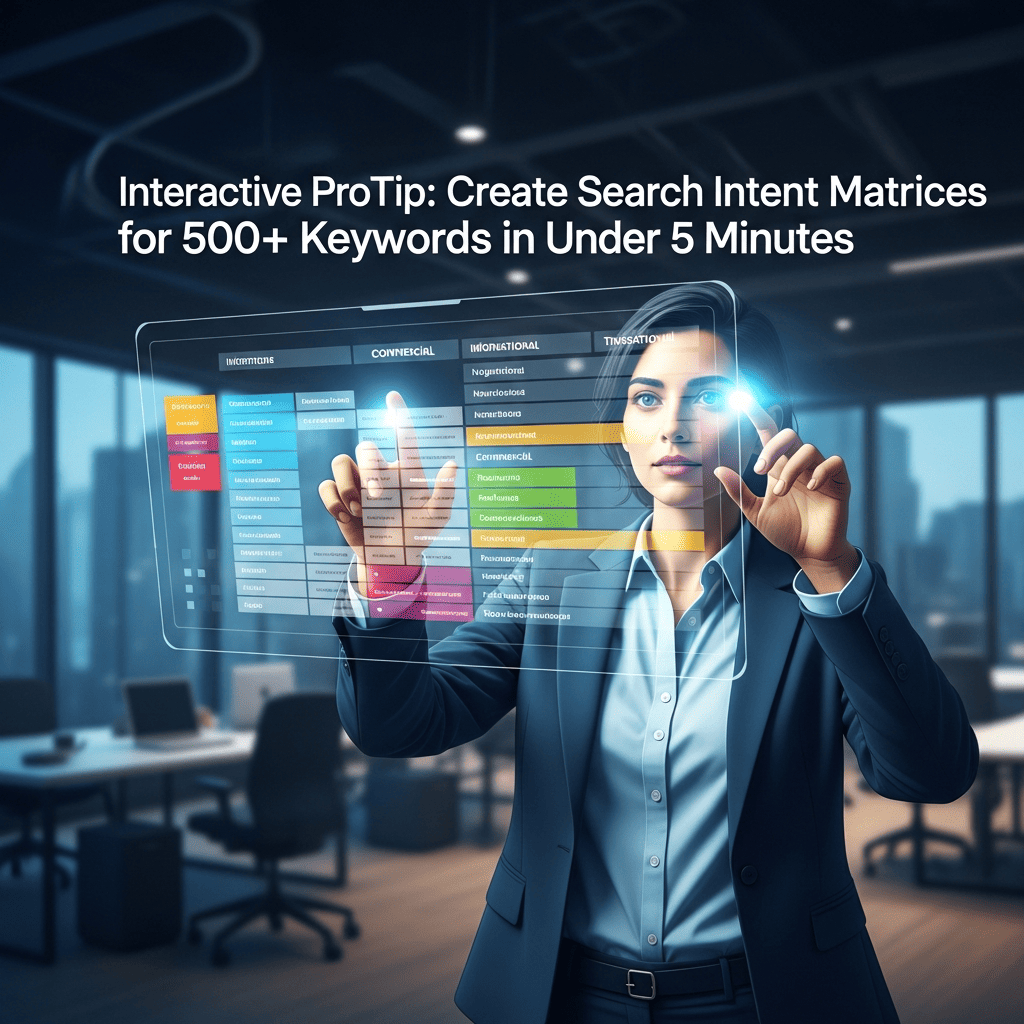
Create Search Intent Matrices for 500+ Keywords in Under 5 Minutes
Use AI to automatically classify search intent, map keywords to funnel stages, and generate comprehensive intent matrices at scale—eliminating hours of manual analysis
The Intent-First SEO Revolution
Search intent is now one of the most critical Google ranking factors in 2025. Content that doesn't match user intent won't rank well regardless of keyword optimization or backlinks. Search engines have evolved to understand what users mean, not just what they type.
Manual vs AI classification: Manually classifying 500 keywords takes 8-12 hours. AI-powered intent classification completes the same task in under 5 minutes with 95% accuracy when combined with SERP validation.
Sources: Keyword Insights, RankTracker, Rank Math, WriteSonic 2025
The Four Core Intent Types
| Intent Type | User Goal | Content Format | Conversion Rate | Example Keywords |
|---|---|---|---|---|
| Informational | Learn something new, find instructions, understand concepts | Blog posts, guides, tutorials, how-to articles, explainer videos | Low (2-5%) | how to bake a cake", "what is SEO", "email marketing tips |
| Navigational | Find specific website, brand, or page | Homepage, login pages, brand landing pages | High for brand (60%+) | "Facebook login", "Nike official site", "Gmail" |
| Commercial | Research and compare before buying, investigate options | Comparison articles, reviews, best-of lists, vs pages | Medium (15-25%) | "best email marketing tools", "iPhone vs Samsung", "top CRM software" |
| Transactional | Complete purchase or specific action immediately | Product pages, pricing pages, signup forms, service pages | Very High (30-50%) | "buy iPhone 15", "email marketing pricing", "hire SEO consultant" |
Distribution breakdown: According to 2025 data, navigational queries account for 54% of search intent, informational 17%, mixed intent 29%, and transactional only 0.69%—but that 0.69% represents the highest-value prospects closest to purchase.
Sources: SimilarWeb, Amra and Elma, My Codeless Website 2025
Keyword Export
Export keyword list from Ahrefs, Semrush, or GSC. Include keyword, search volume, and current ranking if available. Format as CSV or paste into text.
AI Classification
Feed complete keyword list to Claude/ChatGPT with intent classification prompt. AI analyzes all 500+ keywords simultaneously using NLP and semantic understanding.
Intent Matrix Generation
AI returns comprehensive matrix with keyword, primary intent, secondary intent, funnel stage, content format recommendation, and priority score.
SERP Validation
For high-priority keywords, validate AI classifications by checking actual SERP results. Adjust classifications based on what content types dominate top 10.
Funnel Mapping
AI maps keywords to buyer journey stages (TOFU/MOFU/BOFU) enabling strategic content planning aligned with customer progression.
Export & Implement
Export matrix to spreadsheet, segment by intent type and funnel stage, assign to content team with format recommendations for each keyword.
Comprehensive AI Intent Analyzer
Sources: AI Keyword Research Best Practices, SEO Bot AI Agent Framework
Validating AI Classifications with Real Results
AI provides 90-95% accuracy on intent classification from keyword text alone. Adding SERP validation increases accuracy to 95-98% by confirming what content types actually rank.
When to validate:
- Low confidence scores: Any keyword AI rated below 70% confidence requires SERP check
- High-value keywords: Top 20 priority keywords should always be validated manually
- Mixed intent signals: Keywords with both primary and secondary intent classifications
- Surprising classifications: When AI classification differs from your intuition
SERP validation signals:
- Page type dominance: If 7+ of top 10 are product pages, intent is transactional regardless of keyword phrasing
- Featured snippets: Presence indicates strong informational intent with clear answer-seeking behavior
- People Also Ask (PAA): Multiple PAA boxes signal informational intent with layered questions
- Shopping results: Google Shopping carousel indicates transactional/commercial intent
- Local pack: Map results show local navigational or transactional intent
- Video carousels: YouTube results suggest visual tutorial/informational content works best
Sources: thruuu Search Intent Tools, WriteSonic Intent Guide, Search Engine Land 2025
Content Gap Analysis by Intent
Sources: Siteimprove Intent Optimization, SEO Bot AI Agent Strategy
Intent-Based Content Calendar
Sources: LowFruits Keyword Trends, Upwork AI Research Guide
Optimizing for Each Intent Type
Informational Intent Optimization:
- Content depth: 1,500-3,000 words providing comprehensive answers, not just surface-level information
- Structure: Clear H2/H3 hierarchy, table of contents for long articles, scannable formatting with short paragraphs
- Educational elements: Step-by-step instructions, visual aids (screenshots, diagrams), video embeds where helpful
- Related questions: Answer PAA questions within content, include FAQ section addressing common follow-ups
- Soft CTAs: Newsletter signup, related content links, educational resource downloads—not aggressive sales pushes
Commercial Intent Optimization:
- Comparison frameworks: Side-by-side feature tables, pros/cons lists, objective evaluation criteria
- Real data: Pricing information, actual user reviews, performance benchmarks, test results
- Buyer guidance: "Best for" recommendations, use case matching, decision frameworks
- Transparency: Clear methodology, affiliate disclosure if applicable, balanced perspective showing multiple options
- Medium CTAs: Free trials, demos, consultations—low-commitment next steps
Transactional Intent Optimization:
- Clear value props: Lead with benefits, pricing, and what user gets—answer "what's in it for me" immediately
- Trust signals: Customer testimonials, security badges, guarantees, social proof
- Friction reduction: Simple checkout flows, multiple payment options, live chat support, clear return policies
- Urgency elements: Limited-time offers, inventory indicators, competitive pricing highlights
- Strong CTAs: "Buy Now", "Get Started", "Sign Up"—action-oriented language above the fold
Sources: Rank Math Intent Guide, Absolute Websites SEO Strategy 2025
AI Tools for Automated Intent Analysis
| Tool | Method | Accuracy | Speed | Best For |
|---|---|---|---|---|
| Claude/ChatGPT | NLP + semantic analysis from keyword text | 90-95% | 500+ keywords in 2-3 minutes | Large-scale classification, custom frameworks |
| Keyword Insights | ML + LLM + geo-specific SERP data | 95%+ | Real-time per keyword | SERP-validated intent, clustering integration |
| Semrush Keyword Wizard AI | Semantic relevance + commercial intent signals | 85-90% | Automated grouping | Topic clusters, enterprise workflows |
| thruuu SERP Analyzer | SERP analysis + page-level intent classification | 95%+ | Individual keyword analysis | Deep SERP validation, format identification |
| LowFruits | Pre-analysis filters with intent classification | 80-85% | Filter-based instant results | Quick filtering by intent, easy wins |
Recommended workflow: Use Claude/ChatGPT for bulk classification of 500+ keywords in minutes, then validate high-priority keywords with tools like Keyword Insights or thruuu that analyze actual SERP data.
Sources: Keyword Insights, Passionfruit AI Search, thruuu Tools, LowFruits Trends 2025
Use AI to classify search intent for 500+ keywords in under 5 minutes. Generate comprehensive intent matrices with funnel mapping, format recommendations, and priority scoring—achieving 95% accuracy when combined with SERP validation.
Data Sources: Keyword Insights, RankTracker, SimilarWeb, Rank Math, WriteSonic, SEO Bot AI, thruuu, Siteimprove, LowFruits, Passionfruit, Upwork, Absolute Websites, My Codeless Website, Amra and Elma—2025