

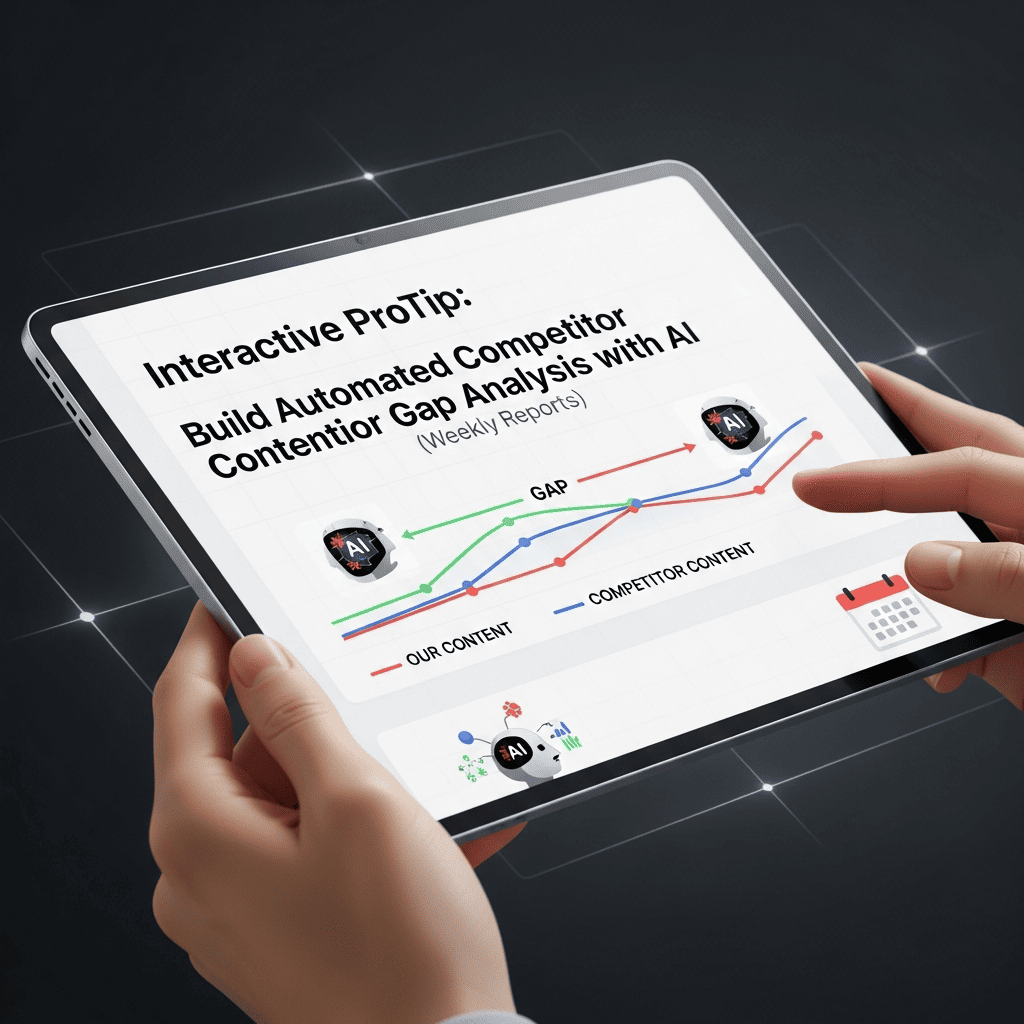
Build Automated Competitor Content Gap Analysis with AI (Weekly Reports)
Set up AI-powered systems that automatically identify competitor content gaps every week, delivering actionable insights without manual research
The Traditional Approach Doesn't Scale
Most content teams run competitive analysis sporadically—once per quarter if they're lucky. By the time insights are gathered, documented, and acted upon, competitors have already moved on to new topics.
The manual workflow problem:
- Spreadsheet chaos: Teams manually export keywords from Ahrefs, Semrush, or Search Console, then spend hours comparing competitor rankings
- Superficial analysis: Manual reviews only catch obvious keyword gaps, missing deeper content angle opportunities and format gaps
- No prioritization: Without AI scoring, teams can't distinguish high-impact gaps from low-value opportunities
- Snapshot limitations: Static audits miss emerging trends and real-time competitor moves
- Execution lag: By the time briefs are created and content published, the opportunity window has closed
Sources: Wellows Content Gap Guide, Single Grain AI Analysis, Search Atlas 2025
The AI Automation Opportunity
AI-powered gap analysis shifts from periodic audits to continuous monitoring. Instead of quarterly manual reviews, automated systems:
- Monitor competitors 24/7: Track new content published, keyword ranking changes, and SERP feature captures in real-time
- Identify patterns instantly: AI recognizes content themes, formats, and angles competitors are pursuing—not just individual keywords
- Score opportunities automatically: Machine learning ranks gaps by search volume, difficulty, business value, and competitive advantage
- Deliver weekly insights: Automated reports highlight top opportunities without requiring manual data compilation
- Generate content briefs: AI creates actionable briefs directly from gap analysis, reducing time-to-execution
Sources: Fullview AI Statistics 2025, SeoProfy, Search Atlas AI Analysis
Data Collection Layer
Automated API connections to SEO tools (Ahrefs, Semrush) pulling competitor rankings, new content, and keyword movements daily.
AI Analysis Engine
LLMs (GPT-4, Claude) process competitor content to identify themes, formats, angles, and audience segments being served.
Gap Identification
Machine learning compares your content library against competitors, flagging missing topics, insufficient depth, and format gaps.
Opportunity Scoring
AI ranks gaps by search volume, keyword difficulty, business relevance, and competitive advantage to prioritize execution.
Report Generation
Automated weekly emails with top opportunities, trend analysis, competitor moves, and ready-to-use content briefs.
Execution Workflow
Integration with content management tools (Notion, Asana) automatically creates tasks and briefs from identified gaps.
Phase 1: Foundation Setup (Week 1)
Define competitor set and monitoring scope:
- Identify 3-5 direct competitors: Choose sites targeting the same audience and keywords, not just largest players in your space
- Map your content inventory: Export all published content titles, URLs, target keywords, and primary topics from your CMS
- Select monitoring keywords: Choose 50-200 core keywords representing your main topics and business priorities
- Set up SEO tool API access: Obtain API keys from Ahrefs, Semrush, or both for automated data collection
- Choose AI platform: Set up ChatGPT Plus, Claude Pro, or API access for processing competitor data
Sources: Single Grain Implementation Guide, Search Atlas Best Practices
Phase 2: Data Collection Automation (Week 2)
Set up automated competitor monitoring:
- Ahrefs/Semrush scheduled reports: Configure weekly exports of competitor top pages, new content, and ranking changes
- RSS feed monitoring: Subscribe to competitor blogs/news sections for instant new content notifications
- Google Sheets automation: Use Apps Script or Zapier to automatically import SEO tool data into central spreadsheet
- SERP feature tracking: Set up monitoring for which competitors appear in featured snippets, PAA boxes, AI Overviews
- Backlink monitoring: Track new backlinks competitors earn to identify content that's gaining authority
Sources: Solveo AI Tools Guide, VisualPing Automation
Phase 3: AI Analysis Configuration (Week 3)
Build AI analysis workflow:
Sources: Single Grain AI Workflows, Wellows Analysis Framework
Phase 4: Automated Report System (Week 4)
Create weekly automated reports:
- Schedule weekly data pulls: Set up Google Sheets/Apps Script to automatically fetch competitor data every Monday morning
- Automated AI analysis: Use Make.com or Zapier to send collected data to ChatGPT/Claude API for analysis
- Report formatting: AI outputs structured report highlighting top 10 gaps, new competitor content, and priority actions
- Email delivery: Automated email to content team every Monday with actionable insights and ready-to-assign briefs
- Dashboard visualization: Google Data Studio or Looker dashboard showing gap trends, competitor activity, coverage improvements
Ahrefs API → Google Sheets (data collection) → Make.com (orchestration) → Claude API (analysis) → Notion (brief creation) → Slack (team notification)
Total weekly time investment: 15 minutes to review and approve briefs vs 8-10 hours manual analysis
Sources: Search Atlas Automation Guide, Wellows Integration Workflows
Beyond Basic Keyword Gaps
Most teams stop at "which keywords do competitors rank for?" Advanced AI analysis reveals deeper strategic opportunities:
- Content angle gaps: AI identifies how competitors frame topics differently (beginner vs advanced, practical vs theoretical, data-driven vs opinion)
- Format innovation gaps: Spots when competitors launch new content types (interactive tools, calculators, comparison engines) that drive engagement
- Funnel stage gaps: Maps which buyer journey stages lack content coverage compared to competitors
- Internal linking patterns: Analyzes how competitors structure topic clusters and identifies superior linking opportunities
- Update frequency analysis: Tracks how often competitors refresh content to maintain rankings
- Multi-competitor synthesis: Combines best practices from multiple competitors rather than copying any single approach
Sources: Single Grain Advanced Analysis, Search Atlas Scholar Features
AI-Powered Content Brief Generation
Sources: Wellows Brief Templates, Single Grain Execution Framework
Key Performance Indicators
- Gap identification rate: Number of new opportunities identified per week (target: 10-15 actionable gaps)
- Execution velocity: Time from gap identification to content published (target: under 2 weeks for high-priority)
- Gap closure rate: Percentage of identified gaps addressed within 90 days (target: 70%+)
- Ranking improvement: How many gap-focused articles reach page 1 within 6 months (target: 60%+)
- Traffic lift: Organic traffic increase from gap-focused content vs baseline (target: 25%+ higher than average)
- Time savings: Weekly hours saved vs manual analysis (typical: 8-10 hours saved per week)
Sources: Fullview AI Statistics, Search Atlas Benchmarks
Common Implementation Pitfalls
- Over-automation trap: Publishing AI-generated content without human review leads to quality issues and brand voice misalignment
- Data overload: Monitoring too many competitors or keywords creates noise that obscures high-impact opportunities
- Missing business alignment: Identifying gaps without connecting to business goals produces content that doesn't drive revenue
- Ignoring existing content: Focusing only on new content gaps while neglecting opportunities to update/expand existing pages
- Set-and-forget mentality: Automated systems require monthly calibration to ensure scoring remains accurate as market evolves
- Lack of experimentation budget: Not allocating resources to test AI recommendations undermines the entire system's value
Sources: Single Grain Best Practices, Wellows Implementation Guide
Essential Tools for Automated Gap Analysis
Ahrefs or Semrush
Core SEO data source. API access required for automation. Ahrefs better for backlink analysis, Semrush stronger for keyword tracking.
ChatGPT Plus / Claude Pro
AI analysis engine. ChatGPT better for structured outputs, Claude better for longer content analysis (200K context window).
Make.com or Zapier
Workflow automation. Make.com more powerful and cost-effective, Zapier easier for beginners. Essential for connecting tools.
Notion or Airtable
Content brief repository. Notion better for documentation, Airtable better for database views and filtering. Both support automation.
Google Sheets + Data Studio
Data centralization and visualization. Free, powerful scripting capabilities, easy sharing. Foundation of most automation stacks.
Wellows or Search Atlas
All-in-one gap analysis platforms. Wellows stronger for AI search visibility, Search Atlas better for traditional SEO automation.
Budget breakdown (monthly):
- Starter setup ($150-200/mo): Ahrefs Lite ($99) + ChatGPT Plus ($20) + Zapier Starter ($30) + Google Workspace ($12)
- Professional setup ($400-500/mo): Semrush Pro ($140) + Claude Pro ($20) + Make.com Pro ($29) + Notion Team ($15) + Ahrefs Standard ($199)
- Enterprise setup ($1,500+/mo): Semrush Business ($500) + OpenAI API ($200) + Wellows ($300) + Search Atlas ($400) + automation tools
Sources: Solveo Tool Comparison, VisualPing AI Tools Guide, Bay Tech Consulting 2025
Build automated competitor content gap analysis systems that continuously identify opportunities, generate actionable briefs, and deliver weekly reports—freeing your team to focus on execution instead of research.
Data Sources: Wellows, Single Grain, Search Atlas, SeoProfy, Fullview AI Statistics, Solveo, VisualPing, Bay Tech Consulting—2025