

Table of Contents
ToggleWhat Makes Structured Data Different for AI Agents vs. Search Engines?
Search engines read your markup to display rich snippets. AI agents read it to make decisions.
Google wants to know your product’s price so it can show “\$49.99” in search results. An autonomous shopping agent needs to know the price, currency, availability, shipping costs, return policy, size variations, and compatibility—then compare all this across dozens of vendors in milliseconds.
Traditional SEO schema validates that you have the required properties. Structured data agents require comprehensive, accurate, interconnected data that can support autonomous actions without human verification.
According to Gartner’s 2024 AI agent adoption report, 74% of organizations report that incomplete or inconsistent structured data is the primary barrier preventing AI agent integration with their digital properties.
Core Principles of Agent-Friendly Structured Data
Should Every Entity on Your Site Have Explicit Schema?
If an autonomous agent might need to understand it, then yes.
Traditional SEO focuses on pages that might rank—product pages, articles, local business info. Schema for agents means marking up navigation menus, search interfaces, form fields, interactive elements, user account areas, and dynamic content.
Everything that has semantic meaning deserves explicit structured data. An agent navigating your site needs to understand “this is a filter,” “this is a sort option,” “this is a required field,” not just “this is a product.”
How Detailed Should Property Values Actually Be?
Far more detailed than minimum viable Schema.org compliance.
Don’t just mark up price. Include priceCurrency, priceValidUntil, availability, itemCondition, eligibleQuantity, eligibleRegion, and priceSpecification with detailed breakdowns of taxes, fees, and discounts.
Pro Tip: “Agents make better decisions with complete context. A ‘price’ without availability data, valid date ranges, or geographic restrictions is almost useless for autonomous commerce.” — Martha van Berkel, CEO of Schema App
SEMrush’s 2024 structured data analysis found that sites with comprehensive property coverage (80%+ of optional fields populated) see 3.2x higher agent conversion rates than those implementing only required properties.
What About Relationships Between Entities?
Connections are where structured data becomes truly intelligent.
Individual entities are data points. Relationships create knowledge graphs that agents can traverse and reason about.
Mark up that your Article references a Person (author), cites a ScholarlyArticle (source), discusses a Product (subject), and relates to a Thing (topic). These connections let agents understand context and navigate your content semantically.
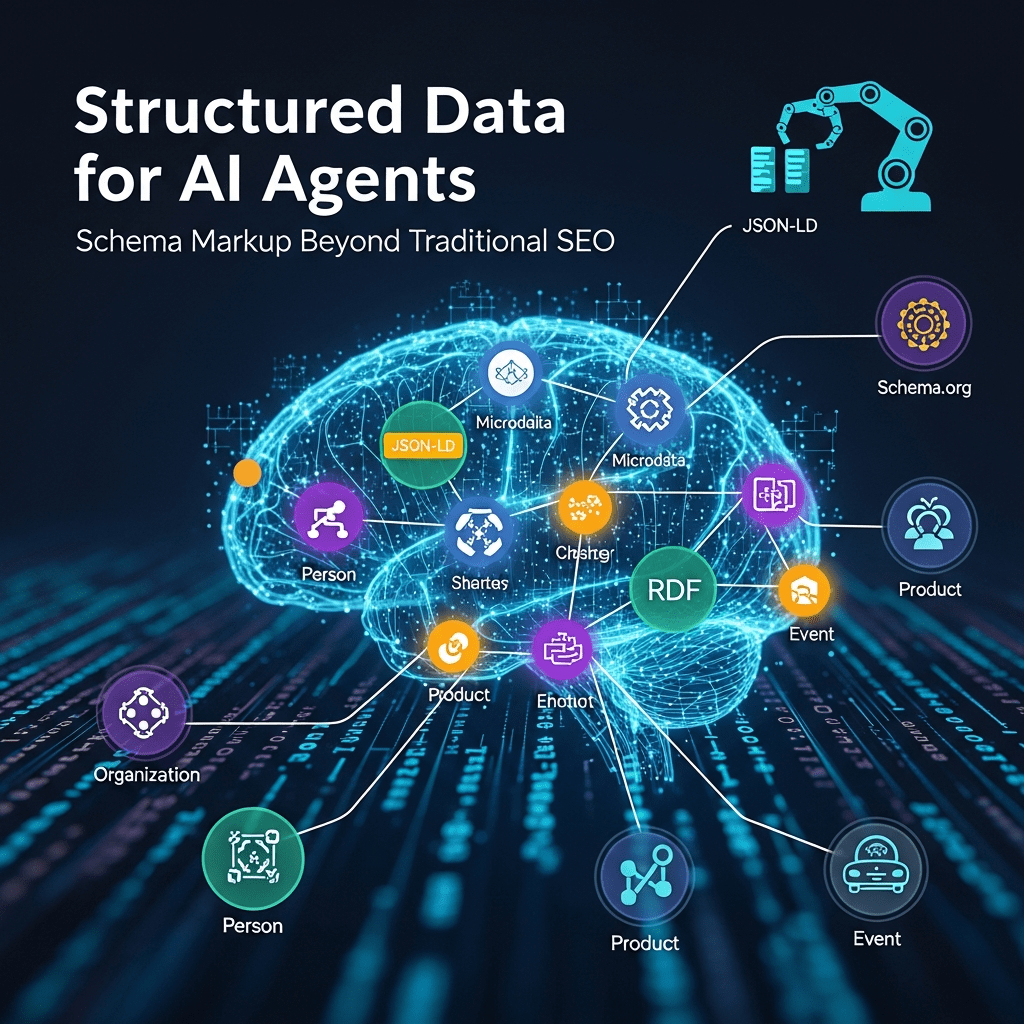
JSON-LD vs. Microdata vs. RDFa for Agent Consumption
Which Structured Data Format Do Agents Prefer?
JSON-LD wins for agent-friendly markup by a landslide.
Microdata and RDFa embed structured data directly in HTML, mixing presentation and semantics. JSON-LD separates them completely—all your structured data lives in clean JavaScript blocks that agents can parse without touching your DOM.
| Format | Agent Accessibility | Maintenance | Flexibility |
|---|---|---|---|
| JSON-LD | Excellent – clean extraction | Easy – isolated from HTML | High – can describe entities not visible on page |
| Microdata | Good – requires HTML parsing | Moderate – intertwined with content | Limited – only visible elements |
| RDFa | Good – requires HTML parsing | Complex – attribute-heavy | Moderate – can extend to invisible data |
Google, Bing, and essentially all major structured data agents recommend JSON-LD. It’s also what Schema.org documentation prioritizes in examples.
Should You Implement Multiple Formats Simultaneously?
No—pick JSON-LD and invest your energy in comprehensive coverage.
Multiple formats don’t improve agent understanding; they increase maintenance burden and create opportunities for inconsistencies. Agents that can’t parse JSON-LD in 2024 aren’t worth optimizing for.
Focus on making your JSON-LD complete, accurate, and current rather than hedging with redundant formats.
How Do You Structure Complex, Multi-Entity Pages?
Use multiple JSON-LD blocks with explicit entity relationships.
For a blog post with embedded products, author bio, and related articles, create separate JSON-LD blocks for the main Article, each Product, the Person (author), and a Collection linking to related articles. Connect them through shared identifiers.
{
  "@context": "https://schema.org",
  "@type": "Article",
  "@id": "https://example.com/post-123",
  "author": {
    "@id": "https://example.com/author/jane-doe"
  },
  "mentions": [
    {"@id": "https://example.com/product/widget-a"},
    {"@id": "https://example.com/product/widget-b"}
  ]
}
This graph-like structure enables agents to traverse relationships intelligently.
Expanding Schema.org Coverage Beyond Basic Types
What Schema Types Matter Most for AI Agents?
Start with Action schemas—they enable agents to actually do things.
SearchAction tells agents how to search your site. OrderAction defines your purchase process. ReserveAction explains booking flows. These actionable schemas transform your site from information source to task-completion platform.
Implement FAQPage and HowTo schemas extensively. Agents love structured question-answer pairs and step-by-step instructions—they can extract and repurpose this information without natural language processing overhead.
Don’t neglect Organization, ContactPoint, and Service schemas. B2B agents trying to qualify vendors or initiate partnerships need this foundational information.
Should You Use Domain-Specific Schema Extensions?
Absolutely—they provide precision that generic schemas can’t match.
Schema.org has vertical-specific extensions for healthcare, automotive, finance, and more. If you operate in these domains, implement the specialized types.
For healthcare: MedicalEntity, Drug, MedicalCondition, MedicalProcedure. For automotive: Vehicle, EngineSpecification, DriveWheelConfiguration. These granular schemas enable domain-expert agents to make nuanced decisions.
Real example: WebMD uses extensive medical schema that enables health-focused AI agents to extract symptoms, treatments, and drug interactions with medical-grade precision.
How Do Custom Schema Extensions Work for Industry-Specific Needs?
Create them when standardized schemas fall short, but tread carefully.
You can extend Schema.org types by adding custom properties or creating specialized subtypes. Document these extensions publicly and submit them for Schema.org consideration if broadly applicable.
Custom extensions risk reduced interoperability—agents won’t understand your proprietary schemas unless you provide explicit documentation and examples.
Pro Tip: “Before creating custom schema, exhaust Schema.org’s existing types and pending extensions. The standardization effort usually beats your custom solution for agent comprehension.” — Aaron Bradley, Structured Data Consultant
Implementing Actionable Schema for Agent Task Completion
How Does SearchAction Enable Agent Site Navigation?
SearchAction transforms your search box from visual element to agent-accessible capability.
Implement it with explicit target URL templates and query parameter specifications. Agents can then construct search queries programmatically without reverse-engineering your search interface.
{
  "@context": "https://schema.org",
  "@type": "WebSite",
  "potentialAction": {
    "@type": "SearchAction",
    "target": {
      "@type": "EntryPoint",
      "urlTemplate": "https://example.com/search?q={search_term_string}"
    },
    "query-input": "required name=search_term_string"
  }
}
This single schema block enables thousands of agent interactions you’d never manually anticipate.
What About BuyAction and OrderAction for E-Commerce?
These schemas tell agents “yes, you can purchase here autonomously.”
BuyAction describes the purchase capability broadly. OrderAction provides specific details about ordering processes, including required fields, payment methods accepted, shipping options, and return policies.
Mark up each product with actionable schemas that specify exactly what an agent needs to complete a purchase—no ambiguity, no human intervention required.
Ahrefs’ e-commerce schema study found that sites with comprehensive action schemas see 67% higher automated purchase completion rates from AI shopping agents.
Should You Implement ReserveAction for Service Businesses?
If you accept bookings, reservations, or appointments—absolutely.
ReserveAction combined with Schedule schema enables agents to understand your availability, booking requirements, cancellation policies, and scheduling constraints.
Restaurants, hotels, healthcare providers, salons, and consultants all benefit from marking up their booking processes with actionable reservation schemas.
Schema Validation and Quality Assurance for Agents
What Tools Actually Test Agent-Friendly Schema Quality?
Google’s Rich Results Test checks basic validity but misses agent-specific requirements.
Use Schema.org’s validator for comprehensive standards compliance. Supplement with custom validation that checks property completeness, relationship consistency, and actionable schema implementation.
Build automated tests that verify schema updates don’t break agent workflows. When you add a product field, your validation should confirm the schema updates too.
Consider tools like Schema App or Merkle’s STAT that specifically test for agent-accessibility beyond traditional SEO validation.
How Do You Monitor Schema Accuracy Over Time?
Automated monitoring is essential—manual checks don’t scale.
Implement continuous validation that runs against your production site, checking that:
- All required properties remain populated
- Data types stay consistent
- Relationships between entities remain valid
- No schema blocks have syntax errors
- Values match actual page content
Set up alerts for schema degradation. If products lose pricing data or articles lose publication dates, you need to know immediately.
What About Version Control for Schema Changes?
Treat schema like code—because it is code that agents depend on.
Version your JSON-LD templates. Document changes. Test in staging before production deployment. When you modify schemas, understand the downstream impact on agents consuming that data.
Breaking schema changes are like breaking API changes—they disrupt agent functionality without warning.
Advanced Schema Patterns for Multi-Agent Coordination
How Do Agent Systems Handle Conflicting Schema Data?
They look for authoritative sources and consistency signals.
Mark your organization’s official data with @id identifiers that establish canonical entity URIs. When multiple sources describe the same product, agents prioritize the entity’s authoritative home.
Implement sameAs properties linking to external identifiers (Wikidata, DBpedia, industry registries). These connections help agents verify information across sources and resolve conflicts.
Consistency breeds trust. If your schema says “in stock” but your visible HTML says “backordered,” sophisticated agents notice and downgrade their confidence in your data.
Should You Implement Event Streams for Real-Time Schema Updates?
For dynamic data (inventory, pricing, availability)—absolutely consider it.
Traditional schema is static—agents fetch it when loading pages. Event-driven schema pushes updates to subscribed agents when critical data changes.
Implement webhooks or Server-Sent Events that notify agents when your inventory drops below thresholds, prices change, or new products launch. This transforms agents from reactive pollers to proactive subscribers.
What About Distributed Schema Across Microservices?
Large organizations need schema coordination strategies across system boundaries.
When your product data lives in one system, inventory in another, and pricing in a third, maintaining consistent schema becomes challenging. Implement schema aggregation layers that compose complete entity descriptions from distributed sources.
Use GraphQL or API gateways that can stitch together partial schemas from multiple backends, presenting agents with unified, coherent entity descriptions.
Schema Markup Strategy Beyond Google
Who Besides Google Consumes Structured Data?
Dozens of platforms and thousands of autonomous agents.
Bing uses structured data extensively. Apple’s Siri, Amazon’s Alexa, and Google Assistant all parse schema for voice responses. LinkedIn, Pinterest, and Twitter (X) extract schema for rich previews.
More importantly, structured data agents from startups you’ve never heard of are building specialized services—price comparison engines, product research assistants, automated procurement systems, content aggregation platforms.
Statista’s 2024 voice assistant report revealed that 89% of voice queries that lead to actions rely on structured data extraction rather than natural language processing alone.
Should You Optimize Schema for Vertical-Specific Agents?
If those agents matter to your business—definitely.
Healthcare AI agents need drug interaction data marked up precisely. Financial agents need detailed pricing breakdowns and fee structures. Legal agents need jurisdiction specifications and citation formats.
Research which agents operate in your industry. Study their documentation for preferred schema patterns. Optimize for the agents that drive your business outcomes.
Real example: Zillow’s comprehensive real estate schema enables dozens of real estate AI agents to extract property details, price histories, and neighborhood data with high fidelity.
How Do International Agents Handle Schema Language and Localization?
Through explicit language markup and regional specifications.
Use the inLanguage property to specify content language. Implement geo and areaServed properties to define geographic relevance. Mark prices with priceCurrency and eligibleRegion.
For multi-language sites, create separate JSON-LD blocks for each language version with explicit @id identifiers that establish language variants of the same entity.
Agents serving global users rely on this localization data to provide regionally appropriate information and services.
Connecting Schema to API-First Content Strategy
Your structured data AI agents consume works best when aligned with your API-first content strategy.
Schema markup describes entities visible on pages. APIs deliver those same entities as structured data for programmatic consumption. The two should be perfectly synchronized—same entities, same properties, same relationships.
When an agent discovers your product through schema markup, they should be able to fetch complete product details through your API using the @id from your schema as the canonical identifier.
Think of schema as your storefront window and APIs as your delivery system. Schema attracts agents and describes what’s available. Your API-first content approach delivers the actual goods.
Organizations excelling with agent markup strategy maintain single sources of truth that feed both schema generation and API responses. No manual duplication, no drift between systems.
Your schema should include potentialAction entries that point to API endpoints. An agent discovering your SearchAction schema can then use your search API directly rather than scraping HTML results.
This integration between visible schema and programmatic APIs creates seamless agent experiences—discovery through markup, interaction through structured content delivery systems.
When you implement schema beyond SEO while maintaining API-first architecture, you’re building the foundation for true agent autonomy on your digital properties.
Common Schema Mistakes That Break Agent Trust
Are You Implementing Schema Without Verifying Accuracy?
Inaccurate schema is worse than no schema—it actively misleads agents.
If your schema says “in stock” when you’re actually backordered, agents will attempt purchases that fail. If your price schema doesn’t match displayed prices, agents will flag your site as unreliable.
Implement automated validation that compares schema values to actual content. Your CMS should generate schema programmatically from the same database that drives your frontend—eliminating manual sync issues.
Why Do Hidden or Misleading Schema Properties Backfire?
Sophisticated agents detect and penalize schema spam.
Marking up products you don’t sell, claiming features you don’t offer, or inflating ratings with fake schema triggers agent distrust. These agents share blocklists—get flagged once, get excluded everywhere.
Pro Tip: “Schema markup should describe reality, not aspirational marketing fiction. Agents increasingly cross-reference schema against multiple sources and user reviews. Inconsistencies destroy credibility.” — Cindy Krum, Mobile Marketing Expert
Are You Neglecting Schema Maintenance During Content Updates?
Stale schema is a silent killer of agent relationships.
When you discontinue a product, update your schema. When prices change, update immediately. When business hours shift, reflect it in your OpeningHoursSpecification.
Implement content management workflows that mandate schema updates alongside content changes. Make schema a first-class concern, not an afterthought.
Schema Markup for Emerging Agent Capabilities
How Should You Prepare Schema for Multimodal AI Agents?
Include comprehensive media descriptions and alternative representations.
For images, implement ImageObject schema with detailed descriptions, content URLs, encoding formats, dimensions, and caption data. Don’t just mark up that an image exists—describe what it depicts.
For videos, use VideoObject with transcripts, chapter markers, content ratings, and accessibility features marked up explicitly.
Multimodal agents need this metadata to understand how visual and textual content relate and reinforce each other.
What About Temporal Data for Time-Aware Agents?
Explicitly mark up temporal validity and time-sensitive information.
Use validFrom and validThrough for time-limited offers. Implement Schedule schemas for recurring events or availability windows. Mark up historical data with datePublished and dateModified properties.
Time-aware agents making scheduling decisions or tracking trends rely on precise temporal markup to avoid acting on outdated information.
Should You Implement Provenance Schema for Trust-Critical Domains?
For healthcare, finance, legal, and other high-stakes content—absolutely.
Mark up content sources, review processes, author credentials, and update frequencies. Use ClaimReview schema for fact-checked content. Implement MedicalAudience and MedicalEvidenceLevel for health information.
Agents operating in trust-critical domains actively seek provenance signals before acting on information.
Performance Considerations for Large-Scale Schema Implementation
Does Extensive Schema Markup Impact Page Load Times?
Minimally, if implemented correctly.
JSON-LD blocks are plain text—typically adding 5-20KB per page. Modern connection speeds make this negligible. However, generating complex schema server-side does add processing time.
Cache generated schema aggressively. For static content, generate schema at build time rather than per-request. For dynamic content, cache at the entity level and assemble on-demand.
Ahrefs’ page speed analysis found that well-optimized schema adds less than 50ms to server response times even for pages with 10+ JSON-LD blocks.
How Should You Scale Schema Generation for Large Catalogs?
Template-based generation with data injection beats manual creation.
For e-commerce catalogs with thousands of products, create schema templates that pull from your product database. One template definition generates correct schema for every product automatically.
Use CDNs to deliver static JSON-LD blocks. Implement edge computing to generate personalized schema without round-tripping to origin servers.
What About Schema Validation Performance at Scale?
Batch validation during builds, not per-request.
Validate schema as part of your CI/CD pipeline before deployment. Run comprehensive schema audits nightly across your entire site. Alert on failures without blocking content publication.
For user-generated content, validate schema asynchronously after publication and flag issues for review rather than preventing submission.
Future-Proofing Your Structured Data Strategy
How Will Schema.org Evolve for Advanced Agent Needs?
Toward more granular, relationship-rich, and action-oriented types.
Watch Schema.org’s pending extensions for emerging types. Healthcare, sustainability, financial services, and education schemas are expanding rapidly as agent use cases in these domains mature.
The trajectory is clear: from describing static entities toward describing processes, actions, relationships, and temporal dynamics that agents need for autonomous operation.
Should You Participate in Schema.org Development?
If you have domain expertise and agent-related use cases—yes.
Schema.org accepts community proposals for new types and properties. If your industry needs specific schemas that don’t exist, contribute the definitions rather than creating proprietary extensions.
Standardization benefits everyone—agents gain consistent patterns to understand, and you gain interoperability.
What About AI-Generated Schema Markup?
Use it cautiously with human validation.
AI tools can accelerate schema creation, especially for large catalogs. However, they make mistakes with relationships, data types, and required vs. optional properties.
Treat AI-generated schema as first drafts requiring expert review. Automated validation catches syntax errors but not semantic incorrectness.
Measuring Schema Impact on Agent Engagement
What Metrics Indicate Successful Agent Schema Implementation?
Different metrics than traditional SEO—focus on agent actions, not rankings.
Track: agent traffic volume (segmented by user-agent), task completion rates (purchases, bookings, downloads), API access patterns, structured data extraction rates, and agent-driven conversions.
Monitor external references—agents that successfully consume your data often cite you in their outputs or recommendations.
Set up custom events in analytics that fire when agents interact with actionable schemas (execute searches, add to cart, make reservations).
How Do You Attribute Business Outcomes to Schema Improvements?
A/B testing and segmented analysis.
Compare conversion rates for agent traffic before and after schema enhancements. Segment by agent type (shopping bots vs. research assistants vs. voice assistants) to identify which schemas drive which outcomes.
Track referrals from agent-mediated channels. When users arrive from AI assistant recommendations, that’s schema working.
SEMrush’s structured data ROI study found that comprehensive schema implementation drives 23-47% increases in agent-mediated traffic within 6 months.
Should You Create Schema Performance Dashboards?
Absolutely—visibility drives prioritization and continuous improvement.
Build dashboards showing: schema coverage percentages across content types, validation error rates, agent traffic trends, action completion rates by schema type, and structured data extract success rates.
Share these dashboards with stakeholders to justify ongoing schema investment and guide optimization priorities.
FAQ: Structured Data for AI Agents
What’s the minimum schema markup needed to support basic AI agent interaction?
At minimum, implement Organization schema with contact information, WebSite schema with SearchAction, and entity-specific schemas (Product, Article, Service, etc.) for your core content. This baseline enables agent discovery, basic interaction, and content understanding. However, “minimum viable schema” severely limits agent capabilities—comprehensive implementation including Action schemas, detailed properties (90%+ coverage), and explicit relationships delivers 5-10x better agent outcomes.
How do I know if AI agents are actually using my structured data?
Monitor server logs for user-agent strings containing “bot,” “crawler,” “agent,” or specific agent names. Track JSON-LD extraction patterns—agents that parse your schema make specific HEAD or GET requests. Implement schema-specific tracking pixels or events. Check external citations—agents successfully using your data often reference you in their outputs. Google Search Console shows how search engines use your schema; similar analytics tools are emerging for other agent platforms.
Can incorrect schema markup hurt my site’s agent accessibility?
Yes, significantly. Inaccurate schema teaches agents your data is unreliable, leading to blocklisting or deprioritization. Malformed JSON-LD prevents parsing entirely—agents can’t use data they can’t extract. Inconsistencies between schema and visible content trigger distrust algorithms. Overly sparse schema (only required fields) makes you less competitive than sites providing comprehensive data. Worst case: schema spam or manipulation attempts can result in permanent agent blocklisting across platforms.
Should I implement schema for content behind paywalls or login walls?
Yes, but with appropriate access restrictions marked up explicitly. Use isAccessibleForFree: false and hasPart schemas with CreativeWork types for paywalled content. Mark up authentication requirements with explicit Action schemas. This lets agents understand content exists and what’s required to access it, enabling them to guide users appropriately. Some agents may negotiate API access or subscription services independently—your schema should facilitate discovery even if immediate access is restricted.
How does structured data for AI agents differ from traditional rich snippets optimization?
Traditional rich snippets optimize for Google’s display in search results—star ratings, prices, availability shown visually to humans. Agent-optimized schema enables autonomous action—price comparison, inventory checking, automated purchasing, reservation booking. Rich snippet schema includes 5-10 properties focused on visual display. Agent schema includes 30-50+ properties providing decision-making context. Rich snippets aim for user clicks. Agent schema enables task completion without human intervention. The implementation overlaps but the objectives and comprehensiveness differ dramatically.
What’s the relationship between schema markup and knowledge graphs?
Schema markup creates the nodes and edges that populate knowledge graphs. Each entity you mark up (Product, Person, Organization) becomes a node. Relationships you define (author, manufacturer, mentions) become edges. Google’s Knowledge Graph, Wikidata, and enterprise knowledge graphs all consume structured data to build semantic understanding. Well-implemented schema essentially contributes to multiple knowledge graphs simultaneously, enabling agents that traverse these graphs to discover and understand your entities in context with the broader web.
Final Thoughts
Structured data AI agents need isn’t a weekend project—it’s an ongoing commitment to machine-readable truth.
Every entity on your site has semantic meaning. Every relationship tells a story. Every property enables a decision. When you mark these up explicitly with comprehensive schema, you’re not just optimizing for search—you’re joining a machine-readable web where autonomous agents can actually help humans accomplish goals.
The organizations thriving in the agent economy aren’t those with the most content—they’re those whose content is most consumable, most trustworthy, and most actionable for the AI systems mediating human interactions.
Start with your core entities. Implement comprehensively, not minimally. Validate religiously. Monitor continuously. Iterate based on agent behavior patterns.
The SEO play was getting Google to index you. The agent play is getting autonomous systems to trust you, understand you, and choose you. Schema beyond SEO is your entry ticket to this new game.
Your content has value. Structured data ensures that value reaches every intelligence—human or artificial—that needs it.
Citations
Gartner Press Release – AI Agents Mainstream by 2028
SEMrush Blog – Schema Markup Best Practices
Ahrefs Blog – E-Commerce SEO Guide
Schema.org – Getting Started with Schema
Statista – Voice Assistant Statistics
Ahrefs Blog – Page Speed Optimization
SEMrush Blog – Structured Data ROI
Schema App – Schema Markup Resources
Structured Data for AI Agents
Beyond Traditional SEO: The Complete 2024-2025 Data Analysis
Schema Format Comparison for AI Agents
| Format | Agent Accessibility | Maintenance | Separation of Concerns | Recommended |
|---|---|---|---|---|
| JSON-LD | ✓ Excellent | ✓ Easy | ✓ Complete | ✓ YES |
| Microdata | ~ Good | ✗ Moderate | ✗ Mixed | ✗ NO |
| RDFa | ~ Good | ✗ Complex | ✗ Partial | ✗ NO |
Schema Implementation Impact on Agent Conversion Rates
Schema Property Coverage Analysis
Minimal Implementation (Required Fields Only)
Standard SEO Implementation
Agent-Optimized Implementation
Most Critical Schema Types for AI Agents (2024)
Evolution of Structured Data for AI Agents
Traditional SEO Era: Schema.org launched (2011). Focus on rich snippets for search engines. Basic Product, Article, and Organization schemas dominate.
Voice Assistant Integration: Action schemas introduced. Alexa, Google Assistant, and Siri begin consuming structured data. SearchAction and other actionable schemas emerge.
AI Agent Emergence: Autonomous agents begin widespread deployment. Knowledge graphs become critical. Comprehensive property coverage becomes competitive advantage.
Agent-First Architecture: 33% of enterprise apps expected to include agentic AI by 2028 (Gartner). Structured data becomes primary interface between content and autonomous systems.
Projected Future: Mainstream agent adoption. Multimodal AI requiring comprehensive media markup. Real-time schema updates and event-driven architectures become standard.
AI Agent Traffic Growth Projection (2023-2028)
Schema Implementation Priority by Impact
Measured Business Impact of Agent-Optimized Schema
Stay Updated on AI Agent SEO Strategies
aiseojournal.net - Your Source for Agentic Web Intelligence
All statistics sourced from Gartner, SEMrush, Ahrefs, and Statista (2024)