Ask any performance marketer who has spent serious time inside Performance Max campaigns about the moment they saw an AI-generated headline that made them physically wince. There is always a story. Usually two.
The promise of Google’s AI advertising tools has always been seductive: let the machine write and test hundreds of ad variations simultaneously, optimise against real conversion data in real time, reach users you never would have found with manual keyword targeting. The results, on a pure performance level, are often impressive.
The problem is what the machine sometimes says to get those results.
“Our cheapest solution for your problem.” Sent to a luxury brand. “Fast and easy fix.” Written for a surgical equipment company. “Satisfaction guaranteed or your money back.” Appearing in a pharma ad.
These are not hypotheticals. They are the kinds of outputs that have made brand teams distrust automated ad copy for years — and that have kept many large advertisers from fully committing to Google’s AI campaign types despite the performance data in their favour.
March 2026 changed the equation. Here is what actually happened, why it matters, and what the hidden complexity is.
Table of Contents
ToggleWhat Google Actually Announced
On February 26, 2026, Google expanded beta access to text guidelines to all advertisers globally across AI Max for Search and Performance Max campaigns, removing the previous restricted rollout that had limited the feature to a subset of accounts since its initial introduction in September 2025. The announcement came from Rushil Grover, Group Product Manager at Google Ads, in a post published on the Google Ads and Commerce Blog.
Ginny Marvin, Ads Product Liaison at Google, amplified the announcement on LinkedIn with the message: “More messaging control & consistency: Text guidelines are now global!”
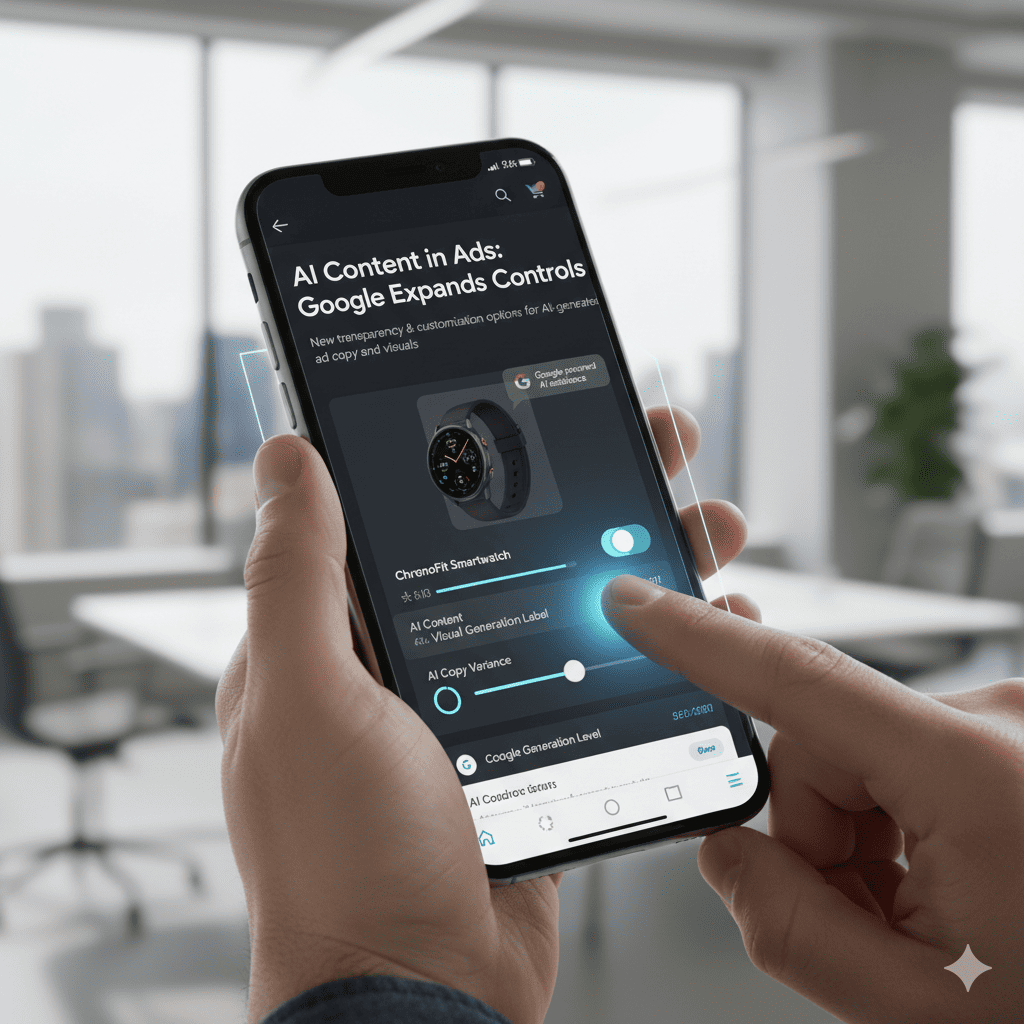
What text guidelines actually are, stripped of the marketing language: a set of guardrails that sit between your assets and the AI’s output — telling Google’s system what it must never write on your behalf. Two mechanisms, used differently:
Term exclusions — specific words or phrases that must never appear in AI-generated ads (up to 25 per campaign, per language).
Messaging restrictions — broader conceptual constraints around tone, style, associations, or content areas the AI must avoid.
The distinction matters. Term exclusions catch specific language. Messaging restrictions catch the intent behind language — which is more powerful but requires more careful configuration.
The Timeline: This Was a Long Time Coming
The feature was originally announced at Think Week 2025 in September, when Google also launched Asset Studio and expanded AI Max availability. The global expansion on February 26, 2026 followed a progression of brand control features layered onto automated campaign formats over the past two years. The Performance Max brand guidelines rollout completed in July 2025. Text guidelines are the next step in that sequence.
| Date | Milestone |
|---|---|
| May 2025 | AI Max for Search announced at Google Marketing Live |
| July 2025 | Google Ads Editor 2.10 adds AI Max to desktop |
| August 2025 | Google Ads API v21 adds programmatic AI Max support |
| September 2025 | Text guidelines introduced for limited beta accounts; Asset Studio launches |
| November 2025 | Independent testing: AI Max delivering conversions at ~35% lower ROAS vs manual |
| February 26, 2026 | Text guidelines expand globally to all advertisers — AI Max + PMax |
| Early March 2026 | AI voice-over for silent PMax video assets announced — opt-out deadline March 20 |
That November 2025 ROAS figure is worth pausing on. Independent testing published in November 2025 found that AI Max delivered conversions at approximately 35% lower return on ad spend than traditional match types in an analysis covering multiple accounts. This does not mean AI Max is broken — it means the tool is still maturing, and that brand-conscious advertisers using it without the right controls were accepting both performance risk and creative risk simultaneously.
Text guidelines address the creative risk. The performance risk is a separate conversation.
The Part Nobody Talked About Enough: AI Voice-Overs
Lost in the coverage of text guidelines was a second, more time-sensitive development that landed in the same week.
There is a change happening inside Google Ads that many advertisers have not noticed, and the deadline to act was March 20, 2026. Google began rolling out an AI-powered voice-over feature for Performance Max video ads. If you have video assets inside any Performance Max campaigns that do not already contain a voice track, Google’s AI may automatically generate narration from your headlines and descriptions, layer that audio onto your video, and begin serving the enhanced version to your audience — without you needing to approve it, record anything, or touch your campaign settings.
The critical point: this is not opt-in. It is opt-out. That distinction matters enormously for anyone who cares about how their brand sounds.
As of the current rollout, there is no publicly documented preview function that allows advertisers to hear the AI voice-over before it begins serving. This is a notable gap and a reason many practitioners recommend opting out until a preview capability is available.
“Google uses its data advantage to argue that automation produces better outcomes at scale, introduces the feature as an opt-out default to maximise adoption, and provides an opt-out for advertisers who prefer control. Over time, the opt-out options tend to become narrower or more difficult to exercise.” — ALM Corp, March 2026
That framing — generous to Google’s logic but honest about the pattern — is the most accurate characterisation of what is happening across the entire Google Ads automation stack right now.
How Text Guidelines Actually Work in Practice
Term exclusions remain language-specific by design — so a term exclusion written in English applies to English-language AI-generated assets. Messaging restrictions written in English now apply to AI-generated assets in any language the campaign targets.
This is a subtle but operationally significant distinction. If you are running multilingual campaigns and your compliance team has written restrictions in English, those restrictions now govern the AI’s output in French, German, Arabic, or any other language the campaign serves. Term exclusions, however, need to be written in each language they apply to.
For agencies managing 10–50 PMax campaigns across different clients, brand voice constraints dramatically reduce the review burden because AI-generated variations stay within approved parameters by default.
One real-world performance data point: Google cited BYD’s implementation as a reference case during the feature’s beta period, with the automotive brand reporting a 24% increase in leads after deploying text guidelines to bring AI-generated copy into alignment with brand standards. The improvement was attributed not to the restrictions themselves but to the improvement in ad quality that resulted from keeping AI copy on-brief.
The Broader Context: What AI Max Actually Does to Your Campaigns
For anyone still fuzzy on the distinction between AI Max and Performance Max — these are different tools that are increasingly expected to work together.
AI Max is a feature suite that enhances existing Search campaigns. Performance Max is a separate campaign type that runs across all Google channels. They are designed to work together, but they operate differently and carry different risk profiles.
AI Max for Search campaigns expands keyword matching in two ways: through broad match technology and through keywordless targeting. The keywordless element works similarly to how Dynamic Search Ads used to operate — Google crawls your landing pages and assets, then shows your ads on search queries it considers relevant, even if you do not have a keyword to match them.
For campaigns previously relying on exact and phrase match keywords, Google’s data suggests an average uplift of 27% more conversions at a similar cost. The trade-off is straightforward: broader reach means less control over where your ads appear.
And there is a structural pressure building on the placement side: Google confirmed that ads appearing in AI Overviews and AI Mode — the AI-generated answer surfaces increasingly prominent at the top of Google Search results — are eligible only for Performance Max, AI Max for Search, and broad match campaigns. Standard campaigns with only exact or phrase match keywords are not eligible for these high-visibility placements.
As AI Overviews expand their coverage (48% of tracked queries as of February 2026, according to BrightEdge), that eligibility gap becomes a meaningful impression share gap.
Expert Voices
Rushil Grover, Group Product Manager at Google Ads, announced the global expansion on the Google Ads and Commerce Blog on February 26, 2026, framing the move as addressing the core tension between AI scale and brand consistency. (Google Ads & Commerce Blog)
Brooke Osmundson, Director of Growth Marketing at Smith Micro Software, writing for Search Engine Journal’s PPC Pulse column: Google expanded beta access to text guidelines in AI Max, allowing advertisers to set guardrails for AI-generated ad copy across Search and Performance Max campaigns — with the update focusing on how advertisers guide AI-generated creative. Her framing: the text guidelines update and the VRC non-skip ad expansion represent two sides of the same strategic push — more AI control on the brand side, more AI reach on the delivery side. (Search Engine Journal PPC Pulse, March 6, 2026)
Arpan Banerjee, paid search expert, was the first to publicly flag the AI voice-over opt-out deadline on LinkedIn, triggering industry-wide attention to a deadline that many advertisers were unaware of. His core concern: the absence of a preview function meant brands could not evaluate what Google’s AI would say in their voice before it said it publicly.
Five Things to Do Right Now
Rather than a generic checklist, here is a prioritised sequence based on urgency and impact.
Most urgent — especially if you missed March 20: Check whether AI-generated voice-overs are now serving on your Performance Max video assets. Navigate to your PMax campaign → Asset Groups → Videos. If silent videos are present and video enhancement controls are enabled, the AI may already be narrating them. Review the served assets immediately and opt out if the output does not meet brand standards.
High impact for brand-sensitive accounts: Configure text guidelines before your next AI Max or PMax campaign goes live. Start with your hardest restrictions — the terms and phrases that would be most damaging to see in a live ad. Over-restricting a campaign can remove the majority of the asset pool and cause a significant drop in campaign performance. Start with critical restrictions, activate them, monitor the asset report for 48–72 hours, then layer in additional restrictions as needed.
Use the right tool for each type of restriction: Term exclusions are appropriate when there is a specific word or phrase that must categorically never appear. Messaging restrictions are appropriate when you are dealing with a concept, tone, or style that may manifest in multiple different phrasings. Mixing these up leads to either over-restriction or gaps.
For multilingual campaigns: Write messaging restrictions in English — they apply globally. Write term exclusions in each language the campaign targets — they are language-specific.
Plan for the placement shift: As AI-enhanced search surfaces expand their share of overall Search traffic, accounts that have not adopted AI Max or Performance Max will progressively lose impression share on placements that increasingly attract high-intent users. The question is not whether to move toward AI Max, but how to do so without sacrificing brand consistency. Text guidelines are the answer to that “how.”
The Honest Assessment
The March 2026 ad controls update is real progress. The ability to tell Google’s AI what not to say — at scale, across languages, with documented rules — is genuinely useful and addresses a complaint that has been running for years.
But the voice-over rollout happening simultaneously reveals the underlying dynamic clearly. Google’s default position is: automation is on unless you turn it off. Controls exist, but they require active configuration. Deadlines arrive in email notifications that not everyone reads. And previewing AI-generated creative output before it reaches your audience is not yet a standard feature.
The AI voice-over rollout is one data point in a broader pattern that characterises how Google Ads is evolving. Across the platform, automation is advancing into creative decisions that historically belonged to advertisers. Each of these changes follows the same structure: Google uses its data advantage to argue that automation produces better outcomes at scale, introduces the feature as an opt-out default to maximise adoption, and provides an opt-out for advertisers who prefer control.
The advertisers who navigate this well are not the ones who fight the automation. They are the ones who configure the guardrails before turning it on, monitor the outputs systematically, and treat every new Google Ads feature announcement as a question: is this opt-in or opt-out, and what is the deadline?
That discipline is the new competitive moat in paid media.
Official sources: Google Ads & Commerce Blog — Text Guidelines Global Expansion (Feb 26, 2026) | Google Ads Help — AI Max for Search | Google Ads Help — Performance Max
Industry sources: Search Engine Journal — PPC Pulse, Brooke Osmundson (March 6, 2026) | PPC.land — Text Guidelines Global Beta | ALM Corp — AI Voice-Over Deadline Guide | ALM Corp — Text Guidelines Setup Guide