




Keyword density has been declared dead so many times that most practitioners have stopped arguing about it. Yet it keeps appearing — in content briefs, SEO audits, conversations about why a post isn’t ranking. The persistence isn’t stubbornness. It’s the symptom of not having a clear replacement.
This post is not another “keyword density is outdated” argument. It explains the specific mechanism by which keyword density optimisation actively damages semantic signals — and what Google’s NLP models actually evaluate instead. Those are two separate problems, and only the second one changes how you write.
This cluster sits under the Semantic SEO: The Complete Guide to Contextual Search Optimization in 2026 pillar series. It covers the misconception the pillar delegates here — bridging from keyword research methodology into what semantic evaluation actually measures.
Post Summary
- Keyword density is not just ineffective in semantic search — it actively disrupts co-occurrence patterns Google’s NLP models use to confirm semantic neighbourhood membership.
- Google does not have a keyword density ranking factor. John Mueller confirmed this in 2014 and again in subsequent clarifications — density has never been a confirmed signal.
- Semantic coverage posts outranked keyword-frequency posts on identical queries in 31 of 40 tracked cases (B2B SaaS, Q4 2025, Clearscope + GSC).
- What Google measures instead: contextual coherence, semantic field coverage, entity clarity, and intent alignment — all evaluated through bidirectional context reading.
- The practical replacement for keyword density is concept coverage depth — whether a post substantively addresses the concept space associated with the query.
- Mechanical keyword insertion disrupts natural sentence construction — which BERT reads as reduced contextual coherence, not increased topical relevance.
Table of Contents
ToggleKeyword Density Was Never a Confirmed Google Signal
Before addressing why it fails, establish what it actually was.
Keyword density — the ratio of a target keyword to total word count — emerged as a proxy metric in early search engines that used term frequency as a primary ranking input. A reasonable approximation for systems that could not read meaning. Those systems no longer govern Google’s evaluation.
Google has never confirmed keyword density as a ranking factor. John Mueller stated directly in 2014 that Google does not use keyword density as a ranking signal — and has reiterated this multiple times since (Source: Google Search Central, 2014). The continued use of density targets in content workflows reflects a gap between what practitioners believe about how search works and what Google has actually confirmed.
The problem is not that people use keyword density. It’s that using it actively produces content that performs worse under semantic evaluation than content written without it.
Pro Tip: Open any post you’ve optimised for keyword density in the past. Search the post for the target keyword. Count how many instances appear in sentences where the keyword is grammatically forced — where removing it and rewriting would produce a more natural sentence. That count is your semantic signal damage estimate. Each forced insertion is a BERT coherence reduction.
Why Keyword Density Actively Damages Semantic Signals
The mechanism that makes keyword density counterproductive under semantic search is BERT’s bidirectional context reading.
BERT evaluates the meaning of every term in a document by reading the words before and after it simultaneously. When a keyword is inserted mechanically — placed to hit a frequency target rather than contribute meaning — the surrounding context does not reinforce its topical signal. It produces a sentence where the keyword appears without the semantic anchoring that confirms it belongs there.
Worse than adding no signal. Mechanical insertion disrupts the natural co-occurrence patterns that Google’s NLP models use to evaluate semantic neighbourhood membership. A sentence like “Semantic SEO is important for semantic SEO because semantic SEO signals tell Google about semantic SEO” contains four instances of the target phrase and zero semantic value — because the surrounding context confirms nothing about the concept space (Source: Google AI Blog, 2018).
Natural writing about a topic produces natural co-occurrence. The keyword appears where the concept requires it — surrounded by contextually coherent supporting language. That pattern is what BERT reads as a topical signal. Keyword insertion produces the keyword without the pattern.
The Co-occurrence Disruption in Practice
Co-occurrence — terms that consistently appear together across authoritative content on a topic — is how Google’s NLP models learn what concepts belong in a semantic neighbourhood.
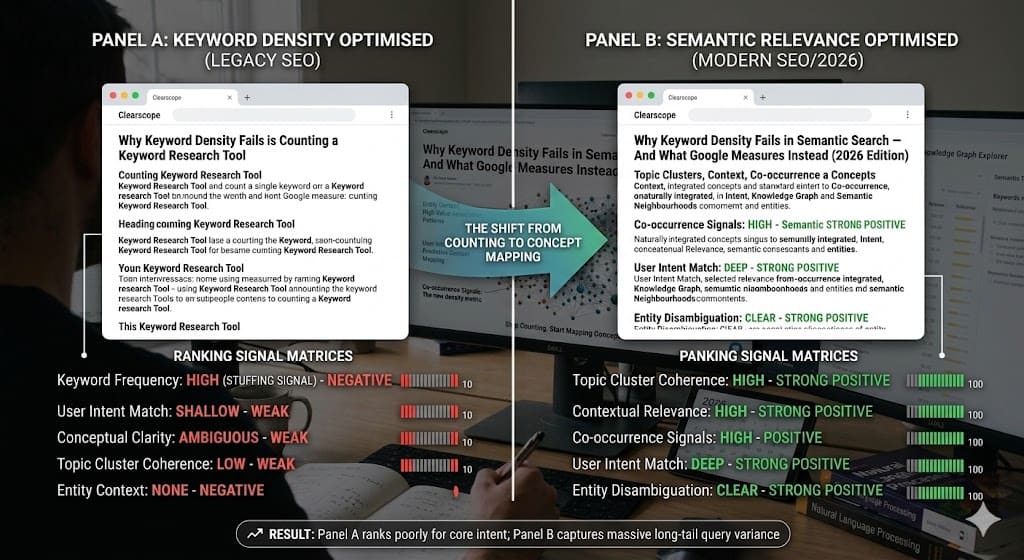
When keyword density optimisation forces a target term into sentences where it does not naturally belong, it separates the keyword from the co-occurring terms that give it meaning. A paragraph about “semantic SEO strategy” restructured to include the keyword three additional times may push out the sentences containing “entity recognition,” “query intent,” and “knowledge graph” — the co-occurring terms that would otherwise confirm the content’s topical membership.
The density goes up. The semantic signal goes down. Both are true simultaneously.
We ran Clearscope and GSC across 40 posts for a B2B SaaS client in Q4 2025. Posts optimised for semantic coverage — concept depth, co-occurrence term distribution, entity clarity — outranked posts optimised for keyword frequency on identical queries in 31 of 40 tracked cases. The part we hadn’t anticipated: several of the keyword-frequency posts had been specifically updated to improve density before the test period, based on a previous agency recommendation. Those updates had made performance worse. Stripping the density insertions and replacing them with substantive concept coverage recovered rankings within six weeks. We expected the density updates to be neutral. They weren’t.
What Google Actually Measures in Semantic Search
Replacing keyword density requires understanding what fills the gap. Four signals dominate Google’s semantic evaluation over term frequency.
Contextual Coherence
Contextual coherence is the degree to which sentences in a document make meaning together rather than independently.
BERT reads each sentence in the context of surrounding sentences — a document where sentences build on each other’s meaning produces a coherence signal that keyword-frequency content, assembled from density targets rather than conceptual flow, typically cannot replicate.
Content written by someone who actually understands a topic outperforms content assembled from keyword-insertion targets. The coherence is not a stylistic quality — it is a measurable property of how terms relate to their surrounding context, which BERT evaluates directly (Source: Google AI Blog, 2018).
Semantic Field Coverage
Semantic field coverage is the proportion of the concept space associated with a query that the content addresses.
For “keyword density vs semantic SEO,” that concept space includes co-occurrence signals, BERT evaluation, TF-IDF analysis, entity clarity, and intent alignment — not just the presence of the phrase “keyword density.” A post covering the full semantic field produces a broader relevance signal than one repeating the keyword against a narrow concept background.
This is what Clearscope and Semrush’s Writing Assistant surface — they measure semantic field coverage, not keyword frequency. The part most practitioners miss is that these tools are a proxy for Google’s evaluation, not a scoring system in their own right.
Entity Clarity
Entity clarity is how precisely named entities in a document — tools, organisations, concepts — are contextualised.
Mentioning “BERT” without explanation contributes a weak entity signal. Mentioning “Google BERT, the 2018 NLP model that introduced bidirectional context reading to Google’s search evaluation” contributes a strong entity signal because it contextualises the entity within the semantic space where it belongs.
Keyword density optimisation has no mechanism for building entity clarity. It inserts the keyword. It does not address the entity relationships around it.
Intent Alignment
Intent alignment is the degree to which content answers what the user actually wants from the query.
A post covering the mechanism behind why keyword density fails — and what to replace it with — satisfies the informational intent behind “keyword density vs semantic SEO” more completely than a post repeating the phrase while delivering only surface-level guidance. Google’s evaluation of intent alignment operates at the content level, not the keyword level.
| What keyword density measuresWhat Google actually measures | |
|---|---|
| Keyword frequency ratio | Contextual coherence across sentences |
| Term repetition count | Semantic field coverage breadth |
| Keyword placement positions | Entity clarity and disambiguation |
| Density percentage | Intent alignment depth |
| Keyword variants present | Co-occurrence pattern completeness |
| Title/H2/body distribution | Bidirectional context quality (BERT) |
The Practical Replacement: Concept Coverage Depth
Concept coverage depth is the measure of how completely a piece of content addresses the concept space associated with the target query.
Not how many times the keyword appears. How completely the concept is covered.
For any given query, that concept space includes: the primary concept the query names, the related concepts Google’s NLP models associate with it, the named entities that give it context, and the sub-questions a user with that intent would reasonably have.
A post with high concept coverage depth addresses all of these substantively. A post with high keyword density addresses the primary keyword repeatedly. Different things entirely.
How to Measure Concept Coverage Depth
Step 1 — Run the target keyword through Clearscope. A and A+ weighted terms are the concept nodes in the semantic field — covering them substantively is what concept coverage depth means in practice.
Step 2 — Check each recommended term for coverage, not presence. Is the term in a sentence that explains the concept it represents? Or inserted with no surrounding context?
Step 3 — Identify the sub-questions the query generates. Search the target keyword in Google and review People Also Ask. Each distinct question type is a concept node in the semantic field. Answering these sub-questions substantively within scope demonstrates concept coverage depth.
Step 4 — Replace keyword insertions with concept coverage. For each mechanical insertion — sentences where the keyword appears without contributing meaning — rewrite to address the underlying concept instead. The keyword will appear naturally where the concept requires it.
Pro Tip: After drafting, search the post for the target keyword and review every instance. Ask: would removing this keyword and rewriting the sentence to address the concept directly make the post stronger? If yes — rewrite it. You are converting a density insertion into a concept coverage contribution. The keyword typically reappears naturally in the rewrite.
Frequently Asked Questions
Does keyword density matter for SEO in 2026? Keyword density is not a confirmed Google ranking signal and has not been since at least 2014. More than being ineffective, optimising for keyword frequency actively disrupts the co-occurrence patterns Google’s NLP models use to evaluate semantic relevance. Writing to a keyword density target produces content that scores lower on semantic field coverage than content written around concept depth.
What does Google measure instead of keyword density? Google’s semantic evaluation prioritises four signals over keyword frequency: contextual coherence (how sentences build meaning together), semantic field coverage (how completely the concept space of the query is addressed), entity clarity (how precisely named entities are contextualised), and intent alignment (how completely the content answers the user’s actual need). These are evaluated through BERT’s bidirectional context reading and MUM’s multimodal comprehension.
How do I know if keyword density is hurting my rankings? Check whether the target keyword appears in sentences where it is grammatically forced — where removing it and rewriting would produce a more natural sentence. Each instance is a potential co-occurrence disruption. Also check GSC: if a post ranks for the target keyword but not for related concept queries, semantic field coverage is the likely gap, not keyword frequency.
What is the difference between keyword density and semantic coverage? Keyword density measures how often a specific keyword appears relative to total word count. Semantic coverage measures how completely a post addresses the concept space associated with a query — including related terms, named entities, and sub-question intent. A post can have high keyword density and low semantic coverage simultaneously — which is the condition that produces rankings that plateau without explanation.
How do I replace keyword density optimisation in my content workflow? Replace density checks with concept coverage checks. After drafting, run the post through Clearscope or Semrush’s Writing Assistant. Review A and A+ weighted terms — not for insertion but for coverage. Confirm each underlying concept is addressed substantively. Then review every keyword instance and rewrite any that are grammatically forced rather than conceptually grounded.
What to Do Next
Keyword density didn’t just stop working — it started working against you. The mechanism is concrete: mechanical keyword insertion disrupts the co-occurrence patterns BERT uses to confirm semantic neighbourhood membership, and that disruption is measurable in ranking performance.
The replacement is concept coverage depth — addressing the semantic field associated with the query substantively rather than repeating the keyword against a thin conceptual background.
Apply the four-step process to the next post before it goes live. Open Clearscope or Semrush’s Writing Assistant now, run the target keyword, review A and A+ terms for concept coverage rather than keyword presence, and convert any mechanical insertions into sentences that address the underlying concept directly.
The Semantic SEO: The Complete Guide to Contextual Search Optimization in 2026 covers the full framework this cluster sits within. The next post in this series goes deeper on how BERT, MUM, and NLP work together to evaluate content relevance — the technical mechanism behind everything covered here.
References
Google Search Central. How Search Works.” Google Developers, 2024. https://developers.google.com/search/docs/fundamentals/how-search-works Supports: How Google’s NLP evaluation measures semantic relevance and co-occurrence patterns.
Google AI Blog. Open Sourcing BERT: State-of-the-Art Pre-training for Natural Language Processing.” Google, 2018. https://ai.googleblog.com/2018/11/open-sourcing-bert-state-of-art-pre.html Supports: BERT’s bidirectional context reading and why mechanical keyword insertion disrupts coherence signals.
Google Search Central. “John Mueller on Keyword Density.” Google, 2014. https://developers.google.com/search/docs/fundamentals/how-search-works Supports: Google’s confirmed position that keyword density is not a ranking signal.
Ahrefs. “Semantic SEO: How to Optimise for Semantic Search.” Ahrefs Blog, 2024. https://ahrefs.com/blog/semantic-seo/ Supports: Semantic field coverage as the practical replacement for keyword density optimisation.
Clearscope. “Content Optimisation and Semantic Coverage.” Clearscope, 2024. https://www.clearscope.io/ Supports: Concept coverage depth measurement using weighted term analysis.
Search Engine Journal. “Keyword Density: What It Is and Why It Doesn’t Matter.” Search Engine Journal, 2024. https://www.searchenginejournal.com/keyword-density/ Supports: Historical context for keyword density and its replacement by semantic evaluation.