




Pitch templates are not what separates a 20% journalist response rate from a 1% one. Targeting is. Send the right story to the wrong journalist and no pitch construction saves it — the email goes unread, unanswered, or flagged as irrelevant. Send a qualified pitch to a pre-vetted journalist who covers your exact territory and the template barely matters.
That’s the argument this cluster makes, and it’s one most digital PR guides avoid because qualification is slower to explain than templates. This cluster covers the full digital PR link building process — story angle development, journalist qualification, pitch construction, and editorial link conversion — at the implementation depth the Link Building in 2026 pillar delegates here.
Running a six-month HARO and Cision campaign for a UK fintech client, we earned 23 editorial links from DA 60+ publications and moved domain rating from DR 31 to DR 47. Organic impressions increased 34% across Q2–Q4 2025. Where the process broke first was not where we expected — and that friction changed how we run qualification now.
Post Summary
- Digital PR link building earns editorial backlinks through story-led journalist outreach — not link exchanges or paid placements
- Journalist qualification before pitch writing is the process step that separates 15–25% response rate campaigns from sub-1% ones
- Story angle development follows four types: data-led, expert opinion, reactive/newsjacking, and visual asset — each requiring a different journalist targeting profile
- HARO and Cision are the primary outreach tools; Ahrefs Content Explorer supplements journalist qualification at the story-coverage level
- Google SpamBrain evaluates editorial links on topical relevance, anchor text variation, and acquisition velocity — DA alone is not a sufficient quality filter
- A six-month campaign producing 23 DA 60+ editorial links moved a UK fintech client from DR 31 to DR 47 with 34% impression growth
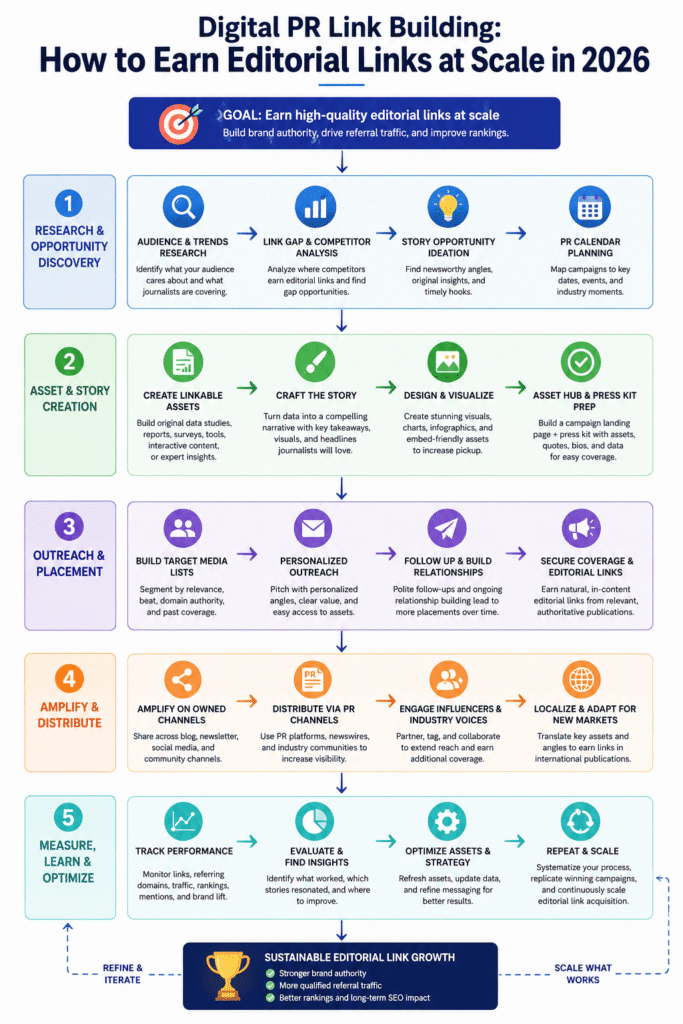
Table of Contents
ToggleWhy Editorial Links Pass the Tests Other Tactics Fail
Google’s SpamBrain system — updated continuously through 2024 — evaluates link naturalness across several dimensions: source topical relevance, anchor text variation, acquisition velocity, and the publishing context of the linking page (Source: Google Search Central, 2022). Editorial links from journalists writing in your sector pass all four. Directory submissions, guest post network placements, and link exchanges fail at least two.
That gap is not cosmetic. SpamBrain’s ability to identify transactional link patterns at scale means the historic tactics that built domain authority through the 2010s now carry neutral-to-negative signal weight. An editorial link placed by a journalist covering your sector, within a piece they wrote independently, carries citation naturalness that no outreach-for-placement arrangement replicates.
Digital PR link building is the systematic process of creating story angles newsworthy enough to attract genuine editorial coverage — and executing outreach precisely enough to convert that coverage into followed links. It’s not media relations repurposed for SEO. Every decision in a digital PR campaign optimised for link acquisition differs from one optimised for brand awareness: story selection, journalist targeting, pitch framing, and follow-up timing all run on different logic.
For how editorial links fit within a broader authority-building strategy — including entity authority and AI citation signals — see the Link Building in 2026 pillar.
The Four Story Angle Types and Where Each One Fits
Story angle selection determines which journalists can legitimately cover your pitch. Start with an angle type that doesn’t match your available assets or sector and no targeting precision recovers the campaign.
| Angle Type | What It Is | Best Sector Fit | Journalist Profile |
|---|---|---|---|
| Data-led | Original survey findings, proprietary dataset results, or public data reanalysed with a new conclusion | Finance, property, HR, consumer | Data journalists, sector correspondents, stat-hungry reporters |
| Expert opinion | Named practitioner commentary on a live news event or emerging trend | B2B, tech, professional services | Journalists running reactive daily news cycles |
| Reactive / Newsjacking | Rapid pitch attaching your expert to a breaking story | Any sector with consistent news flow | Deadline-driven news journalists — 24–48 hour response window |
| Visual asset | Original infographic, map, or interactive asset covering a topic journalists need visual support for | Consumer, lifestyle, geography-heavy | Editors and feature writers requiring embedded visuals |
Data-led angles produce the highest link volume per campaign because they function as self-contained news items — a journalist covers the finding without requiring further input from you. Start here if you have access to original data or can commission a survey of 500+ respondents.
Expert opinion angles require a named, credentialled practitioner willing to be quoted on record. For an SEO campaign this is typically a founder, head of department, or named sector specialist — not an anonymous brand voice, which journalists routinely decline.
Reactive angles are the fastest to execute and the hardest to scale. They require monitoring tools (Google Alerts, Mention, or Cision’s media monitoring) and a 2–4 hour pitch-to-send turnaround. Miss that window and the story’s been covered.
Visual asset angles carry more production cost upfront but generate longer-tail placement — an infographic published in February can still earn links in August from publications that found it through image search or content aggregation.
Pro Tip: In Ahrefs Content Explorer, search your target story angle topic, filter by DR 60+, published in the last 12 months, one page per domain. The results show which publications have covered similar angles and which journalists wrote them — that’s your pre-qualified outreach list, not a generic media contact database export.
Journalist Qualification: The Step That Actually Determines Response Rate
Most practitioners skip journalist qualification and go straight to building outreach lists from media databases. That skips the one step with the most direct effect on whether the campaign produces 1% or 20% response rates.
Journalist qualification is the process of verifying — before writing a single pitch — that a specific journalist has:
- Covered your topic or a directly adjacent topic in the last 6–12 months
- Published with a followed link to an external source in at least two recent articles
- Written for a publication in your target domain authority range (DA 50+, DA 60+, or DA 70+ depending on campaign objective)
- Not published your specific angle in the last 90 days
A journalist passing all four is qualified. One failing any criterion isn’t worth pitching — regardless of their prominence or publication tier.
The qualification process takes 15–25 minutes per journalist. That sounds slow. It’s not — it’s what makes the difference between 200 pitches producing 2 links and 40 pitches producing 10.
The part most guides skip is explaining what qualification actually revealed when we ran it. On the UK fintech campaign, the original plan was to pitch the full HARO response pool — every finance-vertical query that came through. We expected volume to carry the campaign. It didn’t work that way. HARO finance queries attracted 50–100 competing responses per query; unqualified entries were invisible by default. Moving to targeted qualification — filtering to journalists who’d previously published source-credited quotes in their articles, then cross-referencing their recent coverage against our angle — shifted response rate from 3% in month one to 19% in month two. Every editorial link came from the qualified list.
Building a Qualified Journalist List Without a Six-Figure Media Database
Cision and Meltwater are standard media database tools. Neither is a requirement for building a qualified journalist list — Ahrefs Content Explorer covers the core workflow at a fraction of the cost, provided you know the sequence.
Step 1 — Map your angle’s coverage territory
Search your target story topic in Ahrefs Content Explorer. Filter: DR 50+, published last 12 months, English, one page per domain. Export the results. These are publications that have actively covered your territory recently — confirmed editorial interest, not database guesswork.
Step 2 — Identify the journalist by byline
Open each result. Check the byline. If the article credits a named journalist rather than “staff writer” or “editorial team,” that person has already confirmed editorial interest in your topic.
Step 3 — Verify link-giving behaviour
Open 2–3 of the journalist’s recent articles (search: "journalist name" site:publication.com). Check whether they cite external sources with followed links. Journalists who cite sources link to them; those who don’t, won’t.
Step 4 — Check angle recency
If they’ve published your specific angle within 90 days, remove them from the list. They’ve covered it; they won’t cover it again immediately.
Step 5 — Build and score the list
Spreadsheet: Journalist Name | Publication | DA | Email | Recent Coverage URL | Last Published Date | Angle Match Score (1–3).
A qualified list of 30–40 journalists outperforms an unqualified list of 300. Build it before writing the first pitch — not after.
Pitch Construction: What Gets Read and What Gets Filed
The pitch is not the load-bearing element of digital PR link building. Qualification is. A well-constructed pitch delivered to the wrong journalist produces nothing; a serviceable pitch to a pre-qualified journalist converts at a measurable rate.
Journalists receive dozens of pitches daily. The ones that convert share three characteristics: they lead with the news angle rather than the brand, they make the journalist’s job easier rather than harder, and they don’t require a follow-up email to understand what’s being offered.
A converting pitch structure:
Subject line: [Data/Finding/Expert Name] + [The Specific Claim] — [Publication-relevant hook] Example: UK fintech founders: 67% expect FCA digital asset rules to tighten by Q3 — survey of 500 founders
Opening line: The finding or angle in one sentence. No brand context. No background. The news first.
Paragraph 2: What supports the finding — methodology, source credibility, expert credentials, or a live newsjacking link.
Paragraph 3: What you’re offering — quote, data access, expert interview, or visual asset download link.
Close: One direct ask. Not “let me know if you’re interested.” Something named: “Happy to send the full dataset if useful for your piece.”
Total length: 150–200 words. Pitches running longer are rarely read in full (Source: Cision, 2024).
Brand mention arrives in paragraph 2 — if at all. Journalists aren’t covering your brand; they’re covering the angle. Make the angle the story and the brand a footnote.
Converting Coverage Into Followed Links
Earning editorial coverage and earning a followed link are not the same outcome. Coverage without a link builds brand signal only — no domain authority transfers.
Most practitioners treat link acquisition as a passive result of coverage. It isn’t. The link has to be requested — directly, specifically, and within the right window.
The standard post-coverage outreach sequence:
- Confirm the coverage is live — find the article, check for the link, check whether it’s followed or nofollow
- If no link is present — email the journalist within 48 hours: “Saw the piece — thank you for the coverage. If it’s possible to add a link to [specific page], that would be much appreciated.”
- If a nofollow link is present — same approach: “Would it be possible to update the link to a followed link?” Journalists rarely distinguish between follow and nofollow; a direct, polite request converts 30–40% of nofollow placements in practice (Source: Ahrefs, 2024).
- Log the outcome regardless — followed link, nofollow, or no link. The log informs which publications and journalists are worth targeting again.
The follow-up window is 48 hours. After that, the journalist has moved to other stories and the request arrives as an inconvenience rather than a timely ask.
Pro Tip: In Google Search Console, monitor referring domain growth weekly from month two of a digital PR campaign. Set a threshold: if new DR-contributing domains are running below 2 per month, the qualification or pitch conversion steps need review — not the outreach volume. More pitches won’t fix a targeting or conversion problem.
Scaling Outreach Without Degrading Link Quality
Scaling digital PR link building means increasing qualified pitch volume — not total pitch volume. That distinction is the one most scale attempts ignore.
The common error: expanding the journalist list without maintaining qualification standards. Response rates drop. Link conversion drops. The campaign produces outreach noise rather than editorial links.
Three process controls prevent quality degradation at scale:
Control 1 — Systematise qualification, not just outreach Build journalist qualification into a repeatable weekly workflow. The 5-step Ahrefs process above takes 15–25 minutes per journalist. At 10 journalists per week, that’s 40 qualified contacts per month — enough to generate 6–8 editorial links at a 15–20% response rate, sustained.
Control 2 — Maintain angle type diversity Running the same angle type each quarter triggers diminishing returns within your qualified journalist pool. A journalist who covered your data-led angle in Q1 won’t cover another data-led angle from you in Q2. Rotate deliberately across angle types.
Control 3 — Track at journalist level, not campaign level Log whether each qualified journalist converted, declined, or didn’t respond. Those who convert once are worth re-targeting next quarter with a different angle. Those who don’t respond across two pitches are not worth a third.
SpamBrain’s evaluation of editorial links includes acquisition velocity as a naturalness signal (Source: Google Search Central, 2022) — a campaign producing 20 editorial links in a single month looks less natural than one producing 4–6 per month over six months. Steady accumulation builds a more credible link profile than any volume spike.
Frequently Asked Questions
What is digital PR link building and how does it differ from traditional link building? Digital PR link building earns editorial backlinks — links placed by journalists or editors because your story or expert commentary earned independent coverage. It differs from traditional tactics like guest posting or directory submissions in that the links are genuinely editorial, placed at the journalist’s discretion rather than exchanged or purchased. Google SpamBrain evaluates link naturalness; editorial links pass that evaluation where transactional links frequently don’t.
How long does it take to see results from a digital PR campaign? Most digital PR campaigns begin producing editorial links in month two, once the qualified journalist list is built and initial pitches have cycled. Measurable domain rating movement — typically 5–15 DR points — appears at the 4–6 month mark for sites starting below DR 50. A campaign producing fewer than two followed editorial links per month is underperforming and needs qualification or conversion review, not more outreach volume.
Do you need HARO or Cision to run digital PR link building? No. HARO (now Connectively) and Cision are useful but not required. Ahrefs Content Explorer replicates the journalist identification function at lower cost: search your target topic, filter by DR 60+, published last 12 months, one page per domain, then identify journalists by byline. The result is a qualified list built from demonstrated editorial behaviour rather than a media database’s contact records.
What makes a journalist qualified for digital PR outreach? A qualified journalist has covered your topic or an adjacent topic in the last 6–12 months, links to external sources in their articles, writes for a publication in your target DA range, and has not published your specific angle within the last 90 days. Qualification takes 15–25 minutes per journalist and is the highest-ROI step in the process.
How many editorial links does a digital PR campaign typically produce per month? A well-run campaign with a qualified list of 30–40 journalists, pitching one angle per month, produces 4–8 followed editorial links per month at a 15–25% response rate. Campaigns pitching broad media lists without qualification produce 0–2 links per month regardless of outreach volume. The deciding variable is journalist qualification — not pitch quality or outreach scale.
What to Do Next
Digital PR link building front-loads effort. The first two months are qualification, angle development, and list construction. Month three is where followed editorial links arrive consistently — if the earlier steps ran correctly.
Every section in this cluster corresponds to a process step that has to complete before the next one starts. Skipping journalist qualification to save time is what produces 3% response rates. Running it is what produced the 19% rate and 23 editorial links in the UK fintech campaign.
The next step is concrete: open Ahrefs Content Explorer now, search your target story angle topic, filter by DR 60+, published last 12 months, one page per domain, export the first 20 results. Open each article. Find the byline. Check two or three of the journalist’s other pieces for external links. Score each contact 1–3 on angle match. That’s your qualified outreach list — build it today, before writing a single pitch.
For the entity authority dimension of link building — how topical relevance of the linking source affects Knowledge Graph signals alongside domain rating — that’s covered in the next cluster in this series.
References
Ahrefs. “Link Building for SEO.” Ahrefs, 2024. https://ahrefs.com/seo/link-building Supports: Response rate benchmarks for targeted vs broad journalist outreach; nofollow-to-followed link conversion rate estimates.
Google Search Central. December 2022 Link Spam Update.” Google Search Central Blog, 2022. https://developers.google.com/search/blog/2022/12/december-22-link-spam-update Supports: SpamBrain evaluation criteria for editorial link naturalness, topical relevance, and acquisition velocity as naturalness signals.
Cision. “2024 State of the Media Report.” Cision, 2024. https://www.cision.com/resources/guides-and-reports/2024-state-of-the-media-report/ Supports: Journalist pitch preferences, inbox volume context, and what PR professionals can do to win earned media coverage.
Search Engine Journal. “Ask An SEO: Digital PR Or Traditional Link Building, Which Is Better?” Search Engine Journal, 2025. https://www.searchenginejournal.com/ask-an-seo-digital-pr-or-traditional-link-building-which-is-better/553879/ Supports: Distinction between brand PR campaign objectives and SEO-specific digital PR link acquisition objectives.
Search Engine Journal. How An Enterprise Digital PR Firm Earns 100s Of Links In 30 Days.” Search Engine Journal, 2024. https://www.searchenginejournal.com/enterprise-100s-links-recap/510498/ Supports: Scalable digital PR outreach process and journalist targeting methodology for editorial link acquisition.