

Unilever just redrew the map for enterprise content marketing. Whether the rest of the industry can follow — or even measure what happens next — is a different question entirely.
- Unilever CEO Fernando Fernández declared traditional TV-heavy advertising “lazy marketing” and is shifting half the company’s global ad budget to a social-first model
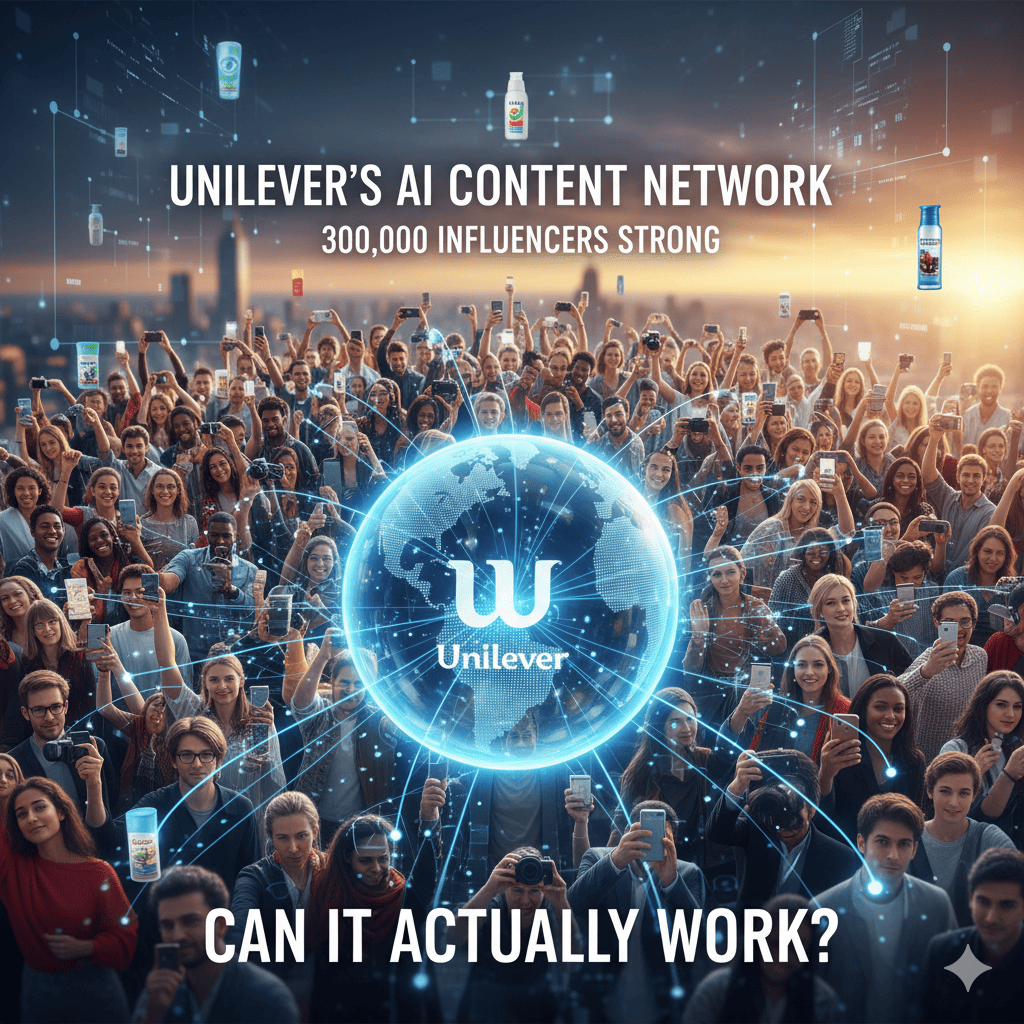
- The target: over 300,000 influencers, including a micro-influencer in every postal code in key markets like India — a 20x scale-up in creator collaborations
- A March 2026 Adobe Express study found 71% of video creators on YouTube, TikTok, and Instagram now use AI video generation or editing tools (Adobe Express, March 2026)
- Creators using AI tools report a 19% average increase in audience watch time and a 17% boost in community engagement (Adobe Express, March 2026)
- DAIVID and ADIN.AI announced a partnership on 27 April 2026 to solve the creative evaluation problem this scale creates
- The honest answer to whether it will work: nobody knows yet — and the measurement infrastructure to find out barely exists
The Strategy That Rattled an Industry
Fernando Fernández did not ease into the announcement. He called traditional brand advertising — the expensive, agency-produced, TV-first kind — “lazy marketing.” Half of Unilever’s global advertising budget, one of the largest in the world, is moving to social-first.
Creator collaborations would scale by 20 times. The goal is an army of 300,000 influencers — micro-influencers embedded in specific communities, down to postal-code level in markets like India.
Traditional advertising agencies felt the shockwave immediately. Manual sourcing, onboarding, and content approval at 300,000-creator scale does not exist as a human workflow. Specialised creator agencies picked up business that legacy agency relationships had assumed were locked in. Understandably so.
The panic, though, was aimed at the wrong target.
The AI Layer Nobody Is Talking About
Here is the number that changes the conversation. A March 2026 Adobe Express study surveyed video creators across YouTube, TikTok, and Instagram and found that 71% have now adopted AI video generation or editing tools (Adobe Express, March 2026).
Of those, 41% deploy them weekly.
Stats Block
| Metric | Figure | Source |
|---|---|---|
| Creators using AI tools | 71% | Adobe Express, March 2026 |
| Weekly AI tool users | 41% of AI adopters | Adobe Express, March 2026 |
| Average time saved per video | 30+ minutes | Adobe Express, March 2026 |
| Creators saving 4+ hours per video | 10% | Adobe Express, March 2026 |
| Increase in audience watch time | 19% average | Adobe Express, March 2026 |
| Boost in community engagement | 17% average | Adobe Express, March 2026 |
| Creators planning to increase AI spend | 50% | Adobe Express, March 2026 |
Source: Adobe Express Creator Survey, March 2026
What Unilever is building, when you layer these two facts together, is not simply an influencer network. It is a massive distributed network for the production and distribution of AI-assisted content at a scale the marketing industry has never attempted.
The question nobody has cleanly answered yet is whether any of it will work.
The Signal-to-Noise Problem
Scale creates a specific trap. When 300,000 hyper-local micro-influencers produce AI-assisted videos for niche audiences across hundreds of markets simultaneously, the traditional test-and-learn framework stops working.
Individual pieces of content may perform well in isolation. The overall brand narrative, meanwhile, could diffuse into incoherence. Or — and this is equally possible — the hyper-personalisation lands exactly as intended, and the aggregate effect outperforms anything a single high-production campaign could achieve.
Right now, the honest answer is that nobody knows with confidence. That is not a criticism of the strategy. It is a description of how new this territory is.
AI Trend Watch
The DAIVID and ADIN.AI partnership, announced 27 April 2026, is a direct response to the evaluation gap Unilever’s model creates.
DAIVID is a creative intelligence platform whose AI models — trained on tens of millions of human responses to ads — predict how any piece of ad creative will perform. The platform measures attention, 39 distinct emotions, memory encoding, brand recall, and likely next-step actions, without requiring human panels.
ADIN.AI is an AI-native operating system for enterprise marketing — a unified intelligence layer sitting above an organisation’s existing tools, spanning channels, budgets, and decisions.
The partnership embeds DAIVID’s creative effectiveness models directly into ADIN.AI’s platform. The result is a live loop: creative is scored before launch, high-performing assets are scaled in real time, underperformers are paused, and historical data becomes the benchmark for future planning.
Ian Forrester, CEO of DAIVID, described the problem plainly:
“Creative is a key driver of advertising outcomes, but for too long it has been measured in isolation, disconnected from media results.” — Ian Forrester, CEO, DAIVID, DAIVID Blog, April 2026
The first live client under the partnership is Ajinomoto, the global food and nutrition company.
Why This Matters for SEO and Content Practitioners
The Unilever pivot is not really about replacing agencies with influencers. That framing misses the actual disruption.
The real disruption is what happens to evaluation infrastructure when 71% of 300,000 creators are producing AI-assisted content at speed, across dozens of platforms, in hundreds of markets, simultaneously.
Human panels are too slow. A/B testing individual assets across a network this size is logistically impossible. Traditional brand-tracking surveys tell you what happened last quarter. They do not tell you what is working right now.
The DAIVID and ADIN.AI partnership does not solve the content quality problem. What it does solve is the evaluation problem — and at 300,000-creator scale, that is arguably the more urgent gap.
Implications
For SEO practitioners and content strategists: AI-assisted content at hyper-local scale will increasingly surface in search results. The signal quality question — which pieces of content earn authority versus which dilute it — is now a live SEO issue, not just a brand question. Monitor how Google’s quality systems respond to distributed AI-assisted content over the next two to three algorithm cycles.
For agencies: The operational model has changed. Manual content workflows at 300,000-creator scale do not exist. Agencies that have not built or adopted AI-native evaluation tools are not positioned to manage campaigns of this type. The DAIVID–ADIN.AI model is the direction of travel — creative scoring at scale, connected to media performance in real time.
For site owners and publishers: Unilever’s social-first shift means less budget flowing to display and traditional media, and more flowing through creator channels. If your site relies on brand advertising revenue, the structural budget shift is worth tracking. If you are a publisher in a niche where Unilever operates, expect more branded creator content competing for the same audience attention.
For content teams: The 30-minute average time saving per video reported by AI tool users (Adobe Express, March 2026) is a production efficiency data point — not just for video, but for written content too. The more important metric is the 19% watch time increase. Efficiency gains that also improve performance are rare. Pay attention to how AI tool adoption is reshaping audience expectations for content quality and cadence.
Takeaway
Unilever’s 300,000-influencer network is the most ambitious test of AI-assisted content production at enterprise scale attempted to date. The strategy is credible. The measurement infrastructure to evaluate it honestly is still being built — and the DAIVID–ADIN.AI partnership is one of the first serious attempts to close that gap.
For practitioners, the lesson is familiar: distribution channels change, production tools change, volume increases. What stays constant is the need to measure what is actually working and make decisions from that measurement rather than from assumptions. That is true whether you are optimising for search citations or creator content performance.