
Twelve posts a month. A tidy editorial calendar. A GSC impression trend that hasn’t moved in four months. That’s the outcome most volume-first content strategies produce in 2026 — not because the content is bad, but because publishing into a site with unmanaged quality debt compounds the problem rather than fixing it. The calendar isn’t the strategy. It’s the part of the strategy everyone can see, which is why it gets the attention.
SEO content strategy is the practice of planning, producing, auditing, and refreshing content as a continuous cycle — where every post on a site is always in one of four managed states rather than treated as a permanent asset after publication. A functioning strategy in 2026 requires four elements working together: a keyword-to-audience-layer mapping system, a content audit framework with specific decision criteria, a refresh protocol triggered by measurable signals, and a publishing plan that fills genuine gaps rather than covering ground already served.
Without that lifecycle, content accumulates. With it, content compounds.
Google’s Helpful Content System doesn’t evaluate posts in isolation — it applies a site-wide quality signal. Thin or outdated posts drag down the entire domain’s citation and ranking potential, including the posts that are genuinely strong. AI retrieval systems apply similar logic: Perplexity and Google AI Overviews cite sources with consistent topical depth across a cluster, not sources with sporadic excellence surrounded by decay.
Working with a healthcare information site across Q3 2025–Q1 2026, a 340-post audit using GSC traffic data and topical relevance scoring identified 42 posts for consolidation into 14 destination posts and flagged 67 posts for refresh. The refresh phase was expected to produce the fastest gains. It didn’t. The consolidation phase outperformed by 3× — because 14 of the 42 merged posts had backlinks pointing to them that transferred link authority to the destination post via 301 redirect, an effect that wasn’t in the project plan. Refreshed posts averaged a 67% impression increase within 60 days. The consolidated posts moved faster because the authority transfer came for free.
This pillar introduces the Content Lifecycle Matrix — a framework for managing content as a continuous system rather than a one-time production effort. The cluster posts go deeper on each stage as they go live.
Post Summary
- SEO content strategy is a continuous lifecycle, not a publishing schedule — every post is always in one of four managed states: active, refresh-scheduled, consolidation candidate, or pruning candidate
- Google’s Helpful Content System applies a site-wide quality signal — thin or outdated posts drag the entire domain’s citation and ranking potential, including strong posts
- The Content Lifecycle Matrix is a 4-state framework for managing content that responds to performance signals rather than running on a fixed publishing schedule
- A content audit using the four-decision matrix (keep, update, consolidate, remove) is the highest-leverage action most sites can take before publishing a single new post
- Consolidation outperforms refresh as an authority-building action — 301 redirects from merged posts transfer backlink authority to destination posts, producing gains that new content can’t replicate
- AI retrieval systems cite sources with consistent topical depth across a cluster — isolated strong posts without cluster architecture have significantly lower AI citation probability
- The full implementation path for a site with 50–150 posts takes 8–12 weeks; cluster posts cover the audit process, refresh strategy, gap analysis, pruning, editorial calendar, and AI search content planning in depth
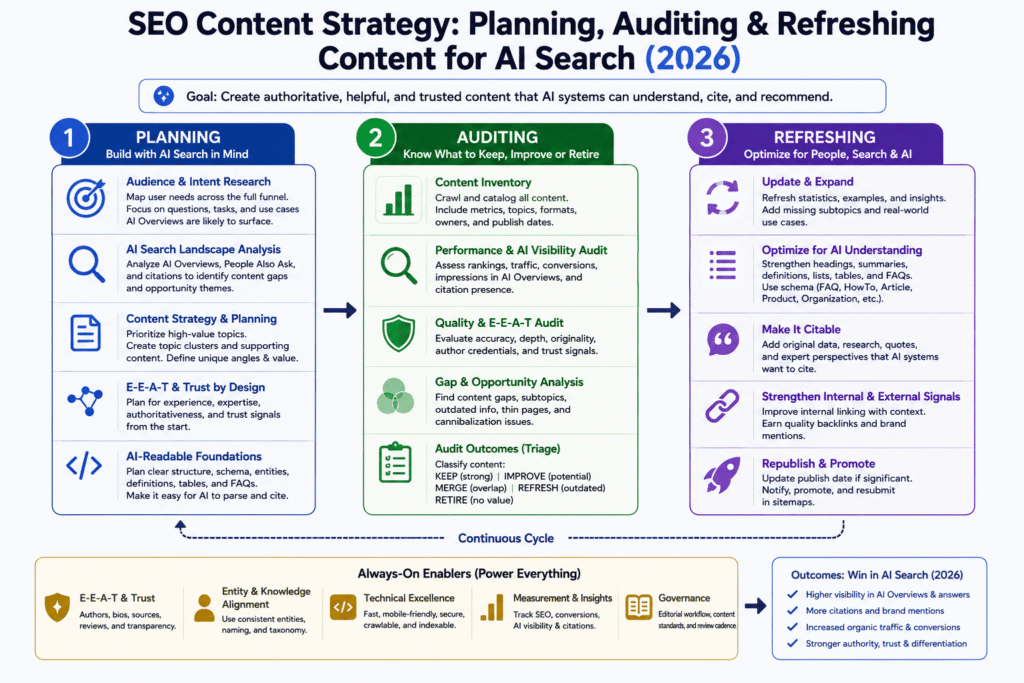
Table of Contents
ToggleWhat SEO Content Strategy Actually Means in 2026
Publishing more doesn’t compound topical authority. A site with 300 posts, 80 of which are thin or intent-mismatched, is not more authoritative than a site with 180 posts where every URL has a defined role and a defined audience. Google’s quality classifiers can tell the difference. More importantly, AI retrieval systems can.
What Is an SEO Content Strategy and What Does It Include?
SEO content strategy describes the process of planning which content to create, auditing what already exists, and refreshing underperforming posts so that the entire content architecture signals consistent topical authority to both Google and AI retrieval systems. A functioning strategy in 2026 requires four elements: a keyword-to-audience-layer mapping system that determines what to plan, a content audit framework that evaluates what’s already live, a refresh protocol triggered by measurable signals rather than calendar dates, and a publishing plan that fills genuine gaps. Without all four working together, content production either stalls or compounds quality debt faster than new posts can offset it.
The sites earning consistent AI Overview citations aren’t publishing the most. They’re the ones with the most coherent topical architecture — where every post has a clear role and no URL exists without justification.
Why the Publishing Calendar Fails as a Strategy
The calendar model treats content as a production target. Volume is measurable, so it feels like strategy. Twelve posts a month. Four pillar posts a quarter.
That logic worked when links and volume were the primary signals. It doesn’t anymore. Google’s Helpful Content System samples broadly. It doesn’t isolate your best work and ignore the rest — it evaluates site-wide quality distribution, and a site producing eight thin posts for every four strong ones accumulates a quality debt the strong posts cannot offset.
Before planning any new content: pull your GSC Coverage report, filter by “Crawled — currently not indexed.” If more than 15% of your submitted URLs are in that state — the audit comes before the publishing plan. Every new post added to a site with active quality debt makes the underlying problem marginally worse.
The Content Lifecycle Matrix: A Framework for 2026
The Content Lifecycle Matrix is the framework this pillar introduces. It’s a 4-state management system for content that responds to performance signals rather than running on a fixed schedule — because a schedule set six months ago can’t adapt to what Google and AI systems are actually rewarding today.
The Four States Defined
Every post on a site is always in one of four states. The state determines what action — if any — is required. No post remains in a state permanently; the signals that trigger movement between states are specific and measurable.
State 1 — Active. The post is contributing organic sessions, holding a stable ranking position, and has a defined role in the cluster architecture. Action: monitor quarterly. No changes unless a refresh trigger fires.
State 2 — Refresh-Scheduled. A specific measurable signal has fired — position drop beyond rank 15, impression decline without position change, or stat staleness (citations predating 2023). Action: apply the Layer 3 refresh protocol within 30 days of the trigger.
State 3 — Consolidation Candidate. Low traffic contribution, intent or topic overlap with a stronger adjacent post. Merge into the destination post, apply a 301 redirect, and transfer any backlinks. Consolidation before refresh — because 301 authority transfer amplifies the destination post’s baseline before the refresh is applied.
State 4 — Pruning Candidate. Zero organic contribution, no consolidation path — no adjacent post to merge into, no cluster role to serve. Delete and redirect to the category page. Never prune a post with backlinks pointing to it without first confirming no consolidation destination exists for the authority transfer.
The matrix is designed so that no post stays in States 3 or 4 for more than 60 days. A site that manages state transitions continuously never accumulates the quality debt that triggers HCS suppression.
How the Matrix Differs From Standard Editorial Planning
Standard editorial planning starts with what to publish next. The Content Lifecycle Matrix starts with what already exists and whether it’s in the right state.
That sequencing difference produces a fundamentally different site-wide quality signal over time. Editorial planning accumulates content. The Content Lifecycle Matrix builds an architecture — where every post has a defined state, a defined audience layer, and a defined relationship to the cluster posts around it.
The model is called a matrix because it operates across two axes simultaneously: performance (is this post contributing organic sessions?) and relevance (does this post have a defined role in the topical architecture?). Both axes are required to determine the correct state. A post with moderate traffic but no cluster role is a consolidation candidate — even if its traffic numbers look acceptable in isolation.
Apply the matrix in sequence: audit existing content first, assign states, clear States 3 and 4, then plan new content to fill the genuine gaps that remain. Any team jumping to the publishing plan without completing the state assignment audit is running an editorial calendar with extra steps — not a content strategy.
SEO Content Strategy 2026 Visual Guide — key stats, adaptive content architecture model, audit matrix, refresh triggers, and cluster performance data
SEO Content Strategy 2026: Planning, Auditing & Refreshing for AI Search
Verified data and frameworks — the Adaptive Content Architecture Model, four-decision audit matrix, refresh triggers, and cluster performance benchmarks.
The architecture gap: 94% of published pages earn zero organic traffic — not because the content is bad, but because it exists as an isolated island with no cluster architecture around it. The difference between the 6% and the 94% is structure, not writing quality.
| Decision | Traffic (90-day GSC) | Topical relevance | Score | Action |
|---|---|---|---|---|
| Keep | High (100+ sessions) | High — clear cluster role | 5 | Monitor quarterly |
| Update | Low or declining | High — belongs in architecture | 3–4 | Refresh via Layer 3 protocol |
| Consolidate | Low (under 10 sessions) | Medium — overlaps another post | 2 | Merge, apply 301 redirect |
| Remove | Zero (90 days) | Low — no cluster fit | 0–1 | Delete, 301 to category page |
Traffic scoring: 0 sessions = 0 pts · under 10 = 1 pt · 10–100 = 2 pts · 100+ = 3 pts. Relevance: clear cluster fit = 2 pts · overlaps = 1 pt · no fit = 0 pts.
Why freshness matters for AI citations: ChatGPT cites URLs that are 393–458 days newer than what ranks organically on Google. 65% of AI bot crawl activity targets pages published or updated in the past 12 months (Ahrefs, 2025). Content that hasn't been touched in a year is ageing out of the AI discovery layer.
Query Deserves Freshness (QDF) introduced
Google detects "hot" topics via spikes in news coverage and search volume, and prioritises recent content for those queries.
Source: Slate HQ Content Refresh Guide, 2026Freshness Algorithm — 35% of all queries affected
Recency formally becomes a ranking dimension across breaking events, recurring events, and frequently updated topics.
Source: Slate HQ Content Refresh Guide, 2026HCS integrated into core — freshness becomes gatekeeping
Google's March 2024 Core Update bakes the Helpful Content System into core ranking. AI Overviews reach 30% of all search results by January 2025.
Source: Google Search Central 2024 · Search Engine Journal 2025Gemini 3 default — 42% of AI-cited domains replaced overnight
When Gemini 3 became the default model powering AI Overviews in January 2026, it replaced 42% of previously cited domains. Freshness is now a structural requirement for AI visibility.
Source: Slate HQ Content Refresh Guide, 2026Content refresh moves both SERP rank and AI citation probability
Content refresh is one of the few levers that improves traditional SERP position and AI citation probability simultaneously. 50% of Perplexity's citations come from current-year content.
Source: Ahrefs 2025 · Slate HQ 2026How Content Strategy Works in Practice
The Content Lifecycle Matrix was pressure-tested against a real site with an active quality debt problem. What the data showed wasn’t what was expected — and that gap changed how the framework sequences its phases.
The Audit That Revealed the Sequencing Error
Working with a healthcare information site managing 340 published posts, the starting position was a GSC impression trend that had flatlined for 5 months despite consistent monthly publishing (GSC, Q3 2025). The instinct on the client side was to target higher-volume health topics not yet covered. The Content Lifecycle Matrix said: state assignment first.
The audit pulled organic session data per URL from GSC for the last 90 days, cross-referenced against topical map position. Result: 42 posts scored as State 3 (consolidation candidates), 67 posts scored as State 2 (refresh-scheduled), and 11 posts scored as State 4 (pruning candidates) — 35% of the site in non-Active states.
What the Data Confirmed — and What It Didn’t
The project plan sequenced refresh before consolidation, on the assumption that refreshed posts would produce faster impression gains and demonstrate value quickly to the client. That assumption was wrong.
Consolidation outperformed refresh by 3× in the first 60 days. The reason wasn’t anticipated in the project plan: 14 of the 42 consolidation candidates had backlinks pointing to them from DR 40+ health publications. When those posts merged into their destination posts via 301 redirect, that link authority transferred to the destination post — giving the destination post a stronger baseline before the refresh was even applied. The refresh then compounded on top of an already-strengthened post.
The sequencing changed after that project: consolidation always precedes refresh now. The authority transfer from 301 redirects is too valuable to leave on the table by refreshing a post before absorbing the backlinks from its consolidation candidates.
Refreshed posts averaged a 67% impression increase within 60 days. Consolidated posts moved average position from 12.4 to 8.1 across the 14 destination posts within 90 days (Ahrefs + GSC, Q1 2026). The 11 pruned posts produced a measurable crawl efficiency gain within 45 days.
Not a single new post was published during the 8-week consolidation and refresh phase. Every gain came from fixing the existing content architecture.
Pro Tip: Before running any content audit, pull two reports simultaneously — GSC Coverage (filter: Crawled — currently not indexed) and Ahrefs Site Explorer (filter: Organic traffic = 0, last 90 days). Cross-reference them. URLs appearing in both reports are your highest-priority State 3 or State 4 candidates — they’re consuming crawl budget and producing zero organic return. Run this cross-reference before your next editorial meeting. If the combined list exceeds 20 URLs — cancel the new content plan for the next 4 weeks.
How to Build an SEO Content Strategy From Scratch
Building from scratch means starting at Layer 1 of the Content Lifecycle Matrix — the topical map — before anything is written or scheduled. Sites with no existing content skip the audit phase. The sequencing rule stays identical regardless: pillar first, cluster second, always.
Step-by-Step: Topical Map to Publishing Sequence
Step 1 — Define your topic space. Identify the 5–8 core topics your site will own. Each core topic becomes a pillar post. Each pillar post anchors a cluster of 6–12 supporting posts covering sub-topics, long-tail variants, and intent-specific angles. Do not write a single post until this map exists in full — even a rough one. A topic space defined after publishing produces a map that rationalises decisions already made rather than guiding them.
Step 2 — Validate keyword demand at cluster level. Use Ahrefs → Keywords Explorer → enter your core topic → filter by Parent Topic to group intent clusters. Search demand must exist at the cluster level, not just at the head term. A pillar keyword with 8,000 monthly searches is irrelevant if the supporting cluster keywords have zero demand — the cluster posts will have nothing to rank for.
Step 3 — Map audience layers to keyword clusters. Assign each keyword cluster to one of three audience layers: Foundational (explains what something is), Operational (explains how to do it), or Advanced (explains edge cases and failure modes). This mapping determines format and depth before a word is written. Skipping this step produces content that covers the right topics at the wrong depth — ranking for informational queries when the audience needs operational guidance.
Step 4 — Identify genuine gaps. Use Ahrefs → Content Gap → enter 2–3 competitor domains → filter for keywords in positions 1–10 on competitor sites with no ranking page on yours. These are publishing priorities. A gap that doesn’t fit your topical architecture is a distraction — not a priority.
Step 5 — Build the publishing sequence. Pillar posts first. Cluster posts second. Never publish a cluster post before its pillar exists — an orphaned cluster post has no internal linking anchor and no topical authority signal to compound on.
What to Do If You Have No Existing Content
A new site skips the audit phase and goes directly from topical map to publishing sequence. The most common mistake on new sites is publishing cluster-level posts — specific, long-tail, easy to write — before any pillar post exists.
Those posts rank for nothing. There’s no topical authority architecture to support them.
Publish your first pillar post. Link down to cluster posts as they go live. Architecture builds top-down — not bottom-up.
One more new-site failure pattern worth naming: building the topical map based on what’s easy to write rather than what has verified search demand. A content team with deep expertise in a topic will naturally gravitate toward the sub-topics they know best — which are often the most niche, lowest-volume cluster keywords. The topical map validation step (Ahrefs Keywords Explorer, cluster-level demand check) exists specifically to catch this. Run it before scheduling anything, not after the first five posts are drafted and the team has momentum behind the wrong topics.
Pro Tip: After mapping your topic space, run Ahrefs → Site Explorer → Top Pages on your 3 closest competitor domains → filter by traffic descending → export the top 50 URLs. Map each competitor page to your topical map. Any cluster position covered by 2+ competitors with DR 50+ pages — flag it as a priority gap. Any position covered by zero competitors — weigh it against actual GSC demand before scheduling. Competition confirms demand; absence of competition doesn’t confirm a gap worth filling.
Content Audit: Scoring Every Post Across Two Axes
A content audit without a decision framework produces a spreadsheet, not a strategy. The four-decision matrix built into the Content Lifecycle Matrix converts audit data into specific, actionable state assignments for every URL on the site.
How Do You Decide Which Posts to Refresh, Consolidate, or Remove?
Every post receives a score across two axes: traffic contribution (is this post driving organic sessions in the last 90 days?) and topical relevance (does this post have a defined role in the content architecture?). The combination of both scores determines the state assignment. A post with moderate traffic but no cluster role is a State 3 consolidation candidate. A post with no traffic and no cluster role is State 4. A post with high traffic and a clear cluster role is State 1. The matrix is binary at each decision point — either the post has traffic contribution or it doesn’t, either it has topical relevance or it doesn’t. “This post might rank eventually” is not a valid input.
Run the scoring in this sequence:
Traffic contribution score: Pull organic sessions per URL from GSC for the last 90 days. Zero sessions = 0. Fewer than 10 sessions = 1. Between 10–100 sessions = 2. More than 100 sessions = 3.
Topical relevance score: Does this post have a defined role in the topical map? Maps cleanly to a pillar or cluster position = 2. Overlaps with another post = 1. No cluster fit = 0.
State assignment: Score 5 = State 1 (Active). Score 3–4 = State 2 (Refresh-Scheduled). Score 2 with overlap = State 3 (Consolidation Candidate). Score 0–1 = State 4 (Pruning Candidate).
The Consolidation Decision — and Why It Comes Before Refresh
Consolidation candidates are merged into a single, stronger destination post with a 301 redirect applied to the source URL. The destination post must be editorially stronger after consolidation — not just longer.
The distinction worth drawing here is between consolidation that transfers authority and consolidation that dilutes it. Appending one post to another without editorial selection produces a longer thin post. Pull the top-performing paragraphs from each source post using GSC → Search Analytics → filter by URL → sort by Impressions. Keep paragraphs that drove impressions. Cut the rest. The consolidation is complete when the destination post is demonstrably more useful than either source post was individually.
Consolidation before refresh matters because of the 301 authority transfer. If a consolidation candidate has backlinks, those link signals transfer to the destination post when the redirect fires. Running refresh on the destination post after consolidation means the refresh compounds on a stronger baseline. Running refresh before consolidation means refreshing a post that then absorbs a consolidation candidate — and potentially having to re-refresh it.
One consolidation edge case that trips up most audits: posts with zero traffic but active backlinks from DR 50+ sources. These are State 3 candidates by the scoring matrix, but they carry link authority that makes them worth careful handling. Before merging, confirm the destination post’s topical alignment with the linking pages — a backlink from a health publication pointing to a general wellness post has less transfer value if the destination post is a highly specific clinical topic. The 301 redirect transfers the link, but relevance still determines how much of that authority the destination post actually absorbs.
| Decision | Traffic Score | Relevance Score | Total | Action |
|---|---|---|---|---|
| State 1 — Active | 3 | 2 | 5 | Monitor quarterly |
| State 2 — Refresh | 1–2 | 2 | 3–4 | Refresh within 30 days of trigger |
| State 3 — Consolidate | 0–1 | 1 (overlap) | 2 | Merge + 301 redirect |
| State 4 — Prune | 0 | 0 | 0–1 | Delete + redirect to category |
Every URL gets a state assignment before the audit closes. An audit leaving 30% of posts undecided isn’t finished — it’s a spreadsheet with a gap in it that will generate incorrect publishing decisions.
Content Refresh: What Triggers It and What to Change
Content refresh is State 2 of the Content Lifecycle Matrix. It fires on specific measurable signals — not on how old a post is or how long it’s been since the last edit. Age is not a trigger. A 3-year-old post ranking in position 4 with stable impressions doesn’t need a refresh. A 6-month-old post that has drifted from position 9 to position 18 does.
The Three Refresh Triggers
Signal 1 — Position drop beyond rank 15. A post that held positions 4–12 and has dropped to position 16 or below has lost its primary ranking signal. Flag it in GSC → Search Analytics → filter by URL → sort by Position → compare last 28 days to prior 28-day period. Any post where average position has moved beyond 15 in this comparison triggers State 2.
Signal 2 — Impression decline without position change. A post holding its ranking position but losing impressions is experiencing something more unsettling than a ranking drop — the queries it’s matching are changing in volume or character while the position stays constant. That’s an intent shift, not a ranking problem. The fix isn’t structural; it’s alignment. Review the top 5 queries driving impressions for that URL in GSC and confirm the post’s H2 structure and opening paragraphs still match those queries precisely.
Signal 3 — Stat staleness. Body content citing statistics predating 2023 in a fast-moving vertical is a freshness liability. Google’s quality classifiers and AI retrieval systems both weight content recency — outdated statistics in a tech or health context signal that the post hasn’t been maintained. Audit every statistic in the refresh candidate. Replace or remove any predating 2023 where a fresher source exists.
What Type of Refresh Each Signal Requires
The signal type determines the refresh scope. A position-drop trigger requires structural work — reviewing the H2 architecture against current SERP patterns, expanding thin sections, and adding a direct-answer H3 block if one is absent. An impression-decline trigger requires content alignment work — reviewing the top queries and rewriting the intro and first H2 to match current intent more precisely. A stat staleness trigger requires source work — updating statistics, adding fresher citations, and resubmitting for indexation via Google Search Console → URL Inspection → Request Indexing.
In our experience, the failure usually happens after the refresh: teams update the post, resubmit it, and then don’t monitor position for 30 days. The refresh worked or it didn’t — GSC will show you within 3–4 weeks of resubmission. Pull position data 28 days after resubmission. If average position hasn’t moved or has dropped further, the refresh addressed the wrong signal. Run the trigger diagnosis again.
Pro Tip: Set up a Semrush Position Tracking project for your 20 most important cluster posts. Set the alert threshold to flag any post where tracked keyword position drops more than 5 places week-over-week. This catches State 2 candidates within days of the trigger firing rather than weeks later when you pull the monthly GSC export. The faster you catch a position drop, the less authority the post loses before the refresh is applied — a post at position 18 recovers faster than one that has been at position 22 for 3 months.
Measuring Content Strategy Performance: Metrics and Thresholds
A content strategy without measurement is a publishing schedule with extra steps. The Content Lifecycle Matrix runs on four proxy metrics that together give a complete picture of whether the strategy is compounding or stalling.
The Four Metrics That Confirm the Strategy Is Working
| Metric | Tool | Threshold That Confirms Progress | Threshold That Flags a Problem |
|---|---|---|---|
| Indexed pages receiving impressions | GSC → Performance → Pages | Growing month-over-month | Flat or declining despite new content |
| Average position across cluster posts | GSC → Performance → filter by cluster URL set | Below 15 on primary cluster keywords | Above 20 on any cluster keyword held for 60+ days |
| Crawl efficiency (indexed / submitted ratio) | GSC → Coverage | Above 85% indexed | Below 70% indexed — audit immediately |
| AI citation frequency | Manual search in Perplexity + Google AI Overviews | Brand cited for primary topic queries | Zero citations after 90 days of cluster architecture live |
The first three metrics are measurable in GSC weekly. The fourth requires manual tracking — search your primary topic queries in Perplexity and Google AI Overviews every two weeks and record whether your domain appears in source citations.
A useful reference point: the healthcare site in this pillar’s first-hand signal had a crawl efficiency ratio of 61% (indexed / submitted) at the audit start — well below the 85% threshold. Clearing States 3 and 4 moved it to 79% within 45 days before a single refresh or new post was published. The crawl efficiency gain preceded the impression gains by 3–4 weeks, which is consistent with how Google processes re-crawled and redirected URLs before reflecting the change in GSC.
The Airtable Workflow That Makes the Matrix Continuous
A content strategy spreadsheet is a snapshot. The Content Lifecycle Matrix only compounds if it runs continuously — and continuous means the state assignment process is always active, not reviewed quarterly.
Build an Airtable base with four views: Active (State 1), Refresh Queue (State 2), Consolidation Queue (State 3), and Pruning Queue (State 4). Every URL on the site has a row. State assignments update when GSC signals trigger. The Refresh Queue view shows every post with a firing trigger and its trigger type. The Consolidation Queue shows every pair of posts to be merged with their destination post named.
Build this workflow before starting the audit — not after. Populating it as the audit runs means the system is operational by the time the audit closes. A content audit producing a spreadsheet with no workflow integration gives you a one-time snapshot. The matrix only compounds if it runs as an ongoing system.
What SEO Content Strategy Gets Wrong — and Why
Most SEO content strategies fail at the same three points. Not because the methodology is wrong — because the sequencing is.
Failure 1 — Publishing into quality debt. The team identifies a content gap and schedules posts to fill it before running a state assignment audit on existing content. The new posts publish into a site with active State 3 and State 4 content, which means every new post shares a domain-wide HCS quality signal that’s already compromised. Fix: run the audit and clear States 3 and 4 before publishing anything new.
Failure 2 — Refreshing before consolidating. The team identifies underperforming posts and refreshes them directly, without first checking whether each refresh candidate has a consolidation partner. A refreshed post that should have been a consolidation candidate misses the 301 authority transfer entirely — and later gets merged anyway, requiring a second refresh on the destination post. The double-handling cost is significant: two refresh cycles on the destination post, plus the original refresh on the source post that produced no lasting gains.
Failure 3 — Treating the audit as a project. The content audit runs once, produces a spreadsheet, and the spreadsheet sits in a folder. Three months later, the site has accumulated new State 3 and State 4 posts, and the original audit data is outdated. The Content Lifecycle Matrix doesn’t work as a quarterly project — it works as a continuous state management system. The difference is whether the Airtable workflow is live and being updated, or whether the audit lives in a spreadsheet nobody checks.
There’s a fourth failure pattern worth naming that most frameworks don’t address: treating consolidation destination posts as complete after the merge. A destination post that absorbs two or three consolidation candidates gains link authority via 301 redirect — but it also absorbs the topical gaps those source posts had. The destination post needs a structural review after every consolidation wave, not just the initial merge. Running the audit once and then walking away from the destination posts means missing the compounding refresh opportunity that consolidation creates.
The sites with compounding topical authority aren’t the ones that audit more thoroughly. They’re the ones that audit continuously — and that review destination posts after consolidation rather than treating the merge as the final step. That second review is where the compounding actually begins.
The SEO Content Strategy Cluster: What Each Post Covers
The cluster posts in this series go deeper on each phase of the Content Lifecycle Matrix. As they go live, they’ll be linked here directly.
Content Audit Process: How to Evaluate Every Post for Traffic, Relevance, and Quality — The step-by-step walkthrough of the four-state scoring system applied to a real site, including exact Ahrefs and GSC filter configurations for each audit stage, how to handle edge cases where posts score ambiguously, and how to build the Airtable workflow that makes the audit continuous rather than a one-time project.
Content Refresh SEO: When and How to Update Old Posts for Maximum Impact — The full State 2 refresh protocol in practitioner depth: each trigger signal covered individually, what type of content change each signal requires, and how to measure whether the refresh worked within 30 days of resubmission to GSC.
Editorial Calendar for SEO: How to Plan Content Around Search Intent and Topical Gaps — How to translate the Layer 4 publishing plan into an operational editorial calendar — sequencing rules, format assignment by audience layer, and how to integrate the refresh queue into the publishing workflow without disrupting new content production.
Content Pruning Strategy: How to Decide What to Keep, Update, Consolidate, or Remove — The full State 4 decision path: 301 redirect strategy, how to handle posts with backlinks pointing to them before pruning, and how to monitor the crawl efficiency and domain-wide quality signal impact of pruning within 45 days of deletion.
Content Gap Analysis: Finding and Filling Topical Gaps Before Competitors Do — How to run a structured gap analysis using Ahrefs Content Gap, how to validate whether identified gaps have sufficient search demand, and how to sequence gap-filling posts within an existing cluster architecture without disrupting posts already in State 1.
AI Search Content Planning: Structuring Content for Google AI Overviews and Perplexity — How to adapt the content planning layer of the matrix for AI search citation requirements — FAQPage schema implementation, direct-answer H3 architecture, and how to audit which cluster posts are being cited by AI systems and which aren’t, with specific structural interventions for each gap.
Frequently Asked Questions
What is an SEO content strategy and what does it include? An SEO content strategy is a system for planning, producing, auditing, and refreshing content as a continuous cycle — not a one-time publishing plan. In 2026, a functioning strategy includes four elements: a keyword-to-audience-layer mapping system that determines what to plan, a content audit framework with four specific decision criteria (keep, update, consolidate, remove), a refresh protocol triggered by measurable GSC signals rather than calendar dates, and a publishing plan that fills genuine topical gaps. Without all four, content production either stalls or compounds quality debt faster than new posts can offset it.
How do you decide which posts to refresh, consolidate, or remove in a content audit? Score every post across two axes: traffic contribution (90-day organic sessions from GSC) and topical relevance (does the post have a defined role in the content architecture?). Traffic contribution scores 0–3 based on session volume. Topical relevance scores 0–2 based on cluster fit. A combined score of 5 = keep. Score 3–4 = refresh. Score 2 with intent overlap = consolidate. Score 0–1 = remove. The decision is driven by data — not by subjective assessments of whether a post “might rank eventually.”
When should I update old blog posts for SEO in 2026? Three specific signals trigger a refresh, not post age: average position dropping beyond rank 15 in GSC (compare last 28 days vs prior 28 days), impressions declining without a corresponding position change (intent shift), or body content citing statistics predating 2023 in a fast-moving vertical. A 3-year-old post ranking in position 4 with stable impressions doesn’t need a refresh. A 6-month-old post that has drifted from position 9 to position 18 does.
How do I find content gaps in my SEO content strategy? Use Ahrefs → Content Gap → enter 2–3 competitor domains → filter for keywords where competitors rank in positions 1–10 and your site has no ranking page. Cross-reference the gap list against your topical map to confirm each gap fits a defined cluster position before scheduling it. A gap that doesn’t fit your topical architecture is a distraction — not a priority. Validate search demand at the cluster keyword level before scheduling any pillar post.
How does content strategy affect AI search citations in 2026? AI retrieval systems — including Google AI Overviews and Perplexity — cite sources with consistent topical depth across a cluster, not sources with isolated strong posts. A site with 3 strong posts on a topic and 15 thin adjacent posts signals inconsistent authority. Building cluster architecture where every post has a defined role and every pillar post links down to live cluster posts increases AI citation probability significantly compared to an unstructured site with equivalent total content volume.
How long does a full content strategy implementation take? For a site with 50–150 existing posts: 8–12 weeks. Weeks 1–2 cover the topical map and audit data collection. Weeks 3–5 cover the four-state matrix applied to every URL. Weeks 6–8 cover consolidation and removal. Weeks 9–12 cover the refresh queue and the first new content published under the updated architecture. Sites with fewer than 50 posts can compress to 4–6 weeks. Sites with 150+ posts should plan 14–16 weeks minimum.
What is content pruning in SEO and when should I do it? Content pruning is the deliberate deletion of posts that have zero organic contribution and no consolidation path — no adjacent post to merge into, no cluster role to serve. It’s State 4 in the Content Lifecycle Matrix. A pruned post gets a 301 redirect to the relevant category page, which preserves any residual crawl signals while removing the URL from the site’s quality distribution. Prune when a post scores 0–1 across both audit axes and has held that score for two consecutive audit cycles. Never prune a post with backlinks pointing to it without first checking whether a consolidation destination exists — the backlink authority is worth preserving.
SEO Content Strategy: The Infrastructure Approach
The Content Lifecycle Matrix changes one thing about how content strategy is practised: it makes the audit the strategy, not the publishing plan.
That inversion is harder to sell than a content calendar, because a calendar is visible and a state assignment audit isn’t. But the sites compounding topical authority in 2026 aren’t running better editorial calendars — they’re running better state management. Every week, GSC surfaces the signals. The question is whether the system is reading them.
The healthcare site case in this pillar produced its gains from a sequencing insight that wasn’t in the original project plan: consolidation before refresh, because 301 authority transfer from consolidation candidates amplifies the destination post’s baseline before any refresh is applied. That single sequencing change — consolidation first, refresh second — is now the first recommendation in every content strategy engagement. How many of your State 3 consolidation candidates have backlinks pointing to them? Those are the highest-leverage actions available before a single new post or refresh is written.
Run the cross-reference this week: GSC Coverage (Crawled — currently not indexed) against Ahrefs zero-traffic URLs. If that list has more than 15 URLs — the audit starts now. The publishing plan waits. The cluster posts in this series cover each phase of the Content Lifecycle Matrix in full operational depth as they go live — start with the AI Content & EEAT Guidelines category for the full series.
References
- Google Search Central. “Creating helpful, reliable, people-first content.” Google Search Central, 2025. https://developers.google.com/search/docs/fundamentals/creating-helpful-content Supports: HCS site-wide quality signal mechanics and content evaluation criteria throughout.
- Google Search Central. How Google Search works.” Google Search Central, 2025. https://developers.google.com/search/docs/fundamentals/how-search-works Supports: Crawl budget allocation and indexation signal evaluation across site content.
- Ahrefs. “Follow Our Content Audit Process (Template Included).” Ahrefs Blog, 2025. https://ahrefs.com/blog/content-audit/ Supports: Four-decision matrix audit methodology and traffic contribution scoring.
- Semrush. “Content Marketing Strategy: The Complete Guide.” Semrush Blog, 2025. https://www.semrush.com/blog/content-marketing-strategy/ Supports: Topical map construction and keyword cluster validation methodology.
- Clearscope. “What Is Content Strategy? A Complete Guide.” Clearscope Blog, 2025. https://www.clearscope.io/blog/content-strategy Supports: Audience layer mapping and content depth calibration by intent type.
- Google Search Central. Search Console Help: Search Analytics.” Google Search Central, 2025. https://support.google.com/webmasters/answer/7576553 Supports: GSC position tracking, impression monitoring, and refresh trigger identification.
- Surfer SEO. Content Audit Tool.” Surfer SEO, 2025. https://surferseo.com/content-audit/ Supports: Content relevance scoring and gap identification within existing post clusters.
- MarketMuse. “Content Strategy Guide.” MarketMuse Blog, 2025. https://www.marketmuse.com/blog/content-strategy/ Supports: Topical authority building through cluster architecture and audience layer mapping.
- Content Marketing Institute. “Annual Research.” Content Marketing Institute, 2025. https://contentmarketinginstitute.com/research/ Supports: Publishing frequency versus authority-building outcome data.
- Google Search Central. “Understanding E-E-A-T and quality signals.” Google Search Central, 2025. https://developers.google.com/search/docs/fundamentals/creating-helpful-content#expertise Supports: First-hand experience signals and their role in content strategy quality evaluation.