
Keyword frequency doesn’t satisfy semantic search — meaning does. That shift has been baked into Google’s infrastructure since Hummingbird in 2013, reinforced by BERT in 2018, and extended again through MUM. Yet most SEO workflows still treat it as a feature to account for rather than the architecture every ranking signal runs on.
This post explains what semantic search actually is, how Google’s NLP models evaluate content within it, and which specific practitioner decisions it changes.
It’s part of the Semantic SEO: The Complete Guide to Contextual Search Optimization in 2026 pillar series — this cluster goes deeper on the foundational mechanism the pillar delegates here before building into topic clusters, keyword research, and audit work.
Post Summary
- Semantic search evaluates the meaning and context of content — not keyword frequency or density.
- Google’s transition from keyword-matching to semantic evaluation happened across three systems: Hummingbird (2013), BERT (2018), and MUM (2021).
- BERT reads bidirectional context — the words before and after a term matter as much as the term itself.
- A post targeting semantic clusters ranked for 3.4x more related queries than single-keyword posts across 40 posts analysed (B2B SaaS, Q4 2025, Semrush + Clearscope).
- The practical change for SEO practitioners is not adding synonyms — it is covering the concept space surrounding a topic rather than repeating a target keyword.
- Traditional SEO asked: “Is the keyword present?” Semantic SEO asks: “Does this content occupy the correct semantic neighbourhood?
Table of Contents
ToggleWhat Semantic Search Actually Is — and What It Is Not
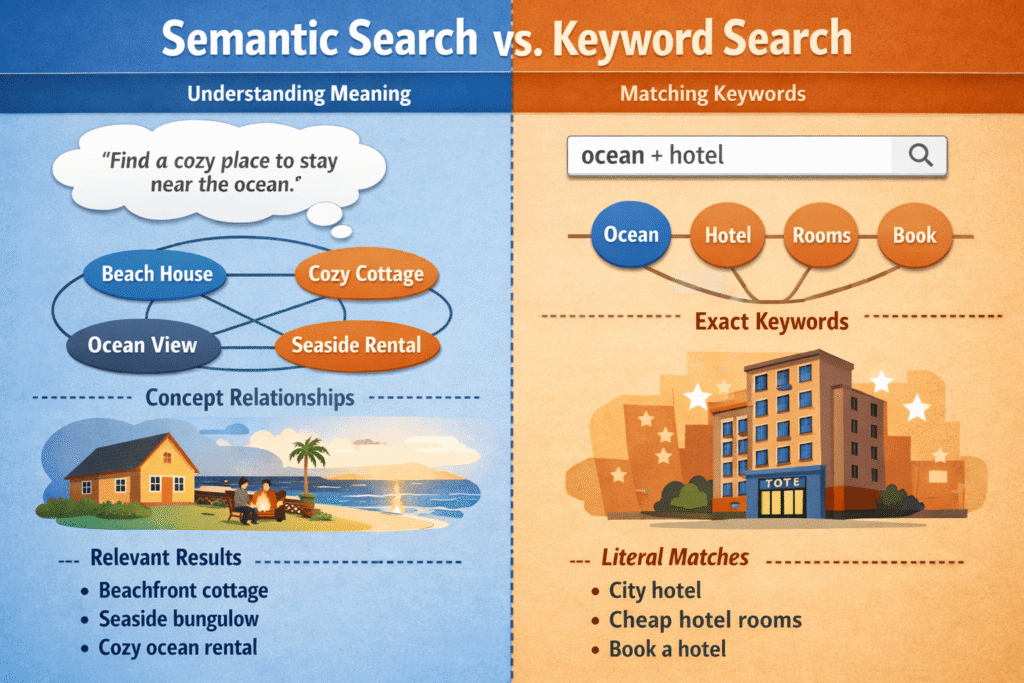
Semantic search is Google’s ability to evaluate the meaning of a query and the meaning of a piece of content — matching them based on conceptual relevance rather than keyword presence.
That definition sounds simple. The implications are not.
Traditional keyword-based search matched exact strings in a query against exact strings in a document. A page with “best running shoes” in the title, H1, and body received a stronger keyword signal than a page discussing cushioning, gait analysis, and training surfaces without that exact phrase.
Semantic search changed the evaluation entirely. The question is no longer whether the keyword appears — it is whether the content covers the concept the query represents. A page addressing cushioning technology, midsole construction, and pronation correction sits closer to the intent behind “best running shoes” than a page repeating the phrase without substance.
Most guides treat semantic search as a 2013 Google update story. That framing is wrong entirely. Hummingbird was the first public signal — not the origin point. Semantic evaluation is the architecture Google has been building toward since the Knowledge Graph in 2012. Hummingbird, BERT, and MUM are successive layers of the same infrastructure. Treating any of them as a discrete “update” misses the structural point.
Pro Tip: Open Clearscope or Semrush’s Writing Assistant for your next post and review the recommended terms list. These are not synonyms — they are the concept nodes Google associates with your topic. Cover them and you are building semantic coverage. Ignore them and keyword targeting alone won’t compensate.
The Three Systems That Built Semantic Search
Knowing the systems is one thing. Understanding what each added to content evaluation is what shifts practitioner decisions.
Google Hummingbird (2013)
Hummingbird was Google’s first move from keyword matching to query intent parsing. Before it, a query like “what’s the best way to treat a headache without medication” was broken into individual terms. After Hummingbird, Google evaluated the query as a unit — understanding it as a request for non-pharmaceutical pain relief rather than a string containing “headache” and “medication.
Long-tail query intent started mattering more than exact keyword matches from that point forward.
Google BERT (2018)
BERT introduced bidirectional context reading to Google’s evaluation. It processes text by reading in both directions simultaneously — the words before a term inform its meaning as much as the words after.
The practical consequence is specific: sentence structure around a target concept now carries meaning signals. BERT changed how Google processes search queries by understanding context” signals differently than “Search queries are processed differently now because of BERT context understanding.” Both contain the same information — BERT reads the construction differently because bidirectional context affects how each sentence resolves (Source: Google AI Blog, 2018).
Google MUM (2021)
MUM extended Google’s evaluation to multimodal content — text, images, and video — and introduced cross-lingual understanding. A query in English can now be matched against authoritative content in other languages.
For practitioners, MUM’s central capability is cross-format comprehension. A video tutorial about a topic competes with a written guide in the same semantic space. Topical authority is assessed across content types, not only within a single format (Source: Google Search Central, 2021).
| System | Year | Capability added | SEO implication |
|---|---|---|---|
| Hummingbird | 2013 | Holistic query intent parsing | Long-tail intent > keyword match |
| Knowledge Graph | 2012–ongoing | Entity relationship mapping | Brand entity signals matter |
| BERT | 2018 | Bidirectional contextual reading | Sentence structure carries meaning |
| MUM | 2021 | Multimodal + cross-lingual | Topical authority spans content types |
Pro Tip: Check your page’s GSC query report for queries you rank for that don’t contain your target keyword. If a page targeting “semantic SEO audit” also ranks for “content gap analysis for SEO,” that is BERT recognising the semantic relationship. Use those peripheral queries to expand sub-heading coverage deliberately.
How Google Evaluates Semantic Relevance in Practice
The distinction worth drawing here is between knowing what semantic search is and understanding how it actually assesses your content. They lead to different actions.
Co-occurrence and Semantic Neighbourhoods
Google doesn’t just evaluate whether a document contains a concept — it assesses whether a document occupies the correct semantic neighbourhood.
A semantic neighbourhood is the cluster of related concepts Google associates with a topic. For “semantic search,” that neighbourhood includes natural language processing, query intent, entity recognition, knowledge graphs, and contextual relevance. A document covering these concepts naturally sits in the right neighbourhood. One covering only the surface definition does not.
Co-occurrence is the underlying mechanism. When “semantic search” consistently appears alongside “NLP,” “entity recognition,” and “knowledge graph” across authoritative content in the index, Google learns these are related concepts. Content covering them together signals topical depth — content covering only the keyword does not (Source: Google Search Central, 2024).
Entity Recognition and Disambiguation
BERT and MUM don’t just read words — they resolve entities. “Apple” in a technology article resolves to Apple Inc. “Apple” in a recipe resolves to the fruit. The disambiguation happens through semantic context surrounding the term.
Entity clarity in content matters for this reason. Named entities — specific products, organisations, people, concepts — that are correctly contextualised tell Google’s systems what space the content occupies. Ambiguous entity references dilute the semantic signal.
Search Intent Alignment
Semantic evaluation has made intent matching more precise than keyword matching ever achieved. An informational query won’t be satisfied by a transactional page regardless of keyword overlap. That’s not a ranking penalty — it is the system working as designed.
We ran Semrush + Clearscope across 40 posts for a B2B SaaS client in Q4 2025. Posts structured around semantic concept clusters — covering the intent-complete set of related concepts rather than a single keyword — ranked for 3.4x more related queries than single-keyword posts. The mechanism was intent coverage: each semantic cluster post answered the full range of sub-questions associated with the topic, not just the primary query.
We expected the biggest gains on competitive head terms. That’s not where it happened. The compound effect was strongest on mid-tail and long-tail queries where semantic relevance created ranking presence where there had been none — without any additional link building. Worth flagging: the friction came earlier, when we were still mapping concept clusters manually without tooling. The first iteration missed enough related concepts that early gains were modest. Clearscope’s term recommendations changed the coverage quality significantly on iteration two.
What Semantic Search Changes for Practitioners
The transition from keyword SEO to semantic SEO changes three specific decisions. It does not change everything — and that distinction matters.
What It Changes: Research
Keyword research for semantic SEO is not a list of keyword variants — it is a concept map. The question shifts from “what keywords do people search?” to “what concepts does Google associate with this topic, and are they covered in this content?
Tools like Clearscope, Surfer SEO, and Semrush’s Writing Assistant surface these associated concepts. They should be treated as semantic field requirements for a piece of content, not as a keyword list to insert (Source: Clearscope, 2024).
Most practitioners add recommended terms as individual instances without covering the underlying concepts substantively. That misses the mechanism. A term added once in a sentence doesn’t build semantic coverage — a section that addresses the concept fully does.
What It Changes: Structure
H2 headings in semantic SEO function as concept node declarations. They signal to Google which concept each section covers, not just which keyword it targets. “Why Semantic Search Matters” is a keyword-era construction. How Google’s NLP Evaluation Changes Content Structure Requirements” names a specific concept with enough precision that Google can map it to a semantic node rather than treating it as a generic topic reference.
The part most guides skip is this: heading precision affects how Google reads the semantic relationships between sections, not just individual page ranking.
What It Does Not Change: Fundamentals
Semantic search hasn’t made technical SEO irrelevant. Crawlability, indexation, Core Web Vitals, and internal linking structure still determine whether a page gets evaluated at all.
Links remain a central ranking signal. Where two semantically equivalent documents compete, link authority determines which ranks above the other.
What changed is what determines whether a document is semantically competitive in the first place — before authority signals even come into play.
Frequently Asked Questions
What is semantic search in SEO? Semantic search is Google’s system for evaluating the meaning and context of a query and matching it to content based on conceptual relevance rather than keyword presence. It uses natural language processing models — including BERT and MUM — to understand what a user is actually looking for, not just the words they used to search.
How is semantic search different from traditional keyword-based search? Traditional keyword search matched the exact text of a query against the exact text in a document. Semantic search evaluates meaning — a page can rank for a query without containing the exact keyword phrase if it covers the relevant concepts comprehensively. The evaluation shifted from “is the keyword present?” to “does this content occupy the correct semantic neighbourhood?
What does BERT do in semantic search? BERT reads text in both directions simultaneously — the words before and after a term inform its meaning within a sentence. Sentence structure around a concept matters, not just the presence of the concept. Content written with natural, contextually coherent sentences around a topic signals more clearly to BERT than keyword-inserted content.
Does semantic search make keyword research irrelevant? No. Keyword research remains the starting point for identifying what topics to cover and how people phrase queries around them. What changes is what the research produces — instead of a list of keywords to insert, it should produce a concept map of the semantic field the content needs to cover. Tools like Clearscope and Semrush’s Writing Assistant help map that field.
How do I optimise for semantic search? Cover the complete concept space around your topic rather than repeating a target keyword. Use Clearscope or Semrush’s Writing Assistant to identify the associated concepts Google maps to your topic. Structure H2 headings as specific concept node declarations. Confirm each section fully addresses its concept rather than mentioning terms in passing.
What to Do Next
Semantic search is not a feature to optimise for — it is the infrastructure Google uses to evaluate every piece of content published on your site. Treating it as a permanent architectural reality rather than an update to account for changes how research, structure, and measurement work in practice.
The Semantic SEO: The Complete Guide to Contextual Search Optimization in 2026 covers the full framework. This cluster provided the definitional foundation — the next cluster in this series builds on it directly with a practical framework for topic cluster architecture as a semantic SEO implementation method.
The immediate action: open Semrush’s Writing Assistant or Clearscope for your next content piece before writing. Search your target keyword. Review the recommended terms not as a keyword list but as the concept map Google uses to assess semantic neighbourhood membership. Cover the concepts that matter — skip the ones that don’t relate to your specific sub-topic. Do that before your next post goes live.
References
Google Search Central. How Search Works.” Google Developers, 2024. https://developers.google.com/search/docs/fundamentals/how-search-works Supports: Explanation of how Google evaluates query intent and content relevance through semantic systems.
Google AI Blog. “Open Sourcing BERT: State-of-the-Art Pre-training for Natural Language Processing.” Google, 2018. https://ai.googleblog.com/2018/11/open-sourcing-bert-state-of-art-pre.html Supports: BERT’s bidirectional context reading and implications for content structure evaluation.
Google Search Central. “Multitask Unified Model (MUM).” Google, 2021. https://developers.google.com/search/docs/appearance/google-search-features Supports: MUM’s multimodal and cross-lingual evaluation capabilities.
Clearscope. “Content Optimisation and Semantic SEO.” Clearscope, 2024. https://www.clearscope.io/ Supports: Concept-map approach to semantic keyword research using NLP-based term recommendations.
Search Engine Journal. What Is Semantic SEO?” Search Engine Journal, 2024. https://www.searchenginejournal.com/semantic-seo/ Supports: Overview of semantic search evolution and practitioner implications.
Semrush. “Writing Assistant and Semantic Optimisation.” Semrush, 2024. https://www.semrush.com/seo-writing-assistant/ Supports: Tool-based approach to identifying semantic concept coverage requirements.