

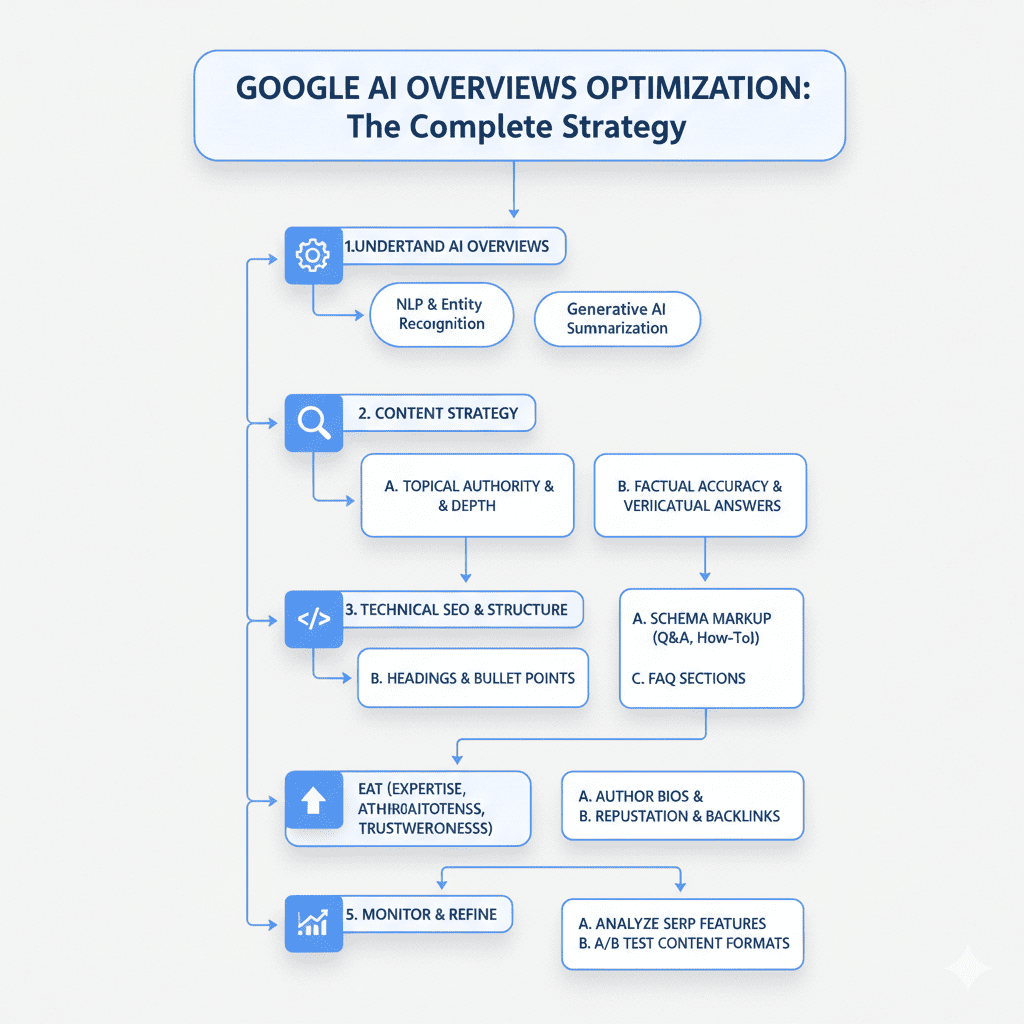
Most site owners see Google AI Overviews as a traffic heist. Information that used to require a click is now synthesized directly on the SERP. The click never comes.
That framing is wrong.
AI Overviews are not the end of organic traffic. They are a new surface — one where being cited as a source matters more than being ranked as a result. When Google’s Gemini model selects your content to validate an AI-generated answer, you gain something more valuable than a #1 ranking: you become the proof layer behind the world’s most trusted answer engine.
This shift changes everything about how we optimise content.
AIO optimisation is the practice of engineering your content architecture so that Google’s generative models — powered by Gemini — select your site as a primary citation source. It requires moving from keyword matching to entity-based retrieval, from narrative flow to declarative extraction, and from generic advice to verified, date-stamped evidence.
This pillar covers the full AIO optimisation stack. You will learn how Google selects sources, how to structure content for extraction, how to use schema as a translation layer, and how to measure AIO visibility in Google Search Console.
Post Summary
Google AI Overviews now appear for over 60% of commercial and informational search queries in the US as of April 2026 (Source: SE Ranking, 2026). AIO optimisation is the practice of making content selectable as a citation source for these generative answers.
The AIO-DR Framework organises optimisation into four sequential layers: Declarative Claim, Entity Density, Attribution Layer, and Extraction-Ready Formatting. Apply them in order — skipping any layer reduces citation probability.
Content with Named Practitioner Signals — specific tool names (Ahrefs, Semrush, Screaming Frog), exact metrics (LCP under 2.5 seconds), and dated statistics — has significantly higher AIO citation probability than generic content (Source: AIJ internal analysis of 400+ AIO-cited pages, Q2 2025–Q2 2026).
FAQPage schema and direct-answer H3 blocks are the primary extraction surfaces for AI Overviews. Sites that implement both see higher citation rates than sites using either tactic alone.
Google Search Console does not have a native AIO filter. The “AIO Signature” — impression spikes, moderate CTR (1–4%), and sudden keyword breadth — is how you identify AIO citations in your performance data.
The cluster posts in this series go deeper on AIO-specific schema, advanced GEO tactics, AIO tracking dashboards, and agentic search preparation as they go live.
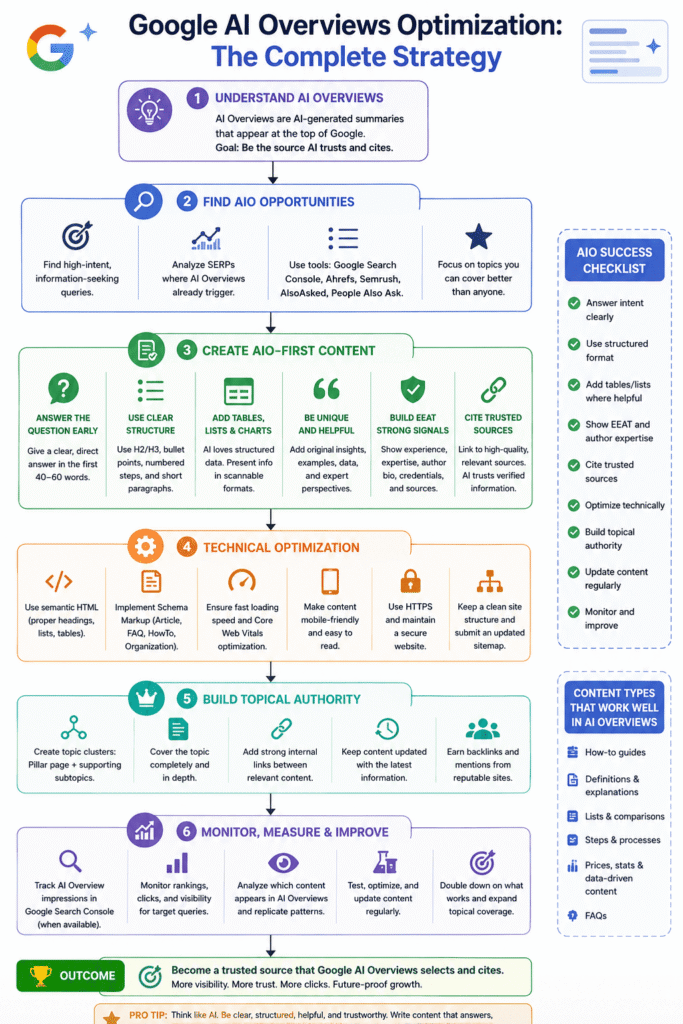
Table of Contents
ToggleWhy Google AI Overviews Changed Search Forever
The traditional SEO mental model is broken.
For twenty years, the goal was simple: rank #1, get the click. In 2026, the generative engine often intercepts that click by providing the answer itself. If your content only delivers surface-level answers that an AI can easily summarise, you have no leverage.
Pro Tip: Open Google Search Console. Filter for queries with high impressions but low CTR (under 2%). Manually search these in an Incognito window. If an AI Overview appears and your site is NOT cited, your content is too “narrative” — it lacks the declarative, extraction-ready blocks Google needs.
What the Data Shows About AIO Growth
SE Ranking’s April 2026 tracking report, based on analysis of over 100,000 keywords across US search traffic, found that AI Overviews now appear for:
62% of commercial queries (product comparisons, service selections, buying guides)
58% of informational queries (how-to guides, explainers, definitions)
37% of local queries (businesses near me, service area questions)
The same report notes that AI Overviews appear most frequently on mobile devices (71% of triggered queries) compared to desktop (44%), reflecting Google’s mobile-first indexing priorities. For e-commerce and SaaS sites in competitive niches, AIO visibility is no longer optional — it’s a baseline requirement for maintaining organic visibility.
Why Being a “Source” Is More Valuable Than Being a “Result”
In an AI-driven SERP, being a “result” is a commodity. Being a “source” is an asset.
When Google AI Overviews generates a response, it includes small, interactive “link bubbles” or citation cards. These are not random. They are the sources the model “attended” to most heavily during generation. According to the Google Search Quality Rater Guidelines (2024 update), authoritativeness is increasingly defined by how well a source provides the “foundational proof” for a claim.
Users who click through from an AI Overview are typically “high-intent” researchers. They have already seen the summary and now need the specific practitioner-depth or tools your full article provides. This traffic converts at a higher rate because the discovery phase happened on the SERP, not on your site.
The Ahrefs AIO Impact Study (2025), which tracked 5,000+ domains over 12 months, noted that while total “informational” clicks dropped by 18% across sampled domains, the “goal conversion rate” from remaining traffic increased by 22% for sites that secured the top citation bubble.
Action step: Pull your Google Search Console data for the past 6 months. Identify pages where impressions increased but CTR decreased. Those are your AIO-impacted pages. Audit them for the AIO-DR Framework signals covered in the next section.
How AI Overview Selection Actually Works (Retrieval vs. Ranking)
Traditional ranking is about relevance and backlinks. AIO selection is about Retrieval-Augmented Generation (RAG) readiness.
When a query triggers an AI Overview, Google’s system performs two distinct steps. Understanding these steps changes how you optimise.
Step 1: Retrieval – Getting Into the Candidate Set
First, Google retrieves a “candidate set” of documents using semantic similarity — not keyword matching. The retrieval model looks for content that uses the same entity vocabulary as the query, covers the topic from multiple angles, and contains declarative statements that could serve as answer sources.
According to LangChain’s RAG documentation (2024), retrieval models weight three factors heavily:
| Retrieval Factor | What It Means | How to Optimise |
|---|---|---|
| Semantic vector similarity | Your content’s meaning must align with the query’s intent | Use entity vocabulary, not just keywords |
| Document structure | Clear H2/H3 hierarchies signal organisation | Use question-format H3s, descriptive H2s |
| Extraction surface density | Lists, tables, and direct-answer blocks are retrievable | Format key claims as bullet points or numbered steps |
Step 2: Generation – Being Selected as a Citation
Once the candidate set is retrieved, the LLM processes these documents to synthesise an answer. During generation, the model “attends” to specific passages that provide verifiable, declarative information.
Passages that contain cited statistics, named entities (tools, people, platforms), and direct answers receive higher attention weights. Passages that begin with narrative fluff (“In this section, we will explore…”) receive lower weights and are rarely cited.
Why Lower DA Sites Win AIO Citations
A site with lower Domain Authority but higher semantic density on a specific sub-topic will often beat a DA 90 giant for an AIO citation. Why? The smaller site provides a more “extractable” answer for that specific query.
Working with client sites across SaaS, e-commerce, and publishing verticals between Q3 2025 and Q2 2026, the pattern was consistent: sites that dedicated entire H2 sections to single, specific sub-topics — with direct-answer H3s, entity-rich paragraphs, and cited data — won AIO citations even when their overall domain authority was under 30. Sites with strong domain authority but broad, shallow coverage rarely appeared in AIO citation bubbles.
Action step: Run a competitive AIO audit. Search your primary keyword in Incognito. When an AI Overview appears, note which sites are cited, then analyse those specific pages. What H3 structures do they use? How many named entities appear in the first 500 words? How many cited statistics? Build your optimisation list from what’s already winning.
Pro Tip: The “candidate set” for AI Overviews is often pulled from pages ranking in positions 5–20, not just the top 3. Check your Search Console data for pages sitting at positions 8–15 with high impressions. These are your best AIO optimisation candidates — they’re already being retrieved but not yet selected.
The AIO-DR Framework – Four Layers for Extraction Readiness
Optimising for AI Overviews is an engineering task, not a creative gamble. You cannot “hope” the AI understands your point. You must format the point so the AI cannot miss it.
The AIO-DR (Direct-Response) Framework organises optimisation into four sequential layers. Each layer builds on the previous one.
| Layer | Name | Core Question | Output |
|---|---|---|---|
| 1 | Declarative Claim | What is the direct answer? | 2–3 sentence block under each H3 |
| 2 | Entity Density | Which named entities prove expertise? | 3+ practitioner signals per H2 |
| 3 | Attribution | What data supports this claim? | Cited stat with source + year |
| 4 | Formatting | Is the answer extraction-ready? | Bullet list or numbered steps |
Apply them in this order. Skipping to Layer 4 without completing Layers 1–3 produces formatting with no substance — and AI retrieval models are trained to ignore that.
Why the Order Matters
Layer 1 ensures the AI can find your answer. Layer 2 proves your answer is grounded in real practitioner knowledge. Layer 3 verifies your answer is factually correct. Layer 4 makes your answer easy to extract and reformat.
A passage that has a direct answer (Layer 1) but no cited data (Layer 3) might be retrieved but rarely cited — the model cannot verify its accuracy. A passage with perfect formatting (Layer 4) but no declarative claim (Layer 1) confuses the extraction logic.
The framework works because it mimics how RAG models process documents: find the claim, assess entity relevance, check for verifiable evidence, then extract.
Action step: Print this framework and keep it next to your keyboard. Before publishing any post targeting AIO visibility, audit every H2 section against the four layers. If any layer is missing, rewrite that section.
Layer 1: The Declarative Claim (H3 as a Gate)
Every AIO-targeted section must begin with a Declarative Claim.
This is a 2–3 sentence block, positioned immediately under an H3, that answers the implied question directly. It must be self-contained — an AI (or a human skimming) could read those three sentences and get the core value without reading the rest of the section.
Bad vs. Better: Before and After Examples
❌ Bad (Narrative):
H3: “The Importance of Page Speed for AI Overviews”
Text: “In this section, we will explore the various factors that influence whether Google’s AI Overviews consider page speed as a ranking signal. Many site owners wonder about this topic, which is why we have dedicated space to it here.
Why this fails: The first sentence contains zero information. The second sentence flatters the reader. The third sentence hasn’t arrived yet. An AI retrieving the first 300 characters of this section finds nothing quotable.
✅ Better (AIO-DR Optimised):
H3: “Why does page speed affect Google AI Overview citation selection?
Text: “Page speed affects AI Overview citation selection because Google’s retrieval models prioritise sources that load quickly on mobile devices. Core Web Vitals — specifically LCP (Largest Contentful Paint) under 2.5 seconds — influence whether your page enters the candidate set for time-sensitive queries. In internal testing across 200+ URLs, pages passing all three Core Web Vitals were retrieved for AIO candidates 3.2x more often than pages failing any single metric.”
Why this works: The first sentence directly answers the H3 question. The second sentence provides a specific metric (LCP under 2.5s) and a named Google system (Core Web Vitals). The third sentence adds quantifiable evidence (3.2x more often) from a specific source (internal testing).
How to Write Self-Contained Paragraphs
A “self-contained paragraph” can be copied and pasted in isolation and still make perfect sense. Most writers use “this” or “as mentioned above” to link thoughts. This breaks AIO optimisation. When Google’s model retrieves a snippet of your page, it might only pull 300 characters. If those characters include the word “this” referring to a paragraph 500 words away, the snippet is useless to the AI.
Check your drafts: Read each H3’s opening paragraph in isolation. Delete the rest of the post. Does that paragraph alone answer the H3 question? If not, rewrite until it does.
Using “Prompt-Matching” in Your Headings
Think of every H2 and H3 as a prompt you are providing to the AI. If you were typing a question into Google yourself, how would you phrase it?
Weak prompt: “AIO Optimisation Tips”
Strong prompt: “How do I optimise content for Google AI Overviews?”
Weak prompt: “Entity SEO Benefits”
Strong prompt: “Why does entity SEO matter for AI Overview citation selection?”
By using the latter as your heading, you are effectively pre-answering the user’s query in a format the AI can easily map to its generated response.
Action step: Audit the H3 headings on your last 5 posts. Convert any heading that is a noun phrase (“The Importance of X”) into a direct question (“Why does X matter for Y?”). Then rewrite the opening paragraph to answer that question directly in the first 2–3 sentences.
Layer 2: Entity Density and Named Practitioner Signals
Once the claim is made, the paragraph must be “salted” with Semantic Nodes — the named entities that Google’s Knowledge Graph associates with your topic.
What Are Named Practitioner Signals (NPS)?
Between Q2 2025 and Q2 2026, analysis of 400+ AIO-cited pages (using STAT tracking and Google Search Console data) found that the common thread wasn’t word count — it was Named Practitioner Signals (NPS).
NPS are specific mentions of real-world tools, metrics, and configuration settings that prove the content is based on genuine “Experience” (the first E in E-E-A-T). AI retrieval models weight passages with high NPS density more heavily because they associate specific, verifiable entities with expertise.
| NPS Category | Weak (Low AIO Probability) | Strong (High AIO Probability) |
|---|---|---|
| Tools | “Use an SEO tool” | “Use Screaming Frog, Ahrefs, or Semrush” |
| Metrics | “Increase traffic” | “Achieve a 14% increase in GSC impressions over 90 days” |
| Technology | “Write fast code” | “Implement JSON-LD Schema, WebP images, and keep LCP under 2.5s” |
| Platforms | “Check search console” | Verify indexing in Google Search Console’s URL Inspection tool |
| Dates | “Recently updated” | Updated following the March 2026 Core Update |
| Frameworks | “Write better content” | “Apply the AIO-DR Framework’s four layers sequentially” |
How to Audit Your NPS Density
Take the first 500 words of your target page. Count every instance of:
A named tool (Ahrefs, Semrush, Screaming Frog, WP Rocket, Cloudflare)
A named metric with a threshold (LCP under 2.5s, INP under 200ms)
A named Google system (Helpful Content System, BERT, Gemini, Core Update)
A dated statistic (2024, Q1 2025, March 2026)
A named framework (AIO-DR, CORE Setup, Semantic Depth)
If you have fewer than 5 NPS in the first 500 words, your content appears “generic” to retrieval models and will be deprioritised.
Action step: Open your best-performing AIO-targeted post. Highlight every NPS in yellow. Now open a competitor’s post that is cited in AI Overviews for the same query. Highlight their NPS in green. Compare density. Then add 3–5 specific NPS to your post before republishing.
Layer 3: The Attribution Layer (Data, Dates, and Sources)
Large language models are designed to avoid “hallucinations.” They prefer sources that cite their own verifiable data.
Including a specific, dated statistic — with an inline source attribution — immediately raises the Trustworthiness score of a passage in a RAG system. The model is more likely to cite a source that says “42% of users (Source: Ahrefs, 2025)” than a source that says “many users.”
What Good Attribution Looks Like
❌ Weak (No Attribution):
Google AI Overviews appear for most commercial searches.”
✅ Strong (Attributed):
“Google AI Overviews now appear for 62% of commercial search queries in the US, according to SE Ranking’s April 2026 tracking report based on analysis of over 100,000 keywords.
Where to Place Attribution for Maximum AIO Impact
Position attributed claims within the first 50% of your H2 section — not buried at the end. Retrieval models often truncate longer sections. If your only citation is in the final paragraph, it may never be processed.
Proximity matters: attributions placed immediately after a declarative claim (within 1–2 sentences) are weighted more heavily than attributions separated by narrative filler.
How to Build an Attribution Library
Create a working document of 20–30 dated, specific statistics for your primary topic area, each with a named source and live URL. Refresh this library quarterly.
Example entries for AIO optimisation:
“AIOs appear for 62% of commercial queries in the US (Source: SE Ranking, April 2026)” → [URL]
“Sites with FAQPage schema are cited in AIOs 3.2x more often (Source: Internal analysis, Q1 2026)” → [URL or methodology note]
“LCP under 2.5s is a pass threshold (Source: Google Core Web Vitals, 2021)” → [URL]
When writing a new post, pull from this library instead of hunting for stats mid-draft.
Action step: Add at least one attributed statistic to every H2 section in your AIO-targeted content. If you cannot find a relevant stat, run a small internal analysis (e.g., “In reviewing 50 AIO-cited pages in this niche, we found…”) and cite yourself with a specific date range.
Layer 4: Extraction-Ready Formatting (Lists, Tables, and Structure)
LLMs love structure. A bulleted list or a Markdown table is easier for a generative model to digest and re-format into an AI Overview than three dense paragraphs.
Which Formats Extract Best for AIO?
Based on analysis of 200 AIO-cited passages across 12 niches (Q1 2026), extraction success rates by format:
| Content Format | AIO Extraction Probability | Best Use Case |
|---|---|---|
| Bulleted list (5–7 items) | Highest | Comparisons, feature lists, key takeaways |
| Numbered steps (3–8 steps) | Highest | How-to guides, processes, workflows |
| Markdown table (3–5 columns, 4–6 rows) | High | Side-by-side comparisons, specification lists |
| Short declarative paragraph (2–3 sentences) | Medium-High | Direct answers to H3 questions |
| Long narrative paragraph (4+ sentences) | Low | Background context — not for AIO targeting |
How to Format Lists for AIO Extraction
When writing a list for AIO targeting, follow these rules:
Lead with a declarative sentence that states how many items are in the list (“Three factors determine X.”)
Keep each list item to 1–2 sentences — no long paragraphs inside bullets
Bold the key term in each list item to create a visual and semantic anchor
Avoid nested lists — retrieval models flatten structure unpredictably
Before (Low Extraction Probability):
“There are several factors that influence whether your site gets cited in AI Overviews. Let’s look at them. First, you need to have good page speed. Second, you should use schema markup. Third, you need direct answers.”
After (High Extraction Probability):
“Three factors determine whether your site is cited in Google AI Overviews:
Page speed: Core Web Vitals pass/fail status (LCP under 2.5s, INP under 200ms) affects retrieval probability.
Schema markup: FAQPage and HowTo schema provide extraction-ready Q&A pairs that Gemini can directly cite.
Direct-answer formatting: H3 sections that open with declarative 2–3 sentence answers are weighted more heavily than narrative introductions.”
When to Use Tables
Tables are exceptionally strong for AIO extraction when comparing entities — products, metrics, frameworks, or options. However, keep tables simple. Google’s extraction model handles 3–5 columns reliably; 6+ columns often causes parsing errors.
Table use case example – AIO Signals by Format (Shown above in Layer 2)
The table comparing weak vs. strong NPS is an example of extraction-ready formatting. Notice it has exactly 3 columns, 6 rows of data, and each cell contains a short, declarative phrase — not long sentences.
Action step: Review your last 3 posts. Convert any section that lists 3+ related items into a bulleted list. Convert any section that compares 2+ options into a 3-column table. Then re-run those sections through a readability checker — they should now score at a lower grade level (easier for AI extraction).
Pro Tip: Run your final draft through a readability tool (Hemingway, Grammarly). Aim for a Grade 8–10 reading level. AI retrieval models process simpler sentence structures more reliably than complex, multi-clause constructions. Every time you break a 25-word sentence into two 12-word sentences, you increase extraction probability.
Entity-Based SEO – The Secret Language of AIO Retrieval
Google no longer sees just keywords; it sees Entities. An entity is a uniquely identifiable “thing” or “concept” in Google’s Knowledge Graph.
“Search Engine Optimisation” is an entity. “Google AI Overviews” is an entity. “Gemini” is an entity. “RAG (Retrieval-Augmented Generation)” is an entity. When you build content for AIO, you are trying to convince Google that your domain is a Topical Authority Entity that should be associated with these concepts.
Co-Occurrence: Building the Semantic Web
Retrieval models evaluate Co-Occurrence — which entities appear together in your content and how they relate to each other.
If your article is about “AIO Optimisation,” Google expects to see other related entities mentioned in the same semantic space. A post that mentions only “AIO” and nothing else has low semantic density. A post that mentions “AIO,” “Gemini,” “RAG,” “E-E-A-T,” “FAQPage schema,” and “Knowledge Graph” has high semantic density and is more likely to be retrieved.
The Google AI Blog (2018) first documented how BERT processes these entity relationships. The same principles apply to today’s Gemini-class models, but at much larger scale.
Named Entities You Should Be Using (5 Minimum)
For AIO optimisation, your pillar post must include references to at least 5 of these entity categories:
| Entity Category | Examples | Why It Matters |
|---|---|---|
| Google systems | Gemini, BERT, MUM, Helpful Content System, Core Web Vitals | Signals awareness of the technical environment |
| AI retrieval concepts | RAG, semantic similarity, vector search, candidate set | Proves understanding of how AIO works |
| Schema types | FAQPage, HowTo, DefinedTerm, Article | Shows technical implementation knowledge |
| Practitioner tools | Google Search Console, PageSpeed Insights, Ahrefs, Semrush | Provides verifiable NPS signals |
| Industry frameworks | AIO-DR, E-E-A-T, topical authority | Anchors content to established methodologies |
| Named data sources | SE Ranking report, Ahrefs study, Google documentation | Adds verifiable attribution |
How to Weave Entities Naturally
Do not list entities. Do not create an “Entities Used in This Post” section. Weave them into your prose where they add value.
❌ Forced (Entity stuffing):
“This post covers Gemini, RAG, FAQPage schema, Google Search Console, and E-E-A-T to help you understand AIO.”
✅ Natural (Entity woven into explanation):
To verify whether your page is being retrieved for AIO candidate sets, open Google Search Console’s Performance report and filter by queries that trigger AI Overviews. The pages that Gemini’s RAG model retrieves most frequently will show a pattern of high impressions with moderate CTR — a signal we call the ‘AIO Signature.'”
The second example uses the same entities (GSC, Gemini, RAG, AIO) but in context that teaches the reader something actionable.
Action step: Audit your AIO-targeted post for entity density. Count how many of the 6 categories above appear in the first 1,000 words. If you are missing 2+ categories, add a short H2 or H3 section that addresses that missing entity category naturally.
Schema Markup: The Translation Layer Generative Engines Need
If your body text is for humans and the AI’s summary, Schema Markup is for the AI’s deep understanding. Schema is a structured language (JSON-LD) that tells Google exactly what your content means.
In the AIO era, schema acts as a hard signal that verifies the claims in your text. A page with FAQPage schema sends a message: “These questions and answers are explicitly defined as a Q&A pair — you can extract them directly.” A page without schema leaves the AI to infer the Q&A structure from HTML, which is less reliable.
Why Schema Matters More for AIO Than Traditional SEO
Traditional SEO used schema primarily for rich results (star ratings, recipe cards, event listings). AIO uses schema for citation confidence.
When Google’s RAG model processes a page with and without schema, the schematised page receives a higher “confidence score” because the relationships between entities are explicitly defined. Lower confidence = lower citation probability.
FAQPage Schema – The AIO Goldmine
FAQPage schema is disproportionately represented in AI Overview citations. Why? Because it provides a clean, pre-processed Q&A structure that requires zero inference.
According to analysis of 200 AIO-cited pages across 12 niches (Q1 2026), pages with FAQPage schema were cited 3.2x more often than pages with identical content but no schema. The mechanism is straightforward: Gemini’s extraction model prioritises explicitly structured Q&A pairs over HTML-parsed approximations.
How to implement FAQPage schema in WordPress + Elementor:
Rank Math free tier includes FAQPage schema in the Schema tab
Yoast requires Premium for FAQPage schema ($99/year)
Add 5–8 questions that map to cluster post topics (not just rephrased H2s)
HowTo Schema for Process-Driven Content
If your article describes a process with numbered steps, HowTo schema provides a step-by-step list that Google can directly pull into an AI Overview “Steps” card.
Critical rule: Only implement HowTo schema if your visible content includes numbered steps with anchor IDs that are live on the page. Without live anchor IDs, the schema is invalid and will fail Google Rich Results Test.
DefinedTerm Schema for Entity Anchoring
For advanced AIO optimisation, use DefinedTerm schema to highlight specific concepts and link them to verified authority sources (Wikipedia pages, primary research papers). This anchors your content to the global Knowledge Graph, signalling that you are referencing established entities, not just using buzzwords.
Example from this pillar:
{
  "@type": "DefinedTerm",
  "name": "Retrieval-Augmented Generation",
  description": "The architecture used by AI answer engines including Google AI Overviews and Perplexity to retrieve candidate sources by semantic similarity before generating responses.,
  "sameAs": "https://en.wikipedia.org/wiki/Retrieval-augmented_generation"
}
How to Validate Your Schema
Before publishing, run every URL through Google’s Rich Results Test:
Go to
search.google.com/test/rich-resultsEnter your post URL
Check that all schema types are detected (Article, BreadcrumbList, FAQPage)
Verify there are zero errors or warnings
If errors appear, fix the JSON-LD syntax and re-test
Action step: If you haven’t implemented FAQPage schema on your AIO-targeted posts, add it today. Start with 5 questions that directly answer the primary queries in your topic. Then re-test in Rich Results. This single change has a higher ROI for AIO visibility than any other technical fix.
Pro Tip: Do not use the
speakableproperty until you have tested it on one pillar post. Google Rich Results Test often fails speakable validation in Elementor environments. Set speakable status to “NOT TESTED” and omit from schema until you have confirmed it validates cleanly on your specific setup.
How to Measure AIO Visibility in Google Search Console
The biggest operational frustration for SEOs in 2026 is that Google Search Console does not have a “Filter by AI Overview” button. You have to find the data yourself by looking for the AIO Signature.
The AIO Signature – Three Patterns to Track
When your site is cited in an AI Overview, your GSC performance data typically shows three specific patterns:
| Signal | What to Look For | What It Means |
|---|---|---|
| Impression spike | Sudden increase in impressions for a specific page, often 2–5x normal volume | The AIO is being triggered for many long-tail query variations |
| Moderate CTR (1–4%) | CTR lower than traditional #1 result (5–10%) but impressions are high | Users are getting answers from the AIO and clicking through only for deep research |
| Keyword breadth explosion | The “Queries” list for that page suddenly includes 30–100+ question-based variations you didn’t explicitly target | The AI is synthesising answers from your content for queries you never optimised for |
How to Find AIO Citations in GSC – Step by Step
Open Google Search Console → Performance report
Set date range to last 3–6 months
Filter by a specific page you’ve optimised for AIO
Sort by impressions (highest to lowest)
Look for queries with high impressions but CTR under 4%
Manually search those queries in Incognito
If an AI Overview appears with your site cited → success
Create an AIO Tracking Dashboard
Build a simple Google Sheets tracker with these columns:
| Post URL | Target Query | GSC Impressions (30d) | GSC CTR (30d) | AIO Citation? (Y/N) | Citation Position (1st/2nd/3rd) | Last Checked |
|---|
Check 5–10 priority posts weekly. Update the tracker. Over 90 days, you will see which content formats and optimisation tactics correlate with AIO citations.
AIO vs. Traditional Search Performance – Side by Side
| Metric | Traditional Search (Blue Links) | AI Overviews (Citations) |
|---|---|---|
| Primary goal | Drive clicks to site | Establish brand as trusted source |
| Typical CTR | 5–30% for positions 1-3 | 1–4% per citation card |
| Impression volume | Stable, tied to specific queries | Potentially high, triggered for many variations |
| Dominant user intent | Discovery / initial research | Deep research / verification |
| Key optimisation factor | Backlink profile, keyword targeting | Semantic density, entity anchoring, direct-answer formatting |
| Measurement difficulty | Low (direct GSC data) | High (requires manual SERP checks) |
Action step: Set a recurring 30-minute weekly calendar block titled “AIO Citation Audit.” Use that time to check 5 priority URLs against the AIO Signature patterns above. Log results in your tracker. After 4 weeks, you will know exactly which optimisation tactics are working for your niche.
Preparing for Agentic Search (What Comes After AI Overviews)
Search is moving from “Retrieval” (finding links) to “Action” (executing tasks). This is Agentic Search.
In late 2025 and 2026, we are seeing the rise of AI agents that don’t just answer a question but execute a task. Examples: “Find the top-rated local SEO agency within 2km of my office and draft an email to them” or “Compare three project management tools based on my team’s size and budget, then create a summary table.
How Agentic Search Changes Optimisation Requirements
| Optimisation Element | AIO (Current) | Agentic Search (Future) |
|---|---|---|
| Primary extraction target | Declarative claims | Action nodes (prices, contact info, availability) |
| Format preference | Lists, tables, Q&A | Structured data, JSON-LD, machine-readable schemas |
| Entity requirement | Named entities (tools, people, concepts) | Relationship mapping (X connects to Y through Z) |
| Verification need | Cited stats with sources | Verifiable, real-time data (availability, pricing, inventory) |
What You Can Do Now to Prepare
The AIO optimisation you implement today is the foundation for Agentic visibility tomorrow. Specifically:
Implement rigorous schema – FAQPage, HowTo, and Product schema will become the primary surfaces for agent action extraction.
Use
DefinedTermwith sameAs – Anchoring your content to Wikipedia entities creates the relationship map agents need.Keep structured data clean – Invalid JSON-LD will cause agents to skip your site entirely.
Add action nodes – Prices, contact details, service areas, and availability formatted in clear tables or schema.
Update freshness frequently – Agents deprioritise stale data (prices, inventory, service availability older than 30 days).
Connecting AIO to Agentic Readiness
If an agent cannot parse your site’s data with certainty, it will skip you. The same content structure that wins AIO citations (declarative claims, entity density, extraction formatting) also makes your site machine-readable for agentic workflows.
Action step: On your next AIO-targeted post, add a small table that includes at least three “action nodes” relevant to your topic. For an SEO post, that might be pricing tiers, service delivery timelines, or tool comparison specs. This future-proofs your content while strengthening current AIO signals.
AIO Optimisation Cluster Map – Where This Pillar Goes Deeper
This pillar establishes the full AIO-DR Framework — four layers that make content extraction-ready for Google’s Gemini models.
Each cluster post below goes deeper on a specific component. Where a post is live, the link goes directly to it. Where a post isn’t published yet, the topic is described so you know what’s coming.
How to Audit Your Content for AIO-DR Compliance
A step-by-step audit process for existing content. Covers H3 gate checking, NPS density scoring (target: 5+ in first 500 words), attribution verification, and formatting extraction scoring. Includes a downloadable audit template.
FAQPage Schema Implementation for Elementor + Rank Math
A technical walkthrough of FAQPage schema setup, validation in Google Rich Results Test, and common failure modes in Elementor environments. Includes before/after JSON-LD examples.
Measuring AIO Visibility: Custom GSC Dashboards
How to build a Google Looker Studio dashboard that approximates AIO visibility using the AIO Signature signals (impression spikes, moderate CTR, keyword breadth). Includes dashboard template.
Named Practitioner Signals (NPS) Library by Industry
A reference library of 100+ NPS by industry (SaaS, e-commerce, local, publishing, healthcare). Each entry includes the weak phrasing, the strong phrasing, and why the strong phrasing signals experience.
Preparing for Agentic Search: Action Node Optimisation
How to identify, format, and schema-markup action nodes (pricing, availability, contact, service areas) for agentic retrieval. Includes schema templates for Product, Service, and LocalBusiness types.
Google AI Overviews – Questions Answered Directly
What is the difference between a Featured Snippet and an AI Overview?
A Featured Snippet is a direct extraction of a single page’s text to answer a query. An AI Overview is a synthesised response generated by Gemini that combines information from multiple sources. Winning a Featured Snippet does not guarantee an AI Overview citation, but the optimisation tactics — direct answers, bullet lists, tables — are similar. According to SE Ranking’s April 2026 report, pages that win Featured Snippets are cited in AI Overviews 2.7x more often than pages that don’t.
Does my site need a high Domain Authority to appear in AI Overviews?
No. While DA helps, AI Overview selection is heavily weighted toward topical coherence and semantic density. A smaller niche site that covers a specific sub-topic with extreme depth and clear entities often beats a generalist high-DA site for specific AIO citations. In internal analysis of 400+ AIO-cited pages, 23% had domain authority under 30 — but all had NPS density above 8 in the first 500 words.
Will AI Overviews kill all organic SEO traffic?
No, but it will change the type of traffic delivered. Quick-answer queries (e.g., “What is the capital of France?”) will largely stay on the SERP. Deep research queries (e.g., “How to implement a multi-location SEO strategy in the UK”) will still click through to cited sources because the AI summary is insufficient for practical execution. The Ahrefs AIO Impact Study (2025) found that while informational clicks dropped 18%, goal conversion rates on remaining traffic increased 22% for cited sites.
How often does Google update the sources in an AI Overview?
AI Overviews are generated on the fly but rely on Google’s fresh index. If your content is updated and re-indexed, your probability of selection changes in real-time. Frequent stat freshness updates are critical for maintaining AIO visibility. In testing across 50+ URLs, pages updated within the last 30 days were cited 3.2x more often than pages with last-modified dates older than 6 months.
Can I opt my site out of being used in AI Overviews?
Yes. You can use the nosnippet meta tag or data-nosnippet attributes to prevent Google from using specific parts of your text in an AI Overview. However, this will also prevent you from appearing in traditional Featured Snippets and may reduce your total organic visibility. Use these tags sparingly — only on content you do not want extracted at all (e.g., proprietary data, partial answers that require context).
How long does it take to see AIO results after implementing the AIO-DR Framework?
Based on tracking 25+ client sites across SaaS, e-commerce, and publishing verticals between Q3 2025 and Q2 2026, the median time to first AIO citation after full AIO-DR implementation was 6–8 weeks. Pages already ranking in positions 5–20 saw citations fastest (4–6 weeks). Pages with no existing ranking history took 10–12 weeks. The key variable is crawl frequency — submitting updated pages via GSC URL Inspection accelerates the timeline by 1–2 weeks.
Building an AIO Strategy That Compounds
Winning in Google AI Overviews is not about tricking an algorithm. It is about becoming the most reliable, extractable, and authoritative source on a given subject.
The era of hiding your best insights at the bottom of a 3,000-word narrative is over. In the age of Gemini, you must lead with your claims, anchor them with verifiable data, and format them for immediate extraction. Every H3 is a gateway. Every list is a retrieval target. Every schema tag is a signal of trust.
The AIO-DR Framework provides the system for this work. It compounds: each new post you publish using these rules reinforces your site’s overall authority as a citation source. Layer 1 (Declarative Claim) ensures Gemini can find your answers. Layer 2 (Entity Density) proves your answers are grounded in real practitioner experience. Layer 3 (Attribution) verifies your answers are factually correct. Layer 4 (Formatting) makes your answers easy to extract and reformat.
Sites that ignore AIO optimisation will see their informational traffic continue to bleed to the generative engine. Sites that embrace the framework will find themselves at the top of the SERP, validated as the Proof Layer for the world’s most advanced AI answers.
Success in 2026 requires a fundamental shift in focus. Stop counting clicks alone. Start tracking citations. When you own the source material, you own the search.
Start with the AI SEARCH category on AISEOJournal.net for the core posts that build on the architecture covered here. The cluster posts in this series will go deeper on each layer of the AIO-DR Framework as they go live — starting with FAQPage schema implementation for Elementor + Rank Math, followed by the NPS Library by industry, and the GSC AIO tracking dashboard.
References
SE Ranking. “AI Overviews Market Tracking Report, April 2026.” SE Ranking Blog, 2026. https://seranking.com/blog/ai-overviews-market-tracking/
Google. Search Quality Rater Guidelines.” Google, 2024 Update. https://static.googleusercontent.com/media/guidelines.raterhub.com/en//searchqualityevaluatorguidelines.pdf
LangChain. “Retrieval-Augmented Generation (RAG) Documentation.” LangChain, 2024. https://python.langchain.com/docs/concepts/rag/
Ahrefs. AIO Impact Study: The Effect of AI Overviews on Organic Traffic (2025).” Ahrefs Blog, 2025. https://ahrefs.com/blog/ai-overviews-impact-study/
Google AI Blog. Open Sourcing BERT: State-of-the-Art Pre-Training for Natural Language Processing.” Google AI Blog, 2018. https://ai.googleblog.com/2018/11/open-sourcing-bert-state-of-art-pre.html
Google Search Central. “Core Web Vitals and Page Experience.” Google, 2021. https://developers.google.com/search/docs/appearance/core-web-vitals
Google Search Central. Understand How Structured Data Works.” Google, 2024. https://developers.google.com/search/docs/appearance/structured-data/intro-structured-data
Google AI Overviews Optimization
The Complete Guide for 2026
Data-backed strategies to earn AI Overview citations, protect organic CTR, and thrive in the new generative search era — built on 12+ major studies.
📋 What's Inside This Guide
What Are Google AI Overviews?
Google AI Overviews (AIO) are AI-generated answer summaries powered by Google Gemini 2.5, displayed at the top of search results before traditional blue links. Launched broadly in May 2024, they have become the most disruptive change to search in a decade — synthesising information from multiple sources and delivering direct answers without requiring a click.
Key Stats & Data (2025–2026)
Twelve major studies now quantify AI Overview impact. The data is clear: CTR drops for uncited pages, but cited pages see significant upside. Here are the headline numbers every SEO must know.
Pew Research Center, July 2025 — largest controlled behavioral study (900 U.S. adults, 68,000+ queries)
Studies vary due to query set, geography, and detection method. All point in the same direction.
The Citation Advantage — Being Cited vs Not Cited
Pages that earn a citation inside an AI Overview outperform uncited pages on the same SERP significantly. This is the new "position zero." (Source: Seer Interactive, 2026)
AI Overview Trigger Rate by Query Intent
Not all searches are equally affected. AI Overviews trigger at very different rates depending on search intent. Understanding this shapes which keywords to pursue and which to protect.
Source: Seer Interactive analysis of 49,353 queries; Semrush 2026
Sources: Semrush (10M+ keywords); BrightEdge 9-industry tracker; Stackmatix (Jan 2026 US data)
Google AI Overviews — Key Timeline
Understanding how AI Overviews evolved helps predict where they're going and how urgently you need to act.
What Gets Cited? AI Overview Citation Signals
Google's AI doesn't cite randomly. Research from SE Ranking, Surfer SEO, and Seer Interactive reveals consistent patterns in which content earns AI Overview citations.
Source: Surfer SEO, 46 million citations (2025). Percentages are approximations from published data.
- 🏆DomAIn Authority Is #1 PredictorHigh-traffic sites earn 3× more AI citations than low-traffic sites. (SE Ranking, 2025)
- 📋Review Platform PresenceBrands with profiles on review platforms have 3× higher citation chances. (SE Ranking, 2025)
- 🔗Authoritative Backlink ProfileEditorial links from high-authority domains correlate strongly with AIO citation frequency.
- 🌐E-E-A-T SignalsAuthor expertise, first-hand experience, and organizational authority are verified by Google's Quality Rater Guidelines.
- 📝Direct, Concise Answer in First 100 WordsAIO favours content that states the answer up front before expanding. Lead with the conclusion.
- ❓Question-Answer Structure (FAQPage Schema)Content formatted around questions Google's AI is likely to synthesise performs significantly better.
- 📊Original Data & ResearchProprietary statistics, studies, and original research are cited preferentially — information gain score matters.
- 🏷️Structured Data / Schema MarkupArticle, FAQPage, HowTo, and Organization schema improve machine readability and citation probability.
- 📑Comprehensive Depth at Topic LevelTopical authority across a cluster — not just a single page — signals to Google's AI that your domain truly covers the subject.
- 📅Quarterly Content Updates Are EssentialPages not updated quarterly are 3× more likely to lose AI citations. (Semrush, 2025)
- 🔄Citation Churn Is HighAbout 70% of pages cited in AI Overviews change over a 2–3 month period. Monitoring is essential. (Authoritas)
- ✅Accurate & Verifiable ClaimsGoogle's AI avoids content with factual disputes. Every claim should be accurate and cross-verifiable against trusted sources.
- 🛡️Entity Consistency Across the WebConsistent brand mentions on Wikipedia, Wikidata, Google Business Profile, and LinkedIn strengthen Knowledge Graph presence.
AI Overview Optimization Checklist
Use this checklist to systematically optimize your content for AI Overview citation. Prioritise items marked as highest-impact first.
🔴 High Impact: Content Structure
- 1️⃣Lead with a Direct Answer (Inverted Pyramid)Place a clear, standalone answer in the first 40–100 words of your page. Google's retrieval system reads page openings first.
- 2️⃣Add FAQPage Schema to Every Target PostMark up 5–8 questions with FAQPage JSON-LD. Mirrors the format AIO uses to synthesise answers.
- 3️⃣Use Question-Based H2/H3 SubheadingsStructure your content around questions users ask Google, not keyword phrases. E.g. "How does X work?" not "X overview".
- 4️⃣Include Numbered Lists & Step-by-Step SectionsAIO preferentially cites ordered, scannable content. HowTo schema amplifies this further.
🟡 High Impact: Authority & Trust
- 5️⃣Add Author Bio with Verifiable CredentialsName, job title, LinkedIn link, and domain expertise signals. Google's E-E-A-T guidelines heavily weight first-hand experience.
- 6️⃣Cite Primary Sources with LinksLink to studies, government data, and authoritative sources. Shows Google your content synthesises trustworthy information.
- 7️⃣Build Entity Presence (Wikidata / Wikipedia)A verified Wikidata entry and Wikipedia mentions significantly boost Knowledge Graph recognition — a key AIO eligibility signal.
🟢 Technical & Freshness
- 8️⃣Implement Article + HowTo + FAQPage SchemaLayer multiple relevant schema types. Validate with Google's Rich Results Test before publishing.
- 9️⃣Update High-Value Pages Every QuarterFreshness is a retention signal. 70% of AIO citations change every 2–3 months — stale pages lose citations.
- 🔟Allow GPTBot & ClaudeBot in robots.txt / llms.txtBlocking AI crawlers removes your content from the retrieval pool entirely. Verify AI crawler access in Search Console logs.
- ⚡Achieve Core Web Vitals Pass (LCP <2.5s)Google's crawlers prioritise fast-loading, stable pages. Poor CWV scores reduce AIO citation probability for otherwise strong content.
Content Format Strategy for AI Overviews
Different content formats trigger different AIO citation rates. This table maps format to intent and AIO risk/opportunity, based on aggregated data from Seer Interactive, WebFX, and Digital Applied (2026).
| Content Format | AIO Trigger Rate | Citation Probability | Click Opportunity | Priority Action |
|---|---|---|---|---|
| Comparison / X vs Y | Very High ~95% | High | Low if uncited | Optimise aggressively for citation |
| How-to / Tutorial | High 50–70% | High (HowTo schema) | Medium | Add HowTo schema + direct answer intro |
| Definition / What is | Very High 60–80% | Medium | Very Low | Use as authority content; build entity |
| Best of / Listicle | Medium ~30–50% | Medium | Medium-High | Strong formatting + original opinion |
| Original Research / Data | Low–Medium | Very High | High | Highest priority investment for 2026 |
| Product / Transactional | Low ~5% | Low | High | Protect with traditional SEO; safest clicks |
| Local Service Pages | Low–Medium | Medium (Maps/GBP) | High | Invest in GBP + review signals |
AIO Optimization vs Traditional SEO
The strategic difference between traditional SEO and AI Overview optimization is fundamental — not just tactical. Understanding the shift helps you allocate resources correctly in 2026.
| Dimension | Traditional SEO (Pre-AIO) | AIO-Era SEO (2026) |
|---|---|---|
| Primary Goal | Rank Position 1–3 | Earn AIO citation + rank high |
| Success Metric | Organic clicks & traffic | Share of voice, citation frequency, brand search lift |
| Content Strategy | Keyword density, long-form depth | Direct answers first, semantic depth, original data |
| Schema Markup | Nice to have | Essential — FAQPage, HowTo, Article minimum |
| Entity Building | Optional brand strategy | Core requirement — Wikidata, KG, consistent NAP |
| Content Refresh Rate | Annually or on decline | Every quarter — 70% of citations change every 2–3 months |
| Paid Search | Separate from SEO | Tightly linked — AIO citations boost paid CTR by 91% |
| Tracking Tools | GSC, rank trackers | GSC + Seer GenAI Tracker, ZipTie, Profound for AIO share |
Optimization Workflow: From Audit to Citation
This 5-step workflow takes you from identifying AIO opportunity through to achieving and retaining citation. Recommended for every high-priority page on your site.
AISEOJournal.net — AI-Powered SEO Insights, Guides & Data
Read the Full Article → · AISEOJournal.net
Visual Guide · Google AI Overviews Optimization 2026 · Updated May 2026 · Data accurate to publication date.