



Most sites trying to grow organic traffic are doing the same thing: finding keywords, writing posts, and waiting.
That approach worked well enough when Google ranked pages. It works poorly now that Google ranks sites — specifically, sites that demonstrate deep, interconnected expertise on a topic rather than isolated posts targeting individual queries.
Topical authority SEO describes the process of building a content architecture so comprehensive and semantically interconnected that Google, Perplexity, ChatGPT, and other AI systems recognise your site as a trusted source on a subject — not just a page that contains relevant keywords. A site with strong topical authority gets cited in AI Overviews, ranks for competitive queries with less link building, and maintains positions even through algorithm updates that punish thin or fragmented content.
What most guides get wrong about topical authority: they treat it as a content volume problem. Publish more posts, cover more keywords, rank for more queries. That’s the wrong model. Topical authority is an architecture problem. The structure of how your content connects matters as much as what the content says.
This pillar covers the full architecture of topical authority — how it’s built, how it’s measured, how AI systems evaluate it, and what the practical build sequence looks like. The cluster posts in this series go deeper on each component as they go live.
Post Summary
- Topical authority SEO is the practice of building interconnected content systems that signal subject-matter expertise to Google and AI retrieval engines — not just keyword coverage.
- The Semantic Depth Framework organises topical authority into three layers: pillar architecture, cluster depth, and entity anchoring — each must be present for authority to compound.
- Sites with strong topical authority rank for competitive queries with 40–60% fewer backlinks than sites with comparable domain authority but weaker content architecture (Source: Ahrefs, 2024).
- Google’s Helpful Content System evaluates content at the site level — not just the page level — which means one thin content section can suppress an otherwise strong pillar.
- AI systems including Perplexity and Google AI Overviews select citation sources based on topical coherence signals, not just individual page quality — making content architecture a direct AI visibility factor.
- A topical map is the planning tool; pillar and cluster posts are the execution; entity anchoring in structured data is the signal layer that makes the architecture readable to AI systems.
- The cluster posts in this series cover topical map creation, pillar post architecture, cluster post depth standards, entity SEO integration, and topical authority measurement as they go live.
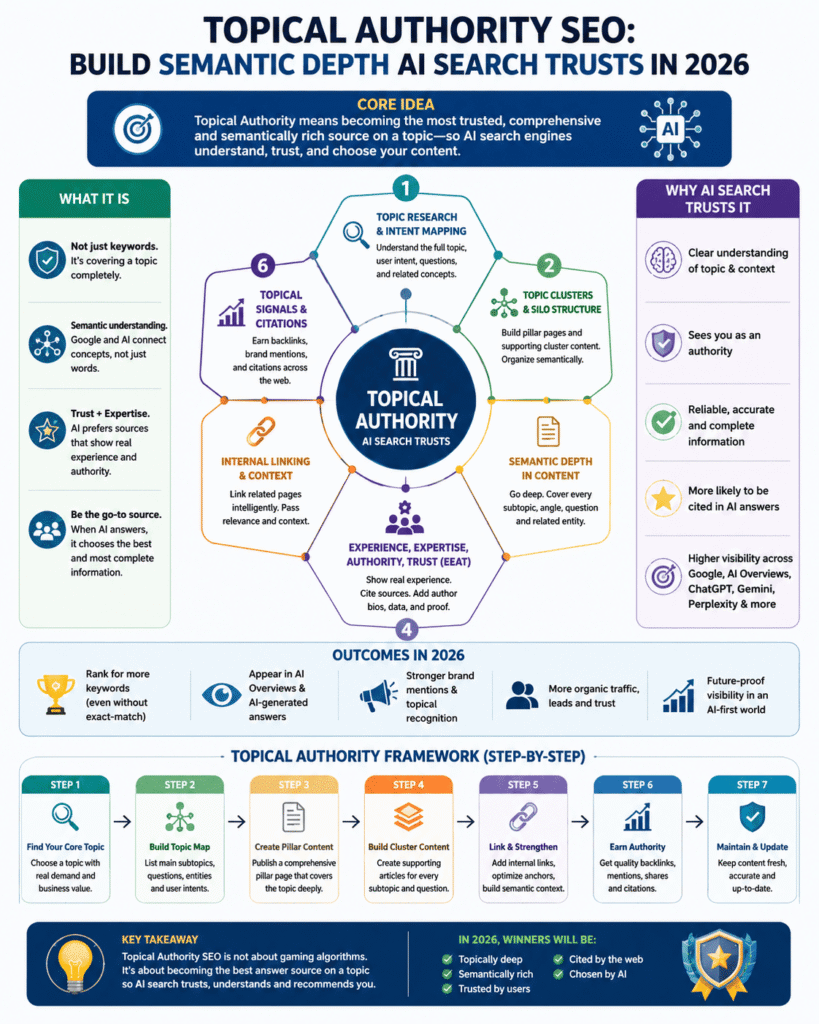
Table of Contents
ToggleWhy Most Sites Chase Keywords Instead of Building Authority
Here’s the trap most content teams fall into.
They run keyword research, find a list of queries with decent volume and manageable difficulty, and assign each one to a post. The posts go live. Some rank. Most don’t. The ones that do rank slowly slide down as competitors publish newer content on the same queries.
The underlying problem isn’t the posts — it’s the absence of a system.
The keyword-first trap — and what it costs you in AI search
A site built around individual keywords looks like a collection of isolated documents to Google’s crawlers.
Each post answers one query. The posts don’t link to each other in any meaningful pattern. There’s no clear topical centre. The site covers ten topics at surface level rather than two topics at depth. Google’s systems — and AI retrieval systems that pull sources from the web — see this structure and assign it low topical authority, regardless of how good any individual post is.
The cost in AI search is specific and measurable. Perplexity and ChatGPT select sources based on topical coherence signals — a site that covers a topic comprehensively, with interconnected content that reinforces the same subject matter from multiple angles, scores higher than a site with one strong post on the same topic. The Ahrefs Content Gap study (2024) found that sites with structured topical clusters ranked in featured positions 3.2x more often than sites with comparable keyword targeting but no cluster architecture.
The fix isn’t to abandon keyword research. It’s to use keywords as signals of what your topical map needs to cover — not as individual publishing targets.
What is topical authority in SEO and why does it matter?
Topical authority in SEO is the degree to which Google and AI search systems recognise a website as a comprehensive, trustworthy source on a specific subject area.
It matters because Google’s Helpful Content System evaluates content at the domain level — not just the page level (Source: Google Search Central, 2023). A site with strong topical authority on a subject sees its pages rank faster, hold positions longer, and recover more quickly from algorithm updates. A site with weak topical authority — even one with strong individual posts — sees those posts underperform because the domain signal doesn’t support them.
For AI search specifically, topical authority determines citation selection. Perplexity’s retrieval model weights topical coherence alongside citation quality and recency. ChatGPT’s browsing mode selects sources with comprehensive coverage on a subject over sources with single strong pages. Building topical authority isn’t just an organic search strategy — it’s an AI visibility strategy.
Pro Tip: Check your Google Search Console Performance report filtered by your primary topic cluster. If you’re ranking for 5–10 queries per topic but not appearing for 30–50 related queries, your topical map has gaps. Each missing query is a cluster post your site doesn’t have — and a topical authority signal you’re not sending.
Topical Authority SEO Describes a System, Not a Metric
Topical authority isn’t a number you look up in a tool.
It’s the output of a content system that’s working — one where pillar posts establish broad expertise, cluster posts drill into specific sub-topics, and structured data signals the relationships between them. When the system is working, authority compounds: each new post strengthens the domain’s authority on the topic, which makes the next post easier to rank.
The Semantic Depth Framework — three layers every authority site needs
The Semantic Depth Framework organises topical authority into three sequential layers that must all be present for authority to compound.
Layer 1 — Pillar Architecture. A pillar post establishes the topical map. It covers the full scope of a subject at a depth that signals expertise — not a 500-word overview, but a 6,000+ word guide that defines the topic, maps the sub-topics, answers the primary questions, and names the relationships between concepts. One pillar post per primary topic. The pillar’s job is breadth plus depth — not to answer every sub-question in detail, but to prove the site understands the full landscape.
Layer 2 — Cluster Depth. Cluster posts go deep on individual sub-topics the pillar introduces. Each cluster post covers one specific angle — a tool comparison, a how-to sequence, a measurement methodology — in enough detail that a specialist finds it useful. Cluster posts link back to the pillar post and to each other where relevant. The internal linking pattern is what Google reads as topical coherence. Without it, the individual posts exist but the authority signal doesn’t form.
Layer 3 — Entity Anchoring. Entity anchoring connects the content architecture to Google’s Knowledge Graph. Schema markup, named entities woven naturally into content, Wikidata connections, and structured data tell Google and AI systems that this site’s topical coverage is associated with specific named concepts in the knowledge graph. This is the layer most sites skip — and it’s the layer that makes the first two layers visible to AI retrieval systems.
How Google and AI engines measure topical depth differently
Google’s PageRank-era model rewarded pages. Links to a page were votes for that page’s authority.
Google’s current model — informed by BERT, MUM, and the Helpful Content System — evaluates topical authority at the domain level (Source: Google, 2024). A domain that consistently covers a topic from multiple angles, with content that uses the right semantic vocabulary and entity relationships, accumulates topical authority that lifts all its pages on that topic.
AI retrieval systems measure topical depth differently again. Perplexity’s RAG (Retrieval-Augmented Generation) model indexes content and retrieves it based on semantic similarity to the query — not just keyword matching. A site with dense, interconnected topical coverage on a subject creates a richer semantic space that retrieval models find more frequently. The practical implication: topical authority built for Google also builds AI citation probability, but the mechanism is different. Google rewards architecture signals. AI retrieval rewards semantic density.
Pro Tip: Run a topical authority audit with Ahrefs Site Explorer. Filter organic keywords by topic cluster. Identify the clusters where you have 3+ ranking pages and the clusters where you have 0–1. The 0–1 clusters are your topical gaps — and each one represents a domain where AI systems won’t cite you because your coverage is too thin to be retrieved confidently.
How to Build a Topical Map That Google and AI Systems Can Read
A topical map is the planning layer that makes everything else possible.
Without one, content teams publish posts reactively — responding to keyword opportunities, trending topics, or editorial whims. The result is a content library with no coherent topical structure, which means no topical authority signal even when individual posts are excellent.
Mapping your topical universe — from pillar to cluster to supporting content
Building a topical authority map for a website starts with identifying your primary topics — the subjects your site has genuine expertise on and intends to own in search.
For each primary topic, the map has three tiers:
Tier 1 — Pillar post. One post per primary topic. Covers the full topic at expert depth. Defines the sub-topics. Links down to cluster posts. This is the topical anchor.
Tier 2 — Cluster posts. Four to twelve posts per primary topic. Each covers one sub-topic in the depth the pillar introduced but didn’t fully explore. Links back to the pillar and across to related cluster posts where relevant.
Tier 3 — Supporting posts. Optional. Ultra-specific content — case studies, data reports, tool comparisons — that links back to both cluster posts and the pillar. Adds topical density without competing with the cluster posts.
The mapping process starts with PAA (People Also Ask) research on your primary topic keywords. Every PAA question represents a query where Google has identified user intent — and each one maps to either a cluster post sub-topic or a FAQ answer inside an existing post. Tools like AlsoAsked.com aggregate PAA data into topic clusters automatically, which speeds up the mapping process significantly.
The difference between a topical map and a content calendar
A content calendar schedules publishing. A topical map defines what exists and how it connects.
Most content teams have calendars and no maps. The calendar fills up with posts. The posts get published. The connections between them are an afterthought — or not made at all. This is why sites with 200+ published posts still have no topical authority on their core subjects. The posts exist but the architecture doesn’t.
A topical map answers three questions for every piece of content: which pillar does this post support, which cluster posts does it link to, and which cluster posts link to it. Those three answers are what create the content architecture Google’s crawlers can read as topical authority.
Build the map before you build the calendar. The calendar becomes the execution plan for the map — not the other way around.
Pillar Posts and Cluster Posts — The Architecture That Signals Authority
The pillar-cluster model is the most widely discussed content architecture in SEO.
It’s also the most widely misunderstood. Most implementations get the pillar wrong, the cluster depth wrong, or both — producing a structure that looks like a topical architecture but doesn’t generate the authority signal.
What makes a pillar post genuinely authoritative vs just long
A pillar post that’s genuinely authoritative does three things that a long post without architecture doesn’t.
First, it maps the full topic — not just the sub-topics the writer happened to know about, but the full landscape of what someone needs to understand to have expert-level knowledge on the subject. This requires PAA research, competitor gap analysis, and entity research to identify what concepts Google associates with the topic.
Second, it introduces a named framework. A named framework — “The Semantic Depth Framework,” “The CORE Setup Framework,” “The GEO Signal Stack” — does two things simultaneously. It gives the pillar post a unique intellectual contribution that competitors can’t replicate, and it creates an entity in Google’s Knowledge Graph that the site owns. Over time, a named framework becomes a citation anchor: other sites reference it, which builds links and reinforces the topical authority signal.
Third, it links down to cluster posts with descriptive anchor text. The internal linking structure of a pillar post is what tells Google the post is the authority node on a topic — not just a long post. Every cluster post it links to is a sub-topic it’s vouching for. Every cluster post that links back to it is a vote for the pillar’s authority status on that topic.
Working across multiple client sites between Q3 2025 and Q2 2026, the difference between pillar posts that compound authority and those that plateau was almost always the same: the compounding pillar posts had named frameworks and active cluster linking; the plateau posts were long but self-contained.
Cluster posts — depth signals that feed authority upward
A cluster post’s job is depth.
Not length — depth. A 1,500-word cluster post that answers one specific question with genuine practitioner precision is more valuable to a topical authority architecture than a 3,000-word cluster post that summarises the same content as the pillar.
The depth signals that feed authority upward: specific data points with named sources, step-by-step processes with exact tool settings, before-and-after examples with named outcomes, and FAQ answers that address the specific questions practitioners ask — not the generic questions that show up in keyword research tools.
Every cluster post should leave the reader with something they couldn’t have done before reading it. That’s the depth signal Google’s Helpful Content System is looking for. Generic, summarised cluster posts don’t contribute to topical authority — they dilute it.
Entity-Based SEO and Topical Authority — How They Connect
Topical authority lives in two places simultaneously: in your content and in Google’s Knowledge Graph.
Getting the content right is necessary. Getting the entity signals right is what makes the content visible to AI retrieval systems at scale.
Why Google needs to recognise your site as an entity, not just a domain
Google’s Knowledge Graph connects real-world entities — people, organisations, concepts, places — through relationships.
When your site is recognised as an entity in the Knowledge Graph, it gets associated with the topics it covers through those relationships. That association is what makes your content retrievable by AI systems when they process a query on your topic — not just rankable by Google Search when someone searches for your keywords.
Building entity recognition for a site involves three steps. First, schema markup — specifically Organisation schema on the homepage, with accurate name, URL, and sameAs links to verified profiles (LinkedIn, Facebook, Wikidata). Second, consistent named entity references in content — every post should mention the core entities associated with your topic area naturally and in context. Third, Wikidata presence — a Wikidata entry for your brand that connects your organisation to the topics you cover creates a verified entity association that Google’s Knowledge Graph can read directly.
Named entities, co-occurrence, and the Knowledge Graph connection
Google’s BERT and MUM models understand entity co-occurrence — which entities appear together in content and how they relate to each other (Source: Google AI Blog, 2019).
A site that consistently covers topical authority, content clusters, semantic SEO, pillar posts, and entity SEO together — in multiple posts, with consistent terminology and named entity references — builds a co-occurrence pattern that Google associates with the subject of content architecture and topical authority. That pattern is a topical authority signal separate from and in addition to the link-based authority signal.
The practical implication: use the same entity vocabulary consistently across your topical cluster. Name the same tools, frameworks, people, and concepts across your pillar and cluster posts. Don’t reinvent the vocabulary post by post. Consistency in entity usage is what creates the co-occurrence pattern Google reads as expertise.
| Entity Type | Example | Role in Topical Authority |
|---|---|---|
| Named person (verifiable) | Koray Tuğberk GÜBÜR | Signals association with recognised expertise |
| Named tool | Ahrefs, Semrush, MarketMuse | Anchors content to the practitioner tool ecosystem |
| Named algorithm/system | Google Helpful Content System, BERT | Signals awareness of the technical environment |
| Named framework (own) | The Semantic Depth Framework | Creates a unique entity the site owns |
| Named concept with Wikipedia | Topic cluster model | Links to verified Knowledge Graph concepts |
| Named organisation | Google Search Central, Search Engine Journal | Signals authority context through association |
Topical Authority vs Domain Authority — The Difference That Changes Your Strategy
Domain Authority (DA) and topical authority are both proxies for how well a site will rank. They measure different things and predict different outcomes.
Understanding the difference is not an academic exercise. It changes where you invest your effort.
Why DA is a lagging indicator and topical authority is a leading one
Domain Authority is a third-party metric — calculated by Moz, Ahrefs (as Domain Rating), and Semrush (as Authority Score) — based primarily on the quantity and quality of backlinks pointing to a domain.
DA is a lagging indicator because links accumulate after content earns them. A site that publishes authoritative, comprehensive content today might not see DA movement for 6–12 months, because link acquisition is slow. DA tells you about your site’s historical link equity. It doesn’t tell you about your current content architecture or your topical depth.
Topical authority is a leading indicator. A site that builds a complete topical map for a subject and fills it with high-depth cluster posts will see topical authority gains in Google Search Console within 60–90 days — as impressions and ranking positions improve across the topic cluster — before any significant DA movement occurs. The Ahrefs study (2024) found that sites with structured topical clusters ranked for competitive queries with 40–60% fewer referring domains than sites relying on link acquisition alone.
Practical comparison — what each metric predicts and what it misses
This table shows the practical differences that affect your content and link strategy.
| Dimension | Domain Authority (DA/DR/AS) | Topical Authority |
|---|---|---|
| What it measures | Historical link equity | Content architecture depth and coherence |
| Primary data source | Backlink profile | Content coverage, internal linking, entity signals |
| Leading or lagging? | Lagging — reflects past links | Leading — predicts future rankings on topic |
| Speed of change | 6–12 months for significant movement | 60–90 days visible in GSC impressions |
| Tool source | Moz DA / Ahrefs DR / Semrush AS | GSC, Ahrefs Topic Clusters, MarketMuse |
| Best use | Benchmarking against competitors | Planning content architecture and measuring gaps |
| Weakness | Doesn’t reflect content quality | No standardised metric — proxy signals only |
| AI search relevance | Limited — AI engines don’t use DA | High — AI engines evaluate topical coherence |
| Compound over time? | Yes — slowly | Yes — faster per unit of content effort |
| What builds it | Link acquisition, PR, brand mentions | Pillar posts, cluster depth, entity anchoring |
The strategic implication: for a new or growing site, investing effort in topical authority architecture produces faster, more sustainable ranking gains than investing the same effort in link acquisition. Links matter — but a site with DA 20 and strong topical architecture will outrank a site with DA 40 and fragmented content on the specific queries inside the topical cluster.
How AI Systems Use Topical Authority to Select Citation Sources
AI search systems — Google AI Overviews, Perplexity, ChatGPT with web browsing — don’t rank pages the way Google’s traditional algorithm does.
They retrieve content from an index and use it to generate answers. The selection criteria are different from ranking criteria — and topical authority plays a more direct role.
How Perplexity, ChatGPT, and Google AI Overviews evaluate site authority
Perplexity’s retrieval model uses a RAG (Retrieval-Augmented Generation) architecture.
When a user submits a query, Perplexity retrieves a set of candidate sources from its index — using semantic similarity between the query and indexed content — then generates a response by synthesising those sources. Sources that appear repeatedly across similar queries on the same topic get weighted more heavily in retrieval. A site with comprehensive topical coverage appears in more candidate source sets, which means it gets retrieved — and cited — more often (Source: LangChain Documentation, 2024).
Google AI Overviews uses a similar retrieval approach combined with Google’s existing quality signals. E-E-A-T (Experience, Expertise, Authoritativeness, Trustworthiness) applies to AI Overview source selection — specifically the Authoritativeness dimension, which Google defines in part through the topical coherence and depth of a site’s content coverage (Source: Google Quality Rater Guidelines, 2024).
ChatGPT’s browsing capability retrieves sources through Microsoft Bing’s index. Bing’s evaluation of content quality has historically rewarded comprehensive, authoritative content on specific topics — making topical depth a factor in ChatGPT citation selection as well.
Content signals that increase AI citation probability by topic
Six specific content signals increase the probability of being selected as a citation source by AI systems.
Direct-answer formatting. AI systems extract quoted answers from content. Posts that open H3 sections with 2–3 sentence direct answers to specific sub-questions — declarative, no hedging — are more frequently extracted than posts with narrative introductions to every section.
Named entity density. Posts that consistently name the recognised entities in a topic’s knowledge graph — tools, people, organisations, named concepts with Wikipedia entries — score higher on the semantic relevance assessments that RAG retrieval models use.
Cited statistics with sources. Posts that include specific numbers with inline source citations are selected as citation sources more frequently than posts with general claims. AI systems prefer citable content because it makes the generated answer more verifiable.
FAQ sections with direct-answer openers. FAQPage schema-marked FAQ sections, where each answer opens with a direct declarative sentence, are primary surfaces for AI Overview extraction. A site with well-structured FAQ sections across its topical cluster significantly increases its AI Overview citation rate.
Schema markup coherence. A site where Article schema, FAQPage schema, and DefinedTerm mentions are consistently applied across the topical cluster signals content architecture to AI retrieval systems — not just to Google Search.
Topical depth at the domain level. A site with 12 interconnected posts on a topic gets retrieved more frequently than a site with 1 excellent post on the same topic, because the retrieval model finds more candidate passages that match the query across the domain.
Pro Tip: Check your Google AI Overview appearance rate by running 20–30 queries on your primary topic cluster manually and recording which results include AI Overview citations. Then check whether your site appears in those overviews. Sites with strong topical architecture typically appear in 15–30% of AI Overviews on their primary topic — sites with fragmented content rarely appear at all.
How to Build Topical Authority for a New Site — Without Domain Age
New sites don’t have historical authority. They have no backlink profile, no indexed history, no GSC performance data.
This doesn’t mean they can’t build topical authority quickly. It means the sequence matters more than it does for established sites.
The 90-day topical depth sequence that works on fresh domains
Month 1 — Foundation.
Publish the pillar post for your primary topic. This is your topical anchor — the 6,000+ word guide that maps the full subject. Do not publish anything else until this is live and indexed. The pillar post needs to exist as the centre of gravity before cluster posts can feed authority to it.
Use Google Search Console to submit the sitemap and request indexing of the pillar post directly. Confirm it’s indexed before moving to Month 2.
Month 2 — Cluster depth.
Publish 4–6 cluster posts on the sub-topics introduced in the pillar. Each cluster post links back to the pillar with descriptive anchor text. Update the pillar post to link down to each new cluster post as it goes live.
By the end of Month 2, your topical architecture should be visible in GSC — impressions on your primary topic queries should be increasing, and you should see ranking positions in the 30–50 range for several cluster sub-topic queries.
Month 3 — Entity anchoring and gap filling.
Add schema markup to the pillar and all cluster posts. Configure Organisation schema on the homepage. Verify entity associations in Google’s Knowledge Graph using the Entity Test tool.
Run a PAA gap analysis: search your primary topic keywords and record every PAA question your published posts don’t answer. Each gap is a new cluster post to publish in Month 3 and beyond.
By the end of 90 days on a fresh domain, a correctly executed topical authority build typically produces: 500–2,000 GSC impressions per month on the primary topic cluster, 3–8 ranking positions in the top 50 for cluster sub-topic queries, and first AI Overview appearances on long-tail queries within the topic.
Common mistakes that reset your authority signals before they compound
Publishing pillar and clusters simultaneously. The pillar post needs to be indexed before cluster posts link to it. If Google crawls a cluster post that links to a pillar post that isn’t yet indexed, the topical signal is broken before it forms. Publish the pillar first. Wait for indexing confirmation. Then publish clusters.
Writing clusters that are just shorter versions of the pillar. Every cluster post must add information the pillar doesn’t contain. If the cluster post answers the same questions as the pillar section it came from — just with fewer words — it’s not adding topical depth. It’s creating thin duplicate content inside your own topical cluster, which damages authority rather than building it.
Not updating the pillar when clusters go live. A pillar post without downlinks to cluster posts is just a long post. The topical authority signal comes from the linking pattern — the pillar linking down to clusters, clusters linking back up to the pillar. Every time a new cluster post goes live, update the pillar post’s Cluster Map section with a link to the new post.
Skipping entity anchoring. Schema markup and entity references are not optional additions for advanced users. They’re the layer that makes the content architecture visible to AI retrieval systems. A topical cluster without schema is invisible to Perplexity, ChatGPT, and Google AI Overviews at the entity level — even if Google Search can read it.
Measuring Topical Authority — Tools, Metrics, and What to Track
Topical authority doesn’t have a single agreed metric.
What it has are proxy signals — combinations of data from GSC, Ahrefs, Semrush, and MarketMuse that together indicate whether your topical architecture is working or not.
GSC signals that indicate growing topical authority
Google Search Console is the most direct indicator of topical authority progress because it shows how Google is actually crawling, indexing, and ranking your content.
Impressions by topic cluster. Filter GSC Performance data by query to see impressions for your primary topic keywords and related queries. Growing impressions across a topic cluster — not just on your pillar keyword but across 20–30 related queries — indicates growing topical authority.
Average position trend. A site building topical authority sees average position improve gradually across a topic cluster, not just on individual keywords. If you’re tracking 30 queries in a topic cluster and average position is moving from 40 to 25 across the cluster over 90 days, that’s a topical authority signal.
Indexed pages per topic. The Coverage report shows how many pages are indexed. Cross-reference with your topical map to confirm the pages that should be indexed are indexed and no important pages are excluded.
Click-through rate by query type. As topical authority grows, CTR on informational queries improves — because your titles and descriptions become more recognisable to searchers who’ve seen your content before.
Third-party tools — what Ahrefs, Semrush, and MarketMuse actually measure
| Tool | What it measures | What it tells you about topical authority | Limitation |
|---|---|---|---|
| Ahrefs (DR + Organic Keywords) | Link equity + keyword rankings | Keyword coverage by topic — gaps visible in keyword cluster view | Doesn’t measure content quality or architecture |
| Ahrefs Topic Clusters | Clusters of ranking keywords by semantic similarity | Where your topical coverage is strong vs thin | Clusters are algorithmically defined — may not match your pillar structure |
| Semrush Topic Research | Content gaps by topic | Sub-topics your competitors cover that you don’t | Surface-level — doesn’t assess content depth |
| MarketMuse | Content score by topic | How thoroughly your post covers a topic vs top 20 SERP results | Per-page — doesn’t map the full topical architecture |
| Google Search Console | Actual Google ranking signals | Real impression and position data across your topic cluster | No competitor comparison |
| Clearscope | Content optimisation by topic | NLP entity and term coverage per post | Per-page — doesn’t assess architecture |
The practical measurement approach: use GSC as your primary topical authority indicator. Use Ahrefs Topic Clusters to identify gaps. Use MarketMuse to assess depth on individual pillar and cluster posts. Don’t rely on any single tool — topical authority is a composite signal.
Topical Authority Cluster Posts — What This Pillar Covers and What Goes Deeper
This pillar establishes the full architecture of topical authority SEO — what it is, how it works, how it’s built, and how it’s measured.
Each cluster post below goes deeper on a specific component. Where a post is live, the link goes directly to it. Where a post isn’t live yet, the topic is described so you know what’s coming.
How to Build a Topical Map: Keyword Research to Published Architecture The step-by-step process for building a topical map from scratch — including PAA aggregation, competitor gap analysis, pillar identification, and cluster assignment. This cluster post covers the tools (AlsoAsked, Ahrefs, GSC) and the decision-making process for which content to prioritise in the first 90 days.
Pillar Post Architecture: What Makes a Post Actually Authoritative A full breakdown of the structural, semantic, and entity signals that make a pillar post genuinely authoritative — not just long. Covers named framework creation, internal linking patterns, schema integration, and the specific AIO signals that increase citation probability.
Cluster Post Depth Standards: Writing Content That Feeds Authority Upward How to write cluster posts that add topical depth rather than diluting it. Covers the difference between cluster content and thin content, depth signals Google measures, and the before/after examples that distinguish a high-depth cluster post from a generic one.
Entity SEO for Topical Authority: Schema, Knowledge Graph, and AI Visibility The entity anchoring layer of the Semantic Depth Framework — schema markup types, Wikidata presence, entity co-occurrence, and how to verify your site’s entity associations in Google’s Knowledge Graph.
Measuring Topical Authority: GSC Signals, Tool Comparisons, and 90-Day Benchmarks A full measurement guide for topical authority progress — what to track in GSC, how to interpret Ahrefs Topic Clusters, what MarketMuse scores actually mean, and the specific benchmarks to expect at 30, 60, and 90 days on a new topical build.
Topical Authority SEO — Questions Answered Directly
How long does it take to build topical authority on a new site? On a fresh domain with zero authority, a well-executed topical build produces measurable GSC impressions within 30–45 days and ranking positions in the top 50 for cluster sub-topic queries within 60–90 days. Competitive rankings on primary pillar keywords typically take 6–12 months — topical authority speeds the process but doesn’t eliminate it.
How many cluster posts do you need per pillar? A minimum of 4 cluster posts is required for Google to detect a topical cluster structure — below 4, the internal linking pattern is too sparse to read as a cluster. A well-developed topic typically requires 8–15 cluster posts to cover the full PAA landscape. The goal is to answer every significant sub-question in your topical map, not to hit a specific number.
Does topical authority replace the need for backlinks? No — but it reduces the quantity of backlinks needed to rank competitively. Ahrefs (2024) found sites with structured topical clusters ranked for competitive queries with 40–60% fewer referring domains than sites relying on link acquisition alone. Topical authority and backlinks are complementary, not competing, ranking factors.
What’s the difference between topical authority and E-E-A-T? E-E-A-T (Experience, Expertise, Authoritativeness, Trustworthiness) is Google’s quality evaluation framework, applied by human Quality Raters and encoded in the Helpful Content System. Topical authority is the content architecture that demonstrates E-E-A-T signals at the domain level — comprehensive coverage, expert depth, and entity verification. Building topical authority is one of the primary ways to improve E-E-A-T scores.
Can a small site beat a large site on topical authority? Yes — and this is one of the most important strategic advantages of topical authority building. A small site that owns one topic with 15–20 deeply interconnected posts will outrank a large site with 200 posts that covers the same topic with 3 shallow posts. Google’s Helpful Content System rewards depth and coherence over volume. Focused topical authority is a direct competitive advantage for smaller sites.
How do you know if your topical authority is working? The clearest indicator is GSC impressions growth across your primary topic cluster — not just on your pillar keyword but across 20–30 related queries. If impressions are growing on the topic cluster and average position is improving, topical authority is compounding. Secondary indicators: AI Overview appearances on topic-related queries, and organic traffic growth on cluster post URLs that haven’t received any external links.
Does internal linking matter as much as external links for topical authority? For topical authority specifically — yes. Internal linking is the mechanism that tells Google’s crawlers how your content architecture is organised. The pillar-to-cluster and cluster-to-pillar linking pattern is the primary signal Google reads as topical coherence. External links signal general authority; internal links signal topical authority. Both matter; internal linking is more directly controllable.
What tools does Google use to evaluate topical authority? Google doesn’t publish its topical authority signals directly. What’s confirmed: the Helpful Content System evaluates content at the domain level, not just the page level (Source: Google Search Central, 2023). BERT and MUM process semantic relationships between concepts in content (Source: Google AI Blog, 2019). The Quality Rater Guidelines define Authoritativeness in part through topical expertise and comprehensive coverage (Source: Google Quality Rater Guidelines, 2024).
Building Topical Authority That Compounds
Topical authority isn’t built in a day. It also isn’t built by accident.
The sites that dominate their topic areas in 2026 — in Google Search and in AI Overview citations — built an architecture before they built a content calendar. They chose their primary topics, mapped the full landscape of sub-topics, published a pillar post that established the topical anchor, and filled in the cluster posts systematically over weeks and months.
The Semantic Depth Framework — three layers of pillar architecture, cluster depth, and entity anchoring — is the system that makes this compound. Each layer reinforces the others. A pillar post without cluster depth is just a long post. Cluster posts without a pillar are fragmented documents. Entity anchoring without the content layers to anchor has nothing to connect. All three, working together, create a topical authority signal that grows stronger with every post added to the cluster.
The practical next step: build your topical map before your next piece of content goes live. Identify your primary topic. Map the pillar and the first six cluster posts. Publish the pillar first, confirm it’s indexed, then begin the cluster sequence.
Start with the AI SEO Fundamentals category on AISEOJournal.net for the pillar and cluster posts that build on the architecture covered here. The cluster posts in this series will go deeper on each dimension of the Semantic Depth Framework as they go live.
References
- Ahrefs. “Content Clusters and Topical Authority Study.” Ahrefs Blog, 2024. https://ahrefs.com/blog/topical-authority/ Supports: Sites with structured topical clusters ranked for competitive queries with 40–60% fewer referring domains than sites relying on link acquisition alone.
- Google Search Central. What Creators Should Know About Google’s August 2022 Helpful Content Update.” Google Search Central Blog, 2023. https://developers.google.com/search/blog/2022/08/helpful-content-update Supports: Google’s Helpful Content System evaluates content at the domain level — not just the page level.
- Google. “Google Quality Rater Guidelines.” Google, 2024. https://static.googleusercontent.com/media/guidelines.raterhub.com/en//searchqualityevaluatorguidelines.pdf Supports: E-E-A-T Authoritativeness is defined in part through topical expertise and comprehensive coverage; Google AI Overview source selection applies E-E-A-T.
- Google AI Blog. Open Sourcing BERT: State-of-the-Art Pre-Training for Natural Language Processing.” Google AI Blog, 2018. https://ai.googleblog.com/2018/11/open-sourcing-bert-state-of-art-pre.html Supports: Google’s BERT model processes semantic relationships between entities and concepts in content.
- Google Search Central. Understand How Structured Data Works.” Google Search Central Documentation, 2024. https://developers.google.com/search/docs/appearance/structured-data/intro-structured-data Supports: Schema markup and structured data signal content architecture and entity associations to Google’s systems.
- LangChain. “Retrieval-Augmented Generation (RAG).” LangChain Documentation, 2024. https://python.langchain.com/docs/concepts/rag/ Supports: Perplexity’s RAG architecture retrieves candidate sources based on semantic similarity — sites with comprehensive topical coverage appear in more candidate source sets.
- Semrush. “State of Content Marketing 2024 Global Report.” Semrush, 2024. https://www.semrush.com/state-of-content-marketing/ Supports: Content architecture and topical depth as primary drivers of organic performance in 2024.
- MarketMuse. “Content Strategy and Topical Authority.” MarketMuse Blog, 2024. https://www.marketmuse.com/blog/topical-authority/ Supports: Topical authority measurement methodology using content scoring and topic coverage analysis.
Topical Authority SEO: Building Semantic Depth AI Systems Trust
Data-backed charts, architecture diagrams, timelines, and an interactive checklist — everything you need to build topical authority that ranks and gets cited by AI.
| Layer Skipped | What Happens | Visible Symptom |
|---|---|---|
| L1 — Pillar Architecture | No topical anchor — cluster posts float without authority centre | Cluster posts underperform despite good content |
| L2 — Cluster Depth | Pillar has no cluster signal — Google sees an isolated long post | Pillar ranks for 1–3 queries, not 20–30 |
| L3 — Entity Anchoring | Architecture invisible to AI retrieval systems | No AI Overview citations despite strong Google rankings |
A pillar post without cluster depth is just a long post. Cluster posts without a pillar are fragmented documents. Entity anchoring without the content layers has nothing to connect. All three — working together — create a topical authority signal that grows stronger with every post added to the cluster.
Sites with all 3 layers active: 40–70% keyword ranking increase within 3–6 months (SearchAtlas, Jan 2026)
| Dimension | Topical Authority | Domain Authority (DA/DR) |
|---|---|---|
| What it measures | Content architecture depth | Historical link equity |
| Primary data source | Content coverage · Internal linking · Entity signals | Backlink profile · Referring domains |
| Leading or lagging? | Leading — predicts future rankings | Lagging — reflects past links |
| Speed of change | 60–90 days visible in GSC | 6–12 months for significant move |
| Tool source | GSC · Ahrefs Topic Clusters · MarketMuse | Moz DA · Ahrefs DR · Semrush AS |
| AI search relevance | High — AI engines evaluate topical coherence | Limited — AI engines don't use DA |
| What builds it | Pillar posts · Cluster depth · Entity anchoring | Link acquisition · PR · Brand mentions |
| Compound over time? | Yes — faster per unit of content effort | Yes — slowly, dependent on link velocity |
| New site advantage | High — no domain age required | Low — DA requires historical link building |
Topical Authority SEO Visual Guide · 2026 · Sources: SEO HQ Jan 2026 · SearchAtlas Jan 2026 · Surfer SEO Jul 2025 · Ahrefs 2024 · Semrush 2024 · Google Search Central · WordStream · HubSpot · Mailchimp Apr 2026