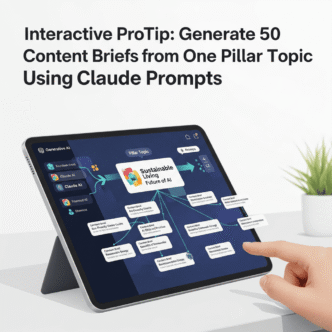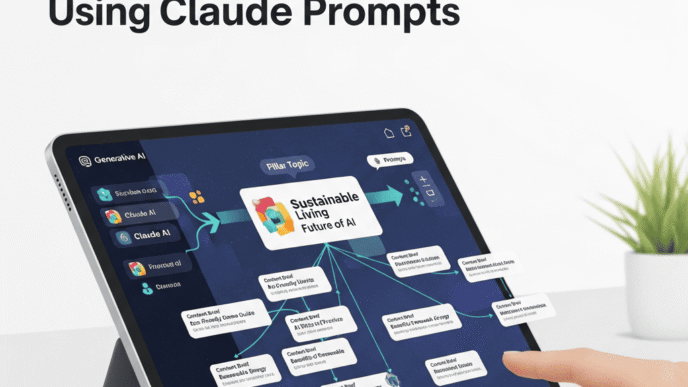


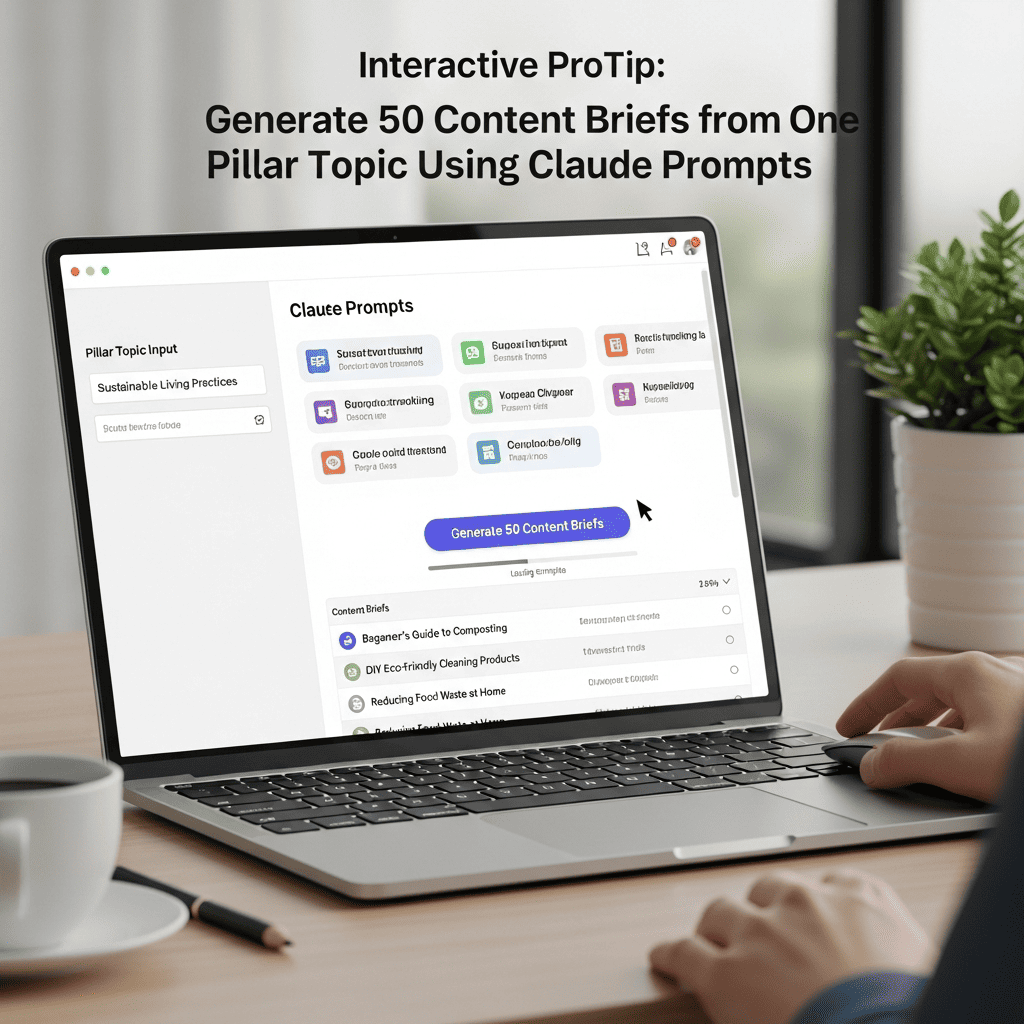
Generate 50 Content Briefs from One Pillar Topic Using Claude Prompts
Leverage Claude's 200K token context window to transform a single pillar topic into a comprehensive content ecosystem of 50+ detailed briefs in under 30 minutes
The Topical Authority Revolution
Google's June 2025 core update reinforced topical authority as a primary ranking factor, rewarding sites that demonstrate comprehensive, interconnected coverage of topics rather than isolated keyword-focused articles.
The shift from keywords to topics: Google now evaluates whether your site provides complete, credible answers across an entire topic spectrum, not just individual search queries. Sites demonstrating depth through pillar-cluster architecture signal expertise that algorithms reward with higher visibility.
Sources: Search Engine Land Topic Clusters Guide, HireGrowth 2025 Analysis
Real Performance Data
- 10-20% ranking improvement: Websites implementing topic clusters see consistent ranking gains across target keywords within 3-6 months (WebWej 2025)
- 134% organic traffic increase: Companies report dramatic traffic growth within six months of pillar-cluster implementation (WebWej, Niumatrix)
- 2x traffic in 90 days: Combining pillar-cluster content with quality backlinks doubles website traffic in three months (Whitebunnie, Stan Ventures)
- 45% bounce rate reduction: Well-executed pillar models significantly reduce bounce rates as visitors discover interconnected content (Page Optimizer Pro)
- 53% traffic lift in 3 weeks: One architecture rollout drove 53% traffic increase with most support posts showing triple-digit view increases (Search Engine Land)
Sources: WebWej, Whitebunnie, Page Optimizer Pro, Search Engine Land, Stan Ventures 2025
Why Claude Excels at Brief Generation
Claude's 200,000 token context window (approximately 150,000 words or 500+ pages) enables processing entire pillar topics with all subtopics, keywords, and strategic context simultaneously—maintaining perfect coherence across all 50 briefs.
What this means for brief generation:
- Complete topic awareness: Claude maintains understanding of all 50+ subtopics simultaneously, ensuring zero content overlap or cannibalization
- Strategic hierarchy maintenance: Automatically organizes briefs into logical pillar → cluster → supporting article structure
- Consistent quality: Applies the same depth requirements, brand voice, and SEO standards across all briefs
- Relationship mapping: Identifies optimal internal linking opportunities between all cluster articles
- Gap prevention: Ensures comprehensive topic coverage without redundancy or missing subtopics
Sources: Anthropic Claude Documentation
Topic Selection
Choose one broad pillar topic aligned with business goals, audience needs, and keyword research. Should support 10-50 subtopics minimum.
Research Compilation
Gather keyword lists, competitor analysis, existing content inventory, and brand guidelines into single document for Claude.
Master Prompt
Feed comprehensive brief generation prompt to Claude with all context data and specific requirements for output format.
Brief Generation
Claude analyzes entire topic landscape and generates 50+ detailed content briefs with SEO specs, outlines, and linking strategy.
Export & Review
Export briefs to spreadsheet or project management tool, review for accuracy, and assign to content team for execution.
Implementation
Execute content creation following pillar-first approach, publishing pillar page and clusters together for maximum SEO impact.
Comprehensive Brief Generation Prompt
Sources: Claude API Best Practices, Content Strategy Frameworks
The Strategic Hierarchy
Level 1: Pillar Page (1 comprehensive guide):
- Length: 2,500-4,000 words minimum providing broad overview of entire topic
- Purpose: Establish topical authority and rank for high-volume, high-difficulty primary keyword
- Content: Covers all major aspects at high level with links to detailed cluster articles
- Structure: Clear table of contents, logical sections, strategic internal links to all clusters
- Updates: Refresh quarterly to maintain authority and add newly published cluster links
Level 2: Primary Clusters (10-15 major subtopics):
- Length: 1,500-2,500 words diving deep into specific aspect of pillar topic
- Purpose: Rank for medium-volume keywords with strong commercial or informational intent
- Content: Detailed exploration of one facet mentioned in pillar page with practical examples
- Linking: Link back to pillar page and to related clusters within same hierarchy
- Examples: For "Email Marketing" pillar → "Email Segmentation Strategies", "A/B Testing Email Subject Lines"
Level 3: Supporting Articles (35-45 detailed pieces):
- Length: 800-1,500 words addressing highly specific subtopic or question
- Purpose: Capture long-tail keywords, answer specific user questions, provide tactical guidance
- Content: Focused, actionable content on narrow aspect of cluster theme
- Linking: Link to parent cluster and pillar page, plus related supporting articles
- Examples: "How to Write Email Subject Lines for B2B SaaS", "Email Segmentation for E-commerce Abandoned Carts"
Sources: Siteimprove Pillar Strategy, Niumatrix Guide, Search Engine Land
Internal Linking Best Practices
- Pillar to clusters: Every major section in pillar should link to relevant cluster article using descriptive anchor text
- Clusters to pillar: Each cluster links back to pillar 2-3 times using natural contextual phrases, not "click here"
- Cluster to cluster: Related clusters link to each other when topically relevant, creating topic network
- Supporting to parent: Supporting articles link to their parent cluster and main pillar page
- Contextual integration: Links embedded naturally in sentences that add value, not forced or disruptive
- Anchor text variation: Use different descriptive phrases for same target URL across multiple sources
Sources: Siteimprove, Search Engine Land Internal Linking Guide
Iterative Enhancement
After Claude generates initial 50 briefs, use these follow-up prompts to refine and enhance:
Sources: Content Strategy Best Practices
Optimal Publishing Approach
Phase 1: Foundation (Weeks 1-4)
- Publish pillar page: Launch comprehensive pillar page with table of contents linking to planned cluster articles (even if not yet published)
- Launch 5-8 primary clusters: Publish core cluster articles supporting main pillar sections, linking back to pillar
- Early SEO signal: Publishing pillar + initial clusters together signals topical depth to search engines immediately
Phase 2: Cluster Completion (Weeks 5-12)
- Complete remaining clusters: Publish all 10-15 primary cluster articles, maintaining 2-3 articles per week pace
- Update pillar page: Add links to newly published clusters, update table of contents, refresh statistics
- Backlink outreach: Begin promoting pillar page for authoritative backlinks
Phase 3: Supporting Content (Weeks 13-24)
- Publish supporting articles: Roll out 35-45 detailed supporting pieces targeting long-tail keywords
- Strengthen clusters: Add links from supporting articles to parent clusters and pillar
- Track performance: Monitor rankings, traffic, engagement across entire content ecosystem
Phase 4: Optimization (Ongoing)
- Quarterly pillar refresh: Update statistics, add new insights, link to any new clusters published
- Performance-based updates: Expand underperforming articles, add depth where needed
- New content additions: Add emerging subtopics as trends evolve
Sources: Whitebunnie, WebWej, Siteimprove Publishing Strategy
Key Performance Indicators
- Topical coverage completeness: Percentage of target subtopics addressed with published content (target: 90%+ coverage)
- Ranking improvements: Average position gains for pillar and cluster target keywords (target: 10-20% improvement in 6 months)
- Organic traffic growth: Traffic increase to pillar-cluster content ecosystem (target: 30%+ lift vs standalone content)
- Internal link strength: Average internal links per page within cluster (target: 5-8 contextual links)
- Engagement metrics: Time on page, pages per session, bounce rate for cluster content (target: 45% bounce rate reduction)
- Conversion performance: Lead generation or sales from pillar-cluster content vs other content
- Backlink acquisition: Natural backlinks earned by pillar page due to comprehensive authority
Sources: Page Optimizer Pro, Search Engine Land Analytics
Common Implementation Mistakes
- Publishing clusters before pillar: Clusters published without pillar context lack strategic foundation and miss bidirectional linking benefits
- Keyword cannibalization: Multiple articles targeting same keyword due to poor brief coordination
- Shallow pillar pages: Pillar pages under 2,000 words don't establish sufficient topical authority
- Weak internal linking: Failing to create strong contextual links between pillar and clusters reduces SEO value
- One-and-done approach: Never updating pillar page after initial publication misses ongoing authority opportunities
- Ignoring user intent: Creating clusters based on keywords alone without considering actual user needs and questions
Sources: Siteimprove, Br8kthru Best Practices
Transform a single pillar topic into 50+ detailed content briefs in 30 minutes using Claude's 200K context window. Build topical authority that drives 30% more organic traffic and rankings that last 2.5x longer.
Data Sources: Search Engine Land, HireGrowth, WebWej, Whitebunnie, Niumatrix, Siteimprove, Page Optimizer Pro, Stan Ventures, Br8kthru, 7 Eagles—2025