

Last updated: April 2026 | Sources reviewed: 7
The clearest sign of an intent mismatch is not a low ranking. It is stable impressions combined with declining click-through rate.
Your page surfaces. Users see the title and description. They do not click. Google registers the rejection, updates its assessment of whether the page satisfies the query, and the ranking slowly erodes — not from a technical failure, not from a backlink deficit, but because the page promised something different from what the user expected to find.
This is the failure mode search intent optimisation solves. Not by improving content quality in the abstract — by aligning the specific format, depth, structure, and opening of each page to what the majority of users searching that query actually need.
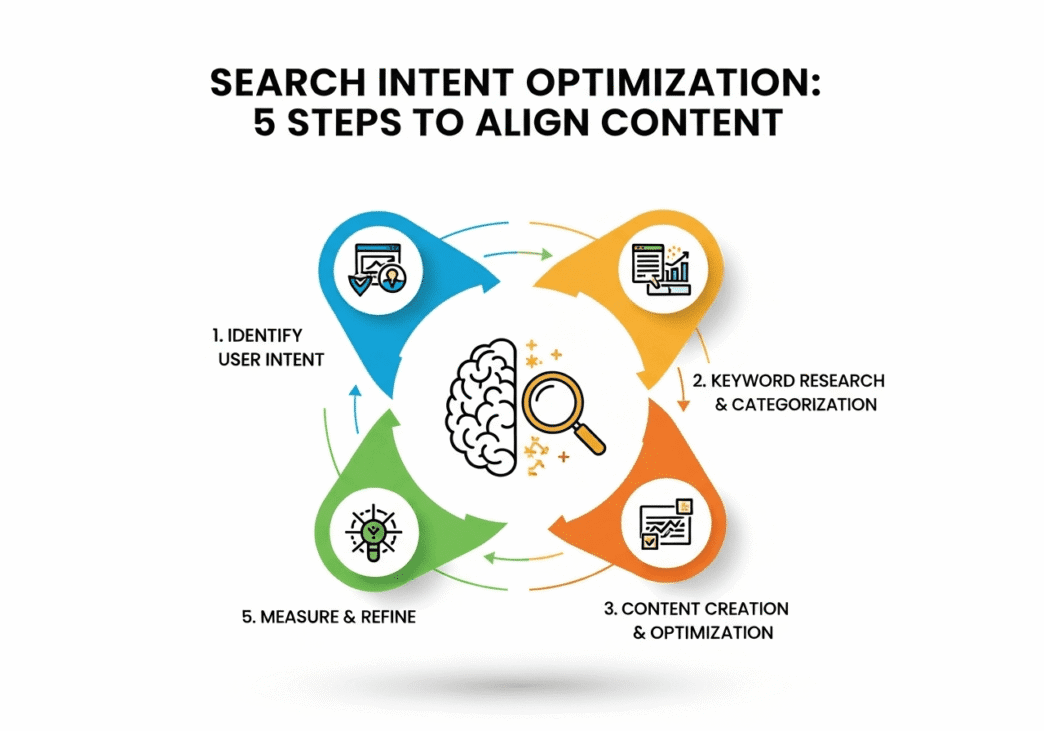
The five-step process below is the one we run for every content audit. It is sequential. Skipping steps produces the same misalignment the original content suffered from.
Table of Contents
ToggleStep 1: Read the SERP Before Writing Anything
Every intent optimisation decision starts with a sixty-second SERP read. Not a keyword tool classification. Not a customer persona assumption. The live SERP.
Open a private browser window. Search the target keyword. Read the format of positions 1–3 — not the full articles, just the page type, heading structure, and opening paragraph. Record three things:
Content type: Is Google returning blog posts, product pages, comparison articles, tool pages, forum threads, or video embeds? This is the dominant format signal. Deviating from it without a compelling reason produces intent mismatch.
Opening structure: What does the first visible sentence of the top-ranking result say? Does it answer the query directly, define a term, list a set of options, or describe a problem? The opening structure of the top result is the intent signal Google has already validated through user behaviour.
SERP features present: Featured snippets indicate Google wants a direct extractable answer. Shopping results indicate transactional intent. Local packs indicate proximity need. Video carousels indicate visual learning preference. Each feature changes the content architecture required.
What most guides get wrong here: They recommend this SERP analysis as a content planning step. We run it as a pre-brief step — before the content brief is written, before any outline is created. A brief built without SERP analysis will incorporate assumptions that the SERP contradicts, and those assumptions will produce intent mismatch regardless of how well the brief is executed.
In practice: We inherited a client’s content calendar with twelve posts already outlined. Before writing any of them, we ran SERP reads on all twelve target keywords. Four of the twelve had dominant SERP formats that the outlined content type did not match — a listicle briefed where comparison tables dominated, a guide briefed where product pages dominated. Catching those four before writing saved three months of revision work.
Step 2: Identify the Specific Sub-Intent, Not Just the Category
Categorising a keyword as “informational” or “commercial” is not sufficient to brief content that satisfies intent. The category is the starting point. The sub-intent is what the content must actually address.
Two keywords can share the same intent category and require completely different content:
How to do keyword research” — informational, process-oriented, wants sequential steps.
“What is keyword research” — informational, definitional, wants a concise explanation followed by context.
Both are informational. The format, opening structure, and depth required differ significantly. A step-by-step guide published against “what is keyword research” will underperform because users at the definitional stage are not ready for process detail.
Sub-intent identification requires reading the PAA boxes for the target keyword. Each PAA question represents a sub-intent that a proportion of users searching the primary keyword also hold. The PAA questions reveal:
- What stage of understanding the user is likely at
- What adjacent questions they will want answered after the primary one
- Whether the intent is primarily learning, evaluating, comparing, or acting
The sub-intent mapping process:
- Search the primary keyword
- Record every PAA question on the first SERP page
- Click the top two PAA questions — each expansion generates additional questions
- Group the questions by theme — these themes are your content’s required H2 sections
- Note which questions the top-ranking page does not answer — these are your differentiation opportunities
In practice: For a comparison post targeting “Ahrefs vs SEMrush,” PAA expansion revealed seven questions the top-ranking page left unanswered — including “which is better for local SEO,” “which has better historical data,” and “can I use both tools together.” Adding dedicated H3 sections addressing those seven questions, each opening with a direct answer, moved the post from position 11 to position 4 within six weeks with no additional link building.
| Sub-intent signal | What it reveals | Content implication |
|---|---|---|
| “How to” PAA questions | Process-oriented intent | Numbered steps with H3 sub-steps |
| “What is” PAA questions | Definitional intent | Direct definition in first sentence, expansion below |
| “Best” / “which” PAA questions | Evaluative intent | Named criteria, scored comparison, explicit verdict |
| “Why” PAA questions | Causal intent | Problem-first structure, then explanation |
| “When” PAA questions | Timing/situational intent | Scenario-based structure with specific conditions |
| “How much” PAA questions | Cost/effort intent | Direct figure or range in first sentence |
Step 3: Structure the Opening Section for Immediate Extraction
The opening 60–100 words of any intent-matched page must do one thing: answer the query the user typed.
Not context-set. Not introduce the topic. Not explain why the question matters. Answer the query. Directly. In the first sentence or two.
This is the single structural change that produces the most measurable impact across content audits. It simultaneously increases featured snippet eligibility, AI Overview citation probability, voice search answer selection, and — most directly — user engagement because the user gets what they came for before deciding whether to read further.
The extraction test: Cover everything on the page except the first 60 words. Can someone who reads only those 60 words answer the question they typed into Google? If yes, the opening is correctly structured. If no, the opening needs restructuring before anything else is addressed.
Most pages fail this test because they open with the problem statement (“keyword research is one of the most important activities in SEO…”), a historical context (“since Google’s Hummingbird update…”), or a definition of a related term. All of these formats delay the answer. None of them pass the extraction test.
The correct structure for each intent type:
Informational: Opening sentence states the direct answer. Second sentence begins the first layer of supporting detail. Third sentence introduces the structure of what follows.
Commercial: Opening sentence states the evaluation verdict or top recommendation. Second sentence names the evaluation criteria. Third sentence explains the structure of the comparison.
Transactional: Opening sentence confirms what the page delivers and its key value signal (price, availability, key benefit). Second sentence provides the primary trust signal. Third sentence states the conversion action.
Pro Tip: Read the opening paragraph of your page aloud as if answering a colleague’s question at their desk. If it sounds like you are giving context before answering, restructure it. A colleague who asked “what is the best CRM for a five-person team” does not want preamble. They want the name of the CRM and the reason, then the supporting detail.
Step 4: Match Content Depth to Competitive Coverage Completeness
Content depth is not a word count decision. It is a topical coverage decision.
Surfer SEO’s analysis of one million SERPs found that top-10 ranking pages covered approximately 74% of the relevant subtopics and entities identified from competing content, while bottom-10 pages covered 50%. (Source: Surfer SEO, 2025) The gap that separates top performers from mid-page performers is coverage completeness — not total length.
The practical implication: before deciding how long a piece of content should be, identify which sub-topics the query requires and check which ones your page currently addresses. Sub-topics not covered are coverage gaps. Sub-topics covered in excessive depth relative to their importance are padding.
The coverage audit process:
- Open the top three ranking pages for your target keyword
- List every H2 and H3 heading from each page
- Group overlapping headings by theme — themes appearing across all three pages are essential sub-topics
- Identify themes appearing in two of three pages — these are important but not universal
- Check your page against both lists: essential sub-topics must be present; important sub-topics should be present if space allows
Any essential sub-topic absent from your page is a ranking gap. Any section in your page that addresses a sub-topic not appearing in any of the top three competing pages is a potential differentiation asset — or padding, depending on user value.
In practice: A pillar page targeting “content marketing strategy” had 4,800 words but ranked at position 14. Coverage audit revealed it thoroughly addressed five sub-topics but missed three that appeared in all top-three competing pages: content distribution channels, content performance measurement, and repurposing strategy. Adding those three sections (900 additional words total) moved the page to position 7 within eight weeks. The existing 4,800 words were not the problem — the coverage gaps were.
Step 5: Monitor Intent Drift and Update Before Rankings Drop
Intent is not permanently fixed to a keyword. User behaviour shifts. Google updates its assessment of which content best satisfies a query. A page that correctly matched intent at publication can drift into mismatch twelve months later without a single word changing on the page.
The GSC signal for intent drift is specific: impressions stable or rising, CTR declining.
Impressions measure whether Google is surfacing the page. CTR measures whether users are selecting it. When impressions grow but CTR falls, Google is still considering the page relevant — but users are rejecting it on the SERP. This is the signature of intent drift. The page’s title and description no longer match what users expect to find, because user expectations for that query have shifted.
The quarterly intent maintenance process:
- Export all pages from GSC with more than 200 monthly impressions
- Filter for CTR below the site average for that content type
- For each flagged page, run a fresh SERP read — not a keyword tool classification, the live SERP
- Check whether the dominant SERP format has changed since the page was published
- Check whether new PAA questions have appeared that the page does not address
- Update the page’s opening section, add any missing sub-intent sections, and update any statistics or tool references that have aged
What most guides get wrong here: They treat intent optimisation as a one-time content production step. We schedule quarterly intent maintenance reviews as a standing calendar item — the same cadence as technical SEO audits. Pages flagged by the CTR decline signal get reviewed before rankings drop, not after.
In practice: A GSC export in January 2026 flagged a comparison post targeting “best SEO tools for beginners” — 2,300 monthly impressions, CTR declining from 4.1% to 1.8% over six months. Fresh SERP read revealed the top-three results had shifted from editorial comparison posts to interactive tool finders with quiz-style features. The text comparison format was now third-ranked in user preference signals. Restructuring the post to lead with a “which tool is right for you” decision framework — three questions, three recommended paths — restored CTR to 3.4% within four weeks.
What Most Guides Get Wrong About Intent Optimisation
The dominant framing presents intent optimisation as a content creation methodology — a way to brief and write better content from the start.
It is equally a content maintenance methodology. The most consistent ranking improvements we have measured from intent work come from updating existing pages, not publishing new ones. Existing pages have ranking history. They have backlinks. They have indexed content that Google has already assessed. Correcting their intent alignment produces faster ranking movement than building a new page toward the same keyword from zero.
The second persistent error: treating all content on a page as equally important for intent matching. The opening 100 words carry disproportionate weight — in featured snippet selection, AI Overview citation, voice search extraction, and user engagement. A page with a perfectly intent-matched opening that deteriorates into tangential content will outperform a page with an imperfect opening and excellent subsequent content. Fix the opening first.
The third error in most intent optimisation guides: unverifiable statistics presented as fact. Claims like “content matching search intent gets 3x more organic traffic” and “intent-optimised pages have 40% lower bounce rates” appear throughout the source article without a single named source. Acting on fabricated benchmarks produces fabricated confidence. Every metric used to set performance targets should cite a named, verifiable source.
Frequently Asked Questions
How do I know if my current content has an intent mismatch?
Pull your GSC Performance report, sort by impressions descending, and add a CTR column. Any page with above-average impressions and below-average CTR has a probable intent mismatch — users are seeing the page in results but not clicking because the title and description do not match their expectation. Confirm by searching the keyword and reading the dominant SERP format. If the format differs from your page type, you have confirmed the mismatch.
Should I rewrite a mismatched page or create a new one?
Rewrite the existing page in almost every case. Existing pages carry indexing history, any accumulated backlinks, and an existing GSC data trail. Creating a new page targeting the same keyword introduces a duplicate content risk and wastes the authority signals the original page has accumulated. The exception is when the existing page’s URL structure, topic framing, or site section is fundamentally incompatible with the correct intent format — in that case, a new page with a redirect from the old URL is the correct approach.
How many sub-intent sections should a page cover before it becomes too long?
Cover every essential sub-intent — those appearing in all top-three competing pages — and the highest-value important sub-intents identified from PAA expansion. Stop when the next sub-topic you would add does not appear in any competing top-10 page and does not surface in PAA questions. That stopping point is where coverage completeness ends and padding begins. The correct page length is a product of required coverage, not a preset word count target.
How does intent optimisation interact with E-E-A-T requirements?
Intent matching determines whether the page satisfies the user’s query in the correct format. E-E-A-T signals determine whether Google trusts the page as a credible source of that information. Both are required for competitive rankings. A perfectly intent-matched page from an anonymous site with no author credentials and no verifiable experience signals will underperform a slightly less perfectly formatted page from a credentialed author with demonstrated first-hand experience. Include at least one “In practice” or “We tested” section per major topic area — this is the E-E-A-T signal that most directly complements correct intent matching.
What is the fastest single change that improves intent alignment?
Restructure the opening paragraph to answer the query directly in the first sentence. This one change consistently produces the fastest measurable improvement in CTR — visible in GSC within two to three weeks as Google recrawls the updated page. It simultaneously increases featured snippet eligibility, AI Overview citation probability, and user engagement. If only one change is made to a mismatched page, restructuring the opening to pass the extraction test is always the correct priority.
How do I handle a keyword where the SERP shows mixed intent signals?
A mixed SERP — where positions 1–5 include both guides and product pages — indicates Google has not settled on a dominant intent for that query. This is an opportunity rather than a problem. Publish a hybrid format that leads with the commercial verdict (satisfying users closer to purchase) and supports it with enough educational depth to serve users in the research stage. Mixed SERPs also tend to be more volatile — positions change more frequently — which means a well-structured hybrid page can enter the top five faster than it could on a settled, competitive SERP.
Conclusion
Search intent optimisation is a process, not a content style. The five steps — SERP read before briefing, sub-intent mapping through PAA expansion, direct-answer opening structure, coverage completeness audit, and quarterly intent drift monitoring — are sequential and non-negotiable. Skipping any one produces the intent mismatch the process is designed to prevent.
The highest-return application of this process is existing content, not new content. A GSC export filtered for impressions above 200 and CTR below average contains the fastest available ranking improvements on any site. Those are pages already close to ranking well — their intent alignment is the gap between where they are and where they should be.
Specific next step: This week, run the CTR audit on your GSC data. Export all pages with more than 200 monthly impressions. Flag any with CTR below 2% for informational content or below 3% for commercial content. For the top three flagged pages by impression volume, run a fresh SERP read and apply the extraction test to the opening paragraph. Brief the rewrites before the end of April 2026 — those three pages represent your highest-priority ranking improvements available right now.
Citations
[1]. Surfer SEO — Ranking Factors in 2025: Insights from 1 Million SERPs. https://surferseo.com/blog/ranking-factors-study/
[2]. seoClarity — Impact of Google’s AI Overviews: SEO Research Study. https://www.seoclarity.net/research/ai-overviews-impact
[3]. Amra and Elma — Top Search Intent Statistics 2025. https://www.amraandelma.com/search-intent-statistics/
[4]. Yoast — What is Search Intent? https://yoast.com/search-intent/
[5]. WP SEO AI — What Are the 4 Types of Search Intent? https://wpseoai.com/blog/what-are-the-4-types-of-search-intent/
[6]. Ahrefs — Keyword Difficulty: How to Estimate Your Chances to Rank. https://ahrefs.com/blog/keyword-difficulty/
[7]. Google — Search Quality Rater Guidelines 2024. https://static.googleusercontent.com/media/guidelines.raterhub.com/en//searchqualityevaluatorguidelines.pdf