

Last updated: April 2026 | Sources reviewed: 7
Marcus spent three months writing a detailed guide to the best accounting software for freelancers. He researched every feature. He compared twelve tools. He published 2,400 words he was genuinely proud of.
Nothing ranked.
He Googled his target keyword — “accounting software for freelancers” — and read what was actually sitting at positions 1 through 5. Every single result was a comparison article with a scored shortlist, a clear winner, and a pricing table. His guide had none of those things. He had written an informational piece for a commercial intent query. Google already knew what that searcher wanted. His content just did not match it.
That gap — between what a user types and what they actually need — is search intent. Getting it right is the difference between a page that ranks and a page that sits invisible regardless of how good the writing is.
Quick Answer
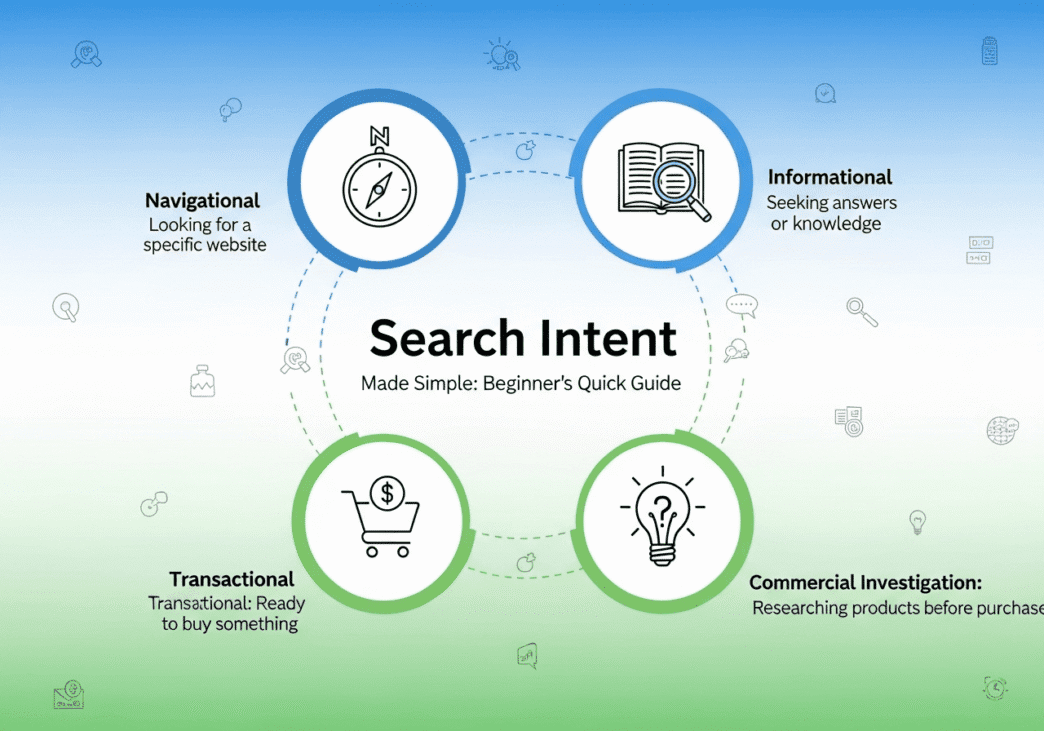
Search intent is the specific goal behind a search query. Google classifies queries into four types: informational (the user wants to learn), navigational (the user wants to reach a specific site), commercial (the user is comparing options before buying), and transactional (the user is ready to act). The fastest way to identify intent for any keyword is to search it in Google and read the format of the top three results — if they are guides, publish a guide; if they are comparison posts, publish a comparison post; if they are product pages, publish a product page. As of 2025, informational queries account for 52.65% of all searches, making intent matching essential for the majority of content decisions. (Source: Amra and Elma, 2025)
Marcus will appear again later. His story is not finished yet.
Table of Contents
ToggleWhat Are the Four Types of Search Intent?
Every search query fits one of four intent types. Each type tells you something different about what the person typing it actually wants — and what kind of content will satisfy them.
Informational Intent — the user wants to learn
The user is looking for an answer, an explanation, or a guide. They are not ready to buy. They are not heading to a specific website. They want to understand something.
Queries with informational intent often include: how, what, why, when, guide to, tutorial, tips for, examples of.
Examples: “how does compound interest work,” “what is search intent,” “why is my website not indexing.”
Google rewards this intent with: long-form guides, step-by-step tutorials, definition posts, FAQ content, and video walkthroughs.
The content mistake: Publishing a product page or a list of tools in response to an informational query. The user wanted to learn — you tried to sell them something before they were ready. High bounce rate follows every time.
Navigational Intent — the user wants to go somewhere specific
The user already knows where they want to go. They are using Google as a shortcut rather than typing a URL directly.
Queries with navigational intent include: brand names, product names, and phrases like “login” or “official site.”
Examples: “Google Search Console login,” “Ahrefs keyword explorer,” “NHS coronavirus guidance.
Google rewards this intent with: the brand’s own homepage, login page, or specific product page.
The practical implication for most sites: Do not target navigational queries for other brands. A small site cannot outrank Nike for “Nike running shoes” — that is a navigational query Nike owns. Targeting it wastes the content investment.
Commercial Intent — the user is comparing before buying
The user has decided they want something. They have not decided which version, which brand, or which price point. They are researching.
Queries with commercial intent often include: best, vs, review, top, comparison, alternative to, ranked.
Examples: “best project management tool for small teams,” “Ahrefs vs SEMrush,” “alternatives to Mailchimp.
Google rewards this intent with: comparison articles with named evaluation criteria, scored review posts, and “best of” roundups with a clear verdict.
The content mistake: Writing an educational explainer about what project management software does when the user already knows what it does and wants to know which one to choose. They need a verdict, not a definition.
Transactional Intent — the user is ready to act
The user has finished researching. They know what they want. They are ready to buy, sign up, download, or book.
Queries with transactional intent often include: buy, order, download, sign up, book, price, near me.
Examples: “buy Ahrefs subscription,” “book SEO audit,” “download Rank Math plugin free.
Google rewards this intent with: product pages, category pages, and landing pages with clear calls to action and trust signals.
The content mistake: Publishing a long guide against a transactional query. The user did not ask to be educated — they asked to take action. Anything that delays that action increases friction and reduces conversion.
How Do You Identify Intent for Any Keyword in 60 Seconds?
No tool is required. The method takes less than a minute and is more accurate than any automated intent classification.
- Open a private browser window — this removes personalisation from your results.
- Type the target keyword into Google exactly as a user would.
- Read the format of the top three results. Not the full articles — just the format and structure.
- Note what type of page Google is rewarding: guide, comparison post, product page, or brand homepage.
- Match your content format to what Google is already ranking.
That format is Google’s live assessment of what satisfies intent for that query. It updates continuously as user behaviour changes. Any keyword tool’s intent label is a historical approximation — the live SERP is always more accurate.
Pro Tip: Also read the People Also Ask boxes beneath the top results. Each PAA question is a sub-intent — a related question a proportion of users who searched the primary term also wanted answered. Including clear answers to those sub-intents in your content increases both depth of coverage and the probability of appearing in PAA boxes yourself.
| Intent typeSERP format signalWhat Google is showingContent to publish | |||
|---|---|---|---|
| Informational | Guides, tutorials, Wikipedia | Users want to learn | Step-by-step guide or explainer |
| Navigational | Brand homepages, login pages | Users want a destination | Your own brand page — don’t target others |
| Commercial | Comparison posts, review roundups | Users are evaluating | Scored comparison with named verdict |
| Transactional | Product pages, category pages | Users are ready to act | Landing page or product page with CTA |
| Mixed informational + commercial | Mix of guides and comparisons | Users are in early research | Hybrid: guide that leads into comparison |
| Local + transactional | Google Maps, local business pages | Users want something nearby | Local landing page with address, hours, CTA |
What Happens When Intent Shifts for the Same Keyword?
Search intent is not permanently fixed to a keyword. User behaviour shifts — and when it does, Google’s SERP format shifts to match.
A keyword classified as informational by a tool in 2023 may now produce commercial results because the majority of users who search that phrase have shifted from learning mode to buying mode.
In practice: We run quarterly SERP re-reads on every active keyword target for this reason. Posts that were correctly formatted at publication can drift into intent mismatch as Google’s assessment of the query updates. The signal to watch in Google Search Console: stable or growing impressions alongside declining CTR. This pattern means Google is still surfacing the page but users are passing it over — because the page’s format no longer matches what the SERP is rewarding.
The fix is a format update to the lead section and page structure, not a content rewrite from scratch.
What Most Guides Get Wrong About Search Intent for Beginners
Most beginner guides treat intent as a classification exercise — identify the type, then write content. The classification is only the first step.
The operational skill is reading the SERP and extracting the specific format signals that distinguish pages ranking in positions 1–3 from pages ranking in positions 8–15. Both groups may have correctly identified the intent type. The gap is execution — heading structure, opening format, presence or absence of a verdict, depth of sub-intent coverage.
The second mistake is publishing the right content type for the wrong intent at the wrong moment in the user journey. A comparison post published against an informational query fails. A guide published against a commercial query fails. Even experienced practitioners make this error when they rely on tool classifications rather than live SERP reading.
Marcus went back to his accounting software article. He searched his keyword. He read the format of the top three results. He restructured his piece: led with a scored comparison table, named a clear winner in the second paragraph, added pricing and pros/cons for each tool, and removed the explanatory background section that every ranking competitor had omitted.
He published the updated version in the second week of a month. By the end of the following month, it was ranking in positions 4–7.
The content quality had not changed. The intent alignment had.
Frequently Asked Questions
How is search intent different from keyword research?
Search intent and keyword research answer different questions. Keyword research tells you how many people search a phrase and how competitive it is to rank for. Intent analysis tells you what those people actually want when they search it — and therefore what content format Google will reward. You need both: keyword research to confirm demand exists, intent analysis to determine how to satisfy that demand. Running keyword research without intent analysis produces pages targeting the right phrase with the wrong format. Running intent analysis without keyword research produces content that addresses genuine needs nobody searches for.
Can a single page satisfy more than one intent type?
Yes, when the intents are adjacent in the user journey. A page can satisfy both informational and commercial intent when the user is in early research mode — they want to understand the topic and start comparing options simultaneously. A page cannot effectively satisfy informational and transactional intent at the same time. Those formats are structurally incompatible: a guide and a product page serve different user states and require different opening structures, depth levels, and calls to action. Trying to merge them produces a page that partially satisfies both intents and fully satisfies neither.
Do I need a paid tool to identify search intent?
No. The live SERP — available to anyone with a browser — is the most accurate intent signal available and costs nothing. Type the keyword into Google in a private window and read the format of the top three results. That reading takes 60 seconds and is more current than any tool’s intent label, which reflects historical data rather than live user behaviour. Paid tools are useful for keyword discovery, volume data, and difficulty scoring — but intent identification from SERP reading requires no subscription.
How often does search intent change for a keyword?
Meaningful intent shifts for established keywords happen roughly quarterly, often correlated with Google core updates. Between updates, individual keyword SERPs are relatively stable. Seasonal keywords shift more frequently — “best gifts” carries different intent in November than in March. The practical maintenance schedule: re-read the SERP for every page generating more than 200 monthly impressions once per quarter, and update the content format if the dominant SERP type has changed. This quarterly check prevents intent drift from quietly eroding rankings earned at publication.
What is the fastest improvement a beginner can make using intent analysis?
Check the five highest-traffic pages on your site against their target keywords using the live SERP method. For each page, confirm whether the format matches the dominant SERP format. If any mismatch exists — a guide where comparisons rank, a product page where guides rank — restructure the lead section and page format to match. This targeted intent correction to existing pages produces ranking movement within four to eight weeks for most sites, faster than publishing any new content. You are not improving the content quality; you are correcting the format signal Google is using to evaluate the page.
Why do informational pages sometimes rank for commercial keywords?
This happens when the query has split intent — a proportion of users want to learn and a proportion want to compare. Google surfaces a mix of guides and comparison posts to serve both segments. Informational pages can rank for commercial keywords when they address the evaluation question comprehensively — explaining what criteria matter in the decision, even without making an explicit product recommendation. The reverse is less common: commercial comparison posts rarely rank for purely informational queries because the format signals the wrong user state. When a query shows mixed SERP results, a hybrid format — guide that leads into a comparison — typically outperforms either format alone.
Conclusion
Search intent is not a content theory — it is a practical formatting decision that precedes every piece of content you publish.
The process is simple: search the keyword, read the top three results, match the format, then write. That sequence produces pages that rank. The reverse sequence — write first, check rankings later — produces pages that do not, regardless of quality.
Specific next step: Pick the single piece of content you most want to rank this month. Search its target keyword in a private browser right now. Read the format of the top three results. If your planned or existing format does not match what those three pages are doing, change the format before publishing or update it before the end of April 2026. That one change, on that one page, is the highest-return action available to you this week.
Citations
[1]. Amra and Elma — Top Search Intent Statistics 2025. https://www.amraandelma.com/search-intent-statistics/
[2]. Yoast — What is Search Intent? https://yoast.com/search-intent/
[3]. WP SEO AI — What Are the 4 Types of Search Intent? https://wpseoai.com/blog/what-are-the-4-types-of-search-intent/
[4]. Semrush — 4 Types of Keywords: A Beginner’s Guide. https://www.semrush.com/blog/types-of-keywords-commercial-informational-navigational-transactional/
[5]. Google — Search Quality Rater Guidelines 2024. https://static.googleusercontent.com/media/guidelines.raterhub.com/en//searchqualityevaluatorguidelines.pdf
[6]. Surfer SEO — Ranking Factors in 2025: Insights from 1 Million SERPs. https://surferseo.com/blog/ranking-factors-study/
[7]. seoClarity — Impact of Google’s AI Overviews: SEO Research Study. https://www.seoclarity.net/research/ai-overviews-impact