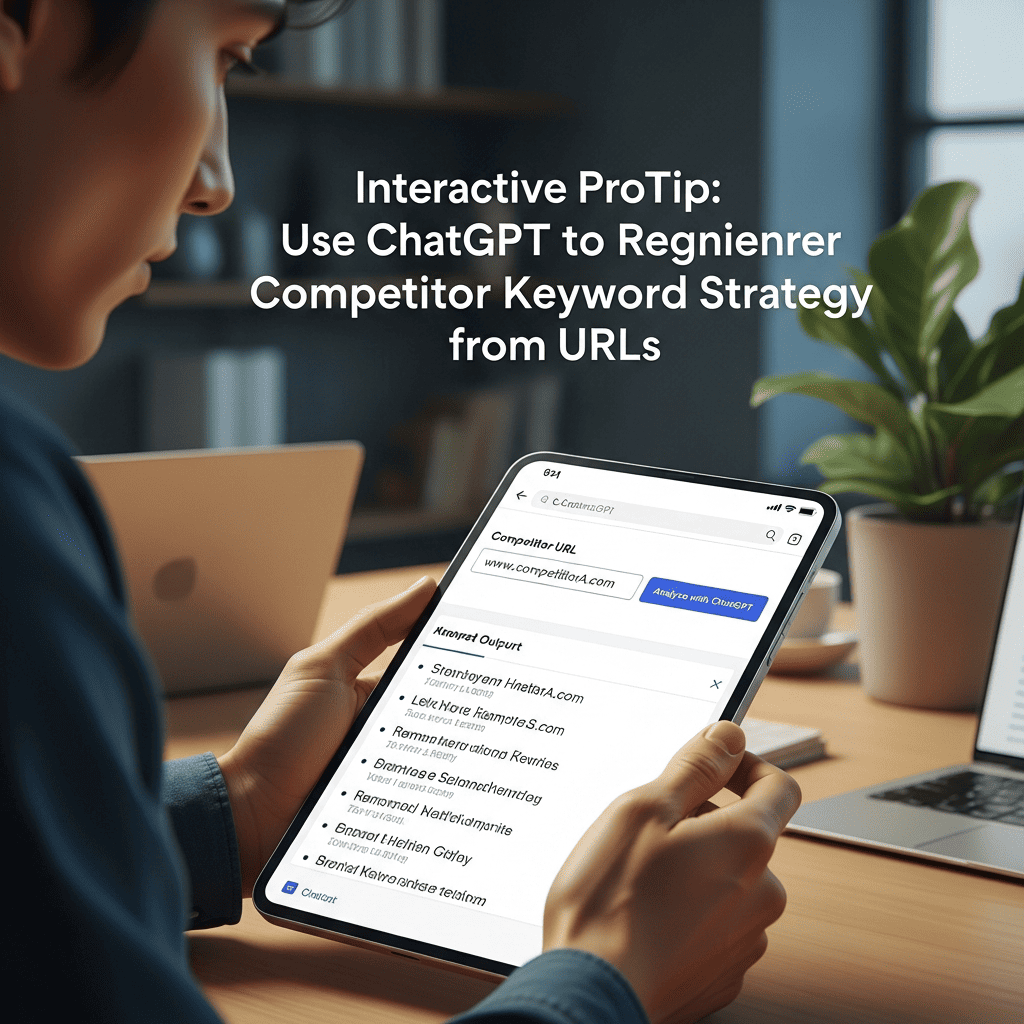
Use ChatGPT to Reverse-Engineer Competitor Keyword Strategy from URLs
Extract competitor keywords, content structure, and ranking strategies directly from their URLs using ChatGPT—bypassing expensive SEO tools for rapid competitive intelligence
The Competitive Intelligence Advantage
Reverse engineering competitor keyword strategy means analyzing what's already working instead of guessing what might work. Competitors who consistently outrank you have discovered successful formulas—keyword targets, content structures, semantic relationships—that you can identify and improve upon.
What you can extract from competitor URLs: Primary and secondary target keywords, semantic keyword variations, content structure and H2/H3 hierarchy, word count and content depth, internal linking patterns, user intent signals, topic coverage breadth, and content format approach.
Sources: eLearning Industry, Frase.io Competitor Analysis Guide 2025
ChatGPT vs Traditional SEO Tools
Traditional tools (Ahrefs, Semrush, Moz):
- Strengths: Access to massive keyword databases, accurate search volume data, historical ranking tracking, comprehensive backlink analysis, competitor traffic estimates
- Limitations: Expensive monthly subscriptions ($99-$999+), steeper learning curve, data overload requiring manual interpretation, focused on metrics over strategic insights
ChatGPT approach:
- Strengths: Free or low-cost (\$20/month for Plus), instant strategic analysis of content, extracts semantic relationships and keyword patterns, provides actionable recommendations, no learning curve, conversational interface
- Limitations: No search volume data, no historical tracking, requires URL content to be provided, analysis depends on quality of prompts
Best practice: Use ChatGPT for rapid content and keyword extraction from competitor pages, then validate high-priority keywords with free tools like Google Keyword Planner or Ubersuggest for volume data.
Sources: SEO.AI ChatGPT Guide, SEO for Journalism Analysis Methods
Identify Top Competitors
Search your primary keywords on Google. URLs consistently appearing in top 5-10 positions are your SEO competitors—may differ from business competitors.
Copy Page Content
Open competitor page, select all text (Ctrl+A or Cmd+A), copy entire content including headings, body text, and visible elements. Paste into text file.
ChatGPT Extraction
Paste content into ChatGPT with keyword extraction prompt. AI analyzes semantic patterns, identifies primary/secondary keywords, and reveals content strategy.
Strategic Analysis
Use follow-up prompts to analyze content structure, identify gaps in competitor coverage, and generate improvement recommendations for your content.
Validation & Execution
Validate extracted keywords with free volume tools, prioritize based on relevance and opportunity, create superior content addressing gaps identified.
Scale Analysis
Repeat process for top 3-5 competitors per keyword. Compare strategies, identify patterns across multiple competitors, synthesize unified approach.
Prompt 1: Keyword Extraction
Sources: SEO.AI Extraction Methods, eLearning Industry Strategy
Prompt 2: Content Structure Analysis
Sources: Frase.io Content Analysis Framework, SERPrecon Strategy
Synthesizing Multiple Competitors
Sources: Flow Ninja Reverse Engineering, Backlinko Competitor Analysis
Beyond Keywords: Strategic Elements
Content Angle Analysis:
Sources: Upward Impact SEO Intelligence, Single Grain AI Analysis
URL Pattern Analysis
Sources: SEO for Journalism URL Analysis, Apto Digital Strategy
From Analysis to Action
Step 1: Organize Extracted Intelligence
- Create competitor keyword database: Spreadsheet with columns for keyword, search intent, competitor rank, content type, opportunity score
- Document content patterns: Note structural elements used by 2+ competitors as "best practices to match"
- Identify quick wins: Keywords where competitors rank with thin content—opportunity for superior content
- Map content gaps: List topics competitors miss that users likely search for
Step 2: Validate Keywords with Free Tools
- Google Keyword Planner: Free search volume estimates for extracted keywords
- Google Search Console: If you have existing content, see which competitor keywords you already rank for positions 11-50
- Ubersuggest (free tier): Limited free searches per day for volume and difficulty
- Answer the Public: Free question-based keyword expansion
- Google autocomplete: Manual but free—type keywords to see suggested variations
Step 3: Create Superior Content
- Match proven elements: Use structural patterns and keyword coverage that works for 2+ competitors
- Increase depth: If competitor average is 2,000 words, write 2,500-3,000 with more detail
- Fill gaps: Address subtopics all competitors miss for comprehensiveness advantage
- Add unique value: Include original data, expert insights, visual aids, or tools competitors lack
- Optimize user experience: Better formatting, clearer explanations, more scannable structure
- Update with freshness: Include 2025 data, recent examples, current best practices
Sources: SpyFu Reverse Engineering, Hir Infotech Competitive Analysis
Reverse Engineering Ethics
What's ethical:
- Analyzing publicly visible content: If it's indexed by Google, it's public information
- Extracting keyword patterns and strategies: Learning from competitors is standard business practice
- Identifying content gaps and opportunities: Market research to serve users better
- Creating better content based on insights: Competition drives quality improvement
What's NOT ethical:
- Copying content verbatim: Plagiarism violates copyright and Google penalizes duplicate content
- Scraping proprietary data behind logins: Violates terms of service and potentially laws
- Republishing competitor's unique research/data: Respect intellectual property
- Negative SEO tactics: Never try to harm competitors—focus on making your content better
ChatGPT limitations to know:
- No search volume data: Can't tell you monthly searches—must validate elsewhere
- No ranking verification: Can't confirm what position competitor holds—check SERPs manually
- Content length limits: Very long pages may need to be analyzed in sections
- No historical data: Can't show how strategy evolved—only analyzes current state
- Interpretation quality depends on prompts: Better prompts = better insights
Sources: Upward Impact Ethics, Frase.io Best Practices
Use ChatGPT to reverse-engineer competitor keyword strategies from URLs in minutes. Extract target keywords, content structure, and strategic insights—learning from proven success to create superior ranking content without expensive SEO tools.
Data Sources: Frase.io, eLearning Industry, SERPrecon, Backlinko, Flow Ninja, Upward Impact, Single Grain, SpyFu, SEO.AI, SEO for Journalism, Apto Digital, Hir Infotech—2025