


Last updated: April 2026 | Sources reviewed: 7
Most SEO practitioners can export a competitor’s keyword list in three minutes. The export is not the problem.
The problem is the 4,000-row spreadsheet that follows — unsorted, unfiltered, and full of keywords that have nothing to do with what you actually need to rank for this quarter.
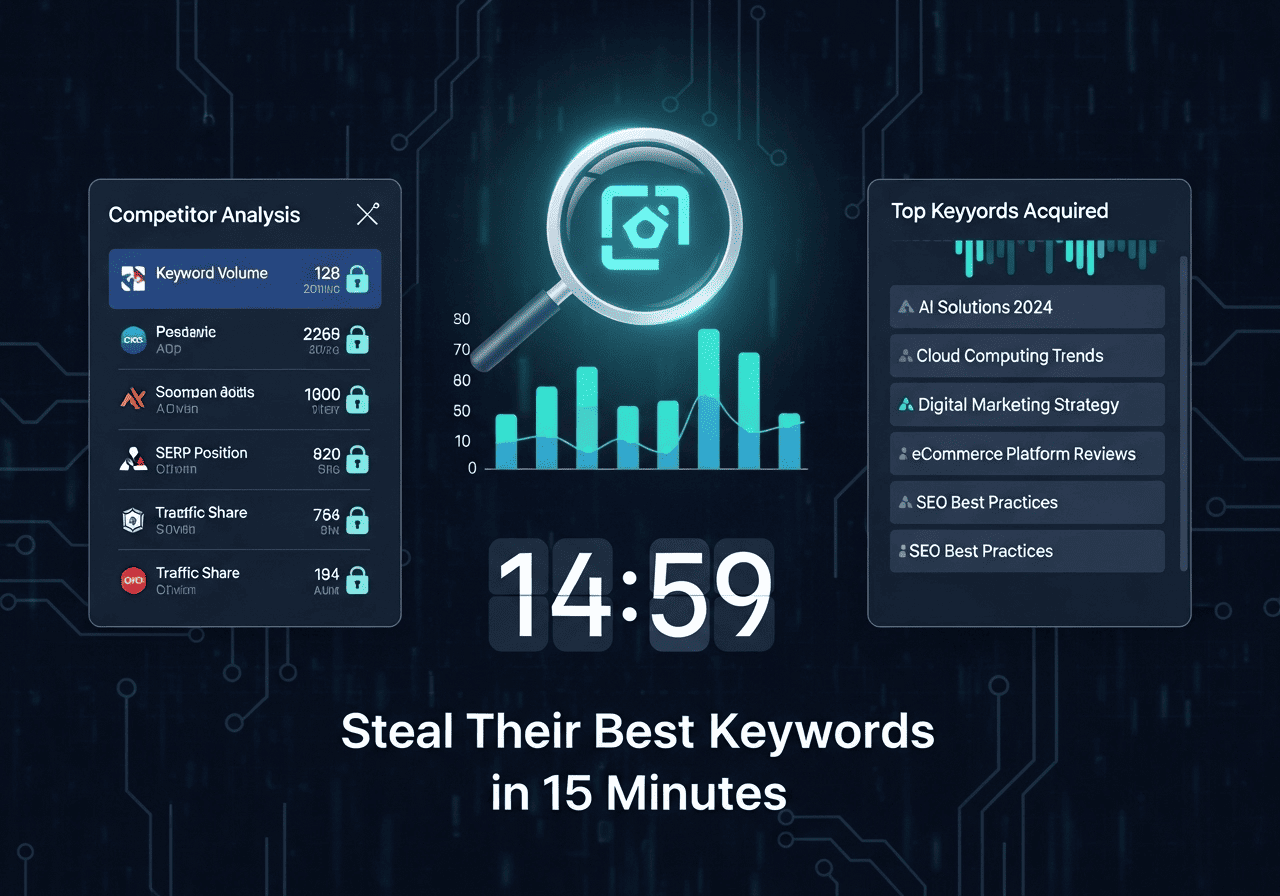
Competitor keyword analysis only produces results when the extraction process ends with a prioritised shortlist, not a data dump. This article documents the four-stage process that gets from a competitor domain to ten actionable keyword targets in under twenty minutes.
Quick Answer
Competitor keyword analysis identifies keywords your competitors rank for that you either do not rank for at all (“missing”) or rank poorly for compared to them (“weak”). The fastest method uses Ahrefs Content Gap or SEMrush Keyword Gap filtered to three to five direct SERP competitors simultaneously — not marketplace competitors. The output requires three filters before it becomes actionable: keyword difficulty below your domain’s realistic ceiling, clear commercial or transactional intent alignment, and a traffic value that justifies content production cost. Skipping any one of these filters produces a list that looks like insight but produces no rankings. The full process takes fifteen to twenty minutes per competitor set.
Table of Contents
ToggleStage 1: Identifying the Right Competitors to Analyse
The most common mistake in competitor keyword analysis is analysing marketplace competitors rather than SERP competitors.
A marketplace competitor sells the same product. A SERP competitor ranks for the same keywords. These are frequently different websites — and only the SERP competitor’s keyword data is useful for this process.
In practice: When we ran a gap analysis for a B2B SaaS client, their instinct was to analyse the three companies they considered direct business rivals. Two of those companies had domain ratings above 80 and keyword portfolios built over a decade. None of their keywords were realistically achievable for a DR 38 domain. The two SERP competitors we identified through Ahrefs’ Competing Domains report — a specialist blog and a comparison site — had overlapping keyword sets at KD 15–35. That is where the actionable gap existed.
The correct identification method:
- Enter your domain into Ahrefs Site Explorer → Competing Domains, or SEMrush Organic Research → Competitors tab
- Sort by “Common keywords” — highest overlap appears first
- Select three to five domains with similar or slightly higher domain authority to your own
- Exclude publishing giants and aggregators unless your domain already competes at that level
Pro Tip: SERP competitors change as your content portfolio grows. Re-run this identification step quarterly — the domains overlapping with your keyword set shift as you publish into new clusters.
Stage 2: Running the Gap Analysis and Filtering the Output
The raw output of a keyword gap analysis is not a keyword list. It is a data set that requires three mandatory filters before it becomes usable.
Running the gap:
In Ahrefs: Site Explorer → your domain → Content Gap → enter three to five competitor domains → Show keywords → filter to “Missing” (keywords you do not rank for in the top 100).
In SEMrush: Keyword Gap → enter your domain and up to four competitor domains → filter by “Missing” → sort by keyword volume.
The raw export will contain hundreds or thousands of rows. Apply these three filters in sequence:
| Filter | Parameter | Rationale |
|---|---|---|
| Keyword difficulty | Below your domain’s realistic ceiling (DR ÷ 2 as a starting rule) | Removes keywords you cannot rank for regardless of content quality |
| Monthly search volume | 100 minimum, 10,000 maximum for new targets | Removes zero-opportunity and hyper-competitive terms |
| Intent alignment | Commercial or transactional only for revenue targets; informational for cluster build | Removes keywords that cannot convert or support your pillar architecture |
| Competitor ranking position | Competitor ranks 1–10 | Confirms the keyword drives real traffic; avoids targeting terms competitors barely rank for |
| Traffic value (CPC × volume) | Sort descending | Surfaces keywords where ranking has highest commercial impact |
| Business relevance | Manual review | Removes keywords that match intent but fall outside your product or service scope |
What most guides get wrong here: They recommend filtering by volume and difficulty alone. A keyword with volume 2,000 and KD 25 that targets an audience segment you do not serve is worth nothing. Business relevance is a manual filter — no tool applies it automatically.
In practice: After applying these filters to a competitor gap export for an e-commerce client in Q1 2026, a 3,400-row export reduced to 47 viable targets. Those 47 keywords produced a content plan for the following quarter. The other 3,353 rows were correctly excluded.
Stage 3: Identifying High-Value Weak Keywords Worth Re-targeting
Missing” keywords — terms you do not rank for at all — get most of the attention in competitor analysis. Weak” keywords — terms you rank for but your competitor outranks you — represent faster ranking wins.
A weak keyword means Google already associates your domain with the topic. The page exists. The signal exists. The gap is execution, not authority.
The weak keyword extraction:
In Ahrefs Content Gap: change the filter from “Missing” to “At least one of the below targets” and set your domain as one of the comparison targets → filter for positions 11–30 on your domain.
In SEMrush Keyword Gap: select “Weak” from the filter options rather than “Missing.”
Apply the same three filters from Stage 2. Then add a fourth:
Ranking volatility filter: Check the keyword’s position history in Ahrefs or SEMrush. If the position has fluctuated between 8 and 25 over the past 90 days, Google is actively re-evaluating which page to rank. A content update timed to that volatility window produces faster ranking movement than a stable keyword does.
Pro Tip: Weak keywords with a competitor ranking in positions 4–7 while you sit at positions 12–18 are the single highest-ROI update targets available. Your page already has topical authority — it needs structural improvement to the lead section, intent alignment, and internal link volume. No new content required.
Stage 4: Converting the Shortlist into a Content Decision
A prioritised keyword list is not a content plan. Each keyword requires one of three decisions before it enters a content schedule.
Decision 1: Create a new page
Apply when the keyword has no matching page on your site. Build a brief against the keyword’s SERP format — check the top three ranking pages for format (list, guide, comparison, tool page) and match it. Do not create content in a format the SERP does not reward.
Decision 2: Update an existing page
Apply when the keyword maps to a page that ranks in positions 11–30. The update should target the lead section first: rewrite the opening 150 words to answer the query directly, ensure the primary keyword appears in the H1 and first paragraph, and add any sub-intent sections identified through People Also Ask chain analysis for that query.
Decision 3: Internal link reinforcement
Apply when a relevant page exists and ranks in positions 6–15, but receives fewer than three internal links from topically related pages. Add contextual internal links from cluster pages using the target keyword as anchor text. This is the lowest-effort improvement available and frequently produces a three to seven position gain within four to eight weeks.
| Keyword state | Recommended action | Expected timeframe |
|---|---|---|
| Missing, KD 0–20, informational | New cluster post | 6–10 weeks to rank |
| Missing, KD 20–35, commercial | New pillar-supported cluster post | 10–16 weeks |
| Weak, position 11–20, commercial | Lead section rewrite + internal links | 4–8 weeks |
| Weak, position 21–30, informational | Full content update + FAQ schema | 8–12 weeks |
| Weak, position 6–10, any intent | Internal link reinforcement only | 2–5 weeks |
| Missing, KD 35+, competitive | Flag for pillar build; defer until DR increases | 6–12+ months |
What Most Articles Get Wrong About Competitor Keyword Analysis
The dominant framing in guides is that competitor keyword analysis is a one-time research phase that feeds a content calendar.
It is not. It is a recurring signal source that reflects how your competitive landscape shifts month by month.
A keyword your competitor ranked for in January 2026 may have lost ranking by April 2026 — either to algorithm changes, content decay, or a third competitor entering. Targeting that keyword in May 2026 based on a January export means chasing data that no longer reflects the actual SERP.
The correct cadence: full gap analysis quarterly, weak keyword review monthly using GSC data cross-referenced against live SERP checks. Tools automate the data pull — the strategic evaluation must happen at the frequency the market moves, not the frequency that is convenient.
The second error: prioritising keywords where the competitor ranks at position one with a domain rating of 85. That is an observation, not an opportunity. The actionable opportunities are where the top three positions are held by domains within ten to fifteen rating points of your own — meaning the competitive gap is closeable with content quality rather than requiring multi-year authority building.
Frequently Asked Questions
How many competitors should I include in a keyword gap analysis?
Three to five competitors produces the most useful output. Below three, the keyword set is too narrow and misses opportunities. Above five, the intersection of “missing” keywords becomes diluted with terms that are relevant to one competitor’s niche but not yours. For most sites, three SERP competitors identified through the Competing Domains report — filtered by common keyword overlap — produces a gap of 200 to 800 keywords before intent and difficulty filtering. After filtering, expect 30 to 80 actionable targets per analysis run.
Can competitor keyword analysis work without a paid SEO tool?
To a limited degree. Google Search Console shows your own performance data but not competitors’ keyword rankings. The most useful free combination is Google’s “site:” search operator to catalogue competitor content, paired with Google Keyword Planner for volume estimates on manually identified terms. Ahrefs Webmaster Tools (free) provides your own keyword data but not competitor gap analysis. For a one-time analysis, using SEMrush’s free trial to run a gap report and export before the trial period ends is a practical option noted by several practitioners.
How do I filter out irrelevant keywords from a competitor gap export?
Apply filters in this sequence: keyword difficulty threshold first (removes unachievable targets), search volume floor second (removes zero-opportunity terms), then intent filter (commercial or transactional for revenue-driving content, informational for cluster authority building). The final filter — business relevance — is manual. Spend ten minutes reviewing the filtered list and remove any keywords that relate to the competitor’s product scope rather than your own. This last step has no automation shortcut and is where most practitioners produce waste by skipping it.
How does AI change competitor keyword analysis in 2026?
AI-powered tools now surface semantic intent clusters rather than individual keyword lists, which reduces the manual clustering step. SEMrush’s AI-assisted gap analysis and Ahrefs’ content gap with intent filtering both produce grouped outputs rather than flat keyword lists. The more significant AI application is LLM fan-out analysis — identifying the sub-queries AI systems generate from competitor ranking pages. A competitor’s page ranking for “best CRM for small business” may surface in AI Overviews because it addresses five specific sub-intents. Identifying those sub-intents and building them into your own competing page increases both ranking probability and AI citation likelihood simultaneously.
What is the difference between “missing” and “weak” keywords, and which should I prioritise?
Missing keywords are terms where you have no page in the top 100 results. Weak keywords are terms where you rank but underperform competitors. Weak keywords almost always produce faster results because the ranking signal already exists — Google associates your domain with the topic. A weak keyword at position 14 requires a content update; a missing keyword at the same difficulty requires a new page, internal link structure, and a six to twelve week indexation and ranking period. Prioritise weak keywords for the current quarter’s content updates and missing keywords for the following quarter’s new content plan.
How often does a competitor’s keyword portfolio change significantly?
Meaningful shifts occur after Google core updates, which deploy roughly every three to four months. Between updates, individual keywords fluctuate but the overall competitive landscape is relatively stable. The practical implication: run a full gap analysis within two weeks of any confirmed Google core update completion, when the dust has settled and new ranking positions have stabilised. Mid-cycle analysis is most useful for monitoring specific keywords you are actively targeting, rather than re-running the full gap analysis from scratch.
Conclusion
Competitor keyword analysis is not a discovery exercise — it is a prioritisation framework. The keywords worth pursuing already exist in your competitors’ ranking data; the process surfaces which of them are achievable for your domain, align with your content strategy, and represent the fastest path to new traffic.
The four-stage process — SERP competitor identification, gap extraction with three-filter validation, weak keyword isolation, and content decision mapping — converts a raw export into a twelve-week action plan in under twenty minutes.
Specific next step: Run the Competing Domains report in Ahrefs or SEMrush’s Competitors tab for your domain this week. Select your three closest SERP competitors by keyword overlap. Run the Content Gap filtered to “Missing” with KD capped at your domain rating divided by two. Export, apply the intent filter, and identify your top ten targets by traffic value before the end of April 2026. That list is your Q2 content brief.
Citations
[1]. SEO Sherpa — Competitor Keyword Research: The Complete Beginners Guide. https://seosherpa.com/competitor-keyword-research/
[2]. HubSpot — What is Competitor Keyword Analysis? 6 Best Tools for the Job. https://blog.hubspot.com/website/10-best-online-tools-spying-competitors-traffic
[3]. Answer Socrates — Keyword Gap Analysis: Steal Your Competitors’ Best Keywords. https://answersocrates.com/blog/keyword-gap-analysis/
[4]. iBeam Consulting — SEO and Stealing Your Competitor’s Keywords. https://www.ibeamconsulting.com/blog/seo-stealing-competitor-keywords/