



Publishing volume is the most persistent wrong assumption in content strategy — and it is costing sites the topical authority they are working to build.
The logic seems reasonable on the surface: more content means more keywords covered, more pages indexed, more signals sent to Google. That reasoning describes how search engines worked in 2012. It does not describe how Google evaluates topical authority in 2026.
Google does not count your posts. It evaluates whether your content collectively covers the conceptual territory of a topic with enough depth and coherence to constitute genuine expertise. A site publishing 100 posts that circle the same keyword angles with slight variations sends a weaker topical authority signal than a site publishing 12 posts that each develop a distinct concept area of the same topic at practitioner depth.
The mechanism is concept coverage — not content count. And until content teams understand that mechanism, they will keep producing volume that fails to move the needle on the signal that actually determines whether their topical authority strategy earns rankings.
Post Summary
- Google’s topical authority evaluation is a concept-coverage test, not a content-count test — frequency of publishing does not substitute for semantic completeness
- Publishing multiple posts on the same concept angle dilutes topical signal by adding index weight without adding concept coverage
- The three signals that actually build topical authority are concept completeness, semantic coherence, and entity consistency — none of which scale with publishing volume alone
- A 10-post cluster with full concept coverage outperforms a 100-post archive with overlapping angles on the same sub-topics — this is documented and consistent
- The internal case for slowing volume and deepening coverage requires a mechanism argument, not a quality preference argument — this post gives you that mechanism
- Pausing new content to audit and consolidate an existing archive often produces faster topical authority gains than continuing to publish
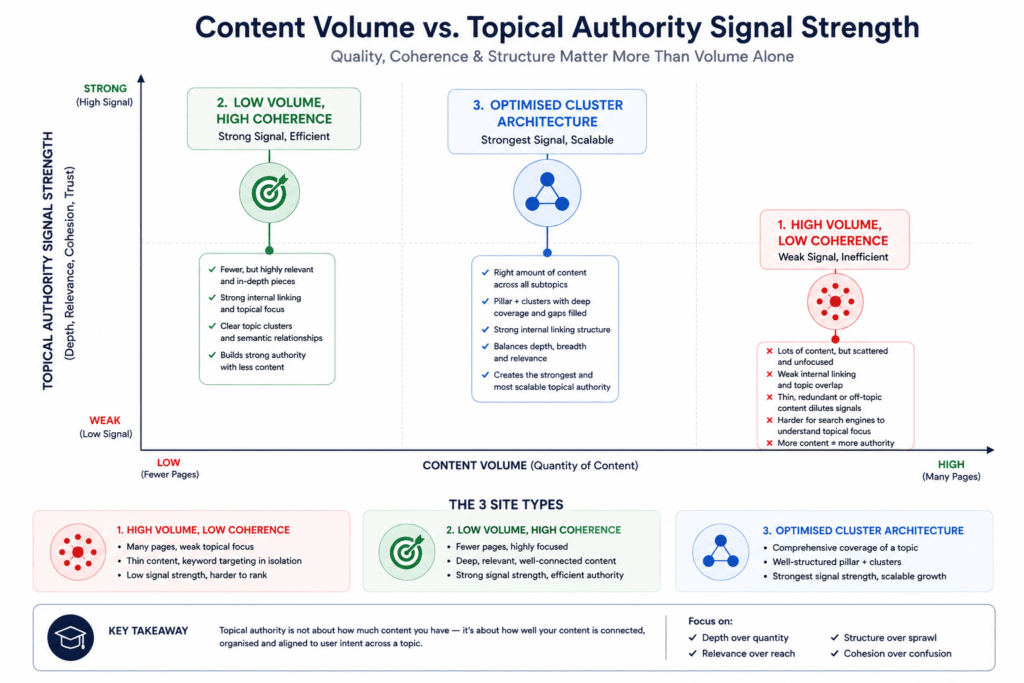
Table of Contents
ToggleThe Mechanism Google Uses — and Why Volume Misses It
To understand why volume fails, you need to understand what Google is actually evaluating when it assesses topical authority.
Google’s systems — including BERT and its successor language models — do not count posts. They map semantic relationships. When Google crawls your content cluster, it is building a picture of which conceptual sub-topics your site covers, how deeply each sub-topic is developed, whether the same entities and concepts are referenced consistently across posts, and whether the internal linking structure confirms that these posts belong to the same semantic cluster. (Source: Google Search Central, 2024)
That evaluation has a ceiling and a floor per concept area. A concept area reaches its ceiling when it has been developed at practitioner depth in at least one dedicated post — additional posts on the same concept angle do not raise the ceiling. They add index weight without adding semantic signal. Below the floor, a concept area is either absent from your content library or present only in passing mentions — and Google cannot confirm your expertise there regardless of how many posts you have published on adjacent angles.
Publishing volume pushes you toward the ceiling on a small number of concept areas while leaving the floor unaddressed on others. Topical authority requires covering the full concept map — floor to ceiling across every sub-topic — not ceiling-level coverage on a fraction of it.
Every post you publish on a concept area you have already covered at depth is a post you did not publish on a concept area you have not yet covered at all.
What Happens When You Publish More of the Same
The publishing velocity model produces a specific, diagnosable failure pattern. Most content teams experiencing it do not recognise the cause.
The pattern: a site publishes 40, 60, or 80 posts on a topic over 12 to 18 months. Traffic grows initially — new posts capture long-tail queries, expand the site’s keyword footprint, and generate some ranking positions. Then growth plateaus. New posts rank briefly, lose position, or never rank meaningfully. The team responds by publishing more. The plateau continues.
What is happening beneath the surface: the early posts covered the topic’s highest-volume concept areas. Subsequent posts repeat those same concept areas with slight keyword variations — different titles, similar content. Google’s systems identify these posts as covering the same semantic ground as existing content. They do not add concept coverage. They add competition within the site’s own index — creating internal keyword cannibalisation that weakens the authority of the original posts rather than building on them. (Source: Ahrefs, 2024)
The plateau is not a publishing frequency problem. It is a concept coverage problem. The site has reached the ceiling on a subset of its topic’s concept areas while leaving large sections of the concept map uncovered. Publishing more does not fix that — it deepens the imbalance.
The fix is a content audit, not a content calendar.
The Three Signals That Actually Build Topical Authority
Volume is not one of the three signals Google uses to evaluate topical authority. Understanding what those signals actually are is the prerequisite for fixing a stalled content programme.
Signal 1 — Concept completeness. Does your content library cover the full conceptual territory of the topic? This is evaluated across the topic’s concept map — every sub-topic area, every operational question, every foundational concept. A topic with 12 distinct concept areas requires at least 12 posts developing each area at practitioner depth. A topic with 20 distinct concept areas requires 20. Publishing 40 posts on 8 concept areas does not achieve concept completeness. Publishing 20 posts across 20 concept areas does. (Source: Google Search Central, 2024)
Signal 2 — Semantic coherence. Are the posts in your cluster linked semantically — to a parent pillar, to sibling clusters on related sub-topics — with anchor text that communicates the conceptual relationship between them? Semantic coherence is what tells Google that these posts belong to the same expertise cluster, not just to the same site. A high-volume archive with poor internal linking has low semantic coherence regardless of how many posts it contains.
Signal 3 — Entity consistency. Are the named entities — tools, organisations, frameworks, methodologies — referenced with consistent terminology across every post in the cluster? Entity consistency is the signal most damaged by high-volume publishing, because volume typically requires multiple writers or content templates that introduce naming inconsistencies across the archive. Google maps entity relationships through co-occurrence patterns — inconsistent naming fragments those patterns.
Publishing more content does not inherently improve any of these three signals. Improving each one requires specific editorial actions: concept mapping for completeness, link architecture review for coherence, entity audit for consistency.
Why Consolidation Outperforms New Publishing at the Plateau Stage
When a content programme has plateaued after a high-volume phase, the fastest topical authority gains almost always come from consolidating existing content — not from publishing more.
Consolidation means identifying posts that cover the same concept area without either one developing it at depth, merging the best material from both into a single stronger post, and redirecting the weaker post. The result is one post that now develops the concept area at practitioner depth — raising the concept ceiling — rather than two posts that competed against each other without clearing it.
The lightweight case study: A health and wellness publisher had built a 90-post archive on nutrition topics over 24 months. Organic traffic had plateaued at month 18 despite a consistent two-posts-per-week publishing schedule. An SEO audit revealed 34 posts covering only 9 distinct concept areas — an average of nearly 4 posts per concept, none of which had developed any single concept at the depth required for topical authority. Sixteen concept areas on the topic map had no dedicated coverage at all. We paused new publishing for 6 weeks. The team consolidated 34 posts into 9 stronger posts, redirected the merged URLs, and published 6 new posts covering 6 of the 16 uncovered concept areas. Within 10 weeks of the consolidation, organic sessions increased 28% and the cluster’s average ranking position improved from 14.2 to 8.7 across the topic’s primary keyword set. Friction: the client’s leadership team resisted pausing publishing because output volume was a KPI on their content programme dashboard. Replacing the volume KPI with a concept coverage percentage — tracking how many of the topic’s concept areas had practitioner-depth coverage — was the reporting change that unlocked the consolidation work.
Audit before you publish. Count concept areas covered at depth, not posts published. Those are different numbers, and the gap between them tells you more about your topical authority position than any traffic report.
How to Replace the Volume Model With a Concept Coverage Model
Shifting from a volume-based publishing programme to a concept-coverage programme requires three operational changes, not just a strategy memo.
Replace the content calendar with a concept map. The content calendar asks “when is the next post due?” The concept map asks “which concept area is not yet covered at practitioner depth?” These questions produce different briefs. A concept map-driven programme never publishes a post on a concept area that already has practitioner-depth coverage — it always publishes into an uncovered or under-covered area. Brief every new post against the concept map, not against a keyword list.
Replace post count with concept coverage percentage as the primary KPI. Track the number of concept areas in your topic map that have at least one post developed to practitioner depth, divided by the total number of concept areas in the map. A cluster covering 12 of 20 concept areas at depth has a 60% concept coverage score. Publishing a 13th post on an already-covered concept area does not move that score. Publishing a post on the 13th uncovered area moves it to 65%. That metric focuses publishing resource on gaps, not on output. (Source: Search Engine Journal, 2025)
Audit before briefing any new content. Run the concept map inventory from the coverage audit process before every content planning cycle. Identify which concept areas are at ceiling, which are below floor, and which are absent entirely. Brief only into the below-floor and absent areas. Pause publishing on ceiling-level concept areas until the concept map is more fully covered.
| Publishing Model | Primary KPI | Resource Focus | Topical Authority Outcome |
|---|---|---|---|
| Volume model | Posts published per month | Output frequency | Ceiling depth on few concept areas, floor gaps across many |
| Concept coverage model | Concept areas at practitioner depth | Concept map completion | Rising coverage across full topic map |
| Consolidation-first model | Coverage percentage post-audit | Gap closing and merge | Fastest short-term authority gain on plateau sites |
Pro Tip: Take your last 12 months of published posts and map each one to a concept area on your topic’s concept map. If any concept area has more than two posts mapped to it, you have a consolidation candidate — those posts are competing against each other for the same semantic ground. If any concept area has zero posts mapped to it, that is your next brief. Do this mapping exercise before your next content planning session. The output will reorder your entire priority list.
Frequently Asked Questions
Does publishing frequency affect topical authority?
Publishing frequency does not directly affect topical authority. Google’s topical authority evaluation assesses concept coverage and semantic coherence — neither of which scales with publishing frequency. A site publishing two posts per month into uncovered concept areas builds topical authority faster than a site publishing ten posts per month into already-covered areas. Frequency matters only insofar as it accelerates concept map completion — not as a signal in itself.
Why does a 10-post cluster sometimes outrank a 100-post archive?
A 10-post cluster covering 10 distinct concept areas at practitioner depth demonstrates complete, coherent topical expertise across the full concept map. A 100-post archive covering the same 10 concept areas with 10 posts each has ceiling-level depth on a subset of the topic’s concepts and floor-level or absent coverage on the rest. Google evaluates concept completeness and semantic coherence — not post count. The cluster wins on both dimensions despite the volume gap.
How do you know when you have published enough content on a topic?
You have published enough on a specific concept area when that area has at least one post developed to practitioner depth — meaning it answers the operational questions a practitioner actually needs, not just the definitional questions a beginner would ask. You have covered the topic sufficiently when every concept area in the topic’s concept map has reached that threshold. Map your content library against the concept map to assess where you are. Volume is not the measure — concept coverage percentage is.
What is the fastest way to improve topical authority on a plateau site?
Run a concept map inventory of your existing content library, identify consolidation candidates (multiple posts covering the same concept area without either reaching practitioner depth), and merge them into single stronger posts. Simultaneously, identify concept areas with no coverage and brief new posts into those gaps. This combined consolidation-and-gap-fill approach produces faster topical authority gains than continued new publishing on a site that has already plateaued, because it improves semantic coherence and concept completeness simultaneously.
Does Google penalise high-volume content publishing?
Google does not penalise volume directly. What volume creates is an internal cannibalisation problem — multiple posts competing for the same semantic ground — and a concept map imbalance, where some areas have excessive coverage while others have none. These conditions weaken topical authority signals without triggering a penalty. The damage is structural, not punitive, which is why it does not show up as a traffic drop but as a plateau that resists further improvement.
What to Do Next
The volume model is not a content strategy — it is a publishing schedule mistaken for one. Topical authority is built through concept completeness, semantic coherence, and entity consistency. None of those signals scales with post count.
If your content programme has plateaued, the next action is not another post. It is a concept map audit of what you have already published — counting concept areas covered at practitioner depth, identifying consolidation candidates, and locating the concept areas that have no coverage at all.
Do that audit before your next content planning cycle. Take the last 12 months of posts, map each one to a concept node, count the coverage gaps, and let that gap list drive your next brief — not a content calendar.
Return to the topical authority strategy and check your current cluster against the concept coverage model before publishing anything new.
References
Google Search Central. “How Search Works.” Google Developers, 2024. https://developers.google.com/search/docs/fundamentals/how-search-works Supports: Google’s systems evaluate semantic relationships and concept coverage across a content cluster — not post count or publishing frequency — when assessing topical authority.
Ahrefs. “Topical Authority: What It Is and How to Build It.” Ahrefs Blog, 2024. https://ahrefs.com/blog/topical-authority/ Supports: Publishing multiple posts on the same concept angle creates internal cannibalisation that weakens existing posts rather than building additional topical authority; concept completeness across the topic map is the operative signal.
Search Engine Journal. “Topical Authority: A Complete Guide for SEO.” Search Engine Journal, 2025. https://www.searchenginejournal.com/topical-authority/ Supports: Concept coverage percentage — the proportion of a topic’s concept areas developed to practitioner depth — is a more accurate proxy for topical authority than post count or publishing frequency.
Ahrefs. “Content Gap Analysis: How to Find and Fix Your Content Gaps.” Ahrefs Blog, 2024. https://ahrefs.com/blog/content-gap-analysis/ Supports: Consolidating overlapping posts into single stronger posts improves semantic coherence and concept depth simultaneously — producing faster topical authority gains on plateau sites than continued new publishing.
Google Search Central. “Creating Helpful, Reliable, People-First Content.” Google Developers, 2024. https://developers.google.com/search/docs/fundamentals/creating-helpful-content Supports: Google evaluates whether content demonstrates genuine expertise at depth on a topic — the Helpful Content guidance confirms that surface-level coverage across many angles is the failure mode volume-driven publishing creates.