




You have built the cluster architecture. The internal linking is coherent. The pillar post is live and the cluster posts go to practitioner depth. The content is well-cited and structured.
And the topical authority signal is still not consolidating at the level the architecture should produce.
This is not a hypothetical scenario. It is one of the most consistent findings in advanced topical authority audits — a cluster that looks structurally sound but underperforms because one signal layer is missing entirely. Not content volume. Not link architecture. Entity consistency — the degree to which the same named entities appear, are correctly disambiguated, and are referenced with stable terminology across every post in the cluster.
Entity consistency is the signal most topical authority guides do not cover at the implementation level. This cluster covers it at the level an advanced practitioner needs: what it is, why it matters mechanically, how to audit it, and how to fix the specific failure patterns that suppress the authority signal a well-built cluster should already be producing. The full topical authority strategy depends on this layer working correctly.
Post Summary
- Entity consistency is the degree to which named entities — tools, organisations, frameworks, platforms — are referenced with stable, unambiguous terminology across every post in a cluster
- Google’s Knowledge Graph maps entity relationships through co-occurrence patterns in training and indexed data — inconsistent naming fragments those patterns and weakens topical signal consolidation
- The May 2024 Google Content Warehouse API Leak confirmed that siteFocusScore and siteRadius are algorithmically measured at the site level — entity inconsistency directly degrades both metrics
- Three specific failure patterns account for the majority of entity consistency problems in cluster posts: naming drift, disambiguation gaps, and entity relationship vagueness
- An entity consistency audit on a 10-post cluster takes 2–3 hours and produces a standardisation list that, once applied, measurably improves topical authority signal consolidation within 4–6 weeks of re-crawl
- This signal is absent from most topical authority frameworks because it is invisible to standard SEO tool audits — keyword gap tools, ranking trackers, and crawl tools do not surface it
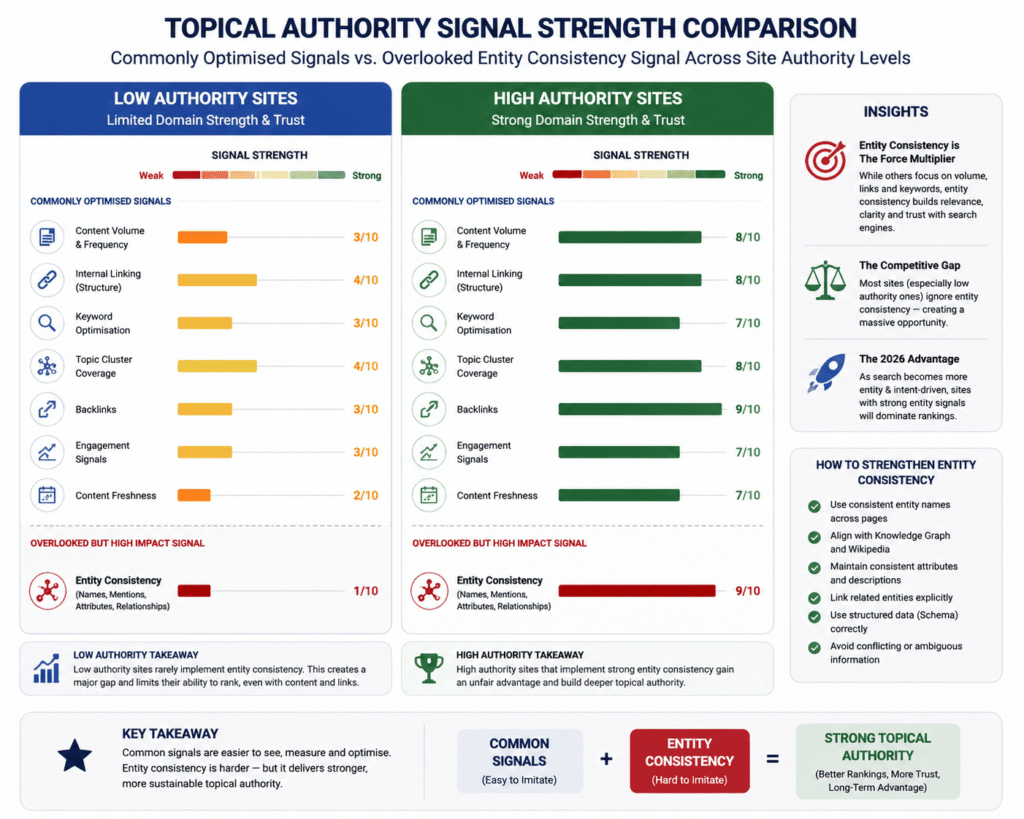
Table of Contents
ToggleWhy Entity Consistency Is the Signal Standard Audits Cannot Find
Most topical authority audits run through the same diagnostic stack: keyword rankings, internal link count, content depth scores, backlink profiles. None of these surfaces entity consistency as a variable.
That diagnostic gap is why the signal gets missed. Entity consistency is not a metric any standard SEO tool reports. Screaming Frog does not flag naming inconsistencies. Ahrefs does not measure entity disambiguation gaps. Semrush cannot tell you that “Google Search Console” appears as “GSC” in three posts, “Search Console” in four others, and “Google’s console tool” in one more.
That fragmentation is invisible to tools and load-bearing to Google’s semantic evaluation.
Google’s Natural Language Processing systems — including the BERT architecture that underpins its semantic understanding — build entity associations through co-occurrence: the repeated appearance of the same entity name alongside related concepts across multiple documents. (Source: Google Search Central, 2024)
When entity naming is consistent — the same name, the same disambiguation, the same relationship framing across every cluster post — those co-occurrence patterns are strong and coherent. Google maps the cluster to that entity clearly and confidently. When naming drifts across posts, co-occurrence patterns fragment. Google cannot build a strong, stable association between your cluster and the entity in question.
Most practitioners building topical authority clusters focus on what tools can measure and skip what tools cannot. Entity consistency is exactly the kind of signal that rewards the practitioners who look further.
The Three Entity Consistency Failure Patterns
Entity consistency failures fall into three distinct patterns. Each produces a different kind of semantic fragmentation and requires a different fix.
Pattern 1 — Naming Drift. The same entity is referenced by different names across posts. “Google Search Console” becomes “GSC” in one post, “Search Console” in another, “Google’s webmaster tool” in a third. “Screaming Frog” becomes “the Frog tool” or just “the crawler.” Each variation is understood by a human reader without friction. Google’s co-occurrence mapping treats each as a potentially different entity — or at minimum, builds weaker associations for the variants than it would for a consistent canonical name.
The fix is canonical name standardisation: establish the full, official name for each entity and apply it consistently across every post. Abbreviations are acceptable after the first use within a post — but the canonical name must appear at first use in every post, every time.
Pattern 2 — Disambiguation Gaps. An entity name is used without sufficient context to identify which entity it refers to. “HubSpot” could refer to the CRM, the marketing platform, or the company. “BERT” in an SEO context refers to Google’s language model — but without disambiguation, a reader or a language model processing the text cannot confirm which BERT is meant. Disambiguation gaps are particularly damaging in competitive or multi-meaning topic areas where the same term refers to different entities across different domains.
The fix is disambiguation anchoring: on first use of any entity that could refer to more than one thing, include a one-clause identifier. “Google BERT, the language model that powers semantic search understanding” is sufficient. Applied once per post, it gives Google’s NLP systems the contextual signal they need to map the entity correctly. (Source: Schema.org, 2024)
Pattern 3 — Entity Relationship Vagueness. The relationship between two entities is implied rather than stated explicitly. A post might mention Ahrefs and topical authority in the same paragraph without stating what the relationship is — Ahrefs as a tool for auditing topical authority, or Ahrefs as a publisher of research on topical authority. These are different relationships and Google’s Knowledge Graph treats them as different entity relationship types. Vague co-occurrence creates weaker relationship signals than explicit relationship statements.
The fix is relationship anchoring: when two entities appear together in a sentence or paragraph, state the relationship explicitly in the same sentence. “Ahrefs’ 2024 research on topical authority” states the relationship — Ahrefs as publisher, topical authority as subject — in a single clause. “As Ahrefs found…” followed by a claim does the same work in two. The relationship should never have to be inferred from context alone.
How Google Maps Entity Relationships — and Why Consistency Matters Mechanically
Understanding why entity consistency matters requires understanding how Google builds its Knowledge Graph associations from indexed content.
Google’s Knowledge Graph is a database of named entities and the verified relationships between them. When Google indexes content, its NLP systems identify named entities in the text, map co-occurrence relationships between them, and use those patterns — across millions of documents — to build and update the Knowledge Graph’s understanding of how entities relate to each other. (Source: Google Search Central, 2024)
This process is probabilistic, not deterministic. Google does not read a single document and update the Knowledge Graph. It reads patterns across the full corpus of indexed content. Strong, consistent co-occurrence patterns across many documents produce strong, stable entity associations. Weak, inconsistent patterns produce uncertain or absent associations.
The May 2024 Google Content Warehouse API Leak confirmed the mechanistic implications of this at the site level. The siteFocusScore measures how concentrated a site is around specific topic entities. The siteRadius measures how far individual pages deviate from the site’s core entity focus. (Source: Google Content Warehouse API Leak, May 2024)
A cluster where entity references are consistent — canonical names, disambiguation anchors, explicit relationships — produces a high siteFocusScore signal for those entities and a low siteRadius for every post in the cluster. A cluster where naming drifts, disambiguation is absent, and relationships are vague produces fragmented co-occurrence patterns that degrade both metrics.
Most practitioners who have implemented cluster architecture, internal linking, and content depth are already addressing the structural signals. Entity consistency is the semantic layer those structural signals require to function at full authority strength.
The lightweight case study: A financial services content team in the UK had built a 14-post cluster on personal finance planning — pillar plus 13 cluster posts, coherent internal linking, practitioner-depth content on every node. Their pillar post had reached position 14 for its primary keyword after 18 weeks and had not moved in 8 weeks. An entity audit revealed 22 named entities across the cluster with naming inconsistencies in 14 of them. The most damaging: their primary entity — “Individual Savings Account” — appeared as “ISA” in six posts, “Individual Savings Account (ISA)” in three, “stocks and shares ISA” in two others, and “the ISA scheme” in two more. None of these were wrong. All of them were fragmenting the co-occurrence pattern for the entity that should have been anchoring the cluster’s topical focus. We standardised all 22 entities across the full cluster — 4 hours of editing across 14 posts. The updated posts re-crawled over a 3-week window. The pillar post moved from position 14 to position 7 within 5 weeks of the final post being re-indexed. No new content was published. No links were built. The entity standardisation was the only change. Friction: the team’s editorial style guide had been using “ISA” as standard shorthand for years. Convincing the editor that “Individual Savings Account” on first use in every post was worth the word overhead required showing the mechanism, not making the preference argument.
Running an Entity Consistency Audit on an Existing Cluster
An entity consistency audit is a manual process. No tool automates it. The output is a standardisation reference list that governs every future post in the cluster.
Step 1 — Extract all named entities across the cluster. Open every post in the cluster. Pull a list of every named entity: tools, platforms, organisations, frameworks, methodologies, named concepts. Include every entity that appears in more than one post. Do not filter for importance at this stage — include every named reference.
Step 2 — Identify naming variants. For each entity on the list, note every name variation used across the cluster’s posts. This step surfaces naming drift immediately. Build a simple spreadsheet: entity in column one, all variants found in column two.
Step 3 — Establish the canonical name for each entity. For each entity, select one canonical name — the full, official name as the entity itself uses. For tools: check the product’s own website for the official name. For organisations: use the legal or trading name as the organisation uses it. For Google products: use the name as it appears in Google’s own documentation on Google Search Central. (Source: Google Search Central, 2024)
Step 4 — Check for disambiguation gaps. Review any entity that could refer to more than one thing. Flag every instance where the entity appears without a one-clause identifier on first use in a post. Note which posts require disambiguation anchors to be added.
Step 5 — Check entity relationship statements. For each entity that co-occurs with another entity, verify that the relationship between them is stated explicitly in the sentence or immediately adjacent sentence. Flag any instance where the relationship is implied rather than stated.
Step 6 — Apply the standardisation list. Update every post with the canonical name, disambiguation anchors, and explicit relationship statements. Do not update one post at a time over weeks — batch the corrections and push them together so Google re-indexes a coherent, consistent cluster rather than a partially corrected one.
Pro Tip: In Wikidata (wikidata.org), search for any entity you are unsure about naming. Wikidata’s Q-identifier pages list the official name, all known aliases, and the disambiguation context for each entity — giving you the canonical reference point for any named entity your cluster references. If your primary entity (the one most central to your cluster’s topic) does not have a Wikidata entry, creating one is a direct entity-building action that strengthens Google’s ability to map your cluster to that entity.
Frequently Asked Questions
What is entity consistency in SEO?
Entity consistency is the practice of referencing named entities — tools, organisations, frameworks, platforms, and concepts — with stable, unambiguous terminology across every post in a content cluster. It matters because Google’s NLP systems build entity associations through co-occurrence patterns across indexed content. Inconsistent naming fragments those patterns, weakening the topical authority signal a cluster produces regardless of how sound its architecture and internal linking are.
Why is entity consistency overlooked as a topical authority signal?
Entity consistency is invisible to standard SEO tools. Keyword gap tools, ranking trackers, and crawl tools do not surface naming inconsistencies or disambiguation gaps. Most topical authority frameworks focus on signals that tools can measure — rankings, backlinks, internal link counts — and skip the semantic signal layer that tools cannot report. This is why practitioners who have implemented cluster architecture correctly still find their authority signal underperforming: the structural signals are present but the semantic layer is fragmented.
How does the Google Knowledge Graph relate to entity consistency?
Google’s Knowledge Graph maps relationships between named entities by processing co-occurrence patterns across its indexed content. When an entity is named consistently across multiple documents — with the same canonical name and explicit relationship statements — Google builds strong, stable associations between that entity and the topic. When naming drifts across documents, co-occurrence patterns fragment and Knowledge Graph associations weaken. The May 2024 Google Content Warehouse API Leak confirmed that site-level signals including siteFocusScore algorithmically measure how concentrated a site is around specific entity clusters.
How long does an entity consistency audit take?
A full entity consistency audit on a 10–15 post cluster — extracting all named entities, identifying naming variants, establishing canonical names, checking disambiguation gaps, and flagging relationship vagueness — takes 2–3 hours. Applying the corrections across the cluster takes a further 2–4 hours depending on the number and severity of inconsistencies found. The measurable improvement in topical authority signal typically appears within 4–6 weeks of the corrected posts being re-indexed.
What is the fastest entity consistency fix for an existing cluster?
Standardise the canonical name of the primary entity — the one most central to the cluster’s topic. This is the entity whose co-occurrence pattern most directly determines the cluster’s topical focus signal. In a cluster on topical authority SEO, the primary entity might be “topical authority” itself, or “Google Search Console,” or “cluster architecture.” Identify which entity appears most frequently across the cluster, establish its canonical name, and apply it consistently across every post before addressing secondary entities.
What to Do Next
If your cluster architecture is sound, your internal linking is coherent, and your content goes to practitioner depth — but your topical authority signal is still not consolidating at the level you expect — entity consistency is the most likely missing variable.
The audit is manual. No tool will surface it for you. Open a spreadsheet now, pull every named entity from your three highest-priority cluster posts, and check for naming variants. If you find more than two naming variants for any single entity, you have found the suppression point.
Fix the canonical names across those three posts first. Push the corrections. Check GSC impression trajectory for that cluster 4 weeks after re-indexing. That is the fastest diagnostic cycle available for confirming whether entity consistency was the signal the cluster was missing.
The topical authority strategy that earns consistent ranking and AI citation depends on every layer working — architecture, linking, depth, and entity consistency. This is the layer most implementations leave incomplete.
References
Google Search Central. “How Search Works.” Google Developers, 2024. https://developers.google.com/search/docs/fundamentals/how-search-works Supports: Google’s NLP systems build entity associations through co-occurrence patterns across indexed content — consistent entity naming produces stronger, more stable Knowledge Graph associations than naming variants.
Google Content Warehouse API Leak. “siteFocusScore and siteRadius.” Documented by Hobo Web, Growfusely, Keyword Insights, May 2024. https://www.hobo-web.co.uk/the-google-content-warehouse-leak-2024/ Supports: siteFocusScore and siteRadius are confirmed site-level signals that algorithmically measure topical concentration and page deviation from core entity focus — entity inconsistency degrades both metrics.
Wikidata. “Wikidata Main Page.” Wikimedia Foundation, 2024. https://www.wikidata.org/wiki/Wikidata:Main_Page Supports: Wikidata Q-identifier pages provide canonical entity names, aliases, and disambiguation context — the authoritative reference for establishing canonical entity names in cluster posts.
Schema.org. “Full Hierarchy.” Schema.org, 2024. https://schema.org/docs/full.html Supports: Schema.org’s entity taxonomy provides structured entity relationship types — the basis for explicit relationship anchoring between co-occurring entities in cluster posts.
Search Engine Journal. “Topical Authority: A Complete Guide for SEO.” Search Engine Journal, 2025. https://www.searchenginejournal.com/topical-authority/ Supports: Standard topical authority frameworks focus on content architecture, publishing strategy, and internal linking — entity consistency as a distinct signal layer is absent from most practitioner-level coverage.
Keyword Insights. Topical Authority SEO: Your Moat Against AI Search.” Keyword Insights AI, 2025. https://www.keywordinsights.ai/blog/how-to-build-topical-authority-in-seo/ Supports: The 2024 Google Content Warehouse API Leak confirmed that siteFocusScore and siteRadius are algorithmically measured — niche authority and entity focus are rewarded at the site level, not just at the page level.