




Standard competitor gap analysis asks the wrong question.
Most practitioners open Ahrefs Content Gap or Semrush Keyword Gap, compare their ranking keyword profile against two or three competitors, and build a content list from the terms they are not ranking for. That process identifies keyword gaps — it does not identify concept gaps. And closing keyword gaps without addressing concept gaps produces posts that compete at the individual URL level while the competitor continues to dominate at the topical level.
The question a competitor topical gap analysis should answer is not “which keywords do they rank for that I don’t?” It is “which concept areas have they achieved semantic authority in — and which of those gaps can I close fast enough to challenge that authority rather than just fill an adjacent ranking position?”
That reframe changes the entire analysis process: which competitors you study, how you map their coverage, which gaps you prioritise, and what you build first. This cluster walks through the full process — from competitor selection to gap classification to a prioritised build list that accelerates topical authority faster than a linear publishing schedule allows.
Post Summary
- Competitor topical gap analysis maps concept-area authority, not just keyword ranking gaps — the distinction changes which gaps you prioritise and what you build
- Select topical competitors, not domain competitors — the site ranking most consistently across your topic’s concept areas, not the site closest to yours in DA
- Gap classification produces three zones: competitor-owned gaps (high effort), shared coverage gaps (medium effort), and uncontested opportunities (fastest wins)
- Uncontested opportunities — concept areas no competitor has covered at depth — are the highest-return gaps to close first, not the last
- Closing a concept-area gap requires building cluster depth on that sub-topic, not publishing a single post targeting the competitor’s ranking keyword
- A full competitor topical gap analysis on a 10-post cluster takes three to four hours and produces a prioritised build list that a keyword gap tool cannot replicate
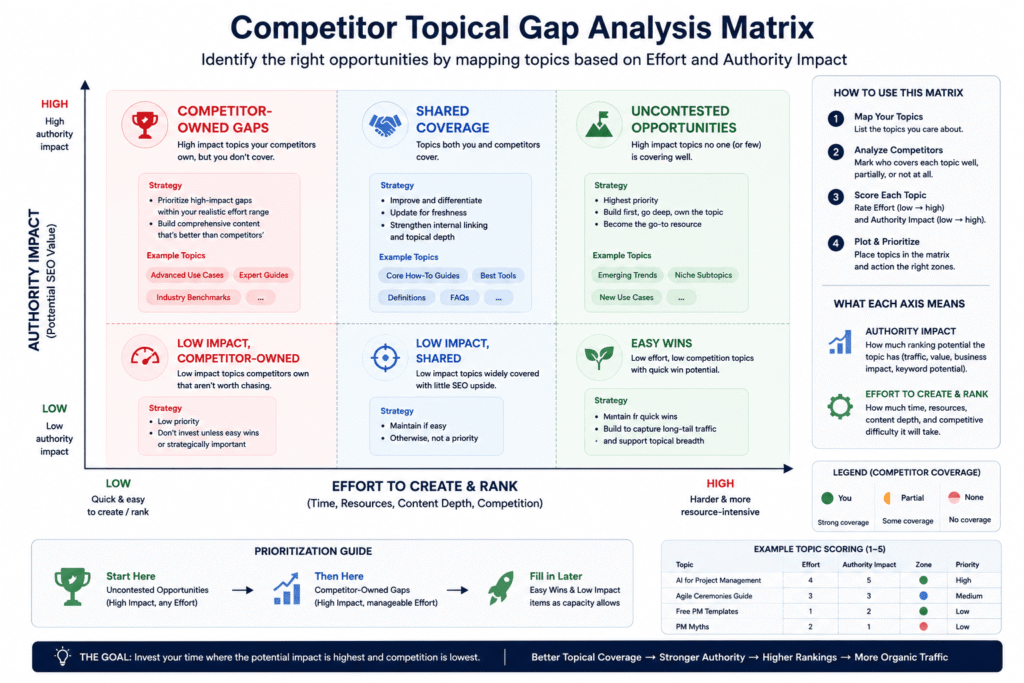
Table of Contents
ToggleWhy Keyword Gap Tools Give You Competitor Data, Not Competitor Intelligence
Keyword gap tools are data retrieval systems. They show you which terms a competitor ranks for that you do not. That data is accurate and genuinely useful — but it describes the symptom, not the cause.
When a competitor ranks across 40 keywords in the topical authority cluster, they are not ranking because they published 40 posts. They are ranking because they built semantic authority across the concept map of that topic — and the 40 keyword rankings are the output of that authority, not the input.
If you identify 40 keyword gaps and publish 40 new posts targeting those terms, you are copying the output. You are not building the underlying semantic structure that produced it. The competitor’s authority on that topic remains intact; you have added volume to your site without building the coherence that would challenge their position. (Source: Ahrefs, 2024)
The correct starting point is the competitor’s content architecture — the cluster structure, the pillar topics, the concept areas they have developed at depth — not their keyword ranking list.
Open the competitor’s site directly before you open any gap tool. Map their cluster architecture manually: which topics do they have a pillar post on, and how many cluster posts support each pillar? That structural map tells you which concept areas they have invested in at depth — and that investment is what produced the keyword rankings you are looking at in the gap tool.
Stage 1 — Select Topical Competitors, Not Domain Competitors
The first mistake in competitor gap analysis is choosing the wrong competitors to analyse.
Most practitioners benchmark against sites with similar domain authority or similar traffic profiles. For topical gap analysis, that selection criterion is irrelevant. What you need is the site that demonstrates the strongest semantic authority across the specific topic you are building — regardless of its overall size, DA, or traffic profile.
A topical competitor is the site that appears most consistently in positions 1 to 5 across the full concept map of your topic — not a single high-volume keyword, but the broadest range of conceptual sub-topics within the topic area. (Source: Semrush, 2024)
To identify topical competitors accurately, take your concept map from the coverage audit process and select 8 to 10 representative concept nodes — one from each major sub-topic area of the topic. Search Google for each one and note which domain appears most frequently across those searches. The site appearing in positions 1 to 5 on six or more of your ten concept searches is your primary topical competitor.
This process typically surfaces one or two sites that are not your most obvious competitors — sites that have built deep cluster architecture on your topic without being prominent in your industry conversation. These are often the most valuable sites to analyse, because they reveal what systematic cluster building produces rather than what brand recognition or high DA produces.
Identify your top two topical competitors before running any gap tool. Analyse their architecture first.
Stage 2 — Map the Competitor’s Concept Coverage
With topical competitors identified, the next step is mapping which concept areas they have developed at depth versus which they have covered only at surface level.
Go to their site and build a manual content inventory for your topic. List every post — pillar and cluster — that covers the topic. Group posts by sub-topic area. For each sub-topic area, count the number of posts and assess the depth: does any post go to practitioner-level detail, or are they all introductory?
This inventory reveals three things a keyword gap tool cannot: which concept areas have cluster depth (multiple posts developing the same sub-topic from different angles), which have only surface coverage (one or two thin posts), and which are absent entirely.
Sub-topic areas with cluster depth are where the competitor has topical authority. Sub-topic areas with surface coverage are where their authority is shallow — and potentially vulnerable. Sub-topic areas that are absent are uncontested territory. (Source: Ahrefs, 2024)
Mark each sub-topic area with one of three labels: Competitor-Owned (cluster depth, consistent rankings, strong authority signal), Shared or Contested (some coverage from both of you, neither has clear authority), or Uncontested (competitor has no meaningful coverage, or surface-only coverage that does not develop the concept at practitioner depth).
That classification is the foundation of the gap prioritisation stage.
Stage 3 — Classify Gaps Into Three Zones
Not all gaps are equally fast to close. The three-zone classification — Competitor-Owned, Contested, Uncontested — maps directly to effort and timeline for building competing authority.
Competitor-Owned gaps are concept areas where the competitor has built a full cluster — pillar plus five or more cluster posts — and ranks consistently across the concept’s keyword set. Closing these gaps requires building an equivalent cluster from scratch, which takes three to six months of consistent publishing before topical authority signals begin to compete. These are not fast wins.
Contested gaps are concept areas where both you and the competitor have some coverage but neither has achieved clear authority. Your existing posts in these areas are already partially indexed and partially linked — which means the incremental effort to claim authority is lower than building from zero. Adding two to three strong cluster posts in a contested concept area, linked cohesively to a pillar, can shift authority signals within six to ten weeks. These are medium-speed wins.
Uncontested gaps are the fastest wins — and the ones most practitioners overlook because they are not visible in keyword gap tools. If a competitor has no coverage on a concept area, there is no keyword ranking to surface in the gap report. The gap tool shows nothing. But the concept area exists in the topic’s semantic structure, audiences have questions about it, and no competitor has built authority there. Publishing a well-structured cluster on an uncontested concept area — where you face no established topical authority to overcome — produces ranking signals faster than any contested or competitor-owned gap. (Source: Semrush, 2024)
Build your prioritised gap list in this order: Uncontested first, Contested second, Competitor-Owned as a long-term programme.
Stage 4 — Cross-Reference With Your GSC Data
Before finalising the priority order, cross-reference each identified gap against your Google Search Console performance data.
Pull 90 days of GSC query data and filter for queries related to each gap concept area. An Uncontested gap that is already generating impressions in your GSC — meaning Google is serving your existing content for adjacent queries — is a higher-priority target than an Uncontested gap with no current impression data. Your domain already has partial relevance signal for that concept area; a dedicated cluster post amplifies an existing signal rather than building one from zero.
A Contested gap with 500 or more monthly impressions in your GSC is higher priority than a Contested gap with 50. The impression data confirms demand and confirms Google has already associated your domain with that concept — both factors reduce the time to ranking improvement after publishing.
The lightweight case study: A B2B SaaS content team in the project management vertical ran this analysis against their two primary topical competitors. Their keyword gap tool flagged 34 missing terms. The concept-area analysis identified 11 sub-topic zones across the topic map. Of those 11 zones, 3 were Competitor-Owned (both competitors had full clusters), 5 were Contested, and 3 were Uncontested — not visible in the keyword gap tool at all because neither competitor ranked for them. GSC cross-reference showed one of the three Uncontested zones was already generating 340 monthly impressions on adjacent queries. They published two cluster posts on that zone within three weeks. Within six weeks of publish, both posts ranked in positions 4 to 8 across the zone’s primary query set. The Contested zones produced ranking movement at week ten. The Competitor-Owned zones remained on a six-month programme. Friction: the keyword gap tool had ranked the Uncontested zones as zero-priority because there were no competitor keywords to surface. The manual concept-area analysis was the only process that found them.
Flag every gap where your GSC shows existing impressions. Move those gaps one tier up in the priority order regardless of their competition zone.
Stage 5 — Build the Priority List and Brief Order
With gaps classified and GSC data applied, produce a final priority list in four tiers.
Tier 1 — Uncontested gaps with existing GSC impressions. These are your fastest authority wins: no competitor authority to overcome, existing domain relevance signal confirmed, and confirmed search demand. Brief and publish first.
Tier 2 — Uncontested gaps with no current GSC impressions. No competition, but domain relevance signal not yet established. Brief second — these are still fast wins relative to contested gaps, because you are not overcoming existing competitor authority.
Tier 3 — Contested gaps with existing GSC impressions. Some competition, but partial authority already established on your domain. Medium-speed wins — expect six to ten weeks to measurable ranking improvement after publishing.
Tier 4 — Competitor-Owned gaps. Long-term cluster builds requiring sustained publishing. Include in your six-month content programme but do not brief before Tiers 1 through 3 are published.
| Gap Zone | GSC Impressions | Priority Tier | Expected Timeline |
|---|---|---|---|
| Uncontested | Yes — existing impressions | 1 — highest | 3–6 weeks post-publish |
| Uncontested | No current impressions | 2 | 6–10 weeks post-publish |
| Contested | Yes — existing impressions | 3 | 8–12 weeks post-publish |
| Contested | No current impressions | 3 (lower) | 10–16 weeks post-publish |
| Competitor-Owned | Either | 4 — long-term | 3–6 months sustained programme |
Pro Tip: In Ahrefs Site Explorer, go to your primary topical competitor’s Top Pages report and filter by your topic keyword. Sort by Traffic. The pages generating the most traffic on the topic are their highest-authority cluster posts — not their pillar. Open each one and note which concept area it develops. If that concept area does not appear in your content library at all, you have found a Competitor-Owned gap worth adding to your six-month programme. If it appears in your library with one thin post and no cluster support, you have found a Contested gap ready for a cluster build.
Frequently Asked Questions
What is competitor topical gap analysis?
Competitor topical gap analysis is a process for identifying which concept areas within a topic a competitor has achieved semantic authority in — and which of those areas represent gaps in your own coverage that can be closed to build topical authority faster. It differs from standard keyword gap analysis by focusing on concept-area depth rather than individual keyword rankings, producing a gap list organised by effort and competitive intensity rather than by search volume.
How do you identify topical competitors for a gap analysis?
Select competitors by topical presence, not domain size or DA. Search Google for 8 to 10 concept nodes from your topic’s concept map and note which domain appears most consistently in positions 1 to 5 across those searches. The site ranking across the broadest range of your topic’s sub-topics is your primary topical competitor — regardless of whether it is the most prominent site in your industry.
Why are uncontested gaps the fastest authority wins?
Uncontested gaps are concept areas within your topic that no established competitor has covered at practitioner depth. Without existing topical authority to overcome, your content can establish ranking position faster — particularly when your domain already has partial relevance signal for the topic from existing cluster posts. These gaps are also invisible to keyword gap tools, which is why most practitioners do not find them through standard analysis.
How long does it take to close a competitor-owned topical gap?
Closing a Competitor-Owned gap — a concept area where a competitor has built a full cluster with consistent rankings — typically requires three to six months of sustained publishing to produce measurable topical authority signals. This timeline reflects the need to build cluster depth from scratch in a concept area where an established competitor has already anchored semantic authority. Contested and Uncontested gaps close significantly faster.
Can you run a competitor topical gap analysis without paid tools?
Yes — the most important stages (topical competitor identification, concept map construction, content inventory mapping) are manual processes that require a browser and a spreadsheet, not a paid tool. Ahrefs and Semrush accelerate the keyword cross-reference and traffic data stages but are not required for the concept-area classification. GSC is free and provides the impression data needed for gap prioritisation.
What to Do Next
A competitor topical gap analysis built on keyword data alone produces a content plan that competes at the post level. A concept-area analysis produces a content plan that challenges at the topical level — and identifies the fastest gaps to close first, not the highest-volume keywords to target next.
The uncontested gaps your keyword tool is not showing you are the ones to brief this week. Your competitors have left those concept areas open. That window does not stay open indefinitely — once a well-resourced competitor identifies the same uncontested zone and builds a cluster there, the speed advantage disappears.
Start the analysis now: take your topic’s concept map, identify your top two topical competitors using the search method above, and build the content inventory manually before opening any gap tool. The concept-area map you build in the first 90 minutes will tell you more about where to invest than any keyword report.
Return to the topical authority strategy to check your gap list against your overall cluster architecture before briefing any new content.
References
Ahrefs. “Content Gap Analysis: How to Find and Fix Your Content Gaps.” Ahrefs Blog, 2024. https://ahrefs.com/blog/content-gap-analysis/ Supports: Keyword gap tools identify ranking gaps in competitor keyword profiles — they do not map concept-area authority or reveal uncontested sub-topic zones absent from competitor coverage entirely.
Semrush. “Topic Research: How to Find Content Ideas with Semrush.” Semrush Blog, 2024. https://www.semrush.com/blog/topic-research/ Supports: Topical competitor identification requires mapping concept-area presence across a topic’s sub-topic set — not DA or domain traffic comparison; uncontested concept zones produce faster authority signals than contested zones.
Ahrefs. “Topical Authority: What It Is and How to Build It.” Ahrefs Blog, 2024. https://ahrefs.com/blog/topical-authority/ Supports: Competitor semantic authority is built through cluster depth across concept areas — copying competitor keyword rankings without replicating cluster architecture does not challenge topical authority.
Google Search Console. “Search Console Help.” Google, 2024. https://search.google.com/search-console/about Supports: GSC impression data cross-referenced against concept gap zones identifies which gaps already have domain relevance signal — elevating those gaps in priority order regardless of competition zone.
Search Engine Journal. “Topical Authority: A Complete Guide for SEO.” Search Engine Journal, 2025. https://www.searchenginejournal.com/topical-authority/ Supports: Closing Competitor-Owned topical gaps requires building equivalent cluster depth from scratch — a three to six month sustained programme, not a single-post response to a competitor’s ranking keyword.