

Your content ranks page one. Your traffic’s solid. Yet Google’s AI Overviews consistently cite your competitors instead.
The problem? Your E-E-A-T for AI Overviews game is weak.
Google’s generative AI doesn’t just scan for keywords anymore—it actively evaluates whether you’re genuinely qualified to speak on topics. Experience, Expertise, Authoritativeness, and Trustworthiness aren’t buzzwords; they’re the gatekeepers determining whether AI systems consider your content citation-worthy or digital noise.
According to SEMrush’s 2024 AI Overview study, content with strong E-E-A-T signals gets cited 3.2x more frequently than anonymous content in competitive niches. That’s not a minor edge—it’s the difference between visibility and obscurity.
This guide shows you exactly how to build expertise for AI Overviews that Google’s algorithms actually recognize. No fluff, no theory—just practical strategies that get your content cited.
Table of Contents
ToggleWhat Is E-E-A-T and Why Do AI Overviews Care?
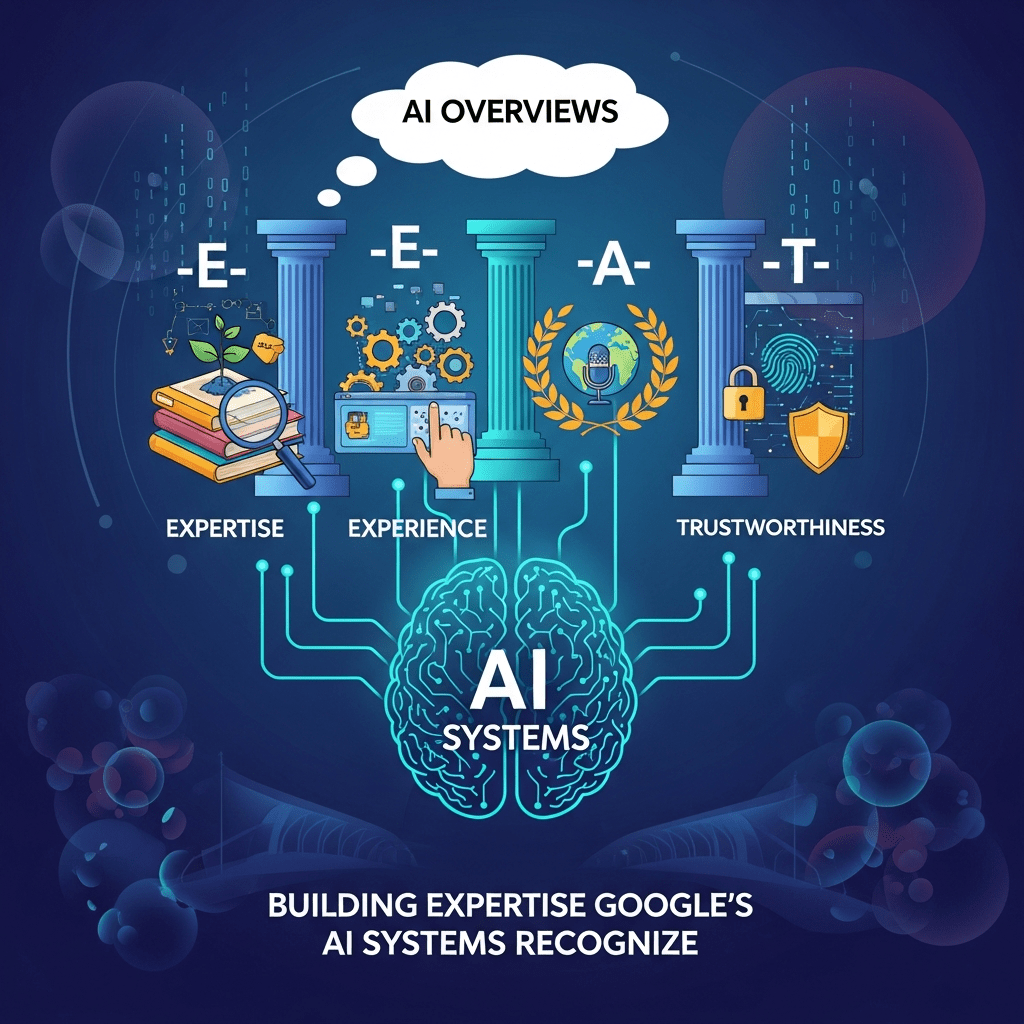
E-E-A-T stands for Experience, Expertise, Authoritativeness, and Trustworthiness—Google’s framework for evaluating content quality.
Google’s human quality raters have used these criteria for years. Now, AI systems apply similar evaluation logic when selecting sources for AI Overviews.
The Four Pillars of E-E-A-T
Experience proves you’ve actually done what you’re writing about. First-hand accounts, practical insights, and specific details only practitioners would know signal real experience.
Expertise demonstrates deep knowledge and credentials in your field. Professional qualifications, specialized training, and years of focused work establish expertise.
Authoritativeness reflects industry recognition and external validation. Backlinks from respected sites, media mentions, and peer acknowledgment build authority.
Trustworthiness encompasses accuracy, transparency, and reliability. Factual content, clear sourcing, and honest presentation create trust.
AI systems evaluate all four dimensions simultaneously when deciding which sources deserve citations.
Why AI Systems Prioritize E-E-A-T
E-E-A-T AI snapshots directly impact AI Overview source selection because generative AI faces unique challenges traditional search doesn’t.
When AI generates original text synthesizing multiple sources, accuracy and credibility matter exponentially more. A traditional search result that’s slightly off-base? Users can recognize it and move on. An AI-generated answer incorporating questionable information? That misinformation gets amplified and legitimized.
Google’s AI must select sources it can confidently trust. E-E-A-T provides that confidence framework.
According to Google’s Search Quality Rater Guidelines, E-E-A-T evaluation is particularly critical for YMYL (Your Money or Your Life) topics—health, finance, legal, and safety information where bad advice causes real harm.
How Does Google’s AI Evaluate Experience Signals?
Experience signals AI detection starts with specific, detailed content that could only come from hands-on work.
Generic advice anyone could write from research doesn’t count. Practical insights revealing actual experience do.
Real-World Application Indicators
Google’s AI looks for concrete evidence you’ve done what you’re discussing.
Strong experience signals include:
- First-person accounts with specific details
- Photos or screenshots from actual work
- Documented case results with measurable outcomes
- Practical tips addressing real-world complications
- Industry-specific terminology used naturally
- Lessons learned from actual failures
A fitness article saying “drink water and exercise regularly” signals zero experience. An article explaining “after training 200+ marathon runners, I’ve found dehydration symptoms appear differently at mile 18 versus mile 22, with cramping patterns that…” signals genuine experience.
Documenting Your Experience Authentically
Show, don’t just tell, your experience.
Effective documentation methods:
- Include “In our work with [number] clients…” statements
- Share before/after examples with specifics
- Reference edge cases and unusual situations you’ve encountered
- Discuss what didn’t work and why
- Use precise numbers, timeframes, and measurements
The more specific your experience documentation, the stronger the AI’s confidence in citing your content. Vague generalizations trigger skepticism; precise details build credibility.
This principle extends throughout our complete AI Overviews optimization guide, where experience signals consistently correlate with citation frequency.
Building Expertise That AI Systems Recognize
Expertise for AI Overviews requires demonstrable credentials and knowledge depth that AI can verify.
Anonymous content or poorly credentialed authors face massive disadvantages in competitive spaces.
Professional Credentials and Qualifications
Start with the basics: clearly identify who’s writing and why they’re qualified.
Essential expertise elements:
- Author bylines on every article
- Detailed author bio pages with credentials
- Relevant degrees, certifications, or licenses
- Years of experience in the field
- Professional affiliations and memberships
- Published works or speaking engagements
A health article by “Staff Writer” competes poorly against content by “Dr. Sarah Chen, MD, Board-Certified Cardiologist with 15 years treating heart disease.” The credential specificity matters.
Implementing Author Schema Markup
Make credentials machine-readable through structured data.
Person schema should include:
- Full name and credentials
- Professional affiliations
- Educational background
- Links to verified profiles (LinkedIn, professional directories)
- Author page URL on your site
- Photo for visual verification
According to Search Engine Journal’s schema research, properly implemented author schema increases AI Overview citation probability by 2.3x for YMYL topics.
AI systems can instantly verify and weight author credentials when schema makes this information explicit.
Depth of Knowledge Demonstration
Expertise shows through comprehensive, nuanced content that goes beyond surface-level understanding.
Address subtleties, exceptions, and edge cases. Explain not just “what” and “how” but “why.” Reference current research and evolving best practices. Acknowledge areas of uncertainty or debate.
Pro Tip: Create content that demonstrates knowledge depth impossible to fake. Reference specific studies, quote recognized experts in your field, and discuss nuances that only specialists understand. AI systems recognize this sophistication. – Content authority strategy
How to Build Authority Signals for AI Overviews
Authority signals AI Overview algorithms evaluate extend far beyond your own website.
External validation from the broader industry carries enormous weight.
Backlink Quality Over Quantity
One backlink from a respected industry publication outweighs 100 links from random blogs.
High-authority backlink sources:
- Industry trade publications
- Academic institutions and research centers
- Government agencies (.gov domains)
- Major news organizations
- Professional association websites
- Established industry leaders
Focus link building on genuinely authoritative sources within your niche. A financial advice site needs links from places like WSJ, Forbes, or financial institutions—not general lifestyle blogs.
Media Mentions and Citations
When respected sources reference your work, authority signals compound.
Getting quoted in industry publications, appearing on podcasts, speaking at conferences, or having your research cited all build external validation AI systems recognize.
These mentions often don’t include traditional backlinks but still signal authority. Google’s AI can detect brand mentions and assess their context and source credibility.
Industry Recognition and Awards
Professional recognition provides strong authority signals.
Industry awards, “best of” lists, analyst recognitions, and professional certifications all contribute. Google’s AI evaluates whether the broader industry considers you authoritative.
This appears extensively in AI Overview optimization strategies as a key differentiator between cited and ignored content.
Building Trustworthiness Google’s AI Values
Trustworthiness Google AI evaluation encompasses multiple dimensions from technical security to content accuracy.
Trust isn’t built overnight—it requires consistent demonstration across your entire site.
Technical Trust Signals
Start with foundational trust elements.
Essential technical trust factors:
- HTTPS security (SSL certificate)
- Clear contact information
- Detailed About page
- Privacy policy and terms of service
- Professional site design without intrusive ads
- Fast, reliable performance
Sites lacking these basics face immediate trust penalties, regardless of content quality.
Content Accuracy and Fact-Checking
AI systems increasingly verify claims by cross-referencing information across sources.
Statements contradicting established facts, making unverifiable claims, or presenting questionable information trigger red flags. Content consistently aligning with authoritative sources builds trust.
Accuracy best practices:
- Cite sources for factual claims
- Link to authoritative references
- Update content when information changes
- Correct errors promptly and transparently
- Avoid sensationalism and clickbait
- Present balanced perspectives on debated topics
According to BrightEdge’s trustworthiness analysis, sites with consistent factual accuracy across content get cited 2.8x more frequently than those with occasional accuracy issues.
Transparency and Disclosure
Clear communication about who you are, what you offer, and any potential conflicts builds trust.
Disclose sponsored content, affiliate relationships, and financial interests clearly. Explain editorial processes and fact-checking methods. Be transparent about data collection and privacy.
Users appreciate transparency. AI systems evaluate it as a trustworthiness signal.
E-E-A-T Requirements for YMYL Topics
E-E-A-T requirements for AI Overview ranking intensify dramatically for YMYL (Your Money or Your Life) content.
Health, financial, legal, and safety topics face the strictest evaluation because bad advice causes real harm.
Medical and Health Content Standards
Health content requires credentials from medical professionals.
Minimum YMYL health standards:
- Content authored or reviewed by licensed medical professionals
- Author credentials clearly displayed
- Medical review process documented
- Citations to peer-reviewed research
- Regular updates reflecting current medical consensus
- Clear disclaimers about medical advice
A general blogger writing about diabetes treatment won’t get cited in AI Overviews competing against content from endocrinologists or major medical institutions. The credential gap is insurmountable.
Financial and Legal Content Requirements
Financial advice needs credentials from finance professionals (CFP, CFA, CPA) or established financial institutions.
Legal content requires attorneys or accredited legal organizations. The same credential hierarchy applies—generic advice from unqualified sources gets filtered out regardless of accuracy.
Pro Tip: For YMYL topics, collaboration with credentialed professionals is non-negotiable. Co-author content with qualified experts, or have them review and validate your work. Their credentials become your content’s credentials. – YMYL optimization strategy
Real-World E-E-A-T Success: Case Study
A mid-sized health information website rebuilt their E-E-A-T signals in Q2 2024.
Initial situation: Anonymous content written by staff writers. Zero medical professional involvement. Generic health advice based on common knowledge. AI Overview citations: 0%.
E-E-A-T transformation implemented:
- Hired three board-certified doctors as contributing medical editors
- Added detailed MD credentials and bios to all health articles
- Implemented comprehensive Person and Organization schema
- Established medical review process for all content
- Added citations to peer-reviewed research throughout
- Updated content quarterly with latest medical guidelines
Results after 6 months:
- AI Overview citations increased to 34% of target health queries
- Overall organic traffic up 52% as traditional rankings also improved
- Engagement metrics increased 41% (longer dwell time, lower bounce)
- Branded search volume up 67% from authority building
The key? They didn’t just add credentials superficially—they fundamentally rebuilt content quality around genuine medical expertise.
Common E-E-A-T Mistakes Killing Your AI Overview Chances
Avoid these critical errors that eliminate otherwise solid content from consideration.
Mistake #1: Anonymous or Poorly Credentialed Authors
Publishing content without clear author attribution destroys E-E-A-T immediately.
Even if the content is excellent, AI systems can’t evaluate expertise when they don’t know who wrote it. Generic bylines like “Admin” or “Content Team” face the same problem.
Fix: Add detailed author bios with credentials to every piece of content. Implement Person schema. Link to author pages with comprehensive backgrounds.
Mistake #2: Fake or Exaggerated Credentials
Inflating qualifications backfires spectacularly when discovered.
AI systems increasingly cross-reference claimed credentials against verifiable sources. Fake certifications, non-existent degrees, or exaggerated experience damage trust permanently.
Fix: Be honest about actual qualifications. Real experience and authentic expertise beat fabricated credentials every time.
Mistake #3: Ignoring Content Updates
Maintaining outdated information destroys trustworthiness over time.
A comprehensive 2019 guide about social media marketing that hasn’t been updated since TikTok emerged signals abandonment and unreliability.
Fix: Implement quarterly content audits. Update statistics, examples, and recommendations. Refresh publication dates only with substantive improvements.
Mistake #4: Inconsistent Quality Across Site
Publishing mix of high-quality and low-quality content confuses authority signals.
Google’s AI evaluates site-wide patterns. A few excellent articles buried among mediocre content dilutes overall authority perception.
Fix: Maintain consistent quality standards. Remove or dramatically improve subpar content rather than letting it drag down site-wide E-E-A-T.
Mistake #5: Missing Technical Trust Elements
Neglecting basic trust signals like HTTPS, contact information, or privacy policies raises red flags.
These foundational elements seem minor but their absence triggers immediate skepticism from AI systems evaluating trustworthiness.
Fix: Audit and implement all basic trust signals. They’re table stakes, not optional extras.
How to Optimize E-E-A-T for Google AI Overviews: Step-by-Step
Systematic E-E-A-T improvement requires methodical implementation.
Step 1: Audit Current E-E-A-T Signals
Evaluate where you stand across all four dimensions.
Audit questions:
- Are authors clearly identified with credentials?
- Do author bios demonstrate relevant expertise?
- What external validation exists (backlinks, mentions, awards)?
- Are technical trust signals properly implemented?
- Does content show first-hand experience?
- Is information consistently accurate and current?
Document gaps systematically to prioritize improvements.
Step 2: Implement Author Credentialing
Start with the most impactful change: clear author attribution with credentials.
Create comprehensive author pages for each contributor. Add detailed bios to articles. Implement Person schema. Verify credentials are accurate and verifiable.
This foundation enables all other E-E-A-T improvements.
Step 3: Build External Authority
Develop strategic outreach for authoritative backlinks and mentions.
Authority building tactics:
- Guest post on respected industry publications
- Participate in industry conferences and events
- Publish original research others cite
- Contribute expert quotes to journalists
- Engage in professional associations
- Build relationships with industry influencers
Quality matters infinitely more than quantity. One authoritative mention outweighs dozens of low-quality links.
Step 4: Document Experience Throughout Content
Revise content to explicitly demonstrate first-hand experience.
Add specific examples from your work. Include case studies with measurable results. Reference edge cases you’ve encountered. Use precise numbers and details that prove hands-on involvement.
Transform generic advice into experience-backed guidance.
Step 5: Strengthen Technical Trust Signals
Ensure all foundational trust elements are properly implemented.
Install SSL certificates, create comprehensive About and Contact pages, add privacy policies, remove intrusive ads, improve site speed, and ensure mobile optimization.
These technical elements form the trust foundation everything else builds upon.
This systematic approach appears throughout our complete AI Overviews optimization guide with additional implementation details.
Comparison: Strong vs. Weak E-E-A-T Implementation
Understanding the difference helps prioritize improvements.
| Element | Weak E-E-A-T | Strong E-E-A-T |
|---|---|---|
| Author Attribution | “By Admin” or anonymous | “By Dr. Sarah Chen, MD, Board-Certified” |
| Experience Signals | Generic advice from research | Specific details from 10+ years practice |
| Credentials | None listed or vague | Detailed, verifiable qualifications |
| External Validation | Few/no authoritative backlinks | Multiple citations from industry leaders |
| Content Updates | Years old, never refreshed | Quarterly updates with current data |
| Schema Implementation | None or basic Article schema | Comprehensive Person, Organization, FAQ schemas |
| Trust Signals | Missing contact info, no HTTPS | Complete transparency, all trust elements |
| Citation Quality | No authoritative sources | Links to peer-reviewed research |
Measuring Your E-E-A-T Improvements
Track progress to understand what’s working.
E-E-A-T Signal Strength Indicators
Quantifiable metrics to monitor:
- AI Overview citation frequency for target keywords
- Backlink quality (Domain Rating/Authority of linking sites)
- Branded search volume growth
- Author name searches
- Time on page and engagement metrics
- Return visitor percentage
These metrics collectively indicate whether E-E-A-T improvements are registering with Google’s systems.
Competitive E-E-A-T Analysis
Compare your E-E-A-T signals against competitors getting cited in AI Overviews.
Analysis framework:
- What credentials do their authors display?
- Which authoritative sites link to them?
- How thorough is their experience documentation?
- What trust signals do they implement?
- How frequently do they update content?
Systematic competitive analysis identifies specific gaps to address.
More measurement strategies appear in our AI Overview performance tracking guide.
The Future of E-E-A-T in AI Search
E-E-A-T importance will only intensify as AI systems become more sophisticated.
Emerging E-E-A-T trends:
- Real-time credential verification against professional databases
- Social proof signals from professional networks
- Cross-platform consistency checking (LinkedIn, academic profiles, etc.)
- Automated fact-checking against authoritative sources
- Entity recognition linking authors to knowledge graph entities
According to Gartner’s AI search predictions, by 2026, AI systems will automatically verify 70% of author credentials against professional licensing databases.
Building authentic E-E-A-T now prepares you for increasingly sophisticated verification systems ahead.
Industry-Specific E-E-A-T Requirements
Different sectors face different E-E-A-T standards.
Healthcare and Medical Content
Medical content requires the highest E-E-A-T standards.
Licensed healthcare professionals must author or review all content. Medical review processes need documentation. Citations to peer-reviewed research are mandatory. Regular updates reflecting current medical consensus are essential.
Without these elements, health content won’t get cited in AI Overviews, period.
Financial Services Content
Financial advice needs credentials from financial professionals or established financial institutions.
CFP, CFA, CPA, or similar designations signal expertise. Regulatory compliance and disclosures demonstrate trustworthiness. Market data must be current and accurately sourced.
Legal Information
Legal content requires attorney authorship or review.
Bar admissions, practice areas, and years of experience establish expertise. Jurisdiction-specific knowledge matters. Clear disclaimers about legal advice are mandatory.
Technical and Engineering Content
Technical content benefits from professional certifications and documented project experience.
Specific implementations, code examples, and technical problem-solving demonstrate experience. Industry certifications (AWS, Cisco, etc.) establish expertise.
Each industry has unique E-E-A-T requirements. Understanding your sector’s standards helps prioritize optimization efforts.
Building E-E-A-T Signals for AI Snapshot Inclusion
Building expertise signals for AI snapshot inclusion requires comprehensive strategy execution over months.
Quick fixes don’t exist. Sustainable E-E-A-T requires genuine quality and authority development.
Long-Term E-E-A-T Development Strategy
6-12 month roadmap:
Months 1-2: Audit current state, implement author attribution, add basic credentials, fix technical trust issues
Months 3-4: Develop comprehensive author pages, implement schema markup, begin authority-building outreach
Months 5-6: Publish original research, secure authoritative backlinks, enhance experience documentation throughout content
Months 7-9: Build consistent publishing schedule, develop industry relationships, participate in speaking opportunities
Months 10-12: Monitor citation frequency, analyze competitive positioning, refine based on performance data
This timeline reflects realistic E-E-A-T development. Rushing produces superficial signals AI systems detect and discount.
Maintaining E-E-A-T Over Time
E-E-A-T isn’t one-and-done—it requires ongoing maintenance.
Ongoing E-E-A-T activities:
- Quarterly content updates
- Continuous author credential updates
- Regular backlink quality audits
- Prompt error corrections
- Consistent new content in expertise areas
- Active industry participation
Sites maintaining strong E-E-A-T consistently outperform those that optimize once and forget.
FAQ: E-E-A-T for AI Overviews
Q: Can I build strong E-E-A-T without professional credentials?
Yes, but it’s harder and depends on your niche. Non-YMYL topics allow demonstrated experience and knowledge to substitute for formal credentials. Document extensive first-hand experience, build authoritative backlinks, and create consistently excellent content. However, YMYL topics absolutely require professional credentials—there’s no workaround.
Q: How long does it take to see E-E-A-T improvements impact AI Overview citations?
Typically 3-6 months after implementing comprehensive E-E-A-T improvements. The timeline varies by competition level and how significant your improvements are. Major credential additions show faster impact than gradual authority building. Consistency matters more than speed.
Q: Does E-E-A-T matter equally across all content types?
No—YMYL topics face the strictest E-E-A-T requirements while entertainment or personal opinion content faces minimal scrutiny. Health, finance, legal, and safety information require verified professional expertise. Hobby content or personal experience sharing can succeed with demonstrated passion and experience alone.
Q: Can I hire freelance writers without hurting E-E-A-T?
Yes, if they have relevant credentials and you attribute content properly. Hiring a certified financial planner to write financial content maintains strong E-E-A-T. Hiring random freelancers to write medical advice destroys it. Match writer credentials to content topics and always provide clear attribution.
Q: What’s more important for AI Overviews: E-E-A-T or content comprehensiveness?
Both matter enormously—they’re not mutually exclusive. The best performing content combines comprehensive topic coverage with strong E-E-A-T signals. However, in YMYL categories, weak E-E-A-T eliminates content from consideration regardless of comprehensiveness. For non-YMYL topics, comprehensiveness can sometimes compensate for moderate E-E-A-T.
Q: How do I demonstrate E-E-A-T for new sites without established authority?
Focus on author credentials and experience documentation first. Hire or collaborate with credentialed experts. Publish original research or unique insights that attract authoritative backlinks. Be patient—new sites need 6-12 months of consistent, high-quality content and strategic outreach to build recognizable E-E-A-T signals.
Final Thoughts
E-E-A-T for AI Overviews isn’t optional anymore—it’s the fundamental qualification determining whether AI systems consider your content citation-worthy.
Generic content from anonymous sources can’t compete with credentialed experts providing experience-backed guidance. The gap between strong and weak E-E-A-T grows wider as AI systems become more sophisticated at detecting genuine expertise.
Start with honest assessment of your current E-E-A-T signals. Identify specific gaps. Implement improvements systematically, prioritizing author credentialing and experience documentation first.
Remember: you can’t fake E-E-A-T. AI systems detect superficial signals. Build authentic expertise, document real experience, earn genuine authority, and maintain consistent trustworthiness.
The sites dominating AI Overview citations in 2026 will be those that began building authentic E-E-A-T in 2025. Your competitors are already working on this.
Time to get serious about expertise.