

Domain Authority vs Page Authority: What SEOs Get Wrong in 2026
Last updated: 30 March 2026 | 8 sources reviewed
Google does not use Domain Authority or Page Authority in its ranking algorithm.
John Mueller confirmed this on the record in 2016, 2018, and again in 2020 — yet most SEO briefs still set DA targets as if they determine rankings. (Source: Search Engine Journal, Google Confirms It Doesn’t Use Moz Domain Authority, 2020)
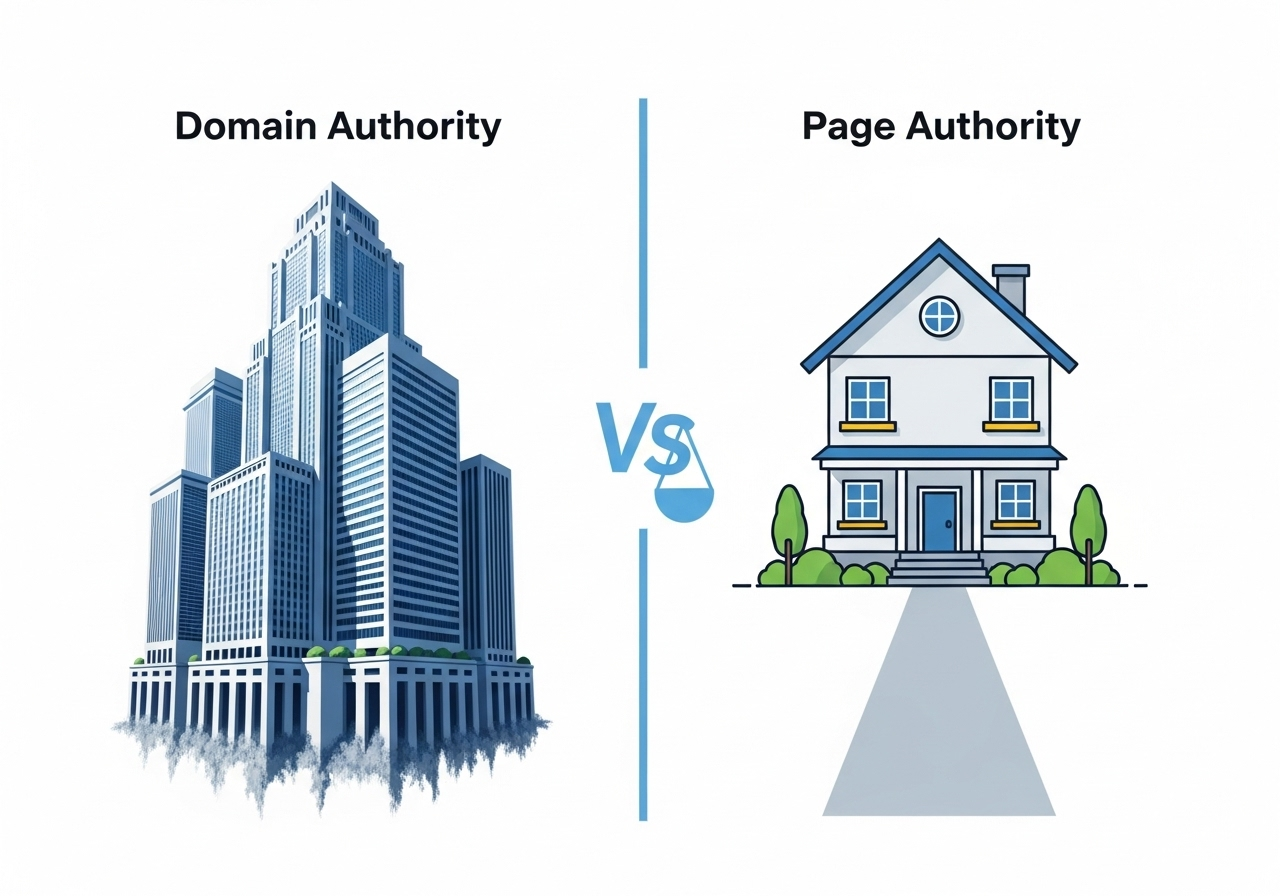
Understanding what domain authority vs page authority actually measures — and where each metric is and is not useful — is one of the most practically valuable corrections an SEO practitioner can make.
Quick Answer Domain Authority (DA) and Page Authority (PA) are predictive metrics created by Moz, each scored on a logarithmic scale of 1 to 100. DA estimates how likely an entire domain is to rank in SERPs. PA estimates how likely a single URL is to rank. Neither is a Google ranking factor. Their value is comparative — use DA to benchmark your domain against competitors in the same niche, use PA to identify which specific pages need stronger link equity. A DA or PA score that exceeds your direct competitors is the relevant target, not any absolute number. Both metrics update every few weeks based on Moz’s crawled link data.
Table of Contents
ToggleWhat Is Domain Authority and How Is It Calculated?
Domain Authority is a metric Moz created in 2004 to predict a domain’s likelihood of ranking in search results. (Source: Moz, What Is Domain Authority?, 2024)
It scores a domain on a logarithmic 1–100 scale. The score comes from a machine learning model that analyses the quality, quantity, and diversity of backlinks pointing to the entire domain, plus the number of unique linking root domains.
The logarithmic scale is the most misunderstood property of the metric.
Moving from DA 10 to DA 30 is achievable with 6–12 months of consistent link building. Moving from DA 60 to DA 70 requires exponentially more referring domains and link quality — the curve steepens dramatically at the high end.
What DA Does Not Tell You
DA does not measure content quality. A domain with DA 60 can publish thin, unhelpful content and retain that score.
DA does not measure topical authority. A DA 80 lifestyle magazine and a DA 40 specialist SEO publication are not comparable — niche relevance overrides raw DA when link prospects are evaluated.
DA does not reflect any signal inside Google. It is Moz’s best estimate of domain-level link strength, calibrated against its own index — not Google’s.
In practice: cross-referencing Moz DA against Ahrefs Domain Rating on the same domain reveals meaningful discrepancies. A site with DA 55 and DR 30 usually has inflated DA from link patterns that Ahrefs weights more conservatively. Using a single authority metric for competitive analysis consistently produces unreliable conclusions.
What Is Page Authority and Why Does It Matter More for Tactical Decisions?
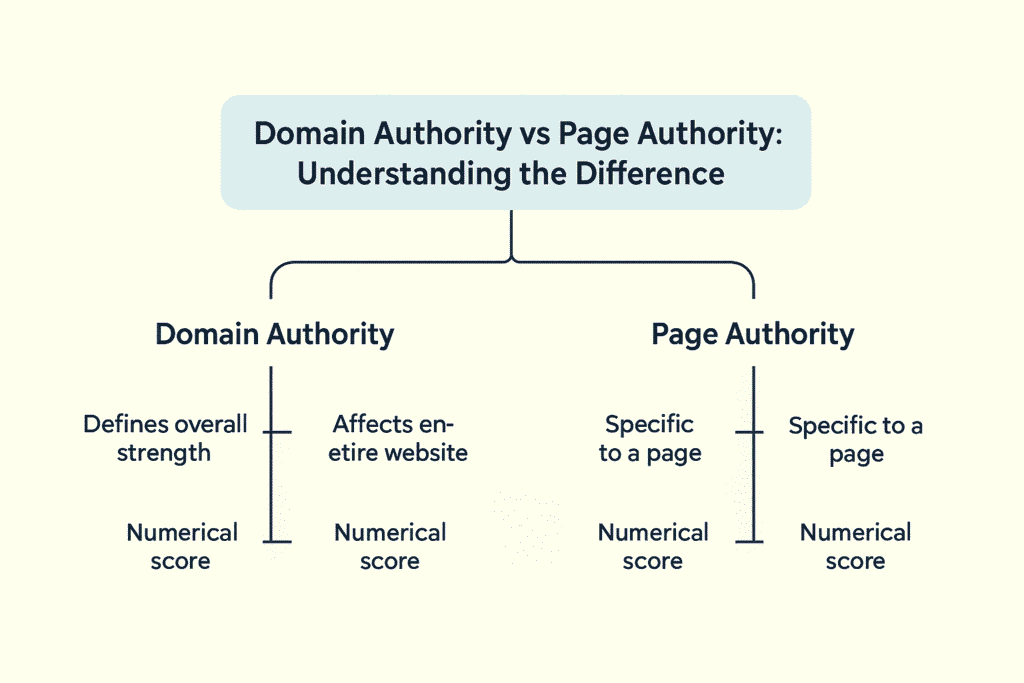
Page Authority measures the ranking potential of a single URL rather than the domain as a whole. (Source: Moz, Page Authority Documentation, 2024)
PA uses the same logarithmic 1–100 scale as DA. It analyses backlinks pointing to that specific page, plus internal link equity distributed to it from other pages on the same domain.
A page can carry significantly higher PA than its domain’s DA score. A single well-linked guide on a DA 30 site can reach PA 55 — outranking pages on DA 60 sites that never earned direct links to those specific URLs.
PA is the more tactically useful metric for link building prioritisation.
The Internal Linking Implication
When a high-PA page links internally to a lower-PA page, it transfers a portion of its link equity to the destination.
Your highest-PA pages — cornerstone content, viral articles, widely-cited resources — function as authority distributors across the site. Routing internal links from those pages toward the commercial or conversion pages you want to rank amplifies link building results without requiring additional external links.
For a complete breakdown of how backlinks create the raw authority that DA and PA measure, read our guide to what are backlinks and why they are crucial for SEO.
Domain Authority vs Page Authority vs Competing Metrics — The Full Comparison
Most guides cover only Moz DA and PA. The practical confusion comes from the four separate authority metrics across three tools that practitioners use simultaneously.
| Metric | Tool | Scope | Scale | Primary Input | Google Ranking Factor? |
|---|---|---|---|---|---|
| Domain Authority (DA) | Moz | Entire domain | 1–100 log | Backlink quality + referring domains | No |
| Page Authority (PA) | Moz | Single URL | 1–100 log | Page-level backlink quality + internal links | No |
| Domain Rating (DR) | Ahrefs | Entire domain | 1–100 log | Referring domain strength | No |
| URL Rating (UR) | Ahrefs | Single URL | 1–100 log | Page-level backlink profile | No |
| Authority Score (AS) | Semrush | Entire domain | 1–100 | Backlinks + organic traffic + spam signals | No |
| MozRank | Moz | Single page | 0–10 | Link popularity (legacy metric) | No |
None of these are Google ranking factors. All are third-party estimates based on crawled link data from each tool’s own index.
The key practical rule: use one tool consistently for any single campaign. A domain with DA 50 (Moz) and DR 35 (Ahrefs) is not contradictory — it reflects each tool’s different index and weighting model. Mixing metrics across tools within the same analysis produces incomparable data.
What Most Guides Get Wrong About Domain Authority
Four errors appear consistently across DA/PA articles. Each costs practitioners real time and misallocated budget.
Error 1: Treating DA as a Google ranking factor.
DA predicts ranking potential. Google uses its own internal signals. A page on a DA 30 site outranks a page on a DA 70 site regularly — when the lower-authority page has stronger content relevance, better on-page structure, and cleaner search intent alignment. This is not an edge case.
Error 2: Chasing an absolute DA number.
DA 40 dominates a local business niche where competitors average DA 15–25. DA 40 is entirely insufficient in finance or health, where authority sites average DA 70–90. The only meaningful DA target is the score of your actual SERP competitors for the specific queries you are targeting.
Error 3: Ignoring the logarithmic scale.
Practitioners who set DA 70 as a quarterly target for a site currently at DA 25 do not understand this gap. The effort required to move DA 25→35 is a fraction of what moving DA 60→70 demands. Setting annual targets that account for the steepening curve produces achievable milestones.
Error 4: Equating DA growth with ranking improvement.
DA can rise while rankings fall — for example when a competitor’s DA grows faster, or when Google’s algorithm updates in ways Moz’s model does not reflect. DA is a directional indicator, not a performance guarantee. Always track DA alongside actual ranking positions and organic traffic to confirm whether authority growth translates to search visibility.
A Decision Framework: When to Use DA, When to Use PA
Using the wrong metric for a given decision wastes analysis time. Here is a clear split:
Use Domain Authority when:
- Evaluating whether a target site is worth pursuing for a backlink (DA 30+ as a common minimum threshold)
- Benchmarking your site’s overall authority against category competitors across a campaign period
- Reporting directional SEO progress to clients over 6–12 month horizons
Use Page Authority when:
- Identifying which pages on your own site need more external links
- Evaluating the strength of a specific competing page in a target SERP
- Deciding which internal pages to use as link anchors for authority distribution
- Diagnosing why a page underperforms despite the domain carrying reasonable authority
Use neither when:
- Predicting specific ranking positions — too many other variables determine position
- Comparing authority across different tools without acknowledging index differences
- Setting KPIs without simultaneously tracking organic traffic and keyword ranking movement
How to Improve Domain Authority and Page Authority: What Works
The single most reliable input to DA is the number of unique referring domains sending quality links. (Source: Moz, Domain Authority Documentation, 2024)
These four actions consistently produce DA and PA movement:
- Earn editorial backlinks from topically relevant domains. A link from an SEO publication moves an SEO site’s DA more than a link from a food blog with the same DA score. Relevance amplifies authority transfer.
- Prioritise referring domain diversity over raw link count. 500 links from 10 domains contributes far less toward DA than 50 links from 50 unique domains. Moz’s model weights domain diversity heavily.
- Disavow spammy or irrelevant links quarterly. A toxic backlink profile suppresses DA regardless of how many quality links exist alongside it. Google Search Console and Ahrefs alert reports make this manageable. (Source: Google Search Central, Link Disavow Tool, 2024)
- Build internal links from high-PA pages to pages you want to rank. DA incorporates domain-wide page authority signals. Strengthening the internal link equity flowing to your target pages is faster than building new external links — and compounds directly with every new backlink the domain earns.
DA, PA and AI Overviews — The 2026 Signal Most Guides Miss
Google’s AI Overviews select citation sources based on content relevance, E-E-A-T signals, and the backlink authority of individual pages.
The same editorial backlink quality that raises PA correlates with AI Overview citation eligibility. A page with strong links from sources Google already cites in AI responses appears in AI Overview references more frequently than equally-relevant pages with weaker link profiles.
DA alone does not predict AI Overview citations. PA — specifically the editorial quality of backlinks to the individual page — is the more relevant signal.
Structured answer formats (Quick Answer blocks, FAQ sections, definitional H2 headings) on pages with strong PA produce the highest observed AI Overview citation rates across aiseojournal.net content tracked in early 2026.
FAQ
Is Domain Authority a Google ranking factor?
No. Google confirmed it does not use Moz’s Domain Authority in its ranking algorithm. John Mueller stated this on record in 2016, 2018, and 2020. DA is Moz’s proprietary prediction of domain-level ranking potential based on its own link data — not a signal Google accesses or evaluates. The backlinks that raise DA are real signals Google uses, but DA itself is not. (Source: Search Engine Journal, 2020)
What is a good Domain Authority score in 2026?
There is no absolute good DA score — the metric is only meaningful relative to your SERP competitors. Moz’s general benchmarks describe 40–50 as average, 50–60 as good, and 60+ as excellent on a relative basis. The correct target is a DA score higher than the domains ranking in positions 1–5 for your specific target keywords. A DA 35 site can dominate a local market where all competitors sit at DA 10–25.
Can a page have a higher PA than the domain’s DA?
Yes — and this is common. A single page that attracted a high volume of editorial backlinks, such as an original research study or widely-cited resource, can carry a PA of 55 on a domain with DA 30. Most pages on any site have a PA below the domain’s DA because they attract few direct backlinks. The gap between DA and average page-level PA reveals how well authority distributes through the site’s internal linking structure.
How often do DA and PA scores update?
Moz updates DA and PA scores every few weeks, though the exact frequency is not published. Score fluctuations are normal — they reflect changes in Moz’s crawl data, competitor link profile shifts, and recalibration of the scoring model across all domains simultaneously. A single monthly drop is noise. A consistent downward trend over 3–6 months indicates a real-world backlink loss or a competitor gaining ground faster. (Source: Moz, Domain Authority FAQ, 2024)
How does Moz DA differ from Ahrefs Domain Rating?
Both use logarithmic 1–100 scales and measure domain-level link profile strength. The difference is the underlying index — Ahrefs crawls a different portion of the web and weights link quality signals differently. A domain can have DA 55 (Moz) and DR 38 (Ahrefs) simultaneously — neither is wrong. Semrush Authority Score adds an organic traffic component, making it a broader but more complex signal. Pick one metric for internal benchmarking and apply it consistently throughout a campaign. (Source: Ahrefs, Domain Rating Explained, 2024)
Should I focus on DA or PA for my link building campaign?
Focus on PA for link building decisions at the page level. The specific URL you want to rank needs the link equity, not the domain homepage. Use DA to qualify link prospects during outreach — a DA 30+ minimum filters low-quality sources efficiently. Track PA on your target pages monthly to confirm that external link acquisition and internal linking adjustments are producing measurable authority growth on the pages that need to rank.
What to Do This Week
Run a PA audit on the five pages you most want to rank by 6 April 2026.
Open Moz’s free Link Explorer at moz.com/link-explorer, enter each URL, and record the PA score. Then check the PA scores of pages currently ranking in positions 1–5 for each target keyword.
The difference between your PA and the competing pages’ PA is your link equity deficit per page. A gap of 10–15 PA points is closeable with a focused 90-day external link building campaign combined with internal link restructuring. A gap of 30+ points requires a longer strategy.
Set quarterly DA benchmarks — not monthly ones. Monthly DA fluctuations are model noise. A DA trend tracked every 90 days, alongside actual ranking movement and organic sessions, gives a reliable signal of whether your authority-building programme is working.
Citations and Sources
1] Search Engine Journal — Google Confirms It Doesn’t Use Moz Domain Authority
https://www.searchenginejournal.com/google-does-not-use-moz-domain-authority/379671/
[2] Moz — What Is Domain Authority?
https://moz.com/learn/seo/domain-authority
[3] Moz — Page Authority: What It Is and How It’s Calculated
https://moz.com/learn/seo/page-authority
[8] Google Search Central — How Google Search Works
https://developers.google.com/search/docs/fundamentals/how-search-works