


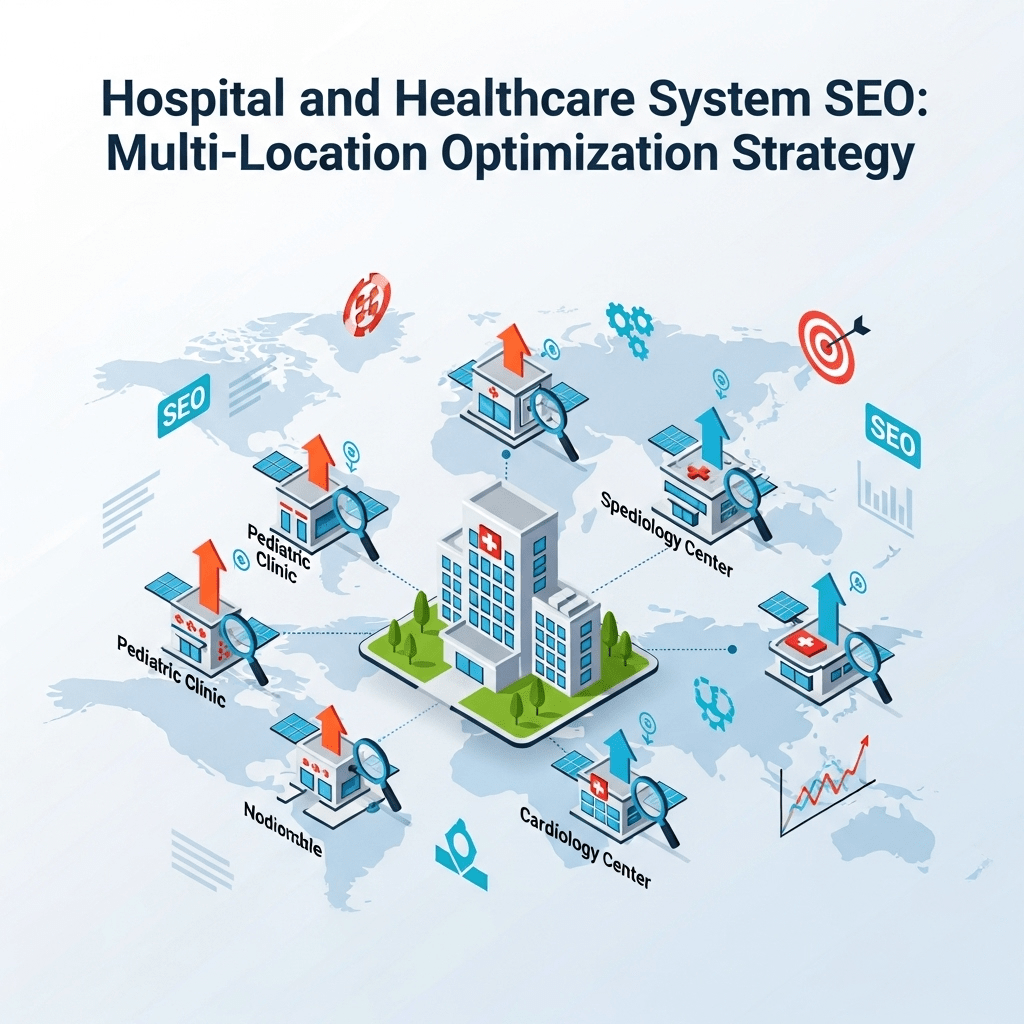
Your hospital system has 12 locations, 47 specialty departments, 340 physicians, and a $4 million marketing budget. Yet somehow, the single-location urgent care clinic down the street outranks you for “emergency care [your city].”
How is that even possible?
Welcome to the paradox of enterprise healthcare SEO: More resources don’t automatically mean better rankings. In fact, hospital SEO strategy often suffers from the opposite problem—too many pages, conflicting content, organizational silos, and technical debt that would make a developer weep.
Here’s what keeps hospital CMOs awake at night: You’re competing simultaneously against local competitors, national health systems, WebMD for informational queries, and even your own locations cannibalizing each other’s rankings.
A patient searching “orthopedic surgeon” should find your orthopedic department. Instead, they find your homepage, three different location pages, two surgeon bios, and a blog post from 2019—none of which answer their question or let them book an appointment.
The brutal truth: Healthcare system optimization is exponentially more complex than single-location medical practice SEO. You’re not just optimizing a website—you’re organizing a digital ecosystem where every location, department, service line, and provider needs strategic positioning without competing against itself.
But here’s the good news: Get it right, and you create an SEO moat competitors can’t cross. Your domain authority compounds, your content library becomes unbeatable, and your market dominance becomes self-reinforcing.
Ready to transform your hospital system into a search engine powerhouse? Let’s decode multi-location medical SEO for enterprise healthcare.
Table of Contents
ToggleWhat Makes Hospital SEO Strategy Different from Single-Practice Optimization?
Hospital SEO strategy isn’t just “regular medical SEO at scale.” It’s a fundamentally different challenge requiring enterprise-level thinking, sophisticated site architecture, and cross-departmental coordination.
The Unique Complexity of Healthcare System SEO
Scale creates exponential problems, not linear ones.
A single-location practice might have:
- 1 location page
- 5-10 service pages
- 3-8 provider bios
- 20-30 blog articles
A mid-sized hospital system has:
- 8-15 location pages
- 100+ service pages
- 200-500 provider bios
- Multiple microsites for service lines
- 500+ legacy blog articles
- Department-specific pages
- Centers of excellence
- Community health pages
This isn’t 10x more work—it’s 100x more complexity because everything must work together without cannibalizing rankings or confusing patients.
The Organizational Challenges Nobody Talks About
Marketing works in silos:
- Corporate marketing owns the main site
- Each hospital location has marketing staff with local priorities
- Service line leaders want independent microsites
- Physicians want personal websites
- Foundation has separate donor site
- HR recruiting on different domain
Result: Seven different teams optimizing for the same keywords, fragmenting your domain authority and confusing Google about which page should rank.
Sound familiar?
Decision-making is glacial:
- Website changes require 6-committee approval
- Legal reviews everything (adding 4-6 weeks)
- Compliance must sign off on all content
- IT controls technical implementation
- Each department wants “their” content prominent
Meanwhile, your nimble single-location competitor publishes 3 optimized pages and steals your patients.
The Technical Debt Inherited from Hospital Mergers
Merger and acquisition chaos: You acquired three hospitals in five years. Now you have:
- Four different CMS platforms
- Inconsistent URL structures
- Duplicate content across legacy sites
- Broken redirects from old domains
- Mixed branding (some locations still use old names)
Each acquisition adds SEO complexity:
- Do you migrate to main domain or keep separate?
- How do you preserve legacy rankings?
- Which content is worth keeping?
- How do you handle local brand loyalty?
Most hospitals opt for the path of least resistance: Keep everything running, creating a Frankenstein SEO nightmare.
For foundational healthcare SEO principles that apply regardless of organizational size, review comprehensive healthcare SEO and YMYL compliance strategies.
How Do You Structure Multi-Location Hospital Websites for Search?
Healthcare system optimization success starts with information architecture. Get the structure wrong, and no amount of content or links will save you.
The URL Structure Decision That Impacts Everything
You have three primary options for organizing multi-location hospital systems:
Option 1: Subdirectories (Recommended for Most)
mainhospital.com/locations/downtown
mainhospital.com/locations/westside
mainhospital.com/locations/eastside
mainhospital.com/services/cardiology
mainhospital.com/services/orthopedics
mainhospital.com/doctors/dr-james-chen
Advantages: ✅ Consolidates domain authority to single site ✅ Easier to manage technically ✅ Clear hierarchy and navigation ✅ Best for locations under single brand
Disadvantages: ⚠️ Harder to differentiate location-specific branding ⚠️ Can feel generic to local communities ⚠️ Some locations may resist corporate identity
Option 2: Subdomains
downtown.mainhospital.com
westside.mainhospital.com
services.mainhospital.com
doctors.mainhospital.com
Advantages: ✅ Allows distinct experiences per location ✅ Easier to implement different CMS per location ✅ Can track analytics separately
Disadvantages: ❌ Google treats subdomains somewhat separately (fragments authority) ❌ More complex to maintain ❌ Harder to create cohesive user experience ❌ Not recommended for SEO unless absolutely necessary
Option 3: Separate Domains
downtownhospital.com
westsidehospital.com
mainhospitalsystem.com (corporate)
Advantages: ✅ Preserves strong local brand identity ✅ Works when locations have different names ✅ Useful post-acquisition during transition
Disadvantages: ❌ Fragments domain authority across multiple sites ❌ Expensive to maintain multiple sites ❌ Harder to create system-wide content strategy ❌ Can confuse patients about relationship between facilities
Decision Framework:
| Scenario | Recommended Structure | Rationale |
|---|---|---|
| Single brand, multiple locations | Subdirectories | Maximize domain authority |
| Recent acquisitions with distinct brands | Separate domains temporarily, migrate to subdirectories | Preserve rankings during transition |
| Locations with completely different names | Separate domains + cross-linking | Maintains brand identity while showing relationship |
| Academic medical center + community hospitals | Subdirectories for community, main domain for academic | Balances prestige and accessibility |
Pro Tip: If you’re choosing between structures, default to subdirectories unless you have compelling reasons otherwise. Google has confirmed that consolidating content under one domain passes authority more effectively than spreading across subdomains or separate sites.
Creating Location Pages That Rank and Convert
Hospital website architecture for locations requires balancing local SEO with system cohesion.
Essential location page elements:
Above the fold:
- Location name + main hospital system name
- Full address (schema markup)
- Phone number (click-to-call on mobile)
- Hours of operation
- Emergency services indicator (if applicable)
- “Get Directions” CTA
- “Schedule Appointment” CTA
Services unique to this location: Not every location offers every service. Highlight what makes THIS location valuable:
- Emergency room (if applicable)
- Specialized services (stroke center, trauma center, birthing center)
- Unique equipment (MRI, CT, cardiac cath lab)
- Specialty clinics at this location
Provider directory for this location:
- Photos of doctors who practice at this location
- Specialties available
- Link to full provider bios
- “Find a Doctor at [Location Name]” search
Patient testimonials location-specific:
- Reviews from patients treated at THIS location
- Star ratings for this facility
- Video testimonials (with consent)
Local community information:
- Nearby landmarks for wayfinding
- Public transportation options
- Parking information
- Accessibility features
- Hospital campus map
Emergency department specific info (if applicable):
- Current ER wait time (if available)
- “When to visit ER vs. urgent care”
- Conditions treated
- Pediatric ER if available
Insurance and billing:
- Insurance plans accepted at this location
- Financial assistance programs
- Billing department contact
Pro Tip: Create a “Services at [Location Name]” section that lists ONLY services available at this specific location, linking to the full service pages. This prevents patients from assuming all locations offer all services, reducing frustrated calls and visits.
Optimizing Department and Service Line Pages
Department pages optimization is where most hospital systems fail. They create generic, duplicated content across departments because nobody owns the holistic strategy.
The department page hierarchy:
Level 1: Service Line Overview
/services/heart-and-vascular

Level 2: Specific Departments
/services/heart-and-vascular/cardiology
/services/heart-and-vascular/cardiac-surgery
/services/heart-and-vascular/vascular-surgery

Level 3: Specific Conditions/Procedures
/services/heart-and-vascular/cardiology/atrial-fibrillation
/services/heart-and-vascular/cardiac-surgery/coronary-bypass
Service line landing page components:
H1: [Service Line Name] at [Hospital System] Example: “Heart & Vascular Care at Memorial Health System”
Opening paragraph (150-200 words):
- Overview of comprehensive services
- Accreditations/certifications (Chest Pain Center, Stroke Center)
- Patient volume statistics
- Unique capabilities
- Focus keyword: hospital SEO strategy incorporated naturally
H2: Our Heart & Vascular Services
- Bulleted list of all related services with links
- Organized by sub-specialty
- Each linking to dedicated page
H3: Locations Offering Heart & Vascular Care
- Interactive map or list
- Not all locations = clear about which offer what
- Link to location-specific service information
H2: Conditions We Treat
- Comprehensive list of conditions
- Each condition links to detailed page
- Organized by frequency/importance
H2: Meet Our Heart & Vascular Specialists
- Featured cardiologists, surgeons, specialists
- Photos, brief bios, credentials
- Link to full provider directory for this service line
H2: Advanced Technology & Techniques
- Specific equipment (hybrid OR, cardiac MRI, etc.)
- Minimally invasive techniques
- Research/clinical trials available
H3: Patient Outcomes & Quality Measures
- Publicly reported quality data
- Accreditations and awards
- Patient satisfaction scores
- Better than state/national averages (if true)
H2: Patient Stories (if available)
- Video or written testimonials
- Real patients (with consent)
- Specific conditions and outcomes
H2: Insurance & Financial Information
- Plans accepted
- Financial counseling available
- Link to detailed insurance page
Call-to-action:
- Schedule consultation
- Find a doctor
- Second opinion services
- Call for more information
Pro Tip: Don’t create separate pages for services offered at multiple locations. Create ONE authoritative service page, then dynamically show which locations offer that service. This concentrates authority on one page and avoids duplicate content issues.
Solving the Provider Bio Scaling Challenge
With 200-500 physicians, how do you create optimized provider bios without overwhelming your site structure?
Provider directory architecture:
/doctors (main directory with search/filter)
/doctors/dr-james-chen-cardiologist
/doctors/dr-sarah-martinez-orthopedic-surgeon

Organized by:
- Specialty filter
- Location filter
- Accepting new patients filter
- Gender filter
- Languages spoken filter
Individual provider page structure:
Above fold:
- Professional photo (consistent style)
- Full name with credentials (MD, DO, PA, NP)
- Specialty and sub-specialties
- Star rating and review count
- “Schedule Appointment” CTA
- Phone number
- Locations where they practice
Bio section (300-500 words):
- Why they chose medicine
- Training and education
- Special interests or approaches
- Personal information (builds connection)
- SEO keyword integration: “As a board-certified cardiologist at Memorial Health System, Dr. Chen specializes in…”
Education & Training:
- Medical school
- Residency
- Fellowships
- Board certifications
- Years in practice
Clinical Interests:
- Specific conditions treated
- Procedures performed
- Research interests
- Publications (if applicable)
Locations & Availability:
- All locations where they see patients
- Link to each location page
- Days/times at each location
- “Request appointment at [location]” CTAs
Patient Reviews:
- Aggregate rating
- Recent reviews (5-10 most recent)
- Link to all reviews
Accepted Insurance:
- Plans this provider accepts
- May vary by location
Languages Spoken: Important for diverse communities
Hospital Privileges: Which facilities where they can admit patients
Schema markup for providers:
{
  "@context": "https://schema.org",
  "@type": "Physician",
  "name": "Dr. James Chen",
  "medicalSpecialty": "Cardiology",
  "affiliation": {
    "@type": "Organization",
    "name": "Memorial Health System"
  },
  "address": {
    "@type": "PostalAddress",
    "streetAddress": "123 Medical Plaza",
    "addressLocality": "Springfield",
    "addressRegion": "IL",
    "postalCode": "62701"
  },
  "availableService": [
    {
      "@type": "MedicalProcedure",
      "name": "Cardiac Catheterization"
    }
  ],
  "image": "https://memorial.com/doctors/dr-james-chen.jpg",
  "telephone": "+1-217-555-0123"
}
Scaling provider content creation:
Template approach:
- Provide questionnaire to all physicians
- Standard questions: training, interests, approach
- Marketing team formats consistently
- Physician reviews and approves
- Publish en masse
Video introductions:
- 90-second provider intro videos
- Filmed in batches (film crew visits)
- Huge differentiation from text-only competitors
- Boosts engagement and trust
Progressive enhancement:
- Launch with basic info for all providers
- Enhance high-volume specialties first
- Add patient reviews as they accumulate
- Update periodically (annual reviews)
How Do You Handle SEO for Multi-Location Healthcare Systems Without Cannibalizing Rankings?
The biggest fear in multi-location medical SEO: Your locations competing against each other in search results instead of dominating as unified force.
The Keyword Cannibalization Problem
The scenario: Patient searches “knee replacement Springfield”
Your hospital system has:
- /services/orthopedics/knee-replacement
- /locations/downtown/orthopedics
- /locations/westside/orthopedics
- /doctors/dr-chen-knee-specialist
- Blog: “Preparing for Knee Replacement Surgery”
Google’s confusion: Which page should rank?
Result: Google shows none of them prominently, or rotates between them, preventing any from dominating the #1 spot.
Strategic Keyword Mapping Across Your System
Solve cannibalization with clear keyword assignments:Page TypeTarget KeywordsExample Internal linking strategy prevents cannibalization: Blog article (“Knee Replacement Recovery Tips”) links to: Service page links to: Location page links to: Provider page links to: The content differentiation strategy: Service page focus: Comprehensive information about the condition/procedure Location page focus: What’s unique about receiving THIS service at THIS location Provider page focus: Why THIS doctor for THIS procedure Pro Tip: Use canonical tags strategically. If you must have location-specific service pages that duplicate main service page content, set canonical tag pointing to main service page. This tells Google “this is the definitive version” while still allowing location-specific booking CTAs. Local SEO for each location without fragmenting authority: Google Business Profile strategy: Each hospital location needs: Category selection nuances: Primary category: “Hospital” or “Medical Center” Secondary categories (choose 5-10 most relevant): Location-specific content on site: Embed map showing service area: “Memorial Downtown Hospital serves patients throughout central Springfield, including [list 10-15 surrounding neighborhoods]” Local community health information: Service availability by location: Clear tables showing which services at which locations: This prevents patients from going to wrong location and reduces bounce rate from location pages. Post-merger SEO strategy when hospital names differ: Scenario: Memorial Health System acquired Riverside Hospital Options: Option 1: Gradual rebrand and migration (18-24 months) Phase 1 (Months 1-6): Maintain separate sites Phase 2 (Months 7-12): Begin co-branding Phase 3 (Months 13-18): Plan migration Phase 4 (Months 19-24): Complete migration Option 2: Maintain separate brands permanently When this makes sense: Implementation: Pro Tip: If maintaining separate brands, create a system-level “Find a Location” tool that includes all hospitals/locations regardless of brand. Host on corporate site and embed on each location site. This captures patients searching generically while preserving brand identity. Healthcare service lines require technical excellence because you’re fighting both complexity and compliance requirements. The challenge: Hospital sites typically have: Result: Slow load times that hurt rankings and conversions. Core Web Vitals targets:MetricTargetCommon Hospital Site RealityLCP (Largest Contentful Paint)< 2.5s4-7 secondsFID (First Input Delay)< 100ms200-400msCLS (Cumulative Layout Shift)< 0.10.15-0.3 Optimization strategies: Image optimization: JavaScript/CSS optimization: Third-party script management: Caching strategy: Pro Tip: Hospital IT departments often resist performance changes due to security concerns. Frame optimization as patient experience improvement: “Every 1-second delay decreases conversions by 7%. That’s [X] lost patient appointments per month.” Leadership responds to business impact, not technical metrics. Standard analytics implementation violates HIPAA for hospitals. Here’s what’s different: What you CAN’T track: ❌ Individual patient behavior through portal ❌ Appointment booking details containing PHI ❌ Form submissions with patient information ❌ User IDs connecting to patient records What you CAN track: ✅ Aggregate page views ✅ Traffic sources (organic, paid, referral) ✅ General form submissions (not field-level data) ✅ Scroll depth and engagement ✅ Appointment initiated (not details) Implementation requirements: IP anonymization: Enable in Google Analytics 4: Disable User ID tracking: Don’t pass patient portal IDs or medical record numbers to analytics Exclude PHI from URLs: Bad: Use aggregate event tracking: Track “appointment requested” not “Dr. Chen cardiology appointment for John Smith” Business Associate Agreements: For comprehensive guidance on HIPAA-compliant analytics implementation, review healthcare privacy and tracking best practices. Schema markup dramatically improves how Google understands and displays your healthcare system. Organization schema (main hospital system): Department/Service schema: FAQ schema for common questions: Video schema for patient education: Pro Tip: Implement Event schema for community health events, screenings, and classes. These can appear in Google’s event search results, driving community engagement and local SEO signals. The common scenario: Over 15 years, your system launched microsites for: Now consolidating to main domain. How do you preserve rankings? Redirect strategy: 1. Audit legacy sites for valuable content: 2. Map redirects carefully: Don’t just redirect everything to homepage: ❌ Bad: HeartCenterSpringfield.com → memorialhealth.com Do precise page-to-page mapping: ✅ Good: HeartCenterSpringfield.com/services/bypass → memorialhealth.com/services/heart-vascular/cardiac-surgery/coronary-bypass 3. Implement 301 redirects: 4. Update external references: 5. Monitor post-migration: Redirect file example (Apache .htaccess): Pro Tip: Don’t delete old domains after redirecting. Maintain ownership and keep redirects active permanently. Competitors can acquire expired domains and use them to compete against you or for malicious purposes. Healthcare service lines require massive content libraries. Creating hundreds of optimized pages without sacrificing quality is the challenge. Establishing systematic content production: Content tiers based on priority: Tier 1 content (Top 50 service/condition pages): Examples: Tier 2 content (Next 150 pages): Examples: Tier 3 content (Comprehensive coverage): Examples: Service page template structure: This template can generate 200+ pages by changing: Content creation workflow: Step 1: Medical accuracy review Step 2: Writer creates draft Step 3: SEO optimization Step 4: Clinical and compliance review Step 5: Publication and promotion Pro Tip: Create a content assembly line with specialists at each step rather than expecting one person to do everything. Medical writer → SEO optimizer → Designer → Compliance → Publisher. This allows scaling without quality sacrifice. The challenge: Physicians are overworked and won’t write blog posts. The solution: Make contribution ridiculously easy. Micro-content approach: 15-minute physician contribution: Result: One blog post, one video, FAQ content, social media posts. Physician interview content model: Process: One 30-minute interview generates: Recognition and incentives: What motivates physician participation: Physician content leaderboard: Pro Tip: Film “day in the life” content for 5-10 physicians across specialties. These authentic videos showing hospital culture, patient interactions (with consent), and physician expertise are marketing gold and require minimal physician time (follow them for 2-3 hours). For additional strategies on creating medical content that ranks and converts, explore comprehensive healthcare content marketing approaches. Even well-funded hospital marketing teams make costly hospital SEO strategy errors. The error: Building site navigation and content hierarchy around internal org chart rather than patient needs. What this looks like: Why it hurts SEO: Google ranks pages that satisfy user intent. Patients search “knee pain” not “Department of Orthopedics.” The fix: Patient-centric navigation: Content organized by patient search behavior: The error: Focusing exclusively on brand and system-level SEO while neglecting individual location optimization. The flawed thinking: “We’re Memorial Health System—people know us. We don’t need to worry about local SEO for each location.” Reality check: The fix: Robust local SEO for every location: Hybrid strategy: The scenario: You offer cardiology services at 8 locations. Someone creates identical “Cardiology Services” page for each location, changing only the location name. Google’s reaction: Sees 8 nearly-identical pages, ranks none of them well, and may even penalize for duplicate content. The fix: Hub and spoke content model: Hub page: Main comprehensive service page Spoke pages: Location-specific pages emphasizing differentiators Alternative: Dynamic location content The tempting idea: “Let’s create MemorialHeartCenter.com as a dedicated site for our prestigious cardiology program!” Why it seems good: Why it hurts SEO: The fix: Subdirectory approach: Benefits: When microsites make sense: Even then: Extensive cross-linking and clear relationship statements. The stat: 68% of healthcare searches happen on mobile devices, yet 47% of hospital websites have poor mobile usability. Common mobile issues: Tiny tap targets: Forms from hell: Navigation nightmares: The fix: Mobile-first design: Progressive disclosure for forms: Mobile-specific testing: Pro Tip: Install session recording software (with HIPAA-compliant setup) and watch recordings of mobile users. You’ll immediately see frustrations: tapping wrong buttons, abandoning forms, bouncing because they can’t find information. This reveals issues analytics alone can’t show. Multi-location hospital SEO requires sophisticated analytics beyond “more traffic. Traffic metrics (vanity metrics—track but don’t obsess): Engagement metrics (more meaningful): Conversion metrics (what actually matters): 📊 Appointment requests submitted (by service line, location, provider) 📊 Phone calls generated (tracked via CallRail or similar) 📊 Provider profile views leading to appointments 📊 Emergency department visits from organic search (harder to track but estimate via ED check-in surveys) 📊 Patient portal registrations (if promoted via SEO content) Revenue metrics (the ultimate KPIs): 💰 Patient acquisition cost from SEO (total SEO investment / patients acquired) 💰 Patient lifetime value by source (SEO vs. paid vs. referral) 💰 Procedure volume from SEO-sourced patients 💰 Revenue per patient from organic search 💰 ROI calculation (revenue from SEO patients – SEO costs) The complexity: Patient journey is rarely linear: Which source gets credit? First touch? Last touch? All touches? Multi-touch attribution models: Recommended for hospitals: Position-based (40/20/40) Implementation: Google Analytics 4: CRM integration: Call tracking: Executive dashboard (high-level monthly reporting): SEO Performance Summary: Patient Acquisition: Revenue Impact: Competitive Positioning: Service line dashboard (department-specific): Cardiology dashboard example: Allows service line leaders to see direct impact of SEO on their department. Location dashboard (individual hospital tracking): Downtown Hospital example: Pro Tip: Create automated monthly reports (via Google Data Studio/Looker Studio) that update in real-time. Stakeholders can access whenever they want rather than waiting for monthly email. This increases transparency and buy-in for SEO initiatives. Healthcare system optimization is evolving rapidly with AI, voice search, and changing patient expectations. Google AI Overviews (formerly SGE) synthesize answers from multiple sources before showing traditional results. For hospitals, this means: Informational queries: “What causes chest pain?” → AI Overview answers directly Patient impact: May get answer without clicking any hospital site Strategy: Focus on transactional queries AI can’t fulfill (“schedule cardiologist appointment”) Transactional queries: “Cardiologist near me” → Still shows map pack and traditional results Why: AI can’t schedule appointments or choose providers for patients Strategy: Optimize for local map pack, provider profiles, appointment booking How to adapt: Create content AI will cite: Structured data for AI understanding: Focus on bottom-funnel content: The trend: 58% of consumers have used voice search to find local business information, including healthcare. Voice search patterns differ: Typed: “orthopedic surgeon Springfield IL” Voice searches are: Optimization strategies: Featured snippet optimization: Voice assistants read featured snippets as answers: FAQ sections with schema: “Near me” optimization: Conversational content style: Write how people speak: Telehealth adoption is permanent: 38% of Americans have used telehealth, up from 11% pre-pandemic. Hospital systems must optimize for virtual care searches: Keywords expanding: Content opportunities: Technical implementation: For comprehensive telehealth SEO strategies, review virtual care optimization and telemedicine marketing best practices. The challenge: Multi-location systems generate reviews across hundreds of profiles (Google, Healthgrades, Vitals, Facebook). Scale of challenge: 12 locations × 8 review platforms = 96 profiles to monitor Systematic reputation management: Centralized monitoring: Response protocols: Positive reviews: Negative reviews: Review generation at scale: Systematic requests: Staff training: Volume by location dashboard: Track which locations generate reviews and which lag: Pro Tip: Don’t try to hide negative reviews or only promote positive ones. Respond professionally to all reviews, demonstrating accountability and patient focus. Hospitals with 4.3-4.7 star average ratings (not perfect 5.0) are actually trusted MORE because they appear authentic. Q: Should our hospital system have one website or separate sites for each location? A: One unified website with subdirectories for each location is recommended for most systems. This consolidates domain authority, makes management easier, and creates better user experience. Use: Exception: If acquired hospitals have strong brand identities and distinct names, consider maintaining separate sites temporarily (1-2 years) with extensive cross-linking, then gradually migrating to unified structure. Q: How do we avoid our locations competing against each other in search results? A: Strategic keyword mapping prevents cannibalization: Use canonical tags when duplicate content is necessary, pointing to the authoritative version. Q: How long does hospital SEO take to show results? A: Realistic timeline: Large hospital systems see meaningful results around 9-12 months due to scale and complexity. Q: What’s more important: organic SEO or paid search for hospitals? A: Both serve different purposes: Paid search (Google Ads): Organic SEO: Recommended: 60-70% budget to paid in Year 1, gradually shifting to 30-40% paid / 60-70% organic by Year 3 as SEO matures. Q: Do physician ratings and reviews impact SEO rankings? A: Yes, significantly. Reviews impact SEO through: Hospitals with 200+ Google reviews and 4.5+ star ratings significantly outrank competitors with fewer/lower reviews, even when other SEO factors are equal. Q: How do we handle SEO when our hospital system has multiple brands? A: Create clear brand architecture: Parent brand (health system): Hospital brands (if distinct): Cross-linking strategy: Content strategy: Q: Should we create separate microsites for centers of excellence? A: Generally no. Create premium sections within main site: Benefits of subdirectory approach: When microsites make sense: Q: What’s the ROI of hospital SEO? A: Hospital SEO typically achieves 300-800% ROI by Year 2-3, with patient acquisition costs from SEO 40-60% lower than paid advertising. Example ROI calculation: Year 1 Investment: $250,000 Year 2 Results: Year 2 ROI: ($7.26M – $250K) / $250K = 2,804% ROI Actual results vary by market competitiveness, service mix, and execution quality, but mature hospital SEO programs consistently deliver 5:1 to 15:1 returns. Here’s the reality about hospital SEO strategy: You’re playing a long game with massive payoffs for winners and irrelevance for losers. The hospitals dominating search in 2026 and beyond won’t be those with biggest budgets—they’ll be those with: Strategic clarity: Understanding that enterprise SEO isn’t just bigger single-practice SEO; it’s different Organizational alignment: Marketing, IT, operations, and clinical leadership working together Patient-centricity: Building site structure and content around patient needs, not internal politics Technical excellence: Fast, secure, mobile-optimized experiences that work flawlessly Content at scale: Systematic content production maintaining quality across hundreds of pages Long-term commitment: Recognizing SEO is a 2-3 year journey to dominance, not a 3-month project Your 90-day hospital SEO action plan: Days 1-30: Audit and strategy Days 31-60: Foundation building Days 61-90: Content and authority The competitive moat you’re building: Unlike paid advertising that stops working when budget ends, SEO creates compounding advantages: Year 1: Foundation and early wins Your hospital system needs patients. Those patients are searching Google right now. The only question: Will they find you or your competitors? The choice is yours. The patients are searching. Your move. Disclaimer: This guide provides general SEO strategies for hospital and healthcare systems. Always ensure marketing practices comply with HIPAA, state healthcare regulations, medical board requirements, FTC advertising guidelines, and CMS rules. Consult with legal counsel specializing in healthcare marketing compliance before implementing new digital strategies. SEO results vary by market, competition, and execution quality.Service line page [Condition] [System name], [Specialty] [System name] “knee replacement Memorial Health”, “orthopedics Memorial” Department page [Department] [System name], [Department] services “orthopedic department Memorial”, “orthopedic surgery services” Location page [Service] near me, [Service] [City], [Location name] “orthopedics near me”, “knee surgery Springfield”, “Downtown Hospital orthopedics” Provider page [Doctor name] [Specialty], [Specialty] doctor [City] “Dr. Chen orthopedic surgeon”, “knee specialist Springfield” Blog content Educational long-tail, questions “how long is knee replacement recovery”, “preparing for knee surgery” Geographic Targeting for Hospital Locations
Service Downtown Westside Eastside Emergency Room ✅ 24/7 ✅ 24/7 ❌ Trauma Center (Level II) ✅ ❌ ❌ Birthing Center ✅ ✅ ❌ Orthopedic Surgery ✅ ✅ ✅ Cardiac Catheterization ✅ ❌ ✅ Managing Multiple Brands After Acquisitions
What Technical SEO Considerations Matter Most for Hospital Websites?
Site Speed for Resource-Heavy Hospital Sites
HIPAA-Compliant Analytics and Tracking
/appointment?patient_id=12345&condition=diabetes Good: /appointment-confirmationStructured Data Implementation for Hospitals
{
  "@context": "https://schema.org",
  "@type": "Hospital",
  "name": "Memorial Health System",
  "url": "https://www.memorialhealth.com",
  "logo": "https://www.memorialhealth.com/logo.png",
  "image": "https://www.memorialhealth.com/facility-photo.jpg",
  "description": "Memorial Health System operates 12 hospitals...",
  "address": {
    "@type": "PostalAddress",
    "streetAddress": "500 Medical Center Drive",
    "addressLocality": "Springfield",
    "addressRegion": "IL",
    "postalCode": "62701",
    "addressCountry": "US"
  },
  "telephone": "+1-217-555-1000",
  "hasMap": "https://maps.google.com/...",
  "openingHoursSpecification": {
    "@type": "OpeningHoursSpecification",
    "dayOfWeek": [
      "Monday", "Tuesday", "Wednesday", "Thursday",
      "Friday", "Saturday", "Sunday"
    ],
    "opens": "00:00",
    "closes": "23:59"
  },
  "medicalSpecialty": [
    "Cardiology",
    "Orthopedics",
    "Neurology"
  ]
}
{
  "@context": "https://schema.org",
  "@type": "MedicalBusiness",
  "name": "Heart & Vascular Center",
  "parentOrganization": {
    "@type": "Hospital",
    "name": "Memorial Health System"
  },
  "medicalSpecialty": "Cardiology",
  "availableService": [
    {
      "@type": "MedicalProcedure",
      "name": "Cardiac Catheterization"
    },
    {
      "@type": "MedicalTherapy",
      "name": "Cardiac Rehabilitation"
    }
  ]
}
{
  "@context": "https://schema.org",
  "@type": "FAQPage",
  "mainEntity": [
    {
      "@type": "Question",
      "name": "Do you accept my insurance?",
      "acceptedAnswer": {
        "@type": "Answer",
        "text": "Memorial Health System accepts most major insurance plans including..."
      }
    }
  ]
}
{
  "@context": "https://schema.org",
  "@type": "VideoObject",
  "name": "What to Expect During Knee Replacement Surgery",
  "description": "Dr. Chen explains...",
  "thumbnailUrl": "https://memorialhealth.com/video-thumb.jpg",
  "uploadDate": "2024-11-15",
  "duration": "PT3M42S"
}
Managing URL Redirects from Retired Microsites
Redirect 301 /services/cardiac-care https://memorialhealth.com/services/heart-vascular/cardiology
Redirect 301 /doctors/dr-chen https://memorialhealth.com/doctors/dr-james-chen-cardiologist
Redirect 301 /about https://memorialhealth.com/about-memorial-health-system
How Do You Create Content at Scale for Hospital Systems?
The Content Factory Model for Enterprise Healthcare
Tier Pages Timeline Investment Tier 1: Essential 50 pages Months 1-3 High-quality, custom Tier 2: Important 150 pages Months 4-9 Template-based, enhanced Tier 3: Complete 300+ pages Months 10-18 Template-based, standard Content Templates That Scale Quality
H1: [Service Name] at [Hospital System Name]
[Include focus keyword naturally]

Opening paragraph (150-200 words):
- What the service/condition is
- Why patients need this care
- What makes your system qualified
- Call-to-action prompt

H2: About [Condition/Service]
- Comprehensive explanation
- Statistics/prevalence
- Risk factors
- When to seek care

H2: Symptoms and Diagnosis
- Common symptoms
- Diagnostic approaches
- When to see a doctor
- Emergency warning signs

H2: Treatment Options at [Hospital System]
- Conservative treatments
- Surgical interventions
- Advanced technologies available
- Multidisciplinary approach

H3: Why Choose [Hospital System] for [Service]
- Accreditations/certifications
- Volume statistics
- Outcomes data
- Technology advantages
- Specialized expertise

H2: Our [Service] Team
- Featured physicians with photos
- Credentials highlighted
- Link to full provider directory
- Team-based care approach

H2: Locations Offering [Service]
- List of locations (with links)
- Interactive map
- Appointment scheduling

H2: What to Expect
- Pre-procedure preparation
- Day of procedure
- Recovery timeline
- Follow-up care

H2: Insurance and Financial Information
- Plans accepted
- Financial counseling
- Payment options
- Link to detailed insurance page

H2: Frequently Asked Questions
- 8-12 common questions
- Schema markup for FAQ
- Answers from providers when possible

H3: Patient Stories [if available]
- 1-2 testimonials
- Real patient experiences
- Photos/videos with consent

CTA: Schedule a Consultation | Find a Doctor | Learn More
Physician-Generated Content Without Overwhelming Busy Doctors
What Are the Biggest Hospital SEO Mistakes (And How to Avoid Them)?
Mistake #1: Prioritizing Stakeholders Over Patients
❌ Hospital structure:
- About Us
- Departments
  - Orthopedics
  - Cardiology
- For Patients
- For Visitors

✅ Patient-focused:
- Find a Doctor
- Services & Conditions
  - Orthopedics & Sports Medicine
  - Heart & Vascular Care
- Locations
- Patients & Visitors
- About [Hospital Name]
Mistake #2: Ignoring Local SEO Because “We’re a Large System”
Mistake #3: Duplicate Content Across Multiple Locations
/services/cardiology/locations/downtown/services (lists all services including cardiology)Mistake #4: Launching Service Line Microsites That Fragment Authority
memorialhealthsystem.com/heart-vascularMistake #5: Neglecting Mobile Experience
How Do You Measure Success for Hospital System SEO?
KPIs That Actually Matter for Healthcare Systems
Attribution Challenges in Multi-Touch Healthcare Journeys
Model How It Works When to Use First-touch Credits first interaction (blog post) Understand awareness drivers Last-touch Credits final interaction (branded search) Understand direct converters Linear Equal credit to all touchpoints Balance awareness and conversion Time-decay More credit to recent interactions Emphasize conversion influences Position-based Credits first and last, less to middle Emphasize awareness and conversion Dashboards for Hospital Marketing Teams
What’s the Future of Hospital SEO?
AI Overviews Impact on Healthcare Search
Voice Search Optimization for Healthcare
Spoken: “OK Google, find me an orthopedic surgeon near me who accepts Blue Cross”Virtual Care Integration and SEO
Reputation Management at Scale
Plus 300 individual provider profiles across platforms
Total: 2,400+ potential review destinationsFAQs About Hospital and Healthcare System SEO
mainhospital.com/locations/downtownmainhospital.com/locations/westsideMemorialHealthSystem.com – Corporate site, system-wide informationMemorialCityHospital.com – Individual hospital with distinct identityRiversideHospital.com – Acquired hospital with community loyaltymainhospital.com/cancer-centermainhospital.com/heart-instituteFinal Thoughts: Building Your Hospital SEO Roadmap
Year 2: Exponential growth as authority builds
Year 3: Market dominance—competitors can’t easily catch up
Year 4+: Sustained competitive advantage requiring minimal incremental investment