


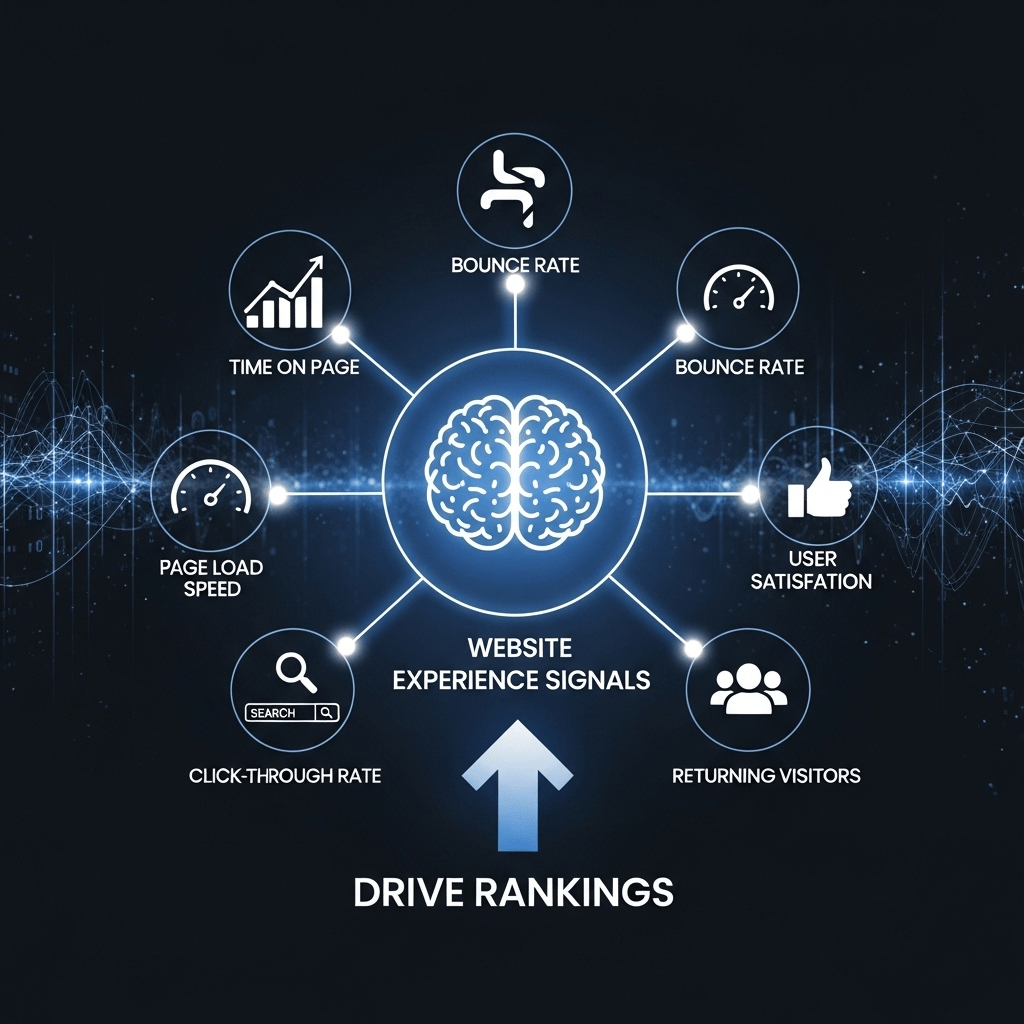
The most persistent misconception in technical SEO is that Core Web Vitals are a tiebreaker — a minor factor that only matters when everything else is equal. Google’s own documentation contradicts this directly, and the data from sites that have resolved chronic Core Web Vitals failures consistently shows ranking improvements independent of content changes.
Website experience signals are the measurable user behaviour metrics — loading performance, visual stability, interactivity, click patterns, and on-site engagement — that Google’s ranking systems use to evaluate whether a page delivers a satisfactory experience to the user who lands on it. They are not a proxy for content quality. They are an independent evaluation layer that can suppress rankings regardless of how strong a page’s content or backlink signals are.
Google’s Page Experience system, confirmed as a ranking signal in 2021 and expanded since, evaluates experience signals at the individual URL level — not the domain level. A site with excellent content and strong authority can have individual pages suppressed because their experience signals fall below threshold, while those same pages rank for less competitive queries where experience signals carry less comparative weight.
S I Moz has audited experience signal profiles across multiple WordPress-based content sites since 2022, tracking which signal improvements — Core Web Vitals fixes, mobile usability resolutions, CTR optimisation — produced measurable ranking changes and which produced none. The pattern that emerges contradicts the “tiebreaker” framing consistently.
What most experience signal guides miss is the distinction between confirmed ranking signals and correlated metrics. This guide maps that distinction precisely — and the practical audit sequence that follows from it.
Post Summary
- Website experience signals = measurable user behaviour metrics Google uses to evaluate whether a page delivers a satisfactory experience
- Confirmed ranking signals: Core Web Vitals (LCP, INP, CLS), mobile usability, HTTPS, intrusive interstitials
- Correlated but unconfirmed: bounce rate, dwell time, pages per session — Google has not confirmed these as direct ranking inputs
- Core Web Vitals are evaluated at URL level — poor scores on individual pages can suppress rankings regardless of domain authority
- CTR from search results functions as a feedback loop — Google uses click patterns across users to adjust ranking positions
- Sites that resolve chronic Core Web Vitals failures consistently show ranking improvements within 4–8 weeks independent of content changes
Table of Contents
ToggleWhat Website Experience Signals Actually Measure
Google’s Page Experience ranking signal system is built around a specific and publicly documented set of metrics. Understanding what is confirmed versus what is assumed clarifies where optimisation effort produces ranking returns and where it produces only operational improvements.
The confirmed Page Experience signals as of 2025 are Core Web Vitals (Largest Contentful Paint, Interaction to Next Paint, Cumulative Layout Shift), mobile usability, HTTPS security, and absence of intrusive interstitials (Source: Google Search Central, “Page Experience,” 2024). Everything else — bounce rate, time on page, scroll depth, pages per session — is correlated with rankings but not confirmed as a direct input.
The Difference Between UX Signals and UX Metrics
This distinction has practical consequences for audit prioritisation. A UX signal is a metric Google has confirmed it uses in its ranking algorithms. A UX metric is a measurement that reflects user behaviour but whose ranking influence is indirect — it affects rankings through user satisfaction, which affects other confirmed signals, rather than feeding directly into the algorithm.
Treating unconfirmed metrics as confirmed signals leads to misallocated optimisation effort. Bounce rate reduction, for example, is a legitimate goal for conversion and user experience — but a site that invests heavily in bounce rate reduction while ignoring a failing LCP score has prioritised a correlated metric over a confirmed signal.
How Google Collects Behavioural Data at Scale
Google collects experience signal data through two primary channels. The Chrome User Experience Report (CrUX) aggregates real-world performance data from Chrome users who have opted into usage statistics sharing — this is what populates the Core Web Vitals data in Google Search Console and PageSpeed Insights (Source: Google, “Chrome UX Report,” 2025).
The second channel is Google’s own crawling and rendering infrastructure, which measures how pages perform under controlled conditions. Both data sources inform the Page Experience evaluation — CrUX data reflects real-world field performance, crawl data reflects lab performance. When the two diverge significantly, CrUX data takes precedence for ranking purposes.
Core Web Vitals: The Confirmed Signal Set
Core Web Vitals are Google’s primary confirmed experience ranking signals. They measure three distinct dimensions of page experience: loading performance, interactivity responsiveness, and visual stability. Each has a defined threshold — Good, Needs Improvement, Poor — and ranking signal weight activates when a URL falls below the Good threshold.
The ranking impact of Core Web Vitals is not linear. Pages in the Poor range for any metric face active suppression relative to competing pages with Good scores. Pages in the Needs Improvement range face no confirmed suppression but also receive no positive signal. The practical implication: effort invested in moving from Poor to Needs Improvement has measurable ranking impact; effort invested in moving from Needs Improvement to Good has less confirmed impact but improves user experience.
| Metric | What It Measures | Good Threshold | Poor Threshold | Ranking Impact |
|---|---|---|---|---|
| LCP (Largest Contentful Paint) | Loading performance | Under 2.5s | Over 4.0s | High — confirmed signal |
| INP (Interaction to Next Paint) | Interactivity responsiveness | Under 200ms | Over 500ms | High — replaced FID March 2024 |
| CLS (Cumulative Layout Shift) | Visual stability | Under 0.1 | Over 0.25 | Medium — confirmed signal |
| Mobile Usability | Mobile experience | Pass | Fail | High — binary confirmed signal |
| HTTPS | Security | Pass | Fail | Medium — confirmed since 2014 |
Pro Tip: In Google Search Console, navigate to Experience → Core Web Vitals. Filter by Poor URLs first — these are the only ones with confirmed ranking suppression. Export the list, cross-reference with your highest-traffic pages, and prioritise fixes where poor experience scores intersect with high impression volume. This is the highest-return audit action available for experience signal optimisation.
LCP, INP and CLS — What Each Measures
LCP measures the time from page load initiation to when the largest visible content element — typically a hero image, featured image, or large text block — finishes rendering. It is the most commonly failing Core Web Vital across content sites because large unoptimised images are the primary cause.
INP replaced First Input Delay (FID) in March 2024. Where FID measured only the first interaction, INP measures the latency of all interactions throughout the page session — clicks, taps, keyboard inputs — and reports the worst-performing one. Sites with heavy JavaScript execution or complex interactive elements are most at risk.
CLS measures unexpected layout shifts during page load — elements moving after the page appears to have loaded, caused by images without defined dimensions, dynamically injected content, or web fonts that cause text reflow. CLS failures are the most visible to users and the most straightforward to fix.
What “Good” Scores Actually Mean for Rankings
Achieving Good scores across all three Core Web Vitals does not produce a ranking boost — it removes a suppression. This is the correct framing. Google’s Page Experience signal functions as a floor condition: pages below it face relative disadvantage; pages above it compete on content, authority, and relevance signals without an experience penalty.
The practical consequence is that experience signal optimisation has asymmetric returns. Fixing a Poor LCP score removes an active ranking suppression and can produce significant position improvements on competitive queries. Improving an already-Good LCP score from 1.8s to 1.2s produces no confirmed ranking benefit.
Behavioural Signals Beyond Core Web Vitals
Beyond the confirmed Page Experience signals, Google’s systems collect and process a wider set of behavioural data from search result interactions. Google has not confirmed these as direct ranking inputs, but has acknowledged using “aggregated and anonymised” interaction data to evaluate search result quality (Source: Google, “How Search Works,” 2025).
The most significant of these is click-through rate from search results — not as a raw metric but as a pattern signal across multiple users searching the same query.
Pro Tip: Run a CTR analysis in GSC filtered by queries where your page has high impressions but below-average CTR for its position. A page in position 3 with 2% CTR when the positional average is 7% is losing clicks to a competing result that better matches search intent. Rewriting the title tag to more precisely match query intent — without keyword stuffing — consistently recovers CTR within 2–4 weeks of Google re-crawling the updated meta.
Click-Through Rate as a Ranking Feedback Loop
CTR functions as a feedback mechanism in Google’s ranking systems. When a page consistently receives fewer clicks than expected for its position — relative to other results on the same query — Google interprets this as a signal that users prefer another result. This can contribute to ranking decline over time, independent of the page’s content or authority signals.
The inverse is also documented: pages that consistently receive higher-than-expected CTR for their position can see ranking improvements as Google’s systems interpret strong click preference as a relevance signal (Source: Google, US Patent 8,972,379, “Modifying Search Result Rankings Based on Implicit User Feedback”).
CTR optimisation — rewriting title tags and meta descriptions to better match search intent — is the highest-leverage unconfirmed signal optimisation available because it operates at the point of user decision-making in search results.
Dwell Time, Pogo-Sticking and Their Disputed Status
Dwell time — the duration between a user clicking a search result and returning to the search results page — is widely discussed as a ranking signal but has not been confirmed by Google. Google’s John Mueller has stated that Google does not use GA data for ranking and has been non-committal about whether any form of dwell time measurement influences rankings directly.
Pogo-sticking — the pattern of a user clicking a result, returning quickly to search results, and clicking a different result — is similarly unconfirmed as a direct signal. What is confirmed is that Google uses “satisfaction signals” in its quality evaluation systems, and pogo-sticking is consistent with dissatisfaction. The practical guidance: optimise for genuine user satisfaction rather than attempting to engineer dwell time metrics, which Google’s systems are designed to detect and discount.
The Experience Signal Audit
Experience signal auditing follows a confirmed-signal-first sequence. Auditing unconfirmed metrics before resolving confirmed signal failures misallocates effort and produces uncertain returns.
GSC and GA4 as Primary Signal Sources
Google Search Console is the primary source for confirmed experience signal data. The Core Web Vitals report (Experience → Core Web Vitals) shows URL-level performance segmented by device type. The Page Experience report shows the percentage of URLs meeting Good thresholds across all confirmed signals. The Search Results report provides CTR and average position data for identifying click-pattern anomalies.
Google Analytics 4 provides behavioural data — engagement rate (GA4’s replacement for bounce rate), average engagement time, scroll depth, and session behaviour — that reflects user satisfaction but does not directly feed into confirmed ranking signals. GA4 data informs content and UX decisions; GSC data informs ranking signal decisions. Using the correct tool for each decision type prevents conflating correlated metrics with confirmed signals.
| Signal Type | Primary Source | Data Lag | Ranking Impact |
|---|---|---|---|
| Core Web Vitals (field) | GSC Core Web Vitals report | 28-day rolling | Confirmed — direct |
| Core Web Vitals (lab) | PageSpeed Insights | Real-time | Indicative — not ranking input |
| Mobile Usability | GSC Mobile Usability report | 28-day rolling | Confirmed — direct |
| CTR patterns | GSC Search Results | 3-day lag | Unconfirmed — indirect |
| Engagement rate | GA4 | Real-time | Unconfirmed — indirect |
| Scroll depth | GA4 | Real-time | Unconfirmed — indirect |
Prioritising Fixes by Signal Weight
The correct audit sequence for maximum ranking impact is: HTTPS status → mobile usability failures → intrusive interstitials → Poor Core Web Vitals (LCP first, then CLS, then INP) → CTR anomalies by query → GA4 engagement patterns.
Each category is addressed in confirmed-signal order before moving to the next. A site with mobile usability failures and a poor LCP score should resolve mobile usability first — it is binary (pass/fail) and the fix effort is typically lower — before investing in LCP optimisation work.
Within Core Web Vitals, LCP is prioritised because it is the most commonly failing metric and because loading performance has the most direct user-visible impact. CLS fixes are typically the fastest to implement. INP fixes require JavaScript profiling and are the most technically complex.
Measuring Experience Signal Impact on Rankings
Post-fix ranking measurement requires a defined timeline and the correct data sources. Core Web Vitals ranking signal updates operate on a 28-day rolling data window — GSC reflects field data from the past 28 days, not current performance. A fix implemented today will not fully reflect in GSC Core Web Vitals data for 28 days and will not produce its full ranking impact until that data window has rolled over.
Leading Indicators Before Rankings Move
Three indicators signal that experience fixes are registering before position improvements appear in GSC.
The first is CrUX data improvement in PageSpeed Insights. The field data section of PSI draws from the same CrUX dataset as GSC but updates more frequently for high-traffic URLs. Improvement here precedes improvement in the GSC Core Web Vitals report.
The second is crawl frequency increase for fixed URLs. URLs with resolved Core Web Vitals failures are typically re-crawled more frequently in the weeks following the fix — Google’s systems are re-evaluating the page against its updated signal profile.
The third is impression recovery before position recovery. Fixed pages often show impression growth — surfacing for more queries — before average position data reflects the improvement. This is consistent with the pattern observed in content freshness updates and suggests Google’s systems are re-evaluating the page’s competitive position progressively.
Where Experience Signals Have Limits
Experience signal optimisation has no ranking impact in three specific scenarios. First, when the primary ranking barrier is content quality or topical authority — no amount of LCP improvement will rank a page that does not answer the query better than competing pages. Second, when Core Web Vitals scores are already in the Good range — removing a suppression that does not exist produces no benefit. Third, when the query is so low-competition that experience signals carry no comparative weight in the ranking decision.
The practical test: if a page has Good Core Web Vitals, passes mobile usability, and is served over HTTPS, experience signal optimisation is complete. Ranking improvements from that point require content, authority, or CTR interventions — not further experience work.
Frequently Asked Questions
What are website experience signals in SEO? Website experience signals are measurable user behaviour metrics that Google uses to evaluate whether a page delivers a satisfactory experience. The confirmed signals are Core Web Vitals (LCP, INP, CLS), mobile usability, HTTPS security, and absence of intrusive interstitials. Metrics such as bounce rate, time on page, and scroll depth are correlated with rankings but have not been confirmed as direct ranking inputs by Google.
Does bounce rate affect Google rankings? Google has not confirmed bounce rate as a direct ranking signal and has stated it does not use Google Analytics data for ranking purposes. However, high bounce rates often indicate a mismatch between content and search intent — which affects CTR patterns and user satisfaction signals that may influence rankings indirectly. The correct intervention for high bounce rate is content-intent alignment, not bounce rate manipulation.
How long does it take for Core Web Vitals fixes to affect rankings? Core Web Vitals field data in Google Search Console operates on a 28-day rolling window. A fix implemented today will fully reflect in GSC after 28 days and will produce its ranking impact within 4–8 weeks of the fix being reflected in field data. Sites with chronic Poor scores typically see the most significant ranking improvements — pages moving from Poor to Good show measurable position recovery on competitive queries within this timeframe.
What is the most impactful Core Web Vital to fix first? LCP (Largest Contentful Paint) is the most commonly failing metric and produces the most significant user-visible impact when fixed. The most frequent cause is unoptimised large images — compressing and properly sizing the largest visible element on the page resolves the majority of LCP failures. Fix LCP before CLS or INP unless a CLS failure is binary and resolvable in under an hour.
Does mobile usability affect desktop rankings? Yes. Google uses mobile-first indexing for the majority of websites — the mobile version of a page is what Google primarily crawls and evaluates for ranking purposes. Mobile usability failures in GSC affect the page’s ranking signal profile regardless of whether the majority of your traffic comes from desktop users.
What tools does Google provide for experience signal auditing? Google Search Console provides the Core Web Vitals report, Page Experience report, and Mobile Usability report — all using field data from real Chrome users. PageSpeed Insights provides both field data (from CrUX) and lab data for individual URLs. The field data in both tools draws from the same source and is the relevant dataset for ranking signal purposes. Lab data is useful for diagnosis but does not directly reflect the ranking signal Google evaluates.
Experience Signals as a Ranking Floor, Not a Ceiling
Website experience signals define a competitive floor — the minimum performance threshold below which ranking suppression occurs regardless of content quality or authority. They do not define a ceiling. A site that achieves Good Core Web Vitals across all URLs has removed an active ranking disadvantage; it has not created a ranking advantage.
This framing produces the correct prioritisation sequence. Resolve confirmed signal failures first — they are suppressing rankings now. Then address CTR anomalies — they are the highest-leverage unconfirmed signal intervention. Then apply GA4 behavioural data to content and UX decisions that improve genuine user satisfaction.
The sites that sustain ranking advantages through experience signal optimisation are not those that obsess over marginal metric improvements beyond the Good threshold. They are those that systematically identify and resolve confirmed signal failures, treat CTR as a feedback loop requiring regular attention, and use behavioural data to make content decisions that keep users on the page.
Start in GSC. Export your Poor Core Web Vitals URLs. Cross-reference with high-impression pages. Fix in confirmed-signal order. Measure at 28 days.
For the broader framework connecting experience signals to E-E-A-T, content quality, and topical authority, the Google’s EEAT Guidelines: The Complete Guide covers how Google evaluates all trust and quality dimensions across its ranking systems.
References
Google. Page Experience.” Google Search Central, 2024. https://developers.google.com/search/docs/appearance/page-experience Supports: Confirmed Page Experience ranking signals throughout.
Google. “Chrome UX Report.” Google Developers, 2025. https://developer.chrome.com/docs/crx/ Supports: CrUX data collection method and field data precedence — Section 1.
Google. “Core Web Vitals.” Google Search Central, 2025. https://developers.google.com/search/docs/appearance/core-web-vitals Supports: LCP, INP, CLS thresholds and confirmed ranking signal status — Section 2.
Google. US Patent 8,972,379 — Modifying Search Result Rankings Based on Implicit User Feedback.” USPTO, 2015. https://patents.google.com/patent/US8972379 Supports: CTR as a ranking feedback loop — Section 3.
Google. How Search Works.” Google Search Central, 2025. https://developers.google.com/search/docs/fundamentals/how-search-works Supports: Aggregated interaction data in search quality evaluation — Section 3.
Google. “PageSpeed Insights.” Google Developers, 2025. https://developers.google.com/speed/docs/insights/v5/about Supports: Field vs lab data distinction and audit tool guidance — Section 4.