

Health content can help a patient or mislead them. That is why Google holds it to a higher standard [1]. A good process matters more than a good adjective.
This guide gives you a writing workflow you can use on any medical page. It is general information, not medical or legal advice.
In short
Start from primary sources. Write in plain language. Have a named clinician review the page. Show the sources and a true review date. Check privacy before you publish.
Table of Contents
ToggleWhat does a safe writing workflow look like?
Read the workflow as text
- Google's three questions. Who wrote it? How was it made? Why does it exist?
- Write the brief. The patient question, the audience and the one action you want.
- Collect primary sources. Clinical guidelines and public-health pages. Open each link.
- Draft in plain language. Short sentences. Explain terms. Say what the evidence does not show.
- Clinical review. A named clinician checks the facts and signs off. Record the date.
- Privacy check. No patient stories without written permission. No identifying details.
- Publish with proof. Show author, reviewer, sources and the review date.
- Review again. Set a date to recheck the page.
- Never use invented people or stories, invented numbers, or promises of cures or results.
- Brief. State the patient question, the audience and the one action you want them to take.
- Sources. Collect primary guidance, such as clinical guidelines and public-health pages. Open each link before you cite it.
- Draft. Write short sentences. Explain terms. Say what the evidence does not show.
- Clinical review. A named clinician checks the facts and signs off. Record the date.
- Privacy check. No patient stories without written permission. No identifying details.
- Publish. Show the author, reviewer, sources and review date. You can mark it up with
MedicalWebPage, which supportsreviewedByandlastReviewed[2]. - Review again. Set a date to recheck the page.
Two templates you can copy
A brief and a source log keep the workflow honest. Fill in every field with true information.
Brief template
Patient question: [the exact question a patient asks]
Audience: [who is reading, and what they already know]
One action: [what the reader should do next]
Primary sources: [guideline or public-health page, with link]
Reviewer: [name, credential, date booked]
Next review date: [date]
Source log template
| Page | Link | Date you read it | Claim it supports | Notes |
|---|---|---|---|---|
| [page title] | [full URL] | [date] | [the one claim in your text] | [anything the source does not say] |
| [page title] | [full URL] | [date] | [the one claim in your text] | [anything the source does not say] |
Which rules should every writer follow?
- No invented people. Do not write a patient or doctor story unless it is real and approved.
- No invented numbers. Every statistic needs a named, linked source and a date.
- No promises. Do not guarantee cures, results or outcomes.
- Say who it is for. Make clear when content is general information and not personal advice.
- Add emergency guidance where it fits. Tell readers when to seek urgent care.
What do risky sentences look like next to safer ones?
These are example sentences, not quotes from any site. Google says health content must be highly accurate and consistent with expert consensus [1].
| Risky sentence (example) | Why it is risky | Safer version |
|---|---|---|
| This treatment cures [condition]. | It promises an outcome. | Some people improve with [treatment]. The evidence is [summary] [source]. |
| Most patients feel better in two weeks. | A number with no named source. | Recovery time varies. Use a figure only when you can link a named source and its date. |
| Our doctors recommend this. | An unnamed authority. | Reviewed by [name, credential] on [date]. |
| You do not need to see a doctor. | It replaces personal advice. | This is general information. See a clinician about your own situation. Get urgent care if [warning signs]. |
| Thanks for coming in, [patient name]. Glad your [procedure] went well. | A reply to a review that confirms a patient and a treatment. | We take feedback seriously. Please contact our office so we can talk. |
Professional tip: Keep a source log for each page: the link, the date you read it and the claim it supports. It makes the next review fast.
Pick one health page. Tick what is already true. The tool counts your ticks and lists what is left. It does not read your page, check medical accuracy or store anything. Nothing leaves this page.
What does Google say about people-first content?
How plain should health writing be?
Write for your audience first. Digital.gov calls that the first rule of plain language [4]. Then keep one idea in each sentence [5]. Keep paragraphs short. Experts it cites recommend no more than 150 words, and never more than 250 [5]. Pick the familiar word over the unusual one [6].
Here is a made-up example to show the difference.
Before (example)
Patients presenting with dyspnoea should seek immediate clinical evaluation.After (example)
If you are short of breath, get urgent care.The plain version is shorter and says what to do. A clinician should still check that it is correct.
What privacy checks should you add?
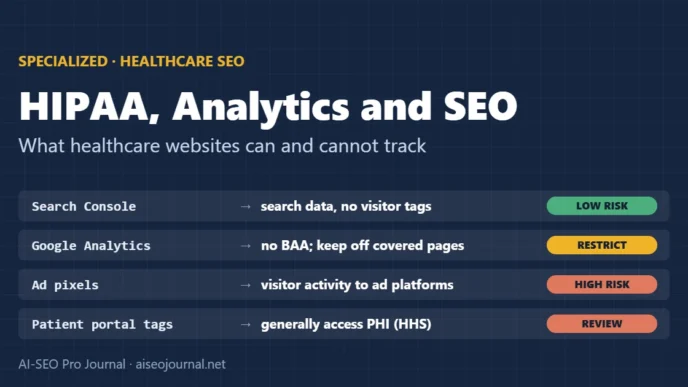
Never use a patient’s name, image or story without written permission. Be careful with replies to reviews. In March 2022, OCR imposed a $50,000 civil monetary penalty on a North Carolina dental practice. The practice’s reply to a negative Google review had revealed a patient’s full name and details of the services he received, and the practice did not respond to OCR’s findings [3]. In 2019, another dental practice paid $10,000 under a resolution agreement over replies to Yelp reviews that included a patient’s last name, treatment plan, insurance and cost details [3]. Read our HIPAA guide for tracking and forms.
What if a page fails the check?
Don’t publish it. Work in this order.
- Hold the page. A draft that fails a rule stays a draft.
- Cut or fix the weak claim. If you cannot link a source, remove the claim or write it without numbers.
- If no clinician is available, say so plainly (“Not clinically reviewed”) and keep the page general. Our guide to showing expertise and trust on health pages explains how.
- Log the change and set the next review date.
This is general information, not medical or legal advice.
From our own site: The earlier version of this article had no outside source. Our audit on 8 November 2026 counted 39 percentage figures in it, two attributed quotes and two “case study” passages. We removed them. On 9 November 2026 we counted the sources listed on our nine healthcare guides. Seven of them, including this one before today’s rewrite, listed only three sources, and ran between about 540 and 1,100 words. The two we had already upgraded listed 6 and 14. We are applying this workflow to the rest, one guide at a time. This counts the sources listed on each page. It does not judge their quality.
Frequently asked questions
Do health pages need a clinical reviewer?
It is a strong trust signal for health topics. Name the reviewer, match them to the subject and show the review date.
Can I use a patient story?
Only if it is real, and you have written permission and have removed identifying details.
How often should I review a medical page?
Set a fixed date, such as once a year, and review sooner when guidance changes.
Should I show sources on the page?
Yes. Link primary sources and say what each one supports.
Is it safe to use AI to draft health content?
Treat any draft as unverified. A named clinician must check every claim before publication.
How plain should health writing be?
Write for your audience, keep one idea in each sentence and prefer familiar words. Digital.gov’s plain-language guidance says the same. A clinician should still check the plain version is correct.
What if a clinician cannot review a page?
Do not claim a review. Say “Not clinically reviewed” near the top, keep the page general and source-backed, and set a date to try again.
What should you do next?
Choose one health page and run it through the seven steps above. Add the reviewer, the sources and the review date. Then read our healthcare SEO guide.
Sources
- Google Search Central — Creating helpful, reliable, people-first content
- Schema.org — MedicalWebPage
- ArentFox Schiff — Disclosing Patient Information in Responses to Online Reviews (29 July 2022; checked 9 November 2026)
- Digital.gov — Principles of plain language (checked 9 November 2026)
- Digital.gov — Clear and short (checked 9 November 2026)
- Digital.gov — Familiar terms (checked 9 November 2026)