


A new analysis by Zyppy’s Cyrus Shepard puts hard numbers behind what separates sites gaining organic traffic from those losing it — and the results challenge some widely-held assumptions about what Google actually rewards.
A large-scale study examining more than 400 websites has identified five specific characteristics that correlate strongly with organic traffic gains over the past 12 months, offering one of the clearest data-backed pictures yet of what Google’s algorithm appears to favour in the current search landscape.
The research, conducted by Cyrus Shepard, founder of SEO toolset Zyppy, drew on the same pool of sites covered in Lily Ray’s December 2025 core update analysis. Shepard classified each site by business model, content type, and structural features, then measured which traits correlated with estimated traffic changes. Traffic estimates were sourced from third-party tools rather than verified Search Console data.
Table of Contents
ToggleFive Traits. One Clear Pattern.
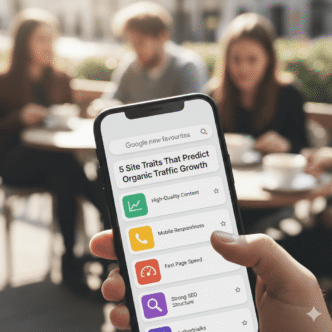
The study identified five features with the strongest association with traffic gains, and the pattern they form points firmly in one direction: Google is rewarding sites that go beyond publishing information.
Offering a product or service was the single biggest differentiator. Seven in ten winning sites had their own product or service — whether physical goods, subscriptions, or digital offerings — compared to just one in three losing sites. The gap is stark enough to suggest that purely informational sites are operating at a structural disadvantage in the current algorithm.
Enabling task completion came in as arguably the most important functional trait. Eighty-three percent of traffic-gaining sites allowed visitors to complete the task they came for — not just read about it. Losing sites scored 50% on the same measure. Critically, Shepard noted that a site does not need to sell anything to meet this criterion. A tool, a calculator, a template download, or a booking form all qualify.
Proprietary assets produced the largest absolute gap in the dataset. Ninety-two percent of winning sites owned something difficult to replicate — a unique dataset, specialised software, or content produced by a genuine user community. Only 57% of losing sites could say the same. This finding puts original, hard-to-copy assets at the centre of any serious organic growth strategy.
Tight topical focus proved more nuanced than expected. A broad definition of topical focus showed no meaningful difference between winners and losers. It was only when Shepard tightened the definition to single-topic depth — one subject covered with genuine thoroughness — that a clear pattern emerged. Covering many topics adequately is not the same as covering one topic exceptionally.
Brand strength, measured by the proportion of navigational branded search terms in a site’s top 20 keywords, showed a two-to-one ratio between winners and losers. Thirty-two percent of traffic-gaining sites demonstrated high branded search volume relative to their overall traffic; only 16% of losing sites did.
The Additive Effect Changes Everything
The most operationally significant finding is not any individual trait, but how they compound. Sites with none of the five characteristics won traffic at a rate of 13.5%. Sites with all five reached 69.7%. Importantly, one trait alone barely moved the needle — a site with a single winning feature had a win rate of roughly 15%, almost indistinguishable from zero. The gap only widened meaningfully at three or more features.
This means partial compliance is not a strategy. Sites that score on one or two traits are not significantly better positioned than sites that score on none.
What the Study Found Does Not Matter
Perhaps as interesting as what correlated is what did not. Shepard tested several features commonly discussed in SEO circles and found no meaningful correlation with traffic changes in this dataset: first-hand experience, personal perspectives, user-generated content, community features, and uniqueness of information.
Shepard was careful to contextualise this result. These features may already be priced into the algorithm from earlier updates — particularly those targeting thin and low-quality content — meaning they remain relevant as a baseline, even if they no longer differentiate winners from losers.
What It Signals for SEO Strategy
Taken together, the five winning traits sketch a profile of a site that functions as more than a content library. The clearest common thread is utility: can a visitor arrive, act, and leave having accomplished something? Sites that answer yes to that question — through a product, a tool, a service, or a genuine proprietary asset — appear to be significantly better positioned in Google’s current evaluation framework.
The correlation values in the study are moderate, ranging from 0.206 to 0.391, and the methodology depends on estimated rather than confirmed traffic data. Correlation does not establish causation. Sites offering products may perform better for reasons beyond ranking alone, including stronger return-visitor rates and more natural backlink acquisition.
The full dataset has been made public by Shepard, allowing other researchers and practitioners to test the same classifications against their own site data.
Source: Search Engine Journal / Zyppy. Original research by Cyrus Shepard. Analysis cross-referenced with Lily Ray’s December 2025 core update dataset.