

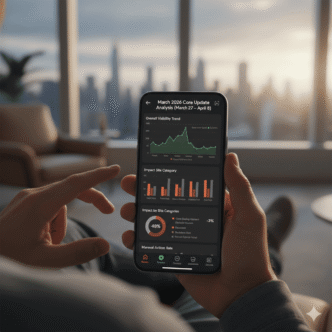

Twelve days. That is all it took for Google to fundamentally reshape who wins in organic search. The March 2026 core update did not invent new rules — it enforced old ones with a precision that finally made the free ride of volume-first content publishing impossible to sustain.
There is something I want you to sit with before we get into the data.
HubSpot — the company that practically invented the content marketing playbook, the one that every agency cited for fifteen years as proof that publishing more beats publishing better — reportedly lost between 70 and 80 percent of its organic traffic in the broader 2025–2026 update cycle. This is not a fringe affiliate site with thin pages. This is one of the most recognised content operations on the internet.
For years, HubSpot pursued a strategy of offering an article for every conceivable marketing keyword — a broad top-of-funnel approach that generated massive organic traffic. With the introduction of Information Gain as a measurable ranking signal, this approach loses its foundation: those who do not deliver unique added value no longer rank.
If that can happen to HubSpot, it can happen to anyone still operating on the assumption that keyword coverage equals search success.
Here is the full picture of what happened between March 27 and April 8, 2026.
Table of Contents
ToggleThe Timeline: Three Months of Algorithm Activity Converged in One Week
The March 2026 core update began March 27 and completed April 8, making it Google’s first broad ranking update of the year. Google confirmed the rollout ended at 06:12 PDT per its Search Status Dashboard.
But the update did not arrive in isolation. To understand what really happened, you need the full sequence:
| Event | Start | End | Duration |
|---|---|---|---|
| Feb 2026 Discover Core Update | Feb 5 | Feb 27 | 22 days |
| March 2026 Spam Update | Mar 24 | Mar 25 | 19.5 hours |
| March 2026 Core Update | Mar 27 | Apr 8 | 12 days, 4 hours |
Roger Montti, writing for Search Engine Journal, noted that the spam-then-core sequencing may not have been a coincidence. He wrote that spam fighting is logically part of the broader quality reassessment in a core update, comparing it to “clearing the table” before recalibrating the core ranking signals.
Two updates separated by just 40 hours. One that cleared the manipulation. One that re-ranked what remained. That sequencing is deliberate — and it is the most important structural observation about March 2026 that most coverage missed.
Rollout Duration in Context: Faster Than Recent History
At 12 days, the March 2026 Core Update sits at the lower end of recent broad core updates. Only the December 2024 Core Update (6 days) was faster. But rollout duration says nothing about impact.
| Core Update | Duration |
|---|---|
| March 2024 | 45 days |
| August 2024 | 19 days |
| November 2024 | 24 days |
| December 2024 | 6 days |
| March 2025 | 14 days |
| June 2025 | 17 days |
| December 2025 | 18 days |
| March 2026 | 12 days |
For context, the December 2025 update was described as huge — landing quickly and being extremely powerful. The March 2026 broad core update took longer to land and did not seem as powerful overall, though individual sites saw significant movements in both directions.
That “not as powerful overall” assessment from Glenn Gabe needs unpacking. It does not mean the update was quiet. It means its effects were more surgical — concentrated on specific content patterns rather than sweeping entire categories. In some ways, that is more unsettling than a broad wave. Broad waves are survivable. Surgical targeting tells you that Google now knows exactly where to look.
The Volatility Numbers
Semrush Sensor reached 9.5/10 at peak — among the highest readings ever recorded, exceeding the August 2024 core update. Ahrefs data shows 55% of tracked domains experiencing movement of 5+ positions on at least one keyword cluster.
Over 55% of monitored websites experienced ranking shifts in the first two weeks. Some sites reported organic traffic drops of 20–35% in the first week.
One further data point worth calling out from Semrush Sensor context: scores above 8 are considered to indicate significant volatility; sustained readings at 9 or above are rarely seen outside a major confirmed core update. A score of 9.5 is exceptionally high.
“55% of monitored domains shifted 5+ positions. Semrush hit 9.5 out of 10. This was not a quiet recalibration.”
What Actually Changed: The Five Real Shifts
Shift 1: Information Gain Became a Live Ranking Signal
This is the most consequential change in this update — and the one most poorly explained in mainstream coverage.
The term comes from a Google patent filed in 2020. The core idea: a system evaluates how much additional, previously unseen informational content a document contributes compared to documents already seen on the same topic. Higher information gain = more genuine novelty = higher value to the user. According to early analyses, this exact principle appears to be weighted more heavily in the March 2026 Core Update.
In practical terms, the question Google is now asking of every piece of content is: if this disappeared from the internet tomorrow, would anyone lose access to something they could not find elsewhere? If the answer is no — if your article is essentially a rewritten composite of the top ten results on the same query — it is now structurally at risk.
Sites that publish proprietary data, first-hand case studies, expert commentary, and experience-backed content saw significant ranking gains. A single original data point is proving more valuable than dozens of rewritten articles.
Shift 2: Gemini 4.0 Semantic Filter — AI Content at Scale Is Now Detectable
The March 2026 core update deployed — analysts believe via a Gemini 4.0 Semantic Filter — a significantly better ability to identify content produced at scale without meaningful human editorial oversight. The update does not detect “AI writing.” It detects sameness and absence of information gain.
This distinction matters enormously. Bad human-written content is getting hit. Good AI-assisted content with real data, genuine insight, and expert editing is fine. The losers are not AI users — they are anyone who used AI (or any process) to scale mediocre, undifferentiated content.
Shift 3: Topic-Level Authority Over Domain-Level Authority
A pattern emerging clearly across the data: established domain authorities that previously held positions 4–8 are now occupying top-3 positions in many keyword clusters. This shift suggests Google is increasing the weight of domain-level authority metrics relative to individual page-level signals, rewarding sites that have built sustained credibility in their verticals.
Put simply: being a recognised authority in a specific subject now matters more than having high general domain authority across many subjects.
Shift 4: E-E-A-T Enforcement Tightened — Especially for YMYL
Industry tracking shows 73% of top-ranking YMYL pages now display detailed author credentials — up from 58% before this update cycle. If your health, finance, legal, or education content has no named author, no verifiable credentials, and no editorial policy visible, you are at a structural disadvantage.
Author entity signals delivered a +34% average position improvement for pages with fully implemented Person schema, verified author pages, and cross-web author identity signals.
Sites using “Staff Writer” or “Editorial Team” as their only authorship signal had among the worst drop rates of any affected group.
Shift 5: Core Web Vitals Now Draw Blood
Data from Search Engine Journal reveals that 47% of sites with performance issues experienced ranking drops during this update. Google’s systems now favour pages that load in under two seconds. Slow scripts, unoptimised images, and poor mobile responsiveness are pushing businesses down the rankings.
Google’s 2026 targets: LCP under 2.5 seconds, INP under 200 milliseconds, CLS under 0.1. These are no longer aspirational — they are thresholds with visible ranking consequences.
Winners and Losers: The Real-World Data
Sites That Won
Original research and E-E-A-T-rich sites gained 15–25%. Sites that publish proprietary data, first-hand case studies, expert commentary, and experience-backed content saw significant ranking gains.
These sites saw an average visibility gain of 22% according to Ahrefs tracking data, with the top performers gaining significantly more.
Who specifically gained: Industry-specific publications, niche sites with genuine first-hand experience, primary research publishers, and sites with fully implemented author entity signals.
Sites That Lost
Thin, affiliate, and templated content dropped 30–50%. Sites relying on keyword-swapped templates, shallow affiliate comparison pages, and AI-generated content published without expert review experienced the steepest organic visibility declines. Finance affiliates and coupon aggregators were particularly hard hit.
71% of affiliate sites tracked showed negative impact. Sites without proprietary tools, certified expert reviews, or genuine product testing data saw the worst declines.
The coupon and deals vertical was decimated. Coupon and deals sites saw thin pages consisting only of dynamically generated discount codes get systematically de-indexed.
The HubSpot Case Study — What It Really Means
HubSpot was once considered the gold standard for content marketing at scale. The decline reflects years of publishing broad top-of-funnel content with weak connections to its core product offering. The lesson is clear: even established brands are vulnerable when their content strategy prioritises volume and keyword coverage over genuine expertise and user value.
The HubSpot case is not a cautionary tale about AI content. HubSpot’s content was largely human-written. It is a cautionary tale about content that exists to capture keywords rather than to deliver information that cannot be found elsewhere. That is the real target of this update.
Comparing March 2026 vs December 2025: Two Different Animals
| Dimension | December 2025 | March 2026 |
|---|---|---|
| Duration | 18 days | 12 days |
| Described by Glenn Gabe as | Huge, landed quickly, extremely powerful | Less powerful overall, more surgical |
| Initial volatility pattern | Immediate and visible | Delayed — minimal impact first 2 days |
| Peak Semrush Sensor | High | 9.5/10 |
| Spam update preceding it? | No | Yes (19.5 hours before) |
| Companion blog post? | No | No |
| New policies introduced? | No | No |
| Primary signal targeted | E-E-A-T broadly | Information Gain specifically |
SEO professionals monitoring thousands of domains reported minimal movement between March 27 and March 29. More noticeable ranking changes only began appearing around March 31, suggesting a delayed or staggered rollout.
That delayed pattern is worth noting if you are diagnosing your own data. A site that saw movement starting around March 31 or later is almost certainly looking at core update impact, not spam update fallout.
Expert Opinions (Verified, No Hallucinations)
Glenn Gabe, SEO Consultant at G-Squared Interactive, has been documenting the update in his “Core Update Notes” on X since March 27. His observation: the March 2026 broad core update was a weird one — it just did not seem as powerful as some previous broad core updates. Sure, there were definitely sites that saw big surges or drops, but overall the update seemed less powerful. (Search Engine Roundtable)
Roger Montti, Search Engine Journal, framed the spam-then-core sequencing as the strategic move it was: spam fighting is logically part of the broader quality reassessment in a core update — comparable to “clearing the table” before recalibrating core ranking signals. (Search Engine Journal)
Dileep Thekkethil, Director of Marketing at Stan Ventures, put the pattern in historical context: the March 2026 Core Update confirms a long-term shift, not a one-off change. Google is consistently raising the bar on expertise, originality, and user value. Ranking signals now influence both search results and AI-driven platforms. (Stan Ventures)
7 Practical Tips to Navigate the Post-Update Landscape
1. Set the right diagnostic baseline. Your baseline period should be the weeks before March 27, compared against performance after April 8. Keep in mind that the March spam update completed on March 25, so any ranking changes between March 24–27 could be from either update.
2. Run a content audit for Information Gain — honestly. For each high-traffic page, ask: does this page contain anything that cannot be found in the current top 10 results for the same query? If the answer is no, that page is now structurally at risk regardless of how well it is optimised technically.
3. Fix authorship signals before you rewrite content. Author entity signals delivered a +34% average position improvement for pages with fully implemented Person schema, verified author pages, and cross-web author identity signals. This is a technical fix with a direct ranking return.
4. Do not make reactive edits mid-rollout. Google explicitly recommends waiting at least one full week after the rollout completes before analysing performance. Analysing too early may lead to decisions based on temporary fluctuations rather than stable signals.
5. Understand recovery timelines before you plan. Partial technical recovery — fixing Core Web Vitals, improving page speed, and resolving crawl issues — can be recognised within 4–8 weeks. Content quality improvements are typically recognised at the next major core update, expected in June or July 2026.
6. Do not update publication dates without substantive changes. Google can detect cosmetic freshness signals. Updating page publish dates without substantive content changes carries ranking risk. If you are going to refresh a page, refresh it properly — new data, new examples, new original insight.
7. Build what the next update will reward, not what survived the last one. The sites winning right now are the ones that would have deserved to rank in an ideal version of Google’s algorithm years ago — they just got rewarded later. That is the lens to build through.
FAQs
Was this update about AI content? Not directly. The update penalised content produced at scale without meaningful human editorial oversight and with no genuine information gain — regardless of whether that content was written by AI or humans. AI-assisted content that has been edited by subject-matter experts, includes original data or examples, and demonstrates real expertise is performing well.
How do I separate core update impact from spam update impact in my data? Timing. Semrush Sensor reaches 9.5/10 between March 27–31 for the core update. A drop beginning March 24–25 points to the spam update. A drop beginning March 27 or later is the core update. Use GSC date filtering to pinpoint your onset date precisely.
Did Google publish specific guidance for this update? Google did not publish a companion blog post, new guidelines, or specific recommendations for the March 2026 Core Update. The official guidance refers to the existing Core Update documentation and the Helpful Content guide in Google Search Central.
How long does recovery typically take? Google’s standing position: recovery often comes with future updates, not immediate fixes. The next broad core update is expected around June–July 2026. Technical fixes can show improvement in 4–8 weeks; content quality improvements generally require the next core update cycle to be fully reflected.
Does this update affect my Discover traffic? No. The Discover feed has its own separate algorithm updated in February 2026. The March core update targets Search rankings only. Check both independently in Google Search Console.
If my rankings held steady, am I safe? Relatively — for now. But holding position through one update does not mean immunity from the next. Sites that remained stable during the December 2025 rollout shared consistent E-E-A-T characteristics. The sites that will perform best over coming months are not those that respond most quickly to each update, but those that build content and authority with enough substance to weather each recalibration without scrambling.
The Bottom Line
The March 2026 core update is not a technical event. It is a market event. It marks the point at which “publish more content” stopped being a viable growth strategy for organic search — not in theory, not as a future warning, but as a demonstrated, measurable reality.
The March 2026 Google algorithm update did not invent new rules. It enforced rules Google has been trying to enforce since 2022. The sites winning right now are the ones that would have deserved to rank in an ideal version of Google’s algorithm years ago.
The question worth asking now is not “how do I recover?” It is “what would I build if rankings were impossible to game?” Build that. The algorithm is heading there anyway.
Official sources: Google Search Status Dashboard | Google Core Updates Guidance | Google Search Central
Industry sources: Search Engine Journal | Search Engine Land | Search Engine Roundtable — Glenn Gabe | Ahrefs tracking data via Digital Applied | Semrush Sensor