

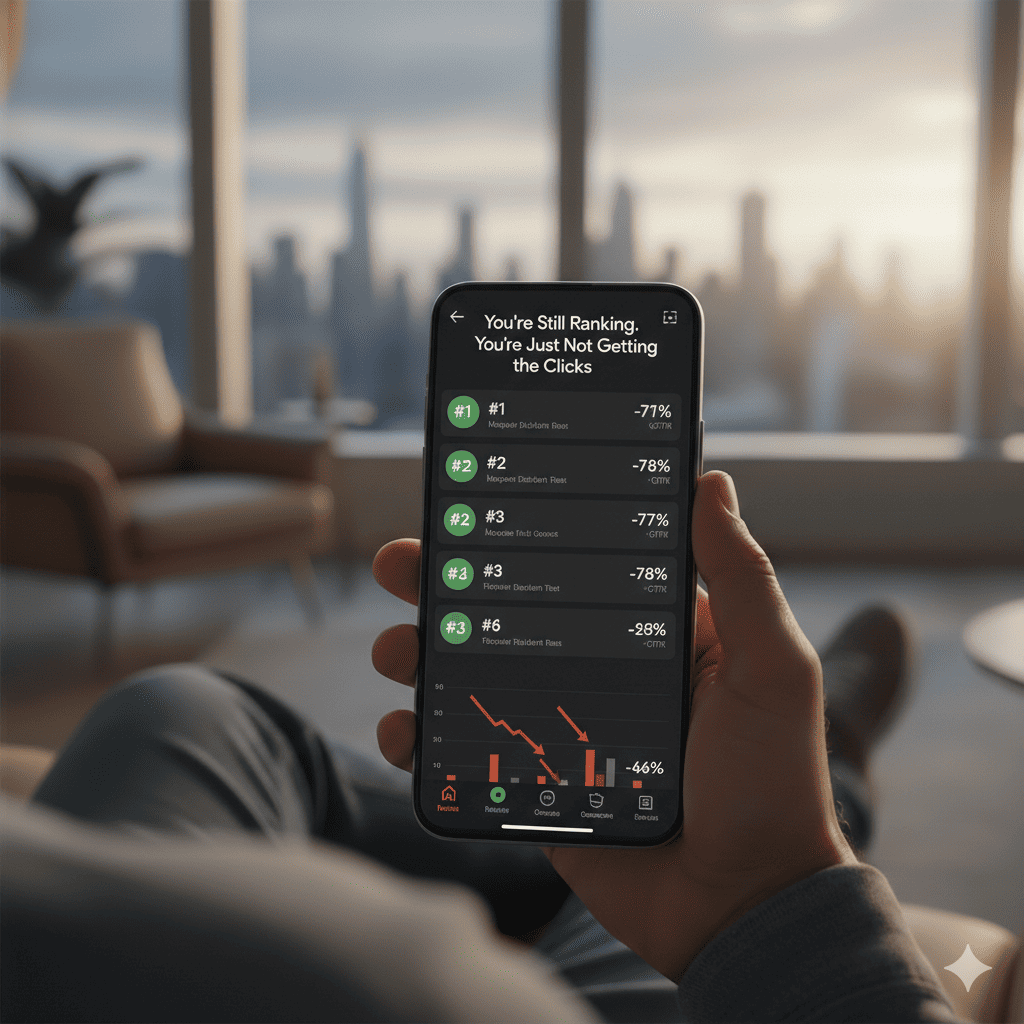
Organic search traffic is not dying. The connection between ranking and receiving traffic is. And in 2026, those are two entirely different problems requiring two entirely different responses.
Let me tell you what is happening on a Tuesday afternoon when someone searches “how to reduce customer churn.”
They type the query. Google generates an AI Overview in roughly 300 milliseconds — a synthesised, structured answer pulled from several sources, sitting above every organic result on the page. The user reads it. Their question is answered. They close the tab. Your article, sitting at position one for that keyword, gets an impression. But not a click.
This is not a hypothetical. It is now the dominant search behaviour pattern on the web — and the data behind it should fundamentally change how you think about every content investment you make.
Table of Contents
ToggleA Timeline of the Unraveling
You cannot understand where we are without seeing how quickly we got here.
Between 2024 and 2025, AI Overviews expanded from appearing in just 6.49% of searches to dominating over 50% of all queries, triggering what industry observers describe as the most significant transformation in search engine behaviour since Google’s inception.
| Date | AI Overview Coverage | Source |
|---|---|---|
| January 2025 | 6.49% of US searches | Semrush |
| July 2024 | 7.47% of US SERPs | SE Ranking |
| November 2024 | 18.76% of US SERPs | SE Ranking |
| January 2026 | 25.8% of US searches | Digiday |
| February 2026 | 48% of all tracked queries | BrightEdge |
| October 2025 | Over 50% of all queries | Digital Bloom |
BrightEdge’s 12-month analysis from February 2025 to February 2026 found that AI Overviews now trigger on 48% of all tracked search queries — a 58% increase year over year.
To be clear about what that means in practical terms: roughly one in two searches now returns an AI-generated summary before any organic result. This is not a niche phenomenon affecting a handful of query types. It is the new default.
The CTR Numbers: What the Research Actually Says
Here is where most coverage gets it wrong. Different studies measure different things — and the range of numbers (15% to 61% CTR drop) is not contradictory. It reflects different methodologies, query types, and time periods. Understanding each one matters.
The Seer Interactive Study (June 2024 – September 2025) — The Most Comprehensive Business Dataset
Seer Interactive analysed 3,119 informational queries across 42 client organisations, spanning 25.1 million organic impressions and 1.1 million paid impressions tracked from June 2024 through September 2025. Queries were categorised by AI Overviews presence and citation status using data from Google Search Console, Google Ads, and Seer’s generative AI tracker.
The results:
Organic CTR plummeted 61% — from 1.76% to 0.61% — for queries with AI Overviews. Paid CTR crashed 68%, falling from 19.7% to 6.34%.
The Pew Research Center Study (March 2025) — The Most Rigorous Behavioural Dataset
The Pew Research Center study tracked 68,879 actual Google searches conducted by 900 US adults in March 2025. Only 8% of users who encountered an AI Overview clicked on a traditional search result, compared to 15% when no AI summary appeared. 26% of searches with AI Overviews ended with no clicks at all, compared to 16% for traditional results pages. Less than 1% of users clicked on links within the AI Overview itself.
That last number deserves a moment. Actual clicks on citation links within AI Overviews remain extremely low at 1%. So even the “good outcome” — getting cited — is not reliably driving traffic.
Ahrefs (December 2025) — Position-Level Data
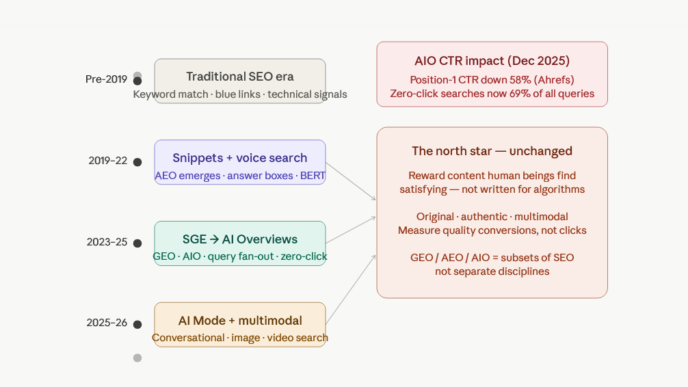
The presence of an AI Overview correlates with a 58% lower average click-through rate for the top-ranking page. This is a material deterioration from Ahrefs’ earlier finding of a 34.5% CTR reduction in April 2025, indicating that as AI Overviews have expanded in scope and quality, their click-compression effect has increased.
The Cross-Study Consensus
| Study | Methodology | CTR Impact |
|---|---|---|
| Seer Interactive (Sep 2025) | 3,119 queries, 42 orgs | -61% organic, -68% paid |
| Pew Research Center (Jul 2025) | 68,000 real queries, 900 users | -46.7% relative decline |
| Ahrefs (Dec 2025) | Position-1 across 300K keywords | -58% |
| Amsive Digital | 700,000 keywords | -15.49% average |
| Authoritas | Multiple methodologies | -47.5% |
The range reflects the data. The direction is unanimous.
Zero-Click Search: The Broader Context
AI Overviews are the most visible driver of zero-click behaviour, but they are not the only one. The full picture is more uncomfortable.
Nearly 60% of all Google searches now end without a single click to any website. According to Semrush’s 2025 zero-click study, 58.5% of US searches and 59.7% of EU searches conclude entirely within Google’s search results page.
Searches triggering AI Overviews now show an average zero-click rate of 83%, while traditional queries (without AI Overviews) average around 60%. In other words, 8 out of 10 users now get their answer directly inside the search interface.
And for Google’s AI Mode, the picture is even more extreme: 93% of searches in Google AI Mode are zero-click.
Stuart Forrest, global director of SEO and digital publishing at Bauer Media, confirmed the trend, telling the BBC: “We’re definitely moving into the era of lower clicks and lower referral traffic for publishers.”
Who Is Getting Hit — and Who Is Being Protected
Not all content is equally exposed. This is the most important nuance in the entire conversation.
“Informational queries: 80–88% AI Overview trigger rate. E-commerce queries: 4% trigger rate. Your how-to blog posts are getting hit hardest. Your service pages and product pages? Mostly untouched.” — WebFX 2026 Benchmarks, via Infinite Labs Digital
According to WebFX’s 2026 benchmarks, AI Overview rates by search intent reveal massive differences. Informational queries trigger AI Overviews at 80 to 88% depending on industry. E-commerce queries trigger AI Overviews only 4% of the time, down from 29% at initial rollout.
Sectors with the highest AI Overview share are Science (43.6%), Health (43.0%), Pets & Animals (36.8%), and People & Society (35.3%). Sectors with the lowest share include Shopping (3.2%), Real Estate (5.8%), Sports (14.8%), and News (15.1%). Only 7.9% of local searches trigger an AI Overview. (Ahrefs, November 2025)
The strategic implication here is significant. If your content portfolio is weighted toward how-to guides, definitions, and informational explainers, your exposure is high. If it leans toward transactional, local, and navigational content, your exposure is comparatively low.
Real-world casualties:
Chegg reported a 49% decline in non-subscriber traffic between January 2024 and January 2025. The decline coincided with AI Overviews answering homework and study questions that previously drove traffic to educational sites.
DMG Media, which owns MailOnline and Metro, reported nearly 90% declines for certain searches.
Clicks to top 50 news sites fell from 2.3 billion to under 1.7 billion monthly visits in 12 months.
The Citation Upside: Getting Named in the AI Overview
Here is the part of this story most publishers are not acting on quickly enough.
When your brand is cited in an AI Overview, you earn 35% more organic clicks and 91% more paid clicks compared to when you are not cited at all. One AI citation can generate more qualified traffic than ranking at position three for the same query in traditional results.
Research shows 92.36% of AI Overview citations come from domains ranking in the top 10. But high rankings no longer guarantee visibility — pages outside the top 10 now have better chances of AI citations than they did for traditional featured snippets.
Roughly 60% of AI Overview citations come from URLs not ranking in the top 20 organic results, according to AirOps’ 2026 State of AI Search report.
That second data point is striking and contradicts the first. Both can be simultaneously true when you consider that AI Overviews pull from a much broader set of sources than traditional featured snippets — and topical authority, schema quality, and content structure play as much of a role as raw ranking position.
What Google’s AI appears to look for in citation candidates:
Branded web mentions have the strongest correlation (0.664) with AI Overview appearances — much higher than backlinks (0.218). (Position Digital, 2026)
Pages not updated in 90+ days are 3x more likely to lose AI citations, per AirOps’ research. More than 70% of pages cited by AI were updated within the last 12 months.
AI Mode: The Next Layer of the Problem
Users spend double the time in AI Mode compared to AI Overviews — 49 seconds vs 21 seconds on average. In 75% of AI Mode sessions, users never left the pane. In other words, most AI Mode sessions end without external visits. Clicks in AI Mode are mostly reserved for transactions.
In classic search, 56% of users built their own shortlist from multiple sources. In AI Mode, 88% of users took the AI’s shortlist without external check. The AI’s top pick becomes the user’s top pick 74% of the time. (Growth Memo, April 2026)
This is not about clicks anymore. This is about whether your brand is the one being recommended in the first place.
Paid Search: The Collateral Damage
Most paid search coverage of AI Overviews focuses on organic CTR. The paid story is equally alarming and less discussed.
Paid CTR crashed 68%, falling from 19.7% to 6.34% between June 2024 and September 2025 for queries with AI Overviews.
For brands running paid campaigns on informational queries where AI Overviews appear, efficiency has cratered. At 6.34% CTR in September 2025 (down from 19.70% in June 2024), cost-per-click may remain stable, but cost-per-acquisition has effectively tripled if CPC remained constant while CTR dropped 68%. High-funnel paid search on informational queries may no longer justify budget allocation.
Expert Opinions
Aja Frost, Head of English SEO at HubSpot, whose data was central to the Seer Interactive study, noted in published commentary that the citation effect is the most actionable finding — being named inside an AI Overview is now more strategically valuable than holding a top-five organic position on the same query. (Source: Seer Interactive)
Stuart Forrest, Global Director of SEO and Digital Publishing at Bauer Media, has publicly confirmed the structural shift: “We’re definitely moving into the era of lower clicks and lower referral traffic for publishers.” — BBC interview, 2025.
Lily Ray, VP of SEO Strategy at Amsive, has been among the most consistent voices on the measurement shift this creates. Her framing at Affiliate Summit West 2026: the core metric is moving from rankings to visibility — how frequently your brand is cited or mentioned in AI-generated answers. Share of voice across LLMs is the new competitive metric. (Source: Affiliate Summit)
7 Tips for Operating in the New Reality
1. Stop measuring success by traffic alone. Traditional CTR is an incomplete metric. When someone reads an AI Overview that synthesises your content without clicking through, you have still influenced their decision — you just cannot track it with Google Analytics. Add AI citation frequency, share of voice in AI answers, and branded search volume to your reporting stack.
2. Identify which of your pages face the highest AI Overview exposure. Check your GSC data for impressions without corresponding clicks on informational queries. These are your highest-exposure pages. Prioritise them for citation optimisation, not just ranking maintenance.
3. Build content that earns citation, not just position. Pages not updated in 90+ days are 3x more likely to lose AI citations. Seer Interactive documented a client case where refreshing outdated content produced a 300% increase in AI traffic — not from writing more, but from updating what already existed. Build a quarterly content refresh cycle.
4. Shift informational content toward proprietary data. A single original data point is proving more valuable than dozens of rewritten articles. If your how-to content can be replaced by an AI Overview, it will be. If it contains your original research, your data, your case study — it cannot be replaced. It becomes the source.
5. Strengthen branded web mentions actively. Branded web mentions have the strongest correlation (0.664) with AI Overview appearances — much higher than backlinks (0.218). Invest in digital PR, third-party mentions, and publications that reference your brand name in context. This is now the highest-ROI citation signal.
6. Protect your transactional and local content — it is your safest traffic. E-commerce queries trigger AI Overviews only 4% of the time. Only 7.9% of local searches trigger an AI Overview. These are your most defensible positions. Invest in them.
7. Reconsider paid budgets on high-AIO informational queries. High-funnel paid search on informational queries may no longer justify budget allocation when CTR has dropped 68%. Conduct a query-by-query ROI analysis and shift budget toward commercial and transactional terms where AI Overview presence is low.
FAQs
Is AI Overviews impact the same across all industries? No. Science (43.6%), Health (43.0%), and Pets & Animals (36.8%) have the highest AI Overview coverage. Shopping (3.2%), Real Estate (5.8%), and Local (7.9%) remain largely protected. Assess your specific exposure before assuming the average applies to you.
Does getting cited in an AI Overview actually drive traffic? Partially. Actual clicks on citation links within AI Overviews remain extremely low at 1%. However, the 35% higher organic CTR for cited brands suggests a halo effect — being named in an AI Overview increases the likelihood that users who do click will choose you.
Are AI-referred visitors valuable even if traffic volume is lower? Yes. AI-referred visitors spend 68% more time on-site and convert at higher rates than traditional organic visitors. Volume is lower; intent and quality are higher.
Is this trend temporary — will Google reverse course? Unlikely. Gartner had predicted in 2024 that traditional search engine volume would drop 25% by 2026 due to AI chatbots and virtual agents. The data from 2025 suggests that trajectory is on course. There is no regulatory or commercial incentive for Google to reduce AI Overview coverage.
Should I block AI crawlers to prevent my content being used in AI Overviews? Blocking AI crawlers removes you from the citation set entirely. If your content earns citations, blocking eliminates that visibility. Blocking only makes strategic sense if your content is subscription-gated and you are actively pursuing licensing arrangements with AI companies instead.
What is the single most important shift in how to measure SEO success now? Moving from rankings and traffic as primary KPIs toward share of voice in AI answers, citation frequency, and branded search volume. The marketers thriving in 2025 stopped optimising for rankings and traffic. They optimise for trust, citation, and share of voice.
The Bottom Line
Here is what the data is telling you, stripped of all abstraction.
Search volume is not declining. User intent is not declining. The gap between a user having a question and your website receiving a visit is simply getting wider — filled by AI summaries that absorb the query and return the user to Google’s ecosystem without ever sending them to you.
That is not a content quality problem. That is a structural change in how information is distributed on the internet. And the organisations adapting fastest are not the ones screaming “SEO is dead.” They are the ones rebuilding their measurement frameworks, investing in citation authority, and building content that AI systems cannot summarise away — because it comes from sources, experiences, and data that only they possess.
The click was never the product. It was always just the proof that you had earned attention. Find new ways to earn it.
Core research sources: Seer Interactive — AIO Impact on CTR (September 2025) | Pew Research Center — AI Overview User Behaviour Study (July 2025) | BrightEdge 12-Month AIO Coverage Analysis (Feb 2026) | Ahrefs CTR Data (December 2025) | Search Engine Journal — Publisher Impact Analysis | ALM Corp — Paid Search vs Organic Click Share (Feb 2026)