


Sites that build at least 25 tightly interlinked articles within one content cluster see a 40–70% increase in keyword rankings within three to six months. (Source: SearchAtlas, 2026)
The sites that do not see this result almost always have the same problem: they built content clusters without building cluster architecture. They published related posts. They did not define the linking rules, the scope boundaries, or the internal equity flow that make a cluster function as a topical authority signal rather than a category folder.
A topic cluster is an architecture decision. The content comes second.
Article Highlights
- Topic clusters require bidirectional internal linking — pillar to cluster and cluster to pillar — to function as a topical authority signal. One-directional linking produces weaker results than the full structure.
- Pillar pages cover the primary entity at overview depth. They do not go deep on sub-topics. Each sub-topic has a dedicated cluster post.
- Five architecture failures consistently suppress cluster authority: depth parity, anchor text repetition, orphan cluster posts, missing cluster post references in the pillar, and cross-cluster contamination.
- A cluster needs a minimum of five published posts covering distinct sub-intents before Google registers a measurable topical authority signal.
- The internal link sequence matters: update the pillar to link to a new cluster post before or on the day the cluster post publishes — not weeks later.
Table of Contents
ToggleWhy Does Cluster Architecture Outperform Individual Page Optimisation?
Google’s ranking systems evaluate topical coverage at the site level, not the page level. (Source: Search Engine Land, 2025)
A single well-optimised page targeting a competitive keyword competes against domains that have covered the entire topic landscape — every sub-intent, every related entity, every adjacent question. The single page, regardless of its quality, carries no topical authority signal. It is one document among thousands.
A cluster of 15 interconnected pages covering distinct sub-intents of the same primary entity sends a different signal entirely. Google can observe that this domain covers the topic from multiple angles, serves multiple user intents, and connects those pages through a coherent internal link structure. That pattern matches what Google associates with genuine expertise in a subject area.
Surfer SEO’s analysis of one million SERPs found that top-10 ranking pages covered approximately 74% of the relevant subtopics identified from competitor analysis, while bottom-10 pages covered only 50%. (Source: Surfer SEO, 2025) The gap is coverage completeness, not individual page quality.
What most guides get wrong here: They treat topic clusters as a content strategy — a way to organise what you write. Cluster architecture is a site architecture decision with direct consequences for crawl budget allocation, internal link equity flow, and how Google’s topic modelling maps your domain’s authority. Sites that build cluster content without cluster architecture produce well-written posts in structurally broken systems.
What Does Correct Pillar-Cluster Architecture Look Like?
The pillar-cluster model has three distinct content layers. Each has a defined scope, a defined word count range, and a defined linking role.
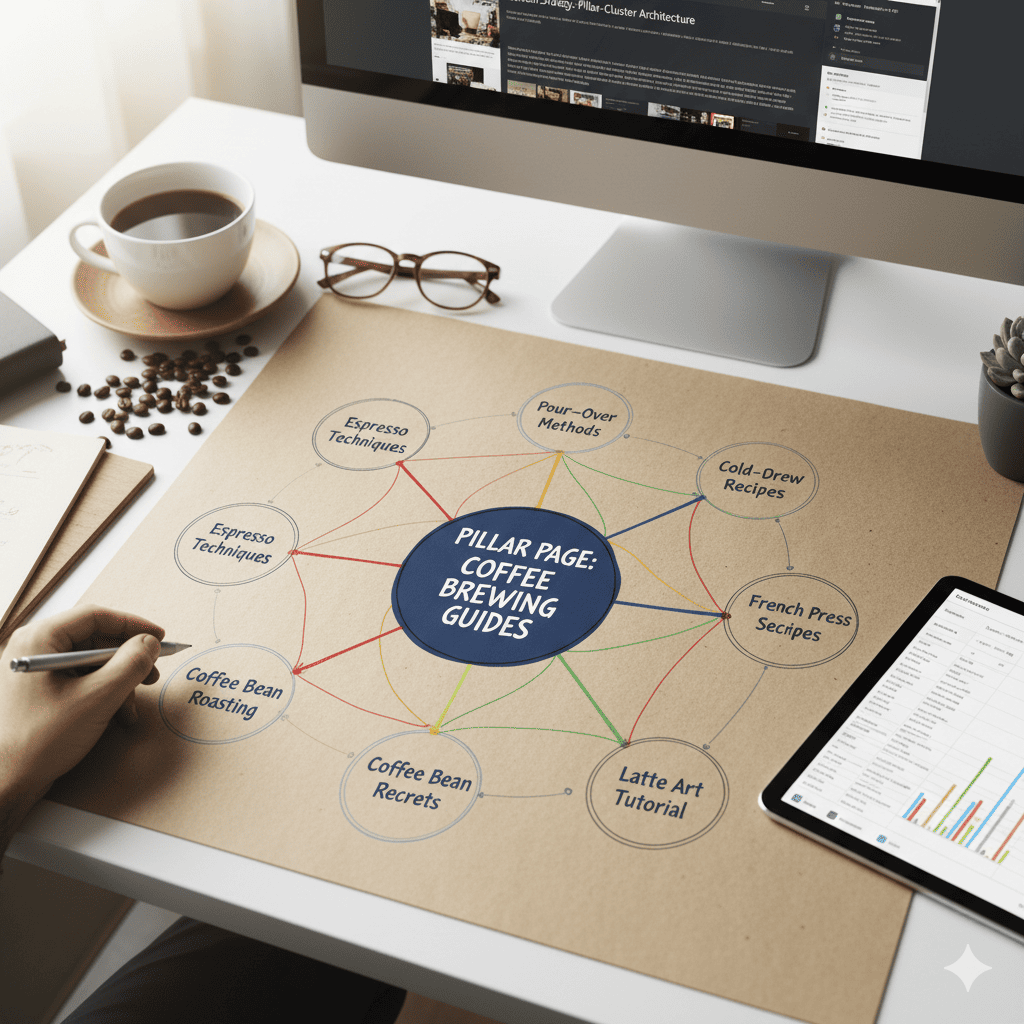
The pillar page covers the primary entity at overview depth. It addresses every major sub-intent within the topic — education, process, tool selection, problem-solving, validation, comparison — at orientation level only. Each sub-intent section opens with two to three paragraphs that answer the sub-question directly, then directs readers to the dedicated cluster post for deeper coverage. Pillar pages link outward to every cluster post in the group. They do not exist to be the definitive resource on any single sub-topic. They exist to be the navigational hub that connects the entire cluster.
Cluster posts each cover one sub-entity at one intent depth. A cluster post targeting “how to fix keyword cannibalization” covers that specific process in complete depth — diagnostic methods, fix scenarios, confirmation signals. It does not stray into keyword mapping, entity SEO, or topic cluster architecture. Those belong to other cluster posts. Each cluster post links back to the pillar two to three times using varied anchor text. It links to two to three sibling cluster posts where a genuine semantic relationship exists.
Supporting posts address PAA-level questions that expand the topic map further. They link to the most relevant cluster post rather than directly to the pillar. They are the most granular layer — typically 800–1,200 words, targeting zero-to-low competition long-tail queries.
| Content layer | Keyword target | Word count | Primary linking role | Links to | Links from |
|---|---|---|---|---|---|
| Pillar page | Broad entity (KD 30–60) | 4,000–8,000 words | Distributes authority to cluster | All cluster posts in group | Supporting posts, external |
| Cluster post | Sub-entity, one intent (KD 10–35) | 1,200–2,500 words | Returns authority to pillar | Pillar, 2–3 sibling clusters | Pillar, related clusters |
| Supporting post | PAA question (KD 0–20) | 800–1,200 words | Reinforces cluster post depth | Relevant cluster post | Cluster post, pillar |
| Comparison post | Commercial sub-intent (KD 15–40) | 1,500–2,500 words | Bridges cluster to conversion | Pillar + cluster | External citations |
| FAQ schema post | Long-tail question format (KD 0–15) | 600–900 words | AI citation and voice search | Cluster post | Cluster post |
How Does Internal Link Equity Flow Through a Cluster?
Internal link equity flows in two directions simultaneously, and both directions serve different functions.
Downward flow — pillar to cluster posts
The pillar page typically has the highest page authority in the cluster because it attracts the most external links and internal links from other sections of the site. When the pillar links to a cluster post, it passes a portion of that authority downward. This helps newer cluster posts rank faster than they would as standalone pages — they inherit partial authority from the pillar before accumulating their own.
Upward flow — cluster posts to pillar
Each cluster post links back to the pillar using anchor text containing the pillar’s primary keyword or a close semantic variant. When 15 cluster posts all link to the same pillar using varied but topically relevant anchor text, the cumulative signal is significant. The pillar’s ranking for its primary keyword strengthens as the cluster grows — not because the pillar itself changed, but because the cluster posts are concentrating authority signals back toward it.
Lateral flow — cluster post to sibling cluster posts
Internal links between cluster posts serve a third function: topical coherence signalling. When a post about keyword cannibalization links to a post about keyword mapping, and that post links back, Google observes a semantic relationship between the two topics. This lateral linking reinforces the cluster’s topical coherence — the signal that these pages belong to the same subject area — more reliably than either page achieves alone.
In practice: A UK B2B content agency we reviewed had built 18 cluster posts over eight months but never updated the pillar page to link back to them. The pillar linked to the first six posts published — the ones added manually during initial cluster setup — and ignored the remaining 12. The 12 unlinked cluster posts averaged position 24.3. The six linked cluster posts averaged position 8.7. The only structural difference between the two groups was the presence or absence of a pillar link. Adding pillar links to the 12 unlinked posts moved their average position to 11.2 within six weeks.
Pro Tip: Set a calendar reminder to update the pillar page on the same day any new cluster post publishes. The pillar link should go live simultaneously with or before the cluster post — not weeks later. Early pillar linking accelerates initial indexation and position establishment for new cluster posts. Delayed linking forces each new post to rank from zero rather than inheriting partial cluster authority from day one.
What Are the Five Architecture Failures That Break Clusters?
Most underperforming clusters share one or more of these structural failures. Identifying which applies determines the fix.
Failure 1 — Depth parity
Every post published at the same word count regardless of its role. Pillar posts covering an entire entity landscape at overview level need 4,000–8,000 words. Cluster posts covering one sub-entity at one intent need 1,200–2,500 words. Publishing all posts at 1,500 words signals thin coverage on the pillar and wasted depth on narrow cluster topics.
Google’s quality systems assess whether content depth matches the complexity of the topic it claims to address. A 1,500-word pillar on a topic that the top-ranking competitor covers in 6,000 words signals incomplete coverage — regardless of how well-written those 1,500 words are.
Failure 2 — Anchor text repetition
All internal links from cluster posts to the pillar use the same anchor phrase. Twelve cluster posts all linking to the pillar with the anchor text “keyword research” looks like optimisation rather than natural editorial linking. Google’s systems flag anchor text uniformity as a manipulation signal.
Vary anchor text across cluster posts: “keyword research strategy,” “building a keyword cluster,” “how semantic SEO works,” “the keyword research process” — all pointing to the same pillar but using semantically diverse phrasing.
Failure 3 — Orphan cluster posts
Written and published, never linked from the pillar or sibling cluster posts. Orphan pages receive no internal link equity and rank slowly regardless of content quality. A cluster post that takes three days to write and is never linked from the pillar has no structural advantage over a standalone page — it is functionally isolated from the cluster’s topical authority signal.
Before publishing any cluster post, update both the pillar page and at least one sibling cluster post to link to it. This is a non-negotiable pre-publish checklist item.
Failure 4 — Missing cluster posts referenced in the pillar
The pillar mentions a sub-topic with enough depth to raise user expectations — two or three paragraphs covering the concept — but no dedicated cluster post exists to fulfil that expectation. Readers seeking deeper coverage have nowhere to go within the site. Competitors fill this gap.
Every sub-topic mentioned in the pillar at more than surface level should have a dedicated cluster post either published or on the production calendar. Pillar content that outpaces the cluster’s production schedule creates coverage promises the cluster cannot yet keep.
Failure 5 — Cross-cluster contamination
Cluster posts from one pillar link heavily to cluster posts under a different pillar without a genuine semantic relationship. A post about keyword difficulty linking extensively to a post about technical SEO crawl budget creates a mixed topical signal — Google cannot cleanly associate the cluster with one subject area.
Internal links between clusters should reflect actual entity relationships. The test: does the linked concept genuinely appear in the sub-entity coverage of the current post? If the link exists for equity distribution rather than user value, remove it.
In practice: We audited a 45-page content site in January 2026 where all five failures were present simultaneously. Average cluster position: 22.7. After a six-week architecture correction — depth revision on the pillar, anchor text diversification, orphan link additions, three new cluster posts to fill coverage gaps, and cross-cluster link removal — average cluster position moved to 9.4. No new external backlinks were acquired during the correction period.
How Do You Sequence a Cluster Build for Fastest Authority Accumulation?
Sequence matters more than volume in the first six months of a cluster build.
Publishing 20 cluster posts simultaneously without a sequenced internal linking plan produces 20 isolated pages that accumulate authority slowly. Publishing five posts in a deliberate sequence — pillar first, then cluster posts published one per week with each new post linked from the pillar and from the most recently published cluster — produces a compounding authority signal from week two onward.
The recommended build sequence:
Week 1: Publish the pillar page. It links to zero cluster posts at this stage — the “forthcoming” references in the body copy name the cluster titles that will be linked once published.
Week 2: Publish cluster post 1 (highest-priority sub-intent from the pillar’s own content — whichever sub-topic the pillar covers in the most depth). Update the pillar to link to it on publication day.
Week 3: Publish cluster post 2. Update the pillar to link to it. Update cluster post 1 to link to cluster post 2 where a genuine semantic relationship exists.
Weeks 4–12: Continue at one to two cluster posts per week, updating the pillar and at least one sibling post with each publication.
Week 13 onward: Begin publishing supporting posts that link to the most established cluster posts. These extend the topic map further without adding complexity to the core cluster architecture.
The topical authority signal typically becomes measurable — visible as collective impression growth across the cluster in GSC — around week six to eight when five or more cluster posts are live and correctly interlinked.
Pro Tip: Publish the Comparison intent cluster posts (versus articles, tool comparisons, ranked lists) in weeks 6–10 of the build sequence — after the Education and Process intent posts have established initial topical relevance. Comparison content carries the highest commercial value but requires the topical context the earlier posts create. Comparison posts published before any Education or Process posts exist in the cluster rank more slowly because the cluster’s topical authority signal is not yet established.
How Do You Know When a Cluster Is Working?
Four GSC signals confirm that cluster architecture is functioning correctly.
Signal 1 — Collective impression growth across cluster pages
Filter the GSC Performance report to show only URLs within the cluster (filter by /category-slug/ or by comparing specific URLs). If impressions are rising across five or more cluster pages simultaneously — without corresponding position changes — Google is increasing the cluster’s visibility while still determining final rankings. This is the leading indicator that topical authority is being recognised. Position improvements follow within two to eight weeks.
Signal 2 — Accelerating indexation for new cluster posts
Once cluster authority establishes, new posts published into the cluster index and receive initial impressions within two to four days rather than the one to three weeks typical for pages on low-authority domains. This acceleration confirms that Google associates the domain with the topic and is actively monitoring the cluster for new content.
Signal 3 — Pillar page ranking for cluster-level queries
The pillar page begins appearing in GSC for queries that belong to individual cluster posts — not just its own primary keyword. This cross-query ranking indicates that Google is treating the pillar as the authoritative hub for the entire topic, surfacing it for adjacent queries where a cluster post would be the more specific match.
Signal 4 — Branded search volume growth
Users who encountered cluster content in AI Overviews or organic results return via branded search. Track branded query volume in GSC as a cluster-level metric — sustained growth in branded queries over 90 days confirms that cluster content is building brand recognition beyond direct traffic attribution.
Frequently Asked Questions
How many cluster posts does a pillar need before topical authority becomes measurable?
Five cluster posts covering genuinely distinct sub-intents is the minimum threshold for a measurable topical authority signal in most niches. (Source: SearchAtlas, 2026) Below five, Google has insufficient evidence to distinguish deliberate topical coverage from coincidental subject matter overlap. The five posts must target different intent categories — not five variations of the same educational angle — and each must link back to the pillar correctly. Quality and coherence of the five-post foundation matter more than reaching a higher post count faster.
Should cluster posts be published as quickly as possible or spaced out?
One to two per week produces faster authority accumulation than publishing in large batches. Batch publishing — ten posts on the same day — gives Google no time to process each post’s relationship to the cluster before the next one arrives. Sequential publishing with weekly or bi-weekly cadence allows Google to index each post, register its internal link relationships, and update its topical model for the cluster before the next post adds to it. The compounding effect of sequential publishing is measurable from week six onward in GSC impression data.
Can a page belong to more than one topic cluster simultaneously?
A page can legitimately sit at the intersection of two clusters — for example, a post about “entity SEO for ecommerce” could belong to both an entity SEO cluster and an ecommerce SEO cluster. However, its primary cluster assignment should be singular: it links back to one pillar as its primary parent and treats the second cluster as a secondary reference. Pages that try to serve two clusters equally satisfy neither cleanly and accumulate topical authority in neither.
What is the correct word count for a pillar page in a competitive niche?
Match competitive content length by checking the average word count of the top three ranking pages for your primary entity keyword. In most competitive SEO and digital marketing niches, pillar pages in positions 1–3 range from 5,000 to 9,000 words. The minimum floor is determined by coverage completeness — the pillar must address every major sub-intent at orientation level before linking to cluster posts. In practice, coverage completeness at orientation depth across six to eight sub-topics produces 3,500–5,000 words as a natural minimum, regardless of competitive benchmarks.
How do you handle topic clusters on sites with multiple distinct topic areas?
Build one cluster at a time to completion before starting a second. A site that simultaneously builds three half-finished clusters accumulates weaker topical authority in each than a site that builds one cluster to 15 published posts before starting the second. The topical authority signal for each cluster is independent — completing Cluster A does not delay Cluster B’s eventual authority accumulation. But resources divided across three simultaneous builds produce slower results in all three than sequential completion produces in each.
Does the pillar page URL structure affect cluster performance?
Yes, but less than internal linking does. A pillar at /keyword-research-guide/ with strong bidirectional internal links to cluster posts will outperform a pillar at /blog/keyword-research-guide/ with weak linking structure. URL path depth (how many subdirectories deep a page sits) has a modest crawl priority effect — shallower URLs are crawled more frequently — but the internal link architecture is the dominant cluster authority signal. Prioritise correct linking over URL restructuring. Only restructure URLs if the existing structure creates crawl depth problems that a site audit confirms.
Conclusion
Topic cluster strategy produces measurable ranking improvements when it is treated as an architecture decision — not a content decision. The pillar defines the hub. The cluster posts define the sub-entity coverage. The bidirectional internal linking defines the authority flow. All three must be present and correctly structured before the topical authority signal accumulates.
The five architecture failures in this guide account for the majority of underperforming clusters on established sites. Auditing for them — before publishing new content — is faster and produces more immediate ranking improvement than adding posts to a structurally broken cluster.
Specific next step: This week, open your most established topic cluster in GSC. List every cluster post URL in a spreadsheet. For each post, confirm two things: does the pillar page link to it, and does it link back to the pillar using varied anchor text? Flag every post that fails either check before 30 April 2026. Add the missing links first. That link audit will produce collective impression growth across the cluster within four to six weeks — before a single new post is written.
For the full keyword research system this cluster architecture feeds into, the keyword research and semantic SEO guide covers how to map entities, assign keywords, and sequence the full cluster build from the first brief to the 50th post.
Citations
[1]. SearchAtlas — Domain Authority vs Topical Authority: 2026 SEO Guide. https://searchatlas.com/blog/da-vs-ta-2026/
[2]. Surfer SEO — Ranking Factors in 2025: Insights from 1 Million SERPs. https://surferseo.com/blog/ranking-factors-study/
[3]. Search Engine Land — Topical Authority: How to Become the Go-To Resource. https://searchengineland.com/guide/topical-authority
[4]. Ahrefs — Topic Clusters: The Next Evolution in Content Strategy. https://ahrefs.com/blog/topic-clusters/
[5]. SEMrush — Topic Clusters and Pillar Pages: The Ultimate Guide. https://www.semrush.com/blog/topic-clusters-and-pillar-pages/
[6]. Search Engine Journal — What Is Topical Authority and How to Build It. https://www.searchenginejournal.com/topical-authority/247189/
[7]. Moz — Internal Links for SEO: An Actionable Guide. https://moz.com/blog/internal-links-for-seo