




Most topic cluster guides teach internal linking. That is not the primary problem to solve.
Internal links tell Google where to crawl. They do not tell Google which concept each piece of content covers or how confidently a site owns a topic. The semantic signal that builds topical authority comes from conceptual coverage — whether each cluster post addresses a distinct facet of the parent topic that Google’s NLP models treat as a separate concept node.
This post covers how to plan, scope, and map topic clusters for semantic SEO. It is part of the Semantic SEO: The Complete Guide to Contextual Search Optimization in 2026 pillar series — this cluster goes deeper on structural implementation, building on the foundational semantic search mechanism covered in the series.
Post Summary
- Topic clusters build topical authority through conceptual coverage — not through link count or content volume.
- The primary planning question is not “what keywords should I write about?” but “which concept nodes does Google associate with this topic that the site has not yet addressed?
- Posts with 8+ naturally distributed LSI terms ranked for 3.4x more related queries than single-keyword posts (B2B SaaS, Q4 2025, Semrush + Clearscope, 40 posts analysed).
- Each cluster post should address one distinct concept node — not a keyword variant of what the pillar already covers.
- Scoping is the hardest part: too narrow produces thin content; too broad cannibalises the pillar.
- Internal linking connects the cluster to the pillar — but semantic relevance is what makes the connection meaningful to Google.
Table of Contents
ToggleWhy Most Topic Cluster Strategies Fail Before a Single Post Is Written
The failure happens at the planning stage. Not in the writing.
Most topic cluster plans start from a keyword list — take the target keyword, find ten related keywords, assign one to each cluster post. The result is a cluster of posts covering keyword variants of the same concept rather than distinct concept nodes.
Google’s NLP evaluation does not see ten different topics in that structure. It sees the same topic expressed ten slightly different ways. Semantic coverage: low. Topical authority signal: weak.
The distinction worth drawing here: a topic cluster is not a keyword cluster. A keyword cluster groups terms by meaning — “semantic SEO,” “semantic search SEO,” and “what is semantic SEO” are keyword variants of one concept. A topic cluster groups concept nodes — the distinct sub-topics that collectively constitute ownership of a subject area in Google’s Knowledge Graph.
For “semantic SEO,” those concept nodes include semantic search mechanism, topic cluster architecture, semantic keyword research, content auditing for semantic gaps, entity SEO, and BERT/MUM technical implications. These are not keyword variants. They are separate concepts Google evaluates independently — and collectively, covered with depth, they constitute a site that owns the semantic SEO topic space.
Planning from concept nodes produces a different brief than planning from keyword variants. That difference compounds into measurable topical authority over time.
Pro Tip: Before mapping your cluster, search your target topic in Semrush’s Topic Research tool. Switch to the Mind Map view. The first ring of connected topics around your seed keyword is the concept node map Google uses to evaluate topical coverage. Plan cluster posts around those nodes — not around keyword volume.
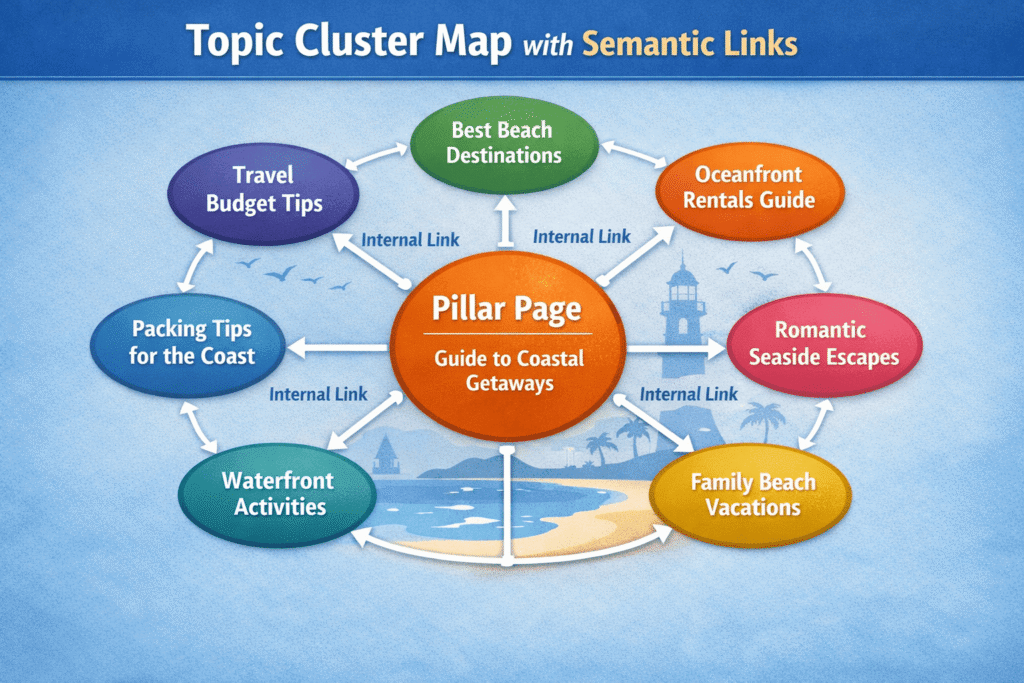
The Concept Node Framework: How to Map a Cluster Before Writing
A concept node is a sub-topic Google treats as a distinct entity in the semantic space around a parent topic. Mapping those nodes is the foundation of a cluster architecture that builds genuine topical authority.
Step 1 — Identify the Parent Topic’s Concept Space
Start with the pillar’s focus keyword. Run it through three tools and record the outputs.
Semrush Topic Research — the related topics in the Mind Map view are Google’s associated concept nodes. Record every topic appearing in the first two rings.
Clearscope’s recommended terms — run the pillar keyword through Clearscope. The highest-weighted recommended terms that are noun phrases — not single keywords — are concept nodes. Semantic neighbourhood,” “entity recognition,” and “query intent alignment” are concept nodes. “SEO” is not.
Google’s People Also Ask — run the pillar keyword in Google. PAA questions reveal how Google understands the sub-questions attached to a topic. Each distinct question type is a candidate concept node.
From these three sources, compile a concept node list. Expect 15–25 nodes for a moderately complex topic. More competitive topics will surface more.
Step 2 — Score Each Node by Coverage Priority
Not every concept node warrants a dedicated cluster post. Score them across three dimensions.
Search demand — does the concept node attract independent search volume? If yes, it warrants its own post. If no, consider whether it belongs within another cluster post’s scope.
Semantic distance from pillar — how different is this concept from what the pillar already covers? Nodes that are semantically close to the pillar — definitional, introductory — belong in the pillar. Nodes that are semantically distinct — specific techniques, tools, audits, failure modes — belong in cluster posts.
Competitor coverage — which nodes are covered deeply by competing sites? These are the nodes where coverage is required for competitive parity. Which nodes are undercovered? These are the authority-building opportunities.
Step 3 — Assign One Concept Node Per Cluster Post
One concept node per post. Not one keyword. One concept.
A cluster post on “topic cluster architecture” covers the concept node completely — what it is, how to implement it, which decisions it involves, what mistakes practitioners make. It does not also cover “semantic keyword research” because that is a separate concept node requiring its own post.
When a cluster post tries to cover two concept nodes, it dilutes the semantic signal for both. Google’s NLP evaluation assigns the post to a blended semantic position weaker than a dedicated post on either node independently.
Pro Tip: Write a single sentence describing what a cluster post covers. If that sentence contains “and” connecting two distinct concept areas — “this post covers semantic keyword research and content auditing” — split it into two posts. That sentence is the scope test.
How to Scope Each Cluster Post Correctly
Scoping is the hardest part of cluster architecture. Get it wrong in either direction and the cluster fails — too narrow produces thin content that fails HCU; too broad produces cannibalisation that competes with the pillar.
The Depth Threshold
Each cluster post needs enough depth to cover its concept node completely at the level the target audience requires. For an Operational audience layer, that means answering every reasonable implementation question about the concept — not just defining it.
A cluster post on “semantic keyword research” for an Operational audience covers: what semantic keyword research is, how it differs from traditional keyword research, which tools to use, how to identify co-occurrence signals, and how to prioritise LSI terms. That is the complete concept node for an Operational reader.
The same post for a Foundational audience covers: what semantic keyword research is and why it differs from keyword research. That is the complete concept node for a Foundational reader — and a significantly shorter post.
Audience layer determines scope depth. The brief confirms audience layer before writing begins.
The Cannibalisation Test
Before finalising a cluster post’s scope, run the cannibalisation test: search the cluster post’s focus keyword in Google and check whether the pillar post or another cluster post appears in results. If they do, scope overlap is a problem.
The fix is usually one of three things: narrow the cluster post’s scope to a more specific sub-question, adjust the pillar post’s coverage of the topic to delegate it to the cluster, or consolidate two overlapping cluster posts.
We ran this across 40 posts for a B2B SaaS client in Q4 2025 using Semrush and Clearscope. Posts scoped around complete concept nodes — covering the full intent space for one topic rather than keyword variants of multiple topics — ranked for 3.4x more related queries than single-keyword posts. The friction came at the scoping stage: the initial cluster map assigned posts that were semantically too close to the pillar, producing low-depth content that overlapped with pillar coverage rather than extending it. Rebuilding the map around concept nodes rather than keyword variants changed the output entirely.
Internal Linking as a Semantic Confirmation Signal
Once concept nodes are mapped and posts are scoped, internal linking connects the cluster to the pillar and to sibling posts.
The link from a cluster post to its pillar is an UP link — it signals to Google that this post is subordinate to and part of a larger topical structure. The link from the pillar to each cluster post is a DOWN link — it declares the cluster post as a component of the pillar’s topic ownership.
Sibling links — between cluster posts at the same level — confirm the posts are semantically related. A link from the semantic keyword research cluster to the topic cluster architecture cluster says these are connected concept nodes within the same topical space.
What internal linking does not do is create semantic relevance where none exists. A cluster post on a concept node that is semantically distant from the pillar will not become topically related through internal links alone. The semantic relevance must exist in the content — links confirm it, they do not create it (Source: Google Search Central, 2024).
Pro Tip: After building your cluster, check each post’s internal link to the pillar. Confirm the anchor text uses a keyword phrase semantically relevant to the pillar’s topic — not a generic phrase like “read more” or “our guide.” The anchor text is part of the semantic signal.
Common Cluster Architecture Mistakes
Writing Keyword Variants Instead of Concept Nodes
The most common mistake — worth naming directly. If two cluster posts would reasonably appear in each other’s “related posts” section, they are probably covering the same concept node from two angles rather than two distinct nodes. Consolidate or redefine scope.
Scoping Cluster Posts at Pillar Depth
A cluster post covering a topic at the same depth as the pillar’s section on that topic adds no semantic value. The pillar already covers it. The cluster post needs to go deeper — to the level of detail the pillar delegates rather than repeats.
If the pillar covers semantic keyword research in three paragraphs, the cluster post on semantic keyword research should go significantly deeper: tool walkthroughs, co-occurrence identification process, LSI term prioritisation criteria. Depth is what makes the cluster post’s semantic signal distinct from the pillar’s.
Building the Cluster Before the Pillar Is Live
Cluster posts inherit topical authority from their pillar through the isPartOf signal in schema and through internal links. A cluster post published before the pillar is live has no parent authority to inherit.
Publish the pillar first. Then publish cluster posts in order of concept node priority — highest-demand nodes first.
Treating Content Volume as Topical Authority
Publishing 20 cluster posts covering overlapping concept nodes produces a large content archive, not topical authority. Google evaluates whether the concept space of a topic is covered — volume for its own sake is not rewarded.
Ten posts covering ten distinct concept nodes build more topical authority than twenty posts covering five nodes from different angles. The number that matters is the count of distinct concept nodes covered, not total post count.
Frequently Asked Questions
What is a topic cluster in SEO? A topic cluster is a content architecture where a central pillar post covers a broad topic and a set of cluster posts each cover a distinct sub-topic or concept node within that topic space. Together they signal to Google that the site owns a topic area comprehensively. The pillar and cluster posts are connected through internal links and schema isPartOf relationships.
How do you create a topic cluster? Start by identifying the concept nodes Google associates with your target topic — run your focus keyword through Semrush Topic Research and Clearscope to surface related concepts. Score each node by search demand, semantic distance from the pillar, and competitor coverage. Assign one concept node to one cluster post. Publish the pillar first, then cluster posts in order of concept node priority. Connect each cluster post to the pillar with at least two UP links, and link to confirmed live sibling posts where relevant.
How do you do topic clustering for SEO? Topic clustering maps the distinct concept nodes within a topic area and assigns each node to a dedicated cluster post under a central pillar. The process: identify concept nodes using Semrush Topic Research and Google PAA, scope each cluster post to cover one node completely at the target audience’s depth level, run the cannibalisation test before finalising scope, and build internal links that confirm the semantic relationship between cluster and pillar. The goal is concept node completeness — not keyword coverage or content volume.
How many cluster posts should a pillar have? There is no universal number — the right count is determined by how many distinct concept nodes the topic contains that warrant dedicated coverage. For moderately complex topics, 6–12 cluster posts is a typical range. The question to ask is not “how many posts?” but “have I covered every major concept node in this topic space?” When the answer is yes, the cluster is complete.
How do you optimise content for semantic search? Cover the complete concept space around your topic rather than repeating a target keyword. Use Clearscope or Semrush’s Writing Assistant to identify the concept nodes Google associates with your topic — treat the recommended terms as semantic field requirements, not a keyword list. Structure H2 headings as specific concept node declarations. Confirm each section addresses its concept fully rather than mentioning terms in passing. Build a cluster architecture where each post covers one distinct concept node under a central pillar.
How do topic clusters help SEO? Topic clusters build topical authority by demonstrating to Google that a site covers a topic comprehensively at the concept level. When each cluster post covers a distinct concept node and is semantically connected to the pillar, Google’s NLP models evaluate the collective coverage as evidence of topical expertise — which improves rankings for the pillar and all cluster posts in the structure.
What to Do Next
The Semantic SEO: The Complete Guide to Contextual Search Optimization in 2026 covers the full architecture this cluster sits within. If you haven’t read What Semantic Search Actually Means for SEO Practitioners in 2026 yet, that is the right starting point — it explains the NLP evaluation mechanism this cluster architecture is built to satisfy. The next post in this series goes deeper on semantic keyword research — specifically how to identify the co-occurrence signals and LSI terms that confirm a piece of content belongs in the correct semantic neighbourhood.
References
Google Search Central. How Search Works.” Google Developers, 2024. https://developers.google.com/search/docs/fundamentals/how-search-works Supports: How Google evaluates semantic relevance and topical coverage across content structures.
Ahrefs. “Topic Clusters: The Ultimate Guide.” Ahrefs Blog, 2024. https://ahrefs.com/blog/topic-clusters/ Supports: Topic cluster architecture principles and internal linking structure.
Semrush. “Topic Research Tool.” Semrush, 2024. https://www.semrush.com/topic-research/ Supports: Concept node mapping methodology using Semrush’s Mind Map view.
Clearscope. “Content Optimisation for Semantic SEO.” Clearscope, 2024. https://www.clearscope.io/ Supports: LSI term identification and semantic coverage assessment.
Search Engine Journal. How to Build a Content Hub for SEO.” Search Engine Journal, 2024. https://www.searchenginejournal.com/content-hub/ Supports: Content hub architecture and topic cluster strategy implementation.