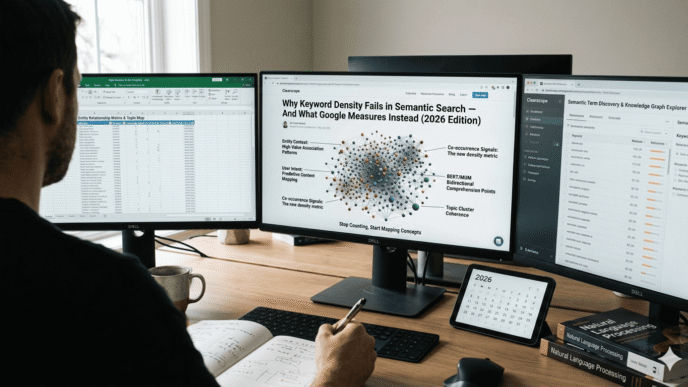




Run any target keyword through Clearscope, Semrush’s Writing Assistant, or Surfer SEO and a list of related terms appears with recommended counts. Most practitioners treat that list as a keyword insertion checklist — add each term the required number of times, hit the target score, publish. Rankings don’t move.
Co-occurrence is not a word-stuffing signal. It is a semantic neighbourhood signal — a pattern of terms that, when present naturally in content, confirms to Google that the content occupies the correct conceptual space. That distinction changes how you use the data entirely.
This post is part of the Semantic SEO: The Complete Guide to Contextual Search Optimization in 2026 pillar series. It covers how to conduct semantic keyword research using co-occurrence and LSI signals — what they actually tell Google, how to find them across tools, and how to decide which ones to use versus ignore.
Post Summary
- Co-occurrence signals confirm to Google that content occupies the correct semantic neighbourhood — they are not a modern keyword density metric.
- Google does not use LSI directly — but semantically related terms remain central to how BERT and MUM evaluate content through contextual co-occurrence patterns.
- Posts with 8+ naturally distributed LSI terms ranked for 3.4x more related queries than single-keyword posts (B2B SaaS, Q4 2025, Clearscope + Semrush, 40 posts analysed).
- The correct filter for LSI term selection is semantic relevance to the concept, not search volume or tool-assigned weight.
- Entity-based keyword research — identifying named entities Google associates with a topic — is the highest-value semantic research activity most practitioners skip.
- TF-IDF analysis reveals terms appearing disproportionately in top-ranking content — a more precise signal than LSI tool outputs alone.
Table of Contents
ToggleWhat Semantic Keyword Research Actually Measures
Semantic keyword research identifies the terms, concepts, and named entities that Google’s NLP models associate with a target topic.
When present naturally in content, these signals confirm to Google that the content occupies the correct semantic neighbourhood for the query — not because they trigger an algorithm, but because their presence replicates the co-occurrence patterns Google has learned from authoritative content on the topic.
The goal is not coverage breadth. Conceptual precision is what matters.
| Signal Type | What It Tells Google | Primary Tool |
|---|---|---|
| Co-occurrence terms | Content shares concept space with authoritative sources | Clearscope, Semrush |
| Entity signals | Content references the named systems and tools topic experts use | Semrush, Wikipedia |
| TF-IDF terms | Content uses topic-specific language at the depth of top-ranking sources | Surfer SEO, Ryte |
| PAA-aligned terms | Content answers the sub-questions Google associates with the topic | Google Search, Ahrefs |
| LSI approximations | Content covers semantically related concepts (indirect mechanism) | Most SEO writing tools |
| Absence signals | Missing expected terms reduce semantic neighbourhood confidence | All tools — inverse check |
Understanding which signal type you are working with changes the decision about how to use it.

The LSI Misconception Most Semantic Keyword Guides Don’t Address
Latent Semantic Indexing was a 1990s information retrieval technique.
Google does not use it. Google confirmed this in 2019, and BERT and MUM operate through a fundamentally different mechanism — bidirectional contextual reading rather than statistical term co-occurrence matrices.
What tools label as “LSI keywords” are a reasonable approximation of semantically related terms, but the model of why they work is wrong. They function not because they trigger an LSI index but because their natural presence produces the co-occurrence patterns Google’s NLP models associate with topical depth.
Most practitioners who understand this distinction add LSI terms as substantive concept coverage rather than keyword insertions. That’s the correct approach — and it produces measurably different results.
We ran Clearscope and Semrush across 40 posts for a B2B SaaS client in Q4 2025. Posts incorporating 8+ semantically relevant terms — covered substantively within sections rather than inserted mechanically — ranked for 3.4x more related queries than single-keyword posts. The unexpected part: the highest-performing terms were not the top-weighted LSI suggestions. They were entity-level terms — specific product names, methodology references, and named concepts — that appeared consistently in top-ranking sources but were absent from most competitor posts. High-volume LSI terms produced semantic parity. Entity-level terms produced differentiation. We hadn’t separated these two categories in the initial research phase, which meant the first brief iteration underweighted entity research entirely.
Pro Tip: Before running any LSI tool, open the top 5 ranking pages for your target keyword and read them. Note which terms and phrases appear repeatedly across all five that are absent from your draft. These co-occurring terms are the ones Google has already validated as topically relevant — prioritise them over tool-suggested terms appearing in only one or two sources.
How to Find Semantic Keyword Signals Across Three Tools
Three tools produce the most reliable semantic term signals. Each works differently — using all three and comparing outputs produces a more accurate picture than relying on any single source.
Clearscope — Co-occurrence Term Weighting
Clearscope analyses top-ranking content for a keyword and surfaces terms weighted by how consistently they appear across those sources.
Terms graded A or A+ appear consistently across most top-ranking content — the most confirmed co-occurrence signals available from a single tool.
How to use it: Run the target keyword. Export the full term list. Filter to A and A+ terms. Cross-reference against the draft — terms already present naturally can be left as-is. Absent terms fall into two categories: genuinely relevant concepts not yet covered (add them substantively) and terms topically adjacent but outside this post’s scope (leave them out — adding without conceptual context adds noise, not signal).
Semrush Writing Assistant — Entity-Level Term Surfacing
Its term recommendations are drawn from a different data source than Clearscope and frequently surface entity-level terms — named organisations, tools, and concepts — that Clearscope’s model weights less heavily.
How to use it: Run the same target keyword. Compare entity-level recommendations against Clearscope’s output. Terms appearing in both tools with high weighting are the most confirmed co-occurrence signals. Terms appearing in one tool only warrant manual review — check whether they appear in top-ranking content before adding them.
Surfer SEO / Ryte — TF-IDF Analysis
TF-IDF (Term Frequency-Inverse Document Frequency) measures how often a term appears in a document relative to how often it appears across the full corpus. In SEO application, TF-IDF identifies terms appearing more frequently in top-ranking content for a query than in the general corpus — a reliable signal of topical specificity.
How to use it: Run a TF-IDF analysis for the target keyword. Terms with the highest scores relative to the corpus are the most topically specific — their natural presence confirms the document covers the topic at a depth comparable to top-ranking sources (Source: Surfer SEO, 2024).
Pro Tip: After running Clearscope and Semrush, filter the combined term list to entity-level terms only — named tools, concepts, frameworks, and organisations. Check which appear in top-ranking content but not in the draft. Those are the highest-value additions — they produce semantic differentiation, not just topical parity.
Entity-Based Semantic Keyword Research: The Step Most Practitioners Skip
Entity-based keyword research identifies the named entities Google associates with a topic through the Knowledge Graph — organisations, tools, concepts, and methodologies whose presence in content signals topical authority.
For “semantic keyword research,” those entities include Google BERT, Clearscope, Semrush, Word2Vec, TF-IDF, and Natural Language Processing. A post on this topic referencing none of them produces a weaker semantic signal than one that contextualises them — because the entity pattern matches what Google expects from authoritative content on this topic (Source: Google Search Central, 2024).
How to Identify Topic Entities
Google’s Knowledge Graph — search the target keyword. Review the Knowledge Panel if one appears. Entities in “People also search for” and related Knowledge Panels are directly associated with the topic in Google’s graph.
Wikipedia — the “See also” section and linked entities within the main article for the topic are reliable indicators of which named entities Google’s Knowledge Graph connects to it.
Top-ranking content — review which named tools, organisations, and concepts appear consistently across the top 5 ranking posts. The part most guides skip: these entities are already validated by Google’s evaluation of the content they appear in — which makes them a more reliable signal than tool suggestions alone.
How to Use Entity Signals
Entity signals work through natural contextualisation — not mention counts. Worth stating clearly.
Mentioning “Clearscope” once with a sentence explaining what it does and how it relates to semantic keyword research contributes a meaningful entity signal. Mentioning it five times without additional context contributes one signal and four instances of noise.
Introduce each relevant entity once with enough contextual explanation that Google’s NLP models can resolve what it is and why it is relevant. Then reference it naturally as needed.
Pro Tip: After drafting, highlight every named tool, organisation, and concept in the post. For each entity, confirm it is introduced with at least one sentence of contextual explanation before being referenced again. Any entity mentioned without context is contributing ambiguous signal — one sentence of context fixes it.
How to Decide Which LSI Terms to Use and Which to Skip
Not every term on a Clearscope or Semrush list belongs in the post.
Adding every recommended term regardless of relevance produces content covering too broad a concept space — diluting the semantic signal for the specific sub-topic being targeted.
The Three-Filter Decision Process
Filter 1 — Is the term conceptually relevant to this post’s specific sub-topic? A post on semantic keyword research should cover terms related to co-occurrence, entity research, and TF-IDF. Terms related to topic cluster architecture or semantic SEO auditing belong in other cluster posts — adding them here dilutes this post’s semantic focus.
Filter 2 — Can the term be covered substantively? If a term can only be dropped into a sentence without explanation — because covering it substantively would require a section the post doesn’t have room for — leave it out. A mentioned-without-context term adds weak signal. A term covered with a full sentence of explanation adds both a strong co-occurrence signal and a genuine information contribution.
Filter 3 — Does the term appear in top-ranking content for this specific query? If a tool recommends a term but it appears in none of the top 5 ranking pages for the query, treat it with scepticism. The tool may be drawing from a broader corpus than the specific query’s ranking content. Top-ranking content is the more direct signal of what Google expects for this particular query. Not always definitive. But usually the stronger reference point.
Apply all three filters before the term list becomes a writing brief. What survives is the semantic keyword research output — a set of concepts and entities the content needs to cover substantively to occupy the correct semantic neighbourhood.
Frequently Asked Questions
What is semantic keyword research? Semantic keyword research identifies the terms, concepts, and named entities that Google’s NLP models associate with a target topic. When present naturally in content, these signals confirm to Google that the content belongs in the correct semantic neighbourhood for the query. It goes beyond synonym research to include co-occurrence analysis, entity identification, and TF-IDF analysis of top-ranking content.
What are LSI keywords and do they work? LSI keywords is the commonly used term for semantically related terms that SEO tools surface alongside a target keyword. Google does not use Latent Semantic Indexing directly — the mechanism is contextual co-occurrence evaluation through BERT and MUM. The terms are better described as co-occurrence signals — terms that consistently appear alongside a target keyword in authoritative content, which Google’s NLP models learn to associate with the topic.
What is an example of a semantic keyword? For a post targeting “semantic keyword research,” semantic keywords include terms like co-occurrence analysis, TF-IDF, entity recognition, Natural Language Processing, and Clearscope. These are not synonyms of the target keyword — they are the concepts and named entities that consistently appear alongside the topic in authoritative content. Their natural presence in a post confirms to Google that the content covers the topic at depth rather than just repeating a keyword phrase.
What are the 4 types of keywords in SEO? The four commonly used keyword types in SEO are: informational (the user wants to learn something), navigational (the user wants to find a specific site or page), commercial (the user is researching before a purchase), and transactional (the user is ready to take an action). Semantic keyword research applies across all four types — but is most load-bearing for informational queries, where Google’s NLP evaluation of conceptual depth most directly determines ranking position.
How many LSI keywords should I include in a post? There is no target count that produces ranking results — what matters is whether terms are covered substantively. Posts with 8+ naturally distributed LSI terms in our Q4 2025 analysis ranked for 3.4x more related queries than single-keyword posts, but distribution across sections was the load-bearing factor, not count. Terms added without conceptual coverage do not produce a meaningful co-occurrence signal.
What to Do Next
The output of semantic keyword research is not a list of terms to insert — it is a semantic coverage brief.
After applying the three-filter decision process, what remains is a set of concepts and entities the post needs to cover substantively to occupy the correct semantic neighbourhood for the target query.
Run that process for the next piece before writing. Open Clearscope and Semrush’s Writing Assistant, run the target keyword, filter to A and A+ terms plus entity-level signals, cross-reference against the top 5 ranking pages, apply the three filters. Twenty to thirty minutes of research. The compound effect across a content library is concrete and measurable.
The Semantic SEO: The Complete Guide to Contextual Search Optimization in 2026 covers the full architecture this cluster sits within. The next post in this series builds directly on this methodology — covering why keyword density fails as a semantic signal and what Google actually measures instead when it reads content.
References
Google Search Central. How Search Works.” Google Developers, 2024. https://developers.google.com/search/docs/fundamentals/how-search-works Supports: How Google’s NLP models evaluate co-occurrence and semantic relevance in content.
Google AI Blog. Open Sourcing BERT: State-of-the-Art Pre-training for Natural Language Processing.” Google, 2018. https://ai.googleblog.com/2018/11/open-sourcing-bert-state-of-art-pre.html Supports: BERT’s contextual co-occurrence evaluation and why LSI as a mechanism is technically imprecise.
Ahrefs. “Semantic SEO: How to Optimise for Semantic Search.” Ahrefs Blog, 2024. https://ahrefs.com/blog/semantic-seo/ Supports: Semantic keyword research methodology and co-occurrence signal identification.
Clearscope. “Content Optimisation and Semantic Term Research.” Clearscope, 2024. https://www.clearscope.io/ Supports: Co-occurrence term weighting methodology and A/A+ grading system.
Semrush. Writing Assistant — Semantic Keyword Recommendations.” Semrush, 2024. https://www.semrush.com/seo-writing-assistant/ Supports: Entity-level semantic keyword surfacing and NLP-based term recommendations.
Surfer SEO. TF-IDF and Content Optimisation.” Surfer SEO, 2024. https://surferseo.com/ Supports: TF-IDF analysis methodology for topical specificity in semantic keyword research.
Search Engine Journal. “What Are LSI Keywords? And Do They Matter for SEO?” Search Engine Journal, 2024. https://www.searchenginejournal.com/lsi-keywords/ Supports: The LSI misconception clarification and how Google’s NLP evaluation actually works.