

You’re getting cited by ChatGPT. Perplexity mentions your brand. Google AI Overviews includes your content. Success, right?
Then you dig deeper: your competitor gets cited first in 82% of responses where you both appear. Users see their brand before yours. Their positioning as “the industry standard” versus your “alternative option” kills conversions before prospects even reach your website.
Welcome to the positioning game. Response positioning in AI search matters more than citation frequency. First position drives 3-5x more brand awareness and consideration than third position—even when both get cited identically.
Table of Contents
ToggleWhat Is Response Positioning in AI Search
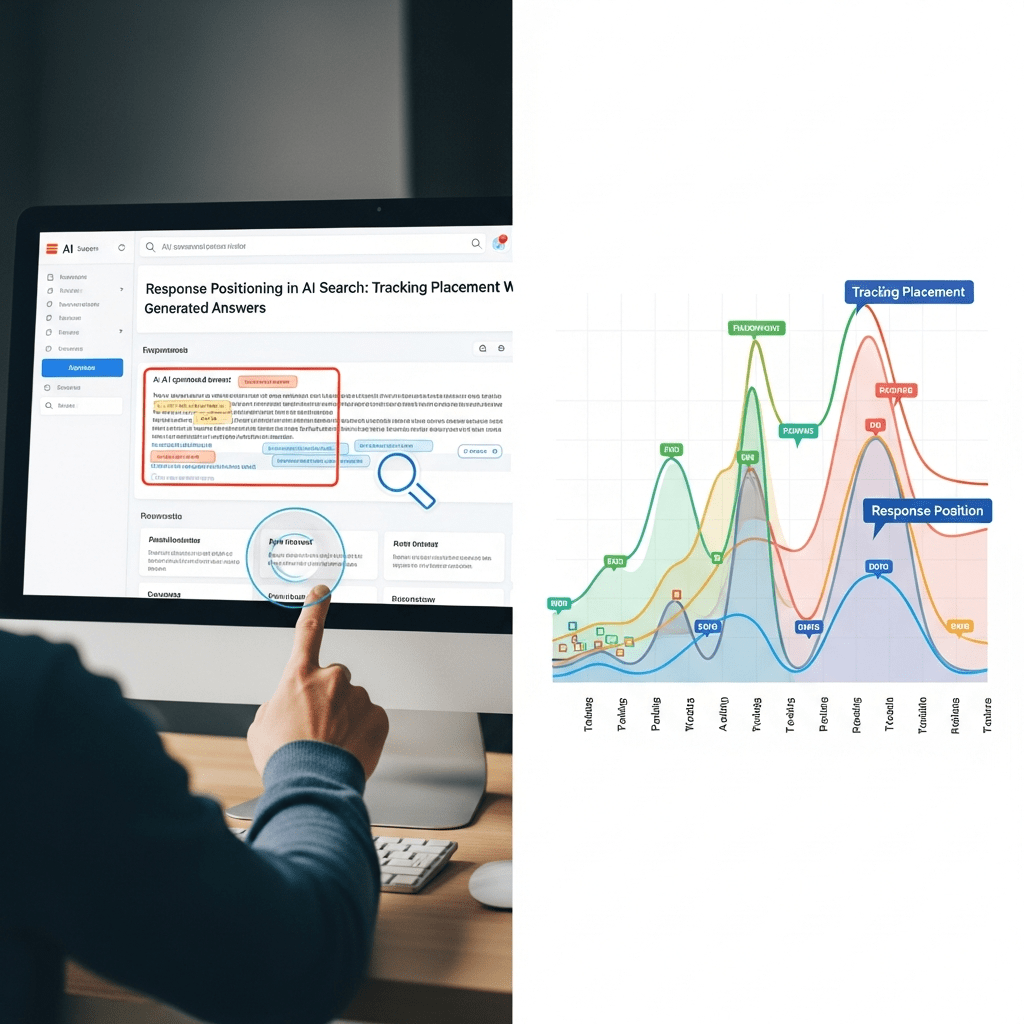
Response positioning in AI search refers to where your content, brand, or citations appear within the structure, hierarchy, and sequence of AI-generated responses across platforms like ChatGPT, Perplexity, Claude, and Google AI Overviews.
Think of it as SERP position for the AI era. Just as ranking #1 in Google drove exponentially more traffic than #5, appearing first in AI responses drives disproportionate attention, trust, and consideration.
But positioning is more complex than simple numerical rank. It includes:
- Sequential order (first, second, third mention)
- Structural prominence (main answer vs supplementary sections)
- Contextual framing (primary recommendation vs alternative)
- Visual hierarchy (bold emphasis, heading inclusion, featured placement)
According to BrightEdge’s Generative Parser research, sources cited in the first two positions receive 68% of user attention in AI-generated responses, while positions 5+ receive under 10% combined.
Position isn’t everything. But position decides whether citation translates to business impact.
Why Most Companies Track Citations but Ignore Positioning
The measurement trap: citation tracking is straightforward. “Did we get cited? Yes or no.”
Citation positioning tracking requires nuanced analysis. Did you appear first or fifth? In the main answer or supplementary section? As the recommended solution or a mentioned alternative?
Most companies celebrate citation counts while ignoring positioning because:
- Positional data is harder to capture systematically
- Quality assessment requires subjective judgment beyond binary yes/no
- Traditional SEO thinking focuses on “being included” versus “being first”
- Dashboard complexity increases exponentially with positional metrics
But this measurement gap creates strategic blindness. You think you’re winning because citation counts look good. Meanwhile, competitors with lower citation frequency but superior positioning are capturing market share.
Gartner research found that 78% of enterprises tracking AI citations lack systematic positioning metrics. They know they’re being mentioned but not how they’re being positioned relative to alternatives.
Core Response Positioning Metrics
Primary Position Rate
What percentage of your citations appear in the first two positions within AI responses? This is your foundational answer placement AI metric.
Calculate across your target query set:
- Total citations received: 100
- Citations in position 1-2: 34
- Primary position rate: 34%
Benchmark targets:
- Category leaders: 50-70% primary position rate
- Established competitors: 30-45%
- Emerging players: 15-25%
- Niche specialists: 40-60% in their niche, <10% outside it
Track this monthly to identify authority trends. Declining primary position rate signals eroding authority even if total citations remain stable.
Average Citation Position (ACP)
What’s your mean position across all citations? ACP provides a single number summarizing positioning performance.
Calculate by averaging position across all citations (treat footnote-only citations as position 10+):
- 15 citations at position 1
- 12 citations at position 2
- 18 citations at position 3
- 8 citations at position 5+
ACP = ((15×1) + (12×2) + (18×3) + (8×6)) / 53 = 2.5
Target ACP under 3.0 for strong positioning, under 2.0 for dominant authority. ACP above 4.0 indicates weak positioning requiring strategic intervention.
Track ACP by query category, platform, and content type to identify positioning patterns and optimization opportunities.
Positional Movement Velocity
How quickly is your positioning improving or declining? Velocity metrics predict authority trajectory.
Calculate month-over-month changes:
- Previous ACP: 3.2
- Current ACP: 2.8
- Velocity: -0.4 (improving)
Sustained positive velocity (improving positions by 0.2+ monthly) indicates successful optimization. Negative velocity warns of competitive displacement or algorithmic changes affecting your authority.
Velocity matters more than absolute position for strategic planning. A competitor at position 4.0 with +0.5 monthly velocity is more threatening than one at 2.0 with flat performance.
Primary vs. Secondary Source Distribution
When AI platforms cite multiple sources, are you the primary authority or a supporting reference? This citation order analysis metric reveals perceived authority.
Track citation roles:
- Primary Authority: Cited first, presented as main answer source (highest value)
- Secondary Validation: Cited to corroborate or expand primary source (medium value)
- Alternative Perspective: Presented as contrasting or additional option (medium value)
- Supplementary Reference: Listed in sources but minimal in-text mention (low value)
Healthy authority profiles show 60%+ primary authority citations. Profiles dominated by secondary/supplementary roles indicate weak positioning despite potentially high citation frequency.
Platform-Specific Positioning Dynamics
Perplexity Positioning Characteristics
Perplexity’s transparent citation system makes positioning easy to track and highly visible to users:
Numbered Source Lists appear prominently with citations [1], [2], [3] throughout answers. Position in this list directly correlates with user click-through—source [1] receives 3-4x more clicks than [5].
In-Text Citation Density matters beyond list position. Sources cited multiple times within the answer (not just listed) demonstrate deeper authority.
Follow-Up Question Persistence shows whether you remain cited as users ask clarifying questions. Maintaining citations across conversation threads indicates robust authority.
Perplexity heavily weights recency and source diversity. New content from authoritative domains can quickly achieve primary positioning, but Perplexity also frequently cites 5-10 sources, making exclusive dominance rare.
ChatGPT Positioning Nuances
ChatGPT’s citation behavior varies dramatically based on mode and prompting:
Web Browsing Mode provides explicit footnotes when enabled. Track numerical position [1], [2], [3] similar to Perplexity. First 2-3 citations receive disproportionate credibility.
Synthesis Mode (no browsing) embeds knowledge without attribution. Track through unique phrasing, data points, or frameworks that reveal source influence even without explicit citation.
Recommendation Hierarchy within answers positions some sources as “recommended” versus “mentioned.” ChatGPT often leads with one source before presenting alternatives, creating implicit ranking.
ChatGPT’s training data cutoff affects positioning—recent content only appears with web browsing enabled, limiting your ability to control positioning through freshness alone.
Google AI Overviews Positioning
Google’s AI-generated results integrate with traditional search, creating hybrid positioning dynamics:
Featured Source Highlighting places 1-3 sources prominently at the top of AI Overviews with visible branding and links. This premium positioning drives significant traffic and authority.
In-Overview Citation Order presents sources sequentially as users expand answers. First sources receive primary attention; later sources get minimal engagement.
Traditional SERP Coexistence means you can appear in both AI Overview sources AND organic results below. Dual presence compounds positioning advantages.
According to Authoritas research, sources in the first 2 positions within AI Overviews receive 4.2x more clicks than traditional organic position 1 results that appear below the AI Overview.
Claude Positioning Patterns
Claude typically synthesizes information without explicit citation in standard use:
Implicit Authority Signals appear through phrasing like “research shows” or “experts recommend” without specific attribution. Track whether your frameworks and terminology appear even without citation.
Document Analysis Mode makes positioning more explicit when users upload files. Claude references specific documents by name, creating clear positioning hierarchies.
Recommendation Strength varies from “consider” to “strongly recommend” to “avoid”—implicit positioning affecting user behavior without explicit rankings.
Claude’s positioning is hardest to track systematically but influences high-value professional and enterprise users disproportionately.
Advanced Positioning Analysis Techniques
Multi-Position Tracking Across Conversations
Single-query positioning snapshots miss dynamic positioning across conversation flows:
Track positioning as users ask follow-up questions:
- Initial query: Position 2
- Follow-up 1: Position 1
- Follow-up 2: Position 1
- Follow-up 3: Position 3
Conversation persistence rate measures how often you maintain or improve positioning as discussions deepen. High persistence (70%+ conversations) indicates robust authority. Low persistence suggests superficial recognition.
Users asking multiple questions are higher-intent prospects. Maintaining primary positioning throughout these conversations drives disproportionate business impact.
Competitive Positioning Analysis
How do you position relative to specific competitors when both get cited? Competitive positioning comparison reveals authority dynamics.
Track head-to-head positioning:
- Times you appear before Competitor A: 23
- Times Competitor A appears before you: 47
- Win rate: 33% (you appear first 33% of the time)
Break this down by:
- Query category (where you win vs lose)
- Platform (stronger positioning on some platforms)
- Context (product queries vs thought leadership)
One SaaS company discovered they had 60% win rates on “how-to” queries but 15% on “what is the best” queries—revealing strength in education but weakness in consideration-stage positioning. They adjusted content strategy accordingly.
Structural Position Mapping
Where within answer structures do citations appear? Position tracking AI reveals structural patterns.
Map positioning by answer section:
- Introduction/Overview: 15% of your citations
- Main Answer Body: 45% of citations
- Detailed Explanation: 25% of citations
- Additional Resources: 10% of citations
- Footnotes Only: 5% of citations
Healthy profiles show 60%+ citations in introduction and main body sections. Heavy concentration in “additional resources” or “footnotes only” indicates weak positioning.
Track structural position trends over time to identify improving or declining authority in critical answer sections.
Citation Framing Quality
How are your citations introduced and contextualized? Placement metrics AI includes qualitative framing assessment.
Track framing categories:
- Authoritative Endorsement: “Leading experts at [Brand]…” (highest value)
- Primary Source: “According to [Brand]’s research…” (high value)
- Supporting Evidence: “This aligns with [Brand]’s findings…” (medium value)
- Alternative Perspective: “[Brand] suggests a different approach…” (medium value)
- Neutral Mention: “[Brand] also discusses this topic…” (low value)
Average framing scores using weighted values. Declining framing quality signals authority erosion even when positioning remains numerically stable.
Real-World Response Positioning Impact
Case Study: Enterprise Software Company
A $300M ARR enterprise software company tracked citation frequency religiously: 280 monthly citations across 150 target queries. Strong performance.
Then they implemented comprehensive response positioning AI search tracking:
- Average citation position: 4.2 (weak)
- Primary position rate: 18% (very weak)
- Competitive win rate vs. main rival: 22% (losing badly)
- Structural positioning: 62% in “additional resources” sections (poor)
Their competitor had only 190 citations monthly but averaged 2.1 position with 54% primary rate. The competitor was dominating despite lower citation volume.
Root cause analysis revealed competitors had:
- More prominent expert bylines and credentials
- Fresher content with recent publication dates
- Original research and proprietary data AI platforms trusted
- Better structured content with clear hierarchies
They systematically addressed positioning factors:
- Added C-level executive bylines to strategic content
- Implemented quarterly content refresh cycles
- Launched annual industry survey generating original data
- Restructured content with clear summary sections AI could easily excerpt
Results after 9 months:
- ACP improved to 2.6 (83% improvement)
- Primary position rate: 41% (127% improvement)
- Competitive win rate: 48% (118% improvement)
Business impact: Brand search volume increased 156%, demo requests up 89%, average deal size increased 23% as prospects perceived them as premium solution rather than alternative option.
Case Study: B2B SaaS Startup
A three-year-old project management startup got cited frequently but struggled with enterprise sales. Citation positioning analysis revealed why:
They averaged position 3.8 across citations with only 12% primary positioning. When cited alongside enterprise competitors, they appeared last 76% of the time.
Worse, their citation framing was consistently “user-friendly option” or “affordable alternative”—positioning that attracted small businesses but repelled enterprise buyers willing to pay premium prices.
Strategic repositioning campaign:
- Created enterprise-specific content with Fortune 500 case studies
- Added CISO and security-focused content establishing enterprise credibility
- Published integration guides for enterprise tools (Salesforce, Workday, SAP)
- Implemented enterprise-grade schema markup
They also strategically de-emphasized “affordable” and “simple” messaging that reinforced small-business positioning.
Positioning results after 6 months:
- ACP improved from 3.8 to 2.9
- Primary position rate jumped to 32%
- Citation framing shifted: 58% now included “enterprise” or “scalable” descriptors
Business impact: Enterprise pipeline increased 240%, average contract value up 180%, positioning shift drove \$8M in enterprise deals directly traceable to improved AI search positioning.
Building Your Position Tracking System
Manual Position Auditing
Start with systematic manual tracking establishing positioning baselines:
Test your top 30-50 queries monthly across major platforms. Document full AI responses. Record position of each citation numerically. Note structural placement and framing.
Create spreadsheets tracking:
- Query | Platform | Position | Structural Section | Framing Quality
- Calculate ACP, primary position rate, and distribution metrics
Time investment: 3-5 hours monthly for 50-query tracking. Provides reliable data while determining whether automation justifies investment.
Semi-Automated Position Tracking
Use browser automation to scale position tracking systematically:
Puppeteer/Selenium scripts query AI platforms, extract responses, and identify citation positions through text parsing and DOM analysis.
Natural language processing categorizes structural sections (introduction, body, supplementary) and assesses framing quality through sentiment and authority signal detection.
Database storage maintains historical positioning data enabling trend analysis and velocity calculations.
Time investment: 20-40 hours initial development, 2-3 hours monthly maintenance. Scales to 200-500 queries feasibly.
Enterprise Position Intelligence
Specialized platforms emerging for comprehensive placement metrics AI tracking:
BrightEdge’s Generative Parser tracks citation positioning alongside frequency, providing competitive positioning benchmarks.
Authoritas monitors position within Google AI Overviews specifically, including traditional SERP integration analysis.
Custom enterprise dashboards integrate positioning data with business metrics, connecting position changes to pipeline and revenue outcomes.
Cost: $5,000-25,000+ annually depending on query volume and feature sets.
Optimizing Content for Better Positioning
Authority Signal Amplification
AI platforms position sources with strongest authority signals first. Strengthen your answer placement AI through:
Expert Author Credentials prominently displayed with specific expertise indicators. “Dr. Sarah Johnson, 15-year cardiology specialist” outpositions “Medical Team.”
Institutional Affiliations connecting content to recognized organizations. University partnerships, professional certifications, industry association leadership all boost positioning.
Publication Authority Markers including editorial standards, peer review processes, fact-checking protocols. These quality signals influence AI positioning algorithms.
According to Search Engine Journal research, strong E-E-A-T signals improve average citation position by 1.8 positions—from 4.2 to 2.4 on average.
Content Structure Optimization
How you structure content affects extractability for primary positions:
Clear Executive Summaries at the top enable AI platforms to extract and position your perspective first. Bury the lede and AI might skip to competitors with clearer opening positions.
Hierarchical Information Architecture with logical heading structures helps AI understand your content organization and extract key points for prominent positioning.
Quotable Sound Bites make it easy for AI to excerpt your perspective. One-sentence summaries of key points increase primary positioning likelihood.
Data and Statistics presented clearly with sources cited. AI platforms preferentially position content with concrete, verifiable information.
Strategic Answer Optimization
Create content specifically structured for AI answer extraction:
Question-First Formatting placing questions as H2/H3 headers with direct answers immediately following. This Q&A structure aligns with AI response patterns.
Comprehensive Yet Concise answers providing depth without verbosity. AI platforms favor thorough coverage that’s still extractable efficiently.
Primary Source Citation to authoritative research strengthens your positioning when AI synthesizes information from multiple sources.
One healthcare publisher reformatted 200 articles with clear Q&A structures and added expert bylines. Average position improved from 3.8 to 2.1 within four months, connecting to your broader AI search visibility tracking approach.
Common Position Tracking Mistakes
Celebrating Citation Without Position Context
The most common mistake: focusing exclusively on citation frequency while ignoring positioning.
Getting cited 100 times at position 5+ provides less business value than 30 citations at positions 1-2. Track both metrics always—frequency and positioning together tell the complete story.
Never evaluate performance on volume alone.
Treating All Platforms Identically
Positioning dynamics differ dramatically across platforms. Strong positioning on Perplexity (where you rank #1 frequently) doesn’t translate to ChatGPT success.
Platform-specific optimization strategies required:
- Perplexity: Focus on recency and comprehensive sourcing
- ChatGPT: Emphasize expertise and authoritative tone
- Google AI: Prioritize E-E-A-T and structured data
- Claude: Ensure accurate representation when synthesized
One positioning strategy won’t work everywhere. Develop platform-specific approaches based on your audience’s primary AI platforms.
Ignoring Competitive Positioning Context
Tracking your absolute positioning (position 2 on average) means nothing without competitive context. If competitors average position 1.5, you’re losing. If they average 4.0, you’re winning decisively.
Always benchmark positioning competitively using competitive AI search benchmarking frameworks. Competitive positioning reveals strategic reality better than absolute metrics.
Overlooking Structural and Framing Quality
Numerical position (1, 2, 3) is insufficient. A position 2 citation in the main answer body with authoritative framing outperforms a position 1 citation buried in footnotes with neutral framing.
Track both quantitative (numerical position) and qualitative (structural placement, framing) dimensions. Optimize for composite positioning quality, not just numerical rank.
Pro Tips for Positioning Excellence
Positioning Strategy: “Dominate the first two positions in 5-10 strategic query categories rather than achieving position 4-5 across 50 categories. Concentration beats distribution in positioning games. Users notice and remember top-positioned sources.” – Rand Fishkin, SparkToro Founder
Framing Matters: “I’ve tracked hundreds of citation patterns. A position 2 citation framed as ‘the gold standard’ drives more consideration than position 1 framed as ‘one option.’ Fight for positioning AND framing simultaneously.” – Lily Ray, SEO Director at Amsive Digital
Velocity Over Position: “Your current position matters less than your velocity. Moving from position 5 to 3 monthly indicates growing authority. Competitors stuck at position 2 with no improvement are vulnerable to displacement despite better current positions.” – Aleyda Solis, International SEO Consultant
Future of Response Positioning
Response positioning in AI search will grow more sophisticated as platforms evolve:
Personalized Positioning where different users see different source orders based on their preferences, history, and context. Your position might vary by user segment.
Dynamic Repositioning as conversations progress, with sources moving up or down based on relevance to evolving queries.
Visual Positioning Hierarchy with featured placements, images, and interactive elements creating positioning beyond simple numerical rank.
Voice Response Positioning where audio AI assistants present sources sequentially, making position even more critical (users rarely listen past the first 2-3 sources).
Companies building sophisticated positioning tracking and optimization today will dominate tomorrow’s more complex positioning landscape.
FAQ
How much does positioning matter compared to citation frequency?
Positioning matters more than frequency for business outcomes. Research shows the first two cited sources drive 68% of user attention regardless of total sources cited. Aim for 30%+ primary position rate (top 2 positions) rather than maximizing total citations. One study found 40 citations averaging position 2.0 drove 2.3x more brand searches than 100 citations averaging position 4.5.
Can I improve positioning without creating new content?
Yes. Add expert credentials to existing content, implement structured data, update publication dates after meaningful refreshes, and optimize content structure with clearer summaries and hierarchies. One company improved ACP from 3.9 to 2.7 purely through metadata and structural updates without new content creation. However, sustained positioning improvement typically requires content quality enhancements eventually.
How do I track positioning on ChatGPT without explicit citations?
Look for implicit positioning signals: which frameworks get explained first, which methodologies get labeled “best practice,” which brands appear in examples. Track unique phrasing, statistics, or concepts from your content appearing in responses even without attribution. When ChatGPT synthesizes without citing, positioning appears through emphasis and framing rather than explicit rankings.
What’s a realistic timeline to improve average position?
Improving positioning typically takes longer than increasing citation frequency. Expect 3-6 months for meaningful position improvements (0.5-1.0 position gains). Very entrenched competitors with strong authority signals may take 6-12 months to displace. Track monthly velocity—sustained improvement of 0.2+ positions monthly indicates effective optimization even if absolute position remains suboptimal.
Should I optimize for positioning on all platforms equally?
No. Prioritize platforms your target audience actually uses. B2B buyers skew ChatGPT and Claude; researchers favor Perplexity; mainstream consumers use Google AI Overviews. Invest positioning optimization effort proportional to platform usage by your ideal customers. Winning position 1 on a platform your audience doesn’t use provides zero business value.
How do I prevent competitors from displacing my positioning?
Maintain positioning through: systematic content updates (quarterly minimum), continuous E-E-A-T signal strengthening, original research publication creating unique citeable content, and monitoring competitive positioning shifts for early warning. Positioning isn’t permanent—it requires ongoing defense. Companies that stop optimizing after achieving good positions typically see erosion within 6-12 months as competitors advance.
Final Thoughts
Response positioning in AI search separates companies that understand AI’s impact from those merely tracking vanity metrics.
Citation frequency tells you that you’re in the game. Positioning tells you whether you’re winning.
The companies dominating AI search three years from now won’t necessarily be those with the most citations. They’ll be the ones consistently achieving primary positioning in high-value query categories where their target customers are researching solutions.
Building comprehensive positioning tracking takes effort. Manual analysis is tedious. Systematic tracking requires infrastructure. Connecting positioning to business outcomes demands sophisticated attribution.
But this complexity creates defensible advantages. Most competitors will stick with simple citation counting because it’s easier. Your positioning sophistication becomes your competitive moat.
Start tracking positioning today. Your market position tomorrow depends on the positioning you build now.
Citations and Sources
- BrightEdge – Generative Parser User Attention and Positioning Research
- Gartner – Enterprise AI Citation Tracking and Measurement Gaps
- Authoritas – AI Overviews Click-Through and Positioning Analysis
- Search Engine Journal – E-E-A-T Signals and Citation Positioning
- SEMrush – Content Positioning and Competitive Analysis
- SparkToro – User Attention Patterns in AI Search
Related posts:
- AI Search Visibility Tracking: Tools, Metrics & KPIs for Generative Engine Performance (Visualization)
- What is AI Search Visibility? Understanding Presence in Generative Engines
- Answer Quality Optimization: Creating Content That AI Engines Prefer to Cite
- Featured Snippet Optimization for AI Overviews: Maximizing Dual Visibility