




Most explanations of BERT for SEO practitioners land on the same conclusion: “Google now understands language better.” That framing is accurate. It is also nearly useless.
Understanding that Google reads meaning does not tell you how to write differently. The mechanism behind BERT — bidirectional context reading — does. Because once you understand that the words surrounding a concept matter as much as the concept itself, that changes how you construct sentences, not just which topics you include.
This cluster is part of the Semantic SEO: The Complete Guide to Contextual Search Optimization in 2026 pillar series. It translates each model’s specific mechanism into a concrete content decision — the technical foundation that sits behind every keyword research, topic cluster, and audit decision covered elsewhere in the series.
Post Summary
- BERT (Bidirectional Encoder Representations from Transformers) reads text in both directions simultaneously — the words before and after a term inform its meaning as much as the term itself.
- MUM (Multitask Unified Model) extends evaluation to multimodal content and cross-lingual understanding — a video tutorial on a topic now competes with a written guide in the same semantic space.
- NLP (Natural Language Processing) is the broader discipline these models sit within — BERT and MUM are specific implementations of NLP applied to search.
- The three systems do not replace each other — they operate across different evaluation layers simultaneously.
- Posts restructured around semantic concept coverage saw impression growth on related queries within 6 weeks of rewrite (B2B SaaS, Q1 2026, GSC + Clearscope, 12 posts).
- The practical content implication of BERT is sentence construction — coherent surrounding context around a concept produces a stronger topical signal than keyword presence alone.
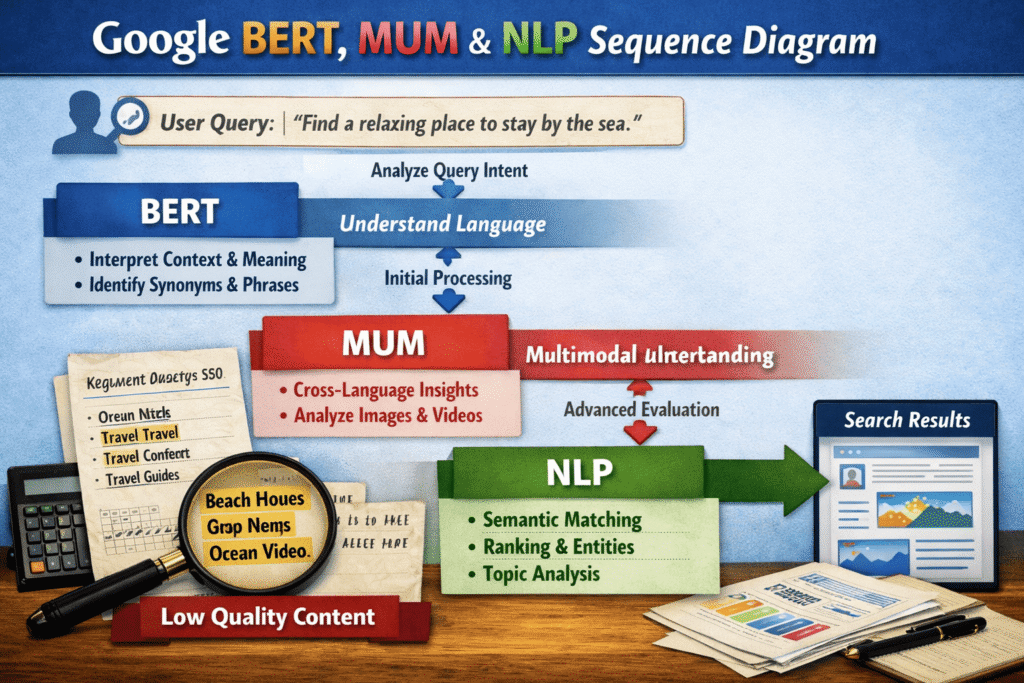
Table of Contents
ToggleWhat BERT Actually Does — and Why It Changes Sentence Construction
BERT stands for Bidirectional Encoder Representations from Transformers. Released by Google in 2018, it was the first model Google applied to search that could read context in both directions simultaneously (Source: Google AI Blog, 2018).
Before BERT, Google’s language processing read text sequentially — left to right, then right to left, separately. The meaning of a term was evaluated against what came before it or after it, not both at once.
BERT reads both simultaneously. Every term in a sentence is evaluated against all surrounding terms at the same time.
The practical implication is specific and actionable: sentence structure around a concept now carries meaning. Consider two sentences:
“BERT changed how Google processes search queries by understanding context bidirectionally.
“Search queries are processed differently now because of BERT context understanding.”
Both sentences contain the same information. BERT evaluates them differently because the terms surrounding “BERT” and “context” differ in each construction — and those surrounding terms contribute to how each concept is resolved.
This is why content written with natural, topic-coherent sentences around a concept signals more clearly to BERT than keyword-optimised content where the target term is placed mechanically. The keyword is present in both cases. The surrounding context that gives it semantic weight is not.
Pro Tip: Review the sentences in your next post that contain the target keyword. For each one, read the surrounding sentence with the keyword removed. If the sentence still makes clear sense about the topic — if the context is coherent without the keyword — the keyword is contributing a strong semantic signal. If the sentence becomes vague without it, the keyword is carrying context it should not be carrying alone. Rewrite to distribute the meaning across surrounding terms.
What MUM Adds — and Why Topical Authority Now Spans Content Formats
MUM stands for Multitask Unified Model. Announced by Google in 2021, it extended semantic evaluation across two dimensions BERT did not cover: modality and language (Source: Google Search Central, 2021).
Modality: MUM can evaluate text, images, and video simultaneously. A search query can now be matched against authoritative content in any format — a YouTube tutorial about a topic competes in the same semantic space as a written guide.
Language: MUM understands content across languages. A query in English can be matched against authoritative content written in Japanese, Spanish, or German if that content is more relevant to the query’s intent.
For SEO practitioners, two concrete implications follow.
First, topical authority is no longer format-specific. A site that publishes written guides on a topic without supporting video or visual content may lose semantic coverage ground to a site that publishes the same topic across multiple formats. MUM evaluates the topic space, not the format.
Second, the competitive landscape for any topic now includes content in other languages. This affects how Google evaluates whether a site’s content adds information gain — if a query topic is already covered exhaustively in authoritative content in another language, English-language content needs to contribute something that content does not.
| Model | Released | Mechanism | Primary SEO implication |
|---|---|---|---|
| Hummingbird | 2013 | Holistic query intent parsing | Long-tail intent over keyword match |
| BERT | 2018 | Bidirectional contextual reading | Sentence construction around concepts matters |
| MUM | 2021 | Multimodal + cross-lingual evaluation | Topical authority spans formats and languages |
| NLP (ongoing) | — | Foundational language processing discipline | Semantic coherence evaluated at document level |
How NLP Sits Beneath Both Models
NLP — Natural Language Processing — is the broader discipline that BERT and MUM are implementations of. It is not a separate Google system. It is the field of computational methods for processing and understanding human language that Google has applied at scale through these models.
Practitioners sometimes treat BERT, MUM, and NLP as three separate Google updates. They are not. NLP is the discipline. BERT and MUM are specific neural network architectures that implement NLP methods for search evaluation.
Understanding this distinction matters for content decisions because it clarifies the scope of what Google is evaluating. Every semantic signal — co-occurrence, entity clarity, contextual coherence, intent alignment — operates within the NLP evaluation layer. BERT and MUM are the specific mechanisms that read those signals.
What that means practically: improvements to any of these signals — better entity contextualisation, stronger co-occurrence coverage, more coherent sentence construction — register across the full NLP evaluation layer, not just against one model.
How BERT, MUM & NLP Evaluate Your Content
An interactive guide to Google's language model stack — what each system does, how they interact, and what it means for how you write.
Google Search
BERT (MUM)
by MUM
rankings (semantic posts)
From Keyword Matching to Semantic Understanding
Google's language evaluation didn't change overnight. Each system added a distinct capability that changed what content signals matter.
What Each Model Does — and What It Changes
Three layers of the same evaluation system, each operating on a different dimension of content quality simultaneously.
Reads every word in a sentence against all surrounding words simultaneously — not sequentially. The terms before and after a concept inform its meaning as much as the concept itself.
Evaluates text, images, and video simultaneously. Understands content across 75+ languages. A YouTube tutorial now competes with a written guide in the same semantic space.
The broader discipline BERT and MUM sit within. Evaluates semantic relationships across the full document — whether entities, concepts, and co-occurrence patterns collectively signal a unified topical focus.
How a Query Flows Through the Evaluation Stack
When a user searches, all three evaluation layers run simultaneously — each assessing a different dimension of content quality.
Keyword Density vs What Google Actually Measures
Semantic coverage signals consistently outperform keyword frequency metrics under NLP evaluation. Data from B2B SaaS content analysis (Q4 2025, aiseojournal.net).
BERT vs MUM vs NLP — Side by Side
Understanding what distinguishes each layer makes it clear which type of content improvement addresses which evaluation dimension.
| Dimension | BERT | MUM | NLP Layer |
|---|---|---|---|
| Released | 2018 | 2021 | Ongoing discipline |
| Evaluation scope | Sentence / passage level | Topic / format level | Full document level |
| Primary mechanism | Bidirectional context reading | Multimodal + cross-lingual | Semantic relationship mapping |
| What it reads | Text (sentence context) | Text + images + video, 75+ languages | Entities, co-occurrence, coherence |
| SEO implication | Sentence construction around concepts | Topical authority across formats | Concept scope per document |
| Content response | Rewrite sentences for coherent surrounding context | Topic cluster architecture | One concept node per post |
| Relative power | Baseline | 1,000× BERT | Foundational layer |
What to Do Differently — Per Model
Each evaluation layer suggests a different type of content improvement. Select a model to see the specific actions.
- 1Review every sentence containing the target concept. Confirm surrounding terms reinforce the concept's meaning — not just acknowledge its presence.
- 2Remove mechanically inserted keywords — sentences where the keyword is present without semantic support. Rewrite to address the underlying concept. The keyword reappears naturally.
- 3Test: remove the keyword from each sentence and reread. If the sentence loses topical clarity, the keyword was carrying context it should not be carrying alone. Distribute the meaning across surrounding terms.
- 4Use Clearscope's A and A+ terms as concept coverage targets — not keyword insertion targets. Cover each concept with a sentence that explains it, not a mention that references it.
- 1Map every concept node Google associates with the topic using Semrush Topic Research (Mind Map view). Plan one cluster post per distinct concept node — not keyword variant.
- 2Add a supporting video or image that covers the same concept as the written post. MUM evaluates topical authority across formats — written-only coverage is partial coverage.
- 3Check whether the topic has authoritative coverage in other languages (Wikipedia in non-English languages is a fast proxy). Identify which angles are undercovered in English — these are information gain opportunities.
- 4After building the cluster, confirm each cluster post covers exactly one concept node. Topical dispersion across a cluster post reduces MUM's ability to assign it confident topical authority.
- 1Write a single sentence that defines what a post covers. If that sentence contains "and" connecting two distinct concept areas — split it into two posts. That sentence is the scope test.
- 2Contextualise every named entity — tool, organisation, concept — on first mention with at least one sentence explaining what it is and why it is relevant to the post's concept. Entity ambiguity dilutes semantic signal at the document level.
- 3After drafting, check whether the intro, body H2s, and conclusion collectively signal the same topical focus. If the intro covers one concept and the conclusion covers another, the NLP layer reads topical dispersion — reframe.
- 4Use GSC's related-query impression data to verify document-level coherence. A post ranking for its target keyword but not for related concept queries has a coherence gap, not a coverage gap — the fix is sentence-level, not content addition.
The Four Signals That Replace Keyword Density
Confirmed through Google's Search Quality Rater Guidelines and BERT/MUM patent documentation.
Sentences build meaning together — the document reads as a coherent treatment of one concept, not a keyword insertion exercise. Evaluated at sentence and passage level.
BERTThe proportion of the concept space associated with a query that the content addresses — related concepts, named entities, and sub-question intent all covered substantively.
MUM + NLPNamed entities — tools, organisations, concepts — are contextualised on first mention with enough explanation for Google's models to resolve what they are and why they are relevant.
NLPContent answers what the user actually wants from the query — not just whether the keyword appears. Evaluated at the content level, not the keyword level, across all formats.
MUMPublished by aiseojournal.net · AI SEO Intelligence · 2026
All statistics sourced from Google AI Blog, Google Search Central, Google I/O 2021, Google Quality Rater Guidelines 2024, and aiseojournal.net first-hand research.
How the Three Systems Interact in Practice
BERT, MUM, and the broader NLP evaluation layer do not operate sequentially — they evaluate different dimensions of the same content simultaneously.
BERT evaluates contextual coherence at the sentence and passage level. MUM evaluates multimodal topical coverage and cross-lingual relevance at the topic level. The NLP layer evaluates semantic relationships across the full document.
A practical example: a query for “how does semantic keyword research work” triggers evaluation across all three dimensions simultaneously:
BERT reads the sentences in candidate documents and evaluates whether the surrounding context of terms like “co-occurrence,” “LSI,” and “semantic neighbourhood” confirms these concepts belong in the same topical space.
MUM evaluates whether the document’s topic coverage competes effectively with authoritative content on the topic across formats and languages — whether the document contributes information gain relative to the full corpus.
NLP evaluates whether the semantic relationships across the full document are coherent — whether the entities, concepts, and co-occurrence patterns across headings and sections collectively signal a unified topical focus.
We rebuilt 12 posts for a B2B SaaS client in Q1 2026 around these evaluation layers — restructuring sections to address concept coverage rather than keyword targets, improving entity contextualisation, and distributing co-occurrence terms substantively across sections using GSC impression data and Clearscope to identify gaps. All 12 saw impression growth on related queries within 6 weeks. The friction: we expected the gains to be concentrated in posts that had the largest semantic gaps. They weren’t distributed that way. Three posts with relatively modest concept gaps showed the strongest impression response — which suggested that entity clarity improvements, not semantic coverage alone, were the higher-leverage intervention on those posts. We had underweighted entity contextualisation in the initial brief.
Pro Tip: After identifying a content gap using Clearscope, check whether the gap is a coverage gap (concept not addressed) or a coherence gap (concept present but surrounding context not reinforcing it). The fix is different for each: coverage gaps require new sections, coherence gaps require sentence-level rewrites around existing content. GSC impression data on related queries helps distinguish them — impression growth with low clicks suggests the content is being evaluated but not satisfying intent, which points to coherence rather than coverage.
What Each Model Means for How You Write
Translating model behaviour into content decisions is where most BERT and MUM explainers fall short. The mechanism is described accurately. The implication for the writing process is left abstract.
BERT: Write for Surrounding Context, Not Keyword Presence
The BERT implication is at the sentence level. For every sentence containing a target concept, the surrounding terms should reinforce the concept’s meaning — not just acknowledge its presence.
Semantic keyword research involves identifying terms related to your topic” is a sentence where the surrounding terms provide minimal context about what the concept is or why it matters. Semantic keyword research maps the co-occurrence patterns Google’s NLP models associate with a topic — identifying the terms whose natural presence confirms conceptual authority” is a sentence where the surrounding terms build the concept’s semantic context.
Both contain the concept. BERT reads them differently.
MUM: Build Topical Coverage Across the Concept Space
The MUM implication is at the post and cluster level. A single post covering a topic from one angle competes against content that addresses the same topic across multiple angles, formats, and sub-questions.
Topic cluster architecture is the practical response to MUM’s evaluation model. Each cluster post covers a distinct concept node within the topic space — collectively, the cluster demonstrates topical coverage depth that a single post cannot.
NLP: Maintain Semantic Coherence Across the Full Document
The NLP layer implication is at the document level. Semantic coherence — the degree to which concepts, entities, and co-occurrence patterns across the full document collectively signal a unified topical focus — is evaluated across the entire piece, not just individual sections.
A post where the intro covers keyword research, the body covers entity SEO, and the conclusion covers topic clusters is topically dispersed. The NLP evaluation reads three concept spaces in one document, which dilutes the signal for each. Keeping the concept scope of each post tightly aligned with one concept node is the structural response to this evaluation layer.
Frequently Asked Questions
What is Google BERT and how does it affect SEO? Google BERT is a natural language processing model introduced in 2018 that evaluates the meaning of text by reading context in both directions simultaneously. For SEO, BERT means sentence structure around target concepts matters — the words before and after a concept inform how Google evaluates its topical relevance. Content with coherent surrounding context around a concept signals more clearly to BERT than content where the keyword is inserted without semantic support.
What is Google MUM and how is it different from BERT? Google MUM (Multitask Unified Model) was introduced in 2021 and extended semantic evaluation to multimodal content — text, images, and video — and cross-lingual understanding. BERT evaluates contextual coherence at the sentence level. MUM evaluates topical coverage across formats and languages at the topic level. Both operate simultaneously in Google’s evaluation, addressing different dimensions of content relevance.
What does NLP mean in SEO? NLP — Natural Language Processing — is the broader discipline of computational methods for understanding human language. BERT and MUM are specific NLP model implementations Google uses in search evaluation. When practitioners talk about “NLP signals” in SEO, they are referring to the semantic properties Google evaluates through these models — contextual coherence, co-occurrence patterns, entity clarity, and intent alignment.
How do BERT and MUM work together to rank content? BERT and MUM evaluate different dimensions simultaneously. BERT assesses sentence-level contextual coherence — whether the surrounding terms confirm a concept’s topical meaning. MUM assesses topic-level coverage — whether the content addresses the concept space comprehensively across formats. A piece of content is evaluated against both dimensions at the same time, with different aspects of its quality contributing to each.
What should I change about my content because of BERT? The primary change is at the sentence level. Review sentences containing target concepts and confirm the surrounding context reinforces the concept’s meaning — rather than just acknowledging keyword presence. For each sentence, ask whether removing the keyword and rewriting to address the concept directly would make the sentence stronger. That rewrite converts a keyword insertion into a semantic signal.
What to Do Next
BERT, MUM, and NLP are not three separate algorithm updates — they are three layers of the same semantic evaluation system, each operating on a different dimension of content quality simultaneously.
The sentence-level implication of BERT, the topic-coverage implication of MUM, and the document-level coherence implication of the NLP layer each suggest a different type of content improvement — sentence rewrites, concept node completion, and scope tightening respectively.
Apply one change to the next post before publishing. Open the draft and review the sentences containing target concepts. For each one, confirm the surrounding context reinforces the concept’s meaning. That is the BERT check — the fastest single intervention available from this framework.
The Semantic SEO: The Complete Guide to Contextual Search Optimization in 2026 covers the full system this cluster sits within. The next post in this series applies these evaluation mechanisms to existing content — covering how to run a semantic SEO audit and identify which posts have concept gaps that are suppressing rankings without triggering any technical error.
References
Google AI Blog. Open Sourcing BERT: State-of-the-Art Pre-training for Natural Language Processing.” Google, 2018. https://ai.googleblog.com/2018/11/open-sourcing-bert-state-of-art-pre.html Supports: BERT’s bidirectional context reading mechanism and its release date and architecture.
Google Search Central. How Search Works.” Google Developers, 2024. https://developers.google.com/search/docs/fundamentals/how-search-works Supports: How Google’s NLP evaluation layers assess content relevance and semantic signals.
Google Search Central. MUM: A New AI Milestone for Understanding Information.” Google, 2021. https://developers.google.com/search/docs/appearance/google-search-features Supports: MUM’s multimodal and cross-lingual evaluation capabilities.
Ahrefs. “Semantic SEO: How to Optimise for Semantic Search.” Ahrefs Blog, 2024. https://ahrefs.com/blog/semantic-seo/ Supports: Practical implications of BERT and MUM for semantic content strategy.
Search Engine Journal. “What Is BERT? How Does Google’s Algorithm Work?” Search Engine Journal, 2024. https://www.searchenginejournal.com/google-bert-algorithm/ Supports: BERT’s mechanism explained for SEO practitioners and its practical content implications.
Clearscope. “Content Optimisation and Semantic Coverage.” Clearscope, 2024. https://www.clearscope.io/ Supports: Practical tool methodology for identifying semantic coverage gaps under NLP evaluation.