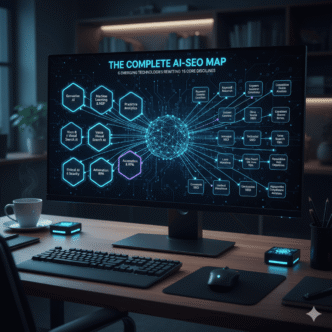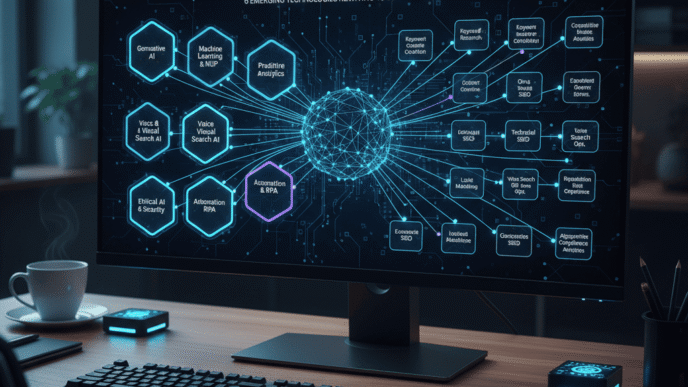


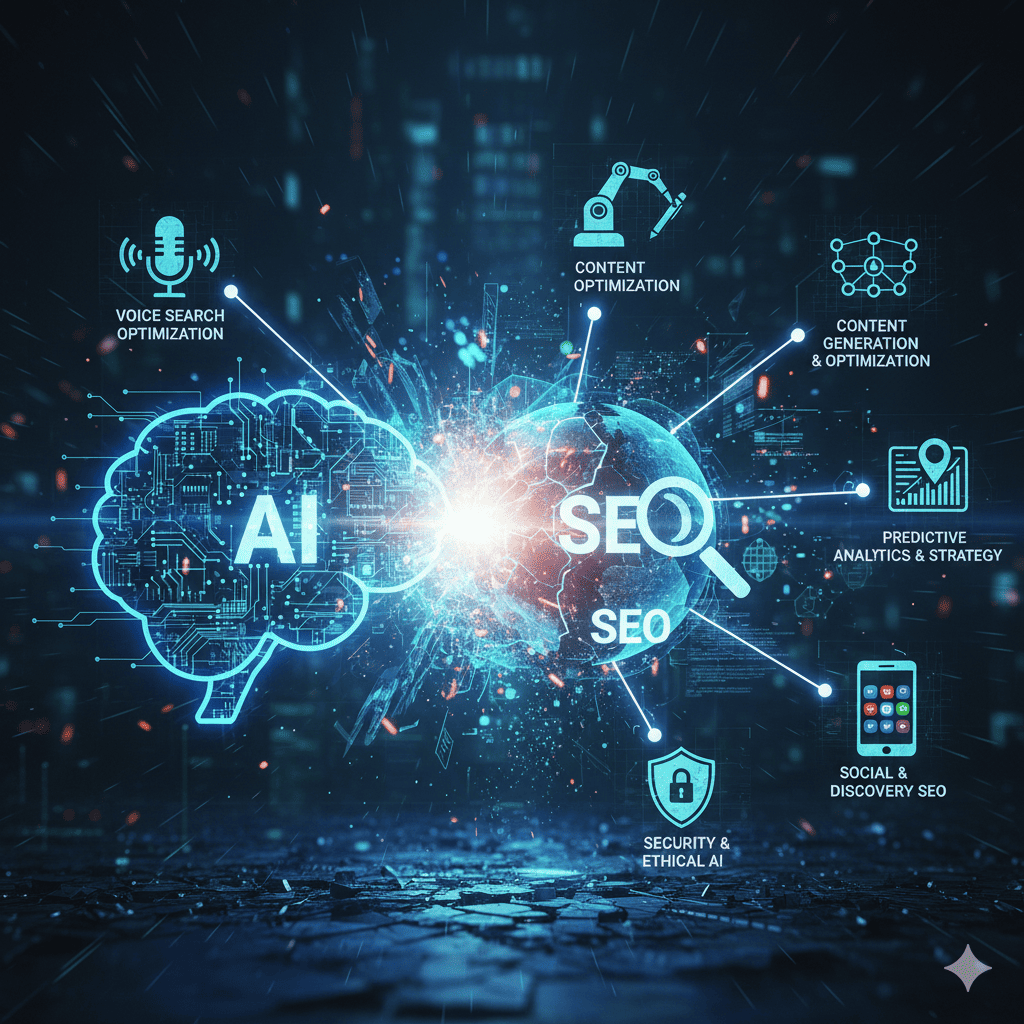
Six AI technologies are no longer nudging SEO at the edges. They are rewriting how every core discipline operates — from keyword research to crawl analysis to voice search — and the pace has outrun most practitioners’ ability to track it.
The collision between artificial intelligence and search optimisation is structural, not cyclical. LLMs synthesise answers instead of serving links. NLP models read intent instead of matching strings. Agentic AI crawls, compares, and acts on behalf of users without a human in the loop. Each technology is pressing on multiple SEO disciplines at once, and the pressure is compounding.
Post Summary
- AI agent requests have reached 88% of human organic search activity, with BrightEdge projecting agent activity will surpass human-driven search entirely by the end of 2026 (BrightEdge, April 2026)
- Six AI technologies — LLMs, NLP & NLU, AI Search, Computer Vision, Predictive ML, and Agentic AI — now intersect with 16 distinct SEO disciplines at varying stages of integration
- Only 19% of websites have specific directives for ChatGPT-related bots, leaving the majority of brands without an agentic search strategy (BrightEdge, April 2026)
- Google AI Overviews now trigger on nearly half of all tracked queries, with coverage growing 58% year-on-year (BrightEdge, March 2026)
- GEO optimisation, E-E-A-T, and entity SEO have shifted from advanced tactics to baseline requirements for AI citation visibility
- Programmatic SEO is the one discipline where Agentic AI has moved directly to core integration — not emerging, not growing, but operational now
Table of Contents
ToggleDesign matrix mapping AI technologies (columns) against SEO disciplines (rows), showing integration strength for each intersection.
| SEO tech → AI tech | LLMs GPT-4o, Claude, Gemini | NLP & NLU BERT, spaCy, entity recog. | AI Search SGE, Perplexity, Copilot | Computer Vision CLIP, image recog. | Predictive ML ranking models, forecasting | Agentic AI AutoGPT, AI crawlers |
|---|---|---|---|---|---|---|
| Content & On-Page | ||||||
| Content creation & optimisation | Core | Core | Growing | — | Growing | Emerging |
| Keyword research & intent mapping | Core | Core | Growing | — | Core | Emerging |
| E-E-A-T & topical authority | Core | Growing | Core | — | Emerging | — |
| Schema & structured data | Growing | Core | Growing | — | Emerging | Emerging |
| Technical SEO | ||||||
| Technical audits & crawl analysis | Growing | Emerging | — | — | Growing | Growing |
| Core Web Vitals & page speed | Emerging | — | — | — | Growing | Growing |
| Log file & crawl budget analysis | Emerging | — | — | — | Core | Emerging |
| Search Visibility & SERP | ||||||
| AI Overviews / GEO optimisation | Core | Core | Core | — | Emerging | Emerging |
| Featured snippets & SERP features | Growing | Core | Growing | Emerging | Core | — |
| Rank tracking & SERP monitoring | Emerging | Emerging | Growing | — | Core | Growing |
| Off-Page & Authority | ||||||
| Link building & digital PR | Growing | Emerging | Emerging | — | Growing | Growing |
| Entity & Knowledge Graph SEO | Growing | Core | Core | — | Emerging | — |
| Specialised SEO | ||||||
| Local SEO | Growing | Growing | Growing | Emerging | Growing | — |
| Image & visual search SEO | Emerging | Growing | Growing | Core | Growing | — |
| Voice & conversational search | Core | Core | Core | — | Growing | Emerging |
| Programmatic SEO | Core | Growing | Emerging | — | Growing | Core |
AI Trend Watch
Six AI technologies are now in active deployment against SEO. Large language models (LLMs) — including GPT-4o, Claude, and Gemini — generate synthesised answers that replace the ranked-links model. Natural language processing (NLP) and natural language understanding (NLU) power intent recognition at the query level. AI Search platforms, led by Google’s AI Overviews, Perplexity, and Bing Copilot, serve those synthesised answers at scale. Computer Vision enables image and visual search at a sophistication that standard alt-text optimisation has not kept pace with. Predictive ML models forecast ranking shifts and content gaps before they appear in analytics. Agentic AI — the most consequential category — acts autonomously: crawling, comparing, and recommending without waiting for human instruction.
These six technologies are not operating in sequence. They are operating simultaneously, across disciplines, with different degrees of penetration.
Where the Disruption Is Deepest
Content creation and keyword research were the first disciplines to absorb the LLM collision. That ground has largely settled. Practitioners who have not integrated LLMs into their content workflows by mid-2026 are not early adopters who missed the window — they are operating with a structural disadvantage.
E-E-A-T and topical authority are where the pressure from AI Search is sharpest. Google AI Overviews now trigger on nearly half of all tracked queries, up 58% year-on-year (BrightEdge, March 2026). The citation logic those overviews use pulls from pages that demonstrate entity-verified authority — not from pages that simply rank for a keyword. Topical coverage, author credentials, and structured entity signals now determine AI citation eligibility as much as they determine organic position.
Entity and Knowledge Graph SEO has moved from a specialist sub-discipline to a front-line requirement. NLP systems and AI Search platforms both depend on entity recognition to anchor their answers. A brand or publication that is not represented in structured knowledge graphs has no reliable path to AI citation — regardless of its organic ranking history.
GEO optimisation — Generative Engine Optimisation — and AEO (Answer Engine Optimisation) are the formal disciplines that have emerged to address this shift. GEO is the practice of optimising content so that generative AI systems can extract, cite, and surface it in synthesised answers. AEO focuses specifically on answer engines and conversational AI platforms. Both disciplines now draw on LLM architecture, NLP signal analysis, and AI Search behaviour simultaneously.
The Agentic Pressure Point
The most disruptive number in current SEO data is not a ranking metric. AI agent requests have reached 88% of human organic search activity (BrightEdge, April 2026). BrightEdge projects that agentic activity will overtake human-driven search entirely before the end of 2026.
GPTBot, ClaudeBot, PerplexityBot, and Google-Extended are not indexing bots in the traditional sense. They fetch information in real time, on behalf of users making active decisions. They do not render JavaScript. They do not browse — they retrieve, compare, and respond. A site that is not structured for agentic readability is not a site that has missed an optimisation opportunity. It is a site that is invisible to a class of traffic that is close to equalling all human organic search combined.
The preparedness gap is stark. Only 19% of sites have specific directives for ChatGPT-related bots, and even those policies vary widely (BrightEdge, April 2026). That leaves 81% of sites without a defined agentic search position — no crawl directives, no structured access logic, no AI-readable content prioritisation.
Pro Tip: Add specific bot directives for GPTBot, ClaudeBot, PerplexityBot, and Google-Extended to your robots.txt now. Without explicit directives, agentic crawlers apply their own access logic — and that logic may not align with your content priorities.
Pro Tip: Structure at least one H2 section per key post as a standalone declarative answer — entity-named, no hedging, no filler. Agentic systems retrieve passages, not pages. A section that reads as a self-contained fact has a higher probability of retrieval than one embedded in narrative prose.
Technical SEO Is Not Insulated
Technical audits, crawl analysis, Core Web Vitals, and log file work are disciplines most practitioners associate with human search engine crawlers. Agentic AI has changed that assumption.
AI agents — GPTBot among them — bounce on HTTP 4XX and 5XX errors, 301 redirects to unexpected URLs, slow load times, CAPTCHAs, and bot-blocking scripts (Search Engine Land, October 2025). A site with technical errors is not merely penalised in rankings. It is inaccessible to agentic retrieval. Core Web Vitals are no longer purely a user-experience signal — they are an agent-access signal.
Log file analysis has moved from an advanced diagnostic tool to a strategic necessity. AI agents leave footprints in server logs that Google Analytics will never capture. Understanding which agents are accessing which pages, and at what frequency, is the only current method of building a baseline agentic performance dataset.
Pro Tip: Pull a 30-day server log segment and filter for GPTBot, ClaudeBot, PerplexityBot, and Google-Extended user agents. The pages these bots access most frequently are your current AI citation candidates — and the ones they skip are content gaps worth addressing.
The Disciplines Being Reshaped by NLP
NLP and NLU are the least visible of the six technologies in day-to-day SEO discussion, and among the most consequential. BERT-era NLP changed how Google read content. The NLP layer inside current AI systems goes further — it extracts entities, maps relationships, and scores semantic completeness at a level that keyword-density logic cannot account for.
Featured snippet and SERP feature optimisation now requires NLP-aware structuring. Schema and structured data are the practical expression of NLP compatibility — marking up entities, relationships, and facts in a format that both traditional search engines and AI systems can parse reliably.
Image and visual search SEO is the one discipline where Computer Vision has moved to a core integration position. CLIP-based models and image recognition systems in AI Search platforms are evaluating images beyond alt text. Descriptive captions, contextual relevance to surrounding content, and file-naming conventions are all now computer-vision-readable signals.
Implications by Practitioner Type
Site owners and publishers face an immediate preparedness gap on agentic access. Bot directives, structured content, and server log visibility are not technical-SEO-team responsibilities that can be deferred. Agentic traffic is live now, at nearly human scale, and it is not appearing in Google Analytics.
SEO practitioners need to expand the definition of a content audit to include AI citation eligibility. A post that ranks on page one but is not structured for agentic retrieval may hold its organic position while losing its AI visibility share — two metrics that are already diverging.
Agencies managing multiple clients need an agentic readiness checklist that sits alongside their standard technical audit template. Bot directives, llms.txt handling, entity coverage, and structured data completeness are four dimensions that are not covered in a standard Core Web Vitals or crawl audit.
Developers integrating CMS platforms need to treat AI agent access as a first-class delivery requirement, not an afterthought. JavaScript-heavy rendering pipelines that work for human browsers do not work for agentic bots that do not render JavaScript.
How the Six Technologies Map Across Disciplines
The six technologies do not disrupt all 16 SEO disciplines equally. Three patterns have emerged from mapping the intersections:
LLMs and NLP are the most broadly integrated — they touch content creation, keyword research, E-E-A-T, schema, GEO optimisation, featured snippets, entity SEO, voice search, and programmatic SEO, either at core or growing integration levels. Their reach across the discipline map is wider than any other technology.
AI Search is a core factor in the disciplines that matter most for visibility: GEO/AEO optimisation, E-E-A-T, entity and Knowledge Graph SEO, and voice and conversational search. Its footprint is narrower than LLMs but deeper where it lands.
Agentic AI has one confirmed core integration — programmatic SEO — and growing integration across technical audits, link building, and rank tracking. Its trajectory is the steepest of the six. The current emerging-stage ratings across crawl analysis, log file work, and schema deployment will not stay at emerging for long.
Takeaway
The six-technology, sixteen-discipline collision is not a future scenario. BrightEdge’s April 2026 data puts agentic traffic at 88% of human search volume. AI Overviews trigger on nearly half of all queries. Only 19% of sites have any agentic access strategy in place. The gap between where AI-driven search is and where most SEO practice currently sits is measurable, growing, and consequential.
Practitioners who map their current discipline coverage against the six AI technologies will find gaps. The gaps are not evenly distributed — agentic readiness, entity coverage, and structured content are where most sites are most exposed. Those three areas are also where the trajectory of AI integration is steepest.
Sources: BrightEdge, April 2026 | BrightEdge AI Overviews Analysis, March 2026 | Search Engine Land, October 2025 | Search Engine Journal, January 2026 | Adobe Business Blog, April 2026