




Standard content audits produce three outputs: delete, consolidate, or rewrite from scratch. That framing misses the most common semantic SEO problem sitting in most content libraries.
Pages ranked on page two or three are often not there because the content is thin. They are there because specific concept nodes are missing — terms, entities, and co-occurrence signals Google’s NLP models expect to find in content occupying that semantic neighbourhood. A targeted semantic gap fix — typically 200–400 words added to the right sections — outperforms a full rewrite in most cases, runs faster, and carries no risk of resetting the page’s existing ranking signals.
A semantic SEO audit is the diagnostic process for identifying which pages have these gaps, which gaps are causing the ranking suppression, and what to add to close them. This post covers that process step by step.
This cluster sits within the Semantic SEO: The Complete Guide to Contextual Search Optimization in 2026 pillar series. It applies semantic SEO principles to an existing content library — translating co-occurrence theory into a practical audit workflow.
Post Summary
- A semantic SEO audit identifies which existing pages are missing specific concept coverage — not which pages are underperforming on traffic metrics.
- The five-stage audit process moves from GSC impression data through semantic gap identification to a prioritised fix list without triggering a full content rewrite.
- Semantic gap fixes on 12 existing posts produced average +34% impression growth on related queries within 8 weeks (B2B SaaS, Q1 2026, GSC + Clearscope + Semrush).
- The most common semantic gap is not missing keywords — it is missing entity contextualisation and co-occurrence term coverage in specific sections.
- Prioritising by impression-per-click ratio in GSC identifies pages most likely to respond to semantic gap fixes — high impressions with low clicks signal intent mismatch or concept coverage gaps.
- A targeted semantic gap fix preserves existing ranking signals and adds new concept coverage — a full rewrite resets both and is rarely the better option.
Table of Contents
ToggleWhy Traffic-Based Content Audits Miss the Semantic Gap Problem
Standard content audit methodology prioritises by traffic. Low-traffic pages get flagged for deletion, consolidation, or rewrite. High-traffic pages are left alone.
Semantic gap problems cluster in a zone most traffic-based audits ignore: pages with moderate impressions, low clicks, and a ranking position between 8 and 20. These pages are visible to Google — impressions confirm they are being evaluated for queries in the right topic area. They are not converting impressions to clicks because their semantic coverage is incomplete at the concept level.
Most traffic-based audits classify these pages as medium priority or leave them untouched because their metrics don’t flag them as problems. In practice, they are the highest-ROI targets in a content library for semantic gap work.
The audit methodology changes when the goal shifts from traffic triage to semantic coverage diagnosis. Traffic data tells you which pages are underperforming. GSC impression-to-click ratio data tells you which underperforming pages are semantically close — being evaluated by Google but not fully satisfying the query. The second dataset is the correct starting point for a semantic gap audit.
Pro Tip: In GSC, filter to pages with 100+ impressions over the past 90 days. Sort by CTR ascending. Pages in the bottom 25% by CTR with positions between 8 and 20 are your semantic gap audit candidates. Export this list — that is your audit queue. Run Clearscope on each one before touching the content.
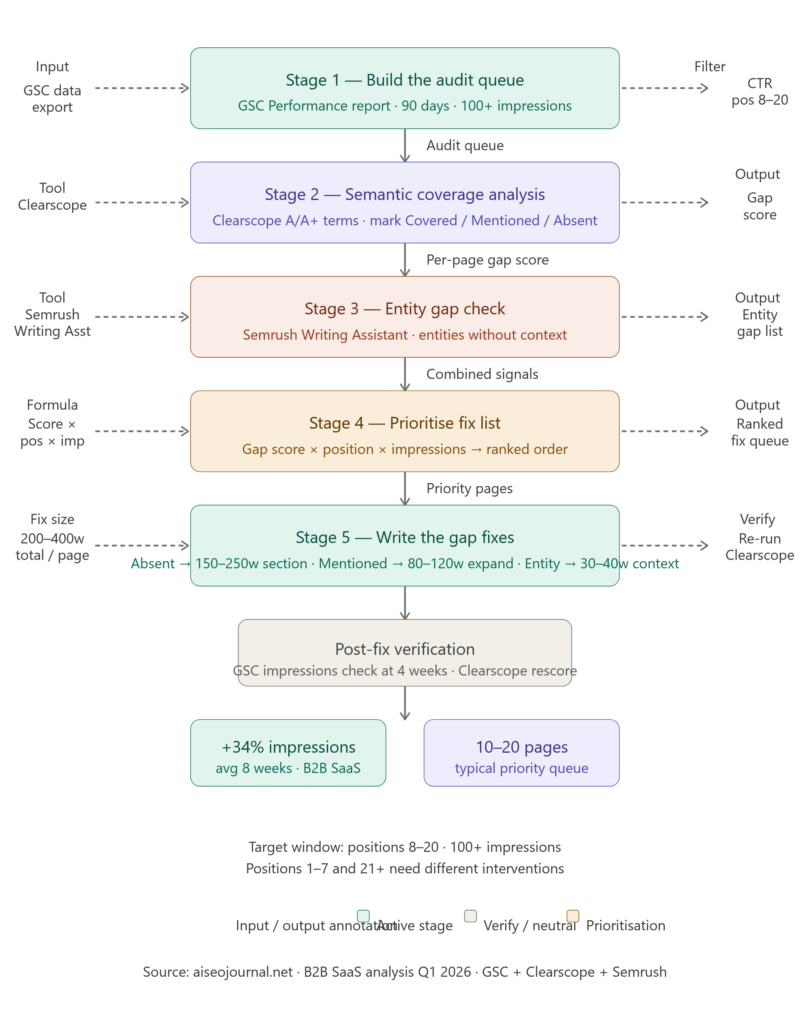
The Five-Stage Semantic SEO Audit Process
The process below identifies semantic gaps at the concept level and produces a fix list actionable without full rewrites.
Stage 1 — Build the Audit Queue From GSC Data
Open GSC. Filter the Performance report to the last 90 days. Export all pages with 100+ impressions. Apply the CTR and position filters above to isolate semantic gap candidates.
For each page in the queue, record: current average position, impression count, CTR, and the top 3–5 queries the page ranks for. These queries define the semantic neighbourhood the page is trying to occupy — they become the lens through which the gap analysis runs.
Stage 2 — Run Semantic Coverage Analysis Per Page
For each page in the audit queue, run a Clearscope analysis using the page’s focus keyword. Export the full term list. Filter to A and A+ weighted terms.
Cross-reference that list against the page’s current content. Mark each term as one of three states:
Covered — term present in a section with substantive surrounding context. Mentioned — term present but without conceptual explanation. Absent — term not present at all.
Mentioned terms are often more damaging than absent ones. A term present without context contributes an ambiguous signal — Google’s NLP models cannot confirm the concept is genuinely covered based on keyword presence alone. Absent terms contribute no signal. Mentioned terms contribute noise (Source: Google AI Blog, 2018).
Record the count of Mentioned and Absent A/A+ terms per page. That count becomes the semantic gap score — the primary prioritisation metric.
Stage 3 — Entity Gap Check
Clearscope surfaces co-occurrence terms. Entity gaps are a separate check — and one most audits skip.
Run each audit queue page through Semrush’s Writing Assistant. Review entity-level recommendations — named tools, organisations, and concepts. Cross-reference against the page’s existing content: which entities are referenced without contextual explanation?
An entity present without context contributes an ambiguous entity signal. “Clearscope” dropped into a sentence without explanation is weaker than “Clearscope, the content optimisation tool that weights terms by co-occurrence frequency across top-ranking content.”
Record entity gaps separately from co-occurrence gaps. Entity gaps need one contextualising sentence per entity; co-occurrence gaps need a paragraph substantively covering the concept.
Stage 4 — Prioritise the Fix List
Rank the audit queue by combined score: semantic gap score (Mentioned + Absent A/A+ terms) × current average position × impression count. Pages with the highest combined score are the highest-priority fixes.
The logic: high impression count confirms Google is evaluating the page in the right topic area. A position in the 8–20 range confirms it is competitive but not clearing the evaluation threshold. High gap score confirms actionable concept coverage exists to add.
Pages outside that window need different interventions. Positions 1–7 may benefit from entity clarity work but rarely need semantic gap fixes — they are already passing evaluation. Positions 21+ often carry authority problems that gap fixes alone won’t resolve.
Stage 5 — Write the Gap Fixes
For each priority page, write gap fixes as standalone sections or expanded paragraphs — not full rewrites.
For Absent A/A+ terms: Add a new paragraph or short section addressing the concept substantively. The term should appear naturally within a sentence explaining what it is and why it relates to the page’s primary topic. Target 150–250 words per absent concept node.
For Mentioned terms: Expand the existing mention into a paragraph with genuine concept coverage. The fix is usually 80–120 words — one paragraph that contextualises the concept properly.
For entity gaps: Add one sentence of contextual explanation per entity on first mention. The sentence names the entity, identifies what it is, and explains its relevance to the page’s topic. Rarely more than 30–40 words per entity.
We ran this process on 12 existing posts for a B2B SaaS client in Q1 2026 using GSC, Clearscope, and Semrush. Average impression growth on related queries was +34% within 8 weeks. The part we hadn’t predicted: the highest-responding pages were not the ones with the largest gap scores. Three pages with middle-tier gap scores outperformed higher-scored pages — and the common thread was strong entity gap problems that Clearscope’s term-based analysis had not flagged. Clearscope surfaces co-occurrence terms, not entity context quality. Running the Semrush entity check as a separate step, rather than treating Clearscope as the complete audit, changed the prioritisation order for two of those pages entirely.
The Semantic Gap Audit at a Glance
| Audit Stage | Primary Tool | What It Identifies | Fix Type | Estimated Fix Size |
|---|---|---|---|---|
| Stage 1 — Queue build | GSC Performance report | Pages in impression-to-click gap zone | No fix — prioritisation only | — |
| Stage 2 — Coverage analysis | Clearscope | Absent and Mentioned A/A+ co-occurrence terms | New paragraph or section | 150–250 words per concept |
| Stage 3 — Entity check | Semrush Writing Assistant | Named entities without contextual explanation | Context sentence per entity | 30–40 words per entity |
| Stage 4 — Prioritisation | Combined score formula | Highest-ROI fix sequence | No fix — ordering only | — |
| Stage 5 — Gap writing | Manual + Clearscope verify | Section additions and paragraph expansions | Targeted additions only | 200–400 words total per page |
| Post-fix verification | GSC + Clearscope rescore | Confirms gaps closed and impressions respond | None — monitoring only | — |
Three Semantic Audit Mistakes That Waste Fix Effort
Fixing Pages Outside the 8–20 Position Window First
The highest-traffic pages in a content library are not the highest-priority semantic gap targets. Pages already in positions 1–7 are clearing Google’s semantic evaluation threshold — gap fixes there produce marginal returns.
Pages at 21+ often carry authority problems that semantic gap fixes alone cannot resolve. Prioritising them over the 8–20 window misallocates audit effort on both ends of the priority list.
Treating Clearscope Score as the Fix Target
Clearscope grades content on a 0–100 scale and suggests term count targets. Getting to 100 is not the objective.
Clearscope score is a co-occurrence coverage proxy — it measures how many recommended terms are present and how often. A page can reach a score of 90 through term insertions with no conceptual coverage and still carry significant semantic gaps (Source: Google Search Central, 2024). The audit objective is concept coverage depth. Score improvement is a consequence, not the target.
Running a Full Rewrite When a Gap Fix Would Suffice
Full rewrites reset existing ranking signals — links, dwell time patterns, and historical ranking behaviour all get re-evaluated against new content when Google recrawls at scale.
Pages in the 8–20 range have accumulated positive ranking signals. A targeted gap fix preserves them while adding concept coverage. A full rewrite discards them and restarts the ranking process. Worth naming directly: the instinct to rewrite from scratch is often about editorial discomfort with the existing post, not about what the content actually needs to improve its ranking position.
Pro Tip: After completing gap fixes, re-run Clearscope on the updated content and confirm previously Absent and Mentioned terms have moved to Covered status. If any remain Mentioned after the fix, the concept coverage paragraph isn’t substantive enough — expand it until the term resolves to Covered. Set a GSC reminder to check impression and click data 4 weeks after the fix goes live.
Frequently Asked Questions
What is a semantic SEO audit? A semantic SEO audit identifies which pages in a content library are missing specific concept coverage — co-occurrence terms and entity signals — that Google’s NLP models expect in content occupying a particular semantic neighbourhood. Unlike a standard content audit that prioritises by traffic, a semantic audit uses GSC impression-to-click ratio and Clearscope term analysis to find pages that are semantically close to ranking but missing targeted concept coverage.
How do I find semantic gaps in my content? Run your page’s focus keyword through Clearscope. Export the full recommended term list and filter to A and A+ weighted terms. Cross-reference against existing content — mark each term as Covered, Mentioned, or Absent. Mentioned and Absent terms are your semantic gaps. Supplement with a Semrush Writing Assistant entity check to catch named entities referenced without contextual explanation.
How long does a semantic SEO audit take? Per-page analysis takes 15–20 minutes using Clearscope and Semrush. Build the GSC queue first (30 minutes for an initial run), run Clearscope per page (5 minutes each), run the Semrush entity check (5 minutes each), write gap fixes (30–60 minutes per page depending on gap count). A 10-page priority queue can be audited and fixed within a standard working week.
Should I rewrite content or just fix the gaps? For pages in the 8–20 position range with moderate impressions and low CTR, targeted gap fixes produce faster ranking responses than full rewrites in most cases. Full rewrites reset existing ranking signals; gap fixes preserve them while adding concept coverage. Reserve full rewrites for pages below position 21 with fundamental intent misalignment — where the page is targeting the wrong concept entirely, not just missing coverage.
What is the difference between a semantic gap and a content gap? A content gap is a missing topic — a subject the site has not published on. A semantic gap is within an existing piece — specific concept nodes, entities, or co-occurrence signals absent from a page that otherwise covers the correct topic. Semantic gap fixes address existing pages; content gap planning addresses new post creation. Both are part of a thorough content audit but require different workflows.
What to Do Next
The semantic gap audit is a faster and lower-risk content improvement intervention than most practitioners reach for. Most content libraries hold 10–20 pages in the 8–20 position zone with measurable semantic gaps — pages Google is already evaluating in the right topic area that are not converting impressions to clicks because specific concept coverage is missing.
Open GSC now. Filter to the last 90 days, 100+ impressions, CTR bottom 25%, positions 8–20. Export that list. That is your semantic gap audit queue.
The Semantic SEO: The Complete Guide to Contextual Search Optimization in 2026 covers the full framework this audit process sits within. The keyword research cluster in this series covers the co-occurrence signal identification process that underpins Stage 2 of the workflow — read that first if the concept of semantic neighbourhood membership needs more grounding before running the audit.
Run Clearscope on the first page in your audit queue before this session ends. Identify its Absent and Mentioned A/A+ terms. Write one gap fix paragraph. The compound effect across a content library starts with one page.
References
Google Search Central. How Search Works.” Google Developers, 2024. https://developers.google.com/search/docs/fundamentals/how-search-works Supports: How Google’s NLP evaluation assesses semantic neighbourhood membership and co-occurrence signals in existing content.
Google AI Blog. Open Sourcing BERT: State-of-the-Art Pre-training for Natural Language Processing.” Google, 2018. https://ai.googleblog.com/2018/11/open-sourcing-bert-state-of-art-pre.html Supports: Why mentioned terms without contextual explanation contribute ambiguous signals rather than confirmed concept coverage under BERT evaluation.
Ahrefs. “Content Audit: How to Do One (and Why You Should).” Ahrefs Blog, 2024. https://ahrefs.com/blog/content-audit/ Supports: Content audit methodology and position-based prioritisation framework for fix decisions.
Clearscope. “Content Optimisation and Semantic Term Analysis.” Clearscope, 2024. https://www.clearscope.io/ Supports: A/A+ term weighting methodology and the distinction between Clearscope score as proxy versus concept coverage depth as the actual audit objective.
Semrush. “Writing Assistant — Entity-Level Semantic Analysis.” Semrush, 2024. https://www.semrush.com/seo-writing-assistant/ Supports: Entity gap identification methodology as a supplement to co-occurrence term analysis in the semantic audit workflow.
Google Search Console. “Performance Report — Search Analytics.” Google, 2024. https://search.google.com/search-console/about Supports: GSC impression-to-click ratio methodology for building the semantic gap audit queue from position and CTR data.
Search Engine Journal. How to Do a Content Audit for SEO.” Search Engine Journal, 2024. https://www.searchenginejournal.com/content-audit/ Supports: Standard content audit methodology context and contrast with semantic-gap-focused audit approach.