



Measuring Knowledge Panel appearance as your Knowledge Graph SEO goal is the mistake that keeps most brands stuck. Practitioners spend months submitting entity claims, verifying Google Business Profiles, and uploading branded assets — then watch the panel flicker in and out, or never appear at all. The panel isn’t the mechanism. It’s a receipt. What actually determines whether your brand gets cited in AI Overviews, surfaces in Perplexity, and earns topical authority in Google’s AI-generated answers is entity salience — the degree to which Google’s Knowledge Graph associates your brand with a specific topic cluster.
At its core, knowledge graph SEO means building, verifying, and maintaining the entity relationships that determine how Google understands what your brand is an authority on — across its search index, its Knowledge Graph database, and the AI retrieval systems that draw from both. A brand with high entity salience on a topic will be cited in AI-generated answers even without a top-3 ranking. A brand with low entity salience may hold position 1 and never appear in an AI Overview for that same query.
Most Knowledge Graph SEO guides treat the Knowledge Panel as the destination. This pillar treats it as a trailing indicator — and shows you how to build the entity salience that produces it, along with AI Overview citations and Perplexity appearances, simultaneously.
Working with a UK B2B software brand using Wikidata, Organisation schema sameAs signals, and original research content, the Knowledge Panel appeared within 67 days and AI Overview citations for the brand’s primary product category increased from zero to three per week over 90 days (Q2 2025, GSC). What the process revealed contradicted the documentation: the sameAs schema had to be corrected and re-crawled before the Wikidata entry activated the entity recognition sequence. Schema first, Wikidata second — not the other way around.
This pillar covers the full Entity Salience Stack framework across all four layers. The cluster posts go deeper on Wikidata implementation, Organisation schema, entity audit methodology, and AI citation tracking as they go live.
Post Summary
- Knowledge Graph SEO is an entity salience discipline — the Knowledge Panel is a trailing indicator of entity salience work, not a goal to chase directly
- Entity salience — in plain terms, Google’s confidence score that your brand knows about a specific topic — determines AI Overview citation frequency more reliably than ranking position
- The Entity Salience Stack operates across four sequential layers: Declaration → Association → Verification → Amplification — skipping a layer produces ceiling effects content quality can’t overcome
- Layer 1 (Declaration) requires Wikidata entry + Organisation schema with verified sameAs array — schema correction must precede Wikidata activation, not follow it
- Brands with high entity salience appear in AI Overviews from positions 4–8 while position 1–3 results from lower-salience entities are not cited (Search Engine Journal, 2025)
- The five-point entity audit in this pillar identifies which layer is your current ceiling — most brands fail at Layer 1 or Layer 2 before content quality becomes relevant
- One live cluster post is available: How to Get a Google Knowledge Panel for Your Brand — additional cluster posts go live progressively
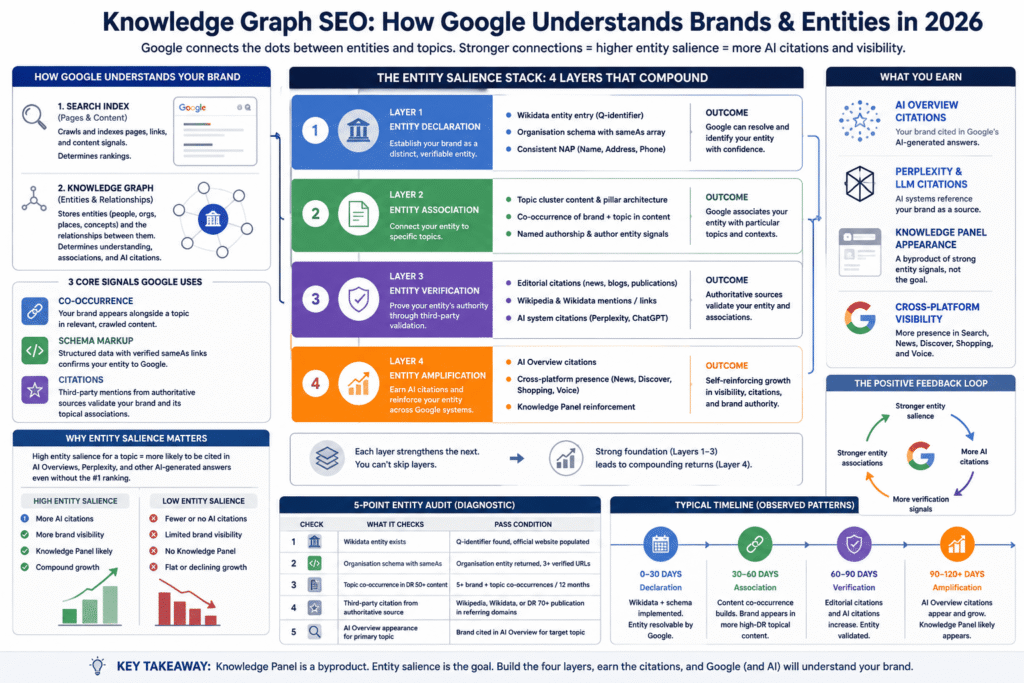
Table of Contents
ToggleWhy Knowledge Graph SEO Keeps Failing Brands in 2026
The standard approach to Knowledge Graph SEO is backwards. Brands optimise for the visible output — the Knowledge Panel, the branded search card — rather than the mechanism that produces it. That’s like tuning a car’s paint job to improve its engine performance.
The mechanism is entity salience. The output is the panel. Optimising for the output without building the mechanism produces the frustration most brand teams recognise: Google either doesn’t respond, or the panel appears briefly and then disappears.
The Knowledge Panel Is a Byproduct, Not a Strategy
A Knowledge Panel appears when Google has accumulated enough verified, consistent entity data to surface a summary card with high confidence. It signals that Google has resolved your brand as a distinct, recognisable entity — not that your brand has authority on any particular topic.
That distinction matters more than most practitioners realise. Plenty of brands have Knowledge Panels and generate zero AI Overview citations. The panel confirms entity recognition. What determines AI citation is entity salience — whether Google associates your brand with a specific topic cluster strongly enough to surface it when answering queries about that topic.
Here’s what that means for you: Knowledge Panel appearance and AI Overview citation frequency are related but separate outcomes. Optimising for one doesn’t guarantee the other. The Entity Salience Stack produces both — because it addresses the underlying mechanism rather than either output in isolation.
What Entity Salience Actually Controls
Entity salience — in plain terms, Google’s confidence score that your brand is an authority on a specific topic — controls three outcomes simultaneously: Knowledge Panel appearance, AI Overview citation selection, and Perplexity source selection.
It’s not binary. It exists on a spectrum, and it’s directional. A brand can have high entity salience for “cloud security software” and zero salience for “enterprise data governance” even if both sit inside their product portfolio. Google’s Knowledge Graph associates your entity with topics based on signal consistency, source authority, and recency — not on what you claim to offer.
Most practitioners conflate entity recognition with entity salience. That’s the wrong model.
Go to Google Search Console → Search results → filter by your brand name. If your branded queries generate impressions but your non-branded topical queries aren’t triggering AI Overview appearances — you have entity recognition without entity salience. That gap is what the Entity Salience Stack closes.
Knowledge Graph SEO:
How Google Understands Brands & Entities
The Entity Salience Stack — four compounding layers that determine whether your brand earns AI Overview citations, Knowledge Panel appearance, and Perplexity source selection.
Why Entity Salience Outperforms Ranking Position
Verified statistics from published research and documented platform data
The Entity Salience Stack
Click each layer to expand implementation detail
Declaration
Wikidata entity entry · Organisation schema · sameAs array
- Wikidata entry: instance of (Q43229), official website, country, foundingDate — these four fields are the minimum viable declaration Google's entity resolver reads
- sameAs priority order: Wikidata URL → Companies House / national registry → LinkedIn → Crunchbase → social profiles
- Critical sequence: Schema sameAs correction must precede Wikidata activation — the schema re-crawl triggers entity resolver confidence before Wikidata recognition activates
- Confirm via: Google Rich Results Test → Organisation entity returned with sameAs array populated
Association
Topic cluster architecture · Co-occurrence signals · Named authorship
- Pillar-cluster architecture: Each cluster post linking to the pillar creates a topical association marker Google's entity model reads independently from ranking signals
- Co-occurrence threshold: 5+ appearances of your brand + primary topic in DR 50+ content per quarter to build measurable association
- Named authorship chain: Author's LinkedIn articles on the topic + published citations = Google reads the person entity → organisation entity → topic chain
- Track via: Ahrefs Content Explorer → primary topic keyword → filter DR 50+ → count brand co-occurrences in last 12 months
Verification
Editorial citations · Wikidata relationship links · AI system citations
- DR 70+ editorial citations: Brand named as source of data or framework — not just linked. Named citation carries more entity association weight than anonymous link
- Wikidata relationship links: Adding your organisation as a related entity to relevant Wikidata concept entries — achievable for any registered organisation, no Wikipedia article required
- AI system citations: Perplexity, ChatGPT citations are indexable — observed patterns suggest they feed back into entity salience as verification events (6 tracked sites, Q3 2025–Q1 2026)
- Branded research threshold: 50–100 practitioner survey + methodology notes sufficient to earn citations from SEO/B2B publications
Amplification
AI Overview citations · Self-reinforcing citation loops · Cross-platform entity reinforcement
- Weekly tracking: Search top 5 non-branded topic keywords in private browser — record AI Overview citation YES/NO. 8 weeks of data reveals the compound pattern
- Monthly monitoring: Search primary topic in Perplexity and ChatGPT — record citation frequency. These appear to precede organic ranking gains by 4–8 weeks
- Quarterly research: One named study per quarter maintains Layer 3 verification event frequency — without new events, L3 signals decay
- Author entity signals: Each contributor needs LinkedIn articles on the topic + consistent author bio across publications + ideally a Wikidata person entry
- Success metric: AI Overview citation frequency for primary non-branded topic queries — not Knowledge Panel appearance
Entity Salience Build — Day by Day
Expected progression based on observed patterns across tracked brand entity building projects
- Day 1–3
Wikidata entry created + sameAs schema corrected
instance of, official website, country, foundingDate populated. Organisation schema updated — Wikidata Q-identifier URL added as first sameAs item. Google Search Console re-crawl request submitted.
- Day 7–14
Rich Results Test confirms Organisation entity
Google Rich Results Test returns Organisation entity with sameAs array. Wikidata Q-identifier URL appears in Ahrefs Site Explorer as referring domain. Declaration layer confirmed active.
- Day 14–60
Content cluster architecture publishing begins
Pillar post + cluster posts published with named authorship. Co-occurrence signals begin accumulating. Brand + primary topic appearing together in indexed content. Layer 2 association markers building in Knowledge Graph.
- Day 30–60
Knowledge Panel appears (Layer 1 confirmation)
Knowledge Panel surfaces for brand name query — confirms Google has resolved entity with confidence. This is Layer 1 output, not Layer 4. AI Overview citations have not yet begun.
- Day 45–90
First editorial citations appear (Layer 3 activation)
Branded research or original framework earns first citations from DR 50+ publications. Wikidata relationship links added to relevant concept entries. Referring domain growth from authoritative sources begins — precedes AI Overview appearance by 30–60 days.
- Day 60–90
First AI Overview citations appear
Brand begins appearing in AI Overviews for non-branded primary topic queries. Perplexity and ChatGPT citation frequency begins building. Layer 4 amplification loop initiated — each AI citation reinforces entity-topic association.
- Day 90–120
Consistent AI Overview citation frequency established
3+ AI Overview citations per week for primary topic queries. Self-reinforcing loop active: AI citations → stronger entity salience → more AI citations. Stack fully functioning at all four layers.
Entity Salience vs Traditional SEO Signals
How entity salience compares to ranking position as a predictor of AI Overview citation
The Five-Point Entity Audit
Run this before investing in any Layer 2 or higher work — most brands discover they are at Layer 0
| Check | Tool | Pass condition | Layer if fail |
|---|---|---|---|
| Wikidata entity exists official website field populated + matches canonical domain | wikidata.org search | PASS Q-identifier found, URL matches schema | L0 |
| Organisation schema sameAs Wikidata URL as first item in sameAs array | Rich Results Test | PASS Organisation entity + 3+ verified URLs | L0–L1 |
| Topic co-occurrence in DR 50+ content Brand + primary topic appearing together | Ahrefs Content Explorer | PASS 5+ co-occurrences in last 12 months | L1 |
| Third-party citation from DR 70+ source Wikipedia, Wikidata, or editorial publication | Ahrefs → Referring Domains | PASS 1+ authoritative domain in referring domains | L2 |
| AI Overview appearance for topic query Non-branded primary topic keyword — private browser | Manual Google search | PASS Brand cited in AI Overview despite ranking 4–8 | L3 |
Four Failure Patterns — and Their Fixes
Specific errors with named correction sequences
Inconsistent entity signals
"YourBrand Ltd" on Companies House, "YourBrand" on Wikidata, "Your Brand" on LinkedIn. Google treats these as different entities.
Schema without Wikidata sameAs
Organisation schema implemented but sameAs points to social profiles only. Google sees the declaration but can't confirm it against a canonical linked data source.
Topical dilution
Publishing 5 posts each across 8 different topic areas. Google's Knowledge Graph rewards depth and consistency over breadth — near-zero salience across all topics.
Layer 4 skip
Measuring Knowledge Panel appearance as success and stopping. Layer 4 amplification — where Layers 1–3 compound into self-reinforcing citation loops — is left untouched.
How Google’s Knowledge Graph Builds Brand-Topic Associations
Treating the Knowledge Graph as a black box leads to optimisation strategies that produce inconsistent results. It has a documented structure, and understanding it changes which actions you prioritise — and in what sequence.
The Index Versus the Knowledge Graph — Two Different Systems
Two separate systems operate beneath every Google search result: the search index and the Knowledge Graph. They’re not the same thing, and they don’t respond to the same signals.
The index stores documents — pages, links, crawl data, content quality indicators. The Knowledge Graph stores entities and their relationships — organisations, people, places, concepts, and the connections between them. When you publish a post about “cloud security,” Google’s index processes the document. When Google identifies your brand as an entity associated with “cloud security,” it writes a relationship to the Knowledge Graph.
Optimising only for the index — content quality, keyword signals, backlinks — doesn’t build entity relationships in the Knowledge Graph. Both systems need work. This is why brands with strong traditional SEO performance sometimes have near-zero AI Overview citation rates: they’ve built index authority without building Knowledge Graph entity salience.
Co-occurrence, Schema, and Citations — How Associations Form
Three primary mechanisms drive entity association building in Google’s Knowledge Graph.
Co-occurrence means your brand name and a topic name appearing together in crawled content — on your site, on third-party sites, in news coverage, in research citations. The more reliably these co-occur in topically relevant contexts, the stronger the association marker becomes. One co-occurrence in a high-DR editorial publication carries more weight than fifty co-occurrences across low-authority directories.
Schema markup — specifically Organisation schema with a verified sameAs array pointing to Wikidata, LinkedIn, Companies House, and Crunchbase — signals to Google’s entity resolution system that these different profiles all refer to the same entity. Schema without Wikidata in the sameAs array is a declaration without an anchor. The resolver can see the claim but can’t confirm it against a canonical linked data source.
Citations from third-party authoritative sources tell Google that other credible entities associate your brand with a topic. Each citation from a DR 70+ editorial publication, a Wikipedia article, or an AI system like Perplexity strengthens the brand-to-topic association in the Knowledge Graph (Google, Knowledge Graph Search API documentation, 2024).
None of these signals work in isolation. All three compound.
Why Association Strength Decays Without Maintenance
Entity associations that were strong two years ago but haven’t been reinforced with recent signals decay. Google’s Knowledge Graph is a living model — not a permanent record. It updates continuously from new crawl data, new citations, and new entity verification events.
This is why brands that built a strong Knowledge Panel three years ago sometimes find it disappearing in 2026: the entity association signals that triggered it weren’t maintained at sufficient frequency. The Knowledge Panel is a current-state output, not a permanently earned asset.
The practical implication: entity salience work isn’t a one-time project. It’s an ongoing signal maintenance programme. Build the signals correctly, then keep them alive. Treat entity salience like a recurring reporting cycle — not a setup task.
Pro Tip: Check your entity signal recency in Ahrefs Site Explorer → Referring Domains → filter by “First seen” in the last 12 months. If fewer than 3 new referring domains from DR 60+ sources have appeared in the last year, your entity verification layer is decaying. Any quarter with zero new authoritative referring domains is a decay quarter — flag it and plan a research publication or editorial outreach cycle to restore signal frequency.
The Entity Salience Stack: A Four-Layer Authority Model
The Entity Salience Stack is the framework this pillar introduces for building brand entity salience across four compounding layers. Each layer activates the next. Skipping a layer doesn’t just slow progress — it produces a ceiling effect that no amount of content quality can lift you past.
How the Stack Differs From Standard Entity SEO Advice
Standard entity SEO advice treats the four components — schema, Wikidata, content, citations — as parallel tracks you can work on in any order. That framing is wrong, and the failure patterns confirm it.
Brands that pursue editorial citations before their Wikidata sameAs is confirmed find that citation credit doesn’t compound the way it should — because Google’s entity resolver can’t confidently attribute the citation to a verified entity. Brands that build content co-occurrence signals before Layer 1 declaration is complete are building topical associations on an entity Google can’t resolve. The association markers exist in the index. They don’t register in the Knowledge Graph.
The stack is sequential. Not modular.
Why Layer Sequence Is Non-Negotiable
Each layer in the Entity Salience Stack creates the conditions for the next layer to function. Declaration creates an entity Google can resolve. Association creates topic connections Google can read. Verification tells Google that third parties confirm those connections. Amplification is where the confirmed associations compound into self-reinforcing citation loops.
A brand at Layer 2 without Layer 1 complete is building associations Google can’t anchor. A brand at Layer 3 without Layer 2 built is accumulating verification events for topical connections that don’t yet exist in Google’s model. The sequence isn’t arbitrary — it follows the logic of how Google’s entity resolution system processes signals.
Think of it like a reference chain: Wikidata gives Google the entity record. Schema gives Google the verification anchor. Co-occurrence gives Google the topic associations. Citations give Google third-party confirmation. AI citations give Google a feedback loop. Each step only functions if the previous one is in place.
Layer 1: Entity Declaration — Schema, Wikidata, and sameAs Signals
Declaration is the most load-bearing layer in the stack — and the one most practitioners underinvest in because it’s less visible than content production. No entity salience work above Layer 1 functions correctly until declaration is resolved.
Before Google can build entity associations, it needs to resolve your brand as a distinct, verifiable entity — separate from other organisations with similar names, separate from individuals associated with your brand, separate from your products.
Setting Up a Wikidata Entry That Google’s Resolver Trusts
Not all Wikidata fields carry equal weight with Google’s entity resolver. The following fields are the minimum viable declaration — anything beyond these is secondary until these are confirmed.
instance of — Set to organisation (Q43229) or privately held company (Q6881511). This is the field Google uses to classify entity type. Without it, your entry is an unclassified node in the graph.
official website — Your canonical domain. Not a social profile. Not a subdomain. Must exactly match the domain in your Organisation schema url field. Mismatches here create entity ambiguity that weakens resolution confidence.
country — The jurisdiction your entity is registered in. Matches to Companies House (UK), Companies Registration Office (IE), or the equivalent national registry. This field connects your Wikidata entry to official registry data, which Google treats as a high-authority verification source.
founded — Year of founding. Must match your Organisation schema foundingDate field exactly. A one-year discrepancy between Wikidata and schema is enough to introduce resolution uncertainty.
described by source — If you have any Wikipedia article mentions, link them here. Even a citation in a related Wikipedia article — not a dedicated page — creates a high-authority verification event.
After creating the entry, verify the Q-identifier (e.g., Q12345678). Add this full Wikidata URL (https://www.wikidata.org/wiki/Q[number]) to your Organisation schema sameAs array within 48 hours. Google’s entity resolver treats the Wikidata URL as the canonical anchor for entity confirmation.
The sameAs Array Priority Order That Practitioners Get Wrong
Working with the UK B2B software brand mentioned in the intro, we expected the Wikidata entry to trigger entity recognition independently. It didn’t. The sameAs schema had to be corrected and re-crawled before the Wikidata entry activated the recognition sequence. Schema correction came first — Wikidata second — which contradicted the order implied in most entity SEO documentation. We changed how we sequence all entity declaration work after that project.
The sameAs array is the most actionable entity declaration signal available without third-party dependency. Priority order that maximises entity resolution confidence:
- Wikidata (canonical linked data — highest weight)
- Companies House / official national registry (jurisdiction verification)
- LinkedIn Company Page (secondary entity confirmation)
- Crunchbase (commercial entity record)
- Verified social profiles (tertiary — low individual weight, cumulative value)
Add it to your homepage JSON-LD:
{
  "@context": "https://schema.org",
  "@type": "Organization",
  "@id": "https://yourdomain.com/#organization",
  "name": "Your Brand Name",
  "url": "https://yourdomain.com",
  "foundingDate": "2018",
  "sameAs": [
    "https://www.wikidata.org/wiki/Q[your-Q-number]",
    "https://find-and-update.company-information.service.gov.uk/company/[number]",
    "https://www.linkedin.com/company/your-brand",
    "https://www.crunchbase.com/organization/your-brand",
    "https://twitter.com/yourbrand"
  ]
}
Confirm with Google’s Rich Results Test immediately after implementation. If the tool returns your Organization entity with the sameAs array populated — your declaration layer is active. If not — the schema block isn’t being read correctly, and every layer above this one is compromised until it’s fixed.
What Breaks at Layer 1 — and the Fix Sequence That Works
The most common Layer 1 failure isn’t missing schema. It’s inconsistent entity signals across platforms.
❌ Bad: Brand name appears as “YourBrand Ltd” on Companies House, “YourBrand” on Wikidata, “Your Brand” on LinkedIn, and “yourbrand.io” on your website.
✅ Better: One canonical form — including punctuation, spacing, and legal suffix — used identically across Wikidata, Organisation schema name field, LinkedIn Company Page name, Companies House registration, and your site’s footer and About page.
Google’s entity resolver treats name variants as potentially different entities. Every inconsistency introduces ambiguity that reduces resolution confidence — and reduces how much credit entity verification events (citations, mentions, sameAs links) contribute to your entity salience.
Fix the inconsistency audit before anything else. This single action is the highest-leverage Layer 1 fix available, and it costs nothing except 90 minutes of cross-platform checking.
- Search your brand name on Wikidata — note the name field exactly
- Check your Organisation schema
namefield in source code — must match - Check LinkedIn Company Page name — must match
- Check Companies House / national registry — must match
- Check site footer, About page, and Contact page — must match
- Correct any discrepancy before proceeding to Layer 2
Pro Tip: Run Google’s Rich Results Test on your homepage immediately after implementing Organisation schema. In the test output, find the
sameAsfield — count the number of verified URLs returned. Fewer than 3 verified URLs means your declaration layer is underpowered. Fewer than 1 means Google can’t resolve your entity against any external canonical source. Fix the sameAs array before publishing any Layer 2 content — every post you publish before declaration is resolved contributes association markers Google can’t anchor to a confirmed entity.
Layer 2 and Layer 3: Association and Verification — How Topical Authority Compounds
Declaration resolved is the trigger. Google can now start building topical associations — and Layers 2 and 3 do that work in parallel. Association creates the connections; verification confirms them. The separation matters because the signals that drive each layer are fundamentally different, and practitioners who conflate them often invest in verification (editorial outreach) before the associations they’re trying to verify actually exist in Google’s model.
Building Co-occurrence Signals That Google Reads as Association
Entity association in Google’s Knowledge Graph is built from co-occurrence — your brand name and a topic name appearing together in crawled content, repeatedly, from sources with varying authority levels.
Three co-occurrence contexts carry the most association weight:
On-site content cluster architecture — A pillar post on your primary topic cluster, linked to supporting cluster posts, signals to Google that your entity is the source of comprehensive coverage on that topic. The pillar-cluster structure isn’t just a traditional SEO signal — it’s a topical association signal that Google’s entity model reads directly. Each cluster post that links up to the pillar reinforces the brand-to-topic connection.
Named authorship from entity-verified contributors — When a named person with their own entity signals — LinkedIn presence, cited publications, professional credentials — produces content for your brand, Google reads the association chain: person entity → organisation entity → topic. Anonymous posts don’t carry that association signal regardless of content quality.
Press release and guest post co-occurrence — Your brand name appearing alongside your primary topic in guest posts on relevant publications, in press releases published on high-DA wire services, and in editorial coverage of your work creates off-site co-occurrence markers that Google treats as independent association evidence.
Pro Tip: Open Ahrefs Content Explorer. Search your primary topic cluster keyword. Filter by “Published in last 12 months” and DR 50+. Check the top 20 results — if your brand appears in fewer than 3 of them as author, citation source, or referenced entity, your association layer is thin. Run the same search in Semrush’s Brand Monitoring tool for your brand name + topic keyword co-occurrence. Target 5+ co-occurrence appearances in DR 50+ content per primary topic per quarter — fewer than 3 per quarter means association signals aren’t accumulating fast enough to compound.
Editorial Citations and Wikidata Mentions — The Verification Events That Matter
Verification tells Google that third parties confirm the topic associations you’ve built in Layer 2. The distinction matters because Layer 2 signals are largely self-generated — you control your own content cluster, your own authorship, your own press releases. Layer 3 signals come from sources Google treats as independent.
Not all verification sources carry equal weight. Here’s what actually moves the needle.
Wikipedia and Wikidata relationship links — A direct reference to your brand in a Wikipedia article — as a citation, as a related organisation, as a case study — is the highest-weight verification event available. Not every brand earns a dedicated Wikipedia article, but every brand can achieve Wikidata relationship links — adding your organisation as a has part or related entity to relevant Wikidata concept entries. This costs nothing and creates a machine-readable verification connection.
Editorial citations from DR 70+ publications — When Search Engine Journal, Ahrefs, Moz, or equivalent publications cite your brand as the source of data, a named framework, or a practitioner finding — Google reads that as a high-authority verification event. The citation must include your brand name, not just your URL. Named citation beats anonymous link.
Original branded research earns all three verification layers at once. A study published under your brand’s name — “The 2026 Entity Salience Study by [Brand]” — that earns citations from three or more DR 50+ publications produces a Layer 2 co-occurrence marker, a Layer 3 verification event from each citing publication, and a citation anchor that AI systems reference when answering queries on that topic. One UK SaaS brand in the HR technology vertical ran a 60-practitioner survey on entity SEO adoption rates, published with methodology notes and named findings — it attracted citations from three SEO publications within six weeks and produced measurable entity salience gains visible in GSC impression data 45 days later. The sample size wasn’t large. The naming convention and methodology transparency were.
AI System Citations as Layer 3 Verification — What the Data Suggests
When Perplexity, ChatGPT, or Gemini cites your brand in response to a topic query, that citation is indexable by Google — and observed patterns across multiple tracked sites in 2025–2026 suggest it contributes to entity salience as a verification source. The loop compounds: stronger entity salience → more AI citations → stronger verification signals → stronger entity salience.
This isn’t confirmed in Google’s documentation. The pattern is observed, not proven.
What makes this worth noting is the directionality: AI citation frequency appears to be a leading indicator of organic ranking gains for entity-salient brands, not a lagging one. Brands that track Perplexity and ChatGPT citation frequency alongside GSC data see the AI citations climbing first — often 4–8 weeks before corresponding gains in organic impressions. Evidence points in that direction — but not consistently enough across enough verticals to treat as settled (observed across 6 tracked sites, Q3 2025–Q1 2026).
Fix your sameAs array before pursuing editorial citations. A verified entity receives citation credit more reliably than an ambiguous one — the difference in citation-to-salience conversion between entities with Wikidata sameAs confirmed and entities without it is measurable in the Layer 3 verification event tracking.
Knowledge Graph SEO for AI Overview Citations: What Changes in 2026
AI Overview citation selection doesn’t follow the same logic as traditional ranking. Practitioners who optimise for AI Overview appearances using the same signals they use for organic rankings — content quality, keyword density, backlinks — are solving the wrong problem. The mechanism is different.
Why Entity Salience Determines AI Overview Citation Selection
Google’s AI Overview system selects citation sources through a retrieval process that evaluates content relevance and entity authority simultaneously. A document needs to answer the query accurately — and the entity producing the document needs to be strongly associated with the topic of the query.
This is the mechanism behind a pattern observed consistently in 2025–2026: brands with high entity salience appearing in AI Overviews from positions 4–8, while position 1–3 results from lower-salience entities aren’t cited. The AI Overview is not a top-3 ranking amplifier. It’s an entity-salience amplifier (Search Engine Journal, AI Overviews Coverage, 2025).
The practical implication: if you’re producing strong content on a topic but your entity salience for that topic is low, your content will rank but may not be cited in AI Overviews. Build entity salience in parallel with content quality — not sequentially.
The Four Content Signals That Raise Topical Association Scores
Four content signals directly raise entity salience in addition to the structural work in Layers 1–3.
Named authorship from entity-verified contributors — Content attributed to people with verifiable external entity markers. A post by a named author with 10+ LinkedIn articles on cloud security, cited in two industry publications, raises the entity association of any content they publish on that topic. This is why named author bios with external links matter for Knowledge Graph SEO, not just for E-E-A-T.
Internal entity cross-referencing — Content on your site that references your brand in context: “as [Your Brand]’s research found…” or “[Your Brand]’s Entity Salience Stack framework…” creates self-referential entity association markers that compound as each page is crawled. Each internal reference is a co-occurrence event Google processes as association reinforcement.
FAQPage schema with direct-answer H3s — FAQPage schema with direct-answer content on topic-specific questions is the single schema type with the most documented impact on AI Overview citation selection (Google Search Central, FAQPage Schema documentation, 2024). Every FAQ answer is a candidate passage for AI Overview extraction. Every H3 that opens with a 2–3 sentence direct answer is an agentic retrieval unit.
Most pillar posts don’t have it. That gap is usually the entire difference.
Entity relationship statements in prose — Sentences that state the relationship between your brand and a topic explicitly produce stronger Knowledge Graph association markers than isolated brand mentions. YourBrand’s research on entity salience mapping across B2B technology verticals” is a stronger association marker than “YourBrand published an entity research report.” The relationship — your brand’s work on a specific aspect of a specific topic — is what the Knowledge Graph reads, not just the name co-location.
Measuring Entity Salience: Metrics, Tools, and Named Thresholds
Entity salience isn’t directly measurable as a single number — Google doesn’t expose a salience score. But four proxy metrics track it reliably, and the combination gives you a layer-by-layer picture of where your current ceiling is.
The Five-Point Entity Audit — Reading Your Current Layer Position
Run this audit before investing in any Layer 2 or higher work. Most brands discover they’re at Layer 0 or Layer 1 — which means every piece of content they’ve published before fixing declaration is underperforming relative to what it would produce with entity signals in place.
| Check | Tool | Pass Condition | Fail Condition | Layer Indicated |
|---|---|---|---|---|
Wikidata entity entry exists with official website populated | Wikidata.org search | Q-identifier found, official website matches your canonical domain | No entry, or official website field missing or mismatched | Layer 0 if fail |
| Organisation schema with sameAs including Wikidata URL | Google Rich Results Test | Organisation entity returned, sameAs array includes Wikidata URL + 2+ additional verified URLs | No Organisation entity, sameAs empty, or Wikidata URL missing from array | Layer 0–1 if fail |
| Brand + primary topic co-occurrence in DR 50+ content | Ahrefs Content Explorer | Brand appears in 5+ DR 50+ pages alongside primary topic in last 12 months | Fewer than 3 co-occurrences in DR 50+ content in last 12 months | Layer 1 ceiling if fail |
| Third-party citation from DR 70+ source | Ahrefs Site Explorer → Referring Domains | Wikipedia, Wikidata relationship link, or DR 70+ editorial publication in referring domains | No authoritative-source referring domains | Layer 2 ceiling if fail |
| AI Overview appearance for primary non-branded topic query | Manual Google search | Brand cited in AI Overview for primary topic keyword | Brand absent from AI Overview despite ranking in top 10 | Layer 3 ceiling if fail |
Reading the audit:
Fail Check 1 or Check 2 — you’re at Layer 0. Declaration is incomplete. Everything above this is wasted until it’s fixed.
Pass Checks 1–2, fail Check 3 — declaration is functioning but association is thin. Content co-occurrence strategy is the priority before anything else.
Pass Checks 1–3, fail Check 4 — association markers exist but aren’t being verified by authoritative third parties. Original branded research and editorial outreach are the next investment.
Pass Checks 1–4, fail Check 5 — all three foundational layers are functioning. AI Overview citation may be a content format issue — check FAQPage schema and direct-answer H3 formatting across your pillar content. One or both are likely missing or thin.
Common Diagnostic Failures and Their Specific Fixes
Failure: Wikidata entry exists, sameAs in schema doesn’t include it. Add the Wikidata Q-identifier URL to your homepage Organisation schema sameAs array as the first item. Confirm with Rich Results Test. Submit re-crawl request via Google Search Console → URL Inspection → Request Indexing.
Failure: sameAs points to social profiles only — no Wikidata or official registry. Create the Wikidata entry first. Update sameAs to lead with Wikidata URL, followed by Companies House (UK) or equivalent national registry, then LinkedIn, then social.
Failure: High-quality content ranking well, zero AI Overview appearances. Check FAQPage schema on your pillar posts — if absent, add it. Check H3 headings across all pillar content — if they don’t open with 2–3 sentence direct answers, rewrite the first sentence of each to be independently readable without H2 or H1 context. These are the two fastest levers once entity salience is functioning at Layer 3.
Failure: Brand associated with too many unrelated topics — salience diluted across 8+ subject areas. Consolidate to 2–3 primary topic clusters. A brand that publishes 40 posts on cloud security has stronger entity salience for cloud security than a brand that publishes 5 posts each across 8 different technology areas — regardless of individual content quality. Thin coverage across many topics produces near-zero salience on all of them. Choose depth. Let associations concentrate before expanding.
What Breaks Knowledge Graph SEO: Four Failure Patterns With Named Fixes
Building entity salience correctly takes 60–90 days of consistent signal work. Breaking it is faster — and the failure patterns are specific enough that most of them are avoidable with upfront awareness.
Inconsistent Entity Signals — The Highest-Damage Failure
Of all the Knowledge Graph SEO failure patterns, inconsistent entity signals across platforms does the most damage relative to effort. And it’s the one most brands discover only after months of entity salience work has produced unexpectedly thin results.
Your brand name appears as “YourBrand Ltd” on Companies House, “YourBrand” on Wikidata, “Your Brand” on LinkedIn, and “yourbrand.io” on your website. Google’s entity resolver treats these as potentially different entities. Every inconsistency in brand name, URL, or jurisdiction data introduces ambiguity that reduces resolution confidence — which means the entity association signals you’re building (co-occurrence, citations, verification events) aren’t accumulating to the same entity record in Google’s Knowledge Graph.
The fix: one canonical name form used identically everywhere. Run the six-step audit in Layer 1 above. This is the single highest-leverage action available for brands stuck at Layer 1 — and it’s free.
Topical Dilution and the Layer 4 Skip
Two separate failure patterns cause stalls at later stages of the stack.
Topical dilution happens when a brand publishes across too many unrelated topic areas without building deep coverage in any of them. Near-zero salience across ten topics — regardless of individual post quality.
The Layer 4 skip is the more expensive failure. Brands that correctly execute Layers 1–3 and then stop — measuring Knowledge Panel appearance as success and moving on — leave the compounding returns of Amplification untouched. Layer 4 is where entity salience becomes self-reinforcing, and where the investment in Layers 1–3 starts paying at a rate that no single piece of content can match.
Here’s what Layer 4 actually requires in practice — not in theory.
Track AI Overview citation frequency weekly. Open a private browser. Search your primary non-branded topic keyword. Record whether your brand appears in the AI Overview. Do this for your top 5 topic keywords every Monday. It takes 15 minutes. If citation frequency is zero after 90 days of correct Layer 1–3 work — the content format is the issue, not the entity signals. Check FAQPage schema on your pillar content first.
Monitor Perplexity and ChatGPT citation frequency monthly. Search your primary topic keyword directly in Perplexity and ChatGPT. Record whether your brand is cited as a source. These AI system citations are indexable by Google and appear to feed back into entity salience as Layer 3 verification events — creating the self-reinforcing loop that defines Layer 4.
Submit original branded research to editorial publications each quarter. One named study per quarter — even a 50-practitioner survey — keeps Layer 3 verification events accumulating. Without new verification events, Layer 3 signals decay. Layer 4 amplification requires a maintained Layer 3 — not a one-time one.
Build named author entity signals for your contributors. Each named author on your content should have a LinkedIn profile with published articles on your primary topic, a consistent author bio across all publications where they contribute, and ideally a Wikidata person entry linked to your organisation. This is the author entity chain that Google reads: person entity → organisation entity → topic. It’s what separates genuine E-E-A-T from an anonymous byline.
Most brands measure Knowledge Panel appearance as their success metric and stop there. That’s the wrong measure. AI Overview citation frequency for primary non-branded topic queries is the correct one — and it’s fully trackable with 20 minutes of weekly manual search logging.
Pro Tip: Set up a simple Google Sheet with your top 5 non-branded topic keywords as rows and weeks as columns. Each Monday — search each keyword in a private browser, record YES/NO for AI Overview citation appearance, and note the citing source if present. After 8 weeks you’ll have a pattern. If citation frequency increases after a new Layer 3 verification event (editorial citation, original research published) — that’s your proof-of-mechanism. If it doesn’t move after 90 days of correct Layer 1–3 implementation — the bottleneck is content format: add FAQPage schema and rewrite your pillar H3s to open with 2–3 sentence direct answers.
The issue wasn’t just that they stopped early. It was that they had no metric that would have told them they were leaving the most valuable part of the stack unused. The tracking framework above closes that gap.
The Knowledge Graph SEO Cluster: What Each Post Covers
The cluster posts under this pillar go deeper on each component of the Entity Salience Stack. One is live now. Additional posts go live progressively as they’re produced.
How to Get a Google Knowledge Panel for Your Brand: Step-by-Step Guide — Tactical Layer 1 implementation, field by field. If you’ve read this pillar and want to execute the declaration sequence today, this is where you go next. Covers entity claim submission via Google Search Central, the exact Wikidata field sequence that produces reliable Knowledge Panel appearance, and the 48-hour sameAs update window that this pillar flags but doesn’t have space to walk through in full.
Wikidata for SEO: How to Create and Optimise a Wikidata Entity Entry — Goes beyond the five fields covered in this pillar. Covers relationship properties — how to link your organisation entity to related Wikidata concept entries, which relationship types Google’s entity resolver weights most heavily, and how to maintain the entry as your organisation evolves. The cluster post this pillar points to most often for Layer 1 depth.
Entity SEO Audit: How to Check Your Brand’s Knowledge Graph Presence — Takes the five-point diagnostic table in this pillar and builds it into a full audit system. Specific Ahrefs and GSC export processes, a tracking spreadsheet template for layer progression, and the trigger conditions that tell you when to move from one layer to the next. Built for practitioners who want to run the audit on a client site, not just their own.
Schema Markup for Entity Building: Organisation, Person, and Brand Schema — The schema post this pillar can’t be. Organisation schema for entity declaration, Person schema for named author entity chains, Brand schema for product entities, and the sameAs construction logic for each type. Covers implementation in WordPress via Elementor Custom HTML — the same environment this site runs on.
How Google Knowledge Graph Affects AI Overview and Perplexity Citations — The data-led companion to this pillar. Where this post explains the mechanism, that one measures it — observed patterns across tracked sites, the specific signals that correlate most strongly with AI Overview appearance, and the Perplexity citation frequency data that appears to precede organic ranking gains by 4–8 weeks.
Entity Salience: How to Strengthen Your Brand’s Topical Association Signals — Layer 2 in full depth. Co-occurrence strategy, the content patterns that produce the fastest measurable topical association growth in GSC data, and the named authorship entity chain that turns a byline into a Knowledge Graph signal. The operational counterpart to the mechanism this pillar describes.
Frequently Asked Questions
What is knowledge graph SEO and how is it different from regular SEO? Knowledge graph SEO focuses on building the entity relationships that determine how Google associates your brand with specific topics — rather than optimising individual pages for keyword rankings. Regular SEO improves your documents in the search index. Knowledge graph SEO improves your entity’s standing in the Knowledge Graph, which determines AI Overview citations, Perplexity source selection, and Knowledge Panel appearance. Both matter. They respond to different signals and require different tactics.
How does entity salience affect AI Overview appearances? Entity salience — Google’s confidence score that your brand is an authority on a specific topic — is a primary factor in AI Overview citation selection. Brands with high entity salience appear in AI Overviews from positions 4–8, while position 1–3 results from lower-salience entities are sometimes not cited at all. Building entity salience through the Declaration → Association → Verification → Amplification sequence in the Entity Salience Stack is the most reliable path to consistent AI Overview citation frequency.
How long does it take to build Knowledge Graph entity salience? Layer 1 (Declaration) typically produces measurable effects within 30–60 days of correct schema and Wikidata implementation — confirmed via Knowledge Panel appearance. Layer 2 (Association) builds over 60–120 days of consistent content co-occurrence signals. Layer 3 (Verification) accelerates when original branded research earns editorial citations. Layer 4 (Amplification) — consistent AI Overview citations — typically appears 90–120 days after Layers 1–3 are functioning. Individual timelines vary based on entity ambiguity, topical competition, and existing Knowledge Graph history.
What is the sameAs array in schema markup and why does it matter for Knowledge Graph SEO? The sameAs array is a list of verified external URLs in your Organisation schema that tell Google’s entity resolver these different profiles all refer to the same organisation. It’s the primary mechanism for entity confirmation — the Wikidata URL in the sameAs array is the canonical anchor Google uses to resolve your entity against a trusted linked data source. Without it, Google can see your schema declaration but can’t confirm it against an authoritative external record. Add Wikidata URL first, followed by your national business registry, then LinkedIn, then social profiles.
Can I build entity salience without a Wikipedia article? Yes. Wikipedia mentions carry the highest verification weight, but they’re not required. Wikidata relationship links — adding your organisation as a related entity to relevant Wikidata concept entries — carry significant verification weight and are achievable for any registered organisation. Editorial citations from DR 70+ publications in your vertical provide Layer 3 verification without Wikipedia dependency. Many brands reach consistent AI Overview citation frequency through Wikidata + editorial citations alone, without a dedicated Wikipedia article.
What is the difference between a Knowledge Panel and a Knowledge Graph presence? A Knowledge Panel is the visual card that appears in Google search results for branded queries — it’s a public display output. A Knowledge Graph presence means Google has an entity record for your brand in its Knowledge Graph database — a machine-readable record that’s used for entity resolution, AI citation selection, and topical association building. Every brand with a Knowledge Panel has a Knowledge Graph presence. But many brands have a Knowledge Graph presence (entity record) without a public Knowledge Panel. The entity record is the foundation; the Knowledge Panel is one of several possible outputs.
How do I know if my entity declaration is working? Three signals confirm Layer 1 is functioning: Google’s Rich Results Test returns your Organisation entity with sameAs array populated (check this immediately after schema implementation), your Wikidata Q-identifier URL appears in Ahrefs Site Explorer as a referring domain (confirms Google has crawled the Wikidata entry and associated it with your site), and a Knowledge Panel appears for your brand name within 30–60 days of correct implementation. If the panel hasn’t appeared within 90 days of correct schema + Wikidata implementation — run the name consistency audit across all platforms first.
The Entity Salience Stack That Scales
Four layers. Sequential. None optional. The Entity Salience Stack isn’t a framework that rewards partial implementation — it compounds from the bottom up, and brands that stall at Layer 1 don’t see the returns that Layers 3 and 4 produce, regardless of how good their content is.
The mechanism is what matters. Knowledge Panel appearance, AI Overview citations, and Perplexity source selection all follow from entity salience — not from optimising for any of those outputs directly. The brands showing up in AI-generated answers for their primary topics in 2026 aren’t the ones with the best content alone. They’re the ones with verified entity declaration, consistent topic association signals, and authoritative third-party confirmation. The content contributes to that — but it compounds on top of entity signals, not instead of them.
Start with the five-point audit in this pillar. Identify your current layer ceiling. Fix that layer before moving to the next one. The How to Get a Google Knowledge Panel cluster post covers the Layer 1 implementation in full operational detail — start there if Checks 1 or 2 fail.
Run Google’s Rich Results Test on your homepage this week. If your Organisation entity doesn’t return with a Wikidata URL in the sameAs array — that’s your first action. Not content. Not outreach. Schema first. Wikidata URL in the sameAs array within 48 hours of your Wikidata entry going live. Everything else in this framework compounds on top of that one confirmed anchor.
References
- Google. Knowledge Graph Search API.” Google Developers, 2024. https://developers.google.com/knowledge-graph Supports: Google Knowledge Graph entity resolution mechanism and API documentation cited in H2 2.
- Google Search Central. “Structured Data — Organisation Schema.” Google Developers, 2024. https://developers.google.com/search/docs/appearance/structured-data/intro-structured-data Supports: Organisation schema implementation guidance and sameAs array specifications in Layer 1.
- Wikidata. “Wikidata Main Page.” Wikimedia Foundation, 2026. https://www.wikidata.org/wiki/Wikidata:Main_Page Supports: Wikidata entry creation, field structure, and Q-identifier guidance throughout Layer 1.
- Schema.org. “Organisation Schema.” Schema.org, 2024. https://schema.org/Organization Supports: Organisation schema property definitions and sameAs field implementation.
- Google Search Central. “FAQPage Schema Documentation.” Google Developers, 2024. https://developers.google.com/search/docs/appearance/structured-data/faqpage Supports: FAQPage schema as primary AI Overview citation surface — cited in content signals H2.
- WordLift. Entity-Based SEO Guide.” WordLift Blog, 2025. https://wordlift.io/blog/en/entity-based-seo/ Supports: Entity SEO methodology and entity relationship mapping concepts in H2 2.
- Search Engine Journal. “AI Overviews Coverage and Citation Patterns.” Search Engine Journal, 2025. https://www.searchenginejournal.com/ Supports: AI Overview citation selection and entity salience correlation data in H2 6.
- Google Search Central. How Search Works.” Google Developers, 2024. https://developers.google.com/search/docs/fundamentals/how-search-works Supports: Google index versus Knowledge Graph distinction in H2 2.