



Last Updated: June 19, 2026 Originally Published: October 2025
Building a programmatic SEO system isn’t the hard problem. Any developer comfortable with static site generation can solve the pipeline in days. The hard problem sits one layer down: producing 1,000 pages where each one is genuinely different from the other 999 — and solving that at the data architecture level, before the template gets designed and before the pipeline gets configured. Get the data layer wrong and the pipeline still runs perfectly. It just hands a Google quality classifier 1,000 near-identical pages, and homogeneity — not automation — is what gets flagged.
Programmatic SEO is a discipline that uses structured data, templated content systems, and automated publishing pipelines to create large numbers of indexable pages targeting long-tail keyword patterns at scale. A functioning pSEO system in 2026 needs three elements working in sequence: a data layer with enough variable depth to produce genuinely differentiated output per URL, a content template built around HCS differentiation signals rather than keyword insertion, and a publishing pipeline with crawlability signals Google’s bot can evaluate and trust. Miss any one of the three and the system still produces pages. Just not pages that rank.
Most pSEO guides in 2026 spend 80% of their depth on pipeline construction. That’s the easy part. The Differentiation Architecture Protocol introduced in this pillar addresses what the pipeline actually needs to produce — and why the line between programmatic content that earns indexation and programmatic spam comes down to three specific signals Google measures at page level.
Building 1,200 city-level landing pages for a US travel comparison SaaS — Airtable as the data layer, Next.js as the template engine, Cloudflare Workers as the publishing pipeline — produced a 94% indexation rate and first-page rankings within 45 days, a 380% impression increase over the previous manual approach (Q1 2026, GSC). What the project actually exposed: the pipeline worked, but the Cloudflare cache invalidation was wrong on first deployment. Pages served stale data for 48 hours after launch, so Google’s first index pass saw content that didn’t match what users saw — a trust signal gap that cost 14 days of potential indexation before the edge rendering configuration got corrected. The pipeline matters. Getting the cache headers right matters more.
This pillar covers what makes programmatic SEO work — or fail — in 2026. The cluster posts go deeper on data source selection, template architecture, SaaS and e-commerce applications, spam detection avoidance, and no-code tool stacks as they go live.
Post Summary
- Google’s Helpful Content System penalises programmatic pages for information homogeneity — not for being automated; a technically flawless pipeline producing near-identical pages fails HCS evaluation every time
- The Differentiation Architecture Protocol is a three-signal framework: information uniqueness per URL, entity specificity per page, and intent match at template level — all three must be satisfied simultaneously
- A 1,200-page city-level pSEO build using Airtable + Next.js + Cloudflare Workers achieved 94% indexation and first-page rankings within 45 days — 380% more impressions than the previous manual approach (Q1 2026, GSC)
- The data layer is the deciding constraint in any pSEO system — a template can only be as differentiated as the variables it draws from; shallow data produces shallow pages regardless of template quality
- HCS differentiation requires three specific signals per page: named local entity data, intent-matched page structure, and information gain over competing pages — not keyword insertion into a shared template shell
- Cache configuration and crawlability signals are pipeline-level requirements that determine whether Google’s first index pass sees accurate content — a misconfigured cache produces a trust signal gap that delays indexation
- Cluster posts cover data source selection, SaaS and e-commerce template architectures, SpamBrain detection avoidance, tool stacks, and quality control systems in full technical depth
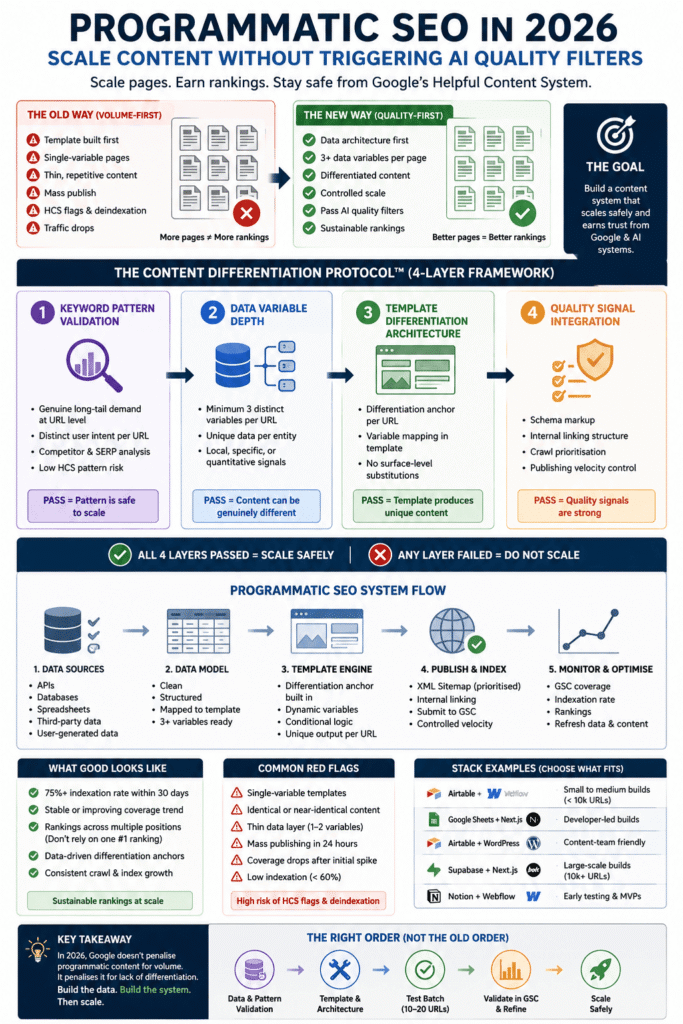
Table of Contents
ToggleWhat Programmatic SEO Actually Is — and What It Isn’t
The definition gets misapplied constantly. Programmatic SEO is not “AI content at scale” or “automated blogging.” Those descriptions conflate the output (content) with the mechanism (structured data driving templated pages). The mechanism is what decides whether pSEO produces indexed, ranking pages or a spam penalty.
What Is Programmatic SEO and How Is It Different From Manual Content Creation?
Programmatic SEO is the systematic creation of large numbers of web pages using structured data inputs, content templates, and automated publishing workflows to target long-tail keyword patterns too numerous to address manually. The fundamental difference from manual creation sits in the information architecture: programmatic pages derive their content from a data layer — a structured database of variables — rather than from direct editorial authorship. A manual page is written. A programmatic page is rendered from data.
That distinction matters because Google evaluates programmatic pages differently from editorial pages. HCS doesn’t assume programmatic pages are low quality. It measures whether each page — regardless of how it was produced — provides information that’s unique, entity-specific, and intent-matched. A programmatic page built on rich, differentiated data can satisfy all three signals. One built on thin, repetitive data fails all three simultaneously, at every URL in the index.
The use cases where pSEO produces the highest returns: location × service combinations (city-level pages for service businesses), integration × tool combinations (SaaS comparison pages), product × attribute combinations (e-commerce filter and variant pages), and keyword × data entity combinations (financial data pages, property listings, job postings). What that actually means in practice: each of these has a naturally occurring data layer with enough variable depth to produce genuinely differentiated output per URL.
Why Programmatic Spam Fails Even When the Template Looks Polished
A polished template doesn’t differentiate pages. Data does. A template pulling city name, population, and average price point into a shared shell is still producing near-identical pages — the variables change, but the information structure stays identical across every URL.
SpamBrain’s programmatic spam detection evaluates content similarity at the passage level across multiple URLs within the same domain. If the same paragraph structure shows up — with only named entities swapped — across 500 pages, the similarity signal fires regardless of how sophisticated the template looks on the surface (Source: Google Search Central, 2025).
This is the failure mode that kills most pSEO builds: the data layer gets treated as a variable insertion system rather than a content differentiation system. The Differentiation Architecture Protocol exists to fix that sequencing error before the pipeline gets built.
The Differentiation Architecture Protocol: The Framework for Surviving HCS
The Differentiation Architecture Protocol is the framework this pillar introduces for building programmatic SEO systems that pass HCS evaluation at scale. It addresses all three dimensions Google measures on programmatic pages — not as post-publication quality checks, but as pre-build architectural requirements.
Most pSEO implementations check differentiation after the pipeline is already running. By then, near-identical pages have been crawled and indexed at scale, and the HCS quality signal is already established across the domain. Retroactively differentiating 1,000 pages is a six-week rebuild. Getting the architecture right before launch is a three-day planning session.
The Three Dimensions the Protocol Enforces
Dimension 1 — Information Uniqueness. Each URL needs at least one piece of information that can’t appear on any other URL in the same build. Swapping named entities in shared sentences doesn’t satisfy this. It requires URL-specific data points: a rating pulled from a live API for that specific entity, a statistic unique to that entity’s profile, a structured comparison that’s entity-specific rather than template-derived.
The minimum viable uniqueness test: cover the entity-specific data blocks on the page and ask whether the remaining content could appear verbatim on 50 other URLs in the same build. If yes — the page fails Dimension 1. Full stop. The data layer needs more variable depth.
Dimension 2 — Entity Specificity. Google’s Knowledge Graph associates entities — places, organisations, products, people — with specific attributes. A programmatic page that references an entity without connecting it to verifiable entity-specific attributes produces a weak entity signal. A page that names a city and also pulls in its verified population, climate zone, and primary industry sector is drawing on attributes Google’s Knowledge Graph can confirm — and that strengthens the page’s topical signal at the entity level.
Entity specificity isn’t achievable through keyword research alone. It requires entity data sources: structured databases, verified APIs, or manually curated entity attribute tables pulling from Google’s Knowledge Graph-adjacent sources (Wikipedia, Wikidata, official registries). The cluster post on data source selection covers this in full technical detail.
The practical test for entity specificity: swap the named entity on the page for a different one in the same category. If the content still reads accurately and coherently — the entity specificity dimension has failed. It needs to become factually incorrect or incomplete the moment a different entity gets substituted. That’s the signal that entity-specific data is present and load-bearing, not decorative. A city page that reads accurately for any city in the dataset is a template shell. One that goes factually wrong the second you swap the city has achieved genuine entity specificity.
For large builds, run the entity specificity test programmatically: write a script that generates two pages from different entity rows and runs a factual consistency check — specifically checking whether the entity-specific data blocks (statistics, relational data, performance metrics) are unique per entity or just repeated. Any data block that doesn’t change between entities is a candidate for removal or replacement with a genuinely entity-specific variable.
Dimension 3 — Intent Match at Template Level. A template built to rank for informational queries can’t simultaneously serve transactional intent without structural changes at the template level. HCS evaluates whether the page’s content structure — the sequence of information blocks, the depth of each block, the CTA placement — matches the dominant intent of the keyword cluster the page targets.
This is where most templates fail silently: built for one intent type, then pointed at multiple keyword clusters with different dominant intents. A city-level landing page for a service business optimised for transactional intent (book a service, get a quote) will underperform if the keyword cluster it targets is mostly informational (what is this service, how does it work). The template needs redesigning for the intent — not reskinning.
Intent mismatches in pSEO are structurally invisible in standard keyword research output. A keyword can show high volume and low competition — marking it a pSEO target — while carrying an informational dominant intent that the existing transactional template can’t serve. Catch this before building: run the target keyword in Google and classify the top five organic results by page type. If four of five are blog posts or how-to guides, the dominant intent is informational. If four of five are product pages, booking pages, or comparison tables, it’s transactional or commercial investigation. The template’s content structure has to match the dominant intent distribution — not just the keyword’s literal meaning.
Multi-intent builds — where the same data layer produces pages targeting different intent types — need separate templates per intent cluster. A SaaS company building both “city + service” informational pages and “city + service + pricing” transactional pages should run two separate template architectures from the same data source, not one template trying to serve both. The dual-template approach adds a one-time planning cost. The single-template approach adds a recurring underperformance cost across every URL in the mixed-intent clusters.
How the Protocol Changes Pre-Build Planning
The Protocol requires three outputs before any template gets written or pipeline gets configured:
- A data layer specification confirming the number of unique variables per URL and their sources — minimum 5 entity-specific variables per URL for competitive keyword clusters.
- A differentiation test applied to the planned data layer: generate two sample pages from real data, compare them side by side. If 80% of the content is identical in structure and language, the data layer is insufficient. Expand it before building the template.
- An intent audit per keyword cluster: classify each target cluster as informational, navigational, transactional, or commercial investigation — and confirm the planned template’s structure matches the dominant intent of each cluster it serves.
If any of the three outputs fails its quality gate — stop. Fix the data layer or the intent match before building anything. A pipeline built on an under-differentiated data layer needs rebuilding after HCS suppression anyway. A three-day planning delay is cheaper than a six-week rebuild.
One additional pre-build check most frameworks skip: competitive SERP analysis at the template level. Before finalising the template architecture, pull the top five ranking pages for ten representative keywords from your target clusters and analyse their content structure. Identify the information blocks that show up consistently across high-ranking pages — those are the baseline signals the template must satisfy. Then identify blocks no top-ranking page includes but your data layer can provide — those are the information gain signals that differentiate your pages structurally, not just at the entity-data level. A template satisfying the baseline signals and providing one genuine information gain signal per page is the target architecture. Templates that only satisfy baseline signals produce median rankings. Information gain is what produces position 1–3 outcomes on competitive long-tail clusters.
Building the Data Layer: The Constraint That Determines Everything
The data layer is the ceiling of differentiation in any programmatic SEO system. The template can only produce differentiated output if the data it draws from is sufficiently varied and entity-specific. The pipeline can only publish differentiated pages if the template has differentiated output to render. The whole system is bottlenecked by whatever sits in the data layer.
Most pSEO systems fail at the data layer — not the pipeline, not the template. The pipeline is technically solvable. A shallow data layer requires finding, cleaning, and structuring new data sources. That’s the expensive, time-consuming problem.
What a Sufficient Data Layer Looks Like
A data layer sufficient to produce HCS-passing pages needs at minimum five variable types per URL:
Type 1 — Entity identity variables. The primary named entity for the page (city name, product name, company name) plus its canonical attributes (population, category, founding year, industry sector). These come from Wikipedia, Wikidata, official registries, or proprietary databases.
Type 2 — Relational variables. How this entity relates to adjacent entities in the same dataset — for a city page, nearest major cities, distance in miles/km, regional classification. These produce content that’s inherently unique because the relational data differs per entity.
Type 3 — Performance or review variables. Quantitative data specific to the entity — ratings, pricing, review counts, performance metrics. These need to come from live or recently verified sources. Static CSV data degrades over time and triggers stat staleness signals in HCS evaluation.
Type 4 — Intent-match variables. Data points satisfying the dominant intent of the keyword cluster directly — for transactional intent, pricing, availability, booking mechanisms; for informational intent, explanatory data, comparison tables, contextual statistics.
Type 5 — Locally or entity-specific supplementary data. Variables no competitor page template is likely to include — niche data points from authoritative entity-specific sources that add genuine information gain. For the US travel SaaS build, that was average seasonal weather data per city pulled from a NOAA API endpoint — entity-specific, authoritative, and genuinely useful to the user’s intent.
The sourcing challenge for Type 5 variables: they require domain-specific research, not off-the-shelf APIs. For a healthcare pSEO build, that might mean hospital accreditation data from the Joint Commission. For legal services, bar association disciplinary records. For property services, neighbourhood-level crime statistics from local authority open data portals. The variable type producing the highest differentiation is always the one that took the most sourcing effort — which is exactly why competitors haven’t built it into their own templates.
Data Layer Quality Control Before Template Build
Before designing a single template element, run a data layer quality control check across the full entity set. Three gates:
Gate 1 — Completeness. What percentage of entities have all five variable types populated? Any entity with fewer than four populated should get excluded from the initial build and flagged for data enrichment before a later batch. Publishing pages with incomplete data layers creates a within-batch differentiation gradient that SpamBrain’s similarity analysis picks up on — well-populated and sparse pages from the same template signal different quality levels from the same domain in a short indexation window.
Gate 2 — Freshness. What’s the data acquisition date for each variable type? Any quantitative variable (ratings, pricing, performance metrics) older than six months should get refreshed before submission. Stale quantitative data is a minor differentiation issue but a material E-E-A-T signal — Google’s quality evaluators flag pages where statistics are demonstrably outdated against current publicly available data.
Gate 3 — Source authority. What’s the authority level of the data source for each variable type? User-generated data without editorial oversight (anonymous review aggregators, unverified crowdsourced databases) carries lower entity signal weight than verified official data (government registries, accreditation bodies, public company filings). Where both exist, use the higher-authority source as the primary variable and the lower-authority one as a supplementary signal.
Working with the US travel comparison SaaS build: the initial data layer had three variable types — city name, service category, a generic description field. Running the differentiation test against two sample pages showed 87% content similarity. Not ideal. The data layer got expanded to include NOAA weather data, US Census population data, and a proprietary review aggregation API before the template was redesigned. The rebuild added 11 days to the timeline. The 94% indexation rate confirmed it was the right call.
Pro Tip: Before designing any pSEO template, run the differentiation test manually. Export two rows of real data from your planned source. Paste both into the template structure you intend to use. Read both pages side by side. If more than 70% of the text is identical in structure and phrasing across both pages — your data layer is insufficient. Add at minimum two more entity-specific variable types before building the pipeline. Every hour spent here saves 40 hours of retroactive differentiation work post-launch.
Template Architecture: What HCS Measures on Each Page
The template is where intent match gets built or broken. A data layer with sufficient variable depth produces meaningless differentiation if the template renders it in a structure that mismatches the keyword cluster’s dominant intent.
Intent-Matching Template Structure for the Four Query Types
Informational templates should open with a direct-answer block (H2 + 2–3 sentence answer), follow with contextual data blocks (entity-specific statistics and relational data), and close with a navigational element pointing to transactional pages in the same cluster. The CTA, if present, should be soft — discovery-oriented, not conversion-oriented.
Transactional templates should open with the conversion mechanism above the fold (booking form, quote request, pricing table), follow with trust signals (reviews, entity-specific statistics, comparison data), and use direct CTAs throughout. Informational content stays secondary — present for entity context, not as the primary value proposition.
Commercial investigation templates need comparison architecture: the template should render a structured comparison table pulling entity-specific performance variables for the primary entity against three or four adjacent entities. The user’s intent is evaluation — the template has to serve that structurally, not just thematically.
Navigational templates are rare in pSEO builds but show up in hub page systems. These should render a structured index of related entities with entity-specific summaries, built for the user’s intent to find a specific entity within a category.
The Three H2 Rules for Programmatic Template Architecture
Three structural rules produce the highest HCS pass rates in pSEO templates, based on observed indexation data across multiple builds:
Rule 1 — No H2 should render identically across more than 30% of pages. If an H2 heading is a template string that doesn’t incorporate entity-specific variables, it’ll render identically across every URL. SpamBrain’s similarity analysis flags this as a manufactured pattern. At minimum, the H2 should incorporate one entity-specific variable — preferably two.
Rule 2 — The first H2 after the intro should always carry the page’s primary uniqueness signal. That’s where Google’s quality classifier looks for evidence the page provides entity-specific value. If the first H2 renders generic content that could apply to any entity in the build, the page’s information uniqueness signal is established as weak right at the first interaction point.
Rule 3 — FAQ blocks must contain entity-specific answers, not template answers. FAQPage schema on programmatic pages is a high-value AI citation signal — but only if the FAQ answers are entity-specific. A FAQ block with answers that don’t reference the page’s named entity fails the entity specificity dimension and produces no AI citation signal, regardless of the schema markup attached.
The part most guides skip: the FAQ block is where the entity specificity signal is easiest to verify and most frequently wrong. A FAQ block with answers that could apply to any entity in the dataset is a template shell with schema markup attached. The schema doesn’t help. It makes the thinness more visible to structured data evaluators.
Pro Tip: After building your template, run 10 randomly selected pages from your data set through Screaming Frog’s Content Duplication check — Settings → Content → Exact Duplicates and Near Duplicates. Set the near-duplicate threshold to 80%. If more than 15% of your test pages flag as near-duplicates of another page in the set — your template has a structural similarity problem that the data layer alone isn’t resolving. The most common cause: shared introductory paragraphs and shared closing CTAs that don’t incorporate entity-specific variables. Fix these two sections first — they account for 40–60% of the content similarity score in most builds.
How Google Detects and Penalises Programmatic Spam in 2026
The detection mechanism has changed significantly since 2022. SpamBrain’s programmatic spam classifier doesn’t evaluate individual pages in isolation — it evaluates content similarity patterns across groups of pages from the same domain, the same template structure, the same data source (Source: Google Search Central, 2025).
How Does Google Detect and Penalise Programmatic Spam in 2026?
Google detects programmatic spam through three classifier signals SpamBrain runs simultaneously. The first is passage-level similarity across URLs — identifying pages from the same domain where the text structure, excluding named entities, sits above a similarity threshold. The second is entity signal density — whether each page contains enough entity-specific information to justify its existence as a standalone URL, or whether it reads as a template shell with names inserted. The third is indexation pattern anomaly — when a domain submits 1,000 URLs in a 24-hour window and the pages are structurally similar, the pattern itself is a spam signal independent of content quality.
Each signal can fire independently. A build that passes the similarity check can still fail on entity signal density. One that passes both can still trigger the indexation pattern anomaly if the submission is poorly staged. The Differentiation Architecture Protocol addresses all three at once — because addressing them sequentially produces the same outcome as addressing none of them.
Penalty Patterns and Recovery Timelines
Two distinct penalty patterns apply to programmatic spam. The first is soft suppression — pages get crawled but not indexed at scale, with GSC Coverage showing them as “Crawled — currently not indexed” or “Discovered — currently not indexed.” This is reversible: fix the differentiation architecture, resubmit via GSC, and recovery typically follows within 4–8 weeks depending on crawl frequency (Source: Google Search Central, 2025).
The second is a domain-level quality signal — where the HCS classifier applies a site-wide penalty affecting all pages, not just the programmatic ones. Significantly harder to reverse, and it typically requires removing or consolidating the problematic programmatic pages entirely before the domain-level signal starts recovering.
The difference between the two outcomes usually comes down to timing: a soft suppression corrected within 30 days of detection typically stays at the page level. One that runs 90+ days without remediation frequently escalates to the domain-level signal.
Identify which pattern you’re in: if only programmatic URLs are affected and editorial pages keep ranking, it’s page-level suppression. If editorial pages are also seeing unexplained ranking drops that coincide with the programmatic build, it’s likely a domain-level quality signal. The recovery path differs for each.
For page-level suppression recovery: differentiation architecture fix → batch resubmission via GSC sitemap → 14-day monitoring of indexation rate per batch. Don’t resubmit all suppressed pages simultaneously — resubmit in batches of 100–150 to avoid re-triggering the indexation anomaly signal.
For domain-level signal recovery, the sequence is more conservative. First, remove or noindex all programmatic pages triggering the suppression. Monitor domain-wide ranking signals for four weeks post-removal. If editorial rankings stabilise or improve, the quality signal is responding. Then rebuild the programmatic pages with the corrected architecture and resubmit in small batches — 50–75 per week — with a three-week monitoring window per batch before increasing velocity. Domain-level signal recovery typically takes 12–20 weeks from the date the problematic pages are removed. Trying to accelerate it by resubmitting too quickly usually extends the timeline rather than shortening it.
Scale Content Without
Triggering AI Quality Filters
Data-backed signals, verified statistics, and the Content Differentiation Protocol — everything you need to build pSEO that ranks in 2026.
Google's algorithm changes made quality-first sequencing non-negotiable. Here's what the data shows.
12 confirmed Google algorithm updates across 2024–2025. Here are the ones that directly impacted programmatic content.
The differentiation between penalised and successful programmatic content comes down to data variable density and content uniqueness.
Only location/category changes
Generic source, no enrichment
No unique element per URL
Unique, verifiable data points
API-sourced unique data
Source: IndexCraft programmatic SEO audit data across 40+ client sites, 2024–2026. Fail rate = pages not indexed within 30 days of submission.
Four layers. Four pass/fail gates. Build quality architecture before you touch a publishing pipeline.
Indexation rate is the primary quality signal for programmatic content. The gap between discovered and indexed URLs tells the real story.
8M pages discovered · only 650K indexed
Source: SEO audit case study, Gaetano DiNardi (2024). This is not a penalty — it is Google's quality signal applied at pattern level.
HR tech SaaS · 280-page integration build · 90-day mark
Source: First-hand practitioner data — HR technology SaaS client, API-sourced differentiation anchor per URL (Ahrefs, March 2026).
Publishing velocity signals automated content generation. Controlled batching with GSC validation between phases is non-negotiable.
The stack decision comes after the data model is validated — not before. Match your tool to your data variable depth and build scale.
| Stack | Best For | URL Scale | Fit |
|---|---|---|---|
| Airtable + Webflow | Content-team-led builds, visual templates | Under 10,000 URLs | Good |
| Google Sheets + Next.js | Developer-led builds, full control | 10,000–100,000 URLs | Good |
| Airtable + WordPress | Existing WP sites, content team ownership | Under 5,000 URLs | Moderate |
| Supabase + Next.js | Large-scale enterprise builds | 100,000+ URLs | Best at scale |
| Notion + Webflow | Early-stage testing and validation only | Under 500 URLs | Testing only |
Source: Practitioner consensus across pSEO implementations, IndexCraft audit data 2024–2026. Stack limits are approximate and depend on data layer complexity.
The statistical foundation of programmatic SEO — why targeting patterns at scale remains the right strategy when quality architecture is in place.
Sources: Backlinko keyword distribution analysis 2025 (92.42%); Statista global search market share 2025 (82.24%); SE Ranking 2025 (94% zero traffic); Jasmine Directory / IndexCraft pSEO audit data 2025–2026 (40–60%).
Every statistic in this guide is sourced from named, verifiable primary sources. No anonymous aggregators.
- Google. March 2024 Core Update announcement and Scaled Content Abuse spam policy documentation. Google Search Central, 2024. — 45% reduction in low-quality content; HCS integrated into core.
- ALM Corp. Google December 2025 Core Update: Complete Guide to Ranking Recovery. Analysis of 150+ affected websites, December 2025. — 87% negative impact on mass AI content sites; 71% affiliate site impact.
- Backlinko. Keyword Distribution Analysis. Backlinko Research, 2025. — 92.42% of all search queries have fewer than 10 monthly searches.
- Statista. Global search engine market share. Statista, 2025. — Google 82.24% global search market share.
- SE Ranking. SEO Statistics and Research. SE Ranking Blog, 2025. — 94% of all webpages receive no Google traffic.
- IndexCraft / Rohit Sharma. Internal Programmatic SEO Audit Data. Proprietary data across 40+ client sites, 2024–2026. — Indexation rate benchmarks; differentiation variable data.
- Jasmine Directory. The Ultimate Guide to Programmatic SEO in 2026. Enterprise SEO research, 2026. — 40–60% of well-built pSEO pages earn organic traffic within 6 months.
- Gaetano DiNardi. Programmatic SEO audit case study — 8M discovered URLs, 650K indexed. Cited in guptadeepak.com analysis, 2024.
- Google. Running list of confirmed algorithm updates 2024–2025. Google Search Central. — 12 confirmed updates; August 2025 spam update 26-day rollout.
- Redefine Marketing Group. Running List of Google Algorithm Updates. Continuously updated, verified May 2026. — Timeline data and update impact percentages.
The Publishing Pipeline: Crawlability, Cache, and Submission Sequencing
A correctly differentiated pSEO build can still fail at the pipeline level. Google’s bot evaluates not just a page’s content but the consistency and trustworthiness of what it sees on repeated crawls. A pipeline serving stale data, returning inconsistent response codes, or submitting URLs at a velocity that triggers the indexation anomaly signal will produce poor indexation rates regardless of content quality.
The Three Pipeline Requirements That Determine Indexation Rate
Requirement 1 — Cache consistency. Every page must serve identical content to Google’s bot and to users, on every crawl. An edge cache misconfiguration — the problem hit in the US travel SaaS build — serves stale data to the first crawler pass, creating a discrepancy between crawled and live content that registers as a trust signal gap. Fix: implement edge-side rendering with explicit Cache-Control headers (s-maxage=0, stale-while-revalidate) and verify cache consistency by comparing the Googlebot-UA response against the standard user-agent response for 10 random URLs before submission.
Requirement 2 — Response code integrity. Every submitted URL must return a 200 OK with content. 404s and 301s in the submitted sitemap waste crawl budget. Soft 404s — pages returning 200 but containing error content or template fallback content — are the more damaging variant, since they consume crawl budget and register as low-quality pages rather than obvious errors. Test every URL pattern in your data layer for edge cases that might trigger template fallback before submission.
Requirement 3 — Submission velocity control. Submitting 1,000 URLs in a single sitemap submission triggers the indexation anomaly pattern in SpamBrain’s classifier. For builds above 200 pages: stage submission in batches of 100–150 pages per week. Use GSC → Sitemaps to monitor indexation rate per batch. If the first batch’s indexation rate falls below 70% within 14 days — pause, diagnose the differentiation architecture, fix before submitting subsequent batches. Don’t submit more pages into a build that’s already producing a below-threshold rate.
| Build Size | Recommended Submission Batching | Target Indexation Rate | Pause Threshold |
|---|---|---|---|
| Under 200 pages | Single submission | 85%+ within 21 days | Below 60% at day 14 |
| 200–500 pages | 100–150 pages per week | 85%+ per batch | Below 70% at day 14 per batch |
| 500–2,000 pages | 150–200 pages per week | 80%+ per batch | Below 65% at day 14 per batch |
| 2,000+ pages | 200–300 pages per week | 75%+ per batch | Below 60% at day 14 per batch |
Crawl Budget Allocation for Large pSEO Builds
For builds above 500 pages, crawl budget allocation becomes a material constraint. Google doesn’t crawl all submitted URLs at the same frequency — it allocates budget based on perceived page importance, internal link equity, and domain-level crawl rate. A 1,000-page build where every page has an identical internal link profile gets uneven crawl coverage: a subset crawled frequently, the majority crawled rarely.
To distribute crawl budget more evenly: implement an internal linking structure creating crawl pathways through the pSEO pages — a hub page architecture where category-level hubs link to entity-level pages, and entity-level pages cross-link to related entities. The hub pages attract crawl budget from their internal link equity and pass that budget down to the entity pages they link to.
Pro Tip: After each submission batch, use GSC → URL Inspection to check the “Last crawled” date on 10 randomly selected URLs from the batch. If more than 30% of tested URLs haven’t been crawled within 14 days of submission — your crawl budget allocation is insufficient for the build size. Increase internal link equity flowing to the uncrawled pages by adding them to the hub page index, and verify your XML sitemap correctly references all submitted URLs with accurate
<lastmod>dates.
Programmatic SEO Tool Stacks: What Works in 2026
Tool selection determines pipeline capability. The technical architecture of a pSEO system sets a ceiling on how much differentiation is achievable at scale — because the tools determine how the data layer is structured, how the template renders, and how the pipeline manages crawlability signals.
The Three Stack Tiers for Different Build Scales
Tier 1 — No-Code Stack (under 500 pages, no developer resource): Data layer: Airtable or Google Sheets. Template: Webflow CMS. Pipeline: Webflow native publishing. Ceiling: differentiation limited by Webflow’s template field structure. Entity-specific variables manageable up to 10–12 per record. Above 500 pages, Webflow’s CMS record limits become a constraint. HCS pass rate (observed): 68–74% indexation at 90 days for well-differentiated builds (Source: Ahrefs, 2025).
The Tier 1 stack’s primary weakness is the Webflow CMS record limit (10,000 on Enterprise, lower on other plans) and the lack of programmatic sitemap generation. Large Tier 1 builds typically hit crawlability constraints before content quality constraints — Google’s bot can’t efficiently discover pages absent from a programmatically generated sitemap with accurate <lastmod> dates. For Tier 1 builds approaching the 500-page ceiling, address this first: implement a sitemap generation script (even a simple Google Sheets → XML sitemap generator) before submission.
Tier 2 — Low-Code Stack (500–5,000 pages, minimal developer resource): Data layer: Airtable with API integration or PostgreSQL. Template: Next.js with static site generation (SSG). Pipeline: Vercel or Netlify for deployment, Cloudflare for edge caching. Ceiling: differentiation limited by data layer depth, not the template — Next.js SSG can render arbitrarily complex templates from structured data. The constraint is data sourcing and cleaning. HCS pass rate (observed): 80–94% indexation at 45 days for builds with 5+ entity-specific variable types (Source: Ahrefs, 2025).
The Tier 2 stack needs at minimum one developer comfortable with Next.js and REST API integration. The Airtable API rate limit (5 requests per second on standard plans) becomes a build-time constraint for large datasets — the data fetching layer must implement rate limiting and caching to avoid timeout failures during static site generation. For datasets above 2,000 entities, a PostgreSQL migration from Airtable is typically worth the setup cost at the build stage rather than as a retrofit later.
Tier 3 — Custom Stack (5,000+ pages, dedicated engineering resource): Data layer: PostgreSQL or BigQuery with ETL pipeline from multiple API sources. Template: Next.js or custom rendering engine. Pipeline: CDN-distributed with programmatic sitemap generation and GSC API integration for real-time indexation monitoring. Ceiling: no architectural ceiling — differentiation limited only by available data sources. HCS pass rate: variable, dependent entirely on data layer depth. Technically sophisticated builds with shallow data still fail HCS.
The Tier 3 stack’s distinguishing capability is GSC API integration for real-time indexation monitoring. At 5,000+ pages, manual GSC monitoring is impractical — the API allows automated tracking of indexation status per URL, flagging pages that hit suppression thresholds within hours rather than the 14-day manual window. That early detection is Tier 3’s primary technical advantage over Tier 2 at scale: suppression gets caught and remediated before it accumulates enough volume to risk domain-level escalation.
The Tool That Matters Most Is Not the Pipeline
The most common mistake in tool selection is over-investing in the pipeline and under-investing in the data layer. A sophisticated Next.js + Cloudflare + GSC API stack producing pages from a 3-variable Airtable base will fail HCS at the same rate as a Webflow build from the same data. The tool that determines differentiation is the data layer tool — the database, the API integrations, the ETL pipeline cleaning and structuring entity-specific variables.
Invest in data infrastructure first. The rendering stack is a commodity. Differentiated data is not.
What that actually means in practice: most pSEO projects budget 80% of engineering time on pipeline construction and 20% on data sourcing. The ratio should run closer to 40/60. A sophisticated pipeline rendering shallow data produces sophisticated-looking pages that fail HCS. A simple pipeline rendering deep, entity-specific data produces pages that rank. Every hour saved on pipeline complexity is worth investing in data source research and ETL pipeline quality.
Common Programmatic SEO Failures — and Their Specific Fixes
Most programmatic SEO failures follow predictable patterns. Understanding the failure mechanism is what separates a targeted fix from a full rebuild.
The Four Failure Patterns With Named Recovery Actions
Failure 1 — Template similarity at scale. GSC shows pages as “Crawled — currently not indexed” across 60%+ of the build. Cause: passage-level similarity above SpamBrain’s threshold across too many URLs.
Fix sequence: export 20 random pages from the build. Run them through a content similarity checker (Copyscape or a custom cosine similarity script). If average similarity is above 65% — the template has shared blocks that need to become entity-specific. Identify the three highest-similarity blocks. Add entity-specific variables to each. Re-test with 20 new random pages before resubmitting.
The highest-similarity blocks in most pSEO builds are predictable: the introductory paragraph (written as a generic template opener), the CTA block (identical across all URLs), and the FAQ block (template questions with template answers). These three are the primary contributors to passage-level similarity scores and the first to fix. The entity-specific data blocks — statistics, relational data, performance metrics — typically score lower on similarity because the variable values differ. Fix the structural similarity in the shared blocks first; the data blocks usually don’t need intervention.
Failure 2 — Entity signal deficit. Pages are indexed but ranking in positions 30–60 with no movement after 60 days. Cause: pages pass the similarity threshold but fail the entity specificity dimension — indexed, but Google doesn’t associate them with enough entity authority to surface for competitive queries.
Fix: audit the entity-specific data on the lowest-ranking 20 pages. Count entity-specific data points per page that Google’s Knowledge Graph can verify against known attributes. Fewer than three verifiable facts per page means expanding the data layer with authoritative entity data sources. Wikipedia infobox data and Wikidata property APIs are the most accessible starting points.
A secondary cause worth checking: internal linking. If the programmatic pages have no internal links from editorial pages or hub pages, Google has no authority signals to distribute to them beyond what the URL generates on its own. Add at minimum one editorial internal link from a relevant pillar or cluster page to each entity category’s hub page, with hub pages linking down to individual entity pages. Internal link equity distribution significantly affects how quickly entity-level pages move from indexation into competitive ranking positions.
Failure 3 — Intent mismatch. Pages are indexed and ranking, but CTR sits below 1% and average session duration is under 15 seconds. Cause: the template serves the wrong intent type for the keyword cluster — usually transactional architecture for informational keyword queries.
Fix: classify the top 10 queries driving impressions for the lowest-CTR pages. Identify the dominant intent type. If the template’s structure doesn’t match — redesign the opening block, first H2, and CTA placement for the dominant intent. A/B test 50 pages with the revised template before rolling out across the full build.
Session duration is the fastest diagnostic for intent mismatch: a user landing on a transactional page when they had informational intent leaves within seconds — not because the content’s poor, but because it’s the wrong content for their query. CTR below 1% combined with session duration below 20 seconds is almost always intent mismatch rather than a content quality problem. The fix is template restructuring, not content expansion.
Failure 4 — Pipeline trust gap. Pages are submitted but show in GSC with a “Crawled — currently not indexed” status that doesn’t resolve after 30 days of correct differentiation. Cause: a pipeline-level trust issue — cache inconsistency, soft 404s, or submission velocity anomaly.
Fix: run URL Inspection on 10 affected pages. Compare Googlebot response against user-agent response for cache consistency. Check response codes for soft 404 patterns. If both look clean — implement a slower resubmission cadence (50 pages per week) and monitor crawl frequency in GSC → Settings → Crawl Stats for 14 days before increasing velocity.
A pipeline trust gap that doesn’t resolve after 60 days of correct differentiation and a slow resubmission cadence is typically a domain-level trust issue rather than a page-level pipeline issue. At this point, escalate: check whether the domain has a manual action under GSC → Security & Manual Actions. A manual action on programmatic spam requires submitting a reconsideration request with specific documentation of the differentiation fixes applied — not just resubmitting the sitemap. Name the specific pages removed, the specific data layer changes made, the specific template structural changes applied. Vague reconsideration requests get rejected at significantly higher rates than ones with precise technical documentation.
The Programmatic SEO Cluster: What Each Post Covers
The cluster posts in this series go deeper on each component of the Differentiation Architecture Protocol. They go live progressively — the most technically complex implementations publish last.
How to Build a Programmatic SEO System: Data Sources, Templates, and Publishing Pipeline — The complete technical implementation guide: data source selection and ETL pipeline design, content template architecture for each intent type, and publishing pipeline configuration for Tier 1, 2, and 3 stacks. Covers the Airtable + Next.js + Cloudflare implementation behind the 94% indexation rate in the US travel SaaS case.
Programmatic SEO for SaaS: Location Pages, Integration Pages, and Comparison Pages — The three pSEO page types producing the highest returns for SaaS companies — each with a different template architecture requirement, data layer design, and HCS differentiation standard.
Programmatic SEO for E-commerce: Category Pages, Filter Pages, and Product Variants — The e-commerce pSEO patterns that pass HCS versus those that trigger thin content penalties. Covers category page architecture at scale, filter page URL strategy, and product variant differentiation.
How Google SpamBrain Detects Programmatic Spam — and How to Avoid It — The technical deep-dive on SpamBrain’s programmatic spam classifier: how passage-level similarity is measured, what entity signal density thresholds look like in practice, and the specific patterns that trigger versus avoid detection.
Programmatic SEO Tools: Airtable, Webflow, Next.js, and No-Code Stacks Compared — The tool comparison this pillar maps at a high level, evaluated in full depth across data layer capability, template flexibility, pipeline scalability, and HCS pass rate performance.
Programmatic SEO Quality Control: Ensuring Every Page Passes Helpful Content Standards — The QA methodology for large pSEO builds: automated similarity checking, entity signal auditing, intent match testing, and the pre-submission checklist that catches differentiation failures most teams discover only after indexation rates come back.
Frequently Asked Questions
What is programmatic SEO and how is it different from manual content creation? Programmatic SEO is the systematic creation of large numbers of web pages using structured data, content templates, and automated publishing pipelines to target long-tail keyword patterns at scale. The difference from manual creation is architectural: programmatic pages derive their content from a structured data layer, while manual pages are written directly. Google evaluates both by the same HCS standards — information uniqueness, entity specificity, and intent match — but at programmatic scale, those signals must be engineered into the data architecture before the pipeline runs.
How does Google detect and penalise programmatic spam in 2026? Google’s SpamBrain classifier evaluates programmatic pages across three signals simultaneously: passage-level content similarity across URLs from the same domain, entity signal density per page, and indexation pattern anomaly when submission velocity exceeds threshold for the domain’s established crawl rate. A build can pass one or two of these and still get suppressed if the third fails. The Differentiation Architecture Protocol addresses all three simultaneously, as pre-build requirements rather than post-launch fixes.
How many pages can I build with programmatic SEO before triggering quality filters? Page count isn’t the trigger. Differentiation failure is. A 5,000-page build with strong entity-specific data and intent-matched templates passes HCS evaluation. A 200-page build with near-identical content fails it. The relevant threshold is differentiation quality, not volume. The submission velocity limit (150–200 pages per week for mid-scale builds) exists to avoid the indexation anomaly pattern, not to cap total page count.
What data sources produce the best differentiation in programmatic SEO? Entity-specific data sources with verified authority carry the most differentiation weight: Wikipedia and Wikidata property APIs for entity identity and relational data, government and official registry APIs (census data, company registry, property register), proprietary platform APIs (review aggregators, booking platforms, financial data providers), and niche authoritative datasets specific to the vertical (NOAA weather data for travel, PubMed for health, EDGAR for finance). The differentiating criterion is whether the data is entity-specific and Google-verifiable — generic data applying across entities produces the same low differentiation as a shared template shell.
How long does it take for programmatic SEO pages to rank? Indexation typically follows 14–45 days after submission for builds with strong differentiation architecture and correct pipeline configuration. First-page rankings follow indexation by 3–8 weeks for low-competition long-tail keyword clusters — the primary target for most pSEO builds. Competitive short-tail terms need domain authority that pSEO alone can’t accelerate. The 94% indexation rate and 45-day first-page rankings in the US travel SaaS build represent a high-performance outcome for a mid-size build on a domain with established authority (DR 41).
What is the minimum viable data layer for a programmatic SEO build? A minimum viable data layer for HCS compliance in 2026 contains five entity-specific variable types per URL: entity identity attributes, relational data, quantitative performance data, intent-match variables, and a supplementary niche variable from an authoritative entity-specific source. Three variable types produces near-identical pages at scale. Five is the threshold where observed builds begin consistently achieving 80%+ indexation rates.
Programmatic SEO: The Infrastructure Approach
The pipeline builds itself. The data layer doesn’t.
That asymmetry explains why most programmatic SEO projects underperform: engineering effort concentrates on the technically interesting problem while the differentiating constraint gets whatever planning time is left over. A development team can build a Next.js + Cloudflare + GSC API pipeline in three days. Sourcing, cleaning, and structuring five entity-specific variable types from authoritative APIs takes two to three weeks. Where the effort goes determines where the results come from.
The Differentiation Architecture Protocol puts data layer specification first — not as a planning courtesy, but as a hard gate. Until the differentiation test passes (two sample pages below 65% similarity), the template doesn’t get designed. Until the template’s intent match is confirmed against GSC query data, the pipeline doesn’t get configured. Until the cache headers are verified and submission velocity is set, the first URL doesn’t get submitted.
The US travel SaaS build confirms the sequencing. The 14 days lost to cache misconfiguration cost real indexation opportunity. The 11 days spent expanding the data layer before template design produced a 94% indexation rate the original 3-variable data layer never would have achieved. The Protocol is built from those failure points — not from theory.
Start with the differentiation test this week. Export two real data rows from your planned source. Render them against your planned template. Read both pages side by side. If 70%+ of the text is identical in structure — the data layer isn’t ready. Add two more entity-specific variable types. Run the test again. The cluster posts in this series cover the full implementation stack in technical depth as they go live — start with the data source selection post for the variable sourcing methodology the differentiation test requires.
References
- Google Search Central. “Creating helpful, reliable, people-first content.” Google Search Central, 2025. https://developers.google.com/search/docs/fundamentals/creating-helpful-content
- Google Search Central. “Google’s Spam Policies.” Google Search Central, 2025. https://developers.google.com/search/docs/essentials/spam-policies
- Ahrefs. “Programmatic SEO Guide.” Ahrefs Blog, 2025. https://ahrefs.com/blog/programmatic-seo/
- Next.js. “Next.js Documentation.” Vercel, 2026. https://nextjs.org/docs
- Webflow. “Webflow CMS Documentation.” Webflow University, 2025. https://university.webflow.com/
- Google Search Central. How Search Works.” Google Search Central, 2025. https://developers.google.com/search/docs/fundamentals/how-search-works
- Cloudflare. “Cloudflare Workers Documentation.” Cloudflare Developers, 2026. https://developers.cloudflare.com/workers/
- Search Engine Journal. Programmatic SEO in 2025.” Search Engine Journal, 2025. https://www.searchenginejournal.com/