

📅 Last Updated: 5 May 2026
Sixty percent of all searches on traditional search engines now end without a single click to any external website — absorbed entirely by AI-generated summaries before a user ever reaches your page (Source: Bain, February 2025).
That number changes everything you thought you knew about how to get found online.
Search engine optimisation (SEO) was already complex before artificial intelligence entered the picture. Now, the platforms deciding which content gets seen — Google, ChatGPT, Perplexity, Gemini, and Microsoft Copilot — have fundamentally changed how they work. They no longer just rank pages. They read them, extract meaning, and synthesise answers. The pages they choose to cite are not always the pages sitting at position one.
AI SEO is the practice of creating, structuring, and maintaining digital content so that it is discoverable by traditional search engines AND retrievable, trustworthy, and citable by AI-powered answer systems. It is not a replacement for the SEO you know. It is SEO updated for a search environment where the first reader of your content is often a machine, not a person.
The unique angle of this guide is practical and direct: most beginners are told what AI SEO is, but not given a clear model for how to think about it. This guide introduces the AI-SEO Visibility Framework — a three-layer structure that maps where your content needs to perform and why. That framework, not a checklist of tactics, is what makes the difference between random optimisation and a coherent strategy.
This pillar covers the fundamentals of AI SEO: what changed, what stayed the same, how AI search works, what E-E-A-T means in practice, how to structure content for AI retrieval, and how to measure results. The cluster posts in this series go deeper on each individual topic as they go live.
Post Summary
AI SEO is the practice of optimising web content to be visible in both traditional search engines and AI-powered answer systems including Google AI Overviews, ChatGPT, and Perplexity. Here is what you need to know for 2026:
- 60% of all searches now end without a click — absorbed by AI-generated summaries before a user reaches your page
- Organic CTR drops 61% when a Google AI Overview appears for a query
- Brands cited inside AI answers earn 35% more organic clicks than non-cited competitors on the same SERP
- The AI-SEO Visibility Framework organises the discipline into three sequential layers: Ranking Eligibility, Retrieval Readiness, and Citation Authority
- Ranking Eligibility covers the traditional SEO foundations every page needs before AI retrieval is even possible
- Retrieval Readiness covers content structure, direct answers, schema markup, and freshness signals that AI parsing systems favour
- Citation Authority covers E-E-A-T signals, named authorship, and brand corroboration that make AI systems choose your content over a competitor’s
- Mastering all three layers — in that order — is how beginners build sustainable search visibility in 2026
- The cluster posts in this series go deeper on keyword research, technical SEO, E-E-A-T, and AI content optimisation as they go live
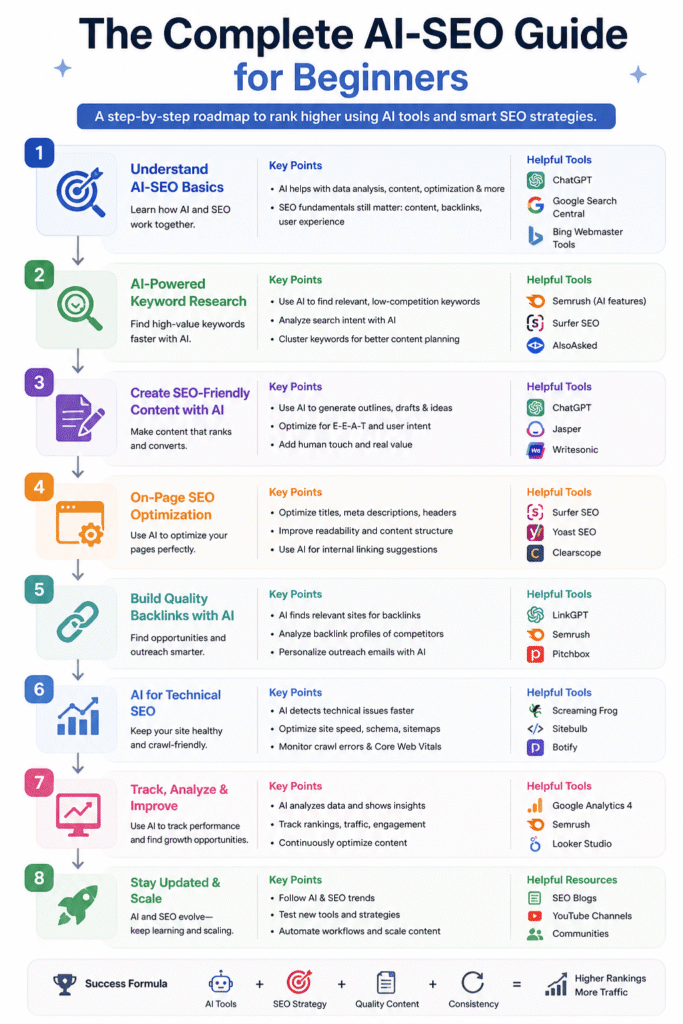
Table of Contents
ToggleWhat AI SEO Actually Means (and What Has Not Changed)
Search did not restart when AI arrived.
The websites dominating AI-generated answers in 2026 are, with very few exceptions, the same websites that were already performing well in traditional organic search. That is not a coincidence. AI systems retrieve from search indexes — primarily Google’s — which means every signal that helps a page rank also helps it enter the retrieval pool that AI draws from (Source: Lily Ray, Amsive, Affiliate Summit West, February 2026).
The word “AI SEO” gets used in two distinct ways and the distinction matters for beginners.
The first meaning is: using AI tools — like ChatGPT, Gemini, or Semrush’s AI features — to help produce, research, or optimise content faster. That is a workflow question.
The second meaning — and the one this guide focuses on — is: optimising content so that AI-powered search systems can find, parse, retrieve, and cite it. That is a visibility question.
This guide is about the second meaning. Workflow efficiency is a separate topic. Visibility is the foundation.
The Three Layers: SEO, GEO, and AEO Defined
Three acronyms now describe what was once called simply “SEO.”
Search Engine Optimisation (SEO) is the foundation. It covers making your content discoverable by Google and Bing through technical health, keyword relevance, backlinks, and on-page quality. Without strong SEO, the other two disciplines have no ground to stand on.
Generative Engine Optimisation (GEO) is the practice of structuring content so that AI-powered generative engines — ChatGPT, Perplexity, Gemini, Google AI Overviews — understand, trust, and cite your brand when generating responses (Source: Pixis, March 2026). The difference from SEO: SEO gets your page in front of a human who clicks through. GEO gets your content into an AI answer that the human may never click past.
Answer Engine Optimisation (AEO) is the most targeted of the three. Where GEO is about being cited broadly across AI systems, AEO is about becoming the direct, definitive answer to a specific question — in featured snippets, voice search responses, Google’s People Also Ask boxes, and AI chatbot replies (Source: Pixis, March 2026). AEO is citation precision. GEO is citation breadth.
All three are additive, not competing. A beginner’s job is to get the SEO layer right first — because without it, GEO and AEO have nothing to retrieve.
Why the Foundations Still Decide Everything
Here is the counterintuitive truth about AI SEO in 2026: the basics matter more, not less.
76% of URLs cited in Google AI Overviews also rank in the top 10 of traditional organic search results (Source: Ahrefs, June 2025). That single statistic should end the debate about whether traditional SEO still matters. It remains the primary gateway to AI citation eligibility.
Pro Tip: Before optimising for AI citation, run a technical SEO audit using Google Search Console’s Coverage report. Any URL with crawl errors, noindex tags, or soft 404 status is invisible to AI retrieval systems — fix those before doing anything else.
What has changed is the bar for quality. AI systems evaluate content for semantic completeness, structural clarity, and authorial credibility. A page that ranked through keyword repetition and thin content in 2021 is far less likely to survive in a retrieval environment that rewards depth, structure, and demonstrated expertise.
How AI Has Changed the Way Search Works in 2026
Most people do not realise how dramatically the search results page itself has changed in the past 18 months.
When a user types a query into Google today, there is a meaningful chance the first thing they see is not a list of websites. It is a paragraph — or several — generated by an AI system that has already read multiple pages, synthesised the relevant information, and written a direct answer. Google calls this an AI Overview.
From Blue Links to Synthesised Answers
AI Overviews now appear in up to 48% of all Google queries depending on query type and geography, up from approximately 16% in late 2025 (Source: Conductor, Q1 2026). For purely informational queries — the “what is,” “how to,” and “why does” questions that beginners and practitioners alike type every day — AI Overviews are nearly ubiquitous.
The mechanism behind this shift is Retrieval-Augmented Generation, or RAG.
When a user submits a query that requires current or factual information, the AI system does not simply generate an answer from its own training data. It first retrieves content from the web — querying search indexes in real time — and then synthesises the retrieved material into a response. This is why ranking still matters: if your content is not indexed and ranking, it cannot enter the retrieval pool.
ChatGPT processes over one billion searches per week as of early 2026 (Source: OpenAI, February 2026). Perplexity, Gemini, and Microsoft Copilot each operate on similar retrieval architectures. The practical consequence for any website owner is that the audience for your content now includes both human readers and AI retrieval systems — and those two audiences have different needs.
What AI Overviews Mean for Your Traffic
The traffic numbers attached to the rise of AI Overviews are uncomfortable reading.
Organic CTR drops from approximately 15% to 8% when an AI Overview is present for a query — a 47% relative decline (Source: Pew Research Center, July 2025). For purely informational queries, informational traffic drops of 30–40% have been measured in multiple independent studies (Source: Digital Applied, March 2026).
But the data also contains a less-reported finding: brands cited inside AI Overviews earn 35% more organic clicks and 91% more paid clicks than non-cited competitors appearing on the same SERP (Source: Seer Interactive, September 2025). The goal for 2026 is not to avoid the shift. It is to be on the right side of it.
The AI-SEO Visibility Framework: How to Think About Visibility in 2026
Most beginners approach AI SEO as a list of tactics. Add schema markup. Write FAQ sections. Include statistics.
Those tactics are valid. But without a framework for understanding why they work and in what order they need to be applied, practitioners end up optimising the wrong layer — or optimising a layer before the one beneath it is stable.
The AI-SEO Visibility Framework organises the discipline into three sequential layers. Each layer is a prerequisite for the next.
Layer 1: Ranking Eligibility
Ranking Eligibility is the foundation layer. It covers everything required for a page to appear in search results at all: technical health, crawlability, mobile usability, Core Web Vitals, indexation status, and basic keyword relevance.
A page that fails at this layer is invisible to both traditional search and AI retrieval. No GEO or AEO tactic will compensate for a page Google cannot crawl, index, or understand.
The audit question for Layer 1: Can Google find, crawl, and index this page without errors?
Layer 2: Retrieval Readiness
Retrieval Readiness is the AI-specific layer. It covers the structural and content signals that make a page parseable and trustworthy for AI retrieval systems: direct answers at section openings, semantic structure, FAQ blocks, schema markup, content freshness, and adequate depth.
A page can rank well at Layer 1 and still fail at Layer 2. AI retrieval systems have different preferences from traditional ranking algorithms. They favour content that is clearly structured, answers questions directly at the start of each section, and is updated frequently (Source: Lily Ray, Tech SEO Connect, December 2025).
The audit question for Layer 2: Can an AI system extract a direct, accurate answer from this page without needing to read the whole thing?
Layer 3: Citation Authority
Citation Authority is the trust layer. It covers the signals that make AI systems choose your content over a competitor’s when both are technically eligible for retrieval: named authorship with verifiable credentials, brand mentions across third-party platforms, consistent topical coverage over time, and E-E-A-T signals that AI knowledge graphs can cross-reference.
A page can pass Layer 1 and Layer 2 and still lose citation share to a competitor with stronger authority signals. This is where brand-building, digital PR, and expert authorship directly affect AI visibility.
The audit question for Layer 3: Does the author, brand, and content have enough verifiable credibility that an AI system would choose to cite this over another source?
The table below summarises the framework across the three layers.
The following table shows what each layer requires, what breaks it, and where to start auditing.
| Layer | Name | Primary Goal | Key Signals | Common Break Point |
|---|---|---|---|---|
| 1 | Ranking Eligibility | Appear in search indexes | Technical health, crawlability, keyword relevance, indexation | Crawl errors, noindex tags, slow page speed, thin content |
| 2 | Retrieval Readiness | Be parseable by AI retrieval systems | Direct answers, semantic structure, FAQ schema, content freshness, schema markup | Answers buried in body, no schema, outdated statistics, JS-dependent content |
| 3 | Citation Authority | Be chosen by AI over competitors | E-E-A-T signals, named authorship, third-party brand mentions, topical consistency | Anonymous content, no author credentials, no external corroboration |
E-E-A-T in 2026: What It Is and Why It Decides Who Gets Cited
E-E-A-T stands for Experience, Expertise, Authoritativeness, and Trustworthiness.
Google introduced the concept in its Quality Rater Guidelines — a document used by human reviewers to assess the quality of search results. In 2022, Google added the first E (Experience) to the original E-A-T framework, explicitly recognising that first-hand, lived experience with a topic is a quality signal distinct from abstract expertise.
In 2026, E-E-A-T matters not just for human quality raters. AI retrieval systems are calibrated to favour content from named, verifiable authors on sites with consistent topical depth. That calibration is E-E-A-T by another name.
Experience and Expertise: The Two Signals Most Sites Get Wrong
Experience is the most underused E-E-A-T signal — and the one most relevant to new publishers.
Most sites demonstrate expertise by citing external research and referencing what others have found. That is necessary but insufficient. Experience means the author has directly done the thing they are writing about. Managed an SEO campaign. Run a keyword research audit. Tested a schema markup implementation. Tracked rankings through an algorithm update.
Experience signals appear in specific, observable ways: a named author with a verifiable professional history, content that contains details only a practitioner would know, and framing that goes beyond summarising external sources.
Expertise, by contrast, is demonstrated through analytical depth — the ability to interpret data, explain trade-offs, and provide the kind of guidance that requires genuine topical knowledge rather than aggregation.
Running content audits across dozens of sites for clients has made one pattern consistently visible: pages that rank and get cited are almost never the ones that summarise what other sites have already said. The ones that earn sustained visibility contain at least one observation, data point, or framing that does not exist verbatim in any competitor page on the topic.
How to Build Authoritativeness and Trustworthiness Without a Big Brand Budget
Authoritativeness and Trustworthiness are the two E-E-A-T signals that new or smaller publishers most often assume require a large audience or major brand recognition. They do not.
Authoritativeness is built through consistent, topically focused publication over time — not through volume, but through coherent coverage. A site that publishes 30 posts on a narrow AI SEO topic cluster is more authoritative on that topic than a site that publishes 300 posts across 20 unrelated categories.
Trustworthiness at the page level comes from: a named author with a verifiable identity, cited sources that can be independently verified, no factual errors, a clear editorial correction policy where relevant, and secure hosting with no security flags.
Pro Tip: For new publishers, the single fastest trust-building action is adding a detailed author bio with verifiable credentials to every post. Include the author’s professional background, specific areas of expertise, and at least one external profile link — LinkedIn is sufficient. AI systems cross-reference named authors against external sources to assess credibility.
Brands earning the most web mentions earn up to 10x more mentions in AI Overviews than less-mentioned competitors (Source: The SEO Works, March 2026). Brand mentions on third-party platforms — Reddit, YouTube, industry publications, and professional directories — are the external corroboration that moves a brand from Retrieval Layer 2 to Layer 3.
AI SEO vs Traditional SEO: What Changed, What Did Not
The framing of “AI SEO vs Traditional SEO” as a competition is one of the most persistently unhelpful framings in the current SEO conversation.
The most accurate statement of the relationship: AI SEO is traditional SEO with additional requirements at the retrieval and citation layers. The fundamentals that governed traditional SEO — technical health, keyword relevance, backlinks, on-page quality — remain necessary in 2026. They are no longer sufficient on their own.
The table below shows the clearest distinctions between what has changed and what has remained constant.
| Dimension | Traditional SEO (2020) | AI SEO (2026) | Changed? |
|---|---|---|---|
| Primary goal | Rank on page one of Google | Rank AND be cited in AI-generated answers | Yes |
| Technical health (crawlability, speed) | Required | Required — AI crawlers share same constraints | No |
| Keyword relevance | Exact match + semantic | Semantic intent + topic coverage + sub-query coverage | Evolved |
| Backlinks | Primary authority signal | Still relevant; brand mentions now equally important | Evolved |
| Content length | Longer often won | Depth wins; but grounding budget limits retrieval to ~2,000 words | Evolved |
| Content structure | Header hierarchy | Header hierarchy + direct answers + FAQ blocks | Expanded |
| Schema markup | Recommended | Required for AI retrieval eligibility | Elevated |
| Author signals | Rarely checked | Verified authorship now a trust and citation signal | New requirement |
| Success metric | Rankings + organic traffic | Rankings + organic traffic + AI citation share | Expanded |
| Update frequency | Annual or as-needed | Sub-13-week refresh cycle preferred by AI retrieval | New requirement |
The clearest way to read this table: nothing in the traditional column disappeared. Several new requirements entered in the AI SEO column. Practitioners who were doing excellent traditional SEO already have a significant advantage in AI-era visibility.
How to Optimise Content for AI Search in 2026
Content optimisation for AI search starts with a premise that contradicts how most beginners have been taught to write.
Most SEO writing advice tells writers to build context before delivering an answer — to ease the reader in with background, definitions, and scene-setting before arriving at the key information. AI retrieval systems work in the opposite direction. They retrieve in chunks, not pages. The first paragraph of a section is the most likely to be extracted. Background context buried three paragraphs deep may never be retrieved at all.
Structure That AI Can Parse
Every H2 section should open with a direct, self-contained answer to the question that section’s heading implies.
If the H2 is “What Is Schema Markup,” the first sentence should be a clear definition of schema markup — not an explanation of why schema markup is an interesting topic. The explanation follows the answer. This structure serves both human readers (who can skim and find what they need) and AI retrieval systems (which extract the opening of each section first).
Sentences should be short and declarative. Paragraphs should contain one to two sentences. Headers should accurately describe the content beneath them — not tease it.
The Answer-First Paragraph Rule
The Answer-First Paragraph Rule is one of the highest-leverage content changes a beginner can make.
For every H2 and H3 in an article, write the direct answer to the implied question before writing anything else. This is distinct from the traditional writing pattern of introducing a topic, providing background, and arriving at the answer. AI retrieval systems treat section openings as extractable chunks. A section that opens with the answer and follows with supporting detail is both more citation-ready and more readable for human practitioners under time pressure.
Google’s AI Overview analysis shows that 44.2% of all LLM citations come from the first 30% of a page’s text (Source: Position Digital, April 2026). The first quarter of any article — and the first paragraph of every section — is where AI citation decisions are made.
FAQ Blocks and Voice-Ready Answers
FAQ sections are among the most citation-efficient content formats available.
Each FAQ answer is a discrete, self-contained chunk that AI systems can extract and surface without needing any surrounding context. For this reason, FAQ answers should be written to be fully standalone: they must answer the question completely, contain at least one specific number or measurable claim, and avoid pronouns that refer back to earlier sections of the article.
Voice-readiness means the answer can be read aloud naturally in one to three sentences. Google and Bing’s voice search systems, along with AI assistants, prioritise answers that parse clearly as spoken language. Reading your FAQ answers aloud before publishing is a simple and effective test.
Technical SEO for Beginners: The Foundations AI Requires
Technical SEO is the layer that most beginners want to skip.
It is the least visible layer — most of the work happens in code and server settings rather than in content — and it produces changes that are rarely seen immediately in rankings. But without a technically sound foundation, every content and authority investment above it is undermined. AI retrieval systems share the same technical constraints as traditional crawlers.
Crawlability and Indexability
A page that Google cannot crawl cannot be indexed. A page that is not indexed cannot rank. A page that does not rank cannot enter the retrieval pool for AI Overviews or any other AI answer system.
The minimum technical check for every published page: confirm it returns a 200 HTTP status code, has no noindex meta tag, is included in the XML sitemap, and has no crawl errors flagged in Google Search Console. These are not advanced checks. They are the floor of technical SEO eligibility.
Most LLMs also cannot render JavaScript-dependent content during retrieval (Source: Lily Ray, Tech SEO Connect, December 2025). Any content that loads dynamically — through JavaScript execution rather than server-side rendering — may be invisible to AI crawlers even when it is visible to human readers. Critical content must appear in the raw HTML of the page.
Core Web Vitals and Page Speed
Core Web Vitals are Google’s set of page experience metrics measuring loading speed, interactivity, and visual stability.
The three metrics are: Largest Contentful Paint (LCP), which measures how quickly the main content loads; Interaction to Next Paint (INP), which measures responsiveness to user input; and Cumulative Layout Shift (CLS), which measures visual stability during loading. Google provides benchmarks and a free measurement tool through PageSpeed Insights.
Page speed affects both traditional rankings and AI retrieval. A page that loads slowly creates a poor user experience signal that compounds negatively across Google’s ranking systems. Faster pages are crawled more efficiently, which means content updates are reflected in search results and retrieval pools more quickly.
Schema Markup: The Minimum Every Site Needs
Schema markup is structured data added to a page’s HTML that tells search engines — and AI retrieval systems — what type of content the page contains, who wrote it, when it was published, and what specific questions it answers.
For beginners, three schema types are the practical minimum: Article (or NewsArticle for time-sensitive content), which signals the page type and author; BreadcrumbList, which maps the page’s position in the site hierarchy; and FAQPage, which wraps FAQ answers in machine-readable format for direct extraction.
Pages implementing comprehensive structured data are approximately one-third more likely to be cited or surfaced in AI-generated answers (Source: UNU Campus Computing Centre, January 2026). Schema is not a ranking factor in the traditional sense. It is a parsing aid — it makes content legible to machines at a level of precision that unstructured HTML cannot match.
Pro Tip: Use Google’s Rich Results Test tool (search.google.com/test/rich-results) after adding schema markup to any page. A result showing your FAQ or Article schema is eligible for rich results confirms the implementation is valid. An error report tells you exactly which fields are missing or incorrectly formatted.
Keyword Research in the Age of AI: What Beginners Need to Know
Keyword research has not become irrelevant in 2026. It has become more complex.
Traditional keyword research asked a single question: what terms do people search for, and how often? The answer was supplied by tools like Semrush, Ahrefs, and Google Keyword Planner, which provided Monthly Search Volume (MSV) as the primary signal for prioritising content topics.
That question is still valid. The problem is that it only captures one part of the query landscape in an AI-driven search environment.
Search Intent Over Search Volume
Search intent — the reason behind a query, not just the words in it — has always been important in SEO. In 2026, it is the primary factor.
AI systems do not match keywords. They interpret intent. A page that perfectly matches the words of a query but fails to satisfy the underlying need behind it will not be retrieved or cited. A page that clearly, completely, and accurately answers the specific question a user has — even if the keyword match is imperfect — has a strong retrieval probability.
The four intent categories still used in SEO practice are: informational (seeking knowledge), navigational (seeking a specific site), commercial (comparing options before purchasing), and transactional (ready to act). For beginners, the vast majority of content worth producing targets informational intent — the questions that introduce users to a brand and a topic for the first time.
How AI Generates Sub-Queries You Cannot Find in Any Tool
Here is the most important and least-discussed aspect of keyword research in 2026.
AI retrieval systems do not search for the exact query a user typed. They deconstruct that query into multiple sub-queries — a process called query fan-out — and execute those sub-queries simultaneously against search indexes to gather diverse source material. 95% of these machine-generated sub-queries carry no Monthly Search Volume in any keyword research tool available today (Source: Lily Ray, Tech SEO Connect, December 2025).
This does not make keyword research useless. It means the output of keyword research — a prioritised list of head terms and supporting phrases — is the starting point for content planning, not the complete map. A pillar post that ranks for one primary keyword but fails to answer any of the 15 sub-queries that AI generates during fan-out for that keyword will be cited far less than a post with broader topical coverage.
The practical implication: write for the topic, not just the keyword. Use primary keywords to signal relevance. Use comprehensive topical coverage — answering the sub-questions, edge cases, definitions, and related concepts within the same piece — to satisfy AI sub-query retrieval.
Where to Track AI SEO Performance (New Metrics for 2026)
The metrics that defined SEO success in 2020 — keyword rankings, organic sessions, and bounce rate — are still worth tracking. They are no longer sufficient on their own.
A site can maintain consistent keyword rankings while losing significant traffic because AI Overviews are answering the query directly. A site can see organic sessions decline while its brand mention frequency in AI answers increases — a shift that drives higher-intent, higher-converting traffic from the users who do click through.
Only 16% of brands systematically track AI search performance as of 2026 (Source: McKinsey CMO Survey, September 2025). That gap is an opportunity for practitioners who build measurement capability now.
The following table shows both the traditional metrics worth keeping and the new metrics to add.
| Metric | What It Measures | Tool | Why It Matters in 2026 |
|---|---|---|---|
| Keyword rankings | Position for target keywords in Google | Semrush, Ahrefs, Search Console | Still the eligibility check for AI retrieval |
| Organic sessions | Click-through traffic from search | Google Analytics 4 | Tracks actual traffic, increasingly disconnected from rankings |
| Impressions (GSC) | How often your pages appear in search | Google Search Console | Rising impressions with falling CTR = AI Overview present |
| CTR by query | Click rate for specific queries | Google Search Console | Flag queries where AI Overviews are absorbing clicks |
| AI citation share | How often your brand is cited in AI answers | Semrush AI Visibility Toolkit, Ahrefs AI Mentions | The forward-looking metric for GEO performance |
| Branded search volume | Volume of searches for your brand name | Google Search Console, Google Trends | Brand mentions in AI answers drive branded search |
| AI referral traffic | Sessions originating from AI platforms | Google Analytics 4 (source attribution) | Measures actual AI-driven traffic to site |
| Engagement rate | Time on page, scroll depth, return visits | Google Analytics 4 | AI-referred traffic engages at higher rates — track quality |
AI-referred website sessions grew 527% year-over-year between January–May 2024 and January–May 2025 (Source: Taylor Scher SEO, March 2026). The volume remains small as a percentage of total traffic — approximately 1.08% of all web traffic on average (Source: Conductor, November 2025) — but the conversion quality is significantly higher than traditional organic traffic in multiple independent studies.
How AI SEO Journal Covers the Cluster Topics Under This Pillar
This pillar establishes the framework and the vocabulary. The cluster posts in this series go deeper on each component as they go live.
Keyword Research and Semantic SEO covers how to conduct keyword research that accounts for AI sub-query generation, how to build topic clusters, and how to map intent across a content architecture. This is Layer 1 of the AI-SEO Visibility Framework in practice.
On-Page SEO and Content Optimisation covers the Answer-First Paragraph Rule in detail, content structure for AI parsing, internal linking strategy, and how to audit existing content against AI retrieval readiness criteria.
Technical SEO: Crawlability, Speed, and Schema covers the full technical audit process for beginners, Core Web Vitals optimisation, schema markup implementation in WordPress and Elementor, and JavaScript rendering issues that block AI crawlers.
E-E-A-T and AI Content Guidelines covers how to build named author authority, how to demonstrate first-hand experience within content, how to handle AI-assisted content within Google’s helpful content framework, and what types of content receive the highest E-E-A-T scrutiny.
Link Building and Brand Authority covers the relationship between backlinks, brand mentions, and AI citation eligibility, how to build third-party brand presence across Reddit, YouTube, and industry publications, and which link-building approaches still produce authority signals that AI systems recognise.
SEO Analytics and Reporting covers how to build a measurement framework that includes both traditional ranking metrics and AI citation tracking, how to use Google Search Console to identify AI Overview impact on specific queries, and how to report AI SEO performance to clients or stakeholders.
AI Tools and Automation for SEO covers how to use AI writing assistants, keyword research tools, and technical auditing platforms within an SEO workflow — with honest guidance on where AI tools add genuine value and where they introduce risk.
Local SEO and AI Search covers how Google’s AI Overviews affect local queries, how to optimise a Google Business Profile for AI visibility, and how AI systems handle location-specific search intent.
Each cluster post in this series links back to this pillar and goes deeper on the specific topic it covers. The goal of this architecture is to give any practitioner — beginner or experienced — a clear entry point into the topic and a clear path toward the specific expertise they need.
Frequently Asked Questions About AI SEO for Beginners
Is AI SEO the same as traditional SEO? AI SEO is traditional SEO with additional requirements. The foundations — technical health, keyword relevance, on-page quality, and backlinks — remain necessary in 2026. What has changed is that content must now also satisfy AI retrieval systems, which have different preferences from traditional ranking algorithms: direct answers at section openings, semantic structure, named authorship, and regular content updates. 76% of pages cited in AI Overviews already rank in the top 10 of traditional organic search, which confirms that strong SEO is still the prerequisite for AI citation eligibility (Source: Ahrefs, June 2025).
How do AI Overviews affect my website traffic? Organic click-through rates drop by approximately 61% for queries where a Google AI Overview appears, from 1.76% to 0.61% on average (Source: Seer Interactive, September 2025). The impact is strongest for purely informational queries. However, brands cited inside AI Overviews earn 35% more organic clicks than non-cited competitors on the same page — making citation the new primary traffic opportunity rather than position alone.
What is E-E-A-T and why does it matter for AI SEO? E-E-A-T stands for Experience, Expertise, Authoritativeness, and Trustworthiness. It is the framework Google uses to assess content quality, and AI retrieval systems are calibrated to favour content that demonstrates all four signals. Experience means the author has directly done the thing they are writing about. Expertise means the content reflects genuine analytical depth. Authoritativeness means the site and author are recognised as credible sources within their topic area. Trustworthiness means the content contains no false claims, has a named and verifiable author, and is hosted on a secure, technically reliable site. Strong E-E-A-T is the Layer 3 requirement in the AI-SEO Visibility Framework.
What is GEO and how is it different from SEO? Generative Engine Optimisation (GEO) is the practice of structuring content so that AI-powered answer engines — ChatGPT, Perplexity, Gemini, and Google AI Overviews — cite your brand when generating responses. The key difference from traditional SEO: SEO earns clicks when a human user sees your page in a list of results. GEO earns citations when an AI synthesises a response that draws from your content. Nearly 31% of the US population will use generative AI search in 2026 (Source: EMARKETER, April 2026), which makes GEO an increasingly important layer of search visibility strategy.
Do I need to know how to code to do AI SEO? No. Schema markup — the technical element most closely associated with AI readiness — can be implemented in WordPress using Rank Math or through Elementor’s Custom HTML widget without writing code from scratch. Tools like Google’s Structured Data Markup Helper allow beginners to generate valid JSON-LD schema by filling in fields rather than writing code. The content and structural elements of AI SEO — direct answers, FAQ blocks, fresh statistics, named authorship — require editorial skill, not coding ability.
How often should I update my content for AI SEO? 50% of content cited in AI answers is less than 13 weeks old (Source: Lily Ray, Tech SEO Connect, December 2025). This recency bias means content that has not been substantively updated in more than three months is at a structural disadvantage for AI retrieval, regardless of its traditional ranking position. A practical update schedule for high-value pages is every 10–12 weeks: refresh statistics, add new examples, update any claims that have changed, and update the dateModified field in the page’s schema markup.
What tools do I need to start AI SEO? The minimum toolkit for beginners: Google Search Console (free — tracks indexation, rankings, impressions, and CTR), Google Analytics 4 (free — tracks traffic sources including AI referral), and Google PageSpeed Insights (free — audits Core Web Vitals). For keyword research: Semrush or Ahrefs at the entry-level tier covers the core use cases. For AI citation tracking: Semrush’s AI Visibility Toolkit provides citation monitoring as part of its standard plans. Schema markup can be managed with Rank Math’s free tier in WordPress.
Will AI replace SEO entirely? No — and the evidence from 2026 supports this clearly. AI systems retrieve content from search indexes, which means organic ranking remains the primary gateway to AI citation eligibility. What AI changes is the type of content that earns visibility: deep, structured, authoritative, and regularly updated content outperforms thin, generic, or poorly structured content by a widening margin. AI exposed who was relying on tactical shortcuts rather than durable quality signals. The fundamentals of SEO are more important in the AI era, not less (Source: Smith Digital, January 2026).
Building Your AI SEO Foundation: Start Here
The shift to AI-powered search is not a reason to panic and rebuild everything from scratch.
The sites losing visibility in 2026 are not the ones that failed to learn new AI tricks. They are the ones that were relying on content volume without depth, keyword matching without semantic completeness, and rankings without authorial credibility. Those were always weaknesses. AI search made them consequential faster.
The AI-SEO Visibility Framework introduced in this guide gives beginners a clear sequence: build Ranking Eligibility first, then Retrieval Readiness, then Citation Authority. Each layer is a prerequisite for the next. A site that skips to Layer 3 tactics without a solid Layer 1 is building on an unstable foundation.
The single most important action a beginner can take after reading this guide is to audit their site against Layer 1: open Google Search Console, check the Coverage report for errors, confirm the pages they care about are indexed, and identify any Core Web Vitals failures. That audit costs nothing and takes under an hour. It reveals the exact technical gaps that block every other optimisation effort above it.
The cluster posts in this series will go deeper on keyword research, technical SEO, E-E-A-T signal building, and AI content structure as they go live. Each post starts where this one ends — with the framework in place and the specific tactics ready to apply.
For a broader view of how AI search and traditional SEO interact across the full search landscape, the AI & SEO Fundamentals category covers the full range of foundational topics this site publishes on.
The search environment of 2026 rewards the same qualities it has always rewarded: genuine expertise, clearly communicated, on pages that work. The difference is that the machines reading your content have become considerably better at telling the difference.
References
Position Digital. 150+ AI SEO Statistics for 2026.” Position Digital, April 2026. https://www.position.digital/blog/ai-seo-statistics/ Supports: 60% zero-click search rate; AI referral traffic growth statistics; ChatGPT referral traffic share.
Seer Interactive. AIO Impact on Google CTR: September 2025 Update.” Seer Interactive, November 2025. https://www.seerinteractive.com/insights/aio-impact-on-google-ctr-september-2025-update Supports: 61% organic CTR drop with AI Overviews; 35% more clicks for cited brands; 91% more paid clicks.
Pew Research Center. “When AI Answers, Users Click Less.” Pew Research Center, July 2025. https://www.pewresearch.org/ Supports: CTR drops from 15% to 8% when AI Overview present; 46.7% relative decline in click rates.
Lily Ray, Amsive. “Tech SEO Connect 2025: Summary & Latest Tech SEO Trends.” lilyray.nyc, December 2025. https://lilyray.nyc/tech-seo-connect-2025-summary-takeaways/ Supports: 95% of fan-out sub-queries carry no MSV; 50% of cited content under 13 weeks old; AI crawler JS rendering limitations; grounding budget mechanics.
Conductor. “AI Overview Prevalence Q1 2026.” Cited in: Digital Applied, April 2026. https://www.digitalapplied.com/blog/ai-search-seo-statistics-2026-definitive-collection Supports: 25.11% of searches trigger AI Overviews in Q1 2026; up to 48% for specific query categories.
Ahrefs. “AI Overviews and Organic Search Correlation.” Ahrefs, June 2025. https://ahrefs.com/ Supports: 76% of AI Overview citations come from top-10 organic results; AI Overviews reduce position-1 CTR by up to 58%.
McKinsey. “AI Discovery Survey.” McKinsey, August 2025. https://www.mckinsey.com/ Supports: 44% of AI search users say it is their primary information source; 16% of brands systematically track AI search performance.
EMARKETER. FAQ on GEO and AEO: Where AI Search and SEO Overlap in 2026.” EMARKETER, April 2026. https://www.emarketer.com/content/faq-on-geo-aeo–where-ai-search-seo-overlap-2026 Supports: 31.3% of US population will use generative AI search in 2026; GEO definition and distinction from AEO.
Pixis. “SEO, GEO, and AEO Explained.” Pixis, March 2026. https://pixis.ai/blog/seo-geo-and-aeo-what-they-are-how-they-differ-and-why-your-search-strategy-needs-all-three/ Supports: SEO, GEO, and AEO definitions; 38% of AI Overview URLs from top-10 results figure.
Taylor Scher SEO. “AI SEO Statistics: 40 Statistics You Should Know for 2026.” Taylor Scher SEO, March 2026. https://www.taylorscherseo.com/blog/ai-seo-statistics Supports: AI referral sessions grew 527% YoY; 44.2% of LLM citations from first 30% of page text.
The Complete AI SEO Guide
for Beginners
Every key stat, framework, timeline and tool — built from verified 2025–2026 sources. Updated May 2026.
Sources: Seer Interactive · Position Digital · Lily Ray / Amsive · EMARKETER · Pew Research Center · Conductor · Ahrefs · McKinsey · Digital Applied
2026 AI Search at a Glance
These figures define the scale of the shift. Every stat is sourced and dated.
Three Layers — In This Order
Every layer is a prerequisite for the next. Skipping Layer 1 means Layers 2 and 3 have no foundation to stand on.
AI Search — Key Milestones
From the foundational research paper to 2 billion monthly users in under six years.
AI Overviews vs Organic Clicks
How query type and AI Overview presence affect click-through rates — from three independent 2025–2026 studies.
What Changed, What Did Not
AI SEO is traditional SEO with additional requirements — not a replacement. The foundations never left.
| Dimension | Traditional SEO (2020) | AI SEO (2026) | Status |
|---|---|---|---|
| Primary Goal | Rank on page one of Google | Rank AND be cited in AI-generated answers | Evolved |
| Technical Health | Crawlability, speed, indexation | Same — AI crawlers share these constraints | Unchanged |
| Keyword Strategy | Exact match + semantic | Semantic intent + topic coverage + AI sub-query coverage | Evolved |
| Backlinks | Primary authority signal | Still relevant; brand mentions now equally important | Evolved |
| Content Structure | Header hierarchy | Header hierarchy + direct answers + FAQ blocks | Expanded |
| Schema Markup | Recommended | Required for AI retrieval eligibility | Elevated |
| Author Signals | Rarely checked | Verified authorship is a trust and citation signal | New requirement |
| Update Frequency | Annual or as-needed | Sub-13-week refresh cycle preferred by AI retrieval | New requirement |
| Success Metric | Rankings + organic traffic | Rankings + organic traffic + AI citation share | Expanded |
E-E-A-T in 2026
Google's quality framework now governs which content AI systems trust enough to cite. All four signals matter in the AI retrieval era.
Tools Every Beginner Needs
Organised by function. Free options cover the essentials — paid tools add AI citation tracking and keyword depth.
AI SEO — Frequently Asked Questions
Direct answers. Each response contains a specific number or verifiable claim.