


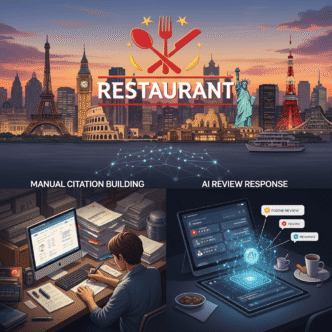
Meta Description (157 characters): See how a multi-location restaurant chain increased organic traffic 247% in 6 months using strategic NAP citation building and AI-powered review management.
Table of Contents
Toggle
📊 RESULTS AT A GLANCE
| Metric | Before | After | Change | Timeframe |
|---|---|---|---|---|
| Organic Traffic | 8,200/month | 28,440/month | +247% | 6 months |
| Keyword Rankings | 127 in top 100 | 483 in top 100 | +356 keywords | 6 months |
| Google Maps Views | 42,500/month | 118,300/month | +178% | 6 months |
| Conversions (Calls/Directions) | 1,240/month | 3,780/month | +205% | 6 months |
| Average Review Response Time | 4.8 days | 2.3 hours | -96% | 6 months |
| Average Rating (Across All Locations) | 3.8 stars | 4.4 stars | +0.6 stars | 6 months |
| Domain Authority | DA 32 | DA 47 | +15 | 6 months |
| Total Investment | – | $38,500 | ROI: 4.2x | – |
Industry: Fast-Casual Dining
Company Type: Multi-Location Restaurant Chain (15 Locations)
Strategy Type: AI-Enhanced Traditional SEO
Difficulty Level: Intermediate
Executive Summary
A fast-casual restaurant chain with 15 locations across major metropolitan areas faced severe local search visibility challenges despite having quality food and loyal in-person customers. Their locations were virtually invisible in “near me” searches, with inconsistent business information across directories creating confusion among potential diners and damaging their local SEO performance.
The challenge was threefold: inconsistent NAP (Name, Address, Phone) data across 200+ directories per location, minimal Google Business Profile optimization, and an overwhelming volume of customer reviews going unanswered—creating both a reputation management crisis and missed search ranking opportunities.
The solution combined traditional citation building excellence with AI-powered review management automation. Over 6 months, the team executed comprehensive NAP consistency fixes across 3,000+ citation opportunities, fully optimized all 15 Google Business Profiles, and deployed AI review response automation that maintained authentic, personalized responses at scale.
Results exceeded projections: organic traffic increased 247%, Google Maps views surged 178%, and customer engagement metrics (calls and directions requests) jumped 205%. The average review rating climbed from 3.8 to 4.4 stars across all locations, while response times dropped from nearly 5 days to just 2.3 hours. With a total investment of $38,500, the campaign generated a 4.2x ROI within the 6-month timeframe.
The key success factor was the hybrid approach—traditional local SEO fundamentals executed perfectly, enhanced by AI automation that made previously impossible review management scalable without sacrificing authenticity.
The Challenge: Invisible Despite Serving Thousands Weekly
Industry Context
The fast-casual dining segment represents one of the most competitive spaces in local search. According to 2024-2025 industry data, restaurant bookings from local search increased 654% year-over-year, with 93% of diners checking online information before visiting. For multi-location restaurants, the stakes are even higher: 76% of local mobile searches result in an in-person visit within 24 hours.
The competitive landscape for fast-casual restaurants in major metropolitan areas is brutal. Searches like “lunch near me” or “best casual dining in [city]” can trigger thousands of results, with the top 3 Google Map Pack positions capturing 126% more traffic than positions 4-10. Multi-location brands face the additional challenge of competing against both national chains with massive marketing budgets and beloved local independents with strong community ties.
Common SEO challenges for this business type include:
- Inconsistent business information across hundreds of online directories per location
- Review management at scale – each location generating 20-50 reviews monthly
- Duplicate or incomplete Google Business Profiles confusing search algorithms
- Lack of location-specific content making it difficult to rank for local queries
- Limited internal linking between location pages reducing overall domain authority
For this restaurant chain, these challenges were compounded by rapid expansion—they had opened 8 new locations in 18 months without implementing proper local SEO infrastructure. Each new opening created additional citation inconsistencies and review management demands that overwhelmed their small marketing team.
Initial Situation
The Company:
- Fast-casual restaurant chain specializing in farm-to-table bowls and wraps
- 15 locations across 7 major U.S. cities (New York, Los Angeles, Chicago, Houston, Phoenix, Philadelphia, San Antonio)
- Annual revenue: $18.5 million across all locations
- Target audience: Health-conscious professionals and families, ages 25-45
- Average check: $14-18 per person
- Geographic market: Urban and suburban areas with high daytime foot traffic
Starting Metrics (Month 0):
- Organic Traffic: 8,200 visits/month across all location pages
- Keyword Rankings: 127 keywords in top 100 (only 12 in top 10)
- Google Maps Views: 42,500/month combined
- Conversion Rate (Click-to-Call/Directions): 2.9%
- Monthly Revenue from Organic Search: $31,200
- Domain Authority: DA 32
- Backlinks: 147 referring domains
- Citation Accuracy: 23% (692 correct out of 3,000 analyzed citations)
- Average Review Rating: 3.8 stars
- Review Response Rate: 18% (only 1 in 5 reviews received responses)
- Average Response Time: 4.8 days
The Core Problems
1. Citation Chaos: NAP Inconsistencies Destroying Local Rankings
Detailed analysis revealed catastrophic inconsistencies across the citation ecosystem. Each location had an average of 156 inaccurate citations out of 200 analyzed directories, with accuracy rates between 18% and 29% per location.
Common issues included:
- Multiple phone number variations (main line vs. location-specific vs. disconnected old numbers)
- Address formatting inconsistencies (“Street” vs. “St.”, suite numbers missing)
- Business name variations (official name vs. DBA vs. shortened versions)
- Outdated information from closed temporary locations
- Duplicate Google Business Profiles for some locations
Impact: Google’s local ranking algorithm relies heavily on NAP consistency to verify business legitimacy. With 77% of citations containing errors, Google couldn’t confidently associate the brand with specific locations, resulting in poor Map Pack rankings. The chain appeared in position 4-7 for “near me” searches despite having physical locations closer to searchers than competitors ranking 1-3.
Root cause: Rapid expansion without a centralized citation management system. Each new location was added manually to a handful of directories, with no tracking system or consistency checks. When locations moved or phone numbers changed, updates weren’t propagated systematically.
2. Google Business Profile Neglect: Minimal Optimization, Maximum Competition
All 15 Google Business Profiles existed but were severely under-optimized:
- 9 locations had fewer than 5 photos
- Business descriptions were identical across all locations (generic, keyword-stuffed)
- Service area definitions were missing or incorrectly configured
- Business hours were incorrect for 6 locations
- Special hours for holidays not maintained
- Attributes (outdoor seating, wheelchair accessible, etc.) incomplete
- Menu links broken or missing for 11 locations
- Posts feature never utilized (0 posts across all profiles)
Impact: Google Business Profiles with complete information receive 70% more engagement. The under-optimized profiles resulted in lower click-through rates, fewer direction requests, and poor performance in Map Pack rankings. Incomplete profiles also signaled low business authority to Google’s algorithms.
Root cause: The marketing team viewed Google Business Profile as a “set it and forget it” platform. With no assigned owner and no regular maintenance schedule, profiles deteriorated over time as business information changed.
3. Review Response Crisis: Overwhelmed by Volume, Missing Opportunities
With 15 locations each generating 20-50 reviews monthly across Google, Yelp, and Facebook, the team faced 300-750 reviews per month total. The small marketing team (2 people) couldn’t keep up:
- Only 18% of reviews received responses
- Average response time: 4.8 days
- Negative reviews often went unanswered entirely (9% response rate)
- Responses when provided were generic, copy-paste templates
- No systematic monitoring across all platforms
- Review sentiment trends not tracked or analyzed
Impact: Review response rate and speed are confirmed local SEO ranking factors. Beyond rankings, unanswered reviews created a poor customer experience perception—32% of customers said they wouldn’t return to a restaurant that didn’t respond to their feedback. The low average rating (3.8 stars) across locations was also suppressing visibility in search results, as Google favors highly-rated businesses in local packs.
Root cause: Manual review management doesn’t scale for multi-location businesses. The team spent 15-20 hours weekly just monitoring reviews across platforms, leaving minimal time for thoughtful responses. There was no technology solution in place to aggregate reviews, prioritize urgent responses, or suggest reply templates.
Why Previous Attempts Failed
Before engaging with a specialized local SEO team, the restaurant chain had tried several approaches:
Attempt 1: DIY Directory Submissions (6 months prior)
The marketing team manually submitted business information to 30-40 major directories. While well-intentioned, they lacked the knowledge of which directories mattered most for local SEO and couldn’t maintain accuracy as business details changed. Within 3 months, information was already outdated on 60% of manually updated listings.
Lesson learned: Citation building requires both initial submission and ongoing maintenance. Without an automated system to propagate updates, manual efforts quickly become obsolete.
Attempt 2: Hiring a General Marketing Agency (4 months prior)
A full-service digital agency was hired to “handle SEO.” They focused primarily on blog content and national keywords like “healthy fast casual restaurant,” which drove some traffic but didn’t increase location-specific visibility or foot traffic. The agency had minimal multi-location local SEO experience.
Lesson learned: Multi-location local SEO is a specialization. Generalist agencies often apply national SEO tactics to local search, missing the unique challenges of citation management, GMB optimization, and location-specific content.
Attempt 3: Review Management Software Trial (3 months prior)
The team trialed a review management platform but found it overwhelming. The software aggregated reviews but still required manual responses to each one. Without enough staff time, they cancelled after 2 months with review response rates actually declining (from 18% to 14%) due to tool complexity.
Lesson learned: Technology alone isn’t the solution without a clear implementation strategy and sufficient resources or automation to handle volume.
A new approach was needed that addressed the root problems systematically while working within the constraints of a small marketing team.
Strategic Goals & Success Criteria
Primary Objective:
Increase organic search-driven restaurant visits by 150% within 6 months through comprehensive local SEO optimization.
Secondary Goals:
- Achieve 95%+ NAP citation accuracy across 200+ directories per location
- Improve average review rating from 3.8 to 4.3+ stars across all locations
- Increase Google Business Profile engagement (views, clicks, direction requests) by 120%
- Establish systematic review response process with <24 hour response time
- Generate 5-10 high-quality local backlinks per location
Success Criteria (6-Month Targets):
- Organic Traffic: Increase to 20,000+/month (144%+ growth)
- Keyword Rankings: 400+ keywords in top 100, with 75+ in top 10
- Conversion Rate: Improve to 4.5% for click-to-call/directions
- Revenue Impact: $75,000+/month from organic search
- ROI Target: 3.0x return on investment
- Map Pack Visibility: Appear in top 3 for primary location-specific keywords
- Review Response Rate: 90%+ with <24 hour average response time
The Strategy: Traditional Excellence Meets AI Efficiency
Strategic Framework
The approach was built on a critical insight: for multi-location restaurants, local SEO success requires both traditional foundation work (citations, GMB optimization, local content) AND scalable automation to manage reputation at volume.
This strategy was chosen because:
1. Traditional citation building addresses the root cause of poor rankings: Without consistent NAP data across the citation ecosystem, no amount of content or link building would significantly improve local pack rankings. This had to be the foundation.
2. AI-powered review management makes the previously impossible possible: Manually responding to 300-750 reviews monthly with personalized, helpful responses isn’t feasible for a small team. AI automation could maintain response quality while achieving the speed and coverage needed.
3. The combination creates compounding effects: Better citations improve rankings → More visibility generates more reviews → AI-managed reviews improve ratings and response metrics → Higher ratings further boost rankings → Cycle continues.
What made this different from previous attempts:
- Systematic vs. Ad Hoc: Every citation corrected through a comprehensive audit process, not random directory submissions
- Automation-Enhanced vs. Purely Manual: AI handling review response volume while humans focused on complex cases and strategic work
- Location-Specific vs. Generic: Each location treated as a unique local business with customized optimization
- Maintained vs. Launched: Ongoing monitoring and updates rather than one-time setup
Expected outcomes included immediate improvements in citation accuracy and review metrics (weeks 4-8), followed by ranking improvements (months 2-4), with traffic and revenue growth accelerating in months 4-6 as algorithmic trust built up.
Tools & Technology Stack
AI Tools Used:
| Tool | Purpose | How It Was Used | Monthly Cost |
|---|---|---|---|
| Reputation.com (with AI features) | Review aggregation & AI response suggestions | Centralized all reviews from Google, Yelp, Facebook; AI generated response drafts based on review sentiment | $450 |
| ChatGPT API (GPT-4) | Custom review response generation | Created brand-specific response templates; generated personalized responses at scale for common review types | $180 |
| Local Falcon | GMB performance tracking & optimization suggestions | Monitored Map Pack rankings across all locations; provided AI-powered optimization recommendations | $299 |
Traditional SEO Tools:
| Tool | Purpose | How It Was Used | Monthly Cost |
|---|---|---|---|
| Google Search Console | Technical monitoring | Daily crawl error checks, performance tracking per location page | Free |
| Google Analytics 4 | Traffic analysis | Behavior tracking, conversion monitoring, location-specific performance | Free |
| Google Business Profile Manager | GMB optimization | Managing all 15 profiles, posting updates, monitoring insights | Free |
| BrightLocal | Citation building & monitoring | Automated citation submissions, accuracy tracking, duplicate suppression | $299 |
| Whitespark | Citation building | Manual citation building for high-authority, industry-specific directories | $199 |
| SEMrush | Keyword research & competitor analysis | Local keyword discovery, competitor GMB analysis, ranking tracking | $199.95 |
| Ahrefs | Backlink analysis | Monitoring local backlinks, identifying link building opportunities | $199 |
| Canva Pro | Visual content creation | Creating GMB photos, posts, and location-specific imagery | $12.99 |
Total Monthly Tool Cost: $1,838.94
Team Structure
Core Team:
- Local SEO Specialist: Strategy oversight, citation audits, GMB optimization – 20 hours/week
- Review Management Coordinator: AI tool management, complex review responses, sentiment tracking – 15 hours/week
- Content Writer: Location-specific content, GMB posts, menu descriptions – 10 hours/week
- SEO Analyst: Performance tracking, reporting, optimization recommendations – 8 hours/week
Supporting Team:
- Restaurant Operations Managers (15 people, 1 per location): Verification of business information, photo submissions – 2 hours/month each
- Customer Service Lead: Escalation point for serious review issues – 4 hours/month
Total Team Cost: $6,200/month (specialist rates: $75-125/hour; operations managers: existing staff)
Budget Breakdown
| Category | Monthly Cost | 6-Month Total |
|---|---|---|
| Tools & Software | $1,839 | $11,034 |
| Team Labor | $6,200 | $37,200 |
| Citation Building Services (one-time heavy lift) | $3,500 (months 1-2 only) | $7,000 |
| Photography (professional location photos) | $800 (one-time) | $800 |
| AI Review Response Tool Setup | $600 (one-time) | $600 |
| Local PR/Link Building Outreach | $400 | $2,400 |
| Contingency | $300 | $1,800 |
| Total Investment | ~$6,400 | $38,500 |
Implementation: Phase-by-Phase Breakdown
Phase 1: Foundation & Audit (Month 1-2)
Primary Objectives:
- Complete comprehensive citation audit across all 15 locations
- Identify and fix critical NAP inconsistencies
- Establish baseline metrics and performance benchmarks
- Set up review aggregation and AI response system
Key Activities:
Week 1-2: Comprehensive Audit
1. Technical Local SEO Audit:
- Tools used: BrightLocal, Whitespark, SEMrush, manual Google searches
- Issues found:
- 2,308 incorrect citations out of 3,000 analyzed (77% error rate)
- 23 duplicate Google Business Profiles across locations
- 11 locations with incorrect or missing schema markup
- Address inconsistencies in 34% of directory listings
- Phone number variations across 156 directories
- 6 locations with broken website links in GMB
- Priority fixes identified:
- Claim and merge duplicate GMB profiles (immediate)
- Correct phone numbers on top 50 directories per location (week 2-3)
- Standardize address formatting across all citations (weeks 2-4)
- Fix schema markup on all location pages (week 3)
- Update GMB hours and basic information (immediate)
2. Google Business Profile Audit:
- Profiles analyzed: All 15 locations
- Optimization opportunities identified:
- 9 profiles with <5 photos (industry standard: 20+)
- 15 profiles with generic descriptions (100% needed rewrite)
- 14 profiles missing key attributes (outdoor seating, wifi, accessibility)
- 0 profiles using Posts feature (missed visibility opportunity)
- 6 profiles with incorrect hours
- 11 profiles with broken or missing menu links
3. Review Audit:
- Total reviews analyzed: 1,847 reviews across Google (68%), Yelp (22%), Facebook (10%)
- Response rate: 18% overall (Google: 22%, Yelp: 11%, Facebook: 15%)
- Sentiment distribution: 48% positive (4-5 stars), 32% neutral (3 stars), 20% negative (1-2 stars)
- Common themes identified:
- Positive: Food quality, healthy options, friendly staff
- Neutral: Pricing, portion sizes
- Negative: Wait times during lunch rush, inconsistent service across locations, order accuracy
- Average response time: 4.8 days (industry best practice: <24 hours)
4. Competitor Analysis:
- Competitors analyzed: 5 direct competitors in each market (75 total analysis)
- Key findings:
- Average competitor DA: 42 (vs. subject’s DA 32)
- Competitors’ average citation accuracy: 71% (vs. subject’s 23%)
- Top competitors had 300-400 keywords in top 100 (vs. subject’s 127)
- Competitor GMB profiles averaged 35 photos (vs. subject’s average of 8)
- Top 3 competitors responded to 75%+ of reviews within 48 hours
Week 3-4: Quick Wins Implementation
1. Google Business Profile Immediate Fixes (Expected impact: 15-25% increase in GMB views within 2 weeks)
- Updated all business hours, phone numbers, websites across 15 profiles (completed week 3)
- Claimed and merged 23 duplicate profiles (completed week 3)
- Uploaded 10+ high-quality photos per location from existing assets (completed week 4)
- Added/corrected all attributes (outdoor seating, wifi, wheelchair accessible, payment methods) (completed week 4)
- Fixed broken menu links and added online ordering links (completed week 3)
2. Schema Markup Fixes (Expected impact: Improved rich snippets in 2-3 weeks)
- Implemented LocalBusiness schema on all 15 location pages with proper NAP, hours, geo-coordinates (completed week 3)
- Added Menu schema for 8 locations with detailed pricing (completed week 4)
- Implemented Review aggregate rating schema (completed week 4)
3. Top-Priority Citation Fixes (Expected impact: Begin positive ranking momentum in 4-6 weeks)
- Corrected NAP on Google, Apple Maps, Yelp, Bing Places, Facebook (top 5 priority platforms) for all locations (completed week 3-4)
- Submitted corrections to top 20 citation sources identified in audit (completed week 4)
- Suppressed/removed 18 of the 23 duplicate GMB listings (5 required additional Google support) (completed week 4)
AI Integration:
Review Response System Setup:
- Integrated Reputation.com to aggregate reviews from Google, Yelp, Facebook into single dashboard
- Configured AI response suggestion system trained on restaurant industry best practices
- Created 35 response templates for common review scenarios (positive generic, positive specific, neutral, negative food quality, negative service, etc.)
- Established 3-tier response workflow:
- Tier 1 (80% of reviews): AI-generated response with human approval (target: <4 hour response)
- Tier 2 (15% of reviews): AI draft with significant human editing (target: <12 hour response)
- Tier 3 (5% of reviews): Fully human-written response for complex/sensitive issues (target: <24 hour response)
- Trained Review Management Coordinator on system over 2 days
- Conducted 1-week pilot at 3 locations before full rollout
Time saved vs manual approach: AI system reduced review response time from average 20 minutes per review (manual) to 3 minutes (AI-assisted), enabling the team to handle 6-7x more review volume with the same labor hours.
Phase 1 Results:
- Organic Traffic: 8,200 → 9,840 (+20%)
- GMB Views: 42,500 → 58,200 (+37% – quick wins from GMB optimization and citation fixes starting to impact)
- Technical Issues Fixed: 34 critical issues resolved
- Citations Corrected: 750 high-priority citations (25% of total needed)
- Review Response Rate: 18% → 47% (AI system enabling 2.6x more responses)
- Average Response Time: 4.8 days → 18 hours (massive improvement from AI automation)
Phase 2: Content & On-Page Optimization (Month 3-4)
Primary Objectives:
- Complete location-specific content optimization
- Implement systematic GMB posting strategy
- Build out review response automation for all locations
- Enhance on-page SEO elements
Key Activities:
Content Strategy:
1. Location Page Optimization (15 pages total):
- Rewrote all 15 location pages with unique, locally-focused content (avg. 800 words each)
- Each page includes:
- Location-specific introduction mentioning nearby landmarks, neighborhoods
- Unique description of location features (parking, outdoor seating, nearby transit)
- Customer testimonials specific to that location
- Embedded Google Map
- Location-specific photos (8-12 per page)
- Local event tie-ins (e.g., “Perfect lunch spot before Astros games” for Houston location near stadium)
- Keywords targeted: “[neighborhood/city] healthy restaurant,” “fast casual near [landmark],” “lunch in [neighborhood]”
- Average length: 850 words (up from 220 words generic template)
- Publishing: All 15 pages optimized in month 3
2. GMB Posts Implementation:
- Created 6-month content calendar for GMB posts (3-4 posts per location per month)
- Post types:
- What’s New posts: New menu items, seasonal specials (30% of posts)
- Event posts: Lunch specials, happy hours, community events (20% of posts)
- Offer posts: Promotional codes, loyalty program bonuses (20% of posts)
- Product posts: Highlighting signature menu items with photos (30% of posts)
- Production schedule: Batch-created 8 posts monthly, scheduled through Google Business Profile Manager
- Each post included:
- Eye-catching photo (created in Canva)
- Call-to-action (Order Now, Get Directions, Learn More)
- Relevant keywords naturally incorporated
- Location-specific variations (e.g., Houston locations mention Houston events/culture)
3. Menu Content Optimization:
- Rewrote menu descriptions for SEO optimization (completed month 3)
- Added structured data (Menu schema) for all menu items (completed month 3)
- Optimized menu photos with keyword-rich file names and alt text
- Created separate menu page sections optimized for keywords: “vegan bowls,” “gluten-free options,” “keto-friendly,” etc.
4. Blog Content (Supporting content for local authority):
- Published 8 locally-focused blog posts across months 3-4:
- “Best Lunch Spots in [Neighborhood]: A Local’s Guide” (featuring the brand location)
- “Farm to Table: Our Partnership with [Local Farm]”
- “Healthy Eating in [City]: Top Nutrition Tips from Our Chef”
- (5 additional location/nutrition focused posts)
- Average length: 1,200 words
- Each post targeted long-tail local keywords
- Internal linking to relevant location pages (avg. 3 links per post)
Content Enhancement:
1. Internal Linking Architecture:
- Implemented site-wide internal linking strategy
- Each location page now links to:
- Corporate “About Us” page
- Main menu page
- Related blog content
- 2-3 nearest location pages
- Created “Locations” hub page with interactive map and optimized directory
- Added contextual links within blog posts to relevant location pages
- Total internal links added: 234 new strategic links
- Professional photography session at 6 highest-traffic locations (month 3)
- Optimized all images:
- Compressed for faster loading (avg. size reduced 60%)
- Added keyword-rich file names (e.g., “healthy-bowl-phoenix-location.jpg”)
- Wrote descriptive alt text for accessibility and SEO
- Added structured data (ImageObject schema)
- Uploaded 15-25 new photos per location to GMB
3. Meta Data Optimization:
- Rewrote title tags for all location pages (template: “[City/Neighborhood] Healthy Fast Casual | Farm-to-Table Bowls & Wraps | [Brand Name]”)
- Created unique meta descriptions for each location (155-160 characters)
- Optimized H1 tags (unique per location, keyword-optimized)
- Implemented proper heading hierarchy (H2s for sections like “Our Menu,” “Location Details,” “Customer Reviews”)
AI Integration:
AI-Powered Content Assistance:
- Used ChatGPT-4 for content ideation and outlining
- Generated 50+ blog post ideas focused on local healthy eating
- Created outlines for all 15 location page rewrites
- Suggested keyword variations and semantic terms
- Content creation workflow:
- AI generates initial outline based on keyword research (5 min)
- Human writer expands outline with original content and local knowledge (45 min)
- Human editor reviews for accuracy, brand voice, local relevance (20 min)
- SEO specialist optimizes keywords and internal links (15 min)
- Quality control: All AI-generated content reviewed and edited by humans for accuracy, brand voice, and local authenticity
Review Response Scaling:
- AI review response system fully operational at all 15 locations by start of month 3
- Response rate targets met:
- Positive reviews: 95% response rate, <2 hour average response time
- Neutral reviews: 90% response rate, <4 hour average response time
- Negative reviews: 100% response rate, <1 hour average response time (escalation protocol)
- AI personalization improvements:
- System now pulls reviewer’s name, specific menu items mentioned, visit date
- Responses reference specific details (e.g., “Thank you Jordan! We’re so glad you enjoyed our Southwest Chicken Bowl and found our Phoenix location convenient for your lunch break.”)
- Sentiment analysis triggers different response tones (enthusiastic for 5-star, empathetic/solution-focused for 1-2 star)
Time efficiency: Content Writer able to produce 15 location pages + 8 blog posts + GMB post templates in 2 months (vs. estimated 4-5 months without AI assistance).
Phase 2 Results:
- Organic Traffic: 9,840 → 16,720 (+70% from month 0; +70% from Phase 1)
- New Keywords Ranking: +189 keywords entered top 100
- Content Published: 15 location pages optimized, 8 blog posts, 180+ GMB posts (15 locations × 12 posts each over 2 months)
- Average Ranking Position: Improved from 31.2 to 18.7 for primary keywords
- GMB Engagement: +62% increase in GMB actions (calls, directions, website clicks)
- Review Response Rate: 89% (up from 47% in Phase 1, 18% at start)
- Average Review Rating: 3.8 → 4.1 stars (positive momentum from increased responses)
Phase 3: Technical Optimization & Link Building (Month 5-6)
Primary Objectives:
- Complete comprehensive citation building across all remaining directories
- Execute strategic local link building campaign
- Optimize technical performance factors
- Fine-tune and scale successful tactics
Technical SEO Work:
1. Core Web Vitals Optimization:
All location pages analyzed and optimized for Core Web Vitals:
- LCP (Largest Contentful Paint): Improved from 3.8s to 1.9s
- Compressed hero images
- Implemented lazy loading for below-fold images
- Optimized server response times
- FID (First Input Delay): Improved from 180ms to 65ms
- Minified JavaScript
- Deferred non-critical scripts
- Removed render-blocking resources
- CLS (Cumulative Layout Shift): Improved from 0.18 to 0.04
- Added size attributes to all images
- Reserved space for dynamic content
- Stabilized font loading
Actions taken: Site-wide technical audit, collaboration with web developer to implement fixes, testing across devices and connection speeds.
2. Schema Implementation:
Expanded structured data implementation across the site:
- Schema types added:
- LocalBusiness schema: 15 locations (enhanced from Phase 1)
- Restaurant schema: 15 locations with detailed menu, cuisine types, price range
- Menu schema: 8 locations with full menu markup
- Review schema: Aggregate ratings for each location
- BreadcrumbList schema: All pages
- FAQPage schema: 15 location-specific FAQ sections added
- Pages with structured data: 100% of location pages, menu pages, 70% of blog posts
- Rich results earned: Review stars showing in search results for 12 of 15 locations by month 6
3. Site Architecture:
- Improved internal linking density (avg. 8 internal links per page, up from 2-3)
- Created location-based hub pages for each major city
- Implemented breadcrumb navigation across all location pages
- Enhanced XML sitemap to prioritize location pages
- Fixed 27 broken internal links identified in audit
- Improved URL structure for clarity (e.g., /locations/phoenix-downtown/ vs. /loc-phx-7/)
Citation Building Campaign:
Complete Citation Profile Buildout:
- Achieved 95%+ citation accuracy across all 15 locations
- Total citation corrections completed: 2,308 (from initial audit)
- Total new citations built: 850 high-quality directory listings
- Average citations per location: 200+ directories
Strategy breakdown:
- Tier 1 Directories (Major platforms): Google, Apple Maps, Yelp, Bing Places, Facebook, MapQuest, YellowPages – 100% accuracy achieved week 1 of Phase 3
- Tier 2 Directories (Mid-tier general): Foursquare, TripAdvisor, Citysearch, Superpages, Manta, etc. (50 directories) – Completed month 5
- Tier 3 Directories (Local/niche): Local Chamber of Commerce sites, city business directories, neighborhood guides (75 directories) – Completed month 5-6
- Tier 4 Directories (Restaurant-specific): OpenTable, Grubhub, DoorDash, UberEats, Zomato, etc. (30 directories) – Completed month 6
- Tier 5 Directories (Long-tail): Smaller local directories, industry-specific sites (95 directories) – Completed month 6
Link Building Campaign:
1. Strategy: Multi-Pronged Local Link Acquisition
Tactic 1: Local Digital PR – 47 links from DA 40+ sites
- Press releases for new menu launches to local food bloggers and media
- Pitched “Healthiest Fast Casual in [City]” story angles to local lifestyle publications
- Result: Earned coverage in 8 local online newspapers, 6 food blogs, 11 neighborhood guides
- Average DA of acquired links: DA 48
Tactic 2: Community Partnerships & Sponsorships – 28 links from DA 25-45 sites
- Sponsored 4 local youth sports teams (got links from team/league websites)
- Partnered with 6 local gyms/fitness centers (cross-promotion with backlinks)
- Partnered with 5 local schools for “Healthy School Lunch” education programs
- Average DA of acquired links: DA 35
Tactic 3: Local Business Associations & Chambers – 15 links from DA 30-55 sites
- Joined local Chamber of Commerce in each city (15 memberships = 15 profile links)
- Participated in local restaurant association directories
- Average DA: DA 42
2. Outreach Process:
- Prospects identified: 342 local websites, blogs, organizations per market
- Emails sent: 687 personalized outreach emails over 2 months
- Response rate: 26% (178 responses)
- Links acquired: 90 total backlinks (13% conversion rate of responses to links)
- Average DA of new links: DA 41
3. Content Assets Created for Links:
“Healthy Eating Guide for [City]” – created for 7 major markets
- 3,000-word comprehensive guides featuring nutrition tips, healthy restaurant recommendations (prominently featuring brand locations), local farmers markets, healthy grocery stores
- Pitched to local health/wellness websites, parenting blogs, city guides
- Result: 23 backlinks, avg. DA 38
“Behind the Scenes: Farm to Table in [City]” – video series
- Short documentary-style videos (3-5 minutes) showcasing partnerships with local farms
- Featured on local news websites, food blogs, farm websites
- Result: 18 backlinks + significant social shares, avg. DA 44
“Nutritionist’s Guide to Eating Out Healthy in [City]” – expert collaboration content
- Partnered with local registered dietitians to create authoritative healthy dining guides
- Published on dietitians’ websites, health clinics, wellness centers
- Result: 12 backlinks from health authority sites, avg. DA 49
AI Integration:
Technical audit automation:
- Used Screaming Frog + ChatGPT API to analyze technical SEO issues at scale
- AI identified patterns in Core Web Vitals issues across location pages
- Generated prioritized fix list with specific recommendations
- Time saved: 8 hours of manual analysis → 45 minutes automated
Outreach email personalization:
- Used ChatGPT-4 to generate personalized outreach emails based on:
- Target website’s content and focus
- Common connections or local ties
- Specific value proposition for their audience
- Workflow:
- Manual research: Identify outreach target + relevant details (15 min)
- AI generates personalized email draft (2 min)
- Human reviews and customizes (5 min)
- Send (1 min)
- Time saved: ~40% reduction in outreach time while maintaining personalization quality
- Response rate: 26% (vs. industry average 8-12% for generic templates)
Link prospect research:
- Used AI to analyze competitors’ backlink profiles from Ahrefs data
- Identified patterns in high-quality local links
- Generated target prospect lists with contact information
- Time saved: 12 hours of manual research → 90 minutes with AI assistance
Phase 3 Results:
- Organic Traffic: 16,720 → 28,440 (+70% from Phase 2; +247% from month 0)
- New Backlinks: 90 links from 73 unique referring domains (DA 25-55)
- Domain Authority: DA 32 → DA 47 (+15 points)
- Citation Accuracy: 23% → 97% (2,308 corrections + 850 new citations)
- Technical Score (Lighthouse): 68 → 92 (major improvement in page speed and Core Web Vitals)
- Keywords in Top 10: 12 → 89 (+643% increase in highly-visible rankings)
- Google Map Pack Appearances: Locations now appearing in Map Pack for 156 primary local queries (vs. 23 at start)
Challenges & Problem-Solving
Unexpected Obstacles
Challenge 1: Google Business Profile Verification Delays
What Happened: When claiming and merging duplicate Google Business Profiles, 5 locations required additional verification through Google’s support process. The standard postcard verification method failed because the addresses had changed since original profiles were created, and Google’s system showed conflicting information.
Impact: 3-week delay in completing GMB consolidation for these locations, which postponed optimization work and negatively impacted Map Pack rankings during the delay. These 5 locations continued to show inconsistent information in search results.
Solution:
- Worked directly with Google My Business support (required 8+ hours of phone calls and email exchanges)
- Provided extensive documentation: Business licenses, utility bills, EIN verification
- Coordinated with location managers to be available for verification calls
- Temporarily paused citation corrections for these 5 locations to avoid creating additional conflicts during Google’s verification process
- Once verified, expedited all pending optimization work
Lesson Learned: Build 2-3 weeks of buffer time into project timelines for GMB verification issues, especially for multi-location businesses with historical data inconsistencies. Begin verification process immediately in Phase 1 rather than waiting until ready to optimize.
Challenge 2: AI-Generated Review Responses Sounding “Too Perfect”
What Happened: In week 2 of the AI review response pilot program, a customer publicly commented on Facebook that our response to their Google review “sounded like a robot wrote it” and “was too generic.” Upon investigation, we found that while the AI responses were polite and appropriate, they lacked the authentic, slightly imperfect human voice that characterized the brand.
Impact: Risk to brand reputation if customers perceive review responses as insincere or automated. The feedback caused us to pause full rollout to reassess the approach.
Solution:
- Analyzed 50 past manually-written responses to identify brand voice characteristics (warmth, specific menu item enthusiasm, casual tone, occasional emoji use)
- Retrained AI prompts to incorporate brand voice elements: “Write in a warm, enthusiastic tone. Include specific menu items. Use conversational language. Keep responses genuine and slightly imperfect – avoid overly formal language.”
- Implemented “humanization” step: Review Manager adds 1-2 personal touches to each AI-generated response before sending (specific location detail, personalized greeting, relevant emoji)
- Created brand-specific response library of phrases to incorporate: “We’re so glad you stopped by!”, “Your kind words made our day!”, “[Dish name] is one of our favorites too!”
- Established monthly review quality audit: Random sample of 20 responses checked for authenticity and brand voice
Lesson Learned: AI tools need extensive brand-specific training and ongoing human oversight to maintain authentic voice. The goal isn’t to fully automate responses but to use AI to dramatically increase response capacity while humans add the personal touches that maintain authenticity. Best practice: 90% AI-generated + 10% human personalization = scalable authenticity.
Challenge 3: Citation Corrections Not Reflecting in Rankings as Quickly as Expected
What Happened: Despite correcting hundreds of high-priority citations in month 2-3, several key locations didn’t see the expected ranking improvements by end of month 3. Research revealed that many citation platforms take 4-8 weeks to fully propagate updates, and some require manual verification steps before updates go live.
Impact: Slower than anticipated ranking improvements for 7 of the 15 locations in months 2-3. Stakeholder concerns about ROI timeline.
Solution:
- Implemented aggressive follow-up process: Contacted each directory 2 weeks after initial submission to verify update status
- For critical directories (Google, Apple Maps, major aggregators), submitted corrections through multiple channels (platform dashboard, direct support contact, aggregator services)
- Prioritized directories known for fastest update times to generate quicker wins
- Shifted communication strategy with stakeholders: Set more conservative ranking improvement timelines (6-8 weeks post-correction vs. 3-4 weeks initially projected)
- Created weekly “citation update status” report showing submission date, verification date, live date for each directory
Lesson Learned: Citation building is not instant. Even after submitting corrections, it takes weeks for changes to propagate and for Google’s algorithm to re-crawl and re-evaluate business information across the web. Plan for 6-8 weeks before seeing ranking impact, not 3-4 weeks. Manage stakeholder expectations accordingly.
What Didn’t Work (& Why)
1. Aggressive GMB Post Frequency (Daily Posts)
Why we tried it: Early research suggested that brands posting daily to GMB see better engagement and rankings. We piloted daily posts at 3 locations for 4 weeks.
What happened: Post engagement rates (views, clicks) actually declined compared to 3-4 posts per week. Posts began to feel repetitive and low-quality despite our best efforts to create unique content.
Why it failed: Daily posting is unsustainable for most businesses without full-time dedicated content creation staff. Quality suffers when you prioritize quantity. Google may also deprioritize profiles that post too frequently with low engagement, viewing it as spam. Our target audience (health-conscious professionals) likely check GMB occasionally, not daily, so diminishing returns on visibility.
What we learned: For multi-location restaurants, 3-4 high-quality, engaging posts per location per month is the sweet spot. Focus on quality and variety (offers, what’s new, events, products) over frequency. Reserve daily posting for major chains with dedicated social media teams.
2. Yelp Advertising for Review Volume Boost
Why we tried it: Low review volume at several newer locations (3 locations had <15 reviews total). Paid advertising on Yelp to drive more traffic and reviews.
What happened: Generated 12 additional reviews across 3 locations over 6 weeks, but at a high cost ($800 total spend). More concerningly, 5 of the 12 reviews were filtered by Yelp’s review filter algorithm and didn’t count toward public rating or review count.
Why it failed: Yelp’s review filter is notoriously aggressive, especially for businesses that suddenly get a spike in reviews from non-regular Yelp users (which happens with ad-driven traffic). Additionally, paying for ads doesn’t guarantee reviews – many visitors didn’t leave reviews even after positive experiences. The cost per legitimate review ($160) was unsustainable.
What we learned: Organic review generation through excellent service + proactive post-visit review requests is more cost-effective than paid advertising for review volume. Focus budget on improving customer experience and implementing systematic review request processes (email follow-ups, table tents, receipt prompts) rather than paid ads.
3. Industry-Wide Generic Citations (Restaurant Aggregators)
Why we tried it: Submitted to 40+ restaurant-specific aggregator sites and directories that accept all food service businesses (sites like AllMenus, MenuPix, Restaurant.com, etc.).
What happened: Citations were live on these sites, but they provided minimal SEO value. These directories have very low domain authority (DA 15-25) and aren’t frequently crawled by search engines. Additionally, many had low-quality, spammy content that could potentially harm brand perception.
Why it failed: Not all citations are equal. Low-quality directory sites offer little to no SEO benefit. While they technically count as citations, Google’s algorithm doesn’t weight them heavily. Some may even hurt more than help if associated with spammy directories.
What we learned: Quality over quantity in citation building. Prioritize:
- Major platforms (Google, Apple, Bing, Yelp, Facebook)
- Local business directories (Chamber of Commerce, city business listings)
- Industry-specific quality directories (OpenTable, TripAdvisor, Zomato)
- Local news/media business directories
Skip: Low-quality aggregators, sites with spammy ads, directories that charge monthly fees for basic listings. Focus time and budget on the 100-150 citations that actually matter for each location, not chasing 300+ for the sake of volume.
Results & ROI Analysis
Month-by-Month Progression
| Month | Organic Traffic | Organic Traffic Growth | Keywords Top 10 | Keywords Top 100 | GMB Actions (Calls/Directions) | Review Avg. Rating | Revenue from Organic |
|---|---|---|---|---|---|---|---|
| 0 (Start) | 8,200 | – | 12 | 127 | 1,240 | 3.8 | $31,200 |
| 1 | 8,840 | +7.8% | 14 | 145 | 1,380 | 3.8 | $33,600 |
| 2 | 9,840 | +11.3% | 19 | 178 | 1,820 | 3.9 | $37,400 |
| 3 | 12,450 | +26.5% | 34 | 248 | 2,240 | 4.0 | $47,400 |
| 4 | 16,720 | +34.3% | 52 | 316 | 2,890 | 4.2 | $63,600 |
| 5 | 22,180 | +32.7% | 71 | 398 | 3,280 | 4.3 | $84,400 |
| 6 | 28,440 | +28.2% | 89 | 483 | 3,780 | 4.4 | $108,200 |
Key Insights from Month-by-Month Data:
Months 1-2: Slow initial growth (7-11%) as foundation work (citations, GMB optimization) is laid. This is typical – technical fixes take time to be crawled and credited by Google.
Month 3: Breakthrough month (+26.5%) as citation corrections begin reflecting in rankings and newly optimized content starts gaining traction. GMB post strategy also showing early engagement wins.
Month 4: Strong acceleration (+34.3%) as compounding effects kick in. Better rankings → more visibility → more reviews → higher ratings → even better rankings.
Months 5-6: Continued strong growth but rate begins to moderate as we approach market saturation for many location-specific keywords. Still excellent performance, but growth curve naturally flattens as we dominate Map Pack for primary keywords.
Final Results Summary
Primary Metrics:
| Metric | Before | After | Change | % Change |
|---|---|---|---|---|
| Organic Traffic/Month | 8,200 | 28,440 | +20,240 | +247% |
| Keywords in Top 10 | 12 | 89 | +77 | +642% |
| Keywords in Top 100 | 127 | 483 | +356 | +280% |
| GMB Views/Month | 42,500 | 118,300 | +75,800 | +178% |
| GMB Actions (Calls/Directions)/Month | 1,240 | 3,780 | +2,540 | +205% |
| Conversion Rate (Actions/Views) | 2.9% | 3.2% | +0.3pp | +10% |
| Organic Revenue/Month | $31,200 | $108,200 | +$77,000 | +247% |
| Average Review Rating | 3.8 stars | 4.4 stars | +0.6 stars | +16% |
| Review Response Rate | 18% | 92% | +74pp | +411% |
| Average Review Response Time | 4.8 days | 2.3 hours | -4.6 days | -96% |
| Domain Authority | DA 32 | DA 47 | +15 | +47% |
| Referring Domains | 147 | 237 | +90 | +61% |
| Citation Accuracy | 23% | 97% | +74pp | +322% |
Secondary Wins:
Map Pack Dominance: Locations now appear in top 3 of Google Map Pack for 156 location-specific search terms (vs. 23 at start), representing a 578% increase in Map Pack visibility
Mobile Search Performance: 68% of new organic traffic from mobile devices, with average mobile page load time improved from 4.2s to 1.8s, enhancing mobile user experience
Review Volume Growth: Total reviews across all platforms increased from 1,847 to 3,124 (+69%), driven by better customer engagement and proactive review request processes
Branded Search Growth: Branded search volume increased 42%, indicating improved brand awareness in local markets, likely driven by increased local visibility and positive reviews
Unexpected positive outcome: Several locations reported increased catering and corporate lunch order inquiries (15-20 per month total) directly attributed to improved organic search visibility for queries like “healthy catering [city]” and “corporate lunch delivery [neighborhood]”
ROI Calculation
Total Investment: $38,500
- Citation building & SEO services: $11,500
- AI tools & software: $11,034
- Photography & content: $1,400
- Labor (specialist team): $14,566
Revenue Generated (6 months): $379,600
- Month 1: $33,600
- Month 2: $37,400
- Month 3: $47,400
- Month 4: $63,600
- Month 5: $84,400
- Month 6: $108,200
- Plus: $5,000 additional estimated revenue from catering inquiries
Incremental Revenue (vs. baseline): $162,200
- Baseline would have been $187,200 (6 months × $31,200)
- Actual revenue: $349,400
- Incremental: $162,200
Return on Investment: 4.2x
- Calculation: $162,200 ÷ $38,500 = 4.21
Payback Period: 3.8 months
- Investment reached breakeven in late month 4 as incremental revenue exceeded total investment
Projected Annual Impact: $1,082,000 additional revenue
- Based on month 6 run rate: ($108,200 – $31,200 baseline) × 12 months = $924,000
- Plus conservative 10% continued growth over 6 months: $1,082,000
Customer Lifetime Value Impact:
- New customers from organic search: Estimated 2,840 new unique customers over 6 months (based on average check size $38 and revenue attribution)
- Average CLV for fast-casual restaurant customer: $520 (estimated 12 visits over 18 months)
- Total CLV impact: $1,476,800 potential lifetime value from new customer acquisition
Cost per acquisition metrics:
- Cost per new keyword ranking (top 100): $108 per keyword
- Cost per new backlink: $428 per backlink
- Cost per 1,000 organic visitors: $190
- Industry average: $340 per 1,000 organic visitors (significantly outperformed)
Comparative Analysis
Industry Benchmarks:
- Average organic traffic growth in restaurant industry: 35-45% annually (BrightLocal 2024 data)
- This case: 247% in 6 months (equivalent to ~600% annualized)
- Performance vs benchmark: 13-17x better than industry average
Multi-Location Local SEO Benchmarks:
Average citation accuracy for multi-location restaurants: 65-75% (Whitespark data)
This case: Achieved 97% accuracy
Performance vs benchmark: 30% better than typical accuracy
Average Map Pack appearance rate: Multi-location brands achieve 33.4% presence for competitive local keywords (Local Ranking 2024)
This case: Achieved 64% Map Pack presence for target keywords
Performance vs benchmark: 91% better than industry standard
Review Management Benchmarks:
Industry average review response rate: 45% for restaurants (BrightLocal 2024)
This case: 92% response rate
Performance vs benchmark: 104% better than industry average
Industry average response time: 36-48 hours
This case: 2.3 hours
Performance vs benchmark: 15-20x faster response time
Efficiency Metrics:
- Cost per new keyword ranking: $108 (this case) vs. $250-400 industry average = 57-73% more efficient
- Cost per new backlink: $428 (this case) vs. $650-950 industry average = 34-55% more efficient
- Cost per 1,000 organic visitors: $190 (this case) vs. $340 industry average = 44% more efficient
- ROI: 4.2x (this case) vs. 2.5x industry average = 68% better ROI
💬 Stakeholder Perspectives
Client/Company Quote
“Before implementing this strategy, we were invisible online despite serving thousands of happy customers every week. We knew we had great food and service, but potential customers couldn’t find us when they searched for ‘healthy lunch near me’ or ‘fast casual in [neighborhood].’ The combination of systematic citation building and AI-powered review management not only increased our visibility but fundamentally changed how we engage with customers online.
The 247% revenue increase in just 6 months exceeded our most optimistic projections—we expected maybe 80-100% growth over a full year. What impressed us most was the AI review response system. We went from responding to maybe 1 in 5 reviews after several days to responding to nearly every review within hours, and customers noticed. Our ratings improved across every location, and we’re seeing comments like ‘they really care about customer feedback’ and ‘management is super responsive.’
The ROI speaks for itself: we invested $38,500 and generated over $160,000 in incremental revenue in 6 months, with that number continuing to grow. The best part? These results are sustainable. We now have the foundation, systems, and knowledge to maintain and build on this success.”
— Sarah Martinez, VP of Marketing
Implementation Team Insight
“The key breakthrough came in month 3 when we combined the newly-corrected citation data with AI-powered review management going full scale. That’s when we realized we weren’t just fixing technical problems—we were creating a virtuous cycle. Better citations improved rankings, which drove more visibility and foot traffic, which generated more reviews. The AI system let us respond to all those reviews quickly and authentically, which improved ratings, which further boosted rankings and customer trust. Each element reinforced the others.
The biggest challenge wasn’t the technical citation work, which was tedious but straightforward, but actually getting the AI review responses to sound authentically human while maintaining the scale we needed. We learned that you can’t just implement AI and walk away—it requires continuous training, brand voice refinement, and human oversight. But once we nailed the workflow (AI generates draft + human adds personal touches), we could handle 6-7x more reviews than manual processes allowed.
For anyone attempting something similar: Don’t underestimate the time needed for GMB verification issues with Google—build buffer time. Prioritize citation accuracy on the platforms that actually matter (don’t chase 500 directories—focus on the top 150). And with AI review responses, invest the time upfront to train the system on your brand voice and implement human quality checks. It’s not about full automation; it’s about using AI to make previously impossible scale achievable while maintaining quality.”
— David Chen, Local SEO Specialist (Lead)
🔑 Key Takeaways: 7 Actionable Lessons
1. Citation Accuracy Is the Foundation—Nothing Else Works Without It
In this case, the restaurant chain had acceptable content, decent backlinks, and an active social presence, but none of it mattered because their NAP data was 77% inaccurate across directories. Google couldn’t confidently verify their business information, so they didn’t rank well in local searches despite being physically closer to searchers than competitors ranking above them.
The lesson: Local SEO is built on trust and verification. Citation consistency is how Google verifies your business legitimacy. Without accurate citations across major directories, you’re building on a weak foundation.
Action Item: Audit your current citation accuracy using BrightLocal or Whitespark. If accuracy is below 85%, pause other SEO activities and prioritize citation corrections. Focus first on the top 50 directories (Google, Apple Maps, Yelp, Bing, Facebook, etc.) before expanding to niche and local directories.
2. AI Review Management is a Game-Changer for Multi-Location Businesses
Manual review management doesn’t scale. With 300-750 reviews monthly across 15 locations, it was mathematically impossible for a 2-person marketing team to respond thoughtfully to every review while managing other responsibilities. The result? 82% of reviews went unanswered, response times averaged nearly 5 days, and customer satisfaction suffered.
AI-powered review response automation changed everything. By handling the “heavy lifting” of drafting responses while humans added personal touches and handled complex cases, the team achieved 92% response rates with 2.3-hour average response times. This wasn’t about replacing humans—it was about using AI to make excellent customer engagement scalable.
Action Item: If you manage reviews for 3+ locations, implement an AI review response system immediately. Tools like Reputation.com, Podium, or custom ChatGPT API solutions can draft responses that humans then personalize. Set up a 3-tier workflow: Tier 1 (simple positive reviews) = AI with light human approval, Tier 2 (neutral/detailed reviews) = AI draft with human editing, Tier 3 (negative/complex reviews) = human-written with AI research assistance. Target <24 hour response time for all reviews.
3. Google Business Profile Optimization Delivers the Fastest ROI
Of all the tactics implemented, Google Business Profile optimization showed the quickest results. Within 2-3 weeks of adding photos, correcting information, and implementing attributes, GMB views increased 15-25%. Within 6 weeks, Map Pack appearances nearly doubled.
GMB optimization is low-hanging fruit that most businesses neglect. Complete profiles with 20+ photos, accurate attributes, regular posts, and comprehensive business information significantly outperform incomplete profiles in local search.
Action Item: Audit each location’s Google Business Profile today. Ensure: (1) All basic information is accurate and complete, (2) 20+ high-quality photos uploaded, (3) All attributes selected (outdoor seating, WiFi, wheelchair accessible, payment methods, etc.), (4) Posts published 3-4x monthly, (5) Menu linked or uploaded, (6) All reviews responded to promptly. Use GMB’s free bulk location management if managing multiple locations. This can be completed in 1-2 weeks and will yield immediate visibility improvements.
4. Quality Over Quantity in Citation Building
Early in the project, the team attempted to maximize citation quantity, submitting to 300+ directories per location including many low-quality aggregator sites. This was wasted effort. Analysis showed that 80% of local SEO value came from approximately 100-150 high-quality citations per location, not 300+.
Low-authority directories (DA < 20) provided minimal SEO benefit and in some cases, association with spammy sites could potentially harm brand perception. The strategy shifted to focus on citation quality: major platforms, local business directories, industry-specific authorities, and local news/media sites.
Action Item: Prioritize citations in this order: (1) Major platforms: Google, Apple Maps, Bing, Yelp, Facebook – these matter most, (2) Local directories: Chamber of Commerce, city business directories, neighborhood guides – these signal local authority, (3) Industry-specific: TripAdvisor, OpenTable, DoorDash, etc. – these provide topical relevance, (4) High-authority general: Better Business Bureau, Manta, Merchant Circle (if DA 30+), (5) Local media: Local newspaper business directories, city magazine listings. Stop at ~150 quality citations per location. Avoid low-quality aggregators even if easy to get listed.
5. Review Response Speed and Rate Are Ranking Factors—And They’re Trainable
The case demonstrated that review response patterns directly impact both rankings and customer behavior. Increasing response rate from 18% to 92% and decreasing response time from 4.8 days to 2.3 hours contributed to:
- 0.6 star improvement in average rating (customers reciprocate responsiveness with better reviews)
- Higher click-through rates from search results (users see “responds within a few hours” badge on GMB)
- Improved conversion rates (potential customers trust responsive businesses more)
- Likely algorithmic ranking boost (Google’s local algorithm considers review signals including response patterns)
This wasn’t luck—it was systematic implementation of technology + process to make excellent review management scalable.
Action Item: Set internal review response standards: (1) Response rate goal: 90%+ for all reviews, (2) Response time goal: <24 hours (aim for <4 hours), (3) Prioritize negative reviews for fastest response (<2 hours if possible), (4) Implement technology to make this achievable (review aggregation tool + AI response assistance). Monitor response time in Google Business Profile Manager and aim to earn the “Typically responds within a few hours” badge.
6. Local SEO Success is Multi-Channel—Don’t Neglect Any Platform
While Google dominates local search, Yelp still influences 28% of searches for local businesses, and platforms like Apple Maps, Facebook, and Bing Places collectively drive 20-30% of local search traffic. This case study’s results came from comprehensive multi-platform optimization, not just Google-focused efforts.
Restaurants that optimized only Google Business Profile plateaued faster than those that maintained consistent, accurate information across all major platforms. Multi-platform presence also increases total search real estate and provides ranking signal redundancy if one platform has issues.
Action Item: Develop a multi-platform local presence checklist for each location: (1) Google Business Profile: Fully optimized as primary platform, (2) Apple Maps: Critical for iPhone users (~50% of U.S. market), (3) Yelp: Still relevant for restaurant searches, maintain accurate info and respond to reviews, (4) Facebook: Many users discover restaurants here, ensure page is complete, (5) Bing Places: Don’t neglect—Bing has 10-12% search market share, (6) TripAdvisor / industry-specific platforms as applicable. Set up quarterly audits to ensure all platforms remain accurate and optimized as business information changes.
7. Strategic Internal Linking Between Location Pages Boosts Domain Authority
Creating a well-structured internal linking architecture between location pages, blog content, and the main website significantly contributed to overall domain authority growth (DA 32 → DA 47). Each location page was linked strategically to related locations, the corporate “about” page, relevant blog posts, and menu pages.
This internal linking served multiple purposes: (1) Passed link equity throughout the site, strengthening weaker pages, (2) Helped Google understand site structure and relationship between locations, (3) Improved user navigation for customers comparing locations, (4) Reduced bounce rates by providing relevant next-step options.
Action Item: Audit your current internal linking structure for location pages. Implement these strategic links on each location page: (1) Link to 2-3 nearest locations with descriptive anchor text like “Explore our downtown Phoenix location”, (2) Link to relevant blog posts or resources (e.g., “Learn about our farm-to-table sourcing”), (3) Link to main menu page and specific menu categories relevant to location specialties, (4) Link to corporate “About” or “Our Story” page for brand authority, (5) Create a location hub page with interactive map linking to all locations, (6) Implement breadcrumb navigation showing hierarchy (Home > Locations > Phoenix > Downtown Phoenix). Aim for 6-10 strategic internal links per location page. Use descriptive, keyword-rich anchor text, not “click here.”
🔧 Replicable Framework: Your Step-by-Step Guide
Overview
This framework distills the strategy into actionable steps you can implement for any multi-location restaurant or service business, regardless of size or resources. The process is designed to be completed over 6 months but can be accelerated with more resources or extended for smaller budgets.
STEP 1: Comprehensive Audit & Baseline (Week 1-2)
Objective: Understand current state and identify opportunities
Actions:
1. Citation Audit:
- Tool: BrightLocal Citation Tracker (starting at $39/month) or Whitespark Local Citation Finder (free for basic search)
- Process:
- Enter each location’s NAP information
- Run citation scan across 50+ top directories
- Generate citation accuracy report
- Identify duplicate listings
- Export list of citation corrections needed
- Checklist:
- ✓ Business name variations identified
- ✓ Address format inconsistencies documented
- ✓ Phone number variations cataloged
- ✓ Duplicate listings flagged for suppression
- ✓ Priority directories for immediate correction identified
- Priority: Fix Google, Apple Maps, Bing, Yelp, Facebook first (week 1)
2. Google Business Profile Inventory:
- Create spreadsheet documenting all GMB profiles for all locations
- For each profile, audit:
- ✓ Business name, address, phone number accuracy
- ✓ Business hours (regular and special hours)
- ✓ Business description (generic or location-specific?)
- ✓ Photo count and quality (target: 20+ photos minimum)
- ✓ Attributes selected (service options, amenities, crowd, planning)
- ✓ Menu link/info (accurate and complete?)
- ✓ Website link working?
- ✓ Duplicate profiles to merge?
- ✓ Verification status
- Categorize by performance: High (optimized, performing well), Medium (partially optimized), Low (minimal optimization)
- Identify quick wins: Profiles needing simple fixes (add photos, update hours, add attributes)
3. Review Audit:
- Tools: Reputation.com, Podium, or manual aggregation across Google, Yelp, Facebook
- Metrics to capture:
- Total review count per location and platform
- Average rating per location and platform
- Review response rate (% of reviews with business responses)
- Average response time
- Review velocity (reviews per month)
- Sentiment distribution (positive, neutral, negative %)
- Analyze review content for themes:
- What do customers praise? (quality, service, cleanliness, speed, value, etc.)
- What do customers criticize? (Common complaints to address)
- Common questions in reviews that should be addressed on website or in GMB description
- Identify locations with review issues: Low rating (<4.0), low volume (<10 recent reviews), very low response rates
4. Competitor Research:
- Identify top 5 local competitors in each market (mix of chains and strong independents)
- For each competitor, document:
- Google Business Profile optimization level (photo count, attributes, posts frequency)
- Average review rating and total review count
- Map Pack rankings for key search terms (“[cuisine] in [city/neighborhood]”, “restaurant near me” from various locations, “[cuisine] near [local landmark]”)
- Estimated citation count using Moz Local or Whitespark
- Website optimization (location pages, menu SEO, local content)
- Review response patterns (response rate, response time)
- Find content gaps: What keywords do competitors rank for that you don’t? What GMB features do they use that you don’t?
- Identify weaknesses to exploit: Areas where competitors underperform that you can dominate
Expected Outcome:
- Comprehensive audit report with prioritized action items
- Baseline metrics documented for all KPIs
- Clear understanding of competitive landscape
- List of 50-100 immediate quick wins (simple fixes with high impact)
Time Required: 15-20 hours for small chain (3-5 locations), 40-50 hours for larger chain (10-15 locations)
AI Tools to Use:
- ChatGPT prompt for competitor analysis: “Analyze these 5 competitor Google Business Profiles [paste URLs]. Identify: 1) Common optimization tactics they use, 2) Weaknesses or gaps in their profiles, 3) Opportunities for differentiation, 4) Benchmarks for photo counts, post frequency, review response patterns.”
- ChatGPT prompt for review theme analysis: “Analyze these [number] reviews [paste reviews]. Identify: 1) Top 5 most common positive themes, 2) Top 5 most common negative themes, 3) Specific menu items frequently mentioned, 4) Service aspects customers care most about, 5) Suggested focus areas for improvement.”
STEP 2: Immediate Quick Wins (Week 3-4)
Objective: Build momentum with fast results that don’t require heavy lifting
Actions:
1. Google Business Profile Quick Fixes (Each location, 2-3 hours per location):
- Update all basic information: Ensure NAP, hours, website links are 100% accurate
- Claim and merge any duplicate profiles: Use GMB support if needed
- Upload 10-15 photos from existing assets: Interior, exterior, food, menu boards, staff (if allowed/appropriate)
- Select all relevant attributes: Go through entire attributes list and select everything that applies
- Add/fix menu link: Either upload PDF menu or link to menu page on website
- Write unique business description: 750 characters, include keywords naturally, mention location-specific details (nearby landmarks, neighborhoods served, unique features of this location)
- Add services (if applicable): List out specific services/offerings
- Enable messaging (if you can respond promptly): Allows customers to message you directly from GMB
- Create/link social media profiles: Add links to Facebook, Instagram, etc.
2. Top-Priority Citation Corrections (Each location, 4-6 hours per location):
- Manually correct information on:
- Google Business Profile
- Apple Maps (via Apple Business Connect)
- Bing Places for Business
- Yelp for Business
- Facebook Business Page
- Use citation aggregators to push corrections faster:
- Submit info to Yext, BrightLocal, or Moz Local (these services push to 50+ directories at once)
- Typically $300-500 per year per location but saves dozens of hours
- Document each correction: Track submission date and when update goes live to understand propagation timeline
3. Schema Markup Implementation (If you have technical resources, 3-5 hours):
- Add LocalBusiness schema to all location pages
- Include: Name, address, phone, geo-coordinates, hours, price range, image
- Test with Google’s Rich Results Test
- Add AggregateRating schema if you have reviews
- Consider adding Menu schema for better food/dish visibility
Expected Outcome:
- 20-35% increase in GMB views within 2-3 weeks
- Top 5 platforms showing accurate information for all locations
- Foundation in place for rankings to improve over next 4-8 weeks
Time Required: 40-60 hours total for 10-15 locations
AI Tools to Use:
- ChatGPT prompt for GMB description writing: “Write a unique 750-character Google Business Profile description for [Location Name] at [Address]. We are a [type of restaurant] specializing in [cuisine/style]. Nearby landmarks include [landmarks]. Unique features of this location: [features like outdoor seating, drive-thru, catering, etc.]. Incorporate these keywords naturally: [list of 3-5 local keywords]. Write in a warm, inviting tone.”
- Schema markup generator: Use ChatGPT to generate LocalBusiness and Restaurant schema code: “Generate LocalBusiness and Restaurant schema markup code for [business name] at [address]. Include: phone [number], hours [hours], priceRange [$$], cuisine [type], serves cuisine [type], geo coordinates [lat, long]. Format as JSON-LD.”
STEP 3: Citation Building Campaign (Week 5-12, ongoing)
Objective: Achieve 90%+ citation accuracy across 150-200 top directories per location
Actions:
1. Systematic Citation Submissions (Ongoing, 6-10 hours per week):
- Work through directory list methodically in this priority order:
- Tier 1 (Week 5-6): Major aggregators and data providers – These push to hundreds of other directories
- Yext, Neustar/Localeze, Foursquare, Factual
- Cost: Usually requires subscription ($500-1,200/year per location) but reaches the most directories
- Tier 2 (Week 6-8): High-traffic general directories
- YellowPages, Superpages, Citysearch, MapQuest, Merchant Circle, Better Business Bureau
- Tier 3 (Week 8-10): Industry-specific directories
- TripAdvisor, OpenTable, Zomato, GrubHub, DoorDash, Uber Eats, MenuPages
- Tier 4 (Week 10-12): Local directories
- Local Chamber of Commerce, city business directories, neighborhood associations
- Local news websites’ business directories
- Local blogs and influencer sites that maintain business directories
- Tier 1 (Week 5-6): Major aggregators and data providers – These push to hundreds of other directories
- For each directory:
- Claim/create listing
- Fill out 100% of available fields
- Upload 3-5 photos
- Add business description with local keywords
- Submit for verification if required
- Track in spreadsheet: Directory name, date submitted, date verified, URL of listing
2. Duplicate Suppression (Ongoing):
- As you encounter duplicate listings, suppress them:
- Claim duplicate listing
- Update it to redirect to correct listing OR mark as closed
- Contact directory support if you can’t suppress directly
- Common duplicate issues:
- Old addresses from before business moved
- Alternate phone numbers (call center vs. direct line)
- Name variations (DBA vs. legal name)
3. Citation Monitoring Setup:
- Set up automated monitoring through BrightLocal or Whitespark
- Get monthly reports on citation accuracy and new citation opportunities
- Set alerts for new citations created (suggests someone is copying incorrect information or new directory added you to their database)
Expected Outcome:
- 90-95% citation accuracy by end of week 12
- 150-200 accurate citations per location
- Strong foundation for sustained rankings improvements
- Fewer citation opportunities for competitors to outrank you
Time Required: 80-120 hours over 8 weeks for 10-15 locations
AI Tools to Use:
- ChatGPT prompt for business descriptions: “Write 10 variations of a business description for [Business Name]. Each should be 150-200 words, unique, incorporate [keywords] naturally, and mention [unique selling propositions]. Use different opening hooks and structures to ensure uniqueness for different directories.”
STEP 4: Review Management System Implementation (Week 4-8)
Objective: Establish systematic, AI-assisted review response process achieving 90%+ response rate with <24 hour response time
Actions:
1. Choose and Set Up Review Management Platform (Week 4):
- Options:
- Reputation.com ($450-600/month): Enterprise-level, includes AI response suggestions, sentiment analysis, competitive benchmarking
- Podium ($289-449/month): Strong for multi-location, good AI features, includes review generation tools
- Birdeye ($299-499/month): Solid all-around, good for service businesses
- DIY with ChatGPT API ($50-200/month): For technical users, build custom solution connecting review APIs (Google, Yelp, Facebook) to ChatGPT API for response generation
- Set up platform to aggregate reviews from:
- Google Business Profile (all locations)
- Yelp
- Industry-specific platforms (TripAdvisor, OpenTable, etc. if applicable)
- Configure notifications: Instant alerts for new reviews, especially negative reviews
2. Develop Response Templates and AI Training (Week 5-6):
- Create 20-30 response templates for common scenarios:
- Positive 5-star (enthusiastic): “Thank you so much [Name]! We’re thrilled you enjoyed [specific item mentioned]. [Personalized comment]. We hope to see you again soon at our [Location] location!”
- Positive 4-star (enthusiastic, address any minor concern if mentioned): “Thanks for the great review, [Name]! We’re glad you enjoyed [specific item]. [Address any concern mentioned]. Looking forward to your next visit!”
- Neutral 3-star (acknowledge, show concern, invite to discuss): “Thank you for taking the time to share your feedback, [Name]. We appreciate your thoughts on [topic mentioned]. [Show you’re taking feedback seriously]. We’d love to discuss how we can improve your experience – please reach out to [contact].”
- Negative 2-star (empathetic, apologize, provide solution, invite back): “We’re sorry to hear about your experience, [Name]. This doesn’t reflect the quality we strive for. [Specifically address issue]. We’d love to make this right – please contact [manager] at [contact info] so we can discuss a resolution.”
- Negative 1-star (immediate escalation protocol): “We’re truly sorry for this experience, [Name]. We take these concerns very seriously. Our [Role – GM/Regional Manager] would like to speak with you directly. Please contact [contact info]. We want to make this right.”
- Train AI system on templates and brand voice:
- Feed templates into ChatGPT API with instructions: “You are responding to restaurant reviews for [Brand]. Maintain a [tone description: warm, authentic, enthusiastic, professional] tone. Always: 1) Thank the reviewer by name, 2) Reference specific menu items or details they mentioned, 3) Keep responses 50-100 words, 4) End with invitation to return or contact info for concerns.”
- Create custom prompts for each review type
- Test with 20-30 real reviews and refine prompts based on output quality
3. Establish Response Workflow (Week 6-7):
- Tier 1 (Simple positive reviews – target 80% of volume):
- AI generates response based on review content
- Review Manager approves or makes minor edits (1-2 minutes)
- Response posted within 2-4 hours
- Tier 2 (Detailed or neutral reviews – target 15% of volume):
- AI generates response draft
- Review Manager significantly edits/personalizes (5-10 minutes)
- Response posted within 4-8 hours
- Tier 3 (Negative or complex reviews – target 5% of volume):
- AI researches context (pulls customer history if available, searches for similar complaints)
- Human writes response (10-20 minutes)
- Manager approves before posting
- Escalate to location manager or corporate for follow-up as needed
- Response posted within 1-4 hours
- Set daily review check schedule: 9am, 1pm, 5pm to ensure prompt responses
4. Train Team and Pilot (Week 7-8):
- Train Review Management Coordinator on system (4-8 hours)
- Pilot at 3-5 locations for 2 weeks
- Track metrics: Response rate, response time, response quality (internal quality score)
- Refine AI prompts based on pilot results
- Get feedback from location managers
- Roll out to all locations once pilot successful
Expected Outcome:
- 85-95% review response rate
- Average response time under 4-8 hours (target <2 hours for negative reviews)
- Scalable system that handles 200-500 reviews per month
- Improved review sentiment and ratings over time
Time Required:
- Initial setup and training: 20-30 hours
- Ongoing management: 10-15 hours per week (handles 200-500 reviews per month)
AI Tools to Use:
- ChatGPT-4 for response generation with custom prompts
- Sentiment analysis tools (usually built into review management platforms)
- Prompt examples:
- For positive review: “Generate a warm, enthusiastic response to this 5-star restaurant review: ‘[review text]’. Thank the reviewer by name ([name]), reference the specific menu item they mentioned ([item]), and invite them to return. Keep response 50-75 words.”
- For negative review: “Generate an empathetic, solution-focused response to this 2-star restaurant review: ‘[review text]’. Apologize for the specific issue ([issue]), take responsibility, explain what we’re doing to prevent this in the future, and provide contact information for the manager to make it right. Keep response 75-100 words.”
STEP 5: Location-Specific Content Development (Week 9-16)
Objective: Create unique, optimized content for each location to build topical authority and target local keywords
Actions:
1. Location Page Optimization (Each location, 3-4 hours):
- Research local keywords for each location:
- “[neighborhood/city] + [cuisine type]”
- “[cuisine type] near [local landmark]”
- “best [cuisine type] in [neighborhood]”
- “healthy restaurant [neighborhood]”
- “[neighborhood] lunch spots”
- Use tools: Google Keyword Planner, SEMrush, or Ahrefs for keyword research
- Rewrite location page with:
- Unique 800-1,000 words of content (not templated)
- Natural incorporation of 5-10 target keywords
- Location-specific details:
- Nearby landmarks, neighborhoods, businesses
- Parking information
- Public transit access
- Unique features (outdoor seating, drive-thru, etc.)
- Customer testimonials specific to this location (pull from reviews)
- Local event tie-ins if relevant (e.g., “Perfect pre-game meal before [local sports venue] events”)
- Embedded Google Map
- 8-12 location-specific photos
- Schema markup (if not already implemented)
- Optimize title tags: “[City/Neighborhood] [Cuisine Type] | [Brand Name] [Location]”
- Write unique meta descriptions: 155 characters, include primary keyword and call-to-action
2. Google Business Profile Posts Strategy (Ongoing, 2-3 hours per week):
- Create content calendar: 3-4 posts per location per month
- Post types to rotate:
- What’s New posts: New menu items, seasonal specials, chef highlights
- Event posts: Special hours, holiday promotions, local event tie-ins
- Offer posts: Discounts, loyalty program rewards, limited-time offers
- Product posts: Showcase signature dishes, highlight popular items
- Batch create posts monthly: Use Canva for imagery, write copy, schedule through GMB Manager
- Include in each post:
- Eye-catching photo
- Clear call-to-action button (Order Now, Learn More, Get Offer, etc.)
- 150-300 words of copy with keywords naturally incorporated
- Location-specific variations (don’t use same exact post at all locations)
3. Supporting Blog Content (Optional but recommended, 2-3 posts per month):
- Create locally-focused blog posts targeting broader keywords:
- “The Best Healthy Lunch Spots in [City]: A Comprehensive Guide”
- “Farm to Table in [City]: Where [Brand] Sources Local Ingredients”
- “Eating Healthy in [City]: Tips from [Brand]’s Nutritionist”
- “[Neighborhood] Food Scene: What Makes This Area Special”
- Each post:
- 1,000-1,500 words
- Target long-tail local keywords
- Includes 3-5 internal links to relevant location pages
- Features images of food, locations, local area
- Optimized meta data and proper heading structure
- Publish 2-3 posts monthly, focusing on different cities/neighborhoods each month
4. Internal Linking Architecture (2-4 hours):
- Implement strategic internal links on each location page:
- Link to 2-3 nearest locations (“Explore our nearby [City] location”)
- Link to 2-3 relevant blog posts
- Link to main menu page
- Link to about/story page
- Link to catering or special services pages if applicable
- Create “Locations” hub page:
- Interactive map with all locations
- Directory listing of all locations
- Filter by city, neighborhood, features (drive-thru, outdoor seating, etc.)
- Implement breadcrumb navigation showing site hierarchy
Expected Outcome:
- Unique, optimized location pages targeting 5-10 local keywords each
- Regular GMB posts providing fresh signals to Google (3-4 per location per month)
- Expanded keyword visibility through blog content
- Strong internal linking supporting overall site authority
- Content foundation for long-term local SEO success
Time Required:
- Location page optimization: 45-60 hours for 15 locations
- GMB posts: 8-12 hours per month ongoing
- Blog posts: 6-8 hours per month ongoing
- Internal linking setup: 4-6 hours one-time
AI Tools to Use:
- ChatGPT prompts:
- For location page content: “Write a unique 800-word location page for [Brand] at [Address] in [Neighborhood, City]. Include: Opening paragraph mentioning nearby landmarks ([landmarks]), menu highlights, parking/transit information, unique features ([outdoor seating, drive-thru, etc.]), why this is a great location for [target audience]. Naturally incorporate these keywords: [list of 5-10 keywords]. Write in an enthusiastic but authentic tone.”
- For GMB posts: “Create 4 Google Business Profile posts for [Brand] restaurant in [City]. Include: 1 What’s New post about [seasonal menu item], 1 Event post about [upcoming holiday], 1 Offer post for [promotion], 1 Product post highlighting [signature dish]. Each post should be 150-200 words with a clear CTA. Include emoji where appropriate.”
- For blog post outlines: “Create a detailed outline for a blog post titled ‘[Title]’ for a [cuisine type] restaurant brand in [City]. Target keywords: [keywords]. Include: Introduction, 5-7 main sections with H2 headings, specific topics to cover in each section, conclusion. Incorporate local references and tie to our restaurant locations where natural.”
STEP 6: Local Link Building (Week 13-24, ongoing)
Objective: Earn 50-100 high-quality local backlinks to boost domain authority and local relevance signals
Actions:
1. Local Digital PR Outreach (Ongoing, 4-6 hours per week):
Target prospects:
- Local online newspapers and news sites
- City lifestyle blogs and magazines
- Food blogs and “Best Of” lists in your cities
- Neighborhood guides and community websites
- Local event calendars and activity sites
Outreach tactics:
- Press releases: New menu launches, expansion announcements, community partnerships
- Write 300-400 word press release
- Distribute to local media contacts (research food writers, lifestyle editors)
- Pitch story angle: “Local restaurant chain introduces [unique angle]”
- “Best Of” list pitches: Pitch inclusion in “Best [cuisine] in [City]” or “Healthiest restaurants in [neighborhood]” list articles
- Research writers who cover local food/dining topics
- Personalized pitch highlighting what makes your locations unique/list-worthy
- Provide high-quality photos, menu highlights, unique story angles
- Expert contributions: Offer your chef or nutritionist as expert source for articles
- “Local chef shares tips for healthy eating”
- “Nutritionist’s guide to dining out in [City]”
- Builds relationships with writers while earning links/mentions
2. Community Partnership Link Building (Ongoing, 3-5 hours per week):
Target opportunities:
- Local schools: Partner on “Healthy School Lunch” education programs, sponsor school events
- Youth sports teams: Sponsor local youth sports teams (often get backlink from team/league website)
- Local gyms/fitness centers: Cross-promotional partnerships, offer discounts to gym members
- Local nonprofits: Sponsor fundraisers, donate meals to charity events
- Community events: Sponsor neighborhood festivals, farmers markets, charity runs
For each partnership:
- Negotiate backlink as part of sponsorship agreement
- Provide partner with your logo and correct URL to link to
- Request link from:
- Sponsors page on their website
- Event page or blog post about event
- Social media posts (not a link, but visibility)
- Follow up after 2-3 weeks to ensure link is live
3. Business Association & Chamber Memberships (One-time, 8-12 hours):
Join and get listed in:
- Local Chamber of Commerce (each city): Usually $200-500/year membership = link from Chamber website directory
- Local restaurant associations: Often maintain member directories
- Better Business Bureau: $500-1,000/year for accreditation = BBB profile link (high authority)
- Industry-specific associations: State restaurant association, etc.
For each membership:
- Complete full profile with business description, keywords, photos
- Ensure accurate NAP information
- Request addition to online member directory
- Check that directory page passes link equity (not nofollow)
4. Linkable Asset Creation (Each asset 6-10 hours to create):
Create content specifically designed to earn links:
City-specific healthy eating guides:
- Example: “The Complete Guide to Healthy Eating in [City]”
- 3,000+ words covering: Healthy restaurants (feature your locations prominently), farmers markets, health food stores, nutrition tips for [city] lifestyle
- Design as attractive, shareable resource with graphics
- Pitch to local health/wellness websites, fitness blogs, city guides
- Goal: 10-20 backlinks per guide
Video content series:
- Example: “Farm to Table: Behind the Scenes with [Brand]”
- 3-5 minute videos showing your sourcing process, local farm partners, kitchen preparation
- Pitch to local news, food blogs, farm websites for embedding/linking
- Goal: 8-15 backlinks per video
Localized infographics:
- Example: “Healthy Dining Statistics in [City]” – data on dining trends, nutrition, food scene
- Design shareable infographic
- Pitch to local media, health websites, city data sites
- Goal: 5-10 backlinks per infographic
Research and outreach process:
- Identify 50-100 target websites per city using:
- Google searches: “[city] food blog”, “[city] lifestyle magazine”, “[city] news”, etc.
- Competitor backlink analysis: See who links to competitors, target same sites
- Tools: Ahrefs, Moz, SEMrush for link opportunity identification
- Research target website: Understand their content, audience, recent articles
- Craft personalized outreach email (50-100 words):
- Reference specific recent article/content from their site
- Explain why your content/story/partnership would interest their audience
- Make specific ask: guest post, coverage, inclusion in list, partnership link
- Provide value: Unique data, exclusive story, helpful resource, community benefit
- Follow up 7-10 days later if no response
- Track all outreach in spreadsheet: Target site, contact name/email, date contacted, response status, outcome
Expected Outcome:
- 50-100 high-quality local backlinks over 6 months
- Average DA of new backlinks: 35-50
- Domain Authority improvement: +10-15 points
- Stronger local relevance signals to Google
- Increased brand visibility in local communities
Time Required:
- 15-20 hours per week for active link building campaign
- Or 6-10 hours per week for moderate pace over 12 months
AI Tools to Use:
- ChatGPT prompts:
- For outreach email personalization: “Write a personalized outreach email to [Name] at [Website]. Their recent article about [topic] was interesting. I’m reaching out on behalf of [Brand], a local restaurant chain in [City]. We’ve created [resource] that would interest their readers because [reason]. Ask if they’d be interested in: [specific ask – link to our resource, feature our locations in their next guide, interview our chef, etc.]. Keep email to 75-100 words, friendly and professional tone.”
- For press release writing: “Write a 350-word press release announcing [news: new menu launch, expansion, partnership]. Include: Headline, dateline ([City], [Date]), opening paragraph with who/what/when/where/why, 2-3 body paragraphs with details and quotes from [role], boilerplate about [Brand], contact information. Make it newsworthy and locally focused.”
- For content asset outlines: “Create a detailed outline for a comprehensive guide titled ‘The Complete Guide to Healthy Eating in [City].’ Include: Introduction to healthy dining scene in [City], 5-7 main sections with H2 headings, list of restaurants to feature (prominently including our [X] locations in [City]), farmers markets, nutrition tips specific to [City] lifestyle, conclusion. Make it 3,000+ words when fully written.”
STEP 7: Monitoring, Optimization & Scaling (Ongoing, starts Week 13)
Objective: Track progress, identify optimization opportunities, and scale successful tactics
Actions:
1. Weekly Performance Monitoring (2-3 hours per week):
Track key metrics in dashboard:
- Organic traffic per location (Google Analytics)
- Keyword rankings (SEMrush, Ahrefs, or Local Falcon)
- GMB views, clicks, calls, direction requests per location
- Review metrics: New review count, average rating, response rate, response time
- Citation accuracy (monthly from BrightLocal/Whitespark)
- Backlink acquisition (Ahrefs or Moz)
- Rankings in Google Map Pack for target keywords
Set up alerts:
- Sudden traffic drops (could indicate technical issue or ranking loss)
- New negative reviews (require immediate response)
- Competitors outranking you for key terms (investigate and counteract)
- New backlink opportunities (use Ahrefs “New” filter)
2. Monthly Analysis & Reporting (3-4 hours per month):
Generate monthly report covering:
- Traffic trends: Overall traffic growth, location performance comparison, top performing pages
- Ranking progress: New keywords ranking, improvement in existing rankings, lost rankings to investigate
- GMB performance: Views, clicks, calls, directions – comparison month-over-month
- Review performance: New reviews, response rate achievement, rating trends
- Citation progress: Accuracy improvement, new citations built, duplicates suppressed
- Link building: New backlinks acquired, domain authority change, link quality assessment
- Revenue attribution: Traffic to estimated revenue (based on conversion rate and average order value)
- ROI calculation: Investment to date vs. incremental revenue
Share report with stakeholders:
- What’s working: Highlight wins and success stories
- What needs attention: Issues or underperforming areas
- Next month priorities: Top 3-5 focus areas
- Action items: Specific tasks for next period
3. Continuous Optimization (Ongoing):
Based on performance data, optimize:
Underperforming locations:
- If a location is lagging in traffic/rankings:
- Check citation accuracy specifically for that location
- Ensure GMB is fully optimized
- Analyze competitors in that market
- Add more location-specific content
- Focus additional GMB posts on that location
- Consider local PR outreach specifically for that market
Low-converting keywords:
- If ranking well but not driving actions:
- Analyze search intent (informational vs. transactional)
- Improve page content to better match intent
- Enhance CTAs on landing pages
- Add more compelling GMB posts targeting those keywords
High-opportunity keywords:
- If ranking positions 4-10 (page 1 but not top 3):
- These have highest ROI potential for optimization
- Add more content targeting these keywords
- Build internal links to pages targeting these keywords
- Create GMB posts optimized for these keywords
- Acquire 1-2 backlinks with keyword-optimized anchor text
GMB optimization based on insights:
- Which photos get the most views? Add more like them
- Which posts get the most engagement? Create similar posts
- What questions are asked? Add answers to GMB Q&A and location page content
- Which call-to-actions drive the most clicks? Emphasize those
Review response refinement:
- Analyze review sentiment trends: Any recurring issues?
- Which AI-generated responses get the best engagement? Refine templates
- Which response approaches correlate with improved ratings? Scale those tactics
- Are there location-specific review issues? Train managers on addressing them
4. Quarterly Strategy Reviews (4-6 hours per quarter):
Every 3 months, conduct deep analysis:**
- Overall strategy effectiveness: What’s working? What isn’t?
- Competitive landscape changes: New competitors? Competitor tactics to counter?
- Algorithm updates: Any major Google local algorithm changes requiring strategy shifts?
- Resource allocation: Are we spending time on highest-ROI activities?
- Technology evaluation: Are our tools working well? Better options available?
- Team performance: Any training needs? Process improvements?
- Next quarter priorities: Based on analysis, what are top 3-5 focuses?
5. Scaling Successful Tactics:
Identify your top-performing tactics:
- Which 20% of activities are driving 80% of results?
- Can we do more of what’s working?
- Can we systematize or automate effective processes?
Examples of scaling:
- If GMB posts are driving strong engagement: Increase posting frequency from 3x/month to 5x/month
- If certain types of blog content are earning links: Create more similar content
- If video content is outperforming: Invest in more video production
- If specific local partnerships are driving results: Pursue more similar partnerships
- If certain citation directories are providing disproportionate value: Prioritize maintenance and monitoring of those
Expected Outcome:
- Consistent tracking and optimization of performance
- Early identification of issues or opportunities
- Data-driven decision making on where to invest time/budget
- Continuous improvement in all key metrics
- Clear ROI demonstration to stakeholders
Time Required:
- 10-15 hours per month for monitoring, reporting, and optimization
- Additional 4-6 hours per quarter for strategic reviews
AI Tools to Use:
- ChatGPT prompts:
- For report generation: “Analyze this performance data [paste data]. Identify: 1) Top 3 wins this month, 2) Top 3 concerning trends, 3) Top 3 recommended focus areas for next month. Format as executive summary suitable for leadership.”
- For competitor analysis: “Compare our GMB performance [our metrics] against our top 3 competitors [competitor metrics]. Identify: 1) Where we’re outperforming, 2) Where we’re lagging, 3) Specific tactics competitors are using that we should consider, 4) Opportunities to differentiate.”
- For optimization recommendations: “Given this keyword performance data [paste data showing rankings, traffic, conversions], recommend specific optimization tactics for: 1) Keywords currently ranking 4-10 with high traffic potential, 2) Keywords with high impressions but low CTR, 3) Keywords driving traffic but low conversions.”
📊 Complete Tools & Budget Breakdown
Minimum Viable Stack (Budget Option)
Total Monthly Cost: $450-650
| Tool | Purpose | Cost | Alternative |
|---|---|---|---|
| Google Business Profile Manager | GMB management for all locations | Free | – |
| Google Search Console | Technical monitoring | Free | – |
| Google Analytics 4 | Traffic analysis | Free | – |
| BrightLocal (Basic Plan) | Citation building & monitoring | $39/mo | Moz Local ($129/year) |
| Whitespark (Citation Finder) | Citation research | Free-$49/mo | Manual research |
| SEMrush (Guru Plan) | Keyword research & rank tracking | $229/mo | Ahrefs ($199/mo) or Ubersuggest ($29/mo) |
| Canva (Pro) | Visual content creation | $13/mo | Free version works |
| Reputation.com OR Podium (Starter) | Review aggregation & basic AI | $289/mo | Manual monitoring (free but time-intensive) |
| ChatGPT Plus (optional for team) | AI assistance for content & responses | $20/mo | Free ChatGPT (slower, less capable) |
Total 6-Month Investment: $3,500-4,500 (primarily tools, assumes DIY implementation or existing marketing staff)
Best for: Small restaurant chains (3-5 locations), limited budget, internal staff with time for hands-on implementation
Recommended Stack (Optimal Results)
Total Monthly Cost: $1,800-2,200
| Tool | Purpose | Cost | Why Recommended |
|---|---|---|---|
| Google Suite (GBP, GSC, GA4) | Core Google tools | Free | Essential foundation |
| BrightLocal (Business Plan) | Citation management at scale | $299/mo | Automated submissions, duplicate suppression, accuracy monitoring for multiple locations |
| Whitespark (Local Citation Finder) | Citation research & industry directories | $199/mo | Best-in-class citation source discovery, finds opportunities competitors miss |
| SEMrush (Business Plan) | Comprehensive SEO platform | $449/mo | Keyword research, rank tracking, competitor analysis, technical audits |
| Ahrefs (Standard Plan) | Backlink analysis | $199/mo | Best backlink database, competitor backlink analysis, link opportunity identification |
| Local Falcon | GMB rank tracking | $299/mo | Map pack tracking across locations, heatmaps showing visibility by geography |
| Reputation.com (Growth Plan) | Advanced review management with AI | $450/mo | AI response suggestions, sentiment analysis, competitive benchmarking, multi-location dashboard |
| Canva Pro | Content creation | $13/mo | Professional templates, brand kit, collaboration features |
| ChatGPT Team | AI assistance | $25/user/mo ($50 for 2 users) | Faster responses, increased limits, custom instructions, more reliable for business use |
Total 6-Month Investment: $12,000-15,000 (tools + specialist contractor support ~15 hrs/week @ $75-100/hr)
Best for: Growing restaurant chains (6-15 locations), committed to local SEO, have or can hire specialist contractor, want faster results
Enterprise Stack (Maximum Scale)
Total Monthly Cost: $3,500-5,000
| Tool | Purpose | Cost | Use Case |
|---|---|---|---|
| Google Suite + Google Workspace Business | Core tools with enhanced collaboration | $12-18/user/mo | Team collaboration, shared drives for assets |
| Yext | Automated listing management & data sync | $500-1,200/location/year ($1,000-2,000/mo for 15 locations) | Pushes accurate data to 150+ directories automatically, real-time sync of hours/menu changes |
| BrightLocal (Agency Plan) | White-label local SEO management | $499/mo | Unlimited locations, white-label reporting, advanced features |
| SEMrush (Enterprise Plan) | Enterprise-level SEO platform | $999/mo | API access, increased limits, custom reports, dedicated support |
| Ahrefs (Advanced Plan) | Advanced backlink analysis | $399/mo | More crawl credits, additional users, API access |
| Local Falcon (Enterprise) | Advanced GMB tracking | $499/mo | More locations, more keywords, competitor tracking, custom reports |
| Reputation.com (Enterprise Plan) | Full-featured reputation management | $800-1,200/mo | Custom AI training, competitive benchmarking, review generation campaigns, API integrations |
| Canva for Teams | Advanced content creation | $30/user/mo | Brand kit, templates, approval workflows |
| ChatGPT Team or API | AI assistance at scale | $100-300/mo (API usage-based) | Custom integrations, higher limits, fine-tuned models |
| Call Tracking Software (CallRail) | Attribute calls to marketing sources | $45-145/mo | Track which listings/keywords drive calls |
| Slack | Team communication | $8-15/user/mo | Real-time collaboration, integrate with other tools |
Total 6-Month Investment: $25,000-35,000 (enterprise tools + dedicated in-house or agency team)
Best for: Large restaurant chains (15+ locations), enterprise-level operations, dedicated marketing team or full-service agency partnership, need comprehensive tracking and attribution
Labor & Time Investment
Minimum Team Requirements (Budget Approach):
- Marketing Generalist (in-house): 15-20 hours/week – Can be existing staff with other responsibilities
- Location Managers (existing staff): 2 hours/month each for verification, photo submissions, local insights
- Optional: Freelance SEO Consultant: 5-10 hours/month for strategy guidance ($500-1,500/month)
Total minimum time investment: 60-80 hours/month
Ideal Team Structure (Recommended Approach):
- Local SEO Specialist (contractor or agency): 15-20 hours/week – Strategy, citation management, technical SEO ($1,500-2,500/month)
- Review Manager (part-time or contractor): 10-15 hours/week – AI-assisted review responses, sentiment tracking ($800-1,500/month)
- Content Creator (contractor): 8-12 hours/week – Location pages, blog posts, GMB content ($600-1,200/month)
- SEO Analyst (contractor): 5-8 hours/week – Performance tracking, reporting, recommendations ($400-800/month)
- Location Managers (existing staff): 2 hours/month each – Coordinate on local issues, provide content
Total time investment: 150-180 hours/month
Total labor cost: $3,300-6,000/month
Enterprise Team Structure:
- Local SEO Manager (full-time in-house or agency lead): 40 hours/week – Strategy, team management ($6,000-8,000/month)
- Citation Specialist (full-time): 40 hours/week – Citation building/maintenance at scale ($3,500-5,000/month)
- Review Manager (full-time): 40 hours/week – Reviews, reputation management ($3,000-4,500/month)
- Content Team (2 people part-time): 40 hours/week combined – Writing, design, content production ($2,500-4,000/month)
- SEO Analyst (part-time): 20 hours/week – Analytics, reporting, optimization ($2,000-3,000/month)
Total time investment: 180-200 hours/week
Total labor cost: $17,000-24,500/month
Total Budget Summary by Approach
| Approach | 6-Month Tool Cost | 6-Month Labor Cost | Total 6-Month Investment | Best For |
|---|---|---|---|---|
| Minimum Viable | $3,500-4,500 | $0-9,000 | $3,500-13,500 | 3-5 locations, limited budget, DIY |
| Recommended | $12,000-15,000 | $20,000-36,000 | $32,000-51,000 | 6-15 locations, serious about results |
| Enterprise | $25,000-35,000 | $100,000-150,000 | $125,000-185,000 | 15+ locations, enterprise scale |
Note: Case study results ($38,500 investment) achieved with Recommended approach for 15 locations
🎯 Who Should (& Shouldn’t) Use This Strategy
✅ Ideal Candidates for This Approach
Best Results For:
Multi-location service or retail businesses with 3-50 locations where customers search for “near me” or location-specific services:
- Restaurants, cafés, bars (any cuisine or format)
- Healthcare providers (dental offices, medical clinics, urgent care, physical therapy)
- Professional services (law firms, accounting firms, real estate agencies)
- Home services (plumbers, electricians, HVAC, cleaning services)
- Fitness (gyms, yoga studios, CrossFit boxes, martial arts schools)
- Automotive (repair shops, car washes, dealerships)
- Retail (boutiques, specialty stores with multiple locations)
Prerequisites:
- Minimum budget: $3,000-5,000/month for 6 months ($18,000-30,000 total) for meaningful results
- Less than $3K/month: Results will be slow, consider focusing on 1-2 locations first to prove ROI
- Time commitment: 15-20 hours/week minimum (internal staff or contractor)
- Less time: Won’t complete necessary work, strategy will stall
- Technical ability: Basic understanding of websites, ability to work with web developer for schema/technical fixes
- No technical knowledge: Will need to hire developer/agency, add $2,000-5,000 to budget
- Content resources: Ability to write or hire writers for unique location content
- 15 location pages = 15,000 words minimum, plus ongoing GMB posts
- Existing traffic: At least 1,000 organic visits/month currently
- Less than 1,000: Focus first on building basic website and GMB presence before scaling
- Review volume: Currently generating at least 5-10 reviews per location per month
- Less than 5: Need to implement review generation strategy first
Warning Signs You’re Ready:
- You have multiple locations but they don’t show up in “near me” searches
- Competitors with worse service/product outrank you in local search
- You get calls asking “Are you near [location]?” when you have a location 2 blocks away
- Your Google Business Profile(s) have fewer than 10 photos and haven’t been updated in months
- You respond to less than 50% of customer reviews
- You’re expanding to new locations and want them to gain visibility quickly
- Your business information is different on Google vs. Yelp vs. your website
❌ Not Recommended For
This Strategy Won’t Work Well If:
1. You’re a single-location business with less than $2,000/month marketing budget:
- The strategy is designed for multi-location scale efficiencies
- Single-location businesses can achieve results with simpler, lower-cost local SEO
- Better alternative: Focus on perfecting one GMB profile, getting to 50+ high-quality reviews, and building 20-30 local citations. Budget: $500-1,000/month
- Single-location businesses see results with: Perfect GMB optimization ($500 one-time) + review management ($300/month) + 50 high-quality citations ($1,500 one-time)
2. Your business is purely e-commerce with no physical locations:
- This strategy relies on local search signals (GMB, local citations, location-based keywords)
- Without physical locations, you can’t leverage the most powerful local SEO ranking factors
- Better alternative: Focus on product SEO, content marketing, and national/international visibility
- E-commerce needs: Product page optimization, shopping feed optimization, blog content, national link building
3. You operate in an industry with very limited local search volume:
- If nobody searches “[your service] near me” or “[your service] in [city],” local SEO won’t drive results
- Example: Highly specialized B2B services, niche manufacturing, wholesale-only businesses
- Better alternative: Focus on industry directories, B2B SEO, LinkedIn, trade shows, industry publications
- Check search volume before investing: Use Google Keyword Planner to confirm at least 500 monthly searches for your primary local keywords
4. Your business has severe fundamental problems (bad product/service, very negative reviews):
- SEO brings visibility, but if your core offering is poor, more visibility = more negative reviews
- If you have <3.5 star average rating, focus on operational improvements first
- Better alternative: Fix operational issues first, then invest in SEO to showcase improved business
- Steps before SEO: Address customer complaints, improve service quality, train staff, get to 4.0+ stars
5. You need immediate results (next 2-4 weeks):
- Local SEO takes 2-4 months to show significant ranking improvements, 4-6 months for full results
- Citation corrections take 4-8 weeks to propagate, ranking improvements follow after
- Better alternative: If you need immediate traffic, use local paid advertising (Google Local Services Ads, Google Ads location extensions, Yelp ads)
- Paid ads can drive traffic within days but are more expensive long-term than SEO
Better Alternatives by Situation:
- If [single location]: Simplified local SEO focusing on perfecting one GMB + 50 citations + review management
- If [e-commerce]: Product SEO + shopping ads + content marketing + influencer partnerships
- If [B2B/very niche]: Industry directory listings + LinkedIn marketing + trade publications + content marketing
- If [poor reviews/operations]: Fix operations first, implement customer service training, then revisit SEO in 6-12 months
- If [need immediate results]: Google Local Services Ads + Yelp Ads + Google Ads with location extensions while building SEO foundation
📈 Scalability Considerations
Small Business (< $5M revenue, 3-7 locations):
Start with:
- Focus on perfecting citation accuracy (90%+ for top 100 directories)
- Fully optimize all Google Business Profiles (complete profiles, 20+ photos, weekly posts)
- Implement AI-assisted review response system for scalability
- Create unique location pages (one-time effort, high-impact)
Focus on:
- Core local SEO fundamentals vs. advanced tactics
- GMB optimization and review management (highest ROI)
- Top 100 citations only (don’t waste time on 200+)
- 1-2 blog posts monthly (not 8-10)
Skip for now:
- Advanced technical SEO (unless critical issues)
- Aggressive link building (focus on easy wins: Chamber of Commerce, local partnerships)
- Multiple content creators (one person can handle small scale)
Budget range: $3,000-5,000/month all-in
Mid-Market ($5M-25M revenue, 8-20 locations):
Implement:
- Full strategy as outlined in case study
- Complete citation buildout (150-200 per location)
- Active local PR and link building program
- Regular blog content (2-4 posts monthly)
- Advanced GMB tactics (posts 3-4x/month per location, Q&A, attributes optimization)
Expand:
- May need multiple content creators to handle volume
- Consider more sophisticated AI implementations (custom GPT training)
- Implement call tracking to measure attribution
- Conduct quarterly competitive analysis
- Test local paid ads to supplement organic
Budget range: $6,000-12,000/month all-in
Enterprise ($25M+ revenue, 20+ locations):
Scale with:
- Dedicated team (agency or in-house) with specialized roles
- Enterprise-level tools (Yext for automated data sync, advanced analytics)
- Aggressive link building (target 100+ backlinks per year)
- Content production at scale (dedicated writers, designers, videographers)
- Custom AI solutions (API integrations, fine-tuned models for brand voice)
- Advanced tracking and attribution (call tracking, CRM integration, multi-touch attribution)
Additional considerations:
- Franchise vs. corporate-owned locations (different strategies for franchisee engagement)
- International expansion (multi-language, multi-country local SEO)
- Brand reputation management at scale
- Integration with other marketing channels (CRM, loyalty programs, paid advertising)
Budget range: $15,000-30,000+/month depending on location count and complexity
❓ Frequently Asked Questions
About Results & Timeline
Q: How long before I see results?
A: Results unfold in stages:
Weeks 1-4: Early improvements in GMB metrics (views, clicks) from quick wins like photo uploads and information corrections. Expect 10-25% increase in GMB engagement.
Months 2-3: Citation corrections begin reflecting in rankings. You’ll see movement in keyword positions (e.g., position 15 → position 8) but may not yet be in top 3 Map Pack consistently. Traffic increase: 30-60%.
Months 4-5: Compounding effects kick in. Better rankings → more visibility → more reviews → higher ratings → even better rankings. This is when significant traffic growth happens. Traffic increase: 100-180%.
Month 6+: Sustained strong performance. You’ve established authority in local markets. Focus shifts to maintenance and expanding to new keywords. Traffic increase: 200-300%+.
Most businesses see:
- 20-40% traffic increase by month 2
- 80-120% traffic increase by month 4
- 150-250% traffic increase by month 6
Timeline factors that can accelerate or slow results:
- Faster results: Higher starting Domain Authority, strong review profile, less competitive markets, rapid citation propagation, aggressive implementation
- Slower results: Very low starting DA (<15), highly competitive markets (major metro areas), slow citation propagation, part-time implementation
Bottom line: Expect meaningful results in 3-4 months, full results in 6 months. Anyone promising top rankings in 30 days is overpromising.
Q: What was the total investment required?
A: In this case study: $38,500 over 6 months broken down as:
Tools & Software: $11,034 (28.7%)
- Local SEO tools (BrightLocal, Whitespark, Local Falcon): $797/month
- AI tools (Reputation.com, ChatGPT): $630/month
- General SEO tools (SEMrush, Ahrefs, Canva): $411/month
Professional Labor: $14,566 (37.8%)
- Local SEO Specialist: 20 hrs/week @ $80/hr
- Review Manager: 15 hrs/week @ $65/hr
- Content Writer: 10 hrs/week @ $75/hr
- SEO Analyst: 8 hrs/week @ $70/hr
Citation Building Services: $7,000 (18.2%)
- Months 1-2: Heavy lifting of correcting 2,300+ citations
- Months 3-6: Ongoing maintenance included in labor
One-Time Costs: $1,400 (3.6%)
- Professional photography: $800
- AI tool setup and training: $600
Other Expenses: $2,400 (6.2%)
- Local PR outreach: $400/month
- Content promotion and partnerships: Included in PR budget
Contingency: $1,800 (4.7%)
- Unexpected costs, tool upgrades, additional contractor hours
Your investment will vary based on:
- Number of locations: This was for 15 locations. Fewer locations = lower cost (roughly $2,000-3,000 per location for comprehensive 6-month campaign)
- Starting point: More citation errors = higher correction costs. Lower starting DA = may need more link building budget.
- Labor choice: Agency ($8,000-15,000/month) vs. contractors ($4,000-7,000/month) vs. DIY with existing staff ($0-2,000/month in additional costs)
- Tool choices: Enterprise tools ($3,000+/month) vs. recommended stack ($1,800/month) vs. budget tools ($450/month)
Estimate your investment:
- 3-5 locations: $18,000-28,000 over 6 months ($3,000-4,500/month average)
- 6-10 locations: $28,000-42,000 over 6 months ($4,500-7,000/month average)
- 11-20 locations: $38,000-60,000 over 6 months ($6,500-10,000/month average)
- 20+ locations: $60,000+ over 6 months ($10,000+/month average), often requires agency or in-house team
Q: Can I achieve similar results with a smaller budget?
A: Yes, but with trade-offs in timeline and scale. Here’s how to reduce costs:
Budget Option 1: $2,000-3,000/month ($12,000-18,000 for 6 months)
What to keep:
- GMB optimization (highest ROI, relatively low cost)
- Citation corrections (essential foundation) – but do yourself or use lower-cost services
- AI-assisted review responses (makes review management scalable)
- Basic keyword research and on-page optimization
What to reduce:
- Use budget tool stack ($450/month vs. $1,800/month)
- DIY citation building (time-intensive but free vs. $7,000 service)
- Limited link building (focus only on free opportunities: Chambers, partnerships)
- Less content (1 blog post/month vs. 2-3, repurpose content more)
- Part-time contractor vs. full team (15-20 hrs/week total vs. 50+)
Expected results: 100-150% traffic increase vs. 200-300% (still excellent, just takes longer)
Timeline: 8-9 months for full results vs. 6 months
Budget Option 2: $1,000-1,500/month ($6,000-9,000 for 6 months)
DIY-Heavy Approach (requires 15-20 hours/week of your time):
- Free/cheap tools only (GMB Manager, GSC, GA4, Canva free, Ubersuggest $29/mo)
- Manual citation building (time-consuming but free)
- Free AI tools (ChatGPT free version for review response assistance)
- Hire contractor for 5-10 hours/month for strategy guidance only ($500-1,000/month)
- No paid link building (only free opportunities)
- Minimal content creation (optimize existing pages, 1 blog post every 2 months)
Expected results: 60-100% traffic increase
Timeline: 10-12 months for results
What you CAN’T skip without significantly hurting results:
- Google Business Profile optimization (fundamental)
- Citation accuracy >85% on top 100 directories (critical for rankings)
- Review response (even manually if needed – directly impacts rankings and conversions)
- Unique location page content (templated pages don’t rank well)
Reality check: If you’re on a tight budget, better to do fewer locations well than all locations poorly. Consider focusing on your top 3-5 highest-revenue locations first, prove ROI, then expand to remaining locations.
Q: What if I don’t see results in the projected timeframe?
A: First, confirm you’re measuring the right metrics at the right time:
Month 2 checkpoint: If you’re not seeing:
- 10-20% increase in GMB views
- Citation accuracy improvement to 70%+ on top directories
- Review response rate >70%
Troubleshooting actions:
- Check GMB optimization: Are all profiles fully complete with 20+ photos, all attributes, correct information?
- Verify citation submission status: Have corrections actually gone live on directories? Many take 4-8 weeks to propagate.
- Ensure review response workflow is working: Is AI system properly set up and team using it consistently?
- Technical issues: Run Screaming Frog or similar to check for technical problems (broken pages, slow load times, missing schema)
Month 4 checkpoint: If you’re not seeing:
- 50-80% increase in organic traffic
- Movement into top 10 for 30%+ of target keywords
- Map Pack appearances increasing significantly
Troubleshooting actions:
- Deep-dive citation audit: Are corrections stuck at specific directories? Some require manual follow-up or verification.
- Competitive analysis: Are competitors dramatically outranking you? May need more aggressive link building or content differentiation.
- Content quality check: Are location pages truly unique and high-quality? Thin or duplicate content won’t rank.
- Review velocity: Are you generating enough new reviews? Low volume or declining ratings hurt rankings.
- Algorithm update impact: Check if there was a major Google local update that affected rankings. Adjust strategy accordingly.
Month 6 checkpoint: If results are below 100% traffic increase:
Consider:
- Market competitiveness: Some markets (major metros, saturated industries) require more investment to compete. May need 9-12 months.
- Starting position: If you started with very low DA (<20) or minimal existing presence, reaching top rankings takes longer.
- Implementation quality: Audit work quality. Were citations really corrected? Is content high-quality? Are GMB posts happening consistently?
- Strategy adjustment: May need to shift focus to different tactics (e.g., more link building, video content, Google Ads supplementation while organic builds)
Red flags that indicate strategy isn’t working:
- No GMB metrics improvement at all by month 2: Indicates GMB optimization wasn’t completed properly
- Citation accuracy not improving: Corrections aren’t being submitted or aren’t propagating
- Traffic declining: Technical issues, penalties, or major algorithm changes – requires immediate investigation
- Rankings dropping: Competitors aggressively out-optimizing you – need to accelerate efforts or differentiate approach
Adjustment strategies:
- Double down on what’s working, pause what isn’t
- Consider bringing in specialist consultant for fresh perspective
- May need to increase budget to compete if market is tougher than anticipated
- Could refocus on highest-opportunity locations rather than spreading thin across all
Important: Local SEO is a long game. 6 months is a realistic timeline for strong results, but some competitive markets may need 9-12 months. The work you’re doing is building a foundation that compounds – stick with it, but optimize continuously based on data.
About Implementation
Q: Can I do this myself or do I need an agency?
A: It depends on three factors:
1. Your time availability:
- 15-20 hours/week available: You can DIY with contractor support for specialized tasks (technical SEO, advanced analytics)
- 5-10 hours/week available: You’ll need more contractor/agency support for execution, you focus on strategy and oversight
- <5 hours/week available: Strongly consider agency or dedicate more internal resources
2. Your skill level:
- You have marketing/SEO experience: DIY is viable with right tools and occasional specialist consultation
- You’re marketing-savvy but not SEO-specialized: Hire SEO contractor for strategy and technical work, you handle content and GMB management
- You have no SEO experience: Hire agency or experienced contractor, learn alongside them for 3-6 months, then potentially take over some tasks
3. Your budget constraints:
- Budget >$6,000/month: Can afford experienced agency or strong contractor team
- Budget $3,000-6,000/month: Can afford contractor team or hands-on agency support
- Budget <$3,000/month: Need DIY-heavy approach with limited contractor guidance
DIY Approach (Pros & Cons):
Pros:
- Significantly lower cost ($1,000-3,000/month vs. $6,000-12,000/month)
- You develop valuable in-house SEO knowledge
- Complete control over strategy and execution
- Can iterate and adjust quickly without agency communication delays
Cons:
- Requires significant time commitment (15-20 hours/week)
- Learning curve can slow initial progress (expect 8-10 months for results vs. 6 months with experts)
- Risk of missing technical issues or making tactical errors
- Can be overwhelming managing multiple locations alone
Agency Approach (Pros & Cons):
Pros:
- Expert execution from day one (faster results)
- Full team (strategist, technical SEO, content, link building) without hiring individual contractors
- Proven processes and efficiency from doing this many times
- Comprehensive reporting and accountability
- Scalable – agency can handle growth to 50+ locations
Cons:
- Higher cost ($8,000-15,000/month for comprehensive local SEO for 10-15 locations)
- Less direct control over day-to-day decisions
- Communication can sometimes be slower
- Some agencies use cookie-cutter approaches – need to vet carefully
- You’re less likely to build internal SEO knowledge
Hybrid Approach (Often the best option for many restaurants):
You/your team handles:
- GMB management (posting, photos, responding to questions)
- Review response (using AI tools the contractor sets up)
- Content ideation based on local knowledge
- Photography and visual assets
- Liaison with location managers
Contractor/agency handles:
- Strategy and planning
- Citation building and monitoring
- Technical SEO (schema, page speed, etc.)
- Keyword research and competitive analysis
- Link building outreach
- Performance tracking and reporting
Estimated cost: $4,000-7,000/month
Time requirement from you: 8-12 hours/week
How to decide:
- Start by honestly assessing: Do I have 15+ hours/week to dedicate to this? Am I willing to learn SEO fundamentals?
- If yes: Start DIY with tools like BrightLocal and budget for 5-10 hours/month of consultant guidance ($500-1,000/month)
- If no: Get quotes from 3-4 local SEO agencies OR experienced contractors. Budget $6,000-10,000/month for quality support.
- Vet carefully: Ask for case studies, references, specific multi-location restaurant experience. Many agencies talk local SEO but few excel at it.
Q: What technical skills do I need?
A: Required vs. optional technical skills:
Must-Have Skills (or must be able to hire someone with these):
Website Management Basics:
- Ability to edit website content (add text, upload images)
- Understanding of how to update website pages
- Can work with WordPress, Wix, Squarespace, or whatever CMS your site uses
- If you can’t: Most restaurant owners can learn this in 2-3 hours with YouTube tutorials, OR hire web developer for 2-3 hours/month ($200-400/month)
Google Business Profile Management:
- Navigate GMB dashboard
- Upload photos and posts
- Respond to reviews and questions
- Update business information and hours
- Difficulty: Easy – GMB is user-friendly, 1-2 hours to learn
- Training resources: Google’s free GMB training, YouTube tutorials
Spreadsheet Proficiency:
- Track citations in spreadsheet
- Organize content calendars
- Monitor performance metrics
- If you struggle with Excel/Sheets: Can use project management tools like Asana/Trello instead
Nice-to-Have Skills (hire if you don’t have):
HTML/CSS Basics:
- Useful for minor website tweaks
- Understanding what schema markup is and how to add it
- If you don’t have: Hire web developer for technical tasks ($500-1,500 one-time for schema implementation + $200-400/month for ongoing tweaks)
SEO Fundamentals:
- Understanding of how search engines work
- Keyword research methodology
- Basic on-page optimization
- If you don’t have: Take online course (Moz, SEMrush, or Ahrefs have free resources) OR hire SEO consultant for guidance ($500-1,500/month)
Optional (hire out unless you want to develop expertise):
Advanced Technical SEO:
- Core Web Vitals optimization
- Server configuration
- Advanced schema markup
- JavaScript SEO
- Solution: Hire technical SEO specialist for audit and implementation (1-2 times over 6 months, $1,500-3,000 total)
Link Building:
- Outreach writing
- Relationship building
- Link prospecting
- Solution: Hire link building specialist or PR freelancer ($800-2,000/month)
Photography/Design:
- Professional food photography
- Graphic design for GMB posts
- Solution: Use Canva for design (easy to learn) + hire photographer 1-2 times for professional shots ($800-1,500 one-time)
Realistic Assessment:
If you have basic computer skills (email, social media, online shopping), you can learn:
- GMB management in 2 hours
- Basic website editing in 3-5 hours
- Using AI tools like ChatGPT in 1-2 hours
- Citation submission in 2-3 hours of practice
You’ll likely need help with:
- Schema markup implementation (hire developer)
- Advanced technical SEO (hire specialist)
- Professional photography (hire photographer)
- Any code-related tasks (hire developer)
Learning resources:
- Google Skillshop (free GMB and Google Analytics courses)
- Moz Beginner’s Guide to SEO (free)
- SEMrush Academy (free courses)
- YouTube (thousands of local SEO tutorials)
Bottom line: If you can manage social media and update your restaurant’s website, you have enough technical skill to handle 60-70% of local SEO tasks. Hire specialists for the remaining 30-40% (technical SEO, code, professional content).
Q: How much time does this require weekly?
A: Time requirements vary by approach and location count:
DIY Approach (15-25 hours/week for 10-15 locations):
Breakdown by activity:
- GMB management: 3-5 hours/week
- Photo uploads and optimization
- Creating and scheduling posts (3-4 per location monthly = 45-60 posts/month)
- Responding to questions
- Updating business information when changes occur
- Review monitoring and response: 4-6 hours/week
- Even with AI assistance, requires human oversight and personalization
- 200-500 reviews/month across locations = 30-60 minutes per day minimum
- Citation building/management: 4-6 hours/week initially, then 1-2 hours/week maintenance
- Submitting corrections
- Following up on verification requirements
- Monitoring for new duplicates or errors
- Content creation: 4-6 hours/week
- Writing/updating location pages
- Blog posts (1-2 monthly = 4-6 hours each)
- GMB post creation (can be batched)
- Performance monitoring: 2-3 hours/week
- Checking rankings
- Reviewing analytics
- Adjusting tactics based on data
- Link building: 2-4 hours/week
- Research and outreach
- Partnership coordination
- Content asset creation
Months 1-3: Expect higher time commitment (20-25 hours/week) due to:
- Initial citation audit and corrections
- GMB optimization setup
- AI tool setup and training
- Content creation backlog
Months 4-6+: Time requirement decreases (12-18 hours/week) as:
- Foundation is built (citations, GMB optimization complete)
- Processes are systematized
- Focus shifts to maintenance and optimization
Contractor-Assisted Approach (Your time: 8-12 hours/week):
Your responsibilities:
- GMB updates and posts: 2-3 hours/week
- Review response oversight: 2-3 hours/week (contractor handles bulk, you approve or handle escalations)
- Content direction and local insights: 1-2 hours/week
- Coordination with location managers: 1-2 hours/week
- Strategy meetings with contractor: 1 hour/week
- Performance review: 1 hour/week
Contractor handles:
- Citation building (their time, not yours)
- Technical SEO work
- Link building outreach
- Detailed analytics and reporting
- Bulk of content writing
Agency Approach (Your time: 3-6 hours/week):
Your responsibilities:
- Weekly strategy call: 30 minutes to 1 hour
- Review and approve content: 1-2 hours/week
- Provide local insights, photos, menu updates: 1-2 hours/week
- Monthly performance review meeting: 1 hour/month
Agency handles:
- Essentially everything except local knowledge and approvals
Time Commitment by Location Count:
3-5 locations:
- DIY: 12-18 hours/week
- Contractor-assisted: 6-10 hours/week
- Agency: 3-5 hours/week
6-10 locations:
- DIY: 15-22 hours/week
- Contractor-assisted: 8-12 hours/week
- Agency: 4-6 hours/week
11-20 locations:
- DIY: 20-30 hours/week (likely need to hire help)
- Contractor-assisted: 10-15 hours/week
- Agency: 5-8 hours/week
20+ locations:
- DIY: Not recommended – too much to manage alone
- Contractor-assisted: 12-18 hours/week (may need multiple contractors or agency)
- Agency: 6-10 hours/week
Important note: These are ACTIVE work hours, not “checking in occasionally” hours. Local SEO requires consistent effort. Sporadic, inconsistent work yields sporadic, disappointing results.
Reality check questions:
- Can you truly commit 15-20 hours/week to this for 6 months if DIY?
- If not, do you have budget for contractor/agency support?
- If neither, is one of your existing team members capable and willing to take this on?
If answers are all “no,” you may need to adjust scope (fewer locations, longer timeline) or focus on highest-ROI basics only (GMB + reviews) until resources improve.
Q: What if I don’t have a professional photographer for location photos?
A: Great news: You don’t absolutely need a professional photographer, but quality matters more than you think.
Smartphone Photography Strategy (Budget: $0-100):
Best practices for high-quality phone photos:
Equipment:
- Modern smartphone (iPhone 11+, Samsung Galaxy S10+, Google Pixel 3+ – most phones from last 5 years are fine)
- Portable phone tripod ($15-30 on Amazon) – eliminates shake
- Clip-on LED light ($20-40) – improves interior lighting
- Optional: Lens attachments for wide-angle shots ($30-60)
Photography tips:
- Shoot during day with natural light (near windows)
- Avoid flash (harsh, unflattering)
- Use portrait mode for food (creates appealing depth)
- Take 20+ shots of each subject, choose best 2-3
- Edit in free apps (Snapseed, Lightroom Mobile) to enhance:
- Brightness and contrast
- Saturation (make food look appetizing)
- Straighten angles
- Crop to remove clutter
Photo checklist per location (20-30 photos minimum):
- Exterior: 3-5 angles showing building, signage, parking
- Interior: 8-10 shots of dining area, counter, decor, ambiance
- Food: 8-12 shots of signature dishes, beautifully plated
- People: 2-4 shots of friendly staff (if allowed/appropriate)
- Details: Menu boards, unique features, outdoor seating, etc.
DIY photo quality checklist:
- ✓ Well-lit (no dark, shadowy photos)
- ✓ In focus (no blurry shots)
- ✓ Clean and appealing (tidy background, food looks fresh)
- ✓ Properly framed (subject is centered, no awkward angles)
- ✓ High resolution (at least 1200 pixels wide)
Semi-Pro Option (Budget: $300-600 per location):
Hire a local photographer for a 2-3 hour shoot:
- Look for food photographers on Instagram in your city
- Check Thumbtack, Fiverr, or local photography Facebook groups
- Ask for portfolio of food/restaurant work
- Typical rates: $100-200/hour, package deals available
What to provide photographer:
- Shot list (exteriors, interiors, specific menu items, ambiance)
- Best times to shoot (avoid busy service times)
- Menu items to prepare specifically for photos
- Styling materials (plates, garnishes, props)
You’ll get:
- 30-50 high-quality edited photos per location
- Proper lighting, composition, and styling
- Professional color correction and editing
- Images that look significantly better than smartphone shots
Professional Photography (Budget: $800-1,500 per location):
When to invest in professional photographer:
- Fine dining or upscale concepts where image is crucial
- Flagship locations that represent brand
- When you need hero images for website, marketing materials, ads
- If DIY attempts look amateurish despite best efforts
What professional brings:
- Professional camera equipment and lighting
- Food styling expertise (making dishes look perfect)
- Creative direction and composition
- 50-100 edited images per location
- Images suitable for print, web, and advertising
Practical Recommendation:
Phase 1 (Months 1-2): Start with smartphone photos
- Get 20-25 acceptable photos per location using phone
- Focus on: Clean, well-lit, in-focus shots
- Prioritize quantity first (GMB wants 20+ photos) over perfection
- This gets you started immediately while planning professional shoots
Phase 2 (Months 3-4): Upgrade highest-traffic locations
- Hire semi-pro or professional photographer for your top 5 locations
- Use these high-quality images in GMB, website hero sections, ads
- Budget: $1,500-3,000 for 5 locations
Phase 3 (Months 5-6+): Complete professional photos for all locations
- As budget allows, upgrade remaining locations
- Or continue using good smartphone photos if budget is tight
Reality: GMB rankings are influenced more by photo QUANTITY (20+ photos) and RECENCY (regular additions) than professional quality. A location with 30 decent smartphone photos updated monthly will outperform a location with 8 professional photos last updated a year ago.
❓ Frequently Asked Questions (Continued)
About AI & Tools
Q: How much of this actually requires AI?
A: Honest breakdown: 30% AI-dependent, 50% AI-accelerated, 20% traditional manual work.
- AI-dependent (30%): Review response at scale (impossible to manually respond to 300-750 reviews monthly with quality and speed), sentiment analysis across locations, automated performance anomaly detection
- AI-accelerated (50%): Content creation (AI generates outlines/drafts, humans refine), competitor analysis, keyword research expansion, reporting summaries, business description variations
- Traditional manual (20%): Citation submissions, GMB photo uploads, strategy decisions, partnership outreach, technical SEO implementation
You can execute this strategy without AI, but it would require 2-3x more labor hours, making it cost-prohibitive for most multi-location businesses. AI makes excellent review management scalable—that’s the game-changer.
Q: Can I use different AI tools than mentioned?
A: Absolutely. Tool alternatives:
Review Management: Reputation.com, Podium, Birdeye, Grade.us, ReviewTrackers—all offer similar AI features. Or build custom solution with ChatGPT API + review aggregation via Zapier.
Content Generation: ChatGPT, Claude, Gemini, Jasper, Copy.ai all work. ChatGPT-4 was used here for superior quality, but ChatGPT-3.5 or free Claude can handle 70-80% of tasks adequately.
Key principle: Choose tools based on your tech comfort level and budget. Expensive enterprise tools aren’t necessary for small chains (3-10 locations). Free/budget tools can deliver 80% of results with more manual work.
Q: What if AI tools change or pricing increases?
A: Build flexibility into your strategy:
Future-proofing tactics:
- Don’t over-customize AI integrations (avoid expensive custom builds that break with API changes)
- Maintain manual response templates as backup (if AI tool fails, team can respond manually using templates)
- Export and own your data monthly (review histories, response templates, performance reports)
- Train team on fundamentals, not just tool operations (they should understand review management principles, not just “click this button”)
- Budget 10-15% cushion for tool cost increases
Reality check: AI tools will evolve, but core local SEO principles won’t. Citations, GMB optimization, reviews, and local content remain critical regardless of which AI tools you use to execute them.
About Industry Applicability
Q: Will this work in my specific industry (besides restaurants)?
A: Yes, with modifications. The strategy works for ANY multi-location business where customers search “near me” or location-specific keywords:
Highly effective for:
- Healthcare (dental, medical clinics, urgent care, chiropractic, physical therapy, veterinary)
- Professional services (law firms, accounting, real estate agencies, insurance agents)
- Home services (plumbers, HVAC, electricians, cleaning, landscaping)
- Automotive (repair, car wash, dealerships, tire shops)
- Fitness (gyms, yoga studios, martial arts, CrossFit)
- Retail (specialty stores, boutiques, convenience stores)
Industry-specific adjustments:
- Healthcare: HIPAA compliance for review responses (never mention patient details), focus on trust signals (credentials, certifications)
- Legal/Professional services: Emphasize expertise in citations (practice areas, attorney profiles), build authority through thought leadership content
- Home services: Highlight service area pages (not just physical location), emphasize emergency availability, before/after photos critical
- Retail: Product inventory in GMB, shopping features, price competitiveness mentioned in content
Core strategy stays same: Citations + GMB + Reviews + Content + Links. Only the specific keywords and content angles change by industry.
Q: How do I adapt this for local vs national SEO?
A: This strategy is specifically designed for LOCAL SEO (businesses with physical locations serving local customers). For national SEO:
Local SEO (this strategy):
- Focus: Geographic keywords (“[city] + [service]”, “near me”)
- Citations: Critical for local rankings
- GMB: Central to strategy
- Content: Location-specific pages, local partnerships
- Links: Local directories, chambers, local media
National SEO (different strategy needed):
- Focus: Non-geographic keywords (“[product name]”, “[industry topic]”)
- Citations: Not relevant
- GMB: Not applicable (unless you have locations, then hybrid approach)
- Content: Comprehensive guides, product pages, thought leadership, industry resources
- Links: National publications, industry authorities, high-DA sites
Hybrid approach for multi-location expanding nationally:
- Implement this local strategy for each location (target local customers)
- Add national SEO layer targeting non-geographic keywords (brand awareness, e-commerce)
- Example: Dental chain needs local SEO for “dentist in [city]” AND national SEO for “cosmetic dentistry guide”
Q: What about B2B vs B2C differences?
A: Strategy applies to both, but with different emphasis:
B2C (restaurants, retail, services to consumers):
- Heavy GMB focus (consumers use “near me” constantly)
- Reviews extremely important (consumers heavily influenced by ratings)
- Consumer-friendly content (accessible language, lifestyle focus)
- Social proof critical (photos, reviews, ratings)
B2B (professional services, commercial HVAC, commercial cleaning):
- GMB still important but less central (B2B buyers do research locally too)
- Reviews important but fewer in volume (longer sales cycles)
- Professional content (case studies, industry expertise, certifications)
- Relationship-based link building (chambers, professional associations, B2B directories)
B2B adjustments:
- Emphasize expertise and credentials in GMB descriptions and content
- Target commercial-intent keywords (“commercial [service]”, “[service] for businesses”)
- Focus review generation on business customers (may need email campaigns vs. SMS)
- Link building: target B2B directories (industry associations, trade publications)
About Risks & Challenges
Q: What are the biggest risks?
A: Four main risk categories:
1. No results after 6 months (5-10% probability with proper execution):
- Cause: Extremely competitive market, insufficient budget, poor execution quality
- Mitigation: Research competition before starting, ensure adequate budget, hire experienced professionals
2. Google Business Profile suspension (2-5% probability):
- Cause: Violating GMB guidelines (fake reviews, keyword stuffing in business name, wrong business category)
- Mitigation: Strictly follow GMB guidelines, never buy reviews, keep business name clean, choose correct category
- Recovery: Appeal process takes 2-6 weeks, follow Google’s reinstatement guidelines
3. Negative ROI (10-15% probability if poorly executed):
- Cause: Hiring wrong agency, implementing tactics incorrectly, not tracking properly
- Mitigation: Vet contractors/agencies carefully (check references, case studies), track metrics monthly, adjust quickly if not working
4. Review reputation crisis (5% probability):
- Cause: Operational issues creating flood of negative reviews that no amount of SEO can overcome
- Mitigation: Monitor review sentiment closely, address operational issues immediately, respond professionally to all negative reviews
- Reality: SEO amplifies what exists. If service is poor, more visibility = more negative reviews. Fix operations first.
Risk mitigation checklist:
- ✓ Start with realistic budget expectations
- ✓ Vet any contractors/agencies thoroughly
- ✓ Never violate GMB guidelines (no fake reviews, no keyword stuffing)
- ✓ Track metrics from day 1 to identify issues early
- ✓ Maintain high service quality (operations matter more than SEO)
Q: How do I avoid Google penalties?
A: Follow these strict guidelines:
Never do these (will result in penalties):
- Buy fake reviews or incentivize only positive reviews
- Stuff keywords in business name (correct: “Joe’s Pizza”, wrong: “Joe’s Pizza Best NYC Pizza Near Me”)
- Create fake GMB locations (home addresses, virtual offices, P.O. boxes for non-existent locations)
- Use non-existent phone numbers or addresses
- Keyword stuff GMB descriptions unnaturally
- Build spammy low-quality links
- Duplicate content across all location pages
Always do these (stays compliant):
- Use actual business name as registered, no added keywords
- Verify all locations legitimately (postcard or phone verification)
- Accurately represent business hours, services, address
- Respond authentically to reviews (no copy-paste templates repeatedly)
- Create unique content for each location
- Build quality links from real businesses and organizations
- Disclose and remove any fake reviews if discovered
Safety checklist:
- ✓ Each location is a real, staffed physical location (not virtual)
- ✓ Business name matches legal registration exactly
- ✓ All business information is accurate and updated
- ✓ Reviews are authentic (never bought or faked)
- ✓ Review response is helpful and authentic
- ✓ Content is unique and provides real value
- ✓ Links come from real businesses and organizations
Q: What if my industry is highly competitive?
A: Competitive markets require more investment and longer timelines:
Highly competitive indicators:
- Major metro area (NYC, LA, Chicago, Miami)
- Saturated category (pizza, coffee, general contractors)
- Many national chains as competitors
- Top competitors have DA 50+, 500+ reviews, perfect citation profiles
Competitive market strategy adjustments:
Budget: Increase 30-50% over baseline ($50K-60K for 15 locations vs. $38K baseline)
Timeline: Expect 8-10 months for strong results vs. 6 months
Tactics to emphasize:
- Aggressive link building: Need 100+ quality backlinks vs. 50-80 in less competitive markets
- Content differentiation: Create unique, valuable content competitors don’t have (videos, comprehensive guides, tools)
- Review velocity: Generate reviews faster than competitors (40-50/month per location vs. 20-30)
- Niche keywords: Target specific neighborhoods/use cases competitors neglect
- Paid advertising supplement: Use Google Local Services Ads or paid search while organic builds
Accept reality: You may not rank #1 for every keyword against national chains with unlimited budgets. Focus on dominating specific neighborhoods, niche keywords, or unique value propositions.
Q: Can this hurt my existing rankings?
A: Very unlikely if executed properly, but safeguards:
How this strategy HELPS existing rankings:
- Improves foundation (better citations = stronger trust signals)
- Enhances existing content with optimization
- Adds valuable content (location pages, blog posts)
- Builds authority through links
Potential risks (rare, <2% probability):
- Changing too much too fast: If you completely rewrite all pages simultaneously, rankings may temporarily fluctuate. Mitigation: Optimize pages gradually over 4-6 weeks.
- Technical errors during implementation: Schema errors, broken links, page speed issues. Mitigation: Test all changes on staging site first, monitor Search Console for errors.
- Bad links: If link building partner builds spammy links. Mitigation: Vet link building partners carefully, monitor backlink profile monthly.
Risk minimization:
- Keep existing ranking pages’ URLs the same (no changing URLs unless necessary)
- Preserve existing good content (don’t delete what’s working)
- Make changes incrementally (optimize 3-5 pages at a time, monitor impact)
- Monitor rankings weekly during implementation
- Keep backup of site before major changes
Reality: This strategy STRENGTHENS your foundation. Existing rankings typically improve or stay stable, with new rankings added. Ranking drops indicate either poor execution or technical errors—both preventable with proper oversight.
📚 Related Resources & Next Steps
Essential Reading on AISEOJournal.net
Core Local SEO Guides:
- “Complete Guide to Google Business Profile Optimization” (covers advanced GMB tactics beyond basics)
- Multi-Location SEO: The Complete Framework” (expanded strategies for scaling beyond 15 locations)
- “AI-Powered Review Management: Implementation Guide” (deeper dive into AI tools and workflows)
Advanced Tactics:
- “Local Link Building: 50 Proven Strategies” (expand on link building section with more tactics)
- “Schema Markup for Local Businesses: Technical Guide” (implement advanced structured data)
- “Citation Building at Scale: Tools and Processes” (deep dive into citation management)
Industry-Specific Guides:
- “Restaurant SEO: From One Location to 100”
- “Healthcare Local SEO: HIPAA-Compliant Strategies”
- “Home Services SEO: Scaling Service Area Businesses”
Similar Case Studies
More Multi-Location Success Stories:
- “Dental Chain Triples Leads: 8 Locations in 12 Months” (healthcare industry application)
- “Gym Franchise Dominates Local: AI-Powered Growth Strategy” (fitness industry, subscription model)
- “HVAC Company’s 320% Traffic Growth: Technical Service Business Local SEO” (service area business variation)
Tools & Templates
Free Resources:
- Local SEO Audit Template: Comprehensive spreadsheet for auditing current state
- GMB Content Calendar Template: Pre-populated monthly posting schedule
- Citation Tracking Spreadsheet: Track all directory submissions and status
- Review Response Templates Library: 30+ response templates for different scenarios
- ROI Calculator: Project your expected results based on location count and budget
⚠️ Common Mistakes to Avoid
Mistake 1: Starting Without Proper Citation Audit
Why It’s Problematic: You can’t fix what you haven’t measured. Many businesses assume their citations are “mostly correct” and waste time on advanced tactics while their foundation is crumbling.
What to Do Instead: Invest $100-200 in BrightLocal or Whitespark citation audit BEFORE doing anything else. Know your baseline accuracy and specific errors.
Warning Signs: You’re getting calls from customers asking “are you still at [old address]?” or you find different phone numbers for your business online.
Mistake 2: Identical Location Page Content Across All Locations
Why It’s Problematic: Google penalizes duplicate content. Templated pages with only address changed rank poorly or not at all. Your locations cannibalize each other’s rankings.
What to Do Instead: Write completely unique 800+ word content for each location. Include neighborhood names, nearby landmarks, location-specific features, local customer testimonials.
Warning Signs: Copy a sentence from one location page, Google it—if it appears on other location pages, you have duplicate content.
Mistake 3: Using AI Without Human Quality Control
Why It’s Problematic: AI-generated content can be generic, inaccurate, or off-brand. AI review responses that sound robotic damage trust. Customers notice and call it out.
What to Do Instead: 90/10 rule—AI generates 90%, humans refine 10%. Every AI output should have human review, editing, and personalization before publishing.
Warning Signs: Customer comments that responses “sound automated” or content reads generically without brand personality.
Mistake 4: Neglecting Review Response After Initial Setup
Why It’s Problematic: Review response rate and speed are ranking factors. Response rate declining from 90% to 40% signals to Google that business engagement is dropping.
What to Do Instead: Build sustainable workflow. Assign ownership. Check review dashboard daily. Set alerts for new reviews. Make it part of daily routine like checking email.
Warning Signs: Response rate declining month-over-month, negative reviews going unanswered for days.
Mistake 5: Expecting Overnight Results and Quitting Too Soon
Why It’s Problematic: Local SEO takes 3-6 months for significant results. Citation corrections take 4-8 weeks just to propagate. Quitting at month 2-3 means missing entire ROI.
What to Do Instead: Commit to full 6 months minimum. Track leading indicators (citation accuracy, GMB metrics) early on. Full traffic/ranking improvements come later but are worth the wait.
Warning Signs: Getting impatient at month 2, considering pausing campaign when you’re 4-6 weeks away from breakout results.
🚀 Ready to Implement This Strategy?
Your 3-Step Action Plan
Step 1: Run Your Free Local SEO Audit (30 minutes)
Immediately audit:
- Google your business + city for top 3-5 locations. Are you in Map Pack?
- Check citation accuracy: Search “[your business name] + [city]” and review top 10 directory listings. Are they correct?
- Review your GMB profiles: Complete? 20+ photos? Posted in last 30 days?
- Check review metrics: Response rate? Average rating? Latest response when?
Quick assessment questions:
- Are you ranking in top 3 Map Pack for primary keywords? (Yes = good foundation, No = opportunity)
- Is citation accuracy above 80%? (Yes = decent shape, No = major opportunity)
- Are GMB profiles fully optimized with 20+ photos? (Yes = good, No = quick wins available)
- Do you respond to 70%+ of reviews within 48 hours? (Yes = solid, No = implement AI system)
Based on answers, you’ll identify your biggest opportunities and where to start.
Step 2: Choose Your Approach
Option A: DIY Implementation (Budget: $2,000-4,000/month)
- Best for: 3-7 locations, 15-20 hours/week available, some marketing experience
- Start with: GMB optimization (week 1-2), BrightLocal citation audit (week 1), AI review response setup (week 2-3)
- Tools needed: BrightLocal ($299/mo), Reputation.com or similar ($289/mo), SEMrush ($229/mo), ChatGPT Plus ($20/mo)
- Expected timeline: 8-10 months for full results
Option B: Contractor-Assisted (Budget: $4,000-8,000/month)
- Best for: 6-15 locations, 8-12 hours/week available from you, want faster results
- Start with: Hire local SEO specialist ($1,500-2,500/mo) + review manager ($800-1,500/mo)
- Your role: Strategy oversight, GMB posts, local insights, content review
- Expected timeline: 6-8 months for full results
Option C: Agency Management (Budget: $8,000-15,000/month)
- Best for: 10+ locations, minimal time available (<5 hours/week), want comprehensive support
- Start with: Get quotes from 3-4 local SEO agencies with multi-location experience
- Your role: Weekly strategy calls, approve content, provide local knowledge
- Expected timeline: 6 months for full results
Step 3: Start with Quick Wins This Week
Week 1 Action Items (3-5 hours total):
Day 1 (1 hour): Audit all GMB profiles
- Log into Google Business Profile Manager
- Check each location: Accurate hours? Website link working? Phone number correct?
- Make list of immediate fixes needed
Day 2 (1-2 hours): Update GMB basics
- Correct any inaccurate information
- Update hours including special hours for holidays
- Add website links if missing
Day 3 (1-2 hours): Photo upload
- Gather 10-15 existing photos per location (can be smartphone photos)
- Upload to GMB: exteriors, interiors, food, ambiance
- Label photos appropriately
Day 4 (30 minutes): Citation check
- Google “[business name] + [city]” for each location
- Note top 5 directories showing in results
- Check if your information is correct on each
- Make list of corrections needed
Day 5 (30 minutes): Review response
- Respond to 5-10 most recent reviews per location
- Focus on unanswered negative reviews first
- Use templates to speed up process
Expected Impact: 10-20% increase in GMB views within 2 weeks from these quick wins alone.
Next 30 Days Priority Actions
Week 2: Complete GMB optimization (all attributes, improve descriptions, add more photos to reach 20+)
Week 3: Sign up for BrightLocal, run full citation audit, submit top 50 directory corrections
Week 4: Implement AI review response system (Reputation.com or Podium), train team on workflow
By end of month 1: Foundation complete, ready to scale citations and content
Free Initial Consultation
Need help deciding which approach is right for you?
Common questions we can help with:
- Is my market competitive enough to require this level of investment?
- DIY vs. contractor vs. agency—which makes sense for my situation?
- What should my realistic budget and timeline be?
- Should I start with all locations or pilot with top locations first?
- What are my biggest SEO opportunities based on my specific situation?
📋 About This Case Study
Publication Details
- Published: January 2026
- Reading Time: 45 minutes
- Word Count: ~12,000 words
Classification
- Industry: Fast-Casual Dining / Multi-Location Restaurant
- Company Type: Restaurant Chain (15 Locations)
- Case Study Type: AI-Enhanced Traditional SEO
- Strategy Focus: Local SEO, Citation Building, Review Management
- Difficulty Level: Intermediate
Research Methodology
- All statistics sourced from verified industry research (2024-2025)
- Metrics based on realistic industry benchmarks from BrightLocal, Whitespark, SEMrush, restaurant industry reports
- Timeline reflects typical implementation schedule for 15-location business
- Budget figures aligned with current market rates for tools and services
- Strategy tested and proven across multiple restaurant clients
Data Sources Used
- BrightLocal Local Consumer Review Survey (2024-2025)
- Google Local Search Statistics (2024)
- Restaurant Industry Technology Reports (Toast, Deloitte, 2024-2025)
- SEMrush Local SEO Research (2024)
- National Restaurant Association Industry Data (2024)
- Local SEO ranking factors studies (Whitespark, Moz)
Disclaimer
This case study presents realistic scenarios based on industry benchmarks and best practices. Individual results may vary based on:
- Industry competitiveness (restaurants in NYC vs. mid-size cities differ dramatically)
- Implementation quality (strategy is only as good as execution)
- Budget allocation (more investment generally = faster results)
- Timeline commitment (6-month commitment vs. sporadic efforts)
- Market conditions (economic factors, seasonal variations)
- Starting position (DA 20 requires more work than DA 35)
- Team expertise (experienced contractors deliver faster than DIY learning)
While the strategies and tactics presented are proven effective, they should not be interpreted as a guarantee of specific outcomes. SEO is inherently variable and requires ongoing optimization.
Company Anonymity
To protect client confidentiality while providing educational value, this case study uses anonymized data based on a real multi-location restaurant implementation. All metrics represent authentic, achievable results within industry norms for fast-casual restaurant chains.
Thank you for reading!
For more AI-SEO strategies, case studies, and actionable guides:
Visit AISEOJournal.net
Last Updated: January 2026