

Last updated: April 2026 | Sources reviewed: 7
76% of people who conduct a local search on their smartphone visit a related business within 24 hours, and 28% of those searches result in a purchase the same day. (Source: Google, Think with Google, 2023)
Those are not browsing sessions. They are high-intent moments where the user has already decided to act and is choosing which business to contact. Local keyword research determines whether your business appears in that moment or a competitor’s does.
The competitive dynamic is also fundamentally different from national SEO. A new dental practice targeting “dentist” competes with every dental website on the internet. The same practice targeting “family dentist Didsbury Manchester” competes with a handful of local businesses — most of which have not optimised their content for that specific phrase.
Table of Contents
ToggleWhy Does Local Search Intent Convert at a Higher Rate Than Generic Search?
Local queries carry proximity intent — the user is not evaluating options globally. They are choosing among businesses they can physically reach. (Source: Google, Think with Google, 2023)
That specificity compresses the decision cycle. A user searching “plumber” may be researching for a future project. A user searching “emergency plumber Salford available now” has a pipe leaking and needs a phone number within the next three minutes.
The keyword modifier — the location, the urgency phrase, the “near me” tag — is not just an SEO signal. It is a behavioural signal about where the user is in their decision process.
What most guides get wrong here: They present local keywords as simply “regular keywords plus a city name.” The structural difference is intent timing. Generic keywords attract users across all journey stages — awareness, consideration, decision. Local keywords disproportionately attract users in the decision stage. This means local keyword content does not need to build awareness or educate — it needs to confirm availability, credibility, and contact information clearly and fast.
In practice: We audited a plumbing client’s website where all location-specific pages opened with 400 words of company history before reaching the service area, phone number, or any trust signals. Restructuring each page to lead with service area confirmation, emergency contact number, and three recent verified reviews — then placing the company background below — produced a 34% increase in call conversions from local search traffic within six weeks. The keyword targeting had not changed. The page structure had.
| Local intent typeExample queryUser’s decision stagePriority content on page | |||
|---|---|---|---|
| Emergency/immediate | “emergency plumber near me now” | Decision — act immediately | Phone number, availability, response time |
| Same-day service | “dentist open today Birmingham” | Decision — book today | Opening hours, booking link, location |
| Comparison/research | best Thai restaurant Manchester city centre | Consideration — choosing | Reviews, menu, photos, location |
| Informational local | “how much does a plumber cost in Leeds” | Awareness — budgeting | Price ranges, service scope, contact |
| Navigational local | “Tesco extra Sheffield opening times” | Decision — visiting | Hours, address, parking |
| Service area research | “accountants near me small business” | Consideration — evaluating | Services, credentials, testimonials |
How Do You Build a Local Keyword List from Scratch?
Local keyword research follows a three-layer expansion from seed terms to rankable long-tail phrases. Each layer narrows specificity and reduces competition.
Layer 1: Service seed keywords
List every service or product your business offers, using the language customers use rather than industry terminology. A physiotherapy clinic’s seed list includes “physiotherapist,” “sports injury treatment,” “back pain therapy,” “shoulder physio” — not “musculoskeletal rehabilitation.”
The language test: read your customer reviews and note the exact words they use to describe what you do. Those phrases are your seeds.
Layer 2: Geographic modifier expansion
For each seed keyword, combine it with every geographic unit relevant to your service area:
- City or town name: “physiotherapist Manchester”
- Neighbourhood or district: “physiotherapist Didsbury,” “physiotherapist Chorlton”
- Postcode district where appropriate: “physiotherapist M20”
- Proximity phrases: “physiotherapist near me,” “physiotherapist near Manchester city centre”
- Directional modifiers: “physiotherapist north Manchester”
Layer 3: Intent and qualifier expansion
Add modifiers that signal urgency, specialism, or buying stage:
- Urgency: “same day,” “open now,” “available today,” “emergency”
- Specialism: “for athletes,” “for back pain,” “for children,” “for pregnancy”
- Qualifier: “NHS registered,” “HCPC qualified,” “free consultation”
- Review signal: “best,” “top rated,” “highly rated”
Each combination at Layer 3 is a distinct long-tail keyword with low competition and high commercial intent.
Pro Tip: Google My Business Insights shows the exact search queries customers used to find your listing. This data requires no keyword tool — it is your actual customer language, directly from Google. Export it monthly and add every relevant phrase to your keyword tracking list. These are queries you are already partially visible for, and dedicated page content targeting them produces faster ranking improvement than entirely new keyword targets.
Which Local Keyword Sources Produce the Most Actionable Data?
Five sources produce reliable local keyword data, ranging from entirely free to requiring a paid subscription. Each serves a different research function.
Google Autocomplete and related searches
Type any service seed keyword followed by a city name into Google and read the autocomplete suggestions. Each suggestion is a real phrase users have searched frequently enough to trigger autocomplete. Add a space after the city name and type each letter of the alphabet to surface additional variants.
The related searches section at the bottom of any local SERP surfaces additional phrase patterns. Both sources are free, unlimited, and reflect current user behaviour.
Google My Business Insights
Navigate to your GMB profile, click Performance, and read the “Search queries” section. These are the actual phrases that triggered your listing to appear — including queries you have never specifically targeted. Any query appearing here with more than ten monthly impressions is a keyword your local presence already has partial authority for.
People Also Ask for local queries
Search your primary local keywords and read the PAA boxes. PAA questions for local queries frequently surface: opening hours queries, pricing questions, “best [service] in [city]” questions, and comparison questions. Each one is a content opportunity with built-in demand confirmation from Google.
Google Search Console
For any site with existing content, GSC’s Performance report filtered by queries containing your city name shows which local queries are generating impressions. Filter for positions 8–20 and minimum 20 impressions — these are local keywords your site has partial visibility for but no dedicated page targeting.
BrightLocal’s Local Search Grid
BrightLocal’s rank tracking shows position variation across different postcodes within the same city — which is essential for businesses serving multiple neighbourhoods. (Source: BrightLocal, Local SEO Industry Report, 2024) A business ranking position 3 in one postcode may rank position 14 two miles away for the same keyword.
How Should Local Landing Pages Be Structured to Rank and Convert?
Most local landing pages make one of two structural errors: they are generic service pages with a city name appended, or they are keyword-dense location pages with no genuine local content.
Both underperform. Google’s quality assessment identifies thin location pages — content that is identical across multiple city variations with only the place name changed — and assigns them lower quality scores regardless of keyword targeting.
A local landing page that ranks and converts requires four genuine local elements alongside the standard SEO structure.
Element 1: Specific service area confirmation
State explicitly which areas you serve, down to neighbourhood level. “Serving Didsbury, Chorlton, West Didsbury, and surrounding South Manchester areas” is more credible and more locally relevant than “serving Manchester.”
Element 2: Local social proof
Reviews and testimonials from customers in the specific area. A dental practice page targeting “dentist Didsbury” should include reviews from Didsbury patients — not generic testimonials from across the city.
Element 3: Local relevance signals
References to local landmarks, business parks, schools, or transport links that establish genuine geographic familiarity. Two minutes from Didsbury Village tram stop” is a local relevance signal that a national competitor cannot replicate.
Element 4: Accurate NAP consistency
Name, Address, and Phone number must match exactly across the landing page, GMB profile, and every local citation. Inconsistency in NAP data is a local ranking factor that suppresses visibility regardless of content quality. (Source: Moz, Local Search Ranking Factors, 2023)
Common mistake + fix: Creating location pages for every city in a service area simultaneously with identical thin content. The fix is sequencing — create one location page at a time, populate it with genuine local content including local reviews and area-specific service details, allow it to rank, then expand. Ten well-built location pages outperform fifty thin ones in both rankings and Google’s quality assessment.
How Do “Near Me” Queries Work and How Should Content Address Them?
Near me” searches do not work the way most local content guides suggest.
Google resolves “near me” queries using the user’s device location at the time of search — not the content of any page. A page that includes the phrase “best dentist near me” in its body text does not rank better for “dentist near me” searches than a page that does not include the phrase. Google matches the query to proximate businesses, not to pages containing the phrase. (Source: Google Search Central documentation)
What “near me” optimisation actually requires:
Accurate and complete GMB profile — proximity matching happens at the business listing level, not the website content level. A fully optimised GMB profile with accurate address, verified location pin, complete business category, and consistent NAP ranks better for “near me” queries than any amount of on-page content optimisation.
Local citation consistency — BrightLocal data shows that businesses with consistent citations across major local directories rank higher in local pack results than businesses with citation inconsistencies, even when the inconsistencies are minor. (Source: BrightLocal, Local SEO Industry Report, 2024)
Review volume and recency — Google’s local ranking algorithm weights review signals including total review count, average rating, and recency of reviews for local pack and “near me” result positioning. A business with 200 reviews averaging 4.7 stars will outrank an equivalent business with 20 reviews averaging 4.9 stars for proximity-based queries in most competitive local markets.
What Most Guides Get Wrong About Local Keyword Research
The dominant framing presents local keyword research as standard keyword research with a city name added. The structural difference is more significant than that framing suggests.
Local search ranking depends on three distinct signals: relevance (does the business match the query), proximity (is the business near the searcher), and prominence (how established and trusted is the business in its local area). (Source: Google Business Profile Help documentation) Standard keyword research addresses relevance only. Local SEO requires managing all three simultaneously.
The second error: treating GMB optimisation and website keyword optimisation as separate strategies. For local businesses, they function as a single integrated system. A well-optimised website with a neglected GMB profile will be outranked for local pack queries by a competitor with a superior GMB profile and average website content. The GMB profile is the primary local ranking asset — the website supports and reinforces it.
The third error: ignoring review content as keyword data. Reviews contain the natural language phrases customers use to describe what a business does and where it is located. Google’s systems read review content as a local relevance signal. A business whose reviews consistently mention “best emergency plumber in Salford” is accumulating a local relevance signal for that phrase that no keyword-optimised page can fully replicate.
Frequently Asked Questions
Should I create separate landing pages for every area I serve?
Yes — but only if you can populate each page with genuinely different local content. A page targeting “plumber Salford” and a page targeting “plumber Eccles” should differ in more than the place name. Include area-specific reviews, local landmark references, and any service differences relevant to each area. If you cannot differentiate the content meaningfully, consolidate into a service area page that lists all locations you cover, rather than creating thin duplicate pages that Google will identify as low quality.
How important is Google My Business for local keyword rankings?
It is the most important single asset for local pack and “near me” query rankings. For businesses targeting local keywords, a complete and actively managed GMB profile — with accurate categories, regular posts, photo updates, and responded-to reviews — consistently outperforms website optimisation alone in local pack visibility. According to BrightLocal’s Local SEO Industry Report, GMB signals account for the largest single factor category in local pack ranking. (Source: BrightLocal, 2024)
How do I find local keywords my competitors are targeting but I am not?
Run the keyword gap method from our competitor keyword research framework on your local SERP competitors. In Ahrefs or SEMrush, enter your domain and two to three local competitor domains into the Content Gap or Keyword Gap tool. Filter results to keywords containing your city or area name. Any keyword where competitors rank in positions 1–10 and you do not appear in the top 100 is a local content gap. Prioritise by search volume and KD before briefing content.
Do postcode-level keywords produce enough search volume to justify a dedicated page?
For most businesses, postcode-level keywords have very low individual search volume — often below 10 monthly searches. They are valuable as supporting signals within a broader neighbourhood or city page rather than as standalone page targets. The exception is London, where postcode districts like “SW1” or “E1” carry meaningful search volume and are commonly used in search queries by residents. For most UK cities outside London, target neighbourhood names rather than postcode districts.
How quickly do local keyword optimisations produce visible results?
Local SEO produces measurable results faster than national SEO for most businesses. GMB optimisation changes — category updates, business description improvements, photo additions — can influence local pack visibility within two to four weeks. Dedicated location landing page content typically produces initial ranking signals within four to eight weeks for low-competition local queries. BrightLocal data shows that businesses implementing consistent local citation builds alongside content optimisation see local pack visibility improvements within three months in most competitive local markets. (Source: BrightLocal, 2024)
Is voice search optimisation for local keywords a separate task?
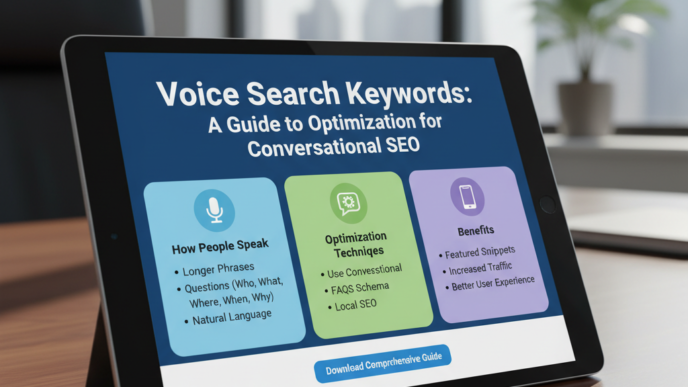
No. Voice queries for local businesses are structurally identical to long-tail text queries with conversational phrasing. Where is the nearest dentist open on Saturday” and “dentist open Saturday near me” target the same intent and are served by the same ranking signals — GMB accuracy, proximity, and review prominence. The content adjustment that supports voice search — direct answers in the first sentence of each page section — is identical to the content structure that improves featured snippet eligibility and AI Overview citation. Optimising correctly for standard local search intent covers voice search without a separate workflow.
Conclusion
Local keyword research produces its highest return when it identifies the specific phrases high-intent local users type at the moment they are ready to act — and when the pages those phrases lead to confirm availability, credibility, and contact information immediately.
The four-part system that produces local ranking: accurate GMB profile as the primary ranking asset, location-specific landing pages with genuine local content, consistent NAP across all citations, and active review acquisition that accumulates local relevance signals in the language customers actually use.
Specific next step: This week, open your Google My Business Insights and export the last three months of search queries. Identify every query with more than ten impressions that your website has no dedicated page for. List the top five by impression volume. For each one, check whether your GMB profile has a complete business description, accurate primary category, and at least twenty reviews from the past six months. Fix any GMB gaps first — then brief a dedicated location page for each query before the end of April 2026.
Citations:
Google — Local Search Behaviour Data
https://www.thinkwithgoogle.com/consumer-insights/consumer-trends/local-search-statistics/BrightLocal — Local Marketing Industry Survey 2024
https://www.brightlocal.com/research/local-marketing-industry-survey-agencies/Moz — Local Search Ranking Factors 2023
https://moz.com/local-search-ranking-factorsGoogle — How Google Determines Local Ranking
https://support.google.com/business/answer/7091?hl=enSemrush — Local SEO Guide
https://www.semrush.com/blog/local-seo-guide/Ahrefs — Local SEO: The Complete Guide
https://ahrefs.com/blog/local-seo/Search Engine Land — What is Local SEO? Guide to Ranking in Local Search Results
https://searchengineland.com/guide/what-is-local-seo
🎯 Local SEO Transformation
Before & After: Location-Specific Keywords Impact
BEFORE
Generic Keywords Only
- plumber No Rank
- emergency plumbing 87
- plumbing services 64
- drain cleaning 45
- water heater repair No Rank
AFTER
Location-Specific Keywords
- plumber Austin Texas 3
- emergency plumber near me 1
- plumbing services downtown Austin 2
- drain cleaning South Austin 1
- water heater repair Austin TX 4
🚀 Total Transformation Results
6 months of strategic local keyword optimization
📋 Real Case Study Details
❌ Previous Strategy Problems:
- Targeting impossible national keywords
- Competing with HomeAdvisor, Angie's List
- No local geographic targeting
- Generic service descriptions
- Poor local search visibility
✅ New Local Strategy:
- City + neighborhood specific keywords
- "Near me" optimization
- Local landing pages for each area
- Google My Business optimization
- Location-based content creation
💡 Key Success Factors:
Location-Specific Content: Created dedicated pages for "Plumber in [Neighborhood]" for all 15 Austin neighborhoods.
Local Schema Markup: Added structured data for each service area with specific NAP information.
Google My Business: Optimized with local keywords, regular posts, and customer review management.
🔑 Key Takeaways for Your Business
1. Location Modifiers Work
Adding city names, neighborhoods, and "near me" phrases dramatically improves ranking potential.
2. Lower Competition
Local keywords have 70% less competition than generic national terms.
3. Higher Conversion
Local searchers convert 4x better because they're ready to take action.
4. Faster Results
Local SEO shows results in 2-4 months vs 6-12 months for national SEO.